Mission Possible
2027 season
On this page(17 sections)
Mission Possible asks a team of up to two students to design, build, test and document one Rube Goldberg device before the tournament. In 2027 the device starts when the Event Supervisor (ES) drops coins into a slot, runs a chain of actions drawn from a fixed menu of twelve (chemical reactions, simple machines, an infrared beam, a hot-wire or motor string break, a magnet release), and ends by dropping a pack of chewing gum onto a small tray.
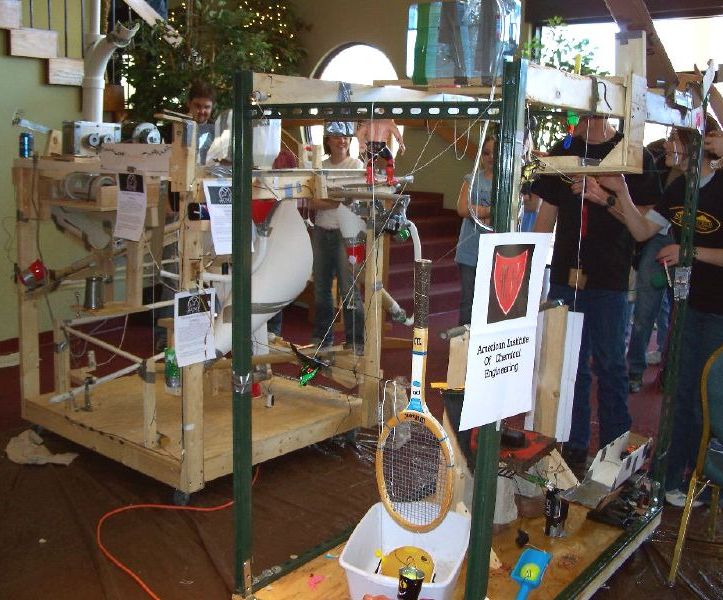
Points come from how the device starts (the quarter is worth the most), each listed action it completes, the gum landing on the tray, a run time that lands close to the Target Operation Time without going over, a water timer bonus, a compact device, clean paperwork, and a fast set-up with no hands-on fixes. There is no written test. At check-in, though, you must answer questions about how the device was designed, built and operates, and the ES decides whether each action counts. The physics and chemistry below are the reasoning you need to make each action work and to defend it.
What the rules cover
Mission Possible is a Division C event in 2027. The 2027 rules manual splits the event into device limits, the start action, the twelve optional scorable actions, the water timer, the final action, the Action Sequence List (ASL), competition procedure, scoring, penalties, tiers and tiebreakers. The parts that change with tournament level are below.
| Rule area | Regionals and Invitationals | State | National |
|---|---|---|---|
| Target Operation Time (announced at the start of set-up, same for every team) | 60 s | 61 to 90 s | 91 to 120 s |
| Impound of device, ASL and tools before the first time slot | No impound | Required | Required |
| When the ASL is due | At check-in | At impound | At impound |
| Set-up points | 50 for 30 min or less | 75 for 15 min or less, otherwise 50 for 30 min or less | Same as State |
| Water timer bonus | 1 point per full second before the target | Also requires showing how the timer is adjusted for the longer target | Same as State |
| Size points (up to 30 per dimension) | In-person tournaments only | In-person tournaments only | In-person tournaments only |
| Eye protection | Category C | Category C | Category C |
| Build questions at check-in | Required | Required | Required |
Some rules apply at every level:
| Area | What the 2027 rules require (paraphrased) |
|---|---|
| Size | At most 80.0 cm in each of depth, width and height while running; the launch lever for the ping pong action counts |
| Visibility | The ES must be able to see or check every scored action; the roof plus two or more side walls are open or see-through |
| Chain | Every action must contribute to the final gum drop; parallel branches and dead ends earn nothing |
| Object reuse | Each movable or adjustable object serves in at most one assigned action; the object ending one action may start the next, then is finished |
| Non-scorable actions | Allowed if they lead toward the final action; no points; must appear on the ASL |
| Stored energy | Springs and mousetraps may be set before the run |
| Electronics | No Arduinos, Raspberry Pis or integrated circuits; timing may not be driven by electricity or springs |
| Electricity | Allowed only in the first 30 s of operation |
| Batteries | Commercial, labeled 9 V or less; series and parallel combinations allowed only if the labeled voltages give at most 9 V between any two points; all energy storage inside the device; the Science Olympiad battery policy applies |
| Banned | Uncontrolled flames, cell phones, flammable gases, and hazardous liquids, gases or materials such as rat traps, lead objects, combustible fuses, dry ice and liquid nitrogen; unsafe chemical handling |
| Supplied by ES | Voltmeter, meter sticks, stopwatches, measuring tape, and an unaltered US nickel, dime and quarter |
| Supplied by team | A commercially purchased, unaltered 5-stick pack of gum |
The full text is in the 2027 Division C rules manual, Mission Possible section (pages C41 to C45). This guide paraphrases it; when the wording matters, read the manual.
Event format
| Rule | Detail |
|---|---|
| Team | Up to 2 students |
| Time | About 40 minutes, covering check-in, set-up and the official run |
| Device | One device, built and tested before the tournament |
| Paperwork | The Action Sequence List, at impound (State and National) or at check-in (Regionals) |
| Written component | None; the build questions at check-in are the knowledge check |
| Calculator and notes | No calculator or notes rule is given for this event; nothing is answered on paper |
| Scoring | High score wins; ties go to fewest penalty points, then smallest length + depth + height |
Because the event is a build event, study looks different from a written event. You are not memorizing facts for a test. You are building a device that works on the day, keeping a record that proves it works, and preparing a short, plain explanation of why every action triggers the next one.
How 2027 differs from last season
Last season Mission Possible was a Division B event. If you competed in it, treat 2027 as a new device rather than an update. Last season's device started when the team dumped a mixed cup of tees, paperclips and marbles into it, sorted them into three containers, and rang a bell; electricity was banned outright, and the timer bonus came from a sand timer. In 2027:
- The start is a coin drop by the ES, scored 25, 50 or 200 points depending on which coin starts the device.
- The final action drops a pack of gum onto a tray. There is no sorting and no bell; timing ends when the gum comes to rest.
- Electricity and batteries are allowed, but only during the first 30 seconds, and integrated circuits are banned.
- The twelve scorable actions are new: three chemistry actions, an infrared beam, an electrical string break and a magnet release join simple-machine tasks (a ping pong launch, an inclined plane, pulleys, all three lever classes, a gravity-driven screw and an Archimedes screw).
- The bonus timer is a water timer.
- A device over 82 cm in any dimension drops to Tier 2 (last season's cutoff was 85 cm).
Device rules that shape every design
Size and visibility
The size limit applies while the device runs. The ES takes measurements before or after the run and may re-measure afterward if the dimensions changed. Every part counts, including the first-class lever and the 20 cm guide used for the ping pong launch. Over 80.0 cm in any dimension costs 25 points per dimension; over 82 cm puts the team in Tier 2. Under 80 cm earns 0.1 point per 0.1 cm (1 point per full centimeter) in each dimension, up to 30 per dimension, at in-person tournaments. A 70 cm cube therefore earns 30 points (10 per dimension), and a 50 cm cube would earn the full 90.
The roof and at least two of the side walls have to be see-through or left open. Missing that costs 25 points, and it also makes it harder for the ES to verify actions, which costs far more. Clear acrylic or polycarbonate panels, or an open frame, satisfy both needs.
One object, one action
Each movable or adjustable object can be used in only one assigned action. The object that finishes one action may start the next, but then it is done. Two consequences:
- The quarter that starts the device may trip the first action, but it cannot also roll down a later ramp.
- The first-class lever in the ping pong launch cannot also be the first-class lever in the three-lever action. Build two separate levers.
Causality, not timing
Every action has to contribute to the gum drop. The rules define parallel paths by cause and effect: two actions are parallel if neither causes the other, so the sequence could carry on if one of them failed. A branch that splits off and dead-ends earns nothing even if it is spectacular. When you draw your device, draw arrows that mean "causes", and check that there is exactly one path from the coin to the gum.
Electricity: the 30-second window
Electricity in the rules means energy carried by moving charge, which is electric current. In 2027 you may use it, with three limits:
- Only during the first 30 seconds of operation. An electrical action after that costs 250 points, and any scorable action started by electricity after 30 s earns nothing.
- Only from commercial batteries labeled 9 V or less, and no combination may put more than 9 V (by labeled values) between any two points.
- No integrated circuits, Arduinos or Raspberry Pis, and no electric or spring-driven timing.
The ES carries a voltmeter, so the labels must be readable and the measured voltage should agree. A fresh 9 V alkaline battery often reads a little above 9 V; the rule is written in terms of labeled voltage, so bring the battery in its labeled state and be ready to show the calculation.
The practical consequence of the 30-second window is ordering. Put the infrared beam and the electrical string break early in the chain, right after the start. A device with a 60-second target can spend its second half on mechanical and chemical actions and the water timer.
The start action: building a coin discriminator
The device needs a vertical coin slot on one side, wide enough for only one coin at a time. On the team's signal, the ES drops coins in the order the ES picked for the tournament: nickel, then dime, then quarter, or dime, then nickel, then quarter. Both orders are possible, and you learn which one at the start of set-up.
| Coin that starts the first action | Start points |
|---|---|
| First coin (nickel or dime) | 25 |
| Second coin (the other of nickel and dime) | 50 |
| Quarter, after both other coins were tried | 200 |
| None; a team member drops a spare quarter from entirely above the device within a 20 s countdown | 0 |
| The team has to touch the device to start it | 0, plus the touch penalty; a touched scorable action does not count |
Timing begins when the first action begins, not when the coin goes in, so the first action must be one the ES can clearly see start. All coins go back to the ES after the run; failing to return them is a competition violation. A coin that falls out of the device also counts as a solid leaving the measured dimensions, which costs 50 points the first time it happens.
The 200-point quarter start is worth as much as four scorable actions and 175 points more than a first-coin start, so most strong teams build a device that ignores both the nickel and the dime and fires only on the quarter. That means a discriminator: a coin path that sends small coins to a catch tray and lets only the quarter reach the trigger.
US Mint specifications for the three coins:
| Coin | Diameter | Thickness | Mass |
|---|---|---|---|
| Dime | 17.91 mm | 1.35 mm | 2.268 g |
| Nickel | 21.21 mm | 1.95 mm | 5.000 g |
| Quarter | 24.26 mm | 1.75 mm | 5.670 g |
Diameter is the cleanest sorting variable. The quarter is about 3 mm wider than the nickel and 6 mm wider than the dime. Thickness is a poor choice, because the nickel is the thickest coin, and mass is a poor choice, because the nickel and quarter differ by only 0.67 g.
A falling-coin variant uses a slot or hole: a 23 mm round hole in a tilted plate passes the nickel and dime and catches the quarter, which then tips a small lever. Either way, test with real coins from circulation, in both drop orders, dozens of times. Add a catch box for the nickel and dime that sits inside the device and is easy to empty, since the ES needs the coins back.
Chemistry actions
Three of the twelve actions use chemical or physical changes. All three must be done with safe handling: closed or splash-proof containers, no hazardous chemicals, and nothing liquid escaping the device (the first escaped liquid or solid costs 50 points).
Action i: vinegar and baking soda balloon
Baking soda (sodium bicarbonate) reacts with the acetic acid in vinegar to give carbon dioxide gas:
The rules require the balloon to expand by 20 cm and then strike an object that started at least 20 cm above the balloon, so that the object starts the next action. The gas does the work: a growing balloon pushes upward and outward, and the object it knocks (a ball on a ledge, a tilted flag) carries the action forward.
Design notes: mix the reactants with a trigger rather than by hand (a tipping cup, a pin pulled from a bag of baking soda), let some CO₂ dissolve and escape so the yield is lower than the ideal, and make the balloon neck airtight with tape or a zip tie.
Action ii: an endothermic change
An endothermic process absorbs heat from its surroundings, so the surroundings cool. The 2027 action requires that the temperature drop itself starts the next action. The cleanest way to show that is with a mechanism that responds only to temperature, not to gas or mass.
Common safe endothermic choices:
| Process | Enthalpy of solution (approximate) | Notes |
|---|---|---|
| Ammonium chloride dissolving in water | +14.8 kJ/mol | Widely used in classroom cold-pack demos |
| Urea dissolving in water | +15 kJ/mol | Low hazard, the active ingredient in many instant cold packs |
| Commercial instant cold pack (squeeze to start) | Varies | Check the label; some contain ammonium nitrate, which an ES may treat as a hazardous material |
How do you turn an 11 °C drop into motion? Two mechanisms work without electricity:
- Gas contraction. A sealed flask of air in contact with the cold solution shrinks in volume (Charles's law, at constant pressure). Cooling air from 295 K to 284 K shrinks it by about 4%, so a 500 mL flask pulls in about 19 mL. Connected to a light syringe plunger, that pull can release a latch.
- Bimetallic strip. Two metals with different expansion rates bonded together bend as temperature changes. A coil from an old dial thermometer or thermostat can rotate a pointer that tips a balance.
A liquid-in-glass effect, such as water contracting, is far too small to use. Whatever you choose, explain it at check-in in terms of temperature: "the cold solution cools the air in the flask, the air contracts, and the plunger pulls the pin."
Action iii: two Alka-Seltzer tablets
Original Alka-Seltzer tablets contain sodium bicarbonate, citric acid and aspirin. In water the acid and bicarbonate dissolve and react, releasing CO₂:
The rules require that both tablets drop into water and that the reaction triggers the next action. Useful triggers: gas pressure in a sealed bottle pushing a syringe or popping a loose cork; buoyancy, where bubbles lift a light float; or a gas-filled bag inside a cup lifting a lid. Warm water reacts faster than cold; cold water slows the reaction and can be a deliberate delay. Do not let foam overflow the device.
Simple machines and ideal mechanical advantage
Six actions are simple machines (iv, vi, vii, viii, ix and x). The rules define ideal mechanical advantage (IMA) as a machine's force-multiplying ability calculated as if no energy were lost. IMA is a ratio of distances, so it has no units.
A machine trades force for distance. It can never give out more energy than goes in:
Action vi: inclined plane
Push or pull a mass of at least 400 g up a slope with IMA of at least 2 so it rises at least 10 cm before it starts the next action. The ES must be able to remove the mass and weigh it.
IMA ≥ 2 means , so the slope must be 30° or shallower. Measure along the ramp surface (the slant), not along the floor.

Action vii: pulley system with IMA ≥ 3
Lift a mass of at least 400 g at least 10 cm with a pulley system whose IMA is at least 3. For an ideal block and tackle, IMA equals the number of rope segments supporting the moving block. Three segments require the end of the rope to be tied to the moving block (an odd count always ends on the moving block). A fixed pulley alone only changes direction; it adds no IMA.

Action viii: all three classes of levers
Use the mechanical advantage of a first-, second- and third-class lever, in any order, to start the next action. The class depends on what sits between the other two:
| Class | Middle element | IMA | Everyday example | What it is good for |
|---|---|---|---|---|
| First | Fulcrum | Above, below or equal to 1 | Seesaw, crowbar | Reversing direction |
| Second | Load | Always above 1 | Wheelbarrow, nutcracker | Multiplying force |
| Third | Effort | Always below 1 | Tweezers, broom | Multiplying distance and speed |


At check-in, expect to point at each lever and name its fulcrum, effort and load. Label them on the device so the ES can see the classes at a glance. Remember the one-object rule: none of these three levers can be the launch lever from action iv.
Action ix: a gravity-driven screw
Gravity must clearly rotate a screw so it works as a screw, turning rotation into straight-line motion. The screw must make at least two full rotations and move an object at least 2 cm before that object starts the next action, and it must be marked so the ES can count rotations.
The key number is the lead, the distance the nut advances per full turn. For a single-start thread the lead equals the pitch.
The nut or carriage must be kept from spinning with the screw (a guide rail does this), or it will just rotate along with it and go nowhere. Mark the screw shaft with a bright flag or tape stripe so the ES can count two clear rotations.
Action x: Archimedes screw
An Archimedes screw is a helix inside or around a tilted tube. As it turns, each pocket of the helix moves up the axis, carrying whatever sits in it. The action must raise a marble at least 20 cm before the marble starts the next action, and the whole action must be visible, so a transparent tube is the practical choice.

If the tube is too steep for the pitch, the pockets vanish and the marble rolls back down each turn; if the pitch is too tight for the marble, it jams. Prototype with the real marble. Driving the screw takes many turns, so a falling weight on a string needs gearing (a large pulley driving a small one), or the screw can be turned by a small motor, which counts as electricity and therefore must finish within the first 30 s.
Action iv: the ping pong launch
A first-class lever must launch an unaltered, commercially sold ping pong ball up and completely out of the top of the device. The ball must travel at least 20 cm horizontally, come back in, start the next action and stay inside. A 20 cm guide at the top level lets the ES confirm the horizontal distance, and the lever counts toward the device's measured size. The ball is the one object allowed to leave the measured dimensions without the 50-point penalty.
Projectile motion sets the launch. For a launch and landing at the same height:
A steeper launch is easier to aim back into a funnel, at the cost of a longer flight time. Build a wide funnel or net-lined catch on the landing side so the ball cannot bounce out, and remember the catch also has to stay within 80 cm.
Electrical and magnetic actions
Action v: infrared beam
An infrared beam must start the next action. The transmitter must be an IR LED, the receiver must be photodiode-based, and the two must be at least 20 cm apart. Because integrated circuits are banned, the common three-pin IR receiver modules (which contain an amplifier IC) and microcontrollers are out; the receiver has to be a photodiode with discrete parts.
How a photodiode works: light of the right wavelength frees charge carriers in a reverse-biased p-n junction, so a small current flows that grows with light intensity. That current is far too small to move anything directly, so a discrete transistor amplifies it to drive a relay, solenoid or small motor.
Two trigger designs work: "beam made", where an object moves out of the way and light reaches the photodiode, or "beam broken", where an object moves into the path and blocks it. Either way, the transistor switches a relay or solenoid that releases the next stage. Shield the photodiode with a short tube so room lighting does not trigger it, and remember the action must complete within the first 30 s.
Action xi: electricity breaks a string
Electricity must directly or indirectly break a string or fishing line, and the break must drop an object that starts the next action. Two common approaches:
- Hot wire. A short loop of resistance wire (such as nichrome) heats when current flows and melts through nylon fishing line, which softens at a few hundred degrees Celsius. Heating power is , so a short, thin wire on a fresh battery heats fastest. Keep the hot wire away from anything flammable: an uncontrolled flame is banned and an unsafe device gets participation points only.
- Motor or solenoid. A small motor winds the line until a weak link snaps, or a solenoid pulls a cutting edge across it. This is the "indirect" route.
Like the IR beam, this action must finish within the first 30 s. A heating wire can take several seconds to cut, so measure the time on a fresh and on a partly used battery.
Action xii: removing a magnet
Removing a magnet from a surface must let a magnetic object fall, and that falling object must start the next action. A typical build holds a steel ball or washer on the front of a thin non-magnetic panel with a magnet on the back; a string or lever then pulls or slides the magnet away and the steel object drops.
Magnetic force falls off very steeply with distance, so the magnet only has to move a short way for the hold to fail. Sliding a magnet sideways off a surface usually takes much less force than pulling it straight off, so a sideways slide makes an easier trigger. Use enough holding force that the steel object does not slip early from vibration, and test with the exact panel thickness you will use, since each extra millimeter weakens the hold. Strong neodymium magnets pinch fingers and snap together hard; handle them with care.
The water timer
You may designate one water timer: an action lasting more than 10 seconds that is not one of the twelve scorable actions. It earns 1 point for each full second it runs before the Target Operation Time, nothing for seconds after the target, and nothing at all unless it starts the next action. At State and National you must also show the ES how you retune it for the longer target.
The usual design lets water drain from one container into another until the receiving cup is heavy enough to tip a balance or lift a float. The flow from a small hole slows as the water level drops:
Retuning methods: swap a calibrated orifice (keep a labeled set of drilled caps), adjust a marked valve, or change the starting volume against a fill line. Keep a calibration table in your log: setting, measured time, average of several runs. Most of all, keep the water inside the device. A leak costs 50 points.
The final action: the gum drop
After every scorable action has been attempted, the device must drop a commercially purchased, unaltered 5-stick pack of gum (team supplied) at least 50 cm straight down onto a platform, or "tray". The final action is worth 250 points. The tray rules:
| Requirement | Limit |
|---|---|
| Material | Flat, rigid, solid, no padding, no sides |
| Size | At most 12 cm × 12 cm × 0.5 cm |
| Clearance | No walls or barriers within 4 cm of its edge |
| Height | Top of the tray at least 2 cm above the top of the base |
| What may be on it | Only the gum, supported by the tray alone and clearly visible |
| Access | An opening on the coin-slot side big enough for a hand to remove the gum; no points if the gum is not removed |
No one may touch the action that leads to releasing the gum. If a team member touches it, the team scores zero for the final action and zero time points.
Physics of the drop: from 50 cm, the pack hits the tray at m/s. An unpadded tray reflects much of that energy, so a pack that lands on a corner can bounce or tumble off a 12 cm square with no sides. Your design goal is a flat, level, spin-free drop so the pack lands on its broad face:
- Release the pack lying flat from a trapdoor that opens fully and quickly, or from two hinged flaps that open together, so neither edge drags.
- Guide the fall with a vertical chute that ends above the 50 cm mark and at least 4 cm clear of the tray edges, so the chute does not count as a wall near the tray.
- Use the maximum 12 cm × 12 cm tray and center it under the chute.
Height budget: 50 cm of drop plus a tray at least 2 cm above the base, plus the release mechanism and the pack's own thickness, means the release sits around 55 to 60 cm up in an 80 cm device. That leaves little room above it, so plan the gum drop first and fit the other actions around it.
Scoring and the point budget
| Item | Points |
|---|---|
| Set-up within 30 min | 50 (State and National: 75 within 15 min, otherwise 50 within 30 min) |
| ASL handed in on time | 25 |
| ASL in proper format | 25 |
| ASL includes and accurately describes every scorable and non-scorable action | 25 |
| ASL column 1 numbers labeled on the device and column 3 gives the action numeral (i to xii) | 25 |
| Each unique scorable action, first completion | 50 each, 12 possible (600) |
| Start action | 25, 50 or 200 |
| Final action | 250 |
| Run time | 2 per full second up to the target; 0 if the run reaches twice the target |
| Water timer | 1 per full second before the target |
| Size under 80 cm | 0.1 per 0.1 cm, up to 30 per dimension (90 total), in-person only |
| No adjustments during operation | 75 |
| Penalty | Points |
|---|---|
| Each full second past the target, up to twice the target | −2 |
| Each dimension over 80 cm | −25 |
| Top and two vertical walls not open or transparent | −25 |
| Each touch or adjustment, up to three | −25 |
| First solid or liquid to leave the device (ping pong ball in action iv excepted) | −50 |
| Electricity used after 30 s | −250, and actions it starts score nothing |
Unsafe devices, remotely timed or controlled devices, and devices impounded but not run get participation points only.
Two lessons follow. First, the quarter start and no-touch bonus together (275 points) outweigh five scorable actions, so reliability beats ambition. Second, run time behaves like a target, not a race: finishing at 30 s on a 60 s target throws away 60 points, while going 10 s over costs only 20, so aim slightly under the target and tune with the water timer.
Tiers and tiebreakers
| Tier | Who lands there |
|---|---|
| Tier 1 | Devices with no violations |
| Tier 2 | Construction or run violations not already penalized, including any dimension over 82 cm |
| Tier 3 | Late impound, participants without eye protection, or teams that cannot answer build questions |
Every Tier 1 team ranks above every Tier 2 team, however many points the Tier 2 team scored. Ties within a tier go to fewer penalty points, then the smallest sum of length, depth and height.
Event day: impound, check-in, set-up and the official run
Before the first slot. At State and National, any team member may impound the device, the ASL and every tool or part you will use; inspections do not happen at impound. The ES picks the Target Operation Time and the coin drop order; you hear both at the start of set-up.
Check-in. Only the competing participants enter. Once check-in starts, you cannot leave or get outside help or materials. The ES runs a safety inspection, measures dimensions and masses (before or after the run), and asks build questions. Eye protection must be worn properly the whole time; a team without it is offered a chance to get some, and otherwise does not compete and is ranked in Tier 3.
Set-up. The ES records your start time. You may adjust, repair and test. Tell the ES when you are ready; the minutes used decide the set-up points. Practice the full set-up against a stopwatch at home, including loading the chemistry, resetting the water timer for the announced target, and setting springs.
The official run. Timing starts with the first action after the coin goes in and stops when the gum comes to rest on the tray or at twice the target, whichever is first. Nothing scores after timing stops. If the device stops, jams or fails, you may adjust it up to three times; one adjustment can involve several touches and ends when the device runs on its own again. Adjusting just to stall or change the timing is grounds for disqualification. Any scorable action that a participant completes, or that an adjustment directly completes, does not count. After a third adjustment, if the device stops again it may not be touched, its time is scored as zero and nothing else scores.
Out-of-order actions. If an action starts out of its ASL order, every action skipped over in the list scores zero, even if it later completes. Build the chain so that a stage cannot fire early from vibration.
After the run. The ES reviews your recorded data with you, and you hand every coin back to the ES. A team that wants to appeal must leave the device and ASL in the event area.
Action Sequence List
The ASL documents every action in the device, in order: the start, the action the coin starts, the water timer if used, each scorable action, every non-scorable action, and the action that drops the gum. It must be legible, neat and accurate. Only scorable actions listed by numeral on the ASL can score. A format example is posted on soinc.org.
| Column | Contents |
|---|---|
| 1 | Ordinal number (1, 2, 3, ...) that matches a label on the device |
| 2 | The named object moved, for each scorable action |
| 3 | The task claimed, such as action iv (the rules' definitions give the full section form, 4.b.iv.) |
Walk the device with the ASL in hand before you print it. Every line should point to a labeled physical object, and every moving part should appear on a line. The ASL earns up to 100 points, and it is the first thing the ES reads before judging whether each action counted.
Design principles and strategy
Plan the skeleton first. Fix the coin slot, the gum drop column and the electrical stages (which must be first) before choosing other actions. Those three constrain the layout most.
Choose actions by reliability. Each scorable action is worth 50 points, but a failure halts everything downstream and invites a 25-point adjustment plus the lost 75-point bonus. An action that works 9 times in 10 is worth adding; one that works 6 times in 10 is a liability. Strong teams often build eight to ten actions they trust rather than twelve that might work.
Budget energy at every handoff. Calculate the energy each action needs ( to lift, to push a latch) and supply at least twice that, because friction, misalignment and worn batteries eat into ideal values.
Make every action verifiable. Mark the 20 cm guides, the 10 cm rise heights, the screw rotations and the balloon start height on the device. If the ES has to guess, the action may not count.
Design for reset and travel. Modules that lift out, labeled connections, spare chemistry pre-measured in labeled bags, and a reset checklist cut set-up time toward the 15-minute State and National tier.
Split the work. One partner can own mechanics and the testing log; the other can own the ASL, chemistry prep, the dimension budget and the water timer calibration. Both must be able to answer build questions about every action, since the ES may ask either.
Keep a testing log. For each action and for full runs, record date, number of attempts, successes, times, and any adjustments. It shows you which action to fix next, and it is the evidence behind your answers at check-in.
Common pitfalls
The quarter is the high-value start
A device that starts on the first coin earns 25 points; one that ignores the nickel and dime and starts only on the quarter earns 200. Test the discriminator in both coin orders.
Electricity after 30 seconds
Any electrical action after the first 30 s costs 250 points, and actions it starts do not score. Put the IR beam, hot wire and any motor at the front of the chain.
Integrated-circuit parts sneak in
Three-pin IR receiver modules, timer chips and microcontrollers are integrated circuits and are not allowed. Use a bare photodiode with discrete parts.
Reusing an object
The launch lever cannot double as one of the three levers, and a marble from the Archimedes screw cannot later run down a ramp to a second scorable action.
The water timer is not a scorable action
It must last over 10 s, must start the next action, and earns nothing for time past the target. At State and National you must show how you retuned it.
Out-of-order firing zeroes skipped actions
If a later stage fires early, every action skipped in the ASL order earns nothing. Latch each stage so vibration cannot set it off.
Touching the gum release
Touching the action that releases the gum costs the 250-point final action and all time points.
The tray must hold only the gum
No chute, ramp or other object may rest on the tray, and nothing may be within 4 cm of its edge. The gum must also be removable through an opening on the coin-slot side.
Coins and liquids escaping
The first solid or liquid to leave the device costs 50 points; only the ping pong ball in action iv is exempt. Catch rejected coins inside the device, and seal the chemistry.
Faster is not better
Time points grow by 2 per second up to the target. A device that finishes far under the target throws away points.
How tournaments test this
There are no archived Mission Possible tests on the site, because the event has no written component; the knowledge check is oral, at check-in. The practice bank holds 8 questions tagged to Mission Possible (all Division C) from the 2018 and 2021 seasons and from undated tryouts, 5 multiple choice and 3 free response. Most predate the 2027 device and several are unrelated to the event, so only two are used below.
What the bank and the rules suggest you should expect at check-in:
- Definitions the rules use: IMA, endothermic, electricity, parallel and dead-end paths, touch.
- Rule facts: the Target Operation Time at each level (60 s at Regionals, 61 to 90 s at State, 91 to 120 s at National), the size limit, the battery limit.
- Questions about your device: which lever class each lever is and why, how you calculated the IMA of the ramp and pulley, what makes the endothermic action respond to temperature, how the IR receiver works without an IC, and how the water timer is retuned.
Test yourself
The two questions below are from the practice bank, so they link to no test. The explanations are ours. The self-check problems after them were written for this guide from the 2027 rules, with answers worked out.
- 1
What is a complex machine designed to perform a task through a series of interconnected steps, often involving a chain reaction?
From: BirdSO Invitational 2021, Division C
1 question from this set is no longer available.
References and further reading
- Science Olympiad, 2027 Division C rules manual (Mission Possible), the Building Policy, the Battery Policy and the ASL format example: https://www.soinc.org
- United States Mint, coin specifications: https://www.usmint.gov/learn/coins-and-medals/circulating-coins/coin-specifications
- OpenStax, University Physics Volume 1 (work, energy, projectile motion, simple machines): https://openstax.org/details/books/university-physics-volume-1
- OpenStax, Chemistry 2e (stoichiometry, gas laws, thermochemistry): https://openstax.org/details/books/chemistry-2e
- OpenStax, College Physics 2e (magnetism, semiconductors and LEDs): https://openstax.org/details/books/college-physics-2e
- International Table Tennis Federation, ball specifications (40 mm, 2.7 g): https://www.ittf.com
- SciOly Wiki, Mission Possible page (community discussion, not copied here): https://scioly.org/wiki/index.php/Mission_Possible