Rocks and Minerals
2027 season
On this page(26 sections)
Rocks and Minerals asks you to do two things quickly and correctly. First, identify a specimen from what you can observe: its hardness, streak, luster, cleavage, density and reaction to acid. Second, explain what that specimen tells you about how it formed and what happened to the Earth around it. The first skill is a toolkit, a short sequence of tests you run the same way every time. The second is a model of the rock cycle: magma cools, sediment is buried and cemented, and rock that is heated and squeezed changes without melting. Strong teams keep both in view. A correct name with no explanation of formation loses the reasoning points, and a convincing story attached to the wrong name loses the identification points.
Identification is worth at least 30% and at most 50% of the points, so the rest of the test is classification, data and explanation. The scope below follows the 2027 rules manual for Divisions B and C and the National Rocks and Minerals List, which is the same for both divisions. Divisions B and C share most of the topic outline. Division C adds several items (solid solutions, phase diagrams, silicate structures, crystal systems, the evolution of igneous melts, metamorphic facies and thin sections), and anything limited to State and National tournaments is marked in the text.
Event format
| Rule | Detail |
|---|---|
| Team | Up to 2 students |
| Time | About 50 minutes |
| Binder | One binder of any size that takes three-ring fittings. Notes can come from anywhere and be in any format; plastic sleeves, laminated pages, dividers and labels are fine |
| Field guide | One store-bought field guide that you may tab and mark up |
| Official list | One copy of the National Rocks and Minerals List. It may be annotated and does not have to be inside the binder |
| Tools | Writing utensils, one magnifying glass and one Class II calculator. No streak plate, magnet or acid is on the list of things you may bring |
| Samples | Teams may not bring samples or specimens of their own |
| Acid and taste | No hydrochloric acid is used or provided, and you may not taste specimens. A question may describe in words how a specimen reacts to acid |
| Format | Identification, classification, reading graphs and charts, and analyzing data, often run as a station rotation. Questions should be balanced between rock and mineral topics |
| Scoring | High score wins. Point values may be announced per question or section. Preselected questions break ties |
If the event runs as stations, the supervisor sets and announces the time at each station. You cannot go back to a station, but you may revise your answers while you are at later stations. The only material that may leave the binder is the National List.
What the rules cover
The table summarizes the 2027 rules manual (Rocks and Minerals B and C, rules 3.h–3.i) in plain words, and the last column says where this guide covers each topic. Check the manual on soinc.org for the exact wording.
| Area | Division B and C (all levels) | Division C adds | State and National only | Where in this guide |
|---|---|---|---|---|
| Definitions | What makes something a mineral; what makes something a rock (one or many minerals, mineraloids, organic matter allowed) | — | — | Mineral identification, What is a rock? |
| Identification | Specimens or images that show observable properties; other diagnostic clues are supplied when observation is not enough. Identification is 30–50% of the points | — | Starred specimens on the National List | The 2027 National List, Mineral reference tables, Rock reference tables, Identification gallery |
| Mineral physical properties | Color, hardness, luster, streak, cleavage or fracture, density, specific gravity or heft, diaphaneity (transparency), tenacity | — | — | Mineral identification |
| Mineral other properties | A closed list of eight: reaction to acid, fluorescence, magnetism, smell, taste, double refraction, piezoelectricity, radioactivity | — | — | Mineral identification, the "Habit & diagnostic tests" column of the Mineral reference tables |
| Habit | A closed list of 21 habit terms (acicular through tabular), including twinning | — | — | Mineral identification |
| Chemistry and polymorphs | Chemical formulas; how chemistry (for example trace elements) changes properties; polymorphs such as diamond/graphite, calcite/aragonite, orthoclase/microcline and the kyanite–andalusite–sillimanite trio | Solid-solution series; phase diagrams of two-component systems | — | Mineral chemistry and structure (chemistry, polymorphs and phase diagrams) |
| Classification and groups | Mineral families by composition, as laid out on the National List; mineral groups (feldspar, garnet, tourmaline) | Silicate structures; the seven crystal systems and how structure controls cleavage and crystal shape | — | Mineral chemistry and structure (families, silicate structures, crystal systems) |
| Formation | Methods of formation (hydrothermal, weathering, crystallization from magma, evaporites, precipitation, heat and pressure); minerals typical of each rock-forming setting; Bowen's reaction series | — | — | How minerals form, ores, uses and gems, Igneous rocks |
| Uses of minerals | Ores, industry, jewelry, geochronology, medicine, manufacturing, construction, electronics; gemstone minerals on the list plus a closed list of named gem varieties | — | — | How minerals form, ores, uses and gems, Mineral reference tables (last column and the gem-variety table) |
| Igneous rocks | Textures, composition, intrusive (plutonic) and extrusive (volcanic) settings and named formations, texture–cooling links, rocks at plate boundaries | Evolution of melts: fractional crystallization, assimilation, magma mixing | Incompatible elements and why pegmatites concentrate them (Division C) | Igneous rocks |
| Sedimentary rocks | Three textures, composition, grain size and its link to stream velocity, sorting and rounding, depositional environments, primary structures | Deep marine is labeled abyssal | — | Weathering and sediment, Sedimentary rocks |
| Metamorphic rocks | Foliated and non-foliated textures, metamorphic minerals, protoliths, regional and contact metamorphism, grade and a closed list of index minerals | Facies read from P–T graphs; plate-tectonic settings of metamorphism | — | Metamorphic rocks |
| Rock cycle and economics | Processes that form rocks; economic uses of rocks | — | — | The rock cycle and uses of rocks and minerals |
| Earth history (geochronology) | Using minerals and rocks to date events (listed under uses of minerals) | — | — | Dating rocks and minerals |
| Thin sections | — | — | Identifying five minerals in polarized light; igneous and sedimentary microscopic textures (Division C) | Thin sections (Division C, State and National) |
Several lists in the rules are closed ("limited to"): the other properties, the habits, the igneous formations, the sedimentary textures, the index minerals, the gem varieties, the solid-solution groups and the thin-section minerals. A test that sticks to the rules will not go beyond them, so learn every item on each closed list rather than extra examples. The list of depositional environments is open, so other environments can appear. Supervisors also write "illustrate a concept" questions about minerals that are not on the list; this guide covers the common ones (for example andalusite, sillimanite, chlorite and serpentine) in the reference tables.
How tournaments test this
This breakdown comes from the scio.ly practice bank: 6,767 Rocks and Minerals questions from past tournaments, of which about 6,500 fall inside the 2027 rules (the rest are state-symbol trivia, earthquakes, meteorites and similar). About 3,400 of them match questions in the archive (which holds 9,102 Rocks and Minerals questions); most of the rest come from tournament tests the archive does not have. Each question was assigned the one topic a student must know to answer it. The bank undercounts identification: most identification is done from physical specimens at stations, which never reach a written question bank, yet the rules make identification 30–50% of the points. Read the table as the split of the non-identification points, and plan your study time with identification first.
| Topic | Share of in-scope questions | Where in this guide |
|---|---|---|
| Igneous textures, composition and classification | 9.6% | Igneous rocks |
| Metamorphic textures, protoliths and types | 7.4% | Metamorphic rocks |
| Chemical formulas, families, groups, chemistry–property links | 7.1% | Chemistry, groups and polymorphs, Mineral reference tables |
| Sedimentary rock types, lithification and cement | 7.1% | Sedimentary rocks, Rock reference tables |
| Uses of minerals and rocks, ores and gems | 6.2% | Uses of minerals by industry, Gemstones and lapidary terms, Economic uses of rocks |
| Properties of a named specimen (ID-style) | 4.4% | Mineral reference tables, Rock reference tables |
| Bowen's reaction series | 4.3% | The Bowen reaction series |
| Intrusive bodies and plate settings of igneous rocks | 3.9% | Where igneous rocks form |
| Other properties (acid, fluorescence, magnetism, smell, taste, double refraction, piezoelectricity, radioactivity) | 3.7% | Other properties: the closed list of eight |
| Hardness and the Mohs scale | 3.2% | Hardness and the Mohs scale |
| General rock classification | 3.2% | What is a rock? |
| Depositional environments and sedimentary structures | 3.0% | Environments and primary structures |
| How minerals form, ore deposits | 2.9% | How minerals form |
| Streak, luster, color, diaphaneity | 2.8% | Streak and luster, Why minerals have color |
| Cleavage, fracture, tenacity | 2.8% | Cleavage, fracture and parting, Tenacity |
| Silicate structures (Division C) | 2.4% | Silicate structures (Division C) |
| Habit and twinning | 2.3% | Mineral habit and crystal form |
| Weathering and erosion | 2.1% | Weathering and sediment |
| Polymorphs and pseudomorphs | 2.1% | Chemistry, groups and polymorphs |
| What is a mineral; mineraloids | 2.0% | What counts as a mineral |
| Metamorphic facies and settings (Division C) | 1.9% | Metamorphic facies (Division C) |
| Magma, viscosity, eruptions, volcano types | 1.9% | Magma and volcanism |
| Grain size, sorting, rounding, Hjulström | 1.8% | Sorting and rounding, Grain size and stream velocity |
| Grade and index minerals | 1.8% | Grade and index minerals |
| Crystal systems (Division C) | 1.5% | Crystal systems (Division C) |
| Rock cycle | 1.4% | The rock cycle |
| Density and specific gravity | 1.2% | Density and specific gravity |
| Solid solutions and phase diagrams (Division C) | 1.1% | Solid solutions, ternary diagrams and phase diagrams (Division C) |
| Dating: radiometric and relative | 1.0% | Dating rocks and minerals |
| Evolution of melts (Division C) | 0.9% | Evolution of igneous melts (Division C) |
| Thin sections (Division C, State and National) | 0.6% | Thin sections (Division C, State and National) |
- Format. Most questions are short free response: name the mineral, give the formula, explain a process in one or two sentences. Multiple choice, true/false and select-all make up the rest. Practice writing the process and the evidence in one sentence.
- Identification stations show a specimen or photo with a number. Some ask only for the name; many add a follow-up about the same specimen (its formula, hardness, crystal system, use, formation or a look-alike). That is why the reference tables carry every property, not just the ID tests.
- Typical shapes. A specimen described by its properties ("which mineral is it?"); a set of test results ("which result rules out X?"); a Hjulström reading; Bowen's order questions; a sedimentary environment inferred from grain size and structures; a protolith, index mineral or grade for a metamorphic rock; a rock-cycle process asked in words; a half-life or specific-gravity calculation.
- Most common answers. Olivine, calcite, limestone, quartz, basalt, granite, gneiss, pyrite, halite and marble. Know each one cold, including what it is most often confused with.
Strategy
- Split by skill, but rotate. At a station event, both partners move together. For paper sections, one partner takes identification and the other takes classification and data. Swap halfway so both of you can check the other's reasoning.
- Use a fixed identification flow. For minerals, start with luster (metallic or not), then streak, hardness, cleavage, reaction to acid and heft. For rocks, start with whether you can see crystals, then glass or vesicles, then clasts, then foliation. The flowcharts are in the Condensed facts.
- Explain in one or two sentences. A strong answer names the process and the evidence: "The rock is vesicular and fine-grained, so it cooled rapidly at the surface with gas trapped in the melt." Partial credit follows reasoning.
- Budget time. Station times are fixed and cannot be extended. If a specimen stumps you, write the best observation-based answer, then move on. Identification is capped at half the points, so you do not need every name to score well.
- Practice on the list. Go through the National List once, naming each mineral's streak, hardness and cleavage and each rock's texture and origin from memory, using the Identification gallery. Then practice with archived tests from several different writers.
What to bring and how to build your binder
You may bring one binder of any size, one field guide, an annotated National List, a magnifier and a Class II calculator. Everything you will look up at a station has to be findable in seconds, so the order of the binder matters more than its thickness.
| Tab | What goes in it | From this guide |
|---|---|---|
| 1. Front pages | The ID flowcharts (metallic by streak; non-metallic by hardness and cleavage), the texture-first rock identification key, the Mohs anchors and common-object hardnesses, and the look-alike pairs | Rock identification key, Condensed facts, Mineral identification |
| 2. Minerals A–Z | One full property line per listed mineral, with a photo | Mineral reference tables, Identification gallery |
| 3. Rocks | Igneous grid, sedimentary and metamorphic tables, rock look-alikes, rock photos | Rock reference tables, Identification gallery |
| 4. Concepts | Bowen's series, silicate structures, crystal systems, Hjulström and Wentworth charts, facies diagram, rock cycle | the concept chapters |
| 5. Calculations | Specific gravity, half-life and age formulas with one worked example each | Calculations index |
| 6. Practice | Two or three old tests with your corrections | the test archive |
The 2027 National List
Identification is limited to specimens on the 2027 National Rocks and Minerals List, although other rocks and minerals can be used to illustrate a concept. Read the list early and annotate your copy: it is one of the three references you may bring, and it is the only thing you may pull out of your binder at a station. A few features of the list change how you study:
- Starred specimens (*) are identified only at State and National tournaments. The official list stars 27 minerals: magnesite, rhodochrosite, siderite, pyrolusite, rutile, zincite, turquoise, pyromorphite, vanadinite, bornite, stibnite, actinolite, tremolite, apophyllite, chrysocolla, dioptase, lepidolite, prehnite, rhodonite, spodumene, jasper, smoky quartz, tiger's eye, stilbite, willemite, wollastonite and zircon. It stars 9 rocks: syenite, tuff, tuff breccia, diatomite, siltstone, greywacke, amphibolite, talc schist (soapstone) and serpentinite. Every other specimen can appear at any level.
- Specimens with supplied information (¹). Footnote 1 on the list marks six specimens, all of them also starred: the minerals magnesite and bornite and the rocks syenite, tuff, diatomite and siltstone. For these the supervisor gives extra information (diagnostic properties, a chemical formula, grain size or composition) to make identification possible. Your job is to match that information to the name; the drill below shows how.
- Naming conventions. The pink or tan potassium feldspar is answered as "Orthoclase/Microcline" or "potassium feldspar"; the rules also note that white or pink/tan orthoclase/microcline occurs in granite. Tourmaline is accepted for the whole group. Celestite may also be called celestine. Goethite/limonite and agate/chalcedony are each one answer. Rock salt and halite, and rock gypsum and gypsum, do not have to be told apart.
- Classification quirks. Bauxite is listed as a sedimentary rock, not a mineral. Opal sits among the quartz varieties even though it is an amorphous mineraloid. Grossular garnet is the green variety. Gypsum appears as three varieties: alabaster (massive), satin spar (fibrous) and selenite (crystalline).
Per-specimen data (formula, crystal system, hardness, specific gravity, luster, streak, cleavage, tests, formation, uses and gem varieties) are in the Mineral reference tables. The three mineral chapters that follow teach the concepts those columns rely on, so that you can reason from a property to a name, and from a name to an explanation: Mineral identification (the properties and tests), Mineral chemistry and structure (formulas, polymorphs, silicates, solid solutions, crystal systems) and How minerals form, ores, uses and gems.
Supplied-information specimens (¹)
A ¹ specimen usually arrives with a data card, because its look-alikes cannot be separated by eye. Learn which number on the card decides it.
| Specimen | Typical data a supervisor gives | Deciding value | Look-alike it rules out |
|---|---|---|---|
| Magnesite*¹ | MgCO₃; white, massive, porcelain-like; H 3.5–4.5; SG ≈3.0; fizzes only in warm acid or as powder | Formula MgCO₃, or SG 3.0 plus "warm acid only" | Calcite (cold fizz, H 3, SG 2.71) and dolomite (CaMg(CO₃)₂, SG 2.85); also chalk and white chert |
| Bornite*¹ | Cu₅FeS₄; fresh surface coppery red to bronze; H 3; SG ≈5.1; grayish-black streak | Fresh-surface color (coppery, not brassy) or the formula | Iridescent-tarnished chalcopyrite (CuFeS₂, brassy fresh surface, H 3.5–4, greenish-black streak, SG 4.2) |
| Syenite*¹ | Phaneritic; mostly pink or white K-feldspar; quartz under about 5%; some hornblende or biotite | Quartz under about 5% with K-feldspar dominant | Granite (quartz 20% or more) and diorite (plagioclase dominant, little K-feldspar) |
| Tuff*¹ | Pyroclastic; ash under 2 mm with glass shards, pumice and broken crystals; light for its size | Glass shards and ash-size volcanic fragments | Sandstone or siltstone (rounded mineral grains, no glass) and tuff breccia (25–75% blocks over 64 mm) |
| Diatomite*¹ | Opal-A (SiO₂·nH₂O) diatom skeletons; white, chalky, very porous; dry bulk density well below 1 g/cm³; no fizz | Silica composition or "no fizz" for a white chalky rock | Chalk (CaCO₃, fizzes, heavier) and kaolinite clay (plastic when wet, earthy smell) |
| Siltstone*¹ | Clastic; grain size 1/256–1/16 mm (0.004–0.0625 mm); feels faintly gritty when rubbed; not fissile | Grain size in the silt range | Shale (clay-size, fissile) and fine sandstone (grains over 1/16 mm, visible to the eye) |
Mineral identification
The 2027 rules open the mineral topics with a definition, and every physical property in this chapter follows from it. A mineral's composition (which atoms) and structure (how they are arranged and bonded) fix its hardness, cleavage, density, luster and many colors. If you know why a property arises, you can answer the "explain" questions that make up the largest share of archived tests, and you can rule specimens in or out instead of memorizing them one by one.
What counts as a mineral
Each word in the definition excludes something, and tests ask you to say which word a substance fails:
| Criterion | What it means | Fails it | Passes it (perhaps surprisingly) |
|---|---|---|---|
| Naturally occurring | Formed by natural processes, not in a lab or factory | Synthetic ruby, cubic zirconia, steel, paper, concrete | Diamond (formed in the mantle) |
| Inorganic | Not made by, and not made of, living tissue | Amber (fossil resin), pearl and mother-of-pearl, coal, kidney stones | Diamond: being made of carbon does not make it organic. "Organic" means built by organisms |
| Solid | Solid at ordinary surface temperatures | Liquid water, petroleum, natural gas | Ice: naturally occurring, solid, crystalline H₂O, so it is a mineral |
| Definite composition | Expressible as a formula, though ions may substitute within limits | Granite (a variable mixture of minerals) | Olivine (Mg,Fe)₂SiO₄ and plagioclase: compositions vary along a solid solution but stay within one formula pattern |
| Crystalline | Atoms repeat in a regular three-dimensional pattern (a lattice) | Obsidian and opal (amorphous), glass | Chalcedony and agate (crystals too small to see) |
Mercury is the classic edge case: a native element that is liquid at room temperature yet is accepted as a mineral by the International Mineralogical Association for historical reasons. Answer "solid" for the definition anyway.
Species, variety and group. A mineral species is defined by its composition and structure (quartz). A variety is a named form of one species that differs in color, habit or trace elements but not enough in composition to be a new species (amethyst, citrine, rose quartz and rock crystal are all quartz; ruby and sapphire are both corundum). A group is a set of species with the same structure and related chemistry (the garnet group: almandine, grossular; the feldspar group; the amphibole group). A series is a group whose members grade continuously into one another (the plagioclase series from albite to anorthite).
Biogenic minerals. Organisms build mineral matter: calcite and aragonite in shells and corals, apatite in bones and teeth, opal in diatoms and sponges, magnetite in magnetotactic bacteria, and calcium oxalates in fungi and lichens, whose acids also lock toxic metals such as lead and uranium into insoluble minerals. The International Mineralogical Association excludes purely biological products such as a pearl or a living shell from mineral status (identical compounds formed geologically are minerals), so a test that asks "is a pearl a mineral?" wants "no, it is organic."
Fluoride and teeth. Tooth enamel is hydroxylapatite, Ca₅(PO₄)₃(OH), and F⁻ (same charge, almost the same size as OH⁻) substitutes for OH⁻ to make fluorapatite, whose more stable lattice dissolves less readily in the acids made by mouth bacteria. That is why fluoride is added to toothpaste and drinking water.
The test sequence
Run the same tests in the same order on every specimen. Consistency matters more than speed, and it makes your binder notes easier to read later. You may bring only a magnifier, so at a tournament you mostly observe luster, color, cleavage, habit and heft yourself; streak, hardness, magnetism and acid results are often given on a card or in the question. Practice the full sequence at home so you know what each result means when it is handed to you.
| Step | Test | How to do it | What it tells you | Watch out for |
|---|---|---|---|---|
| 1 | Luster | Look at light reflected from a fresh surface | Metallic vs nonmetallic splits the list in two; then vitreous, pearly, silky, resinous, earthy and so on | Tarnish and weathering rinds |
| 2 | Color | Note it on a fresh surface | Decisive only for idiochromatic minerals (malachite green, azurite blue) | Trace elements and inclusions change color |
| 3 | Streak | Rub on unglazed porcelain | Color of the powder; more reliable than bulk color | Minerals harder than the plate (about 6.5 to 7) leave no streak |
| 4 | Hardness | Scratch with known materials | Position on the Mohs scale | Grit, coatings, and powder from the softer object that looks like a scratch |
| 5 | Cleavage or fracture | Look at broken surfaces | Number of cleavage directions and the angles between them | Crystal faces are not cleavage |
| 6 | Density and heft | Compare weight in the hand; compute specific gravity if data are given | Heavy metal-bearing minerals vs light ones | Pores and inclusions |
| 7 | Special tests | Acid, magnetism, fluorescence, double refraction, feel, smell | Usually confirms a short list of two or three candidates | Results are described in words at tournaments |
The rules say hydrochloric acid will not be used or provided and that a taste test is not allowed. Acid reactions therefore appear as written descriptions. Learn what the reactions mean, not how to perform them.
Hardness and the Mohs scale
| Mohs | Reference mineral | Absolute (sclerometer) hardness | Remember it by |
|---|---|---|---|
| 1 | Talc | 1 | Greasy, soapy; flakes on a fingernail |
| 2 | Gypsum | 2 | Fingernail scratches it |
| 3 | Calcite | 14 | About equal to a copper coin (a pre-1982 penny marks it faintly); fizzes |
| 4 | Fluorite | 21 | Octahedral cleavage |
| 5 | Apatite | 48 | Slightly softer than glass and a knife blade |
| 6 | Orthoclase feldspar | 72 | Scratches glass |
| 7 | Quartz | 100 | Scratches glass and steel easily |
| 8 | Topaz | 200 | Scratches quartz |
| 9 | Corundum | 400 | Scratches topaz; ruby and sapphire |
| 10 | Diamond | 1500 | Scratches everything |
A common mnemonic is "Tall Giraffes Can Fight And Often Quarrel Till Completely Defeated." The absolute values are the classic sclerometer figures (relative to talc and gypsum at 1 and 2).

Why minerals differ in hardness. Hardness tracks bond strength and how the bonds are arranged. Diamond's carbon atoms are each covalently bonded to four neighbors in a three-dimensional network, so a scratch must break many strong bonds. Graphite is the same element, but its sheets are held together only by weak van der Waals forces, so the sheets slide (hardness 1 to 2). Talc and the micas are soft for the same reason: strong sheets, weak bonds between them. Halite (2 to 2.5) is held by ionic bonds between singly charged ions; quartz (7) by a framework of strong Si–O bonds. Higher ionic charge, smaller ions and closer packing all raise hardness, which is why oxides such as corundum (Al³⁺ and O²⁻ in a dense structure) are very hard. Water in a structure lowers hardness: opal (5.5 to 6.5) is softer than quartz (7) partly because of its water and its amorphous, imperfect bonding.
Hardness can depend on direction. Because bonds are arranged differently along different crystal directions, a knife can scratch some minerals one way but not the other. Kyanite's two hardnesses (values in the kyanite row of the Mineral reference tables) are the classic identification clue; calcite is also slightly softer on its basal surface than on its cleavage faces.
| Tool or object | Approximate Mohs hardness | Use |
|---|---|---|
| Fingernail | 2.5 | Scratches talc, gypsum, and usually halite, graphite, chlorite, satin spar |
| Copper coin | About 3 (pre-1982 US penny, 95% copper); 2.5 to 3 (US penny since 1982, copper-plated zinc) | Roughly equals calcite (marks it faintly at best); does not scratch fluorite. Newer pennies give unreliable results |
| Iron nail | about 4.5 (varies) | Rough separation of 4 from 5 |
| Window glass, steel knife blade | about 5.5 | The key dividing line: feldspar and quartz scratch glass; apatite and softer minerals do not |
| Steel file | 6.5 | Scratches orthoclase; does not scratch quartz |
| Unglazed porcelain streak plate | about 6.5 to 7 | Minerals harder than this scratch the plate instead of leaving a streak |
| Quartz crystal | 7 | Scratches almost every silicate below it |
Streak and luster
Streak is the color of a mineral's powder, made by rubbing it on unglazed porcelain. Powdering removes the effect of crystal size, surface coatings, tarnish and much of the scattering that makes a big crystal look dark, so the streak of a given mineral is far more consistent than its bulk color. Most nonmetallic minerals leave a white or colorless streak whatever their bulk color: amethyst, rose quartz and smoky quartz all streak white, as do calcite, fluorite, gypsum, feldspars, and the colored beryls. Streak is most useful for metallic and dark minerals and for a short list of nonmetallic minerals with colored powders.
| Streak | Minerals from the list | What makes it useful |
|---|---|---|
| Red to red-brown ("cherry red") | Hematite | Separates hematite (black, gray or silvery specimens) from magnetite |
| Yellow-brown | Goethite/limonite | Rusty yellow-brown powder from a brown or black specimen |
| Black | Magnetite, graphite, pyrolusite | Magnetite is also strongly magnetic; graphite marks paper |
| Greenish black | Pyrite, chalcopyrite | Brassy minerals: gold's streak is yellow |
| Lead-gray | Galena, stibnite | Galena is much denser; stibnite forms striated blades |
| Grayish black | Bornite | Coppery fresh surface with a purple-blue tarnish |
| Golden yellow, copper-red, silver-white (shiny) | Gold, copper, silver | Native metals smear rather than powder |
| Pale yellow to light brown | Sphalerite | A light streak from a dark, submetallic specimen is the giveaway |
| Light green | Malachite (also dioptase, pale green) | Idiochromatic copper minerals keep their color in powder |
| Light blue | Azurite | Same reason |
| Pale yellow to white | Sulfur | Yellow mineral with a pale streak |
| Orange-yellow | Zincite | Red-orange specimen |
| Pale brown | Rutile | Reddish-brown to black prisms or needles |
| None (scratches the plate) | Quartz varieties, topaz, corundum, garnet, beryl, zircon, diamond | Harder than about 7; the "streak" is plate powder |
Luster is the way a fresh surface reflects light. It depends on two things: whether the mineral absorbs and re-emits light at its surface (metals, with their free electrons, do, giving a mirror-like shine and opacity), and, for nonmetallic minerals, how strongly the mineral bends light (its refractive index) and the texture of the surface. A higher refractive index gives a brighter, more brilliant luster.
| Luster | Description | Cause | Examples from the list |
|---|---|---|---|
| Metallic | Shines like polished metal; always opaque | Free or delocalized electrons reflect most light | Gold, silver, copper, galena, pyrite, chalcopyrite, magnetite, stibnite |
| Submetallic | Duller metallic shine; nearly opaque | Partly metallic bonding or very high absorption | Hematite (specular), dark sphalerite, rutile, pyrolusite |
| Adamantine | Brilliant, diamond-like | Very high refractive index (about 1.9 or more) | Diamond, zircon, some sphalerite and rutile |
| Vitreous (glassy) | Like broken glass; the most common nonmetallic luster | Refractive index about 1.5 to 1.8 | Quartz, calcite, fluorite, halite, beryl, topaz, garnet, olivine, feldspar |
| Resinous | Like dried resin or rosin | Moderate refractive index, often with yellow-brown color | Sphalerite, sulfur, amber |
| Greasy | As if coated with a thin film of oil | Microscopic surface roughness scatters light | Milky quartz (some), serpentine, nepheline, halite (some) |
| Pearly | Soft iridescent sheen like a pearl | Light reflects from many parallel cleavage planes just below the surface | Talc, muscovite, gypsum (selenite) and apophyllite on cleavage faces, stilbite |
| Silky | Sheen like silk thread | Light reflects from many fine parallel fibers | Satin spar gypsum, chrysotile, tiger's eye, fibrous malachite, ulexite |
| Waxy | Like candle wax | Very fine-grained, slightly translucent surface | Chalcedony, jasper, turquoise, chrysocolla |
| Dull or earthy | No reflection; looks like dry soil | Very fine-grained, porous aggregate scatters light | Kaolinite, limonite, bauxite, earthy hematite |
Why minerals have color
A mineral looks colored when it absorbs some wavelengths of visible light and transmits or reflects the rest. A handful of mechanisms account for nearly all mineral colors:
| Mechanism | How it works | Examples |
|---|---|---|
| Crystal-field (d–d) transitions in a transition-metal ion | Electrons in the partly filled d orbitals of an ion such as Cr³⁺, Fe²⁺, Cu²⁺ or Mn²⁺ absorb particular wavelengths. The same ion gives different colors in different structures because the surrounding atoms change the energy gaps: in ruby, Cr³⁺ sits in a strong field among Al–O bonds and absorbs yellow-green, passing red; in emerald, the more covalent Be–O and Si–O bonds weaken the field, so absorption shifts toward yellow-red and green passes | Ruby red and emerald green (both Cr³⁺, in different hosts); malachite green and azurite blue (Cu²⁺); rhodochrosite pink (Mn²⁺); peridot green (Fe²⁺); aquamarine blue (Fe); morganite and kunzite pink (Mn); hiddenite green (Cr); grossular (tsavorite) green (V, Cr) |
| Charge transfer | Light moves an electron from one ion to a neighbor: between two metals (Fe²⁺ → Ti⁴⁺) or from oxygen to a metal (O²⁻ → Fe³⁺). These absorptions are strong, so a small amount gives deep color | Blue sapphire (Fe²⁺–Ti⁴⁺); the red, brown and yellow of hematite, goethite and limonite (O→Fe³⁺); black magnetite (Fe²⁺–Fe³⁺); vanadinite's red-orange |
| Color centers (defects) | Natural radiation knocks out an electron, leaving a "hole" or a trapped electron next to an impurity or vacancy, which absorbs light. Heating can remove the center and the color. Deliberate irradiation (gamma rays, electron beams) is a routine gem treatment that creates or deepens such centers: blue topaz, smoky quartz, many colored diamonds | Smoky quartz (Al³⁺ replacing Si⁴⁺, then irradiated); amethyst (Fe plus irradiation); purple fluorite; blue halite; amazonite (Pb plus water, irradiated) |
| Band-gap absorption | In semiconducting minerals, all light above an energy threshold is absorbed | Yellow sulfur; red cinnabar (HgS, the ore of mercury; off the list); metallic galena and pyrite reflect broadly instead. (Dark sphalerite owes its color to iron, not to its band gap) |
| Physical (pseudochromatic) effects | Interference, diffraction or scattering at structures of about the wavelength of light | Opal (diffraction from stacked silica spheres); labradorite (interference in thin exsolution layers: a cooling crystal that unmixed into thin sheets of two compositions); iridescent tarnish on bornite and chalcopyrite (thin oxide films) |
| Inclusions | Tiny grains of another mineral color the host | Rose quartz (fibrous dumortierite-like inclusions); green aventurine (fuchsite mica); red jasper (hematite); tiger's eye (goethite after crocidolite fibers) |
| Specimen | Color | Cause | Type |
|---|---|---|---|
| Ruby (corundum) | Red | Trace Cr³⁺ replacing Al³⁺ | Allochromatic |
| Sapphire (corundum) | Blue | Fe²⁺–Ti⁴⁺ charge transfer | Allochromatic |
| Emerald (beryl) | Green | Trace Cr³⁺ and/or V³⁺ | Allochromatic |
| Aquamarine (beryl) | Blue to blue-green | Trace Fe | Allochromatic |
| Amethyst (quartz) | Purple | Fe³⁺ plus natural irradiation (color center); heating destroys it | Allochromatic |
| Citrine (quartz) | Yellow to orange | Iron; most commercial citrine is heat-treated amethyst | Allochromatic |
| Smoky quartz | Gray-brown to black | Al³⁺ in place of Si⁴⁺ plus natural irradiation | Allochromatic |
| Rose quartz | Pink | Microscopic fibrous inclusions | Allochromatic |
| Malachite, azurite, turquoise | Green, blue, sky blue | Cu²⁺ is part of the formula | Idiochromatic |
| Rhodochrosite, rhodonite | Pink to rose | Mn²⁺ is part of the formula | Idiochromatic |
| Almandine garnet, peridot | Deep red; yellow-green | Fe²⁺ is part of the formula | Idiochromatic |
| Fluorite | Any color | Trace elements and color centers | Allochromatic |
| Opal | Spectral flashes | Diffraction from ordered silica spheres | Pseudochromatic |
| Labradorite | Blue-green flash | Interference in thin exsolution lamellae | Pseudochromatic |
| Bornite | Purple-blue "peacock" tarnish | Thin-film interference on an oxidized surface | Pseudochromatic |
Diaphaneity and optical phenomena
Diaphaneity is how much light passes through a mineral. Transparent minerals let you read print through them (rock crystal, selenite, Iceland spar calcite). Translucent minerals pass light but blur the image (most chalcedony and agate, milky quartz, many feldspars). Opaque minerals pass no light even at thin edges (all metallic minerals, magnetite, pyrite). Diaphaneity can change with thickness, so hold a thin edge to the light before you call a dark mineral opaque. It is different from luster: diaphaneity is about light through a mineral, luster about light off its surface.
Several named optical effects appear on tests, often as "name the property":
| Effect | What you see | Cause | Example |
|---|---|---|---|
| Play of color | Flashing patches of spectral color that change as the stone moves | Diffraction by a regular array of tiny silica spheres | Precious opal |
| Chatoyancy ("cat's eye") | A single bright band of light that glides across a domed stone | Reflection from many parallel fibers or needle inclusions | Tiger's eye; satin spar; cat's-eye chrysoberyl |
| Asterism | A four- or six-rayed star on a domed stone | Reflection from two or three sets of oriented needle inclusions (often rutile) | Star ruby and star sapphire; star rose quartz |
| Labradorescence (a type of schiller) | Broad metallic blue, green or gold flash from inside | Interference of light in thin, parallel exsolution lamellae | Labradorite (spectrolite is a dark, full-spectrum variety) |
| Adularescence | Soft, bluish-white glow that floats just under the surface | Scattering from fine intergrowths of two feldspars | Moonstone (orthoclase–albite) |
| Aventurescence | Glittering sparkle | Reflection from flat platy inclusions | Aventurine (fuchsite or hematite platelets) |
| Iridescence | Rainbow colors on a surface | Interference in a thin film or fine layers | Tarnished bornite, chalcopyrite and hematite |
| Pleochroism | Different colors when viewed along different directions | Light vibrating in different directions is absorbed differently in non-cubic crystals | Tourmaline, andalusite, kyanite, ruby |
| Double refraction (birefringence) | A doubled image through a clear crystal | Light splits into two rays traveling at different speeds | Calcite (Iceland spar), strongly; all non-cubic minerals to some degree |
| Fiber-optic effect | Print appears on the top surface of a fibrous block | Parallel fibers carry light along their length | Ulexite ("TV rock") |
Cubic (isometric) minerals such as garnet, fluorite, halite and diamond, and amorphous materials such as opal and glass, are isotropic: light travels at the same speed in every direction, so they show neither double refraction nor pleochroism. Every other crystal system is anisotropic. In general, anisotropic means a property varies with direction: optical behavior here, but also hardness (kyanite) and cleavage. This is why garnet in a thin section stays dark between crossed polarizers (see Thin sections for how this is used in Division C).
Cleavage, fracture and parting
Cleavage is the clearest example of structure controlling a property. Where a crystal has a plane across which bonds are few or weak, it splits there, and every parallel plane is equally weak, so it splits the same way again and again. Count the directions, not the faces: one direction of cleavage produces two parallel faces.

| Directions | Name and shape | Angles | Examples from the list | Structural reason |
|---|---|---|---|---|
| 0 | None; fracture only | — | Quartz and its varieties, garnet, olivine (poor), pyrite, native metals, opal | Bonds equally strong in all directions (quartz framework, garnet) or no lattice at all (opal) |
| 1 | Basal (pinacoidal); sheets or flakes | — | Muscovite, biotite, lepidolite, chlorite, talc, graphite, kaolinite, topaz (basal), apophyllite | Strong sheets held by weak bonds (K⁺ ions in micas, van der Waals in talc and graphite) |
| 2 at about 90° | Prismatic; blocky | Pyroxene about 87° and 93°; K-feldspar 90°; plagioclase about 86° and 94° | Augite, spodumene, orthoclase/microcline, albite, labradorite | Single chains (pyroxene) pack in a way that leaves weak planes nearly at right angles; feldspar framework has two weaker directions |
| 2 not at 90° | Prismatic | About 56° and 124° | Hornblende, actinolite, tremolite | Wider double chains shift the weak planes to 56°/124° |
| 3 at 90° | Cubic | 90° | Halite, galena | Planes of alternating cations and anions in a cubic lattice |
| 3 not at 90° | Rhombohedral | About 75° and 105° | Calcite, dolomite, magnesite, siderite, rhodochrosite | Planes between layers of CO₃ groups and cations in a trigonal lattice |
| 3, unequal | One perfect plus two good | Not all 90° | Barite, celestite (orthorhombic, tabular cleavage blocks) | Weak planes set by the sulfate structure |
| 4 | Octahedral | About 71° and 109° | Fluorite, diamond | Equivalent weak planes in four directions of a cubic lattice |
| 6 | Dodecahedral | 60°, 90° and 120° | Sphalerite | Six equivalent weak directions in its cubic structure |
Cleavage quality describes how easily and how cleanly a mineral splits: perfect (smooth, mirror-like planes, hard to break any other way: mica, calcite, halite, galena, fluorite), good (clear planes but some fracture: feldspars, pyroxenes, amphiboles), fair or distinct and poor or indistinct (planes visible only in places: olivine, beryl's basal cleavage). This guide describes cleavage in words ("perfect basal", "two prismatic at 56° and 124°"). Some references add crystallographic plane labels in braces, such as {001} for basal; that notation is enrichment, not in the 2027 rules.
Cleavage you can recognize in hand specimens

Calcite: rhombohedral cleavageThree cleavages not at 90° (about 75° and 105°) break calcite into rhombs every time you hit it, whatever shape the crystal grew in.Credit: James St. John, CC BY 2.0, via Wikimedia Commons · source 
Fluorite: octahedral cleavageFour cleavage directions cut fluorite into octahedra. Many octahedra sold as specimens are cleaved, not grown.Credit: Ra'ike (see also: de:Benutzer:Ra'ike), CC BY-SA 3.0, via Wikimedia Commons · source 
Galena: cubic cleavageThree cleavages at 90° give galena (and halite) stair-stepped cubic surfaces; galena adds a metallic luster and very high density.Credit: Darla Sondrol, CC0, via Wikimedia Commons · source
Fracture describes breaks that do not follow planes:
| Fracture | Description | Examples |
|---|---|---|
| Conchoidal | Smooth, curved, shell-like surfaces with concentric ridges | Quartz and its varieties, obsidian, chert and flint, opal, glass |
| Subconchoidal | Partly curved, less smooth | Olivine, garnet, topaz across its cleavage |
| Uneven or irregular | Rough, randomly oriented surfaces | Pyrite, many massive minerals, talc and kaolinite masses |
| Hackly | Jagged, with sharp points that catch on skin | Native copper, silver and gold |
| Splintery or fibrous | Elongated splinters or fibers | Satin spar, chrysotile, tremolite and actinolite (asbestiform), kyanite |
| Earthy | Crumbles to powder | Kaolinite, limonite, bauxite, chalk |

Conchoidal fracture is why early people prized flint, chert, jasper and obsidian: a blow detaches a curved flake with a razor-sharp edge, so the stone can be shaped into blades and points.
Parting produces flat breaks like cleavage, but along planes weakened by twinning, by thin exsolution layers or by strain, so only some specimens show it and it is not continuous through the crystal. Corundum (no true cleavage) commonly parts along basal and rhombohedral planes, and magnetite can part along octahedral planes.
Tenacity
Tenacity is how a mineral responds to stress such as hammering, cutting, bending or pulling. It is controlled by bond type: ionic and covalent bonds hold atoms in fixed positions, so the crystal snaps (brittle), while metallic bonds let layers of atoms slide without the crystal coming apart (malleable, ductile, sectile).
| Term | Behavior | Examples |
|---|---|---|
| Brittle | Shatters or powders when struck | Most silicates, carbonates, halides, oxides and sulfides: quartz, calcite, halite, pyrite, galena, azurite |
| Malleable | Flattens into sheets when hammered | Gold, silver, copper |
| Ductile | Can be drawn out into wire | Gold, silver, copper. Copper's ductility plus its high electrical conductivity is why its leading use is electrical wiring |
| Sectile | Can be shaved into curls with a knife | Gold, silver and copper; gypsum is slightly sectile |
| Flexible (inelastic) | Bends and stays bent | Chlorite, talc, selenite gypsum flakes, some stibnite blades |
| Elastic | Bends and springs back | Muscovite, biotite and lepidolite sheets |
Density and specific gravity
Benchmarks to memorize. Knowing a handful of values lets you place almost anything:
| SG range (typical value) | Feel in the hand | Examples from the list |
|---|---|---|
| Below 2.5 | Noticeably light | Amber (about 1.1, not a mineral), opal 1.9 to 2.3, ulexite 1.9 to 2.0, sulfur 2.0 to 2.1, halite 2.17, stilbite 2.1 to 2.2, graphite 2.1 to 2.3, gypsum 2.3, sodalite 2.3 |
| 2.5 to under 3.0 | "Normal" for nonmetallic minerals | Orthoclase 2.56, quartz 2.65, calcite 2.71, talc 2.7 to 2.8, muscovite 2.8, dolomite 2.85, aragonite 2.95 |
| 3.0 to under 3.9 | Slightly heavy | Magnesite 3.0, fluorite 3.18, hornblende and augite 3.0 to 3.6, olivine 3.2 to 4.4 (common 3.3), topaz 3.5, diamond 3.52, kyanite 3.6, rhodochrosite 3.6, malachite 3.6 to 4.0, azurite 3.8 |
| 3.9 to 5.5 | Heavy for its size | Siderite 3.9, sphalerite 3.9 to 4.1, celestite 3.95 to 4.0, corundum 4.0, chalcopyrite 4.2, almandine 4.1 to 4.3, rutile 4.2, barite 4.5, zircon 4.6 to 4.7, pyrite 5.0, bornite 5.1, magnetite 5.2, hematite 5.3 |
| Above 6 | Surprisingly heavy | Pyromorphite and vanadinite about 7, galena 7.4 to 7.6, copper 8.9, silver 10.5, gold 19.3 (15 to 19.3 with silver) |
Why the native metals are so dense. Gold, silver and copper (with lead, the gold group of native metals) combine both causes. Their atoms are heavy (atomic masses: Au 197, Ag 108, Cu 64), and metallic bonding lets them pack as tightly as identical spheres can: cubic closest packing, also called a face-centered cubic lattice, with atoms at the corners and face centers of each cube filling about 74% of the space. Heavy atoms in the tightest possible packing give the highest SGs on the list (gold 19.3, silver 10.5, copper 8.9). The shared structure is also why all three are isometric, malleable and ductile: close-packed planes of atoms glide over one another without breaking the metallic bonds.
Two habits of reasoning follow from the table. Within a solid-solution series, SG rises with the heavier element: fayalite (Fe) is denser than forsterite (Mg), and barite (Ba) is denser than celestite (Sr). And among polymorphs, the high-pressure form is the denser one: diamond 3.52 vs graphite 2.2, aragonite 2.95 vs calcite 2.71, kyanite 3.6 vs andalusite 3.15.
Measuring SG. Tests ask you to describe or compute four standard methods:
| Method | What you measure | Formula | Notes |
|---|---|---|---|
| Water displacement (graduated cylinder) | Mass on a balance; volume as the rise in water level | SG = m ÷ (V_after − V_before) | Simple; poor precision for small specimens |
| Archimedes (weigh in air and in water) | Weight in air, then apparent weight hanging submerged in water | SG = W_air ÷ (W_air − W_water) | The difference is the weight of displaced water |
| Jolly balance (spring balance) | Spring extension readings: zero (S₀), specimen in air (S₁), specimen submerged (S₂) | SG = (S₁ − S₀) ÷ (S₁ − S₂) | Extension is proportional to weight, so readings stand in for weights |
| Pycnometer (specific-gravity bottle) | Mass of mineral grains (M); bottle full of water (B_w); bottle with grains topped up with water (B_wm) | SG = M ÷ (M + B_w − B_wm) | Works for small grains and powders; M + B_w − B_wm is the mass of water the grains pushed out |
Other approaches include heavy liquids (a grain floats or sinks in liquids of known density) and a torsion balance such as the Berman balance, which works like a Jolly balance for small fragments.
Other properties: the closed list of eight
The rules limit "other properties" to eight. Know each one's meaning, cause, standard example, and how a question will describe it.
| Property | What it means | Cause | Minerals from the list |
|---|---|---|---|
| Reaction with acid | Bubbling (effervescence) in dilute hydrochloric acid | Carbonate ion reacts: CaCO₃ + 2HCl → CaCl₂ + H₂O + CO₂. The gas is carbon dioxide | Calcite and aragonite fizz vigorously in cold acid; malachite and azurite fizz as they dissolve; dolomite fizzes only when powdered or in warm acid; magnesite, siderite and rhodochrosite weakly or only warm. Rocks: limestone, chalk, marble, travertine fizz; dolostone weakly |
| Fluorescence | Glows in visible light while under ultraviolet light, stops when the UV is removed | Activator ions or defects absorb UV energy and re-emit part of it as visible light: UV lifts an electron to an excited level, a little energy is lost as heat, and the electron falls back emitting a lower-energy, longer-wavelength (visible) photon | Fluorite (named for it; often blue-violet), calcite (often red), willemite (bright green), ruby (red), sodalite (orange), some halite, opal, zircon, aragonite |
| Magnetism | Attracted to a magnet | Unpaired electrons of iron ions aligned within the crystal; magnetite grains lock in Earth's field as a rock forms (paleomagnetism) | Strongly: magnetite (lodestone is naturally magnetized magnetite; pyrrhotite, off the list, is the magnetic sulfide). Weakly, only with a strong (neodymium) magnet: iron-bearing minerals such as almandine garnet, hornblende, biotite, siderite, schorl. Hematite: not attracted by an ordinary magnet, at most very weakly by a strong one. After heating in a reducing flame hematite, siderite and goethite/limonite turn into magnetite and become strongly magnetic. Quartz, calcite and halite are not attracted |
| Smell | Distinct odor | Released compounds or damp clay | Kaolinite has an earthy "clay" smell when breathed on; sulfur and powdered or struck sulfides (pyrite) smell sulfurous |
| Taste | Distinct flavor (not tested; tasting is banned) | Solubility | Halite salty |
| Double refraction | A clear crystal shows a doubled image | Light splits into two rays traveling at different speeds | Calcite (Iceland spar) shows it strongly. Cubic minerals and glass never do |
| Piezoelectricity | Squeezing produces a voltage, and a voltage makes the crystal flex | Crystal structure has no center of symmetry, so stress separates charge | Quartz (watch and radio oscillators, gas-grill igniters, pressure sensors); tourmaline (also pyroelectric: heating produces a charge); sphalerite (ZnS, a zinc ore) is piezoelectric too |
| Radioactivity | Emits ionizing radiation | Contains uranium, thorium or potassium-40 | Zircon carries trace U and Th (the basis of U–Pb dating; old zircons can become metamict: their lattice is wrecked by radiation damage into glass-like, amorphous material); apatite has trace U. No list mineral is strongly radioactive; the strongly radioactive uranium minerals, uraninite (pitchblende, UO₂) and yellow carnotite (a potassium uranium vanadate), are off the list |
Luminescence family. Tests often ask you to distinguish related terms:
| Term | Trigger | Light emitted | Example |
|---|---|---|---|
| Fluorescence | Ultraviolet (shortwave about 254 nm or longwave about 365 nm) | Only while the UV is on | Fluorite, willemite, calcite |
| Phosphorescence | UV or other energy | Continues after the source is removed | Some calcite, willemite and fluorite specimens |
| Thermoluminescence | Gentle heating | Light released as trapped electrons escape | Chlorophane variety of fluorite |
| Triboluminescence | Friction, crushing or scratching | Flash at the moment of stress | Quartz pebbles rubbed together; some sphalerite |
| Crystalloluminescence | Crystallization from a solution or melt | Faint glow while crystals grow | Some salts as they precipitate (rarely tested) |
| Tenebrescence (reversible photochromism) | Ultraviolet light | Color deepens under UV, then bleaches in daylight or other visible light | Hackmanite variety of sodalite (turns violet-pink) |
How a quartz watch keeps time. A quartz watch uses piezoelectricity both ways: an alternating voltage makes a tiny tuning-fork crystal flex, and the flexing crystal feeds a voltage back, locking the circuit to the crystal's resonant frequency (32,768 Hz, divided down to one pulse per second). Radios, computers and phones use the same oscillators, now cut from synthetic (hydrothermally grown) quartz because natural crystals are rarely free of twins and inclusions.
Heat tests: fusibility and flame color. Two older blowpipe tests sit outside the rules' list of eight but still appear on tests.
- Fusibility is how easily a mineral melts, judged by holding a thin splinter in a flame. It tracks bond strength, as hardness does: weakly bonded minerals melt at low temperature, while minerals built from strong, fully linked Si–O frameworks resist melting. Franz von Kobell's scale of fusibility (19th century) ranks seven reference minerals from easiest to hardest to melt: 1 stibnite (melts in a candle or match flame, about 525 °C), 2 natrolite, 3 almandine garnet, 4 actinolite, 5 orthoclase, 6 bronzite (an iron-bearing enstatite pyroxene), 7 quartz (infusible in a blowpipe flame). Like Mohs, it is a ranking, not a temperature scale.
- A flame test identifies a metal by the color it gives a flame when a powdered grain (often moistened with HCl) is heated, because heated electrons of each element drop back to lower energy levels and emit light of characteristic wavelengths.
| Element | Flame color | Minerals from the list |
|---|---|---|
| Sodium (Na) | Intense yellow (masks the others) | Halite, albite, sodalite, ulexite |
| Potassium (K) | Lilac (pale violet; view through blue cobalt glass to hide sodium) | Orthoclase/microcline, muscovite, biotite |
| Lithium (Li) | Crimson red | Lepidolite, spodumene |
| Strontium (Sr) | Crimson red (red fireworks) | Celestite |
| Calcium (Ca) | Orange-red (brick red) | Calcite, gypsum, fluorite, apatite |
| Barium (Ba) | Pale apple-green to yellow-green | Barite |
| Copper (Cu) | Green to blue-green (bluer with chloride) | Malachite, azurite, chalcopyrite, chrysocolla, turquoise |
| Boron (B) | Bright green | Ulexite (also Na yellow) |
Mineral habit and crystal form
Crystal structure, crystal form and habit are three different things. Structure is the internal, repeating arrangement of atoms (the lattice), and it fixes the mineral's symmetry. A crystal form is a set of equivalent faces related by that symmetry (cube, octahedron, prism); one crystal can combine several forms, as in a cubo-octahedron. Habit is the overall shape a crystal or aggregate actually takes as it grows, which depends on which forms dominate and on the growth conditions (prismatic, bladed, botryoidal). Fluorite has one structure, can grow cube or octahedron forms, and usually has a cubic habit.
A crystal grows euhedral when it has room and time: in an open cavity, in a melt early in crystallization, or as a porphyroblast (a large crystal that grows in the solid state inside a finer-grained metamorphic rock) (garnet and staurolite are classic euhedral porphyroblasts). Late-crystallizing minerals fill whatever space remains and are anhedral, which is why quartz in granite is usually anhedral while early feldspar is subhedral. Fast growth tends to give needles, skeletal or hopper crystals and branching dendrites; slow growth gives compact, well-faced crystals.
| Group | Term | What it looks like | List examples |
|---|---|---|---|
| Single-crystal shapes | Cubic | Six square faces | Halite, pyrite, galena, fluorite |
| Octahedral | Eight triangular faces | Magnetite, fluorite, diamond | |
| Dodecahedral | Twelve faces, rhomb-shaped in garnet | Garnet (almandine, grossular) | |
| Hexagonal | Six-sided prisms or plates | Beryl, apatite, vanadinite; quartz looks six-sided | |
| Tabular | Flat and thick, like a tablet | Barite, celestite; some feldspar and wollastonite | |
| Prismatic | Elongated with parallel side faces | Tourmaline, beryl, quartz, hornblende, augite, staurolite | |
| Bladed | Flattened and elongated like a knife blade | Kyanite, stibnite | |
| Acicular | Very thin and needle-like | Rutile needles in quartz, actinolite, some aragonite, stibnite | |
| Doubly terminated | Pointed faces at both ends, from growth suspended in a cavity, clay or soft sediment | Rock crystal ("Herkimer diamonds" are doubly terminated quartz from New York dolostone), selenite | |
| Groups of crystals | Radiating | Crystals fanning out from a central point | Stibnite, kyanite, actinolite, aragonite |
| Rosette | Platy crystals in a flower-like cluster | Barite and gypsum "desert roses" | |
| Druzy | A crust of many tiny crystals on a surface | Quartz, calcite, dolomite | |
| Geodic | Crystals lining a hollow cavity | Amethyst and agate geodes. A geode starts as a hollow (a gas bubble in lava, or a nodule dissolved out of limestone); groundwater carrying silica or calcite seeps in and deposits layers that crystallize inward toward the center | |
| Dendritic | Branching, tree- or fern-like | Manganese oxides (pyrolusite) on rock surfaces; native copper, silver and gold | |
| Rounded masses | Botryoidal | Rounded, grape-like bulges | Hematite ("kidney ore"), malachite, goethite, chalcedony |
| Stalactitic | Hanging cones or columns from dripping water | Calcite, aragonite, goethite, malachite | |
| Pisolitic | Pea-sized concentric spheres | Bauxite; pisolitic limestone | |
| Aggregates and special forms | Massive | No visible crystal form | Many specimens of nearly every mineral: talc, kaolinite, rose quartz |
| Micaceous | Thin, peelable flakes | Muscovite, biotite, lepidolite, chlorite | |
| Hopper | Faces hollowed into stepped frames because edges grew faster than face centers | Halite from fast-evaporating brine | |
| Twinning | Two or more crystals intergrown in a symmetrical way | Gypsum, staurolite, quartz, feldspars |
The tables also use descriptive words that are not on the rules' list of 21 (fibrous, reniform, mammillary, columnar, granular, foliated, lamellar, earthy); each is defined in the Mineral terms glossary.
Habit terms in real specimens

BotryoidalGrape-like rounded masses grow from radiating fibers in open spaces; hematite (kidney ore), malachite and goethite are the list examples.Credit: James St. John, CC BY 2.0, via Wikimedia Commons · source 
DendriticManganese oxide dendrites (often called pyrolusite) spread along cracks as branching, plant-like films. They are mineral growths, not fossils.Credit: Aram Dulyan (User:Aramgutang), Public domain, via Wikimedia Commons · source 
AcicularNeedle-like (acicular) rutile crystals enclosed in quartz (rutilated quartz). Acicular means very thin and needle-shaped; bladed crystals are flattened like a knife.Credit: Didier Descouens, CC BY-SA 3.0, via Wikimedia Commons · source 
DruzyDruzy: a crust of many tiny crystals coating a surface, here quartz on rhyolite.Credit: Kevin M. Gill, CC BY 4.0, via Wikimedia Commons · source 
GeodicGeodic: crystals lining a hollow cavity, here amethyst growing inward from the cavity wall, so every point faces the center.Credit: Maatpublishing, CC BY-SA 4.0, via Wikimedia Commons · source 
HopperHopper halite: edges grew faster than face centers, leaving stepped, hollowed faces. It records fast growth from strongly supersaturated brine.Credit: Robert M. Lavinsky, CC BY-SA 3.0, via Wikimedia Commons · source
Striations are fine parallel lines on a crystal face or cleavage. Growth striations record alternating growth of two crystal forms: pyrite cubes carry striations that run in different directions on adjacent faces, quartz prisms are striated across their length, and tourmaline prisms are striated along their length. Twin striations on a cleavage surface (plagioclase) come from polysynthetic twinning and are the best way to tell plagioclase from potassium feldspar in hand specimen.
Twinning
Twinning is the symmetrical intergrowth of two or more crystals of the same mineral that share some lattice points. The parts are related by a symmetry operation that is not a symmetry of the single crystal: a reflection across a twin plane or a rotation about a twin axis. (Twin laws can also be written in crystallographic plane and direction notation; like Miller indices for cleavage, that is enrichment.) Re-entrant angles (notches pointing into the crystal) are a quick visual clue, because a single crystal's faces never meet in an inward-pointing notch.
Twins form in three ways: growth twins (an error early in growth is copied as the crystal grows, as in staurolite and swallowtail gypsum), transformation twins (a high-temperature structure converts to a lower-symmetry one on cooling, producing the tartan twinning of microcline and Dauphiné twins in quartz cooled through 573 °C), and deformation or glide twins (stress shears the lattice, producing the twin lamellae in calcite of deformed marble and in plagioclase).
| Twin type | Geometry | Named examples from the list |
|---|---|---|
| Contact (simple) | Two individuals meet on a single flat composition plane; often a V or arrowhead shape | Swallowtail or fishtail gypsum; Japan-law quartz (c-axes about 84° apart); spinel-law twins of magnetite and diamond (flat triangular "macles"); Manebach and Baveno twins in orthoclase; elbow (geniculate) twins of rutile |
| Penetration | Two individuals grow through each other, sharing a volume | Staurolite crosses (about 90° "Greek cross" and about 60° "St. Andrew's cross"); Carlsbad twins in orthoclase (two crystals side by side, interpenetrating); fluorite interpenetrating cubes; pyrite "iron cross"; Dauphiné and Brazil twins in quartz (usually invisible from outside) |
| Polysynthetic (multiple, lamellar) | Many thin parallel twin layers alternate in orientation | Albite-law twinning in plagioclase, seen as straight striations on cleavage faces and as stripes in thin section; calcite lamellae |
| Cyclic | Three or more individuals repeat around a center, often giving a pseudo-hexagonal outline | Aragonite trillings (pseudo-hexagonal prisms); rutile sixlings and eightlings |
| Cross-hatched (two polysynthetic sets) | Two lamellar twin laws at nearly right angles | Microcline's "tartan" or "gridiron" twinning in thin section (albite plus pericline laws) |
Common twins

Quartz: Japan-law contact twinJapan-law twin: two quartz crystals joined on one plane with their c-axes about 84° apart, giving a flat V or heart shape.Credit: Didier Descouens, CC BY-SA 4.0, via Wikimedia Commons · source 
Staurolite: penetration twinStaurolite 'fairy cross': two crystals grown through each other at about 60° or about 90°. Penetration twins interpenetrate; contact twins meet on one plane.Credit: Helgi, CC BY-SA 3.0, via Wikimedia Commons · source 
Gypsum: swallowtail contact twinSwallowtail (fishtail) gypsum: a contact twin, two crystals mirrored across a single plane, giving a re-entrant notch.Credit: Ra'ike (see also: de:Benutzer:Ra'ike), CC BY-SA 3.0, via Wikimedia Commons · source 
Plagioclase: polysynthetic striationsPolysynthetic (albite-law) twinning: many thin twin layers show as fine parallel striations on a cleavage face. Striations identify plagioclase; potassium feldspar lacks them.Credit: James St. John, CC BY 2.0, via Wikimedia Commons · source
Mineral chemistry and structure
The previous chapter covered what you can observe; this one explains it from the inside. Families, formulas and polymorphs are tested at every level. Silicate structures, solid solutions and phase diagrams, and crystal systems are Division C topics, as their headings say.
Chemistry, groups and polymorphs
Atoms bond by reaching a stable, filled outer electron shell. In an ionic bond one atom gives electrons to another (Na⁺ and Cl⁻ in halite), and the oppositely charged ions attract. In a covalent bond neighboring atoms share electrons (C–C in diamond); the Si–O bond in silicates is about half ionic and half covalent. Metals hold their atoms in a sea of shared electrons (metallic bonding), which is why native metals conduct, are malleable and look metallic.
Mineral families. The family is set by the anion, because the anion group controls bonding and therefore most properties.
| Family | Anion or anion group | Typical bonding and properties | Minerals on the National List |
|---|---|---|---|
| Native elements | None (one element, uncombined) | Metals: metallic bonding, malleable, very dense, hackly fracture. Nonmetals: covalent (diamond) or covalent sheets (graphite) or molecules (sulfur) | Copper, gold, silver, diamond, graphite, sulfur |
| Sulfides | S²⁻ (or S₂²⁻ in pyrite) | Partly covalent, partly metallic: most are metallic, opaque, dense, with dark streaks; sources of most metal ores. Selenides, tellurides and arsenides are grouped with them (Dana class 2, sulfides and sulfosalts), so selenium minerals belong here despite the name of selenite, a sulfate with no selenium | Galena PbS, sphalerite ZnS, pyrite FeS₂, chalcopyrite CuFeS₂, bornite Cu₅FeS₄, stibnite Sb₂S₃ |
| Halides | F⁻, Cl⁻ | Ionic: soft, often cubic cleavage, light, may be water-soluble | Halite NaCl, fluorite CaF₂ |
| Oxides | O²⁻ | Ionic-covalent: often hard and dense; many are ores | Corundum Al₂O₃, hematite Fe₂O₃, magnetite Fe₃O₄, rutile TiO₂, zincite ZnO, pyrolusite MnO₂ |
| Hydroxides | OH⁻ | Softer and lighter than the matching oxides | Goethite FeO(OH); the gibbsite in bauxite Al(OH)₃ |
| Carbonates | CO₃²⁻ | Soft (3 to 4.5), effervesce in acid, rhombohedral cleavage in the calcite group | Calcite and aragonite CaCO₃, dolomite CaMg(CO₃)₂, magnesite MgCO₃, siderite FeCO₃, rhodochrosite MnCO₃, malachite, azurite |
| Borates | BO₃³⁻ and BO₄⁵⁻ units | Soft, light, usually from evaporating desert lakes | Ulexite NaCaB₅O₆(OH)₆·5H₂O |
| Sulfates | SO₄²⁻ | Soft to moderate; barite and celestite heavy | Gypsum CaSO₄·2H₂O, barite BaSO₄, celestite SrSO₄ |
| Phosphates (and vanadate) | PO₄³⁻ (VO₄³⁻ in vanadinite) | Moderate hardness; apatite group shares one structure | Apatite Ca₅(PO₄)₃(F,Cl,OH), pyromorphite Pb₅(PO₄)₃Cl, vanadinite Pb₅(VO₄)₃Cl, turquoise |
| Silicates | SiO₄⁴⁻ tetrahedra, linked in different ways | Mostly hard (5 to 7.5), vitreous, white streak; SG mostly 2.6 to 3.5, but garnet, zircon, willemite and staurolite are heavier (3.7 to 4.7) | Quartz, feldspars, micas, pyroxenes, amphiboles, olivine, garnet and the rest of the silicate list |
Reading a chemical formula
Formula questions test five skills: naming the family, counting atoms, assigning oxidation states, reading substitution notation, and computing a percentage by mass.
- Parentheses and subscripts. In Cu₃(CO₃)₂(OH)₂ (azurite) the subscript after a parenthesis multiplies everything inside: 3 Cu, 2 C, 6 + 2 = 8 O, 2 H.
- Substitution notation. (Mg,Fe)₂SiO₄ means the two cation sites hold Mg²⁺ and Fe²⁺ in any proportion; the element written first is usually the more abundant. (Ca,Na)(Al,Si)₄O₈ for plagioclase means Ca and Na share one site and Al and Si share four.
- Hydrated minerals. The "·nH₂O" in gypsum (CaSO₄·2H₂O) means water molecules are built into the structure (water of crystallization). Heating drives it off: gypsum becomes plaster of Paris (CaSO₄·½H₂O) and then anhydrite (CaSO₄). Opal's SiO₂·nH₂O has variable water (usually 6 to 10%), which helps make it a mineraloid. Hydroxyl groups (OH)⁻, as in micas, amphiboles, talc, kaolinite and serpentine, are not "water" in the formula but release water when heated; they also mark minerals that need water to form.
- Oxidation states. Find the unknown charge by balancing. Fe₂O₃: 3 × (−2) = −6, so each Fe is +3. Fe₃O₄: 4 × (−2) = −8 over three Fe, which is one Fe²⁺ and two Fe³⁺ (8 = 2 + 3 + 3). Pyrite FeS₂ contains the disulfide ion S₂²⁻, so Fe is +2. Goethite FeO(OH): −2 −1 = −3, so Fe³⁺. In swamps and other oxygen-poor water, iron travels as soluble Fe²⁺ and precipitates as Fe³⁺ oxides when it meets oxygen.
How chemistry changes properties. Composition controls density (heavy cations raise SG), color (transition metals), hardness (bond strength), solubility (halides and sulfates dissolve more readily than silicates), reaction to acid (carbonates), luster (metallic bonding in native metals and sulfides) and magnetism (iron). Trace elements, present at a fraction of a percent, mostly change color and fluorescence: corundum is colorless when pure, red with chromium (ruby) and blue with iron and titanium (sapphire). The chemical formula tells you what the element list should be, and the color tells you which trace element to suspect.
Polymorphs, isostructural minerals and pseudomorphs
Polymorphs are minerals with the same chemical composition but different crystal structures. Which polymorph forms depends on the pressure and temperature during crystallization: higher pressure favors denser packing. Because structure controls properties, polymorphs differ in hardness, density, cleavage and crystal system even though the formula is identical. (Polymorphs of a single element, such as diamond and graphite, are also called allotropes.)
| Polymorph set | Formula | How to tell them apart | Where each forms |
|---|---|---|---|
| Diamond / graphite | C | Diamond: H 10, SG 3.52, adamantine, transparent, octahedral; each C bonded covalently to four others in a 3D network. Graphite: H 1 to 2, SG 2.2, metallic-greasy, opaque, one perfect cleavage; covalent hexagonal sheets held by weak van der Waals forces | Diamond is stable only at very high pressure (mantle depths of about 150 km or more) and survives at the surface because conversion to graphite is extremely slow. Graphite forms in metamorphosed carbon-rich rocks. A third, rare carbon polymorph, lonsdaleite ("hexagonal diamond"), forms when graphite is shock-compressed in meteorite impacts |
| Calcite / aragonite | CaCO₃ | Calcite trigonal, SG 2.71, perfect rhombohedral cleavage, Ca bonded to 6 oxygens. Aragonite orthorhombic, SG 2.95, poor cleavage, needles or pseudo-hexagonal twins, Ca bonded to 9 oxygens | Aragonite: many shells, corals and pearls, warm Mg-rich seawater, hot springs, and high-pressure (blueschist) rocks. It is metastable at the surface and slowly converts to calcite, which is why old limestones are calcite |
| Orthoclase / microcline (and sanidine) | KAlSi₃O₈ | Orthoclase monoclinic; microcline triclinic with tartan twinning in thin section; sanidine is the high-temperature form in volcanic rocks. On the list, one answer | Microcline forms by slow cooling, when Al and Si order themselves in the framework; sanidine is quenched in lavas |
| Kyanite / andalusite / sillimanite | Al₂SiO₅ | Kyanite: blue blades, two hardnesses, SG 3.6. Andalusite: square-sectioned pink-brown prisms (chiastolite shows a dark cross), SG 3.15. Sillimanite: white fibrous needles, SG 3.24 | Kyanite at high pressure, andalusite at low pressure, sillimanite at high temperature (see the Al₂SiO₅ phase diagram below) |
| Quartz polymorphs | SiO₂ | α-quartz or low quartz (trigonal) below 573 °C; β-quartz or high quartz (hexagonal) above it; tridymite and cristobalite at higher temperatures; coesite and stishovite at very high pressure | Coesite and stishovite mark meteorite impacts and ultra-high-pressure rocks; β-quartz crystals that cooled keep their bipyramid shape as α-quartz. Every quartz specimen at room temperature, and so every one you identify on a test, is low (α) quartz |
| Pyrite / marcasite | FeS₂ | Pyrite cubic, brassy; marcasite orthorhombic, paler, cockscomb crystals, crumbles as it oxidizes | Marcasite forms at lower temperature and in more acidic conditions |
Isostructural minerals (historically "isomorphous") have the same structure but different compositions, the opposite of polymorphs. Because the structure is shared, they show the same cleavage and crystal habit and often form solid-solution series:
| Structure type | Isostructural minerals on the list | Shared feature |
|---|---|---|
| Calcite group (trigonal carbonates) | Calcite CaCO₃, magnesite MgCO₃, siderite FeCO₃, rhodochrosite MnCO₃ | Perfect rhombohedral cleavage; smaller cations (Mg, Fe, Mn) |
| Aragonite group (orthorhombic carbonates) | Aragonite CaCO₃ (plus cerussite, strontianite, witherite off the list) | Larger cations (Ca, Pb, Sr, Ba) need 9-fold sites |
| Barite group (orthorhombic sulfates) | Barite BaSO₄, celestite SrSO₄ | Same tabular crystals and cleavage; differ in SG |
| Apatite group (hexagonal phosphates) | Apatite, pyromorphite, vanadinite | Hexagonal prisms |
| Halite (rock-salt) structure | Halite NaCl, galena PbS | Both cubic with three cleavages at 90° |
| Garnet structure | Almandine Fe₃Al₂(SiO₄)₃, grossular Ca₃Al₂(SiO₄)₃ | Dodecahedral crystals, no cleavage |
A pseudomorph ("false form") is a mineral that has taken the external shape of another mineral, so its outward form does not match its own structure. Types:
- Replacement (substitution): the original mineral is dissolved and another precipitates in its place, molecule by molecule. Goethite/limonite after pyrite (rusty cubes), quartz or opal after wood (petrified wood), calcite after aragonite.
- Alteration: the original is only partly changed chemically. Malachite after azurite: azurite takes up water and loses CO₂ in the weathering zone, so malachite pseudomorphs after azurite are common and pure azurite is the less abundant of the pair.
- Encrustation: a second mineral coats the first, which later dissolves, leaving a hollow cast (quartz over fluorite cubes).
- Paramorph: a polymorph change keeps the old shape: α-quartz in the bipyramid form of β-quartz, calcite in the shape of aragonite.
Silicate structures (Division C)

| Structure | Linking | Oxygens shared per tetrahedron | Anion unit | Si : O (O : Si) | Typical cleavage | Examples from the list |
|---|---|---|---|---|---|---|
| Nesosilicate (orthosilicate, island) | Isolated tetrahedra joined only by cations | 0 | SiO₄⁴⁻ | 1 : 4 (4) | None or poor | Olivine, garnet (almandine, grossular), zircon, topaz, kyanite, andalusite, sillimanite, staurolite, willemite |
| Sorosilicate | Pairs sharing one oxygen | 1 | Si₂O₇⁶⁻ | 2 : 7 (3.5) | Variable | Epidote (has both SiO₄ and Si₂O₇ groups) |
| Cyclosilicate (ring) | Rings, usually of six tetrahedra | 2 | Si₆O₁₈¹²⁻ | 1 : 3 (3) | Poor; crystals are hexagonal or trigonal prisms | Beryl, tourmaline, dioptase |
| Inosilicate, single chain | Chains, each tetrahedron sharing two corners | 2 | SiO₃²⁻ (Si₂O₆⁴⁻) | 1 : 3 (3) | Two at about 87° and 93° | Augite and spodumene (pyroxenes); rhodonite and wollastonite (pyroxenoids: single-chain silicates whose chains repeat every 3 or 5 tetrahedra instead of every 2, because their large Ca or Mn cations kink the chain) |
| Inosilicate, double chain | Two chains cross-linked; tetrahedra alternately share 2 and 3 corners | 2.5 (average) | Si₄O₁₁⁶⁻ | 4 : 11 (2.75) | Two at 56° and 124° | Hornblende, actinolite, tremolite (amphiboles) |
| Phyllosilicate (sheet) | Sheets, each tetrahedron sharing three corners | 3 | Si₂O₅²⁻ (Si₄O₁₀⁴⁻) | 2 : 5 (2.5) | One perfect basal | Muscovite, biotite, lepidolite, chlorite, talc, kaolinite, serpentine, chrysocolla, apophyllite, prehnite |
| Tectosilicate (framework) | 3D framework sharing all four corners | 4 | SiO₂ (neutral) | 1 : 2 (2) | None (quartz) or two (feldspars) | Quartz and its varieties, orthoclase/microcline, albite, labradorite, sodalite, stilbite |
Aluminum in the framework. Al³⁺ is close enough in size to Si⁴⁺ to sit in a tetrahedron, but it brings one less positive charge, so each substitution must be balanced by an extra cation. Replace one Si in four in quartz's framework with Al and add Na⁺ in the cavities and you have albite, NaAlSi₃O₈; replace two Si in four and add Ca²⁺ and you have anorthite, CaAl₂Si₂O₈. The same trick makes micas (KAl₂(AlSi₃O₁₀)(OH)₂) and the feldspathoid sodalite (feldspathoids are feldspar-like framework silicates with less silica, which form instead of feldspar in silica-poor magmas and never with primary quartz).
Cations between the tetrahedra. In the less polymerized structures, cations do the linking: Mg²⁺ and Fe²⁺ in olivine and pyroxene, Ca²⁺, Na⁺ and Fe in amphiboles, K⁺ between mica sheets. That is why the early Bowen minerals are Fe–Mg-rich (ferromagnesian or mafic: olivine, pyroxenes such as augite, amphiboles such as hornblende, biotite) and dark, and the later, highly polymerized ones (K-feldspar, muscovite, quartz) are Si-, Al-, K- and Na-rich (felsic) and light-colored.
| Link | What polymerization explains |
|---|---|
| Bowen's reaction series | Down the discontinuous branch, structures go isolated (olivine) → single chain (pyroxene) → double chain (amphibole) → sheet (biotite), then framework minerals (K-feldspar, quartz) and muscovite. As the melt cools and loses Fe and Mg, the Si : O ratio of the crystallizing minerals rises (see The Bowen reaction series) |
| Weathering (Goldich) | Minerals with more Si–O–Si bridges and fewer cation links resist weathering better: olivine is least stable at the surface and quartz most stable, which is why sand is mostly quartz |
| Cleavage | Chains part along the cation layers between them (two directions); sheets part between the sheets (one); quartz's framework has no weak plane (conchoidal fracture) |
| Hardness and density | Neso and ino silicates with Fe and Mg are denser (olivine, garnet 3.2 to 4.3) than open frameworks (quartz 2.65, feldspar 2.6, zeolites like stilbite 2.2) |
Sheet silicates in more detail. Sheet silicates stack tetrahedral (T) sheets with octahedral (O) sheets of Mg, Fe or Al bonded to OH. In a dioctahedral sheet two of every three octahedral sites hold trivalent Al³⁺ (muscovite, kaolinite); in a trioctahedral sheet all three hold divalent Mg²⁺ or Fe²⁺ (biotite, talc, serpentine). Kaolinite and serpentine are 1 : 1 (T–O) layers; talc, the micas and pyrophyllite are 2 : 1 (T–O–T) layers; chlorite is 2 : 1 with an extra hydroxide sheet between layers. What holds layers together decides the properties: in talc, nothing but weak van der Waals forces (H 1, soapy), in micas a layer of K⁺ ions (stronger, elastic sheets, H 2.5), and in kaolinite hydrogen bonds (clay that is plastic when wet). The flat, reflective cleavage flakes of muscovite are why sheet silicates go into glitter and cosmetics.
Asbestos. "Asbestos" is a commercial term for minerals that grow as long, thin, flexible fibers (an asbestiform habit). Six are regulated: chrysotile (fibrous serpentine, a sheet silicate whose layers roll into tubes) and five amphiboles, including tremolite and actinolite (both on the list) plus crocidolite (blue asbestos, fibrous riebeckite), amosite and anthophyllite. The fibers resist heat and were used in insulation, brake linings, fireproofing and cement pipe. Inhaled fibers lodge in the lungs and cause asbestosis, lung cancer and mesothelioma; the straight, needle-like amphibole fibers persist in lung tissue longer and are generally considered more hazardous than the curly chrysotile fibers. The same minerals in massive or prismatic habit are not asbestos.
Solid solutions, ternary diagrams and phase diagrams (Division C)
Types of substitution.
| Type | What happens | Example |
|---|---|---|
| Simple (ionic) | One ion replaces another of the same charge and similar size | Mg²⁺ ↔ Fe²⁺ in olivine (forsterite Mg₂SiO₄ to fayalite Fe₂SiO₄), amphiboles, biotite, garnet |
| Coupled | Two substitutions happen together so charge stays balanced | Na⁺ + Si⁴⁺ ↔ Ca²⁺ + Al³⁺ in plagioclase |
| Omission (vacancy) | A site is left empty; other ions change charge to balance | Pyrrhotite Fe₁₋ₓS (off the list) |
| Interstitial | Extra ions fit into open channels or gaps | Na⁺, Cs⁺ and water in the channels of beryl's rings |
The 2027 Division C solid-solution groups:
| Group | Substitution | End members | Property that shifts |
|---|---|---|---|
| Plagioclase feldspar | Na⁺ + Si⁴⁺ ↔ Ca²⁺ + Al³⁺ (coupled) | Albite NaAlSi₃O₈ (melts about 1118 °C) to anorthite CaAl₂Si₂O₈ (about 1553 °C) | Melting temperature, density (2.62 → 2.76), color darkens, refractive index rises with Ca |
| Alkali feldspar | Na⁺ ↔ K⁺ | Albite to orthoclase/sanidine KAlSi₃O₈ | Complete only at high temperature (sanidine–anorthoclase in lavas); on slow cooling, K-rich and Na-rich feldspars unmix into perthite |
| Olivine | Mg²⁺ ↔ Fe²⁺ | Forsterite Mg₂SiO₄ (melts about 1890 °C) to fayalite Fe₂SiO₄ (about 1205 °C) | Fe-rich olivine is denser (3.2 → 4.4), darker, and melts at lower temperature. Mantle olivine is about Fo₉₀ |
| Carbonates | Ca²⁺, Mg²⁺, Fe²⁺, Mn²⁺ exchange | Calcite CaCO₃, magnesite MgCO₃, siderite FeCO₃, rhodochrosite MnCO₃ | Mn gives pink color; Fe raises density and gives brown color on weathering. Fe–Mg and Fe–Mn mix freely; Ca mixes only partly with the smaller ions, and Ca + Mg in equal parts forms the ordered mineral dolomite, CaMg(CO₃)₂, rather than a random mixture |
| Amphiboles | Mg²⁺ ↔ Fe²⁺ (and Al, Na in hornblende) | Tremolite Ca₂Mg₅Si₈O₂₂(OH)₂ (white to gray) through actinolite to ferro-actinolite | Color darkens and density rises with iron; hornblende is the Al- and Na-bearing relative |
| Sulfates | Ba²⁺ ↔ Sr²⁺ | Barite BaSO₄ to celestite SrSO₄ | Barite is denser (about 4.5) than celestite (about 4.0) because barium is heavier; natural specimens are usually near one end |
Other series you may meet in specimen questions: garnets (almandine Fe with pyrope Mg; grossular Ca with andradite Fe³⁺), biotite (annite Fe to phlogopite Mg), sphalerite (Zn with up to about a quarter Fe, which darkens it), and tourmaline (schorl, dravite, elbaite).
Naming plagioclase. Plagioclase is named by its percentage of anorthite (An), the Ca end member. A composition written An₆₅ or Ab₃₅An₆₅ is 65% anorthite and 35% albite.
| Plagioclase name | An content | Typical rock |
|---|---|---|
| Albite | 0–10% | Granite, pegmatite, low-grade metamorphic rocks |
| Oligoclase | 10–30% | Granite, granodiorite |
| Andesine | 30–50% | Andesite, diorite |
| Labradorite | 50–70% | Basalt, gabbro, anorthosite |
| Bytownite | 70–90% | Gabbro, some basalts |
| Anorthite | 90–100% | Rare; some gabbros and metamorphosed limestones |
A plagioclase An₆₅ is labradorite. The most calcic plagioclase crystallizes first from a mafic melt, and the albite end is the last; this is the continuous branch of Bowen's series.
The feldspar ternary diagram. A ternary diagram is a triangle with one end member at each corner: potassium feldspar (Or), albite (Ab) and anorthite (An). A point's distance from each side shows how much of the opposite corner's end member it contains: at a corner it is 100% that end member, and on the opposite edge 0%. The three percentages always sum to 100.

A miscibility gap (solvus) is a range of compositions where no single homogeneous crystal is stable: a mixture of that bulk composition is lower in energy as two separate phases. K⁺ and Ca²⁺ differ too much in size and charge to share a site, so the middle of the triangle is a gap. Labradorite sits at An₅₀–₇₀ on the bottom edge; anorthite, at the far end of that edge, is compositionally farthest from orthoclase, since it differs in both cation (Ca for K) and Al : Si ratio. A magma with K, Na, Ca, Al and Si will crystallize feldspar, and its position in the triangle predicts whether that is one plagioclase, one alkali feldspar, or both (as in granite, which has K-feldspar and Na-rich plagioclase side by side).
Binary phase diagrams. A phase diagram shows which phases (liquid, one or more solids, or a mixture) are stable at each temperature and composition. The manual limits you to two-component (binary) systems.

Read any binary diagram in four steps:
- Locate the point for the bulk composition (horizontal axis) and temperature (vertical axis).
- Above the liquidus everything is melt. Below the solidus everything is solid. Between them, crystals and melt coexist.
- In a two-phase field, draw a horizontal tie line through the point. Its ends on the liquidus and solidus give the compositions of the melt and the crystals at that temperature.
- Use the lever rule to find how much of each phase is present.
Equilibrium versus fractional crystallization. If crystals keep reacting with the melt (slow cooling, equilibrium), each crystal ends with the bulk composition (An₅₀ above) once the system reaches the solidus. If crystals are isolated from the melt, by settling or by being armored with new growth, the melt keeps evolving toward albite. The second case produces zoned plagioclase with calcic cores and sodic rims, and it drives the melt toward felsic compositions (see Evolution of igneous melts).
Eutectic systems. When two minerals do not form a solid solution, the liquidus has a V shape. Adding a second component lowers the melting temperature of each pure mineral (the same reason salt lowers the melting point of ice, and why fluxes and water lower the melting point of rock). The bottom of the V is the eutectic: the lowest temperature at which any melt in the system can exist, where the melt crystallizes both minerals at once at a fixed temperature and composition. The classic igneous example is diopside–anorthite (a simple model of basalt), with a eutectic near 1274 °C at roughly 42% anorthite. Melts on the diopside-rich side crystallize diopside first; melts on the anorthite-rich side crystallize anorthite first; both end at the eutectic.
The Al₂SiO₅ pressure–temperature diagram. For a single composition, a phase diagram can plot pressure against temperature instead. The Al₂SiO₅ polymorphs are the standard example, and they are why kyanite, andalusite and sillimanite are pressure and temperature indicators in metamorphic rocks.

| Field | Conditions | Why | Typical setting |
|---|---|---|---|
| Kyanite | High pressure, low to moderate temperature | Densest polymorph (SG 3.6) | Regional metamorphism at depth, subduction and collision zones |
| Andalusite | Low pressure (below about 4 kbar), low to moderate temperature | Least dense (SG 3.15) | Contact metamorphism around shallow intrusions |
| Sillimanite | High temperature, at low to high pressure (its field lies to the right of both others; at low pressure it replaces andalusite only above about 600–750 °C) | Stable where atoms vibrate most | Highest-grade regional metamorphism, inner contact aureoles |
| Triple point | About 500 °C and 0.4 GPa (4 kbar, about 13 to 15 km depth) | All three are equally stable | Rare: a rock with all three formed near these conditions or records more than one event |
In words: andalusite = low pressure; kyanite = high pressure at relatively low temperature; sillimanite = high temperature (at any crustal pressure). Density explains the pressure order (kyanite 3.6 > sillimanite 3.24 > andalusite 3.15).
Crystal systems (Division C)

| System | Axes and angles | Key symmetry | Typical crystal shapes | Minerals from the list |
|---|---|---|---|---|
| Cubic (isometric) | a = b = c; α = β = γ = 90° | Four threefold axes (body diagonals of a cube) | Cube, octahedron, dodecahedron, pyritohedron, trapezohedron; equant grains | Copper, gold, silver, diamond, galena, pyrite, sphalerite, fluorite, halite, magnetite, almandine, grossular, sodalite |
| Tetragonal | a = b ≠ c; all 90° | One fourfold axis | Square prisms capped by pyramids | Zircon, rutile, chalcopyrite, pyrolusite, apophyllite |
| Hexagonal | a₁ = a₂ = a₃ at 120° in a plane, c perpendicular and different (equivalently a = b ≠ c, α = β = 90°, γ = 120°) | One sixfold axis | Six-sided prisms with flat ends; hexagonal plates | Beryl, apatite, pyromorphite, vanadinite, zincite, graphite |
| Trigonal | Same axes as hexagonal (or three equal axes at equal oblique angles in the rhombohedral setting) | One threefold axis | Rhombohedra, scalenohedra, triangular or six-sided prisms with rhombohedral ends | Quartz and its varieties, calcite, dolomite, magnesite, siderite, rhodochrosite, corundum, hematite, tourmaline, dioptase, willemite |
| Orthorhombic | a ≠ b ≠ c; all 90° | Three twofold axes or mirror planes at right angles | Rhombic prisms, tabular plates, "matchbox" shapes | Sulfur, stibnite, aragonite, barite, celestite, olivine, topaz, andalusite, sillimanite, prehnite, goethite; bornite (pseudo-cubic) |
| Monoclinic | a ≠ b ≠ c; α = γ = 90°, β ≠ 90° | One twofold axis or one mirror plane | Prisms with slanted (inclined) ends | Gypsum, azurite, malachite, orthoclase, augite, spodumene, hornblende, actinolite, tremolite, epidote, muscovite, biotite, lepidolite, chlorite, serpentine, stilbite, staurolite (pseudo-orthorhombic); talc (also triclinic) |
| Triclinic | a ≠ b ≠ c; α ≠ β ≠ γ, none 90° | No axes or mirrors (at most a center of symmetry) | Wedge-shaped, flattened crystals, every face paired only with its opposite | Plagioclase (albite, labradorite), microcline and amazonite, kyanite, kaolinite, turquoise, rhodonite, wollastonite, ulexite |
| None (amorphous) | No lattice | — | Rounded masses, conchoidal fracture | Opal, limonite (mineraloids) |
How the system controls cleavage and shape. Symmetry repeats every property, including weak planes. In a cubic mineral, a cleavage plane in one direction must be repeated in the symmetrically equivalent directions, which is why cubic minerals cleave in 3 (halite, galena: cube), 4 (fluorite, diamond: octahedron) or 6 (sphalerite: dodecahedron) equal directions, or not at all (garnet). Lower-symmetry minerals have cleavages that are not repeated: one basal cleavage in micas and topaz, or two prismatic cleavages in pyroxenes. Calcite's threefold axis repeats its one rhombohedral cleavage in three directions at the same angles.
How the system controls optics. In cubic minerals, light travels at the same speed in every direction (isotropic), so they show no double refraction. Tetragonal, hexagonal and trigonal minerals are uniaxial (one direction, along c, with no double refraction); orthorhombic, monoclinic and triclinic minerals are biaxial. This is why garnet stays black in crossed polarizers while quartz and calcite do not.
Bravais lattices. A lattice can have points only at the corners of its unit cell, or extra points at its center or on its faces. In 1848 Auguste Bravais showed that the seven systems combined with these centring types give exactly 14 distinct three-dimensional lattices.
| Centring | Symbol | Extra lattice points |
|---|---|---|
| Primitive | P | None: corners only |
| Base-centered | C (or A, B) | One in the center of each of one pair of opposite faces |
| Body-centered | I | One in the center of the cell |
| Face-centered | F | One in the center of every face |
| Rhombohedral | R | Primitive rhombohedral cell (three equal axes at equal oblique angles) |
| System | Allowed lattices | Count |
|---|---|---|
| Cubic | P, I, F | 3 |
| Tetragonal | P, I | 2 |
| Orthorhombic | P, C, I, F | 4 |
| Monoclinic | P, C | 2 |
| Triclinic | P | 1 |
| Hexagonal | P | 1 |
| Trigonal | R (rhombohedral) or P (shares the hexagonal P lattice) | 1 new (R) |
| Total | 14 |
Some combinations are missing because they reduce to another lattice: a body-centered monoclinic cell, for example, can be redrawn as a base-centered one. Gold, silver and copper are face-centered cubic (F); calcite and corundum are rhombohedral (R); quartz is trigonal on the hexagonal P lattice.
Mineral terms glossary
Specialist words used in the mineral chapters and reference tables, in alphabetical order. Habit words on the rules' list of 21 are defined in Mineral habit and crystal form; the descriptive words below are extra.
| Term | Meaning |
|---|---|
| Columnar | Aggregate of parallel, column-like crystals or fibers thicker than needles (aragonite, pyrolusite) |
| Cumulate | Igneous rock or layer built of crystals that settled or accumulated on the floor of a magma chamber (chromite and magnetite layers of the Bushveld) |
| Dioctahedral / trioctahedral | Sheet silicates in which two of every three octahedral sites hold Al³⁺ (muscovite, kaolinite) / all three hold Mg²⁺ or Fe²⁺ (biotite, talc, serpentine) |
| Disphenoid | Four-faced closed form of triangular faces that looks like a squashed tetrahedron (chalcopyrite crystals) |
| Earthy (vs massive) | Earthy: dull, powdery, soft-looking aggregate that crumbles (kaolinite, limonite). Massive: no visible crystal form but may be dense and hard (rose quartz, magnesite) |
| Exsolution | Unmixing of one cooling crystal into thin intergrown layers of two compositions; perthite is Na-feldspar exsolved inside K-feldspar |
| Feldspathoid | Feldspar-like framework silicate with less silica (sodalite, nepheline); forms in silica-poor magmas and never with primary quartz |
| Fibrous | Made of thin, parallel or radiating fibers that may separate (satin spar, chrysotile, ulexite) |
| Foliated | Made of thin layers or leaves that separate easily (graphite, talc, chlorite); in rocks, any planar fabric |
| Granular | Aggregate of roughly equal, grain-sized crystals (olivine, massive dolomite) |
| Isograd | Line on a map joining points where an index mineral first appears, marking equal metamorphic grade |
| Lamellar | Built of thin plates or layers (lamellae), such as stacked twin or exsolution layers |
| Mammillary | Large, smooth, breast-shaped rounded masses; a coarser version of botryoidal (malachite, chalcedony) |
| Metamict | A mineral whose lattice has been wrecked by radiation from its own U and Th into near-amorphous material, lowering SG and hardness (some zircons) |
| Pinacoid | Open form of two parallel faces, such as the flat top and bottom of a beryl prism |
| Porphyroblast | Large crystal that grew in the solid state inside a finer-grained metamorphic rock (garnet, staurolite) |
| Pyroxenoid | Single-chain silicate like a pyroxene but with a longer chain repeat (wollastonite every 3 tetrahedra, rhodonite every 5) |
| Reniform | Kidney-shaped rounded masses, coarser than botryoidal (hematite "kidney ore") |
| Scalenohedron | Twelve-faced form of scalene triangles, the pointed "dogtooth" crystal of calcite |
| Trapezohedron | Form whose faces are four-sided and kite-shaped; the cubic one has 24 faces and is a common garnet form |
How minerals form, ores, uses and gems
This chapter covers the rules' formation, ore and use topics: the six methods of formation, the minerals typical of each setting, ore deposits, uses by industry and gemstones.
How minerals form
Every crystal starts by nucleation: a few atoms assemble into a stable, ordered cluster (a nucleus), often on a dust grain, bubble wall or existing crystal, and the crystal then grows by adding atoms to its faces. Strong supersaturation or fast cooling makes many nuclei and many small crystals; slow cooling makes few nuclei that grow large.
| Process | What happens | Typical minerals from the list |
|---|---|---|
| Crystallization from magma | Minerals freeze out of a cooling melt roughly in Bowen order; slow cooling gives large crystals | Olivine, augite, plagioclase, hornblende, biotite, orthoclase, quartz, muscovite, magnetite, apatite, zircon |
| Pegmatite growth | As a granite crystallizes, the residual (last) melt becomes enriched in silica, aluminum, water and the alkali elements potassium and sodium (which is why K-feldspar, albite, muscovite and quartz crystallize last), and it also concentrates incompatible elements (Li, Be, B, F, rare earths); water lets ions diffuse quickly, giving very large crystals | Beryl, tourmaline, spodumene, lepidolite, topaz, microcline and amazonite, albite, muscovite, quartz, rose quartz, apatite |
| Hydrothermal | Hot water (from magma or heated groundwater) dissolves metals and silica at depth and deposits them in fractures and pores as it cools, boils or reacts with wall rock | Quartz, calcite, fluorite, barite, celestite, galena, sphalerite, pyrite, chalcopyrite, bornite, stibnite, gold, silver, rhodochrosite; low-temperature fillings of basalt cavities: stilbite, apophyllite, prehnite, agate, amethyst |
| Evaporation (evaporites) | Water evaporates in a restricted sea or desert lake until dissolved salts precipitate | Calcite and dolomite, then gypsum (and anhydrite), then halite, then potassium and magnesium salts; borates (ulexite) in desert playas |
| Precipitation from water and by organisms | Dissolved ions precipitate directly, often helped by organisms or CO₂ loss | Calcite and aragonite (limestone, travertine, cave dripstone, shells), opal and chalcedony (chert, diatomite), siderite, apatite (phosphorite), hematite and chert in banded iron formation |
| Chemical weathering and oxidation | Water, oxygen and CO₂ at the surface break down unstable minerals; the products are stable at surface conditions | Kaolinite (from feldspar), goethite/limonite and hematite (from Fe silicates and sulfides), bauxite minerals (from intense leaching), malachite, azurite, chrysocolla, turquoise, pyromorphite, vanadinite, dioptase (oxidized zones of ore deposits) |
| Metamorphism (heat, pressure, fluids) | Solid rock recrystallizes into minerals stable at new conditions, without melting | Chlorite, muscovite, biotite, garnet, staurolite, kyanite, andalusite, sillimanite (index minerals); epidote, actinolite, tremolite, talc, serpentine, wollastonite, grossular, graphite |
| Very high pressure (mantle) | Crystallization at depths over about 150 km | Diamond, brought up rapidly in kimberlite pipes; mantle olivine (peridot) carried up as xenoliths in basalt |
Minerals typical of each rock-forming setting. The rules ask for minerals of each setting; the table pairs them with the rocks covered in the rock chapters.
| Setting | Characteristic minerals | Why |
|---|---|---|
| Continental crust, granite and rhyolite | Quartz, orthoclase/microcline, Na-plagioclase (albite, oligoclase), muscovite, biotite, hornblende | Late (low-temperature) Bowen minerals rich in Si, K, Na, Al |
| Oceanic crust (basalt, gabbro) and upper mantle (peridotite) | Ca-plagioclase (labradorite), augite, olivine, magnetite; mantle: olivine-rich peridotite | Early (high-temperature) Bowen minerals rich in Fe, Mg, Ca. Where ocean crust and mantle are thrust onto land as an ophiolite, the peridotite is often hydrated to serpentine (serpentinite) |
| Seafloor hydrothermal vents ("black smokers") | Pyrite, chalcopyrite, sphalerite, galena, barite | Seawater heated by magma at ridges leaches metals and precipitates sulfides where it hits cold seawater |
| Marine evaporite basin | Gypsum, anhydrite, halite, then potassium salts | Precipitate in order of increasing solubility |
| Desert playa lake | Halite, gypsum, ulexite and borax | Closed basins concentrate boron from volcanic springs |
| Limestone and carbonate platforms | Calcite, aragonite, dolomite | Shells and chemical precipitation in warm, shallow seas; dolomite by Mg-rich fluids replacing calcite (dolomitization) |
| Caves and hot springs | Calcite and aragonite (stalactites, travertine), opal (geyserite) | CO₂ escaping from water lowers carbonate solubility |
| Regional metamorphism of shale (pelite) | Chlorite → biotite → garnet → staurolite → kyanite → sillimanite | The Barrovian index-mineral sequence with rising grade |
| Metamorphism of mafic rock | Chlorite, actinolite and epidote (greenschist); hornblende and plagioclase (amphibolite); garnet | Same chemistry as basalt, new P–T conditions |
| Contact metamorphism of limestone (skarn) | Grossular garnet, wollastonite, epidote, tremolite, plus magnetite and sulfides | Fluids from the intrusion add Si, Fe and metals to the carbonate (metasomatism) |
| Hydrated ultramafic rock | Serpentine, talc, chlorite, magnetite | Water reacts with olivine and pyroxene at low temperature |
| Tropical weathering profile | Kaolinite, gibbsite (bauxite), goethite, hematite | Intense leaching removes Si, Na, K, Ca, Mg and leaves Al and Fe |
Diamonds deserve a note because they appear as both a mineral and an ore question. They crystallize in the lithospheric mantle beneath old, cold continental cores (cratons) at depths of about 150 to 200 km. They reach the surface only in kimberlite (and the related lamproite) pipes: carrot-shaped volcanic conduits of volatile-rich ultramafic magma that rise fast enough that the diamonds do not convert to graphite on the way. Prospectors trace pipes using indicator minerals that travel with the diamonds and are easier to find in stream sediments: Cr-rich pyrope garnet, chrome diopside, Mg-ilmenite and chromite. Erosion of pipes also concentrates diamonds in placer gravels. In the United States, diamonds have been mined from a lamproite pipe at Crater of Diamonds State Park, Arkansas, the only diamond site in the world open to the public. More generally, an indicator mineral is any mineral whose presence points to a particular setting or process: kimberlite indicators for diamond pipes, index minerals for metamorphic grade, evaporite minerals for an arid, restricted basin.
Ore deposits
An ore is a rock or mineral from which a metal or other commodity can be extracted at a profit. Ore deposits are places where geological processes have concentrated an element far above its crustal average, and each process favors particular minerals.
| Deposit type | How the concentration forms | Ore minerals (list minerals in bold) | Examples |
|---|---|---|---|
| Magmatic segregation (cumulate) | Dense early minerals or immiscible sulfide liquid sink and pile up in layers at the floor of a mafic magma chamber | Chromite, magnetite, Ni–Cu sulfides, platinum-group metals | Bushveld Complex (South Africa), Sudbury (Ontario), Stillwater (Montana) |
| Kimberlite pipe | Deep mantle magma carries xenocrysts rapidly upward | Diamond | South Africa, Botswana, Siberia, Northwest Territories |
| Pegmatite | Incompatible elements concentrated in the last, water-rich granite melt | Spodumene and lepidolite (lithium), beryl (beryllium), gem tourmaline, topaz, mica, feldspar | Pala (California), Black Hills (South Dakota), Minas Gerais (Brazil) |
| Porphyry deposit | Fluids from a cooling intermediate to felsic intrusion fracture it and deposit tiny sulfide grains throughout a huge volume of rock; very low grade but enormous tonnage | Chalcopyrite, bornite, molybdenite, gold; supergene chalcocite | Bingham Canyon (Utah), Chuquicamata (Chile), Bisbee and Morenci (Arizona) |
| Skarn (contact metasomatic) | Hot fluids from an intrusion react with limestone, which neutralizes them and makes them drop their metals | Magnetite, chalcopyrite, sphalerite, galena, scheelite in grossular, wollastonite and epidote rock | Many western US and Mexican deposits |
| Hydrothermal vein (lode) | Metal-bearing water fills fractures and deposits quartz and ore as it cools or boils | Gold and silver in quartz, galena ("argentiferous" galena carries silver-bearing inclusions, so lead–zinc mines yield much of the world's silver as a by-product), sphalerite, stibnite, fluorite, barite | California Mother Lode, Comstock Lode (Nevada) |
| Mississippi Valley-type | Warm basin brines (roughly 75 to 200 °C) carrying metal chlorides migrate into limestone and dolostone; the carbonate dissolves to make space and neutralizes the acid fluid, and the metals meet sulfur (often from organic matter) and precipitate | Galena, sphalerite, fluorite, barite, calcite, dolomite | Tri-State district (Missouri, Kansas, Oklahoma), Illinois–Kentucky fluorite district, Viburnum Trend (Missouri) |
| Volcanogenic massive sulfide (VMS) | Black-smoker sulfides on the seafloor at ridges and back-arc basins | Pyrite, chalcopyrite, sphalerite, galena | Cyprus, Kidd Creek (Ontario) |
| Sedimentary exhalative (SEDEX) | Hot, metal-rich brines vent onto the floor of a sedimentary basin and sulfides settle out in layers within shale | Galena, sphalerite (± pyrite, barite) | Sullivan (British Columbia), Red Dog (Alaska), Mount Isa (Australia) |
| Supergene enrichment and gossan | Above the water table, oxygenated rainwater oxidizes sulfides, leaving an iron-oxide cap (gossan) and carrying copper downward; at the water table the copper reprecipitates as an enriched blanket | Gossan: goethite/limonite, hematite. Oxide zone: malachite, azurite, chrysocolla, turquoise, native copper. Enriched zone: chalcocite, covellite. Lead zone: pyromorphite, vanadinite | Many porphyry copper deposits of Arizona and Chile |
| Placer | Running water (or waves) concentrates dense, hard, chemically resistant grains where flow slows: inner bends, potholes, beaches | Gold, diamond, zircon, rutile, magnetite (black sands), garnet, corundum (sapphire), cassiterite | California 1849 gold rush, Klondike, beach sands of Australia and India |
| Evaporite | Evaporation of seawater or lake water | Halite, gypsum, potash (sylvite), ulexite and borax | Michigan and Gulf Coast salt; Boron and Searles Lake (California) borates |
| Residual (laterite) | Intense tropical weathering leaches soluble elements and leaves insoluble ones behind | Bauxite (aluminum: gibbsite, boehmite, diaspore; named after Les Baux, France, where it was first described), nickel laterite, kaolinite | Jamaica, Guinea, northern Australia |
| Banded iron formation (BIF) | Dissolved Fe²⁺ in ancient oceans met oxygen and precipitated as iron oxide, alternating with chert; mostly 2.6–1.8 Ga (oldest about 3.8 Ga; a brief return about 0.75 Ga) | Hematite, magnetite, with jasper and chert layers | Mesabi Range (Minnesota; low-grade ore called taconite), Hamersley (Australia) |
| Sedimentary phosphate (phosphorite) | Phosphate precipitated on shallow sea floors where nutrient-rich water upwells | Apatite (as collophane, microcrystalline carbonate-fluorapatite); mined as phosphate rock, the essential source of fertilizer phosphorus | Florida, Morocco (largest reserves) |
| Refractory gold ore | Gold locked inside sulfide grains as "invisible" (microscopic or lattice-bound) gold, common in hydrothermal and Carlin-type deposits | Pyrite and arsenopyrite (the most common hosts of invisible gold; native gold is still the main gold mineral); the ore is roasted or oxidized (bacterially or under pressure) to break the sulfide and free the gold | Carlin Trend (Nevada) |
Stratiform deposits are ore bodies that form a layer parallel to the bedding of their host sedimentary or volcanic sequence (BIF, many VMS and sediment-hosted lead–zinc or copper deposits, Bushveld chromite layers), unlike cross-cutting veins and pipes.
Uses of minerals by industry
The rules list ores, industry, jewelry, geochronology, medicine, manufacturing, construction and electronics. Tests ask for a specific use of a specific mineral, often the one that is not an ore use. Uses of rocks (building stone, aggregate, cement, coal) are covered in Economic uses of rocks; individual specimens' uses are in the Mineral reference tables.
| Category | Mineral and use | Property that makes it useful |
|---|---|---|
| Metal ores | Hematite and magnetite (iron, for steel); chalcopyrite and bornite (copper); galena (lead, and silver as a by-product); sphalerite (zinc, for galvanizing steel and brass); bauxite (aluminum, and gallium as a by-product); pyrolusite (manganese for steel); rutile (titanium metal and white TiO₂ pigment); stibnite (antimony for flame retardants and alloys); vanadinite (vanadium for hard steel); zircon (zirconium); spodumene and lepidolite (lithium for batteries); beryl (beryllium); celestite (strontium for red fireworks and flares); magnesite (magnesium) | High concentration of the metal; ease of smelting |
| Electrical and electronic | Copper (wire, motors, circuit boards); silver (contacts, the best electrical conductor); gold (corrosion-proof connectors); quartz (oscillators in watches and radios, and the source of silicon for chips); tourmaline and quartz (pressure sensors); muscovite (electrical insulators) | Conductivity and ductility (copper); piezoelectricity (quartz); dielectric strength and heat resistance (mica) |
| Construction | Gypsum (drywall/wallboard, plaster of Paris; added to cement to slow setting); calcite (lime and cement from limestone); halite (road de-icing); kyanite, andalusite and sillimanite (refractory bricks and spark-plug porcelain); asbestos minerals (formerly insulation and fireproofing, now restricted) | Gypsum releases water in a fire and is easily cut; Al₂SiO₅ minerals withstand very high temperature |
| Manufacturing and industry | Fluorite (flux in steelmaking: "fluor" means to flow; source of hydrofluoric acid); barite (weighting agent in oil-well drilling mud, its largest use, because it is dense, inert and soft enough not to wear drill pipe); kaolinite (porcelain and "china clay," and coating glossy paper); talc (ceramics, paint, paper filler, plastics); graphite (pencils, lubricants, crucibles, battery electrodes); corundum and garnet (abrasives, emery, sandpaper, waterjet cutting); corundum and synthetic alumina also make refractories (furnace linings, crucibles, kiln furniture), because corundum is chemically inert and melts only above about 2,000 °C; diamond (cutting, drilling and grinding tools); sulfur (sulfuric acid, the most produced industrial chemical); ulexite and borax (boron for fiberglass, heat-resistant glass and detergents); quartz sand (glass); wollastonite (ceramics, plastics filler); calcite (Iceland spar for polarizing prisms) | Hardness (abrasives), softness and inertness (talc, kaolinite), density (barite), lowering of melting point (fluorite) |
| Agriculture | Apatite in phosphate rock (phosphate fertilizer: the P of N-P-K fertilizer, essential for phosphorus-deficient soils, and with no substitute); potash salts (potassium fertilizer); gypsum (soil conditioner); calcite and dolomite (agricultural lime to neutralize acid soil) | Supply of P, K, Ca and S; acid neutralization |
| Medicine, health and cosmetics | Barite (barium "meal" for X-ray imaging of the gut, safe because barium sulfate is insoluble); calcite (calcium carbonate antacids and supplements); kaolinite (formerly anti-diarrhea medicine; cosmetics); talc (powders, cosmetics); lithium compounds from spodumene (mood-stabilizing drug); halite (saline solution); muscovite and other micas (shimmer in cosmetics and glitter); gold (gold salts formerly for rheumatoid arthritis) | Insolubility, softness, chemical purity |
| Jewelry and ornament | Gem minerals and varieties (see the next section and the Gem varieties table); malachite, turquoise, rhodochrosite and agate for carving and cabochons; gold, silver and copper as metals | Beauty, durability, rarity |
| Geochronology | Zircon (U–Pb dating; takes in uranium but excludes lead when it crystallizes, and survives weathering and metamorphism); micas and hornblende (K–Ar and ⁴⁰Ar/³⁹Ar dating); apatite and zircon (fission-track dating) | Contain radioactive parent isotopes and retain daughters (see Dating rocks and minerals) |
| Pigments | Hematite (red ochre), goethite/limonite (yellow ochre), malachite (green) and azurite (blue) in historic paints; rutile (titanium white) | Stable, intense idiochromatic color |
Gemstones and lapidary terms
The rules name a closed list of gem varieties plus the gemstone minerals on the National List. The Gem varieties table gives each variety's parent mineral, formula, color cause and hardness. The concepts below are what tests ask about them.
| Term | Meaning |
|---|---|
| Precious and semi-precious | A trade convention, not science: diamond, ruby, sapphire and emerald are traditionally "precious"; everything else is "semi-precious." Value depends on quality more than the label |
| Facet | A flat, polished face cut on a gem. A round brilliant cut has 57 or 58 facets arranged to send light back out of the top |
| Cabochon | A smooth, domed, unfaceted cut, used for opaque or translucent stones (turquoise, malachite, agate, opal) and for stones with chatoyancy or asterism, which need a curved surface to focus the band or star |
| Carat (ct) | Unit of gem mass: 1 ct = 0.200 g. Not the same as karat, which measures gold purity (24 karat = pure gold) |
| Clarity | Freedom from inclusions and surface flaws. Emeralds almost always have inclusions and are graded more leniently |
| Refractive index (RI) | How much light slows and bends entering the stone (speed in vacuum ÷ speed in the gem). High RI gives brilliance and a small critical angle, so light is trapped by total internal reflection. Diamond about 2.42, zircon about 1.92 to 1.98, corundum about 1.76, quartz about 1.54 |
| Dispersion ("fire") | Splitting of white light into spectral colors because RI differs slightly by wavelength. Diamond (0.044) and zircon (about 0.039) are high, which is why colorless zircon was a traditional diamond substitute |
| Pleochroism | Color change with viewing direction (ruby, tourmaline, kunzite, andalusite); cutters orient the stone to show the best color |
| Rough | Uncut gem material |
Treatments, synthetics and simulants. Most gems on the market are treated, and tests occasionally ask which treatment produces a variety. Heating turns amethyst yellow-orange (most citrine on the market is heated amethyst, at roughly 400 to 500 °C), makes greenish aquamarine bluer, and improves the color and clarity of ruby and sapphire. Irradiation (often followed by heating) produces blue topaz and can darken quartz to smoky. Emeralds are commonly oiled or resin-filled to hide fractures, turquoise is stabilized with resin, and agate is often dyed. A synthetic gem has the same chemistry and structure as the natural one but was made in a laboratory (synthetic ruby has been made since the early 1900s by flame fusion); it fails the "naturally occurring" test, so it is not a mineral. A simulant only imitates the look with a different material: cubic zirconia, moissanite or glass imitating diamond. "Herkimer diamonds" (quartz) and "Matara diamonds" (zircon) are misleading trade names for natural stones, not diamonds and not simulants.
Organic gems. Pearl (nacre: aragonite tablets bound by protein, made by mollusks), mother-of-pearl (the nacre lining of shells), amber (fossilized tree resin, light enough to float in salt water, sometimes with trapped insects), jet (a hard, polishable variety of lignite coal) and coral are gems but not minerals, because living organisms made them.
What is a rock?
Rock or mineral?
A mineral is a naturally occurring, inorganic, solid, crystalline substance with a definite (but sometimes variable) chemical composition (see Mineral identification). A rock is an aggregate. Three consequences of the 2027 definition are favorite true/false items:
- A rock can be monomineralic (one mineral: quartzite, marble, rock salt, rock gypsum, dunite) or polymineralic (several: granite is quartz + K-feldspar + plagioclase + mica).
- A rock can consist of mineraloid matter, such as volcanic glass (obsidian, pumice) or opal-rich diatomite.
- A rock can be organic: coal is compressed plant material, and biochemical rocks such as coquina and chalk are built from shells and skeletons.
"All rocks are made of more than one mineral", "all rocks contain minerals" and "rocks are always crystalline" are all false. Granite "is a rock because it is made of several minerals" is the expected reasoning for a polymineralic example, but the deeper criterion is that it is a natural aggregate with no single formula.
The scientist who studies the origin, composition and texture of rocks is a petrologist. A mass of bedrock exposed at the surface is an outcrop. The word igneous comes from Latin ignis, fire.
The three rock families
| Family | How it forms | Diagnostic features in hand sample | Examples (National List) |
|---|---|---|---|
| Igneous | Melt (magma underground, lava at the surface) cools and crystallizes or quenches to glass | Interlocking crystals in random orientation; glass; vesicles; pyroclastic fragments; no fossils | Granite, basalt, obsidian, pumice, tuff |
| Sedimentary | Weathering → erosion → transport → deposition → lithification (compaction + cementation), or precipitation from water, or accumulation of organic remains | Rounded or angular grains held by cement; layers (bedding); fossils; ripple marks, mud cracks | Sandstone, shale, limestone, coal |
| Metamorphic | Existing rock (the protolith) recrystallizes in the solid state under heat, pressure and chemically active fluids | Foliation (aligned platy minerals), banding, or interlocking recrystallized grains; distorted fossils or pebbles; index minerals such as garnet, staurolite, kyanite | Slate, schist, gneiss, marble, quartzite |
Every family can become every other through the rock cycle: weathering and erosion (by water, wind, ice and gravity) break any rock into sediment, burial and heating metamorphose any rock, and melting resets any rock to magma (see The rock cycle and uses of rocks and minerals and Weathering and sediment).
| First observation | Likely family | Next question |
|---|---|---|
| Interlocking crystals, random orientation | Igneous (or non-foliated metamorphic) | Grain size and mineral mix; does it fizz (marble) or scratch glass and break through grains (quartzite)? |
| Glass, vesicles or welded ash | Igneous, extrusive | Color and weight: obsidian, pumice, scoria, tuff |
| Grains held by cement; fossils; layers | Sedimentary | Grain size, rounding, sorting, composition |
| Aligned platy minerals or bands | Metamorphic, foliated | Grain size and sheen: slate, phyllite, schist, gneiss |
When observation is not enough, the rules promise extra diagnostics (for example the mineral makeup of a fine-grained igneous rock, or the acid reaction of chalk versus diatomite). Use the rock reference tables for the specimen-by-specimen look-alikes.
Abundance facts that tests ask
| Fact | Value (approximate) |
|---|---|
| Most abundant rock of the whole Earth | Peridotite (it makes up most of the upper mantle) |
| Most abundant volcanic rock; rock of the ocean floor | Basalt (oceanic crust is basalt over gabbro) |
| Average continental crust | Felsic to intermediate ("granitic"), density about 2.7 g/cm³, typically 35–40 km thick and up to about 70 km under mountains, up to about 4 billion years old |
| Oceanic crust | Mafic (basalt and gabbro), density about 3.0 g/cm³, about 7 km thick, younger than about 200 million years |
| Most abundant mineral groups in the crust | Feldspars (about half the crust), then quartz; silicates as a class make up more than 90% |
| Sedimentary rocks | About 5% of the crust by volume but about 75% of the rocks exposed at the surface (most of the United States too): a thin veneer; shale (mudrock) is the most abundant sedimentary rock |
| Precambrian shields (e.g. the Canadian Shield) | Ancient high-grade metamorphic and igneous rocks (granite, gneiss) |
Igneous rocks
Igneous rocks form when molten rock cools and solidifies. Underground melt is magma; melt erupted onto the surface is lava. Magma is a mixture of melt (mostly O, Si, Al, Fe, Ca, Mg, Na and K, the eight most common elements), suspended crystals and dissolved gases (mainly H₂O, then CO₂ and SO₂). Two things control what you see in the finished rock: how fast it cooled (texture) and what it was made of (composition).
| Term | Where it cools | Typical texture | Examples |
|---|---|---|---|
| Intrusive / plutonic | Deep underground (kilometers), insulated by hot wall rock; cools over thousands to millions of years | Phaneritic, holocrystalline | Granite, diorite, gabbro, peridotite |
| Hypabyssal | Shallow intrusions (dikes, sills, necks) near the surface | Fine to medium grained, often porphyritic | Diabase (dolerite), porphyries |
| Extrusive / volcanic | At the surface, in contact with air or water; cools in minutes to years | Aphanitic, glassy, vesicular or pyroclastic | Basalt, andesite, rhyolite, obsidian, pumice, tuff |

Texture: how it cooled
Why cooling rate sets crystal size
Crystals start at nuclei, tiny ordered clusters of atoms, and then grow as ions diffuse to their surfaces. The cooling rate controls the balance between making new nuclei and growing old ones:
- Slow cooling (deep intrusion): the melt stays only slightly below its crystallization temperature, so few nuclei form and each has a long time to grow → a few large crystals (phaneritic).
- Fast cooling (lava flow): the melt is chilled far below its crystallization temperature, so many nuclei form at once and none has time to grow → many tiny crystals (aphanitic).
- Very fast cooling (quench, or very viscous melt in which atoms cannot move into position): no crystals form at all → glass.
- Slow cooling plus water gives the giant crystals of pegmatitic texture. Pegmatites crystallize from the last, water- and volatile-rich fraction of melt left inside a slowly cooling pluton (often squeezed into dikes and pods at its edges), so they get the long, insulated cooling of any intrusion. The fluid is the extra ingredient: water and other volatiles (F, B, Li) lower melt viscosity and speed up diffusion and suppress nucleation, so ions reach a few growing crystals easily and those crystals grow very large (centimeters to meters). A dry, viscous felsic lava is the easiest melt to quench to glass; a fluid basaltic lava crystallizes so readily that basaltic glass forms only as thin rinds on pillows or droplets.
Depth matters because of insulation: a pluton intrudes hot wall rock kilometers down and loses heat slowly. A thin dike or the edge of any intrusion against cold country rock cools faster, giving a fine-grained chilled margin that coarsens toward the center. Grain size within a lava flow follows the same rule: glassy or vesicular top and base, coarser interior.
Igneous texture terms
| Texture | What you see | What it means | Examples |
|---|---|---|---|
| Phaneritic (coarse-grained) | Crystals visible to the naked eye, roughly equal size (equigranular); fine <1 mm, medium 1–5 mm, coarse >5 mm | Slow cooling at depth (plutonic) | Granite, diorite, gabbro, peridotite, syenite |
| Aphanitic (fine-grained) | Crystals too small to see without a lens; looks uniform, dull or stony | Rapid cooling at or near the surface | Basalt, andesite, rhyolite |
| Porphyritic | Large crystals (phenocrysts) in a finer groundmass (matrix) | Two-stage cooling: slow underground (phenocrysts), then fast after rising or erupting (groundmass) | Andesite porphyry, porphyritic basalt (olivine phenocrysts), granite porphyry |
| Glassy (vitreous, holohyaline) | No crystals; conchoidal fracture, glassy luster | Quench too fast for nucleation, especially of viscous, dry felsic lava | Obsidian |
| Vesicular | Gas holes (vesicles) | Dissolved gas exsolved as pressure dropped on eruption and was frozen in place | Scoria, pumice, vesicular basalt |
| Frothy / pumiceous | Over half the rock is vesicles with thin glass walls; may float | Gas-rich, viscous felsic lava foamed during explosive eruption | Pumice (Latin pumex, pumice stone; related to spuma, foam) |
| Pyroclastic (fragmental) | Angular fragments of ash, pumice, crystals and rock in an ash matrix; may be welded | Explosive eruption shattered magma; fragments fell or flowed and were consolidated | Tuff, tuff breccia, welded tuff (ignimbrite) |
| Pegmatitic | Exceptionally coarse crystals, ≥1 cm and up to meters; often with interlocking giant feldspar, quartz, mica, tourmaline | Slow cooling of the last, water- and volatile-rich melt of a pluton: low viscosity and fast diffusion, few nuclei | Pegmatite, graphic granite |

Crystal shape and crystallinity
These terms describe individual grains and the proportion of crystals to glass. They appear in matching sections and in thin-section questions.
| Term | Meaning | Igneous significance |
|---|---|---|
| Euhedral | Grain bounded by its own well-formed crystal faces | Grew early, freely in liquid (phenocrysts; early olivine, pyroxene, Ca-plagioclase) |
| Subhedral | Only some faces developed | Grew partly free, partly crowded by neighbors |
| Anhedral | No crystal faces; shape fills the space left over | Grew last, in the gaps between earlier crystals (quartz in granite is typically anhedral) |
| Holocrystalline | 100% crystals, no glass | Plutonic rocks (granite, gabbro) |
| Hypocrystalline | Crystals plus some glass | Many lavas and porphyries |
| Holohyaline | 100% glass | Obsidian |
| Equigranular / inequigranular | All grains about the same size / distinctly different sizes | Equigranular = one steady cooling; inequigranular (porphyritic) = changed cooling |
The rule "early crystals are euhedral, late crystals are anhedral" lets you read the crystallization order straight off a rock: in granite, euhedral to subhedral biotite and plagioclase formed before anhedral quartz filled the remaining space, exactly as Bowen's series predicts.
Vesicles, amygdules and other features
- Vesicles are gas bubbles frozen in lava. They concentrate in the upper part of a flow because bubbles rise through the liquid before it solidifies; the flow top is often rubbly and vesicular and the interior denser. Vesicle size and abundance record how much gas escaped and how fast: many large, coalesced vesicles mean abundant, rapidly released gas.
- Amygdules are vesicles later filled with minerals (quartz, chalcedony/agate, calcite, zeolites, even native copper in Michigan's Keweenaw basalts) precipitated from fluids. A rock with them is amygdaloidal. Vesicles are empty holes; amygdules are filled holes. Neither is "country rock broken off by magma" (that is a xenolith).
- Xenolith ("foreign rock"): a fragment of country rock enclosed in an igneous rock. Mantle xenoliths of peridotite carried up in basalts and kimberlites are direct samples of the mantle.
- Joints are cracks along which the rock has split but not slid (a fault has movement). Massive igneous rock develops sets of evenly spaced joints as it cools and contracts, and later as erosion removes the overburden and the rock expands (sheet joints, see exfoliation). They are planes of weakness that guide weathering, erosion and quarrying.
- Columnar jointing: polygonal (often hexagonal) columns formed as a thick lava flow or sill contracts while cooling, cracks growing perpendicular to the cooling surfaces. Most common in basalt (Giant's Causeway, Northern Ireland; Devils Postpile, California).
- Pillow lava: rounded, bulbous pillows with glassy rinds, formed when lava erupts under water (mid-ocean ridges, the submarine flanks of Hawaii, ophiolites).
- Flow banding: streaky layering in viscous rhyolite and obsidian lavas.
- Spherulites and snowflake obsidian: volcanic glass is unstable and slowly devitrifies (crystallizes) into radiating clusters of cristobalite and feldspar, the white "snowflakes". For this reason obsidian older than about 20 million years (the Miocene) is rare; old glass also absorbs water and becomes perlite.


Composition: what it is made of
Felsic to ultramafic
The word felsic combines feldspar and silica; mafic combines magnesium and ferric (Latin ferrum, iron). Felsic minerals (quartz, K-feldspar, Na-plagioclase, muscovite, and feldspathoids: silica-poor, feldspar-like minerals such as nepheline, leucite and sodalite that form instead of feldspar when silica runs short; see Silica saturation) are light-colored and less dense (SG about 2.6–2.8); mafic (ferromagnesian) minerals (olivine, pyroxene, amphibole, biotite) are dark and denser (SG about 3.0–3.5) because they contain heavy iron. That single chemical fact explains why silica content, color and density all track together.
| Class | SiO₂ (wt %) | Chemistry | Essential minerals | Color index | Density | Intrusive / extrusive |
|---|---|---|---|---|---|---|
| Felsic (silicic, granitic) | >≈65 | High Si, Na, K, Al; low Fe, Mg, Ca | Quartz, K-feldspar, Na-plagioclase, muscovite ± biotite, hornblende | ≈0–15 (light) | ≈2.6–2.7 | Granite (pegmatite) / rhyolite, obsidian, pumice |
| Intermediate (andesitic) | ≈52–65 | Intermediate | Plagioclase (andesine), hornblende, biotite ± pyroxene; little or no quartz | ≈15–45 (medium gray, "salt and pepper") | ≈2.8 | Diorite; syenite (K-feldspar-rich) / andesite; trachyte (not on the ID list) |
| Mafic (basaltic) | ≈45–52 | High Fe, Mg, Ca; low Na, K | Ca-plagioclase (labradorite), pyroxene (augite) ± olivine | ≈45–85 (dark) | ≈3.0 | Gabbro / basalt, scoria |
| Ultramafic | <≈45 | Very high Mg, Fe; very low Si, Al, Na, K | Olivine, pyroxene; almost no feldspar | >≈85, usually >90 (very dark green to black) | ≈3.3 | Peridotite (dunite >90% olivine) / komatiite (rare, almost all Archean; not on the ID list) |
The percentages are textbook class boundaries; sources draw them a few percent apart (52 or 55, 63 or 65), so learn the order and approximate numbers rather than one exact line. Ordered from lowest to highest "heavy element" (Fe, Mg) content: felsic, intermediate, mafic, ultramafic. Ordered by silica in the common volcanic rocks: basalt < andesite < rhyolite.
Which elements dominate? In almost every igneous rock the two most abundant elements are oxygen (about 43–48% by weight) and silicon, because nearly all the minerals are silicates (in olivine-rich ultramafic rocks magnesium can overtake silicon); the classes differ in what comes next. A felsic rock is, after O and Si, richest in Al, K and Na (housed in quartz, K-feldspar, Na-plagioclase and muscovite) and poor in Fe, Mg and Ca. A mafic rock has a little less Si and much more Fe, Mg and Ca (plus plenty of Al in its Ca-plagioclase), all housed in olivine, pyroxene and Ca-plagioclase, and is poor in K and Na. Iron and magnesium are why mafic rocks are dark and dense.
A useful check value: a typical mid-ocean-ridge basalt contains about 50% SiO₂ and about 8% MgO. A "melt" with 50% SiO₂ is mafic; one with less than 45% is ultramafic.
Color index
The color index (CI, or M for "mafic") is the volume percentage of dark (mafic) minerals in the rock. It is the quickest field estimate of composition in a coarse-grained rock.
Working scale (used everywhere in this guide): felsic ≈0–15, intermediate ≈15–45, mafic ≈45–85, ultramafic >85.
| Class | Color index | Typical rocks |
|---|---|---|
| Felsic (light) | ≈0–15 | Granite, rhyolite, pegmatite |
| Intermediate (medium, "salt and pepper") | ≈15–45 | Diorite, andesite (syenite is paler, ≈5–30, because its feldspar is pink or white K-feldspar) |
| Mafic (dark) | ≈45–85 | Gabbro, basalt |
| Ultramafic (very dark green to black) | >85, usually >90 | Peridotite, dunite |
IUGS vocabulary (a separate scale): hololeucocratic 0–10 · leucocratic 10–35 · mesocratic 35–65 · melanocratic 65–90 · holomelanocratic (ultramafic) 90–100.
The two scales answer different questions. The felsic-to-ultramafic names describe composition, and textbooks attach approximate CI ranges to them; the IUGS words (Greek leukos, white; melas, black) describe only how dark the rock is, with their own boundaries. The boundaries do not line up: a granite (CI ≈0–15) is hololeucocratic to leucocratic, and a gabbro with CI 60 is mafic but mesocratic. Answer in the vocabulary the question uses. "Light-colored" in a matching question means leucocratic, and the order leuco- → meso- → melano- is what is always tested.
Reading the mineral-percentage chart
The standard classification chart puts silica on the horizontal axis (or the felsic → ultramafic scale) and volume percent of each mineral on the vertical axis. Rock names run across the top, with the volcanic and plutonic name for each composition. To use it, draw a vertical line at the rock's composition and measure how much of the line each colored field occupies. To go backwards (mineral percentages → name), find the vertical line on which the proportions match.

Patterns to read off the chart:
- Quartz and K-feldspar appear only on the felsic side; olivine only on the mafic–ultramafic side. They never overlap, which is why olivine and quartz do not occur together in an igneous rock.
- Plagioclase spans the middle, changing from Na-rich (felsic side) to Ca-rich (mafic side), mirroring Bowen's continuous branch.
- Amphibole and biotite peak in intermediate rocks; pyroxene dominates mafic rocks.
- Granodiorite and dacite sit between granite/rhyolite and diorite/andesite. They are not on the ID list; they appear only on charts.
Naming a rock: the classification grid
Every common name is a texture × composition pair. This is the guide's igneous classification grid (each rock's full properties are in the Igneous rock table). Read down for texture, across for composition; SiO₂ and color-index boundaries are approximate. Names marked "not on the ID list" appear only for comparison.
| Composition → | Felsic | Intermediate | Mafic | Ultramafic |
|---|---|---|---|---|
| SiO₂ (wt %) | >≈65 | ≈52–65 | ≈45–52 | <≈45 |
| Color index | ≈0–15 (light) | ≈15–45 (medium) | ≈45–85 (dark) | >85 (very dark green/black) |
| Main minerals | Quartz, K-feldspar, Na-plagioclase, muscovite, biotite | Plagioclase (andesine), hornblende, biotite ± pyroxene; syenite = K-feldspar-rich | Ca-plagioclase (labradorite), augite ± olivine | Olivine, pyroxene |
| Phaneritic (intrusive) | Granite (pegmatite if crystals ≥1 cm) | Diorite; syenite* (K-feldspar-rich, little quartz) | Gabbro | Peridotite (dunite if >90% olivine) |
| Aphanitic (extrusive) | Rhyolite | Andesite; trachyte (syenite equivalent; not on the ID list) | Basalt | Komatiite (rare, almost all Archean; not on the ID list) |
| Porphyritic | Granite porphyry / rhyolite porphyry | Andesite porphyry / diorite porphyry | Porphyritic basalt (olivine or plagioclase phenocrysts) | — |
| Glassy | Obsidian | — (dacitic or andesitic glass uncommon) | (Tachylite, rare) | — |
| Vesicular | Pumice | Pumice (dacitic) or scoria (andesitic) | Scoria, vesicular basalt | — |
| Pyroclastic | Tuff, tuff breccia, welded tuff (ignimbrite) | Andesitic tuff and tuff breccia | Basaltic tuff, cinders | — |
Extrusive ↔ intrusive equivalents to memorize: rhyolite ↔ granite, andesite ↔ diorite, basalt ↔ gabbro, trachyte ↔ syenite, komatiite ↔ peridotite (trachyte and komatiite are not on the ID list). The hypabyssal equivalent of basalt/gabbro is diabase (dolerite), common in dikes and sills.
Quartz content separates the felsic-looking coarse rocks: granite has abundant quartz (≥20% of the light minerals); syenite looks like granite but has under about 5% quartz; diorite is plagioclase-dominated with ≤5% quartz and abundant hornblende/biotite. Of the National List igneous rocks, only granite, rhyolite and pegmatite (and their glassy/frothy relatives) typically carry more than 5% visible quartz; andesite, syenite, basalt, gabbro and peridotite do not.
Silica saturation
Whether a magma has enough silica to make quartz is a separate axis from felsic–mafic, and it explains several "which minerals cannot coexist" questions.
| Class | Meaning | Diagnostic minerals | Example |
|---|---|---|---|
| Oversaturated | Excess SiO₂ after all feldspars and mafic minerals are made | Free quartz | Granite, rhyolite |
| Saturated | Just enough SiO₂; neither quartz nor feldspathoids | Feldspars, pyroxene, no quartz, no foids | Many syenites, some diorites |
| Undersaturated | Too little SiO₂ to make feldspar from all the Na, K and Al, so silica-poor feldspathoids (nepheline, leucite, sodalite) form instead, or Mg-olivine persists | Nepheline, leucite, sodalite; forsteritic olivine | Nepheline syenite, many alkali basalts |
Quartz and feldspathoids never occur together: they would react to make feldspar (for example nepheline + 2 quartz → albite). Likewise Mg-rich olivine and quartz react to orthopyroxene (Mg₂SiO₄ + SiO₂ → 2 MgSiO₃), so olivine and quartz are not stable together. Feldspar without feldspathoids in a rock shows it is saturated or oversaturated.
The QAPF diagram (Division C)
The QAPF or Streckeisen diagram (IUGS) classifies coarse-grained (plutonic) rocks by the volume of four light-mineral groups: Q = quartz, A = alkali feldspar (orthoclase, microcline, sanidine, albite), P = plagioclase (An₅–An₁₀₀), F = feldspathoids (foids: nepheline, leucite, sodalite). Mafic minerals are ignored; the four are recalculated to 100%. Because quartz and feldspathoids cannot coexist, a rock plots in either the upper (Q) triangle or the lower (F) triangle, never both.

It is used for plutonic rocks because you must be able to see and count the minerals (the mode). Fine-grained and glassy volcanic rocks are instead classified chemically by the TAS (total alkali–silica: Na₂O + K₂O versus SiO₂) diagram. Ultramafic rocks (almost all dark minerals) are classified separately by olivine and pyroxene content.
The Bowen reaction series

The two branches
Discontinuous branch. As a basaltic melt cools, olivine crystallizes first. If the crystals stay in contact with the melt, they react with it at a lower temperature to form the next mineral: olivine + silica from the melt → pyroxene; pyroxene + melt (with water) → amphibole; amphibole → biotite. Each step is an abrupt change to a new mineral with a different silicate structure, hence "discontinuous". When the reaction is incomplete, a crystal keeps a core of the earlier mineral inside a reaction rim (corona) of the later one, for example pyroxene rimming olivine. Amphibole and biotite are hydrous (contain OH), so they can form only if the melt holds water.
Continuous branch. Plagioclase crystallizes over the whole temperature range. The first crystals are calcium-rich (anorthite, CaAl₂Si₂O₈); as the melt loses calcium and the temperature falls, the crystals and melt continuously exchange ions and the plagioclase becomes progressively sodium-rich (through bytownite, labradorite, andesine and oligoclase to albite, NaAlSi₃O₈). The mineral and its framework structure stay the same; only the composition shifts, by the coupled substitution Ca²⁺ + Al³⁺ ↔ Na⁺ + Si⁴⁺ (see Solid solutions, ternary diagrams and phase diagrams (Division C)). Na-rich plagioclase therefore contains more silica than Ca-rich plagioclase. If cooling is too fast for the exchange, crystals keep Ca-rich cores and Na-rich rims (normal zoning).
The merged tail. In the last, silica-, potassium- and water-rich melt, K-feldspar (orthoclase, microcline), then muscovite, then quartz crystallize. Quartz forms last because silica becomes concentrated only after the earlier minerals have removed Fe, Mg and Ca.
| Position | Discontinuous | Continuous | Silicate structure (discontinuous side) | Typical rock |
|---|---|---|---|---|
| Highest T (≈1200 °C in basaltic melt; diagrams often show 1300–1400 °C at the top) | Olivine | Ca-plagioclase (anorthite, bytownite) | Isolated tetrahedra (nesosilicate) | Peridotite, olivine basalt/gabbro (ultramafic–mafic) |
| High | Pyroxene (augite) | Labradorite | Single chains | Basalt, gabbro (mafic) |
| Middle (≈800–1000 °C) | Amphibole (hornblende) | Andesine | Double chains | Andesite, diorite (intermediate) |
| Lower | Biotite | Oligoclase–albite | Sheets | Granodiorite, granite |
| Lowest (≈600–750 °C in wet granitic melt; diagrams often show ≈500–600 °C) | K-feldspar → muscovite → quartz | (merged) | Framework (feldspar, quartz); sheet (muscovite) | Granite, rhyolite, pegmatite (felsic) |
Temperatures are approximate and depend on composition and water content; tests reward the order and the relative temperatures. A test that asks "at which temperature would minerals contain the most calcium?" wants the highest temperature offered.
Why this order?
- Structure. High temperature favours simple, loosely linked structures (isolated SiO₄ tetrahedra in olivine). As the melt cools, structures share more oxygens: single chains, double chains, sheets, and finally the fully linked frameworks of feldspar and quartz. The degree of polymerization rises down the series.
- Chemistry. Early minerals use up Fe, Mg and Ca, which form high-melting compounds with little silica. What is left is enriched in Si, Na, K, Al and water.
- Melting is the mirror image. Minerals that crystallize last melt first. When a rock is heated, quartz, K-feldspar and Na-plagioclase begin to melt before olivine, which is why partial melting makes melts more felsic than their source (see Evolution of igneous melts (Division C)).
What Bowen's series explains
- Which minerals occur together. Minerals that crystallize at similar temperatures are found together; minerals far apart on the series rarely coexist. Olivine + pyroxene + Ca-plagioclase → gabbro/basalt; amphibole + biotite + intermediate plagioclase → diorite/andesite; quartz + K-feldspar + Na-plagioclase + muscovite → granite/rhyolite. Olivine with quartz, or pyroxene with quartz and muscovite in a granite, is the classic "wrong pair".
- Why granite has no olivine. Granite crystallizes from a residual (or crustally derived) melt whose Fe and Mg have already been used up, at temperatures where olivine is no longer stable. Any early olivine would have reacted to pyroxene and amphibole or been removed.
- How one magma makes many rocks. Removing early crystals (fractional crystallization) leaves a melt that is progressively more felsic: basaltic → andesitic → rhyolitic. Granite, rhyolite and pegmatite are "residual-melt" rocks.
- Weathering order. Minerals that formed at the highest temperatures are least stable at Earth's surface (25 °C, 1 bar), so olivine weathers fastest and quartz slowest. This is the Goldich dissolution series (see Weathering and sediment), which is why quartz dominates sand and olivine rarely survives transport.
- Reading a rock's history. Phenocryst minerals tell you where crystallization had reached when the magma erupted: olivine phenocrysts in a porphyritic basalt; quartz phenocrysts in a rhyolite.
Magma and volcanism
Magma composition and properties
A magma's behavior (viscosity, gas content, eruption style) is controlled mainly by its composition (especially silica and dissolved volatiles) and its temperature.
| Property | Basaltic (mafic) | Andesitic (intermediate) | Rhyolitic (felsic) |
|---|---|---|---|
| SiO₂ (wt %) | ≈45–52 (some texts 45–55) | ≈52–63 (some texts 55–65) | >≈63–65, typically 65–77 |
| Other chemistry | High Fe, Mg, Ca; low K, Na | Intermediate | Low Fe, Mg, Ca; high K, Na |
| Eruption temperature | ≈1000–1200 °C (hottest) | ≈800–1000 °C | ≈650–800 °C (coolest) |
| Viscosity | Lowest (like warm syrup; about 10–10³ Pa·s) | Intermediate (about 10³–10⁵ Pa·s) | Highest (about 10⁵–10⁹ Pa·s and more) |
| Dissolved gas (H₂O, CO₂) | Least | Intermediate | Most |
| Eruption style | Effusive: lava fountains and flows | Intermittently explosive | Highly explosive (or a slow dome if degassed) |
| Typical landforms | Shield volcanoes, lava plateaus/flood basalts, cinder cones, pillow lavas | Composite cones (stratovolcanoes) | Lava domes, calderas, ignimbrite (welded tuff) sheets, pumice falls |
| Where made | Mid-ocean ridges, hot spots, rifts | Subduction zones (volcanic arcs) | Continental arcs, continental hot spots (Yellowstone), rifts |
| National List rocks | Basalt, scoria (gabbro intrusive) | Andesite (diorite) | Rhyolite, obsidian, pumice, tuff (granite, pegmatite) |
Ultramafic komatiite lava erupted at about 1600 °C, almost entirely in the Archean, when the mantle was hotter; essentially none forms today. The rule "magmas that form at lower temperatures and pressures tend to be high in silica and viscous; magmas that form at high temperatures tend to be low in silica and fluid" follows directly from Bowen's series.
Viscosity, gas and eruption style
Why silica raises viscosity. In a melt, SiO₄ tetrahedra link through shared oxygens into chains and networks. The more silica, the more extensive these polymerized networks, and the harder it is for the melt to flow. Fe, Mg and Ca break up the networks, so mafic melts are runny. Higher temperature breaks bonds and lowers viscosity; dissolved water also depolymerizes the melt. Going down Bowen's series, residual melt becomes more silica-rich and more viscous.
Why gas makes eruptions explosive. Magma at depth holds water and CO₂ in solution, like CO₂ in a sealed soda. As magma rises, pressure falls, the gas exsolves into bubbles, and the bubbles expand. In a low-viscosity basalt the bubbles rise and escape: fire fountains and lava flows (effusive). In a high-viscosity rhyolite the bubbles cannot escape; pressure builds until the foam fragments into pumice and ash (explosive). The primary cause of a pyroclastic eruption is the exsolution of dissolved gas from viscous magma. A felsic magma that has already lost its gas erupts as a slow, sticky lava dome (high viscosity, low gas).
Eruption styles in brief (named after type volcanoes):
- Hawaiian: fluid basalt; lava fountains and flows (Kilauea, Mauna Loa).
- Strombolian: basaltic; short gas bursts throw out cinders and bombs and build cinder cones (Stromboli, Parícutin).
- Vulcanian: andesitic; short, violent blasts clear a plugged vent (blocks, ash).
- Peléan: a collapsing lava dome sends a pyroclastic flow (nuée ardente, "glowing cloud") downslope (Mont Pelée 1902).
- Plinian: gas-rich, viscous dacitic–rhyolitic magma; a sustained, hot, buoyant column tens of kilometers high rains pumice and collapses into pyroclastic flows (Vesuvius AD 79, Mount St. Helens 1980, Pinatubo 1991).
Volcanic gas is mostly water vapor, then CO₂ and SO₂; SO₂ makes stratospheric sulfate aerosols that cool the climate for a year or two (Pinatubo 1991: about 0.5 °C).
Volcano types
| Type | Shape and slope | Magma and eruptions | Built of | Examples |
|---|---|---|---|---|
| Shield volcano | Very broad, gently sloping dome (flanks under about 10°); the largest volcanoes on Earth | Basaltic, low viscosity, effusive | Thousands of thin lava flows | Mauna Loa and Kilauea (Hawaii), Galápagos, Iceland's shields |
| Composite cone (stratovolcano) | Steep, symmetrical, concave-up cone (up to about 30–35° near the top) | Andesitic (to dacitic), viscous, alternately explosive and effusive | Alternating layers of lava, ash, cinders, mudflow (lahar) deposits | Mount St. Helens, Mount Rainier, Mount Fuji, Vesuvius, the Andes |
| Cinder (scoria) cone | Small (usually <300 m tall), steep (about 25–33°, the angle of repose of loose cinders), bowl-shaped crater | Basaltic, gas-rich, Strombolian; short-lived | Loose scoria and cinders; often a lava flow from the base | Parícutin (Mexico, 1943–52), Sunset Crater (Arizona) |
| Lava dome | Steep bulbous mound over the vent | Rhyolitic/dacitic, very viscous, gas-poor | Lava squeezed out like toothpaste | Lassen Peak, dome in the crater of Mount St. Helens, Novarupta |
| Caldera | Large basin (km to tens of km across) | Collapse into an emptied magma chamber after a huge eruption | — | Crater Lake (Mount Mazama, ≈7,700 years ago), Yellowstone, Krakatau |
| Fissure eruption / lava plateau | Flat, layered plateau | Very fluid basalt from long cracks | Flood basalts, layer upon layer | Columbia River Plateau, Deccan Traps (India), Siberian Traps |

Lava and pyroclastic material
| Product | Description | Typical composition |
|---|---|---|
| Pahoehoe | Smooth, billowy or ropy surface | Hot, fluid basalt |
| Aa | Rough, jagged, clinkery rubble surface | Cooler or faster-moving, more viscous basalt |
| Block lava | Large smooth-faced angular blocks | Andesite to rhyolite |
| Pillow lava | Rounded pillows with glassy rinds | Basalt erupted under water (mid-ocean ridges) |
| Lava tube | Roofed conduit drained of lava | Basaltic pahoehoe flows |
| Ash (tephra) | Fragments <2 mm, mostly glass shards | Usually felsic to intermediate |
| Lapilli | 2–64 mm | Any |
| Blocks | >64 mm, ejected solid (angular) | Any |
| Bombs | >64 mm, ejected as molten blobs that streamline in flight | Usually basaltic to andesitic |
Tephra (pyroclasts, pyroclastic material) is the general name for all fragments ejected by an eruption. Pyroclastic flows (nuées ardentes) are ground-hugging avalanches of hot gas, ash, pumice and lava blocks moving at more than 100 km/h (up to several hundred km/h) and several hundred degrees Celsius, driven by gravity. When they come to rest the deposit is ignimbrite; if hot enough the fragments fuse into welded tuff, with pumice flattened into dark lenses. Tuff is consolidated ash (classified further by setting: subaerial, submarine, lacustrine, reworked); tuff breccia has 25–75% blocks over 64 mm in ash. Pumice is light enough to float; the 1883 Krakatau eruption produced pumice rafts that carried debris across the Indian Ocean.
Where igneous rocks form
Intrusive and extrusive bodies
Molten rock that solidifies underground forms an intrusion (pluton); the older rock it invades is country rock (wall rock). Intrusions are later exposed by uplift and erosion, often standing up as hills because igneous rock resists erosion better than the surrounding sediment.
| Body | Intrusive or extrusive | Concordant or discordant | Shape and size | Texture and typical rock | Example |
|---|---|---|---|---|---|
| Batholith | Intrusive (plutonic) | Discordant | Huge, irregular, many coalesced plutons; ≥100 km² exposed, extends kilometers down | Coarse phaneritic; granite, granodiorite, diorite | Sierra Nevada, Idaho and Coast Mountains batholiths |
| Stock | Intrusive | Discordant | Like a batholith but <100 km² exposed; may be a cupola of a deeper batholith or feed a volcano; a small, roughly circular stock is sometimes called a boss | Phaneritic; granite, diorite | Many small granite plutons |
| Dike (dyke) | Intrusive (hypabyssal) | Discordant: cuts across layers | Tabular (sheet-like), steep, centimeters to tens of meters thick; fills fractures | Fine to medium, chilled margins; usually mafic (basalt, diabase), also felsic and pegmatite dikes | Spanish Peaks radial dikes (Colorado); sheeted dikes of ophiolites |
| Sill | Intrusive (hypabyssal) | Concordant: parallel to layers | Tabular, usually near-horizontal, injected between beds | Diabase/basalt typical; columnar joints | Palisades Sill (New Jersey–New York), Whin Sill (England) |
| Laccolith | Intrusive | Concordant (base) | Mushroom- or lens-shaped; magma spreads between layers and domes the overlying strata upward; flat floor | Often porphyritic intermediate to felsic rock | Henry Mountains (Utah) |
| Lopolith | Intrusive | Concordant | Large saucer or funnel shape, sagging in the middle | Layered mafic cumulates (rocks built from crystals that settled and piled up on the chamber floor): gabbro, norite | Bushveld Complex (South Africa), Duluth Complex |
| Volcanic neck (plug) | Intrusive | Discordant | Solidified pipe that fed a volcano, exposed as a steep pillar after the cone erodes | Hypabyssal, often porphyritic or brecciated | Ship Rock (New Mexico) |
| Pipe / diatreme | Intrusive | Discordant | Carrot-shaped vertical conduit blasted through the crust | Kimberlite (diamonds), breccia | Kimberley (South Africa) |
| Lava flow | Extrusive | — | Sheet of lava on the surface; plateaus when stacked | Aphanitic, glassy, vesicular; basalt, andesite, rhyolite, obsidian, scoria; vesicular top | Columbia River flood basalts, Hawaiian flows |
| Pyroclastic deposit (flow or fall) | Extrusive | — | Ash-fall blankets and pyroclastic-flow sheets | Pyroclastic; tuff, tuff breccia, welded tuff, pumice | Bishop Tuff (California), Yellowstone tuffs |

How to identify a sill from a buried lava flow: a sill bakes (contact-metamorphoses) the rock both above and below it and has chilled margins on both sides, while a lava flow bakes only the rock beneath it and has a weathered, vesicular top that later sediment rests on (see Dating rocks and minerals for cross-cutting relationships). Devils Tower (Wyoming) is a shallow (hypabyssal) intrusion of phonolite porphyry with spectacular columnar joints, exposed by erosion. A landscape where a once-low intrusion or lava now stands as a ridge because softer surrounding rock eroded away shows inverted topography.
How rocks melt
Most of the mantle is solid. The geotherm is the actual temperature at each depth (temperature rises with depth); the solidus is the temperature at which a rock first begins to melt at that depth (pressure); the liquidus is the temperature at which it is fully molten. Between them the rock is partly molten. Rock melts only where the geotherm crosses the solidus, which normally does not happen, so magma needs one of three triggers:
| Mechanism | What changes | Why it melts | Settings | Typical first melt |
|---|---|---|---|---|
| Decompression melting | Pressure drops at nearly constant temperature | Rising mantle carries its heat up; lower pressure lowers the melting point of dry rock, so the hot rock crosses its solidus without adding heat | Mid-ocean ridges, continental rifts, hot spots (mantle plumes) | Basalt (partial melt of peridotite) |
| Flux (water) melting | Volatiles are added | Water released from the subducting slab rises into the hot mantle wedge and lowers its solidus by hundreds of degrees | Subduction zones (island arcs, continental arcs) | Basaltic to andesitic, water-rich |
| Heat-transfer melting | Temperature rises | Hot basaltic magma ponds in or under the crust and heats it past its (lower) melting point | Continental arcs, rifts and continental hot spots | Felsic (granitic, rhyolitic) melt of continental crust |
Ranked by the volume of magma produced: decompression melting at ridges (by far the most; it makes all the oceanic crust) > flux melting at subduction zones > heat-transfer and hot-spot melting. To melt more rock, raise the temperature, lower the pressure, or lower the melting point (add water). Adding water lowers both the solidus and the liquidus.

Plate-tectonic settings of magma
| Setting | Melting | Magma | Volcanic (extrusive) rocks | Plutonic (intrusive) rocks | Volcano type / landform | Examples |
|---|---|---|---|---|---|---|
| Mid-ocean ridge (divergent, ocean–ocean) | Decompression of rising mantle | Basaltic (mafic) | Basalt, pillow basalt | Gabbro (lower oceanic crust), sheeted diabase dikes | Submarine fissures; ridge rift valleys | Mid-Atlantic Ridge, East Pacific Rise; Iceland (ridge + hot spot) |
| Continental rift (divergent, continent) | Decompression; heat transfer to crust | Basaltic plus rhyolitic (bimodal), often alkaline | Basalt, rhyolite, trachyte, flood basalts | Gabbro, syenite, granite | Fissures, shield and composite volcanoes | East African Rift, Rio Grande Rift |
| Ocean–ocean subduction (convergent) | Flux melting of mantle wedge | Basaltic to andesitic | Basalt, andesite | Diorite, gabbro | Volcanic island arc of stratovolcanoes | Aleutians, Mariana Islands, Japan, Lesser Antilles (Mont Pelée) |
| Ocean–continent subduction (convergent) | Flux melting + differentiation, assimilation and melting of continental crust | Andesitic to rhyolitic | Andesite, dacite, rhyolite, tuff, pumice | Diorite, granodiorite, granite (batholiths) | Continental volcanic arc of stratovolcanoes | Andes, Cascades (Mount St. Helens), Sierra Nevada batholith (an ancient arc) |
| Continent–continent collision (convergent) | Crustal thickening and heating, decompression of thickened crust | Felsic, crust-derived | Rare | Granite (leucogranite), pegmatite; migmatite | Mountain belts, few volcanoes | Himalayas |
| Oceanic hot spot (intraplate) | Decompression of a rising mantle plume | Basaltic | Basalt, scoria | Gabbro | Shield volcanoes, island chains, cinder cones | Hawaii, Galápagos, Réunion |
| Continental hot spot (intraplate) | Plume decompression plus heat-transfer melting of continental crust | Basaltic and rhyolitic | Rhyolite, obsidian, tuff, basalt | Granite at depth | Calderas, flood basalts | Yellowstone; Columbia River basalts (linked to the same plume) |
| Transform boundary | Little or none | — | — | — | — | San Andreas Fault |
Why subduction magma becomes andesitic: the mantle wedge first makes a basaltic melt; as it rises through 30–70 km of crust it crystallizes early mafic minerals (fractional crystallization), absorbs crustal rock (assimilation) and mixes with crustal melts (magma mixing), all of which push it toward intermediate and felsic compositions. Felsic rocks (granite, rhyolite) therefore characterize continental plate boundaries, and mafic rocks (basalt, gabbro) characterize oceanic crust and divergent boundaries. In a zoned arc magma chamber, the outer (wall) rock that crystallized first is often more mafic and the core more felsic, or the reverse if felsic melt rises to the roof: questions about "lithology from wall to center" test this logic.
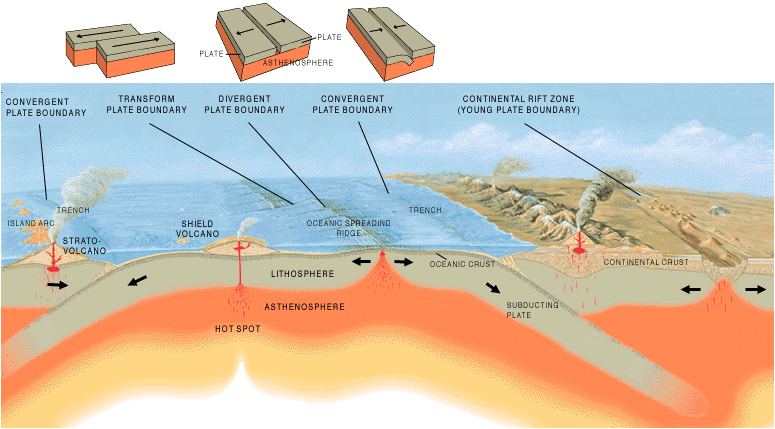
Hot spots and mantle plumes
A hot spot is a long-lived area of volcanism fed by a mantle plume, a column of unusually hot mantle rising from deep in the mantle (possibly the core–mantle boundary). Its head melts by decompression. Hot spots are largely independent of plate boundaries and stay roughly fixed while plates move over them, so they leave age-progressive volcanic chains.
- Hawaii (oceanic plate): basaltic shield volcanoes (Mauna Loa, Kilauea) above the plume; the islands get older to the northwest (Kauaʻi about 5 million years), continuing as the Hawaiian–Emperor seamount chain. Young submarine volcano Kamaʻehuakanaloa (formerly Lōʻihi) is forming to the southeast. Rocks: basalt, scoria, olivine-bearing (peridot) basalt; pillow basalt on the submarine flanks.
- Iceland: a hot spot sitting on the Mid-Atlantic Ridge, so both decompression sources add up; extensive basaltic lava flows and fissure eruptions, with some rhyolite.
- Yellowstone (continental plate): basaltic plume magma melts the continental crust, so eruptions are bimodal (basalt and rhyolite). Huge caldera-forming eruptions about 2.1, 1.3 and 0.63 million years ago produced welded tuffs, obsidian (Obsidian Cliff) and rhyolite flows. The Snake River Plain marks the track, older toward the southwest.
- Flood basalts (large igneous provinces) such as the Columbia River Plateau (mainly about 17–15 million years ago), the Deccan Traps (about 66 million years ago) and the Siberian Traps (about 252 million years ago) are attributed to the arrival of plume heads: enormous volumes of fluid basalt erupted from fissures in a short time.

Ophiolites and the structure of oceanic lithosphere
Oceanic lithosphere has a layered structure made at mid-ocean ridges. From the top down:
- Deep-sea sediment (chert, shale, limestone) settled on the seafloor.
- Pillow basalts: lava erupted onto the seafloor.
- Sheeted dike complex: vertical diabase dikes, side by side, that fed the lavas as the plates pulled apart.
- Gabbro (often layered cumulate gabbro at its base): the crystallized magma chamber beneath the ridge.
- Peridotite (mantle): the depleted mantle left after basalt was extracted; commonly altered by seawater to serpentinite.
An ophiolite is a slice of this oceanic crust and upper mantle that has been thrust (obducted) onto a continent at a convergent boundary. Ophiolites are where peridotite and serpentinite reach the surface (California's Coast Range ophiolite, the Troodos ophiolite of Cyprus, the Semail ophiolite of Oman, Bay of Islands in Newfoundland) and host chromite, copper sulfide and asbestos deposits. An outcrop that runs peridotite, gabbro, sheeted dikes, pillow basalt and sediment is an ophiolite: ancient seafloor uplifted in a collision.

Kimberlites and the source of diamonds
Kimberlite is a volatile-rich (CO₂, H₂O) ultramafic rock, broadly peridotite-like in composition, that erupts extremely rapidly from depths of more than about 150 km through ancient, thick continental cratons. It forms carrot-shaped pipes (diatremes) filled with broken kimberlite and mantle xenoliths. Because diamond is stable only at the high pressures of those depths, kimberlite pipes are the primary source of diamonds; the fast ascent brings diamonds up before they can convert to graphite. Prospectors trace pipes using resistant indicator minerals weathered out into stream gravels: Cr-rich pyrope garnet, chrome diopside, magnesian ilmenite and chromite. Kimberley (South Africa) gave the rock its name.
Evolution of igneous melts (Division C)
Partial melting
Rocks are mixtures of minerals with different melting temperatures, so they melt over a range: the lowest-melting fraction (quartz, K-feldspar, Na-plagioclase and the incompatible elements) melts first. The melt is separated (squeezed out, rising buoyantly) from the solid residue, a process called partial melting. Consequences:
- Partial melting of mantle peridotite (typically 10–20% melting at ridges) yields basalt, not peridotite, because only the lower-melting pyroxene and plagioclase-forming components melt; the olivine-rich residue stays behind as depleted peridotite.
- The smaller the degree of melting, the more enriched the melt is in incompatible elements and alkalis (Na, K). Very small degrees of melting make alkaline melts (alkali basalts, nepheline-bearing rocks), typical of continental rifts and the late stages of hot spots. Volatiles help: water and CO₂ (for example recycled from the surface by subduction, or carried by fluids that have metasomatized, i.e. chemically enriched, the mantle) lower the solidus, so small, alkali-rich melts form more easily. Large degrees of melting make tholeiitic basalt (mid-ocean ridges).
- Melting of sedimentary and metamorphic rocks also produces magma (true): melting of continental crust gives granitic magma.
Fractional crystallization and crystal settling
Fractional crystallization is crystallization in which early-formed crystals are separated from the remaining melt so they cannot react with it (contrast with equilibrium crystallization, where crystals keep reacting along Bowen's series). The separated crystals take the elements they need with them, and the remaining melt changes composition step by step.
How the crystals are removed in nature:
- Crystal settling: dense early minerals (olivine about 3.3, pyroxene, chromite) sink to the floor of the chamber. Light late minerals (plagioclase, especially in iron-rich melts) may float toward the roof.
- Filter pressing: melt is squeezed out of a crystal mush.
- Flow segregation and crystallization on the cool walls of the chamber.
Results:
- The melt evolves from basaltic (≈50% SiO₂) toward andesitic and rhyolitic; "after most minerals have crystallized, the remaining melt contains more silica than the original". Mg is removed before Fe (early olivine and pyroxene are Mg-rich), so in tholeiitic magmas the melt becomes iron-enriched.
- The last melt is enriched in everything the early minerals rejected: silica, aluminum, water and above all the alkali elements potassium and sodium. Olivine, pyroxene and Ca-plagioclase lock up Mg, Fe and Ca but take in almost no K and little Na, so these build up in the shrinking liquid. That is why the final minerals to crystallize are the K-, Na-, Al- and Si-rich ones at the foot of Bowen's series, K-feldspar, muscovite and quartz (with Na-rich plagioclase), and why granite and pegmatite are the typical residual-melt rocks.
- The accumulated crystals form cumulate rocks: layers of nearly pure olivine (dunite), chromite, pyroxene or plagioclase (anorthosite) on the chamber floor. Layered mafic intrusions such as the Bushveld Complex (South Africa, the world's main chromium and platinum-group-metal source), the Stillwater Complex (Montana) and the Skaergaard intrusion (Greenland) show this layering like sedimentary beds.
- The Palisades Sill has an olivine-rich layer near its base: olivine crystallized first and, being denser than plagioclase and the melt, settled to the bottom; plagioclase-rich layers lie above it.
Assimilation
Hot magma rising through the crust melts, digests and absorbs the surrounding country rock (assimilation). Blocks pried off the chamber roof sink into the magma (stoping). Undigested blocks remain as xenoliths. Because continental crust is felsic and melts at lower temperature than basalt, assimilation usually pushes a basaltic magma toward intermediate or felsic composition (a mafic melt intruding continental crust will melt or assimilate it). Assimilation consumes heat, so it is usually coupled with fractional crystallization (AFC).
Magma mixing
Two magmas of different composition meet in a chamber or conduit (for example basalt injected into the base of a rhyolitic chamber) and blend. Thorough mixing gives an intermediate (often andesitic) magma; incomplete mixing (mingling) leaves dark, rounded mafic enclaves in lighter rock or swirled banding. Mixing often triggers eruptions, because the hot mafic magma heats the felsic one and adds gas.
| Process | What happens | Effect on the melt | Evidence in the rocks |
|---|---|---|---|
| Partial melting | Low-melting fraction of a rock melts and is extracted | Melt more felsic and incompatible-rich than source | Depleted residues (harzburgite, dunite); migmatites in crust |
| Fractional crystallization | Early Bowen minerals separate from the liquid (settling, filter pressing) | Liquid richer in Si, Na, K, H₂O; Fe enrichment in tholeiites | Cumulate layers with olivine-rich bases; normally zoned plagioclase |
| Assimilation | Magma melts and absorbs country rock | Takes on crustal chemistry, usually more felsic | Xenoliths, xenocrysts, partly melted inclusions |
| Magma mixing | Two magmas blend | Intermediate composition, often andesitic | Mafic enclaves, disequilibrium crystals (resorbed or reversely zoned), olivine with quartz |
All three of fractional crystallization, assimilation and magma mixing can raise the silica content of a basaltic magma (answer "all of the above"). Over time a typical magma body becomes more felsic before it erupts.
Zoning and disequilibrium textures
| Texture | Description | Interpretation |
|---|---|---|
| Normal zoning | Plagioclase with Ca-rich core, Na-rich rim | Cooling too fast for the continuous-series reaction to keep up |
| Reverse zoning | Na-rich core, Ca-rich rim | Recharge by hotter, more mafic magma (mixing) or a pressure/water change |
| Oscillatory zoning | Many thin concentric bands of alternating composition | Crystal cycling through hotter and cooler, or wetter and drier, parts of a convecting chamber, or repeated growth pulses |
| Reaction rim (corona) | One mineral rimming another (pyroxene around olivine; amphibole around pyroxene) | Bowen reaction incomplete; crystal out of equilibrium with melt |
| Sieve (resorbed) texture | Plagioclase riddled with melt/glass inclusions | Partial dissolution after mixing with hotter magma or decompression |
Incompatible elements and pegmatites
Incompatible elements are elements whose ions are the wrong size (too large: K⁺, Rb⁺, Cs⁺, Ba²⁺, the light rare earths) or the wrong charge (too highly charged: Zr⁴⁺, Nb⁵⁺, Ta⁵⁺, U⁴⁺, Th⁴⁺), or simply too rare and too small (Li⁺, Be²⁺, B³⁺), to substitute into the crystal sites of olivine, pyroxene, amphibole and plagioclase. As a magma crystallizes, the common minerals reject them, so their concentration in the shrinking liquid keeps rising. The last fraction of a granitic magma is therefore rich in water, other volatiles (F, Cl, B) and incompatible elements.
That late fluid crystallizes as pegmatite, usually as dikes, veins and pods in and around granite batholiths:
- Why the crystals are huge: water lowers the viscosity of the melt and lets ions diffuse quickly to a few growing crystals, while nucleation is slow; crystals of feldspar, quartz, mica and spodumene reach meters.
- Why pegmatites are mineral treasure troves: the incompatible elements finally reach concentrations high enough to build their own minerals.
| Element | Pegmatite mineral | Use / gem |
|---|---|---|
| Lithium (Li) | Spodumene, lepidolite (lithium mica), petalite | Batteries; kunzite and hiddenite (spodumene gems) |
| Beryllium (Be) | Beryl | Be metal; emerald, aquamarine, morganite, heliodor |
| Boron (B) | Tourmaline | Gem tourmaline (elbaite, watermelon) |
| Fluorine (F) | Topaz, fluorite, lepidolite | Gem topaz |
| Cesium (Cs) | Pollucite | Atomic clocks, drilling fluids |
| Tantalum, niobium (Ta, Nb) | Columbite–tantalite ("coltan") | Electronics capacitors |
| Tin (Sn) | Cassiterite | Tin ore |
| Rare earths, uranium, thorium | Monazite, uraninite, zircon, allanite | REE magnets, nuclear fuel; zircon for dating |
| (Major minerals) | K-feldspar (microcline), albite, quartz, muscovite "books" | Ceramics, sheet mica, high-purity quartz |
Because pegmatites crystallize from the most evolved granitic melt, they are usually felsic (granitic) and leucocratic, and a pegmatite is a sign that large, high-quality crystals and gem minerals may be nearby. For the gem names and properties of each mineral, see the mineral reference tables.
Weathering and sediment
Every sedimentary rock starts as rock that broke down at Earth's surface. Weathering is the breakdown of rock in place. Erosion is the removal and transport of the products by water, wind, ice or gravity, and deposition is where they come to rest. The two words are not synonyms: weathering makes the sediment, erosion moves it. Questions here ask you to name a weathering process from a description, to write or recognize the feldspar-to-clay reaction, to rank minerals by how fast they weather, and to explain why some rocks last longer than others.
Mechanical weathering
Mechanical weathering exploits weaknesses (joints, grain boundaries, bedding) and wedges rock apart. The products are the same minerals as the parent rock, just smaller: a granite broken by frost gives angular pieces of granite and loose grains of quartz, feldspar and mica.
| Process | Mechanism | Where it dominates | Example or clue |
|---|---|---|---|
| Frost wedging (ice wedging, freeze–thaw) | Water in cracks expands about 9% when it freezes, prying the crack wider; repeated cycles split the rock | Climates and altitudes where temperature crosses 0 °C often (mountains, spring and autumn in temperate zones) | Angular blocks piled as talus below cliffs |
| Exfoliation (unloading, sheeting) | Rock that crystallized under kilometers of overburden expands when erosion removes the load; it cracks into curved sheets parallel to the surface | Granite and other plutonic rock exposed by deep erosion | Exfoliation domes (Half Dome, Stone Mountain, Enchanted Rock) |
| Salt crystal growth (haloclasty) | Salt water seeps into pores; as it evaporates, growing salt crystals push grains apart | Deserts and sea coasts | Honeycomb pits (tafoni) in sandstone; crumbling building stone near roads salted in winter |
| Root wedging (biological) | Roots grow into cracks and widen them; burrowing animals also move and break rock | Wherever plants grow on rock | Trees splitting boulders; sidewalks lifted by roots |
| Abrasion | Grains carried by water, wind or ice grind and scrape other rock | Riverbeds, beaches, deserts (sandblasting), under glaciers | Rounded river pebbles; ventifacts (wind-faceted stones); glacial striations |
| Thermal expansion | Daily heating and cooling expand and contract the outer layer and mixed minerals at different rates | Deserts with large day–night temperature swings; also wildfires | Flaking rock surfaces; its importance alone is debated |
Exfoliation of plutonic rock is a direct consequence of the rock cycle: the rock formed at high pressure and temperature, so it is out of equilibrium at the surface. The same mismatch explains chemical weathering below.
Chemical weathering
Chemical weathering converts minerals that formed at high temperature and pressure (or in the absence of air and water) into minerals stable at the surface: clay, iron oxides and dissolved ions. The key reactant is water, especially water made weakly acidic by dissolved carbon dioxide, which forms carbonic acid:
| Process | What happens | Classic reaction or example | Products |
|---|---|---|---|
| Hydrolysis | H⁺ ions replace metal cations (K⁺, Na⁺, Ca²⁺) in a silicate, breaking it down | Potassium feldspar → kaolinite (see below); plagioclase → clay; this is how granite turns into clay-rich soil | Clay minerals (kaolinite, smectite/montmorillonite, illite) + dissolved silica + cations |
| Oxidation | Fe²⁺ in a mineral loses an electron to oxygen and becomes Fe³⁺, which forms new iron oxides | 2Fe₂SiO₄ (fayalite olivine) + O₂ → 2Fe₂O₃ (hematite) + 2SiO₂; pyrite oxidizes to iron oxides and sulfuric acid | Hematite (red), goethite/limonite (yellow-brown); rust-colored stains on mafic rocks |
| Dissolution | The whole mineral goes into solution | Halite: NaCl → Na⁺ + Cl⁻; gypsum dissolves slowly; quartz dissolves extremely slowly | Ions in groundwater, later precipitated as chemical sediment |
| Carbonation (dissolution of carbonates) | Carbonic acid dissolves calcite | CaCO₃ + H₂CO₃ → Ca²⁺ + 2HCO₃⁻ | Caves, sinkholes and karst; hard water; the reverse reaction deposits travertine and cave formations |
| Hydration | Water molecules are added to a mineral's structure | Anhydrite + water → gypsum: CaSO₄ + 2H₂O → CaSO₄·2H₂O; hematite → goethite | Softer, larger-volume minerals; the swelling can also pry rock apart |
What happens to each mineral of a granite during chemical weathering is a favorite question:
| Mineral in granite | Fate in chemical weathering | Ends up as |
|---|---|---|
| Quartz | Essentially unaffected | Sand grains (beaches, dunes, quartz sandstone) |
| K-feldspar, plagioclase | Hydrolysis | Clay (kaolinite, smectite) + K⁺, Na⁺, Ca²⁺ in solution |
| Biotite, hornblende | Hydrolysis and oxidation | Clay + iron oxides (stain soil red-brown) + Mg²⁺, Fe in solution |
| Muscovite | Weathers slowly | Small flakes in sand and mud; eventually clay |
The dissolved ions go to the sea. Calcium and bicarbonate are taken up by organisms to build shells (later limestone), dissolved silica is used by diatoms and radiolarians (later chert or diatomite), and sodium and chloride stay dissolved until seawater evaporates (rock salt).
Spheroidal weathering combines the two types: chemical attack works in from joint surfaces, fastest at corners (attacked from three sides) and edges (two sides), so angular joint blocks become rounded boulders that peel in concentric shells. It is common in granite and basalt.
Karst. Groundwater with carbonic acid dissolves soluble bedrock along joints, producing caves, sinkholes, disappearing streams and, in the humid tropics, tower karst (steep residual hills). Karst forms mainly in limestone and dolostone, and also in marble, chalk, gypsum and rock salt. Sinkholes form in two main ways. As acidic groundwater widens joints and bedding planes into caves, the rock or soil roof over a growing cavity eventually becomes too thin to hold itself up and collapses into it (a collapse sinkhole, which can open suddenly, often after the water table drops and no longer buoys the roof, or after heavy rain). Where limestone lies at or near the surface, slow dissolution from the top down instead makes a gentle bowl (a solution sinkhole). Florida (whose bedrock is almost entirely limestone and dolostone), Kentucky (Mammoth Cave) and the Yucatán are classic karst regions; land over karst is risky to build on, and pumping groundwater makes collapse more likely. When cave water loses CO₂ to the air, the carbonation reaction reverses and calcite is redeposited as stalactites, stalagmites and flowstone (the same process makes travertine).
Mineral stability: the Goldich dissolution series
In 1938 Samuel Goldich noticed that the order in which igneous minerals weather is the order in which they crystallize in Bowen's reaction series (see The Bowen reaction series). A mineral is most stable in conditions like those it formed in. Olivine and calcium plagioclase form at about 1,200 °C with no free water, so at 25 °C in rain they are far from equilibrium and weather fastest. Quartz forms last, at the lowest temperature, and is the most stable at the surface.
Read it side by side with Bowen's series: the same minerals in the same rows, with the arrow reversed.
| Bowen: order of crystallization | Discontinuous (mafic) side | Continuous (plagioclase) side | Goldich: stability at the surface |
|---|---|---|---|
| First, hottest (≈1200 °C) | Olivine | Ca-plagioclase (anorthite) | Least stable, weathers fastest |
| ↓ | Pyroxene | Ca–Na plagioclase | ↓ more stable |
| ↓ | Amphibole | Na–Ca plagioclase | ↓ more stable |
| ↓ | Biotite | Na-plagioclase (albite) | ↓ more stable |
| ↓ | K-feldspar (branches merge) | ↓ more stable | |
| ↓ | Muscovite | ↓ more stable | |
| Last, coolest | Quartz | Most stable, weathers slowest |
A second reason works with the first: structure. Olivine is an isolated-tetrahedron silicate with Fe²⁺ and Mg²⁺ holding tetrahedra together, so breaking a few metal–oxygen bonds frees whole tetrahedra, and its iron oxidizes. Quartz is a framework of Si–O bonds in all three directions with no cations to remove. The more Si–O–Si linkage, the more resistant the mineral.
Consequences tested often:
- Mafic rocks (basalt, gabbro, peridotite) weather faster than felsic rocks (granite, rhyolite) because they are made of the high-temperature, iron- and magnesium-rich minerals. Iron-bearing mafic minerals also produce the most iron oxide when they weather.
- Quartz is the predominant mineral of beach and desert sand because everything else has been weathered away or ground down.
- A rock made only of quartz held by quartz cement (quartz sandstone with silica cement, quartzite, chert) is the most resistant common rock. Quartzite resists weathering better than its parent sandstone because its interlocking quartz has no pores or weak cement.
- An unweathered olivine-rich sand (as on Hawaii's green-sand beach) is immature: it can exist only very close to its source.
What controls weathering rates
- Climate. Chemical reactions speed up with temperature (roughly doubling for every 10 °C rise) and need water, so chemical weathering dominates in warm, humid climates (rainforest soils are deep and clay-rich, with kaolinite). Mechanical weathering dominates in cold climates (frost wedging) and deserts (salt growth, thermal stress). Arid climates have slow chemical weathering, which is why ancient monuments survive in Egypt.
- Surface area. Breaking a cube into eight smaller cubes doubles the surface exposed. Fractured, jointed or finely broken rock weathers far faster than a solid block.
- Rock type and mineral composition. Follow the Goldich series; soluble rocks (limestone, marble, rock salt, gypsum) dissolve; porous rocks let water in. Marble and limestone are dissolved by acid rain much faster than granite.
- Cement and structure. A sandstone with calcite cement crumbles when the cement dissolves; one with silica cement survives. Foliated rocks such as schist split and slide along their foliation, which makes schist slopes unstable after blasting.
- Time and exposure. Longer exposure gives more weathering; the ratio of altered to fresh minerals measures how long and how intensely a rock was weathered.
- Vegetation and organisms. Roots wedge rock and release CO₂ and organic acids; lichens etch surfaces.
Differential weathering: when a resistant layer (sandstone, quartzite, a dike of fresh basalt) sits next to a weak one (shale, limestone in a wet climate), the weak rock wears back and the resistant one stands up as a ridge, cap rock or hoodoo.
Soils and regolith
Regolith is all the loose material covering bedrock: weathered rock, sediment and soil. Soil is the upper part of regolith that has been altered enough, and mixed with organic matter, to support plants. A soil profile has horizons: O (organic litter), A (topsoil, humus plus minerals), E (leached zone, in some soils), B (subsoil, where clay, iron oxides and calcite washed down from above accumulate), C (partly weathered parent rock) and R (bedrock). Soil type is controlled by climate more than by parent rock.
Laterite is the end member of tropical weathering. Under heavy rain and high temperature, even silica is leached out, leaving a red soil rich in iron and aluminum oxides and hydroxides. Where the parent rock was rich in aluminum and poor in iron, the residue is bauxite, the aluminum ore (see Chemical and biochemical rocks).
Erosion, transport and sediment maturity
The agents of erosion are running water (by far the most important), wind, glacial ice, waves and currents, and gravity (mass wasting: landslides, rockfalls, slumps, creep). Each agent sorts sediment differently:
| Agent | What it can carry | Sorting and rounding of its deposits | Typical deposit |
|---|---|---|---|
| Glacial ice | Everything from clay to house-sized boulders, carried together | Very poorly sorted, angular to subangular; striated clasts | Till (unlithified), tillite (rock); moraines |
| Gravity (mass wasting) | Anything on a slope | Very poorly sorted, angular | Talus, landslide and debris-flow deposits, colluvium |
| Rivers | Gravel on the bed, sand bouncing (saltation), silt and clay in suspension, ions dissolved | Moderately to well sorted, rounding increases downstream | Channel gravel and sand, floodplain mud |
| Waves on a beach | Sand and gravel worked back and forth | Well sorted, well rounded | Beach sand, coquina |
| Wind | Sand (saltation, low dunes) and silt or dust (suspension); cannot lift gravel | Very well sorted, well rounded, frosted (pitted by impacts) sand | Dune sand; loess (wind-blown silt) |
Competence is the largest grain a current can move; capacity is the total amount of sediment it can carry. Both rise steeply with velocity, which is why floods do most of a river's work (see Grain size and stream velocity). A stream also lengthens its valley upslope by headward erosion: water pouring into the head of the channel erodes it backward, away from the direction of flow.
Sediment maturity describes how far weathering and transport have processed a sediment. It is the key to reading where a sandstone came from.
- Compositional maturity: the proportion of stable grains (quartz, plus chert and quartzite fragments) to unstable ones (feldspar, rock fragments, mafic minerals). Quartz sandstone (quartz arenite, over 90% quartz) is compositionally mature; arkose (feldspar-rich) and greywacke (rock fragments) are immature.
- Textural maturity: how much clay matrix has been winnowed out and how well sorted and rounded the grains are. In order: immature (much clay matrix, poorly sorted, angular), submature (little clay, still poorly sorted), mature (no clay, well sorted, not yet rounded), supermature (no clay, well sorted, well rounded).
Maturity increases with transport distance, time and especially with reworking by waves and wind. A supermature quartz sandstone with frosted grains has often been through several cycles of erosion and deposition.
Sedimentary rocks
Sedimentary rocks form at or near Earth's surface, at low temperature and pressure, from sediment that is buried and lithified. They make up only about 5% of the crust by volume but about 75% of the rocks exposed at the surface. They are the only rocks that routinely contain fossils, and their layering (stratification, or bedding) is their most important single feature. The 2027 rules limit sedimentary textures to three: clastic (also called detrital or terrigenous), chemical (crystalline) and biochemical (organic or bioclastic). Per-specimen descriptions are in the rock reference tables; this chapter covers the concepts behind them.
Clastic, chemical and biochemical textures
| Texture class | Made of | How it forms | National List examples |
|---|---|---|---|
| Clastic (detrital, terrigenous) | Fragments of pre-existing rock and minerals, held by cement and/or a fine matrix | Weathering → erosion → transport → deposition → lithification | Breccia, conglomerate, quartz sandstone, arkose, greywacke*, siltstone*, shale |
| Chemical (crystalline) | Interlocking crystals precipitated from water | Evaporation, change in temperature or CO₂, or reaction with another mineral | Rock salt, rock gypsum, travertine, oolitic limestone, dolostone, chert (some), banded iron formation, bauxite (residual) |
| Biochemical (organic, bioclastic) | Material made by organisms: shells, skeletons, microfossils, plant matter | Accumulation of organic remains; organisms extract ions from water to build shells | Fossil limestone, coquina, chalk, diatomite*, chert (many), coal (lignite, bituminous, anthracite) |
* = State and National only. A bioclastic rock (coquina, fossil hash) is made of broken shell fragments, so it is biochemical in origin but clastic in texture; a coquina whose shells were broken and transported by waves is a calcarenite (a sand-size carbonate rock). Clastic rocks are far more abundant than chemical ones because weathering produces enormous volumes of sediment everywhere.
Grain size: the Wentworth scale
Clastic grain size is measured on the Udden–Wentworth scale. Each class boundary is double the one below it (powers of 2 mm), so the classes are evenly spaced on a logarithmic scale. Geologists also use Krumbein's phi (φ) scale, φ = −log₂(diameter in mm): 1 mm = 0 φ, 2 mm = −1 φ, 1/16 mm = 4 φ, 1/256 mm = 8 φ. Larger grains have smaller (more negative) phi numbers.
| Class | Diameter (mm) | Phi (φ) | Lithified rock | Can you see the grains? |
|---|---|---|---|---|
| Boulder | over 256 | below −8 | Conglomerate (rounded) or breccia (angular) | Yes |
| Cobble | 64–256 | −6 to −8 | Conglomerate or breccia | Yes |
| Pebble | 4–64 | −2 to −6 | Conglomerate or breccia | Yes |
| Granule | 2–4 | −1 to −2 | Conglomerate or breccia (granule conglomerate) | Yes |
| Sand (very coarse to very fine) | 1/16–2 (0.0625–2) | 4 to −1 | Sandstone (quartz sandstone, arkose, greywacke) | Yes; feels gritty |
| Silt | 1/256–1/16 (0.0039–0.0625) | 8 to 4 | Siltstone | Barely, with a lens; gritty between teeth (no tasting in the event) |
| Clay | under 1/256 (0.0039) | above 8 | Claystone; with silt, mudstone or shale | No; feels smooth |
Gravel is the collective term for all grains over 2 mm. Mud is silt plus clay; mudstone is a blocky mud rock and shale is a mud rock that is fissile (splits into thin sheets along bedding because its platy clay minerals lie flat). Note that "clay" is both a size (under 1/256 mm) and a group of sheet-silicate minerals; most clay-size particles are clay minerals, but not all.

Sorting and rounding
Sorting is the range of grain sizes in a sediment. Well sorted means one size (one energy level acting steadily); poorly sorted means many sizes dumped together (energy dropped suddenly, or the agent carries everything at once). Geologists rank sorting as very well, well, moderately, poorly and very poorly sorted; engineers use the opposite words ("well graded" means poorly sorted).

| Sorting | Typical environment | Why |
|---|---|---|
| Very well sorted | Wind-blown dune sand, beach sand | Wind can carry only a narrow size range; waves winnow fines out repeatedly |
| Moderately sorted | River channel sand and gravel | Flow varies, but the fines are carried away |
| Poorly to very poorly sorted | Glacial till, alluvial fans, debris flows, landslides, turbidity currents (greywacke) | Ice and dense flows carry all sizes together and drop them together |
Sorting also controls porosity and permeability: in well-sorted sediment the pores between grains stay open, while in poorly sorted sediment small grains fill the gaps. Coarse, well-sorted gravel is the most permeable common sediment, so water flows through it fastest (and contaminants spread fastest); clay is porous but nearly impermeable because its pores are tiny.
Roundness describes the sharpness of a grain's corners and edges, from very angular, angular, subangular, subrounded, rounded to well rounded. Sphericity is a different property: how close the overall shape is to a sphere (equant vs elongated or flat). A flat pebble can be well rounded but have low sphericity.

- Rounding happens by abrasion during transport: grains knock and grind against each other and the bed, so corners are worn off first. Angular grains have not traveled far (breccia at the foot of a cliff, glacial till, landslide debris); rounded grains have traveled far or been reworked for a long time (river gravel, beach and dune sand).
- Larger clasts round faster than small ones: a pebble rolling in a river is rounded within kilometers to tens of kilometers, but sand needs hundreds of kilometers of river transport (or long reworking by wind and waves), and silt hardly rounds at all because water cushions the impacts.
- Wind rounds sand more efficiently than water (no water cushion), and the impacts frost the surfaces, so well-rounded frosted quartz grains are the signature of desert dunes.
- Breccia vs conglomerate is the classic pair: both have clasts over 2 mm; breccia's are angular (little transport, deposited near the source, for example on an alluvial fan, at a cliff base, in a fault zone or a collapsed cave), conglomerate's are rounded (transported and abraded in a river or on a beach).
Grain size and stream velocity
The 2027 rules tie grain size directly to water velocity in rivers and streams. The standard tool is the Hjulström diagram (Hjulström curve), which plots grain size on the horizontal axis against flow velocity on the vertical axis, both on logarithmic scales. Two curves divide it into three fields.
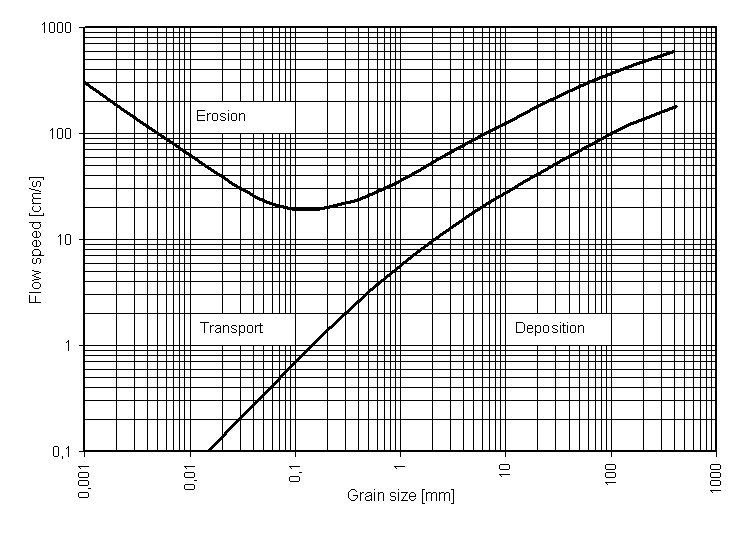
- Erosion (upper curve). Above it, the flow can lift grains of that size off the bed. Fine to medium sand (about 0.1–0.5 mm) is the easiest sediment to erode, needing only roughly 20–30 cm/s. Coarser grains need more velocity because they are heavier: pebbles need roughly 1 m/s and cobbles several m/s.
- Clay and silt are hard to erode even though they are tiny. The flat platy particles stick together (cohesion) and form a smooth bed that the flow skims over, so the erosion curve rises again on the left of the diagram. A compacted clay bed can need as much velocity to erode as gravel.
- Transportation (between the curves). A grain that is already moving keeps moving at velocities well below the one needed to pick it up.
- Deposition (below the lower curve). When the flow slows below the settling curve, grains of that size drop out. For clay the settling velocity is so low that clay stays suspended in almost any moving water and settles only in still water such as lakes, lagoons, floodplain ponds and the deep sea.
The same logic explains sorting and environments: high-velocity mountain streams and alluvial fans leave gravel, rivers in flood leave sand in their channels and silt on the floodplain, and only quiet water lets clay settle into what becomes shale. When a stream's discharge is low, the largest clasts (cobbles and boulders) do not move at all; they move only in floods.
Lithification and diagenesis
Diagenesis is every physical, chemical and biological change that happens to sediment after deposition and before metamorphism, at temperatures up to roughly 150–200 °C and depths of a few kilometers. Lithification, turning loose sediment into rock, is the main part of diagenesis:
- Compaction. The weight of overlying sediment squeezes grains closer together, expels water and reduces pore space. It is the dominant process for mud: a freshly deposited mud can be 60–80% water by volume and loses most of it, and the clay flakes rotate to lie flat, which gives shale its fissility.
- Cementation. Groundwater moving through the pores precipitates minerals that glue grains together. It is the dominant process for sand and gravel, whose rigid grains compact little.
- Recrystallization. Unstable minerals change into stable ones without changing much chemically: aragonite shells recrystallize to calcite, opal to chalcedony and quartz, lime mud to crystalline limestone. Other diagenetic changes include replacement (dolomitization, silicification of wood into petrified wood and of shells into chert) and authigenesis (new minerals, such as pyrite in organic-rich mud).
| Cement | How to recognize it | Notes |
|---|---|---|
| Calcite (CaCO₃) | Fizzes in dilute acid; light colored; rock may be soft | The most common cement; dissolves easily, so the rock weathers fast |
| Silica (quartz, chalcedony) | No fizz; very hard, tough rock that breaks through grains | The strongest, most weathering-resistant cement |
| Iron oxides: hematite, goethite/limonite | Red (hematite) or yellow-brown (limonite) color | Red beds; iron oxidizes in air, so red cement usually means deposition or diagenesis on land in an oxidizing setting |
| Clay | Soft, crumbly, earthy; rock smears | Weak; often a matrix rather than a precipitated cement |
Matrix is fine sediment (mud) deposited together with the coarser grains; cement is precipitated later in the pores. Greywacke has a lot of matrix; a clean quartz sandstone has cement only.
Color as a clue. Red, purple and brown sedimentary rocks owe their color to ferric (Fe³⁺) oxides and usually formed in oxidizing, often terrestrial, settings. Gray, black and dark green rocks usually formed in reducing (oxygen-poor) settings, such as swamps, stagnant lagoons and deep basins, where organic carbon is preserved and iron stays ferrous or forms pyrite.
Clastic rocks
| Rock | Grain size | Grains and matrix | Interpretation |
|---|---|---|---|
| Breccia | Gravel (over 2 mm), angular | Any rock fragments, poorly sorted | Short transport: alluvial fan, talus, landslide, fault zone, cave collapse |
| Conglomerate | Gravel, rounded | Commonly quartz, chert and quartzite pebbles (the survivors), in sand matrix | High-energy transport: river channels, alluvial fans, beaches |
| Quartz sandstone (quartz arenite) | Sand, well sorted and well rounded | Over 90% quartz | Mature sand: long transport or repeated reworking (beach, dune, shallow shelf) on a stable landmass |
| Arkose | Sand, angular to subangular, poorly to moderately sorted | Quartz with at least 25% feldspar; the pink to reddish color comes from pink K-feldspar grains and often from hematite (iron oxide) cement or grain coatings | Immature sand from a nearby granite or gneiss, buried fast or in a dry climate before feldspar could weather (alluvial fans, rift basins) |
| Greywacke* (graywacke) | Sand, angular, very poorly sorted | Quartz, feldspar and dark rock fragments in more than about 15% clay–silt matrix | Dumped rapidly by turbidity currents on submarine fans, typically at active margins (subduction zones, trenches) |
| Siltstone* | Silt | Quartz, feldspar, clay | Low energy: floodplains, lakes, deltas, outer shelf |
| Shale | Clay and silt | Clay minerals, quartz, organic matter; fissile | Lowest energy: lakes, lagoons, floodplains, deep sea; black shale = organic-rich, oxygen-poor water |

The sandstone family is a maturity series: greywacke (most immature, muddy and lithic) → arkose (feldspathic) → quartz sandstone (mature). Fossils are most common in shale and limestone, which form in quiet water where organisms live and remains are buried gently; they also occur in sandstone, but are rare in coarse conglomerate and breccia, where the energy breaks them.
Chemical and biochemical rocks
Carbonate rocks
Limestone is rock made mostly of calcite (CaCO₃). Most limestone is biochemical: corals, molluscs, brachiopods, crinoids, foraminifera and calcareous algae extract Ca²⁺ and HCO₃⁻ from seawater to build calcite or aragonite skeletons. Carbonate production is greatest in warm, clear, shallow tropical seas (the Bahamas, the Great Barrier Reef, the Persian Gulf today), away from rivers that would bury organisms in mud. Calcite is also less soluble in warm water, which helps.
| Rock | Origin | What to notice |
|---|---|---|
| Fossil limestone | Biochemical: whole shells in fine lime mud (micrite) or sparry calcite cement | Visible fossils in a dense matrix; fizzes |
| Coquina | Biochemical (bioclastic): loosely cemented shells and shell fragments | Very porous; forms on beaches and shoals where strong waves break and sort shells (high, intermittent energy); used as a building stone in Florida (Castillo de San Marcos, St. Augustine) |
| Chalk | Biochemical: microscopic calcite plates of coccoliths (planktonic algae) plus foraminifera, accumulated on the sea floor | Nearly pure calcite, white, soft, very porous (often 35–45%), powdery (it writes on a board, unlike hard, dense crystalline limestone, whose calcite grains have recrystallized and interlock); fizzes; the White Cliffs of Dover; much of it Cretaceous ("Cretaceous" comes from the Latin for chalk) |
| Oolitic limestone | Chemical: ooids, sand-size spheres of concentric calcium carbonate layers (aragonite in modern ooids, calcite in most ancient ones) that precipitate around a nucleus as grains are rolled in warm, shallow, agitated, CaCO₃-supersaturated water | Looks like fish roe (from Greek oon, egg); modern ooids form on Bahamian shoals, where steady tidal and wave currents keep the grains rolling so layers grow evenly on all sides (moderately high, constant energy) |
| Travertine | Chemical: calcite precipitated where spring or cave water loses CO₂ (and warms or agitates) | Banded, porous with irregular holes; hot-spring terraces (Mammoth Hot Springs), cave formations |
| Dolostone | Mostly by dolomitization: Mg-rich water (for example evaporated seawater in tidal flats or lagoons) replaces part of the Ca in limestone during diagenesis | Fizzes only weakly, when powdered or in warm acid; often sugary texture; original fossils may be blurred |
Evaporites
Evaporites are chemical sediments left when a body of saline water evaporates faster than it is replenished: a restricted arm of the sea, a lagoon, a salt flat (sabkha) or a lake with no outlet in a hot, dry climate (the Dead Sea, Great Salt Lake). Minerals precipitate in reverse order of solubility, the least soluble first:
| Order | Mineral(s) | Begins when about this much of the seawater is left | Rock |
|---|---|---|---|
| 1 | Calcite (and aragonite) | About 50% | Thin carbonate layers |
| 2 | Gypsum (CaSO₄·2H₂O) or anhydrite (CaSO₄) | About 20% (80% evaporated) | Rock gypsum |
| 3 | Halite (NaCl) | About 10% (90% evaporated) | Rock salt |
| 4 | Potassium and magnesium salts (sylvite KCl, carnallite) | Under about 5% | Potash beds (fertilizer) |
Because seawater holds far more NaCl than CaSO₄, evaporating 1,000 m of seawater gives only about 15 m of evaporite, most of it halite. Thick evaporite deposits therefore require a basin that was repeatedly refilled. Evaporite beds commonly show plane lamination, mud cracks, halite crystal casts (hopper crystals) and nodular gypsum.
Siliceous rocks: chert and diatomite
Chert is microcrystalline to cryptocrystalline quartz (chalcedony). It breaks with conchoidal fracture, is hard (about 7), and has a waxy to dull luster. Most chert is biochemical: the opal (amorphous silica) skeletons of radiolarians, diatoms and sponge spicules accumulate on the sea floor, dissolve and reprecipitate as microcrystalline quartz during diagenesis. Bedded chert forms in deep ocean basins below the depth where carbonate dissolves; nodular chert forms as lumps in limestone and chalk, where silica replaces carbonate. Flint is dark gray to black nodular chert, classically from chalk; jasper is red chert colored by hematite. Because it fractures to sharp edges, flint was the main toolmaking stone of the Stone Age.
Diatomite (State/National) is the unrecrystallized deposit of diatom frustules: white, chalk-like, extremely light and porous. Unlike chalk, it does not fizz, because it is opal (SiO₂·nH₂O), not calcite. It forms in lakes and in nutrient-rich ocean waters. Uses: filters (swimming pools, beer), mild abrasives, insulation and absorbents.
Coal
Coal is a biochemical (organic) sedimentary rock made mostly of carbon from land plants. The steps:
- Accumulation. Plants grow and die in a swamp (or bog). The waterlogged, stagnant, anoxic (oxygen-poor), often acidic water stops bacteria and fungi from fully decomposing the plant matter, so it accumulates as peat.
- Burial (coalification). Sediment buries the peat. Compaction squeezes out water, and heat drives off volatile matter (water, CO₂, methane), so the coal loses mostly hydrogen and oxygen and its proportion of carbon rises: peat → lignite → sub-bituminous → bituminous → anthracite.
- Rank increases with depth, temperature and time. Anthracite forms only where coal was heated by deep burial or mountain building, so many geologists class it as a low-grade metamorphic rock.
| Rank | Carbon (approximate) | Look | Notes |
|---|---|---|---|
| Peat (not a rock) | Lowest of the series (often quoted as about 50–60% total carbon of the dry plant matter, a different basis from the coal ranges below, so do not compare the numbers directly) | Brown, spongy, plant fibers visible | Still forming in bogs today; burned as fuel in Ireland |
| Lignite (brown coal) | 25–35% | Brown to brown-black, soft, dull, may show woody texture | Lowest rank, high moisture, lowest heat value; mostly surface (strip) mined; jet is a hard, polishable gem variety of lignite |
| Sub-bituminous | 35–45% | Dull black | Between lignite and bituminous |
| Bituminous (soft coal) | 45–86% | Black, banded dull and bright layers, blocky, dirties fingers | Named for bitumen (tar or asphalt-like hydrocarbon); any rock that holds and may smell of tar, asphalt or petroleum is called bituminous (bituminous limestone, shale or sandstone). Most abundant rank in the US; widely burned for electricity and used (as coke) for steel; often high sulfur |
| Anthracite (hard coal) | 86–97% | Black, bright submetallic luster, conchoidal fracture, clean to touch | Highest rank and heat per kilogram; burns with little smoke; scarce (Pennsylvania) |
(Carbon percentages are USGS ranges; ranks are formally defined by heat content and fixed carbon, so other sources give slightly different numbers.)
Most of the world's coal formed in the Carboniferous period (about 359–299 million years ago; in North America the coal-rich Pennsylvanian), when vast coal swamps of tree-sized ferns, horsetails and club mosses covered tropical lowlands. There is practically no coal older than the Devonian, because before then there were no large land plants. Moisture lowers coal's heating value, which is one reason anthracite and bituminous coal are worth more than lignite.
Coal versus oil: coal forms from land plants buried in swamps and stays where it formed as a solid rock; oil and gas form mainly from marine plankton and algae buried in organic-rich mud (later black shale, the source rock) and then migrate as fluids into porous reservoir rock.
Two ways textbooks group these rocks. The 2027 rules use three textures: clastic, chemical and biochemical, with coal counted as biochemical (organic). Some textbooks use four groups instead, splitting off organic rocks: biochemical then means rocks whose minerals were built by organisms (fossil limestone, coquina, chalk, diatomite, most chert), and organic means rocks made of the carbon-rich remains of organisms themselves (coal; also oil shale). Others use detrital / chemical (including biochemical limestone) / organic. The rock is the same in every scheme; answer with the scheme the question uses, and if it lists "organic" as an option, coal goes there.
Iron and aluminum rocks: banded iron formation and bauxite
Banded iron formation (BIF) consists of alternating layers of iron oxides (hematite, magnetite; metallic gray or red) and chert (red jasper or gray chert). The banding exists at three scales: macrobands several meters thick (separated by thin shale beds), mesobands of chert or iron oxide from millimeters to a few centimeters thick (the stripes you see in a specimen), and microbands under a millimeter thick within the chert mesobands. BIF is almost all Precambrian: mostly 2.6–1.8 Ga (oldest about 3.8 Ga; a brief return about 0.75 Ga). Origin: the early ocean was anoxic, so iron dissolved as Fe²⁺. When photosynthetic cyanobacteria began releasing oxygen, culminating in the Great Oxidation Event about 2.4 billion years ago, dissolved iron was oxidized to insoluble Fe³⁺ and precipitated as iron oxides, alternating with silica layers (seasonal or cyclic changes are the usual explanation for the banding). Once the deep ocean became oxygenated, dissolved iron disappeared and large BIFs stopped forming. BIFs are the world's main iron ore (Lake Superior region, Pilbara of Australia, Brazil).
Bauxite is a residual deposit, not a deposited sediment: it is what is left after intense chemical weathering in hot, wet, tropical climates leaches out silica, alkalis and much of the iron from an aluminum-rich parent rock (granite, shale, basalt, or clay over limestone). It is a mix of aluminum hydroxide minerals (gibbsite, boehmite, diaspore) with clay and iron oxides. In hand specimen it is earthy and dull, white, cream, tan, red-brown or orange (red from iron), often pisolitic (pea-sized round concretions), soft (roughly H 1–3), light for its size (SG about 2–2.5), with no fizz. It is the ore of aluminum and the main source of gallium as a by-product. Aluminum is the most abundant metal in the crust, but in common rocks like shale it is locked in silicate structures that are expensive to break; in bauxite it is already in hydroxides that dissolve in hot sodium hydroxide. Refining takes two steps: the Bayer process dissolves the aluminum hydroxides in hot NaOH and precipitates pure alumina (Al₂O₃), and then Hall–Héroult electrolysis splits alumina dissolved in molten cryolite into aluminum metal (and oxygen, which burns the carbon anodes to CO₂), using very large amounts of electricity.
Environments and primary structures
A depositional environment is the physical, chemical and biological setting where sediment accumulates: its energy, water depth, chemistry and organisms. Each leaves a recognizable combination of grain size, sorting, rounding, composition, structures and fossils. Thick piles of sedimentary rock (kilometers in sedimentary basins) can accumulate only where the crust slowly sinks, a process called subsidence (caused by stretching and cooling of the lithosphere, or by the weight of sediment, ice or mountain belts); subsidence makes room for each new layer and buries older ones deeper. The rules' list of environments is open, so learn the general logic as well as the table. Division C rules label the deep sea as abyssal.

ReferenceDepositional environments· 18 rows
Energy: H = high, M = moderate, L = low. Non-marine environments first, then transitional, then marine from shallow to deep.
No rows match.
| Environment | Energy | Typical sediment and rocks | Typical structures and features |
|---|---|---|---|
| Glacial | Variable (ice carries everything) | Till/tillite: unsorted mix of clay to boulders, angular striated clasts; outwash sand and gravel | No bedding in till; moraines; varves (annual light/dark couplets) in glacial lakes |
| Alluvial fan | H, sudden drop where a steep stream leaves a mountain front | Poorly sorted gravel and sand: breccia, conglomerate, arkose | Wedge-shaped deposits, debris-flow beds, coarsest near the mountain, red color in dry climates |
| Braided river | H | Gravel and coarse sand: conglomerate, sandstone | Many shifting channels and bars; cross-bedding |
| Meandering river (channel) | M | Sand, rounded gravel at the base of channels: sandstone, conglomerate | Cross-bedding, current (asymmetric) ripples, fining-upward channel fills, imbrication |
| Floodplain | L | Silt and mud from overbank floods: siltstone, shale, mudstone | Thin lamination, mud cracks, root traces, plant fossils, red soils |
| Lake (lacustrine) | L | Mud, silt, some carbonate or diatomite; evaporites in desert lakes | Fine lamination, varves, mud cracks at margins, fish and plant fossils |
| Swamp / bog | L, waterlogged, anoxic | Peat → coal; dark organic shale | Plant fossils, coal seams, root traces |
| Desert / aeolian (wind) | M (wind) | Very well sorted, well-rounded, frosted quartz sand: quartz sandstone; loess (silt) downwind | Large-scale cross-bedding (sets meters thick, from dunes), wind ripples, red color, no mud; Checkerboard Mesa and the Navajo Sandstone of Zion |
| Playa / salt flat (sabkha) | L | Evaporites: rock salt, rock gypsum; red mud | Mud cracks, salt crystal casts, lamination |
| Delta | M → L seaward | Sand at the delta front grading to silt and mud offshore; coal in delta-plain swamps | Cross-bedding, ripples, coarsening-upward sequences, plant fragments |
| Beach (shoreline) | H (waves) | Well-sorted, well-rounded quartz sand: quartz sandstone; shell beds: coquina | Gently dipping plane laminae, symmetric wave ripples, some cross-bedding, burrows |
| Tidal flat | L–M, alternating | Interlayered sand and mud; carbonate mud and dolomite in arid tropics | Mud cracks, ripples (directions reversing), stromatolites, burrows |
| Lagoon (behind barrier islands or reefs) | L, restricted | Mud, lime mud, sometimes evaporites | Fine lamination, burrows, restricted fauna |
| Reef | H on the front | Limestone built in place by corals, algae, sponges | Unbedded massive limestone, abundant fossils in growth position |
| Carbonate shelf / platform | L–M, warm shallow water | Fossil limestone, oolitic limestone, chalk farther out | Fossils, ooids, shell beds, burrows |
| Clastic continental shelf | M near shore → L offshore | Sand near shore grading to mud: sandstone, siltstone, shale | Symmetric and current ripples, storm beds, burrows, marine fossils |
| Continental slope and rise (submarine fans) | Episodic H (turbidity currents) between long L periods | Greywacke interbedded with shale (turbidites) | Graded bedding, repeated graded beds, sole marks on bed bases |
| Abyssal plain (deep ocean) | L | Fine clay, siliceous ooze (→ chert, diatomite) and, above the carbonate compensation depth, calcareous ooze (→ chalk); distal turbidites | Fine lamination, graded beds from distant turbidity currents |
Where a mountain range rises, its weight bends the crust down in front of it into a foreland basin. Rapid erosion of the young mountains fills the basin with thick conglomerate and sandstone shed off the range, called molasse (named for the Molasse Basin north of the Alps); a molasse basin therefore records mountain building nearby.
Primary sedimentary structures
Primary structures form during or just after deposition, before lithification. They record how the sediment moved and which way was up. Secondary features form later, during diagenesis (foliation and slaty cleavage are metamorphic, not sedimentary):
| Feature | What it is | How it forms | Example |
|---|---|---|---|
| Concretion | Hard, rounded mass of cement inside a sedimentary rock | Cement (calcite, silica, siderite, iron oxide) precipitates outward around a nucleus such as a shell, bone or leaf | Calcite concretions in shale |
| Nodule | Rounded, irregular lump that differs in composition from its host and is often harder | Mostly replacement of the host rather than outward cementation | Chert/flint nodules in chalk and limestone; pyrite or phosphate nodules in shale |
| Geode | Hollow, roughly spherical cavity lined with inward-pointing crystals | Crystals grow inward from the walls of a cavity; the hollow counterpart of a concretion or nodule | Quartz or calcite geodes in limestone |
| Stylolite | Jagged, tooth-like seam, often dark with insoluble residue | Grains dissolve under pressure where they press together during burial | Common in limestone |

| Structure | What it looks like | How it forms | What it tells you |
|---|---|---|---|
| Bedding (stratification) | Layers separated by bedding planes | Changes in sediment supply, grain size or a pause in deposition; a short break makes a bedding plane, a very long break an unconformity | The single most important sedimentary feature; beds start horizontal |
| Plane (parallel) bedding / lamination | Flat, parallel layers; laminae are under 1 cm thick | Settling from suspension in quiet water, or sheets of sand moved by fast flow or beach swash | Steady, uniform deposition |
| Cross-bedding | Inclined laminae within a bed, meeting the bed base at a low angle and cut off sharply at the top | Ripples or dunes migrate: sand is pushed up the gentle upstream (stoss) side and avalanches down the steep downstream (lee) side | Current direction = the direction the cross-laminae dip; way up = laminae are truncated at the top and curve tangentially into the base; large sets (meters) = wind dunes, small sets = rivers, tidal and shallow marine |
| Asymmetric (current) ripples | Ridges with a gentle upstream side and steep downstream side | One-directional current of water or wind | Flow direction: the steep (lee) side faces downstream; the ridges run perpendicular to the current |
| Symmetric (wave, oscillation) ripples | Ridges with equal slopes and sharp crests, rounded troughs | Back-and-forth wave motion in shallow water | Shallow water (lake shore, beach, tidal flat) affected by waves; sharp crests point up, so they show way up |
| Graded bedding | One bed fining upward from coarse at the base to fine at the top | A turbidity current (a dense underwater avalanche of sediment-laden water) slows; the largest, heaviest grains settle first and progressively finer ones on top | Deep water at the base of the continental slope, submarine fans and abyssal plains; also deep lakes. Coarse base = original bottom (way up) |
| Mud cracks (desiccation cracks) | Polygonal cracks in mud, V-shaped in cross-section, often filled with sand | Wet mud dries and shrinks | Exposure to air: floodplains, tidal flats, lake margins, playas; the V narrows downward (way up) |
| Raindrop impressions | Small round pits on a mud surface | Raindrops striking soft mud | Exposure to air; a top-of-bed (way-up) feature |
| Tracks, trails and burrows (trace fossils) | Footprints, crawling trails, tubes through the sediment | Animals walking on or burrowing into soft sediment | Living organisms present, often shallow water or exposed surfaces; intense burrowing (bioturbation) destroys lamination |
| Imbrication | Flat pebbles stacked like fallen dominoes, leaning in one direction | A current tilts flat clasts so they dip upstream | Current direction (the pebbles dip upstream) |
| Sole marks (flute casts, tool marks) | Ridges and lumps on the underside of a bed | Currents scour the soft mud below; sand fills the scours | Current direction and way up; typical of turbidites |
Turbidites. The bed (and, once lithified, the rock) left by a single turbidity current is a turbidite. It has a sharp, often sole-marked base and is normally graded, so grain size increases from top to bottom. A complete turbidite shows the Bouma sequence of divisions, from base to top: massive or graded sand (A) → parallel-laminated sand (B) → ripple cross-laminated fine sand and silt (C) → laminated silt and mud (D) → mud that settled slowly afterwards (E). Turbidite successions on submarine fans and at the base of the continental slope stack hundreds of such sand–mud couplets; the typical turbidite sandstone is greywacke, its muddy matrix and poor sorting reflecting rapid dumping from a dense flow.


Metamorphic rocks
Metamorphic rocks form when an existing rock (the protolith, or parent rock) is changed by heat, pressure or chemically active fluids while it stays solid. Metamorphism begins at roughly 150–200 °C, above diagenesis, and ends when the rock starts to melt, at about 650–700 °C for water-saturated granite-like rock (higher for dry or mafic rock). Minerals recrystallize into new ones stable under the new conditions, grains grow, and directed pressure aligns them. Vesicles, flow banding and glass are igneous features; they do not form by metamorphism. Per-specimen data are in the rock reference tables.
Agents of metamorphism
Heat drives the reactions. It comes from burial (temperature rises with depth along the geothermal gradient, typically 25–30 °C per km in continental crust), from nearby magma, and from tectonic thickening of crust. Heat lets atoms diffuse through solid crystals and rearrange into new minerals without melting.
Pressure has two forms:
- Confining (lithostatic) pressure is equal in all directions, from the weight of overlying rock: about 1 kbar (100 MPa) per 3.5 km of depth (roughly 0.3 kbar per km). It makes minerals denser and more compact (kyanite instead of andalusite, garnet, omphacite in eclogite) but does not align them.
- Directed (differential) stress is greater in one direction, at plate boundaries where crust is squeezed. It flattens grains and makes platy and elongate minerals grow or rotate perpendicular to the maximum stress, producing foliation and lineation.
Chemically active fluids (hot water with dissolved CO₂, ions and silica) speed up reactions by carrying ions between grains, and can add or remove elements. When fluids significantly change the bulk chemical composition of the rock, the process is metasomatism.
Changes during metamorphism: recrystallization (existing minerals regrow larger, as calcite in marble), neocrystallization (new minerals not present in the protolith grow, as garnet in schist), phase change (a mineral turns into a polymorph, as andalusite to sillimanite), pressure solution, and plastic deformation. Porosity decreases: metamorphic rocks are denser and less porous than their protoliths. Low-grade metamorphic rocks can still contain recognizable (often stretched) fossils.
Brittle versus ductile. Cool, lightly confined rock near the surface is brittle: it cracks, faults and shatters into breccia. Hot, deeply buried rock under slow, long-lasting stress is ductile: it bends, folds and stretches without breaking, giving the contorted layers of schist and gneiss. The switch lies roughly 10–15 km down in continental crust, so shallow fault zones make fault breccia and deep ones make mylonite.
Types of metamorphism
| Type | Main agent(s) | Setting | Scale | Typical rocks |
|---|---|---|---|---|
| Regional (dynamothermal, orogenic) | Heat + high directed pressure, over millions of years | Convergent boundaries: continental collision (Himalayas, Appalachians), roots of mountain belts | Thousands of km² | Foliated: slate, phyllite, schist, gneiss, amphibolite |
| Contact (thermal) | Heat from an intrusion; low pressure, little directed stress | Country rock around plutons, dikes, sills | Aureole centimeters (dike) to a few km wide (batholith) | Non-foliated: hornfels, marble, quartzite, skarn |
| Burial | Heat and confining pressure from deep burial; no directed stress | Thick sedimentary basins | Large areas, low grade | Zeolite-facies rocks; non-foliated |
| Dynamic (cataclastic) | Directed stress and shearing (brittle near the surface, ductile at depth) | Fault zones | Narrow zones along faults | Fault breccia (broken fragments), mylonite (finely ground, streaky rock from ductile shearing at depth) |
| Hydrothermal (and metasomatism) | Hot circulating water | Mid-ocean ridges (seawater through hot new basalt); around plutons | Local to regional | Greenstone/greenschist, serpentinite (from peridotite), skarn, ore veins |
| Subduction-zone (high P, low T) | High confining pressure, low temperature | Subducting oceanic plate | Long belts parallel to trenches | Blueschist, eclogite |
| Shock (impact) | Extreme pressure in microseconds from meteorite impacts | Impact craters (Meteor Crater, Vredefort, Sudbury) | Local | Shocked quartz, coesite and stishovite (high-pressure SiO₂ polymorphs), shatter cones, impact breccia, tektites |
Metasomatism and skarns. A hot pluton drives groundwater convection and releases its own fluids, which carry silica, iron and metals into the surrounding rock. When the country rock is limestone or dolostone, the reaction produces skarn, a coarse calc-silicate rock with garnet (grossular, andradite), diopside, wollastonite and epidote, often with ores of copper, tungsten, iron, zinc or gold. A simpler example is the reaction calcite + quartz → wollastonite + CO₂ in heated siliceous limestone, or dolomite + quartz + water → tremolite + calcite + CO₂ at low grade.
Serpentinization is hydrothermal metamorphism of peridotite: water added at low to moderate temperature converts olivine and pyroxene to serpentine minerals (plus magnetite and sometimes talc), producing green, waxy, often slickensided serpentinite. It happens where seawater penetrates the mantle at mid-ocean ridges and in subduction zones. Serpentinite and peridotite are exposed on land in ophiolites (see Ophiolites and the structure of oceanic lithosphere). Further hydration and CO₂ alteration of ultramafic rock gives talc schist and soapstone.
Texture: foliated or not
Foliation is any planar fabric in a metamorphic rock: parallel alignment of platy minerals (micas, chlorite) or segregation into layers. It forms under directed stress, perpendicular to the maximum squeeze, so it is a signature of regional metamorphism. It is not the same as sedimentary bedding: slaty cleavage often cuts across the original bedding at an angle.
The four foliated textures form a sequence of increasing grade and grain size:
| Texture (rock) | Grain size | What you see | Why |
|---|---|---|---|
| Slaty cleavage (slate) | Very fine; grains invisible | Splits into flat, smooth, dull sheets; rings when tapped | Microscopic clay minerals recrystallize to aligned chlorite and white mica |
| Phyllitic (phyllite) | Fine; grains barely visible | Silky to satiny sheen; foliation often wavy or crinkled (crenulated) | Micas grow slightly larger and reflect light together |
| Schistosity (schist; Greek skhistos, split) | Medium to coarse; flakes visible | Scaly, glittering surfaces of visible mica; splits readily; may contain porphyroblasts (large crystals such as garnet or staurolite grown in the solid rock) | Micas large enough to see; new minerals grow |
| Gneissic banding (gneiss) | Coarse | Alternating light (quartz, feldspar) and dark (biotite, hornblende) bands; does not split along them | At high grade, ions migrate and minerals segregate; muscovite breaks down. The light bands are often the thicker ones because quartz and feldspar make up most of a granitic protolith |
Foliation by grade (shale protolith)

SlateLow grade. Grains too fine to see; splits into flat sheets along slaty cleavage; dull surface.Credit: Dexter Perkins, CC0, via Wikimedia Commons · source 
PhylliteLow to medium grade. Still fine-grained, but tiny micas give a satiny sheen; foliation often crinkled.Credit: Amcyrus2012, CC BY-SA 4.0, via Wikimedia Commons · source 
SchistMedium grade. Mica flakes visible to the eye give schistosity; the rock splits along glittering, scaly surfaces.Credit: Mike Davis, CC0, via Wikimedia Commons · source 
GneissHigh grade. Minerals segregated into light quartz-feldspar and dark biotite-hornblende bands; coarse; does not split easily.Credit: No machine-readable author provided. Siim assumed (based on copyright claims)., CC BY-SA 3.0, via Wikimedia Commons · source
Non-foliated (granoblastic or hornfelsic) rocks have interlocking, roughly equal-sized grains with no alignment. A rock is non-foliated when (1) its minerals are equidimensional (calcite in marble, quartz in quartzite), so there are no platy grains to line up even under directed stress, or (2) it formed without directed stress (contact metamorphism: hornfels; burial metamorphism). Equal confining pressure and heat alone give a non-foliated texture.
The five basic metamorphic textures are therefore slaty, phyllitic, schistose, gneissic and granoblastic (non-foliated). Other textures to recognize: porphyroblastic (large porphyroblasts in a finer matrix, the metamorphic counterpart of porphyritic), augen (eye-shaped feldspar porphyroclasts wrapped by foliation in augen gneiss) and lineation (aligned needles, as hornblende in amphibolite).
Why foliation wraps around porphyroblasts. Garnet and staurolite are strong, hard, roughly equant (blocky) crystals, while micas are weak, platy and easily bent. When the rock is flattened, the rigid porphyroblast resists and barely changes shape, so the weak micas flow and bend around it and the foliation curves around the crystal like water around a boulder, often with small "pressure shadows" of quartz on either side. Trails of tiny inclusions trapped inside a porphyroblast can preserve an older foliation, and S-shaped trails show that the crystal rotated as it grew during deformation.
Migmatite ("mixed rock") forms at the highest grades when part of a gneiss begins to melt: light, granitic melt (leucosome) collects in swirling veins and bands within the dark unmelted host (melanosome). It is part igneous and part metamorphic and marks the upper limit of metamorphism.
Protoliths
The protolith controls the chemistry; the conditions control the minerals and texture. Different protoliths under the same conditions give different rocks (shale → schist, limestone → marble, sandstone → quartzite side by side), and the same protolith at different grades gives a sequence (shale → slate → phyllite → schist → gneiss).
| Protolith class | Example protoliths | Low grade | Medium grade | High grade |
|---|---|---|---|---|
| Pelitic (argillaceous; Al-rich mud) | Shale, mudstone | Slate → phyllite (chlorite, muscovite) | Mica schist, garnet schist, staurolite and kyanite schist | Sillimanite gneiss; migmatite |
| Quartzofeldspathic | Granite, arkose, rhyolite, greywacke | Meta-granite, weakly foliated | Schist or gneiss | Gneiss (orthogneiss from igneous, paragneiss from sedimentary protolith) |
| Quartzose | Quartz sandstone, chert | Quartzite | Quartzite | Quartzite |
| Calcareous (carbonate) | Limestone, dolostone | Marble (calcite or dolomite marble) | Marble ± calc-silicates (tremolite, diopside) | Marble; skarn at contacts |
| Mafic | Basalt, gabbro, andesite, mafic tuff | Greenstone/greenschist (chlorite, epidote, actinolite); blueschist at high P | Amphibolite (hornblende + plagioclase) | Granulite (pyroxene + garnet); eclogite at high P |
| Ultramafic | Peridotite, dunite | Serpentinite, talc schist, soapstone | Serpentinite, talc–tremolite rocks | Olivine–pyroxene rocks again |
| Organic | Bituminous coal | Anthracite | Graphite-bearing rocks | Graphite |
The rules' protolith pairs to know cold: shale → slate (and phyllite, schist, gneiss), limestone → marble, quartz sandstone → quartzite, peridotite → serpentinite (and serpentinite or ultramafic rock → soapstone), and basalt or gabbro → amphibolite. Gneiss can form from almost any protolith (granite, sandstone, shale, volcanic rocks). Marble cannot form from shale (no calcite), and quartzite cannot form from limestone. Graphite flakes in a schist or marble point to a protolith that held organic carbon, such as a dark, organic-rich shale or limestone.
Grade and index minerals
Metamorphic grade is the intensity of metamorphism, mainly the peak temperature reached (and the pressure): low grade (about 200–400 °C), medium (about 400–600 °C), high (about 600 °C and up). As grade increases, temperature and usually pressure increase, water is driven out of minerals (hydrous minerals like chlorite and micas give way to anhydrous ones like garnet, sillimanite and feldspar), grain size grows and foliation changes from slaty to gneissic. Grade is affected by temperature, pressure and the presence of fluids. Metamorphism on the way up in grade is prograde. Retrograde metamorphism happens as temperature and pressure fall again (during uplift and cooling): it needs water to get back into the rock, so it is usually patchy and incomplete, which is why high-grade minerals survive at the surface. Typical retrograde changes replace hornblende, biotite, garnet and pyroxene with lower-grade, water-bearing minerals such as chlorite (and epidote, actinolite or serpentine), turning an amphibolite greenish.
An index mineral forms only within a particular range of temperature and pressure in a rock of suitable composition, so its first appearance marks a grade. The 2027 rules close the index-mineral list at seven. Six of them are George Barrow's classic zones mapped in metamorphosed shale in the Scottish Highlands (1893–1912; the chlorite zone was formally added by Tilley in 1925): chlorite, biotite, garnet, staurolite, kyanite, sillimanite. Muscovite is added as the low-grade white mica that coarsens before biotite appears.
| Zone (increasing grade) | Index mineral | Formula (simplified) | Approx. temperature | Grade | Typical rock (pelitic) | Facies |
|---|---|---|---|---|---|---|
| 1 | Chlorite | (Mg,Fe)₅Al(AlSi₃O₁₀)(OH)₈ | about 200–400 °C | Low | Slate, phyllite | Greenschist |
| 2 | Muscovite (coarse, visible) | KAl₂(AlSi₃O₁₀)(OH)₂ | about 350–450 °C | Low | Phyllite to fine schist | Greenschist |
| 3 | Biotite | K(Mg,Fe)₃(AlSi₃O₁₀)(OH)₂ | about 400–450 °C | Low to medium | Schist | Greenschist |
| 4 | Garnet (almandine) | Fe₃Al₂(SiO₄)₃ | about 450–550 °C | Medium | Garnet schist | Upper greenschist to amphibolite |
| 5 | Staurolite | Fe₂Al₉Si₄O₂₃(OH) (approx.) | about 550–600 °C | Medium | Staurolite schist | Amphibolite |
| 6 | Kyanite | Al₂SiO₅ | about 600–650 °C | Medium to high | Kyanite schist | Amphibolite |
| 7 | Sillimanite | Al₂SiO₅ | above about 650 °C | High | Sillimanite schist and gneiss | Upper amphibolite to granulite |
Temperatures are approximate (Barrovian pressures of roughly 4–8 kbar; they shift with pressure and rock composition). Index minerals appear in that order but earlier ones do not all vanish: a garnet-zone schist still has biotite and muscovite. At high grade, muscovite reacts with quartz to form sillimanite and K-feldspar (muscovite + quartz → sillimanite + K-feldspar + water), which is why the highest-grade pelitic gneisses lack muscovite.
An isograd is a line on a map joining the points where an index mineral first appears, a line of roughly equal grade. Crossing isograds toward the core of a mountain belt means rising temperature and pressure.

A sequence such as shale → slate → phyllite → schist → gneiss across a region (for example eastward from New York into New England) records grade increasing toward the deeper, hotter core of the old mountain belt; beyond the highest grade, the rock would melt and become igneous.
The Al₂SiO₅ polymorphs. Kyanite, andalusite and sillimanite have the same formula, so the one present depends only on pressure and temperature: andalusite at low pressure (contact aureoles, shallow crust), kyanite at high pressure and moderate temperature (it is the densest), and sillimanite at high temperature, on the hot side of both others. On a P–T diagram sillimanite's field lies to the right (higher temperature) of the andalusite field at low pressure and of the kyanite field at high pressure, so heating either one far enough converts it to sillimanite; that is why sillimanite marks the highest grade in both Barrovian (kyanite → sillimanite) and Buchan (andalusite → sillimanite) sequences. A rock whose aluminosilicates go kyanite → andalusite → sillimanite along its prograde path was heated while pressure fell (decompression during uplift). The three fields meet at a triple point near 500 °C and about 4 kbar (roughly 13–15 km depth). A kyanite-bearing rock was therefore buried deeper than an andalusite-bearing rock. In the north-east Scottish Highlands (Buchan type), andalusite replaces kyanite in the sequence because metamorphism happened at lower pressure. Kyanite also shows anisotropic hardness: about 4.5–5 along the length of its blades and 6.5–7 across them.
Corundum, epidote and andalusite are named in the rules as metamorphic minerals but not index minerals. Epidote is typical of greenschist-facies mafic rocks, so it still indicates low-to-medium-grade metamorphism. Talc, serpentine and actinolite–tremolite indicate low-grade metamorphism of ultramafic and dolomitic rocks.
Regional and contact metamorphism
| Feature | Regional metamorphism | Contact metamorphism |
|---|---|---|
| Heat source | Deep burial and crustal thickening; temperature rises gradually over a large region | A nearby magma body; steep temperature gradient away from the contact |
| Pressure | High; strong directed stress | Low (shallow intrusions); little directed stress |
| Area | Very large: hundreds to thousands of km² (mountain belts, continental shields) | Small: the aureole, from centimeters to a few kilometers |
| Texture | Mostly foliated (slate, phyllite, schist, gneiss) plus marble and quartzite | Mostly non-foliated: hornfels, marble, quartzite, skarn |
| Plate setting | Convergent boundaries: continental collision, subduction | Any setting with intrusions: arcs, rifts, hot spots |
| Index of grade | Barrovian zones over tens of km | Concentric zones over meters to km; andalusite and cordierite common (low P) |
A contact aureole is the zone of altered country rock around an intrusion. Grade is highest at the contact and decreases outward. A dike or sill bakes only a few centimeters to meters; a large batholith can produce an aureole kilometers wide. Shale becomes hornfels (hard, dense, fine-grained, non-foliated, often with spots of andalusite or cordierite), limestone becomes marble or skarn, sandstone becomes quartzite. Contact effects also prove in relative dating that the intrusion is younger than the rock it baked.

Metamorphic facies (Division C)
A metamorphic facies is a set of mineral assemblages that form together under a given range of pressure and temperature, whatever the protolith. Facies are named after the rock that a mafic (basaltic) protolith becomes under those conditions. Read them from a pressure–temperature graph: temperature on the horizontal axis, pressure (and depth) on the vertical axis, with pressure usually increasing upward in metamorphic diagrams (some diagrams plot depth increasing downward; check the axis).

| Facies | Temperature | Pressure / depth | Mafic-rock minerals | Setting |
|---|---|---|---|---|
| Zeolite | Lowest (about 100–250 °C) | Low (under about 3 kbar) | Zeolites (analcime, natrolite, stilbite), clays | Burial metamorphism; basalt altered by warm fluids |
| Prehnite–pumpellyite | Low (about 200–350 °C) | Low to moderate | Prehnite, pumpellyite, chlorite | Deeper burial |
| Greenschist | Low to moderate (about 300–500 °C) | Low to moderate (about 2–8 kbar) | Chlorite, epidote, actinolite, albite (green) | Low-grade regional metamorphism; sea-floor hydrothermal alteration of basalt at mid-ocean ridges |
| Amphibolite | Moderate to high (about 500–750 °C) | Moderate (about 3–10 kbar) | Hornblende + plagioclase ± garnet | Regional metamorphism in collision belts; middle crust |
| Granulite | Highest (above about 700–750 °C) | Moderate to high | Pyroxenes (orthopyroxene, the diagnostic mineral, plus clinopyroxene) + plagioclase ± garnet; almost no hydrous minerals because hornblende has dehydrated | Lower continental crust; roots of collision belts; near melting |
| Blueschist | Low (about 200–450 °C) | High (about 6–12 kbar, 20–40 km) | Glaucophane (blue amphibole), lawsonite | Subduction zones: cold slab carried down fast |
| Eclogite | Moderate to high (about 450–900+ °C) | Highest (above about 12 kbar, deeper than about 45 km) | Red garnet + green omphacite (pyroxene) | Deep subduction; roots of thick collision belts |
| Hornfels (albite-epidote, hornblende and pyroxene hornfels) | Moderate to high | Lowest | Fine granoblastic; andalusite, cordierite in pelites | Contact aureoles |
| Sanidinite | Highest | Lowest | High-temperature, low-pressure minerals | Xenoliths in lava, contact with very hot basalt |
Geotherms tie it together. The temperature gained per kilometer of depth decides which facies a rock passes through:
- Steep geotherm (high T at low P, near intrusions or over hot spots): hornfels facies → contact metamorphism (Buchan-type regional metamorphism is also relatively high T, low P).
- Moderate geotherm (about 25–30 °C/km, continental collision): zeolite → greenschist → amphibolite → granulite (Barrovian path).
- Low geotherm (about 10 °C/km or less, subducting slab): zeolite → blueschist → eclogite. The cold oceanic slab descends faster than it can heat up, so it reaches high pressure while still cool.
Plate-tectonic settings of metamorphism (Division C)
| Plate setting | Metamorphism | Facies and rocks |
|---|---|---|
| Divergent (mid-ocean ridge) | Hydrothermal: seawater circulates through hot new basalt and gabbro | Greenschist and greenstone, serpentinite from peridotite; zeolite near the surface; later carried away on the plate |
| Convergent, ocean–ocean or ocean–continent (subduction) | Trench side: high P, low T in the descending slab; arc side: high T, low P around intrusions | Blueschist and eclogite in the slab and accretionary wedge (mélange of mafic and sedimentary rock); hornfels and Buchan-type rocks in the arc |
| Convergent, continent–continent (collision) | Regional (Barrovian), crust doubled in thickness | Slate → phyllite → schist → gneiss, amphibolite, granulite, migmatite (Himalayas, Appalachians, Alps); eclogite where crust is subducted deeply |
| Transform and other faults | Dynamic | Fault breccia, mylonite |
| Intraplate (hot spots, plutons) and impacts | Contact; shock | Hornfels, skarn; shocked quartz and shatter cones |
Gneiss and granulite make up much of the lower continental crust and of ancient continental shields; the "basement" under sedimentary cover in most continents is old igneous and high-grade metamorphic rock.
The rock cycle and uses of rocks and minerals
The rock cycle
The rock cycle links the three rock families through the processes that convert one into another. It runs on two energy sources: Earth's internal heat (from radioactive decay and heat left from Earth's formation), which drives plate motion, melting, metamorphism and uplift; and the Sun, which drives the water cycle, weather, and therefore weathering, erosion and deposition, together with gravity. Every arrow is a process, and the event tests the processes more than the labels.

| From | To | Processes (in order) |
|---|---|---|
| Any rock | Sediment | Uplift and exposure → weathering → erosion and transport → deposition |
| Sediment | Sedimentary rock | Burial → compaction and cementation (lithification, diagenesis) |
| Any rock | Metamorphic rock | Burial or tectonic thickening, intrusion → heat, pressure, fluids (recrystallization without melting) |
| Any rock | Magma | Deep burial or subduction, decompression or added water → melting |
| Magma | Igneous rock | Cooling and crystallization (solidification); intrusive or extrusive |
| Igneous, sedimentary or metamorphic rock | A different rock of the same family | Igneous: remelting; sedimentary: weathering and redeposition; metamorphic: re-metamorphism to a different grade |
Key points the questions probe:
- Any rock can become any other kind. A metamorphic rock becomes sedimentary by uplift, weathering, erosion, deposition and lithification; a sedimentary rock becomes igneous by burial, melting and crystallization; igneous rock becomes metamorphic if it stays buried and is heated and squeezed (granite → gneiss).
- Shortcuts are common: igneous rock can be metamorphosed without ever being sediment; metamorphic rock need not melt. "Metamorphic rocks always eventually melt" is false.
- Sedimentary rocks form only at or near the surface; metamorphic and plutonic igneous rocks form at depth and reach the surface only by uplift and erosion of the overlying rock.
- Grains survive between cycles. A quartz crystal from a granite can become a sand grain in a sandstone and then part of a quartzite; a zircon can survive several cycles, which is why detrital zircons older than their host rock are found.
- Matching questions: breccia → pegmatite needs melting then cooling; andesite → dolostone needs weathering and erosion (then deposition, precipitation and lithification); magma → gneiss needs crystallization (to granite) then regional metamorphism; granite → sandstone needs weathering, erosion, deposition, compaction and cementation.
- Human activity speeds up the surface part of the cycle: mining, construction, farming and deforestation expose and erode rock and soil far faster than natural rates, while dams trap sediment that rivers would carry to the sea.
Economic uses of rocks
The rules ask for the economic uses of rocks (uses of minerals, ores of individual minerals and gem varieties are covered in the minerals chapters; see How minerals form and the mineral reference tables). A rock's use follows from its properties: strength, hardness, how it splits, how it polishes, how easily it dissolves, porosity, and chemical composition.
| Use | Rocks | Property that suits it |
|---|---|---|
| Building (dimension) stone | Granite (curbs, monuments, gravestones, bridges, countertops; Mount Rushmore), limestone (Indiana limestone of the Empire State Building; the Great Pyramids), marble (Lincoln Memorial, Taj Mahal), sandstone (brownstones), slate | Granite: hard, strong in compression, low porosity, resists weathering, takes a polish. Limestone and marble: easy to cut and carve, attractive, but dissolve in acid rain |
| Ornamental and sculpture | Marble (Carrara, Italy: Michelangelo's David), soapstone (carvings, sinks, lab benches, woodstoves), serpentinite ("verde antique"), travertine (floors, Roman Colosseum), granite and quartzite countertops | Marble: soft (H 3), uniform, translucent, carvable; soapstone: very soft, heat-resistant and chemically inert |
| Roofing and flooring | Slate (roof shingles, flagstones, blackboards, billiard tables) | Splits into thin, flat, durable, waterproof sheets along slaty cleavage |
| Crushed stone and aggregate | Granite, basalt, limestone, quartzite, sand and gravel | Strength and durability; used in concrete, asphalt, road bases and railroad ballast. Crushed stone plus sand and gravel are the largest non-fuel mineral commodities mined by tonnage |
| Cement and lime | Limestone (+ shale or clay) | Heated to about 1,450 °C to make clinker; ground with a little gypsum to control setting = Portland cement. Cement + sand + gravel + water = concrete. Burned limestone gives lime (CaO) for steelmaking, water treatment and mortar |
| Plaster and wallboard | Rock gypsum | Heated to drive off part of the water (plaster of Paris), it rehydrates and hardens when mixed with water: drywall, plaster; fire-resistant because heat must drive off the water first |
| Glass and electronics | Quartz sandstone and quartz sand | Nearly pure SiO₂: glass, silicon metal for chips and solar cells, foundry molds, fracking sand |
| Ores | Bauxite (aluminum via Bayer process → alumina → Hall–Héroult electrolysis; gallium), banded iron formation (iron), rock salt (sodium, chlorine), rock phosphate (phosphorus), potash evaporites (potassium) | High concentration of one element in a form that is cheap to extract |
| Agriculture | Limestone and dolostone (agricultural lime neutralizes acidic soil and adds Ca, Mg), gypsum (adds Ca and S, loosens clay soils), phosphate rock and potash (fertilizer), rock salt (de-icing; in diet and stock feed) | Chemical composition |
| Fossil fuels | Coal (lignite, bituminous, anthracite); oil and gas from organic-rich black shale (source rock), stored in porous, permeable sandstone and limestone (reservoir rock), trapped beneath impermeable shale, rock salt or tight limestone (cap rock or seal) | Organic carbon; porosity and permeability; impermeability |
| Industrial and other | Diatomite (filters, abrasives, absorbents), chalk (whiting, putty, chalkboard chalk now mostly gypsum), pumice (abrasive, lightweight concrete), coal (coke for steel, chemicals; activated carbon filters) | Porosity, fine abrasive particles, light weight |
| Gem and lapidary | Jet (lignite), jasper and flint (chert), obsidian, marble, BIF ("tiger iron") | Polish and color |
Dating rocks and minerals
Geologists date rocks in two ways. Relative dating puts events in order (older or younger) using the geometry of rocks. Absolute (numerical, radiometric) dating gives an age in years from the decay of radioactive isotopes. Questions range from naming a principle shown in a sketch to computing an age from parent and daughter amounts.
Relative dating principles
| Principle | Statement | What it lets you conclude |
|---|---|---|
| Uniformitarianism (James Hutton, 1785; popularized by Charles Lyell) | The processes acting today (erosion, deposition, volcanism) acted in the past, so "the present is the key to the past" | Ancient rocks can be interpreted by comparison with modern environments; rates are often slow, so Earth is very old |
| Superposition (Nicolaus Steno, 1669) | In an undisturbed sequence of sedimentary layers, each layer is younger than the one below it | Oldest at the bottom, youngest at the top |
| Original horizontality (Steno) | Sediment is deposited in nearly horizontal layers because gravity spreads it out | Tilted or folded beds were deformed after deposition |
| Lateral continuity (Steno) | Layers extend sideways until they thin out or meet a barrier | Matching layers on opposite sides of a canyon (Grand Canyon) were once continuous; the gap was eroded later |
| Cross-cutting relationships (Steno; developed by Hutton) | A feature that cuts through rocks (dike, vein, fault, erosion surface) is younger than the rocks it cuts | A basalt dike or a fault is younger than every layer it crosses |
| Inclusions | Fragments of one rock enclosed in another are older than the host | Xenoliths are older than the intrusion; pebbles in a conglomerate are older than the conglomerate |
| Contact effects | Baking (contact metamorphism) next to an igneous body | The intrusion is younger than the baked rock; a lava flow bakes the rock below it but not above it, so the baked side tells flow from sill |
| Faunal succession (William Smith) | Fossil assemblages succeed one another in a definite order | Rocks with the same index fossils are the same age (correlation) |
Bedding planes and unconformities. A short pause in deposition makes a bedding plane; a long interval of erosion or non-deposition makes an unconformity, a gap in the rock record.
| Unconformity | Rocks above and below | How to recognize it |
|---|---|---|
| Angular unconformity | Horizontal layers over tilted or folded layers | Bedding above and below at an angle (Hutton's Unconformity at Siccar Point; the Great Unconformity in the Grand Canyon) |
| Nonconformity | Sedimentary layers over igneous or metamorphic rock | Sediment resting on eroded granite or gneiss (no baking of the overlying layer, which shows the granite was eroded first) |
| Disconformity | Parallel sedimentary layers with an irregular erosion surface between them | Channels, soil or gravel lag along the contact; missing fossil zones |
| Paraconformity | Parallel layers with a flat contact | No visible erosion; recognized only by missing fossils or dates |
Quick sketches (younger rock on top, contact in the middle):
| Type | Above the contact | The contact | Below the contact |
|---|---|---|---|
| Angular unconformity | Flat beds | Erosion surface cutting across tilted ends | Tilted or folded beds |
| Nonconformity | Flat sedimentary beds | Erosion surface, no baking above it | Granite, gneiss or other igneous/metamorphic rock |
| Disconformity | Flat beds | Uneven surface: channels, soil, gravel lag | Flat beds parallel to those above |
| Paraconformity | Flat beds | Looks like an ordinary bedding plane | Flat beds parallel to those above; only missing fossils or dates show the gap |

Marker beds. A volcanic ash layer (later tuff) falls over a huge area in days, so it is the same age everywhere: it correlates sequences between regions, and its crystals (zircon, sanidine, biotite) can be dated radiometrically to give the sediments above and below an absolute bracket.

Radioactive decay
Radioactive isotopes have unstable nuclei that change spontaneously into other nuclei. The original isotope is the parent; the product is the daughter. Some parents reach a stable daughter in one step (K-40 → Ar-40); others pass through a chain of short-lived intermediates (U-238 → … → Pb-206 by 8 alpha and 6 beta decays).
| Decay type | What leaves or enters the nucleus | Change in atomic number Z | Change in mass number A | Example |
|---|---|---|---|---|
| Alpha (α) | An alpha particle (2 protons + 2 neutrons, a helium nucleus) is emitted | −2 | −4 | U-238 → Th-234 (first step of the U-238 chain) |
| Beta-minus (β⁻) | A neutron turns into a proton and an electron (beta particle) is emitted | +1 | 0 | C-14 → N-14; Rb-87 → Sr-87; K-40 → Ca-40 |
| Electron capture | The nucleus captures an inner electron, which combines with a proton to form a neutron | −1 | 0 | K-40 → Ar-40 |
| (Beta-plus, β⁺) | A proton turns into a neutron and a positron is emitted | −1 | 0 | A minor branch of K-40 → Ar-40 |
The key property: decay rate is fixed for each isotope and is not changed by temperature, pressure or chemical bonding, so it works as a clock. Each nucleus has a constant probability of decaying per unit time, the decay constant λ. That makes the decay exponential: in each half-life, half of the remaining parent decays.

| Half-lives elapsed | Parent remaining | Daughter formed | Parent : daughter | Daughter : parent (D/P) |
|---|---|---|---|---|
| 0 | 1 (100%) | 0 | 1 : 0 | 0 |
| 1 | 1/2 (50%) | 1/2 | 1 : 1 | 1 |
| 2 | 1/4 (25%) | 3/4 | 1 : 3 | 3 |
| 3 | 1/8 (12.5%) | 7/8 | 1 : 7 | 7 |
| 4 | 1/16 (6.25%) | 15/16 | 1 : 15 | 15 |
| 5 | 1/32 (3.125%) | 31/32 | 1 : 31 | 31 |
| n | (1/2)ⁿ | 1 − (1/2)ⁿ | 1 : (2ⁿ − 1) | 2ⁿ − 1 |
(This table assumes no daughter at the start and that every decay produces one daughter atom that stays in the mineral.)
Isotope systems
| Parent → daughter | Half-life | Useful range | Decay | What is dated | Notes |
|---|---|---|---|---|---|
| U-238 → Pb-206 | 4.47 billion years | About 1 million to 4.6 billion years | Chain: 8 α + 6 β⁻ | Zircon, also monazite, titanite, baddeleyite | The most precise method for old igneous and metamorphic rocks |
| U-235 → Pb-207 | 704 million years | About 1 million to 4.6 billion years | Chain: 7 α + 4 β⁻ | Zircon (measured with U-238) | Two U clocks in one crystal check each other (concordia) |
| K-40 → Ar-40 | 1.25 billion years | About 10,000 (with Ar–Ar) to 4.6 billion years | Electron capture (about 11%); the other 89% goes to Ca-40 by β⁻ | Biotite, muscovite, hornblende, K-feldspar (sanidine), whole volcanic rock | Argon is a gas: it escapes if the rock is reheated, which resets the clock. The Ar–Ar method is a more precise version |
| Rb-87 → Sr-87 | About 48.8 billion years (49.6 in recent measurements) | About 10 million to 4.6 billion years | β⁻ | Micas, K-feldspar, whole rocks of granite and metamorphic rocks | Uses an isochron; useless for young samples because almost nothing decays |
| Sm-147 → Nd-143 | 106 billion years | Hundreds of millions to 4.6 billion years | α | Mafic and ultramafic rocks, garnet, meteorites | Very slow; for the oldest rocks and mantle studies |
| C-14 → N-14 | 5,730 years | About 100 to 50,000 years | β⁻ | Once-living material only: wood, charcoal, bone, shell, peat | Not for rocks or minerals: C-14 is made in the atmosphere and taken up by living things; after about 10 half-lives too little is left |
Choosing a system. A system works when the age is roughly between 1/1000 of a half-life and a few half-lives: young enough that measurable parent remains, old enough that measurable daughter has formed. Rb–Sr cannot date a 10,000-year-old sample because only about one atom in 7 million would have decayed. C-14 cannot date a 300-million-year-old rock because none would remain (and rocks did not take up atmospheric carbon). Uranium–lead and potassium–argon (or argon–argon) are the standard choices for igneous rocks hundreds of millions of years old.
What can be dated. Radiometric ages date the moment a mineral crystallized or last cooled through its closure temperature. Igneous rocks are ideal: their minerals start with parent and no daughter. Metamorphic rocks can be dated too (the age of metamorphism, from minerals that grew or were reset). Sedimentary rocks are hard to date directly, because their grains are older detritus; a detrital zircon gives the age of the granite it eroded from, not of the sandstone. Sediments are dated indirectly with interbedded ash layers and cross-cutting intrusions.
Why zircon is ideal
- When zircon (ZrSiO₄) crystallizes, U⁴⁺ substitutes for Zr⁴⁺ (same charge, similar ionic radius), but Pb²⁺ (wrong charge, too large) is excluded. So virtually all the lead in a zircon is radiogenic: the starting daughter is effectively zero.
- It contains two uranium clocks (U-238 → Pb-206 and U-235 → Pb-207) with different half-lives. If both give the same age (concordant), the system was closed; if not, lead loss can be detected and corrected.
- It has a very high closure temperature (above about 900 °C), so later heating rarely resets it.
- It is hard (H 7.5), chemically resistant and survives weathering, erosion, transport and even metamorphism; it is common as tiny crystals in granites, rhyolites and tuffs. The oldest known terrestrial material is detrital zircon from the Jack Hills of Western Australia, about 4.4 billion years old, while the oldest known rock (Acasta Gneiss, Canada) is about 4.0 billion years old.
Why the oldest rocks do not give Earth's age. Earth's earliest crust has been destroyed by plate tectonics, melting, metamorphism and erosion, so the oldest surviving rock is younger than the planet. Earth's age (about 4.54–4.57 billion years) comes from meteorites and moon rocks, which formed with the solar system and have not been recycled.
Closure temperature
A mineral behaves as a closed system only when it is cool enough that daughter atoms cannot diffuse out. The closure temperature is the temperature below which a mineral effectively retains its daughter isotope. Above it, daughters escape as fast as they form and the clock stays at zero; once the mineral cools below it, the clock starts. If a rock is later reheated above the closure temperature (by metamorphism or an intrusion), the daughter is driven out and the clock resets. A K–Ar mineral that is completely outgassed and then cools gives an apparent age of zero at that moment, which then records the time since reheating.
| System and mineral | Approximate closure temperature |
|---|---|
| U–Pb in zircon | above 900 °C |
| U–Pb in monazite, titanite | about 650–750 °C |
| Ar–Ar in hornblende | about 500–550 °C |
| Ar–Ar in muscovite | about 350–400 °C |
| Ar–Ar in biotite | about 300–350 °C |
| Ar–Ar in K-feldspar | about 150–300 °C |
Different minerals in one rock can therefore give different ages: zircon records crystallization of a granite, and biotite records when it later cooled to about 300 °C. Together they give a cooling history (thermochronology).
Problems with K–Ar dating: argon is a noble gas that leaks out of minerals that are reheated or altered, giving ages that are too young; excess argon trapped from the surroundings gives ages that are too old; potassium and argon must be measured on different portions of the sample; and only about 11% of K-40 decays to Ar-40, so the branching ratio must be included. The Ar–Ar method irradiates the sample to turn K-39 into Ar-39, so both are measured as argon isotopes in one step-heating experiment that also reveals argon loss.
Isochron dating (enrichment) measures several minerals or samples from the same rock that started with the same Sr-87/Sr-86 ratio but different amounts of Rb. On a plot of Sr-87/Sr-86 against Rb-87/Sr-86 they fall on a straight line (an isochron) whose slope gives the age and whose intercept gives the initial ratio. It removes the need to assume zero initial daughter, the main unknown in simple dating.
Age calculations
Three quantities are needed for an absolute age: the amount of parent remaining, the amount of daughter formed, and the half-life. The amount of parent the rock started with is not measured directly; it is inferred as P + D.
Thin sections (Division C, State and National)
The petrographic microscope: PPL and XPL
Light from the lamp passes through a polarizer (lower polar) so that it vibrates in a single plane: plane-polarized light (PPL). Above the sample sits a second polarizer, the analyzer, oriented at 90° to the first. With the analyzer inserted you see cross-polarized light (XPL, "crossed nicols"): with no sample, or with an isotropic sample, the field is black, because the analyzer blocks all light vibrating in the polarizer's plane.
An anisotropic mineral (any non-cubic crystal) splits light into two rays vibrating at right angles, traveling at different speeds with different refractive indices (double refraction; see calcite's double image in hand specimen). When they recombine at the analyzer they interfere, producing interference colors. Isotropic substances (cubic minerals such as garnet, halite, fluorite, diamond; and glass) have one refractive index in all directions, do not split light, and stay black in XPL.
| Observed in | Property | What to note |
|---|---|---|
| PPL | Color | Most minerals are colorless; biotite brown, hornblende green-brown, augite pale green to colorless, almandine garnet pale pink |
| PPL | Pleochroism | Color or intensity changes as the stage rotates, because the mineral absorbs light differently in different crystal directions (strong in biotite, hornblende, tourmaline). Isotropic minerals are never pleochroic |
| PPL | Relief | How strongly a grain stands out from the mounting cement (refractive index ≈1.54). Large difference → high relief: dark, thick outlines and a rough, pitted surface (garnet, olivine, augite). Similar index → low relief, outlines barely visible (quartz, feldspar) |
| PPL | Cleavage, habit, crystal form | Cleavage shows as thin dark parallel lines; euhedral/subhedral/anhedral shape |
| XPL | Interference color (birefringence) | Highest color in the mineral tells its birefringence |
| XPL | Extinction | The grain turns black every 90° of rotation when its vibration directions line up with the polarizers |
| XPL | Twinning | Twinned parts go extinct at different angles, so they look like stripes or grids |
Dichroism versus trichroism. How many pleochroic colors a mineral can show depends on its optical class. Uniaxial minerals (tetragonal, hexagonal, trigonal) have two principal refractive indices, so they show at most two colors (dichroic): tourmaline changes between pale and dark brown or green as the stage turns. Biaxial minerals (orthorhombic, monoclinic, triclinic) have three principal indices and can show three colors (trichroic): cordierite (gem iolite: violet-blue, pale blue, near colorless), tanzanite (blue, violet, burgundy) and orthopyroxene (hypersthene: pink, yellow, green). Some biaxial minerals look two-colored because two of their colors are nearly identical (biotite: brown and pale tan). Isotropic minerals (cubic, glass) show one color only.
Optical properties
Birefringence (δ) is the difference between a mineral's highest and lowest refractive indices. The interference color depends on the retardation (Δ, the path difference between the two rays), which is birefringence times thickness. Colors are read on the Michel-Lévy chart in orders: first order (0 to about 550 nm: black → gray → white → yellow → red), second order (about 550–1100 nm: blue, green, yellow, red, vivid), third order (about 1100–1650 nm: paler green, pink), and above that pale, creamy "high-order white".

- The maximum interference color of a mineral is seen in grains cut parallel to the optic axis (the direction showing both extreme refractive indices). A grain cut perpendicular to the optic axis looks isotropic (dark) because light traveling along the optic axis is not split. Use the highest color seen among many grains.
- Extinction happens every 90° of rotation. Parallel extinction: the grain goes dark when its cleavage or length is parallel to a crosshair (micas, orthopyroxene). Inclined extinction: it goes dark at an angle to the cleavage, the extinction angle (augite about 35–48°; plagioclase angle depends on its An content, which is how petrographers estimate plagioclase composition). Undulose (wavy) extinction: a dark band sweeps across a strained grain as you rotate (common in quartz). Symmetrical extinction bisects two cleavages (amphibole basal sections).
- Relief depends on the difference between the mineral's refractive index and that of the epoxy (≈1.54). Diamond's refractive index is very high (≈2.42), but rutile is higher still in its extraordinary ray (≈2.9), so among rutile, diamond, calcite and zircon, rutile is highest. A higher refractive index means a lower critical angle for total internal reflection.


Five minerals in thin section
| Mineral | PPL | XPL colors (birefringence) | Twinning | Cleavage | Extinction | Clinchers |
|---|---|---|---|---|---|---|
| Microcline (K-feldspar) | Colorless, low relief, often cloudy from alteration | First-order gray and white (δ ≈ 0.007) | Tartan (cross-hatched, grid-iron): two sets of twins at about 90° | Two, at about 90°, often hard to see | Inclined, patchy because of twins | Tartan twinning; perthite (exsolved albite stringers) common. Orthoclase looks the same but is untwinned or shows one simple (Carlsbad) twin |
| Plagioclase | Colorless, low relief, laths in volcanic rocks | First-order gray and white (δ ≈ 0.008–0.013) | Polysynthetic (albite) twinning: parallel stripes in one direction | Two at about 90° (94°) | Inclined; alternate stripes extinguish together | Stripes in one direction only; may show zoning (concentric rings) |
| Calcite | Colorless; twinkles: relief changes from low to high as the stage turns (indices 1.486 and 1.658) | Extreme: pastel high-order white with faint pinks and greens (δ ≈ 0.17) | Polysynthetic (lamellar) twins, often two intersecting sets | Rhombohedral, two directions crossing at about 75°/105° | Symmetrical to the cleavages | Extreme birefringence + twinkling + rhombic cleavage; the main mineral of limestone and marble. Aragonite (orthorhombic) has similar birefringence but no rhombohedral cleavage |
| Augite (clinopyroxene) | Colorless to pale green or brown, moderately high relief, weak or no pleochroism | Up to second order (bright blues, greens, yellows; δ ≈ 0.02–0.03) | Simple twins common | Two at about 87° and 93° (near 90°), seen in basal (end-on) sections; one set in long sections | Inclined, about 35–48° in long sections | ~90° cleavage distinguishes it from amphibole (56°/124°); inclined extinction distinguishes it from orthopyroxene (parallel) |
| Garnet | Equant, often euhedral (six- or eight-sided outlines), very high relief, irregular fractures; colorless to pale pink (almandine) | Isotropic: black at every stage angle | None | None | Always extinct | High relief in PPL + black in XPL + no cleavage. Glass and other cubic minerals are also black, but have low relief or different habit |

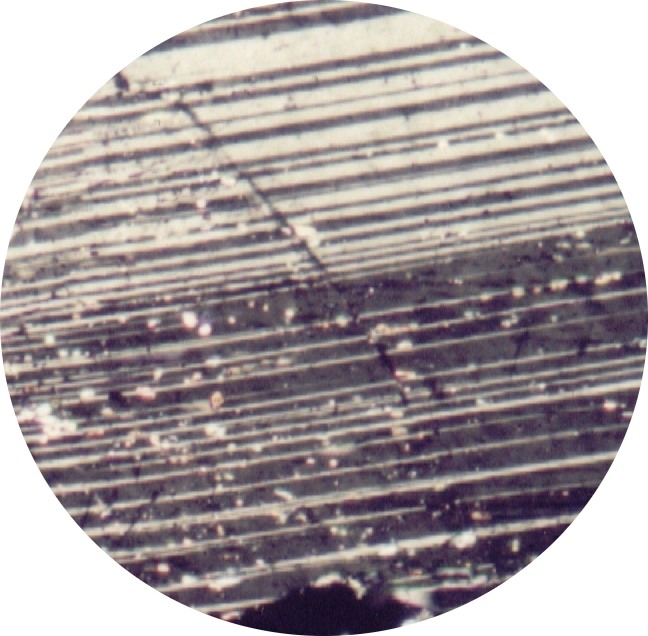


Other minerals that appear in photomicrographs as distractors: quartz (colorless, low relief, no cleavage, first-order gray/white, undulose extinction, rarely altered and with no visible twinning in thin section); olivine (high relief, no good cleavage, irregular fractures, bright second- to third-order colors, often altering along cracks); biotite (strong brown pleochroism, one cleavage, parallel "bird's-eye" speckled extinction); muscovite (colorless, one cleavage, bright second- to third-order colors); hornblende (green-brown pleochroic, 56°/124° cleavage).
Igneous textures under the microscope
| Texture | What you see in thin section | Example rock |
|---|---|---|
| Holocrystalline, equigranular | All crystals, interlocking, similar size; no glass | Granite, gabbro |
| Hypocrystalline | Crystals plus brown or clear glass | Many basalts and andesites |
| Holohyaline (glassy) | Isotropic glass (black in XPL) with flow lines, perhaps a few microlites or spherulites | Obsidian |
| Vesicular / pumiceous | Round or stretched holes (filled with mounting epoxy, often dyed blue) in glass or fine crystals; pumice has thin glass walls between bubbles | Pumice versus basalt: pumice is mostly holes and glass; basalt mostly crystals |
| Porphyritic | Large euhedral phenocrysts (olivine, plagioclase, augite, quartz, sanidine) in a fine or glassy groundmass | Andesite, porphyritic basalt |
| Ophitic / subophitic | Large augite crystals enclosing smaller plagioclase laths | Diabase (dolerite) |
| Poikilitic | Small grains of one mineral enclosed in a large crystal of another | Many gabbros and peridotites |
| Trachytic | Plagioclase or sanidine laths aligned by flow | Trachyte, some andesites |
| Graphic / perthitic | Quartz intergrown in K-feldspar like writing / albite stringers in K-feldspar | Pegmatite, granite |
| Zoned crystals | Concentric rings with different extinction positions in plagioclase | Andesite, diorite |
| Pyroclastic | Angular glass shards (cuspate, Y-shaped bubble-wall fragments), broken crystals, pumice and lithic fragments | Tuff, welded tuff (shards flattened) |


Sedimentary textures under the microscope
Clastic sedimentary rocks show discrete grains held by cement (calcite, silica, iron oxide) or a fine matrix, with pore space (often dyed blue) between them; igneous rocks show interlocking crystals with no pores. Read four things:
| Feature | What to look for | Interpretation |
|---|---|---|
| Rounding | Rounded grains versus angular grains | Rounded = long transport or reworking (beach, dune); angular = short transport, near source |
| Sorting | Grains all one size (well sorted) or a mix (poorly sorted) | Well sorted = steady winnowing by waves or wind; poorly sorted = rapid dumping (alluvial fan, turbidite, glacier) |
| Composition | Quartz (clear, no cleavage, no twins), feldspar (twinned, cloudy), rock fragments, matrix | Mineralogical maturity |
| Grain type | Ooids, skeletal fragments, peloids versus mineral grains | Chemical/biochemical carbonate versus clastic |
| Rock | Thin-section signature |
|---|---|
| Quartz sandstone (quartz arenite) | More than about 90% quartz grains, well rounded and well sorted, little or no matrix; silica cement may grow as overgrowths in optical continuity with the grains. The most mature sandstone |
| Arkose | At least about 25% feldspar: twinned plagioclase and tartan microcline grains, often cloudy; angular to subangular, moderately to poorly sorted; pink in hand sample. Short transport from a granitic source |
| Greywacke | Angular grains of quartz, feldspar and dark rock fragments in more than about 15% fine muddy matrix; poorly sorted |
| Oolitic limestone | Round ooids (0.25–2 mm) with concentric (and radial) layers of calcium carbonate around a nucleus, in sparry calcite cement; formed in warm, shallow, agitated seawater. In XPL, calcite shows high-order pastel colors |
| Fossiliferous limestone, coquina, chalk | Skeletal fragments (bioclasts): curved shell walls, crinoid plates that behave as single calcite crystals, foraminifera chambers; chalk is a fine mass of microscopic coccoliths |


Specimen checklist (A–Z)
Every specimen on the National List in alphabetical order, with its family, whether it is State and National only (*), whether the supervisor supplies identifying data (¹), and where to find its property line and photos. Print this page as the index of your binder.
ReferenceNational List checklist· 129 rows
Type a name, a family, * or ¹ in the filter box.
No rows match.
Mineral reference tables
These tables give one property line for every mineral on the National List, one table per chemical family: first the non-silicates in the order the list prints them, then the silicates, the quartz varieties, the rules-named minerals that are not on the ID list, the gem varieties and a single table of mineral look-alike pairs. At an identification station, start with luster: if the specimen is metallic, go straight to the "Metallic minerals at a glance" table (after the phosphates table), which is sorted by streak, the fastest way to narrow a metallic sample. For a nonmetallic sample, use hardness, cleavage and the special tests in the "Habit & diagnostic tests" column (acid, magnetism, fluorescence, heft) to pick between the few candidates left. Many written questions ask for a formula, an ore, a use or a locality, so read the last two columns as well as the physical properties. * = State/National only; ¹ = the supervisor supplies diagnostic information (see Supplied-information specimens (¹)).
Native elements
ReferenceNative elements: reference table· 6 rows
H = Mohs hardness; SG = specific gravity. Native metals are all isometric, heavy, malleable and lack cleavage. Gold, silver and copper share one structure (gold group): heavy atoms in cubic closest packing (face-centered cubic), which makes them dense and malleable.
No rows match.
| Mineral | Formula | Class & group | Crystal system | H | SG | Luster | Color | Streak | Cleavage / fracture | Habit & diagnostic tests | Forms in & notable localities | Uses, ores & gem varieties |
|---|---|---|---|---|---|---|---|---|---|---|---|---|
| Copper | Cu | Native element; metal (gold group) | Isometric | 2.5–3 | 8.9 | Metallic | Copper-red on fresh surface; tarnishes brown to black; green patina on weathering (mostly basic copper sulfates and carbonates) | Copper-red, shiny | none; hackly fracture | Dendritic, wiry, arborescent, sheets and nuggets, rare cubes/dodecahedra; malleable and ductile; dissolves in nitric acid (blue-green solution, brown fumes); no fizz in HCl; not magnetic | Oxidized zones of copper deposits; cavities and amygdules in basalt flows. Keweenaw Peninsula, Michigan; Ray and Bisbee, Arizona | Wire, electrical and plumbing; alloys brass (Cu–Zn) and bronze (Cu–Sn); minor ore of copper; name from Latin cuprum, "metal of Cyprus" |
| Diamond | C | Native element; nonmetal (carbon polymorph) | Isometric | 10 | 3.52 | Adamantine; greasy on rough crystals | Colorless, yellow, brown; rarely blue, pink, green | none (harder than streak plate) | Perfect octahedral, 4 directions; conchoidal fracture | Octahedra, often with curved faces and triangular pits (trigons); brittle despite H 10; very high refractive index (2.42) and dispersion ("fire"); many fluoresce blue under LW UV; excellent heat conductor; grease-loving (sticks to grease tables) | Crystallizes in the mantle (>150 km) and is carried up in kimberlite and lamproite pipes; also placers. Kimberley, South Africa; Jwaneng, Botswana; Mir pipe, Siberia. Most natural diamonds are 1 to 3.5 billion years old; nitrogen is their commonest impurity (yellow tint) | Gemstone; industrial abrasive, saw blades, drill bits, polishing powder; polymorph of graphite; name from Greek adamas, "unconquerable" |
| Gold | Au | Native element; metal (gold group) | Isometric | 2.5–3 | 19.3 (15–19.3 with Ag) | Metallic | Rich golden yellow, paler with silver; never tarnishes | Golden yellow, shiny | none; hackly fracture | Nuggets, flakes, grains, wires, dendrites, rare octahedra; very malleable, ductile and sectile (cuts with a knife); extremely heavy; insoluble in single acids but dissolves in aqua regia; not magnetic; unlike pyrite and chalcopyrite it dents instead of crumbling | Hydrothermal quartz veins; placers (streams); ancient placer conglomerates. Witwatersrand, South Africa; Mother Lode, California; Kalgoorlie, Western Australia | Monetary reserve, jewellery, electronics (corrosion-proof contacts), dentistry; ore of gold (much is "invisible" gold locked in pyrite and arsenopyrite, freed by roasting or oxidation); electrum = natural Au–Ag alloy (paler) |
| Graphite | C | Native element; nonmetal (carbon polymorph) | Hexagonal | 1–2 | 2.1–2.3 | Metallic to submetallic; dull when earthy | Black to steel-gray | Black to dark gray, shiny | Perfect basal, 1 direction; thin flakes flexible but not elastic | Foliated, scaly or earthy masses; rare hexagonal plates; greasy feel; marks paper and soils fingers; conducts electricity; very light for a metallic-looking mineral | Metamorphism of organic-rich sediments (graphitic schist, gneiss, marble); metamorphosed coal; veins. Borrowdale, England; Sri Lanka (vein graphite) | Pencil "lead" (with clay), dry lubricant, lithium-ion battery anodes, electrodes, crucibles and refractories, nuclear reactor moderator; name from Greek graphein, "to write" |
| Silver | Ag | Native element; metal (gold group) | Isometric | 2.5–3 | 10.5 (10.1–11.1) | Metallic | Silver-white; tarnishes gray to black | Silver-white, shiny | none; hackly fracture | Wires (often curled), dendrites, plates, scales; malleable and ductile; dissolves in nitric acid; black tarnish is diagnostic against platinum-like metals | Hydrothermal veins and the oxidized/enriched zone of silver deposits. Kongsberg, Norway (wire silver); Cobalt, Ontario; Keweenaw, Michigan (with copper) | Jewellery and silverware, electronics, solar cells, mirrors, photography (historic); ore of silver (most silver is a by-product of galena and copper ores) |
| Sulfur | S | Native element; nonmetal | Orthorhombic | 1.5–2.5 | 2.0–2.1 | Resinous to greasy; adamantine on crystal faces | Bright yellow; brownish or greenish with impurities | White to pale yellow | Poor; conchoidal to uneven fracture | Dipyramidal crystals, crusts, earthy masses; very brittle; low melting point (about 115 °C), burns with blue flame and choking SO₂ smell; poor heat conductor (crystals may crack from the warmth of a hand); insoluble in water | Volcanic fumaroles and crater deposits; caprock of salt domes (bacteria reduce gypsum/anhydrite); sedimentary beds. Agrigento, Sicily; Gulf Coast salt domes, Louisiana–Texas; Kawah Ijen, Indonesia | Sulfuric acid (main use), fertilizers, vulcanizing rubber, gunpowder, fungicides and matches; old name "brimstone" ("burning stone") |
Sulfides
ReferenceSulfides: reference table· 6 rows
* = State/National only; ¹ = supervisor supplies diagnostic information. All are brittle metallic minerals except sphalerite (usually resinous).
No rows match.
| Mineral | Formula | Class & group | Crystal system | H | SG | Luster | Color | Streak | Cleavage / fracture | Habit & diagnostic tests | Forms in & notable localities | Uses, ores & gem varieties |
|---|---|---|---|---|---|---|---|---|---|---|---|---|
| Bornite*¹ | Cu₅FeS₄ | Sulfide | Orthorhombic (pseudo-cubic; isometric above roughly 200–265 °C) | 3–3.25 | 5.06–5.09 | Metallic | Coppery red to bronze-brown on fresh surface; quickly tarnishes iridescent purple-blue ("peacock ore") | Grayish black | Poor to none; uneven to conchoidal fracture | Usually massive; rare rough cubes; iridescent purple tarnish is the key clue (but acid-treated chalcopyrite sold as "peacock ore" looks similar; check fresh color: bornite is coppery, chalcopyrite brassy) | Porphyry copper deposits, hydrothermal veins, supergene enrichment zones, mafic intrusions. Butte, Montana; Bristol, Connecticut; Dzhezkazgan, Kazakhstan | Important ore of copper; named after Austrian mineralogist Ignaz von Born |
| Chalcopyrite | CuFeS₂ | Sulfide | Tetragonal | 3.5–4 | 4.1–4.3 | Metallic | Brass-yellow, often with a greenish tint; iridescent tarnish | Greenish black | Poor; uneven fracture | Usually massive; crystals look like tetrahedra (disphenoids); brittle; a steel knife scratches it (pyrite is too hard); deeper yellow than pyrite | Hydrothermal veins, porphyry copper deposits, volcanogenic massive sulfides, magmatic Ni–Cu sulfides. Bingham Canyon, Utah; Chuquicamata, Chile; Cornwall, England | Most important ore of copper; name from Greek chalkos ("copper") + pyrite |
| Galena | PbS | Sulfide (galena group) | Isometric | 2.5–2.75 | 7.4–7.6 | Metallic (bright on fresh cleavage, dull gray when tarnished) | Lead-gray | Lead-gray | Perfect cubic, 3 directions at 90°; breaks into small cubes and stair-step faces | Cubes and cubo-octahedra, but most often massive or coarsely granular cleavable masses; very heavy; brittle; warm HCl slowly releases H₂S (rotten-egg smell); not magnetic | Hydrothermal veins and carbonate-hosted (Mississippi Valley-type) deposits. Tri-State district (Missouri–Kansas–Oklahoma); Viburnum Trend, Missouri; Broken Hill, Australia | Main ore of lead (batteries, radiation shielding); by-product silver (argentiferous galena); early crystal-radio detectors; ancient kohl eye make-up (lead-based kohl causes lead poisoning); name from Latin galena, "lead ore" |
| Pyrite | FeS₂ | Sulfide (pyrite group) | Isometric | 6–6.5 | 4.8–5.0 | Metallic | Pale brass-yellow | Greenish black to brownish black | Indistinct; conchoidal to uneven fracture | Cubes with fine striations (lines on adjacent faces run at right angles), pyritohedra, octahedra, framboids, concretions, flat radiating discs ("pyrite suns"); brittle; sparks against steel; sulfur smell when struck or heated; too hard for a knife; weathers to limonite pseudomorphs | Nearly every environment: hydrothermal veins, black shale and coal (sedimentary), metamorphic rocks. Navajún, Spain (perfect cubes); Huanzala, Peru; Elba, Italy | "Fool's gold", yet the most common host of "invisible" gold: refractory ores hold "invisible" gold in pyrite, released by roasting or oxidation; source of sulfur and sulfuric acid; not used as iron ore; name from Greek pyr, "fire" (sparks against steel) |
| Sphalerite | ZnS, usually (Zn,Fe)S | Sulfide (sphalerite group) | Isometric | 3.5–4 | 3.9–4.1 | Resinous to adamantine; submetallic when iron-rich and black | Yellow, honey-brown, red ("ruby jack"), black (iron-rich "blackjack"), green | White to pale yellow or light brown (much lighter than the specimen) | Perfect dodecahedral, 6 directions | Tetrahedral crystals, cleavable masses, botryoidal crusts; dissolves in HCl with H₂S (rotten-egg) smell; some fluoresce orange or yellow (e.g. Franklin, NJ); triboluminescent; very high dispersion (about 0.156, roughly three and a half times diamond's 0.044), so clear gem sphalerite shows more fire than diamond but is too soft to wear; name means "treacherous" (mistaken for galena) | Mississippi Valley-type carbonate-hosted deposits, hydrothermal veins, sedimentary exhalative deposits. Tri-State district; Elmwood, Tennessee; Picos de Europa, Spain (gemmy) | Main ore of zinc (galvanizing steel, brass, die-casting, batteries); by-product cadmium, gallium, germanium, indium |
| Stibnite* | Sb₂S₃ | Sulfide | Orthorhombic | 2 | 4.6–4.7 | Metallic, splendent on fresh faces | Lead-gray to steel-gray; tarnishes black or iridescent | Lead-gray to black | Perfect, 1 direction (lengthwise); subconchoidal fracture | Elongated prismatic to acicular or bladed crystals, striated lengthwise, often bent or twisted; radiating sprays; slightly sectile, slightly flexible; fuses easily (melts in a match or candle flame) | Low-temperature hydrothermal veins and hot-spring deposits. Ichinokawa mine, Japan; Xikuangshan, Hunan, China; Baia Sprie, Romania | Main ore of antimony (flame retardants, lead-acid battery and type-metal alloys); name from Latin stibium (source of the symbol Sb) |
Halides
ReferenceHalides: reference table· 2 rows
Halite is also the answer for the rock "Rock Salt (Halite)" on the list.
No rows match.
| Mineral | Formula | Class & group | Crystal system | H | SG | Luster | Color | Streak | Cleavage / fracture | Habit & diagnostic tests | Forms in & notable localities | Uses, ores & gem varieties |
|---|---|---|---|---|---|---|---|---|---|---|---|---|
| Fluorite | CaF₂ | Halide | Isometric | 4 (Mohs standard) | 3.18 | Vitreous | Purple, green, blue, yellow, colorless, pink; often color-zoned or banded (e.g. Blue John) | White | Perfect octahedral, 4 directions (cleaves into octahedra) | Cubes, octahedra, interpenetrating twins; fluorescence is named after it, typically blue to violet under LW (and often SW) UV; some varieties thermoluminescent or phosphorescent; brittle; no fizz in acid | Hydrothermal veins, Mississippi Valley-type deposits, granite pegmatites and greisens. Illinois–Kentucky Fluorspar District (Cave-in-Rock); Weardale, England; Castleton, Derbyshire (Blue John) | Flux in steelmaking and aluminum smelting ("fluor" = to flow); source of hydrofluoric acid (fluorochemicals, refrigerants, Teflon); optical lenses; ornamental carving |
| Halite | NaCl | Halide | Isometric | 2–2.5 | 2.17 | Vitreous | Colorless, white; also pink, orange, blue (radiation damage) | White | Perfect cubic, 3 directions at 90°; conchoidal fracture | Cubes, hopper (skeletal) crystals, granular masses; salty taste; dissolves in water; can draw in moisture from humid air and turn damp (hygroscopic, mostly from Mg and Ca chloride impurities); some fluoresce red to orange under SW UV (manganese or organic inclusions) | Evaporite deposits from seawater or salt lakes; salt domes; playas. Wieliczka, Poland; Searles Lake, California; Stassfurt, Germany | Table salt, road de-icing salt, chlor-alkali industry (chlorine, sodium hydroxide), food preservation, water softening; name from Greek hals, "salt"; historically a major traded commodity |
Oxides and hydroxides
ReferenceOxides and hydroxides: reference table· 7 rows
* = State/National only. "Trigonal" belongs to the hexagonal crystal family.
No rows match.
| Mineral | Formula | Class & group | Crystal system | H | SG | Luster | Color | Streak | Cleavage / fracture | Habit & diagnostic tests | Forms in & notable localities | Uses, ores & gem varieties |
|---|---|---|---|---|---|---|---|---|---|---|---|---|
| Corundum | Al₂O₃ | Oxide (hematite group) | Trigonal | 9 (Mohs standard) | 3.9–4.1 | Adamantine to vitreous | Gray, brown, blue (sapphire), red (ruby), also pink, yellow, colorless | White (harder than streak plate) | none; basal and rhombohedral parting; conchoidal to uneven fracture | Barrel-shaped hexagonal prisms and tapering dipyramids; striations on basal faces; heavy for a nonmetallic; star stones (asterism) from rutile needles; ruby fluoresces red under LW and SW UV (chromium) | Silica-poor metamorphic rocks (marble, aluminous schist), syenite and nepheline syenite pegmatites, placer gravels. Mogok, Myanmar (ruby); Sri Lanka (sapphire); Kashmir, India (sapphire) | Gem varieties ruby (red, Cr) and sapphire (all other colors, blue from Fe + Ti); abrasive (emery = corundum + magnetite/hematite); refractory (inert, melts above 2,000 °C: furnace linings, crucibles, alumina spark-plug insulators); synthetic corundum for watch crystals, jewel bearings, scratch-resistant phone and camera covers, and lasers; rutile "silk" marks a natural, unheated stone; name from Tamil kuruntam |
| Goethite/Limonite | Goethite α-FeO(OH); limonite FeO(OH)·nH₂O | Hydroxide (goethite is a defined species; limonite is a field name for poorly crystalline mixtures of hydrated iron oxides, mostly goethite) | Goethite orthorhombic; limonite amorphous (no crystal system) | Goethite 5–5.5; limonite 4–5.5 (earthy masses feel much softer) | Goethite 3.3–4.3; limonite 2.7–4.3 | Goethite adamantine to submetallic, silky when fibrous; limonite earthy to dull | Dark brown to black (goethite); yellow-brown to rusty brown (limonite) | Yellowish brown to brown (both) | Goethite perfect, 1 direction; limonite none, earthy or uneven fracture | Goethite: botryoidal or stalactitic with radiating fibrous interior, velvety needle crusts; limonite: earthy, ochreous, concretions, rusty pseudomorphs after pyrite; neither is magnetic until heated in a reducing flame, which turns them to magnetite | Weathering of iron minerals: oxidized zones and gossans ("iron hats"), bog iron, laterites. Lake Superior iron ranges; Pikes Peak, Colorado (goethite); Lostwithiel, Cornwall | Minor ore of iron; yellow ochre pigment; gossans guide prospectors to buried sulfide ore; goethite named after poet J. W. von Goethe |
| Hematite | Fe₂O₃ | Oxide (hematite group) | Trigonal | 5–6 | 5.0–5.3 | Metallic (specular) to dull/earthy | Steel-gray to black (specular, kidney ore); red to red-brown (earthy, oolitic) | Red to reddish brown ("cherry red") | none; uneven to subconchoidal fracture | Botryoidal/reniform ("kidney ore"), micaceous plates (specularite), rosettes ("iron roses"), oolitic, earthy, tabular crystals; red-brown streak is decisive whatever the color; not attracted by an ordinary magnet (at most very weakly by a strong one); becomes strongly magnetic after heating in a reducing flame (turns to magnetite) | Banded iron formations (Precambrian sedimentary; mostly 2.6–1.8 Ga, oldest about 3.8 Ga, a brief return about 0.75 Ga), hydrothermal veins, oxidation of magnetite, red beds. Mesabi Range, Minnesota; Hamersley Range, Western Australia; Cumbria, England (kidney ore) | Chief ore of iron (steel); red ochre pigment; jeweller's rouge (polishing); "hematine" jewellery beads are often synthetic; name from Greek haima, "blood" (red powder) |
| Magnetite | Fe₃O₄ (Fe²⁺Fe³⁺₂O₄) | Oxide (spinel group) | Isometric | 5.5–6.5 | 5.2 | Metallic to submetallic | Black | Black | none; octahedral parting; uneven to subconchoidal fracture | Octahedra, granular masses, black sand; strongly magnetic (attracts a magnet); lodestone is naturally magnetized and picks up iron filings | Accessory in igneous rocks (layered mafic intrusions), skarns, metamorphic rocks, banded iron formations, placer black sands. Kiruna, Sweden; Bushveld Complex, South Africa; Magnet Cove, Arkansas | Major ore of iron; lodestone used in early compasses; records Earth's magnetic field (paleomagnetism); heavy-media separation; name probably from Magnesia, an ancient Greek region |
| Pyrolusite* | MnO₂ | Oxide (rutile group) | Tetragonal | 6–6.5 (crystals); 2–6 in massive or sooty forms | 4.4–5.1 | Metallic to dull/earthy | Black to dark steel-gray | Black to bluish black | Perfect, 2 directions (prismatic) in crystals; uneven fracture | Fibrous or columnar radiating aggregates, earthy and sooty masses, botryoidal; dendrites on rock faces (black fern-like pseudofossils, usually mixed Mn oxides); soils fingers | Oxidation of manganese minerals; bog, lake and shallow-marine deposits; manganese nodules. Kalahari Manganese Field, South Africa; Ilfeld, Germany | Principal ore of manganese (steel alloys); dry-cell and alkaline batteries; decolorizing glass ("glassmaker's soap"); name from Greek "fire" + "wash" |
| Rutile* | TiO₂ | Oxide (rutile group) | Tetragonal | 6–6.5 | 4.2–4.3 | Adamantine to submetallic | Reddish brown, red, golden yellow, black | Pale brown to light yellowish brown | Good, prismatic; uneven to subconchoidal fracture | Striated prismatic crystals, hair-like needles (in rutilated quartz; silk and stars in ruby/sapphire), elbow (geniculate) twins, lattice-like networks (sagenite); very high refractive index | Accessory in high-grade metamorphic rocks and igneous rocks; pegmatites; quartz veins; heavy-mineral beach sands. Graves Mountain, Georgia; Minas Gerais, Brazil (in quartz); beach sands of Western Australia | Ore of titanium (with ilmenite): TiO₂ white pigment for paint, paper, plastics; titanium metal; welding-rod coatings; name from Latin rutilus, "reddish" |
| Zincite* | ZnO | Oxide (wurtzite group) | Hexagonal | 4 | 5.4–5.7 | Subadamantine to resinous | Deep red to orange-red, rarely yellow | Orange-yellow | Perfect basal, 1 direction; conchoidal fracture | Usually massive or granular grains in white calcite with black franklinite and green willemite; natural crystals rare; bright synthetic crystals (smelter by-products) are common; dissolves in HCl without fizzing | Metamorphosed zinc deposit in marble. Franklin and Sterling Hill, New Jersey (the only major locality) | Ore of zinc at Franklin; synthetic ZnO used in sunscreen, ointments, rubber, ceramics |
Carbonates and borates
ReferenceCarbonates and borates: reference table· 9 rows
* = State/National only; ¹ = supervisor supplies diagnostic information. Acid tests use cold dilute HCl unless stated.
No rows match.
| Mineral | Formula | Class & group | Crystal system | H | SG | Luster | Color | Streak | Cleavage / fracture | Habit & diagnostic tests | Forms in & notable localities | Uses, ores & gem varieties |
|---|---|---|---|---|---|---|---|---|---|---|---|---|
| Aragonite | CaCO₃ | Carbonate (aragonite group; polymorph of calcite) | Orthorhombic | 3.5–4 | 2.93–2.95 | Vitreous; resinous on fractures | Colorless, white, gray, yellow, also blue, green, violet | White | Distinct, 1 direction (poor overall); subconchoidal fracture | Acicular needle sprays, columnar crystals, pseudohexagonal twinned prisms ("sixlings"), coral-like branches (flos ferri), pisolites; fizzes in cold dilute HCl like calcite; often fluoresces under UV; converts to calcite when heated (about 400 °C) | Low-temperature settings: shells, corals and pearls (nacre), cave formations, hot springs; high-pressure metamorphism (blueschist). Molina de Aragón, Spain (twins); Tazouta, Morocco; Erzberg, Austria (flos ferri) | Mother-of-pearl, pearls, coral reefs; cement and lime; aquarium substrate; named after Aragon, Spain |
| Azurite | Cu₃(CO₃)₂(OH)₂ | Carbonate (with hydroxyl) | Monoclinic | 3.5–4 | 3.7–3.8 | Vitreous to adamantine; dull when earthy | Azure to deep blue | Light blue | Perfect, 1 direction, plus a fair one; conchoidal fracture; brittle | Prismatic or tabular crystals, rosettes, spherical nodules ("blueberries"), earthy crusts; fizzes in cold HCl; often intergrown with malachite (azurmalachite) and alters to malachite pseudomorphs | Oxidized zone of copper deposits. Bisbee, Arizona; Tsumeb, Namibia; Chessy, France ("chessylite") | Minor ore of copper; historic blue pigment; ornamental and collector specimens; name from Persian lazhward, "blue" |
| Calcite | CaCO₃ | Carbonate (calcite group) | Trigonal | 3 (Mohs standard) | 2.71 | Vitreous to pearly | Colorless, white; also yellow, orange, pink, green, blue, brown | White | Perfect rhombohedral, 3 directions not at 90° (about 75°/105°) | Scalenohedra ("dogtooth"), rhombs, flat "nailhead" crystals, stalactites, massive; fizzes vigorously in cold dilute HCl; strong double refraction in clear "Iceland spar"; many fluoresce (e.g. red under SW at Franklin, NJ) | Limestone and marble, cave deposits (travertine), hydrothermal veins, shells, carbonatites. Helgustaðir, Iceland (Iceland spar); Elmwood, Tennessee; Tri-State district (Joplin) | Cement and lime, building stone, agricultural lime, antacids, flux in steelmaking; polarizing prisms (Iceland spar); name from Latin calx, "lime" |
| Dolomite | CaMg(CO₃)₂ | Carbonate (dolomite group) | Trigonal | 3.5–4 | 2.84–2.86 | Vitreous to pearly | White, pink, gray, colorless, tan | White | Perfect rhombohedral, 3 directions | Curved "saddle-shaped" rhombs, granular masses; fizzes only weakly in cold HCl unless powdered, readily in warm acid; some fluoresce | Dolomitization of limestone by Mg-rich fluids, evaporitic tidal flats, hydrothermal veins; dolomitic marble. Dolomites, Italy; Eugui, Spain; Tri-State district (Joplin) | Rock dolostone for building stone and aggregate; magnesium source; refractories; agricultural lime; flux; named after French geologist Déodat de Dolomieu |
| Malachite | Cu₂CO₃(OH)₂ | Carbonate (with hydroxyl) | Monoclinic | 3.5–4 | 3.6–4.0 | Adamantine to vitreous; silky when fibrous; dull when earthy | Bright to dark green, in concentric light/dark bands | Light green | Perfect, 1 direction, rarely seen; uneven to splintery fracture | Botryoidal and stalactitic masses with concentric banding, fibrous aggregates, rare acicular crystals, pseudomorphs after azurite; fizzes in cold HCl | Oxidized zone of copper deposits. Katanga Copperbelt, DR Congo; Ural Mountains, Russia; Bisbee, Arizona | Ornamental and lapidary stone (banded cabochons, inlays); minor ore of copper; historic green pigment; name from Greek malache, "mallow" (leaf-green color); its copper-bearing dust is toxic, so wet-cut it and do not inhale or swallow it |
| Magnesite*¹ | MgCO₃ | Carbonate (calcite group) | Trigonal | 3.5–4.5 | 2.98–3.0 | Vitreous; dull and porcelain-like when massive | White, gray, yellowish, brown | White | Perfect rhombohedral (in crystals); massive form has conchoidal fracture | Usually massive, chalky or porcelain-like nodules with cauliflower-like surfaces; rare rhombs; fizzes only in warm HCl or when powdered | Alteration of serpentinite and other ultramafic rocks by CO₂-rich fluids; replacement of dolomite/limestone; evaporites. Brumado, Bahia, Brazil (crystals); Veitsch, Austria; Liaoning, China | Refractory bricks (as MgO); source of magnesium metal and compounds; often dyed to imitate turquoise |
| Rhodochrosite* | MnCO₃ | Carbonate (calcite group) | Trigonal | 3.5–4 | 3.5–3.7 | Vitreous to pearly | Rose-pink to raspberry red; banded pink and white in stalactitic material | White | Perfect rhombohedral, 3 directions | Rhombohedral crystals, banded stalactites and botryoidal crusts, massive; fizzes in warm HCl (weakly in cold); surfaces blacken as Mn oxides form | Hydrothermal silver–lead–zinc–copper veins; sedimentary manganese deposits. Sweet Home Mine, Colorado (first worked for silver, when miners discarded rhodochrosite as worthless); Capillitas, Argentina (banded "Inca rose"); N'Chwaning, South Africa | Ornamental and gem material (Colorado state mineral); minor ore of manganese; name from Greek "rose-colored" |
| Siderite* | FeCO₃ | Carbonate (calcite group) | Trigonal | 3.5–4.5 | 3.9–4.0 | Vitreous to pearly or silky | Tan, yellow-brown, brown, gray-green | White (may brown as it oxidizes) | Perfect rhombohedral, 3 directions | Curved saddle-shaped rhombs, botryoidal masses, concretions (clay ironstone); fizzes in warm HCl; weakly attracted by a strong magnet, strongly magnetic after heating (turns to magnetite); heavy for a carbonate; weathers to limonite | Sedimentary ironstone concretions (coal measures), hydrothermal veins, banded iron formations. Erzberg, Austria; Panasqueira, Portugal; Morro Velho, Brazil | Ore of iron (historically important); name from Greek sideros, "iron" |
| Ulexite | NaCaB₅O₆(OH)₆·5H₂O | Borate (listed separately on the official list) | Triclinic | 2–2.5 (fibrous aggregates seem softer) | 1.9–2.0 | Vitreous; silky or satiny in fibrous masses | White, colorless | White | Perfect, 1 direction; uneven fracture | Parallel-fiber veins that act as optical fibers: a cut slab projects the image underneath onto its top ("TV rock"); "cotton-ball" nodules; acicular crystals; very light | Evaporite deposits in desert playas and salt lakes, with borax. Boron (Kramer), California; Death Valley, California; Argentine and Chilean salars; Turkey | Source of boron: fiberglass insulation, borosilicate glass, detergents, fertilizers; named after chemist G. L. Ulex |
Sulfates
ReferenceSulfates: reference table· 6 rows
The three gypsum varieties share the parent row's formula, H, SG and streak; Rock Gypsum on the list is identified as gypsum.
No rows match.
| Mineral | Formula | Class & group | Crystal system | H | SG | Luster | Color | Streak | Cleavage / fracture | Habit & diagnostic tests | Forms in & notable localities | Uses, ores & gem varieties |
|---|---|---|---|---|---|---|---|---|---|---|---|---|
| Barite | BaSO₄ | Sulfate (barite group) | Orthorhombic | 3–3.5 | 4.3–4.5 | Vitreous to pearly | Colorless, white, gray, blue, yellow, brown; red-brown when sand-filled | White | Perfect basal plus good prismatic (3 directions); uneven fracture | Tabular and bladed crystals, crested aggregates, "barite roses" (sandy rosettes; Oklahoma state rock), concretions, massive; remarkably heavy for a light-colored mineral; green flame test (barium); does not fizz | Hydrothermal veins, Mississippi Valley-type deposits, sedimentary concretions and beds, hot springs. Norman, Oklahoma (roses); Cumbria, England; Elk Creek, South Dakota | Drilling mud weighting agent (main use); barium source; "barium meal" for X-ray imaging; paint and plastic filler; radiation shielding; name from Greek barys, "heavy" |
| Celestite (celestine) | SrSO₄ | Sulfate (barite group) | Orthorhombic | 3–3.5 | 3.95–4.0 | Vitreous to pearly | Pale sky-blue, colorless, white | White | Perfect basal plus good prismatic (3 directions); uneven fracture | Tabular to prismatic crystals, geodes lined with blue crystals, fibrous veins, nodules; crimson-red flame test (strontium); lighter than barite | Sedimentary: in limestone, dolostone and evaporites (with gypsum, anhydrite, sulfur). Sakoany, Madagascar (geodes); Sicily, Italy (with sulfur); Put-in-Bay, Ohio (Crystal Cave) | Main ore of strontium: red fireworks and flares, ferrite magnets, formerly TV-tube glass; name from Latin caelestis, "heavenly" (sky-blue) |
| Gypsum (parent) | CaSO₄·2H₂O | Sulfate (hydrated) | Monoclinic | 2 (Mohs standard) | 2.3 | Vitreous to pearly on cleavage; silky when fibrous; dull when massive | Colorless, white, gray, pink, tan | White | Perfect, 1 direction (plus 2 lesser); thin sheets flexible but not elastic | Scratched by a fingernail; tabular crystals, "swallowtail" twins, sandy desert roses, curved "ram's horn" growths; does not fizz in acid; some specimens fluoresce | Evaporites (marine, sabkha, salt lakes), caves, oxidized zones where sulfide-rich water meets limestone. Naica, Mexico (Cave of the Crystals); White Sands, New Mexico (dune sand); Permian Basin, USA | Drywall (wallboard) and plaster of Paris (heated gypsum); cement set retarder; soil conditioner and fertilizer; blackboard chalk; name from Greek gypsos, "plaster" |
| ↳ Alabaster (massive) | CaSO₄·2H₂O | Sulfate; gypsum variety | Monoclinic | 2 | 2.3 | Dull to sugary or subvitreous | White, cream, pink; translucent edges | White | Cleavage not visible; granular to uneven fracture | Fine-grained massive gypsum; easily scratched by a fingernail; feels warm; no fizz ("Egyptian alabaster" is really banded calcite, which fizzes) | Massive beds in evaporite sequences. Volterra, Tuscany, Italy; Fauld, Staffordshire, England | Carving, sculpture, translucent lamps and vases |
| ↳ Satin spar (fibrous) | CaSO₄·2H₂O | Sulfate; gypsum variety | Monoclinic | 2 | 2.3 | Silky | White, pink, orange | White | Splits along fibers; splintery | Parallel fibers set across veins; chatoyant sheen when polished; scratched by a fingernail; no fizz; no "TV" image (unlike ulexite) | Fracture-filling veins in mudstone and shale of evaporite sequences, e.g. Mercia Mudstone, England | Beads and carvings; often sold under the wrong name "selenite" (sticks, towers, lamps) |
| ↳ Selenite (crystalline) | CaSO₄·2H₂O | Sulfate; gypsum variety | Monoclinic | 2 | 2.3 | Vitreous to pearly | Colorless, transparent; may contain sand inclusions (hourglass patterns) | White | Perfect, 1 direction: peels into clear, flexible sheets | Transparent tabular or bladed crystals, swallowtail twins; giant crystals at Naica; scratched by a fingernail | Evaporites, caves, clay beds, salt plains. Naica, Mexico; Great Salt Plains, Oklahoma (hourglass selenite) | Display specimens; thin sheets used as window panes in Roman times; name from Greek selene, "moon" |
Phosphates
ReferencePhosphates: reference table· 4 rows
* = State/National only. Vanadinite is a vanadate, grouped with the phosphates (apatite group) on the official list.
No rows match.
| Mineral | Formula | Class & group | Crystal system | H | SG | Luster | Color | Streak | Cleavage / fracture | Habit & diagnostic tests | Forms in & notable localities | Uses, ores & gem varieties |
|---|---|---|---|---|---|---|---|---|---|---|---|---|
| Apatite group / Fluorapatite | Group Ca₅(PO₄)₃(F,Cl,OH); fluorapatite Ca₅(PO₄)₃F | Phosphate (apatite group; fluorapatite is the commonest member) | Hexagonal | 5 (Mohs standard) | 3.1–3.2 | Vitreous to subresinous | Green, blue-green, yellow, brown, purple, colorless | White | Poor basal; conchoidal to uneven fracture; brittle | Hexagonal prisms with flat or pyramidal ends, granular masses, sedimentary phosphorite; a steel knife just scratches it (H 5); some specimens fluoresce (e.g. yellow or orange) or are thermoluminescent; name from Greek "to deceive"; no fizz | Accessory mineral in almost all igneous rocks; pegmatites, carbonatites, metamorphic rocks; marine phosphorite beds; bones and teeth (hydroxylapatite). Cerro de Mercado, Durango, Mexico; Khibiny, Russia; phosphorite of Morocco and Florida | Phosphate rock (sedimentary apatite) is the essential, irreplaceable source of fertilizer phosphorus (the P in N-P-K) for phosphorus-deficient soils, and of phosphoric acid (main use); minor gemstone; tooth enamel and bone (hydroxylapatite; fluoride makes acid-resistant fluorapatite) |
| Pyromorphite* | Pb₅(PO₄)₃Cl | Phosphate (apatite group) | Hexagonal | 3.5–4 | 6.5–7.1 | Resinous to subadamantine | Green, yellow-green, yellow, brown, orange | White | Poor; uneven to subconchoidal fracture | Barrel-shaped hexagonal prisms, often hollow or cavernous at the ends; crusts and globular aggregates; very heavy for a nonmetallic; name means "fire form" (melted bead recrystallizes) | Oxidized zone of lead deposits (secondary after galena). Bunker Hill Mine, Idaho; Daoping, Guangxi, China; Les Farges, France | Minor ore of lead; collector specimens |
| Vanadinite* | Pb₅(VO₄)₃Cl | Vanadate (apatite group): lead chlorovanadate | Hexagonal | 2.5–4 | 6.8–7.1 | Resinous to subadamantine | Bright red, orange-red, brownish red, yellow | White to pale yellow | none; uneven to conchoidal fracture; brittle | Short, flat-topped hexagonal prisms (sometimes hollow), crusts; vivid red-orange color plus very high SG for a nonmetallic is decisive | Oxidized zone of lead deposits in arid regions. Mibladen, Morocco; Apache Mine and Old Yuma Mine, Arizona | Ore of vanadium (tough steel alloys; the Ti–6Al–4V titanium alloy of jet engines and airframes) and minor lead; collector specimens; named for its vanadium (after goddess Vanadís) |
| Turquoise* | CuAl₆(PO₄)₄(OH)₈·4H₂O | Phosphate (turquoise group) | Triclinic | 5–6 | 2.6–2.9 | Waxy to subvitreous; dull when porous | Sky-blue, blue-green, apple-green; often with brown/black "spiderweb" matrix veins | White to pale greenish blue | Perfect (rarely seen; crystals are tiny); conchoidal fracture | Cryptocrystalline massive nodules, veins and crusts; porous (absorbs oils and changes color; often stabilized); no fizz; dyed howlite or magnesite are common imitations | Secondary: meteoric water reacting with aluminous rocks near copper deposits in arid climates. Nishapur, Iran; Sinai, Egypt; Arizona and Nevada, USA | Gemstone and ornamental stone since antiquity; name from French for "Turkish" |
Metallic minerals at a glance
ReferenceMetallic minerals at a glance· 15 rows
Every metallic or submetallic mineral on the list, sorted by streak (dark to light). No silicate on the list is metallic. * = State/National only.
No rows match.
| Mineral | Streak | H | SG | One decisive test |
|---|---|---|---|---|
| Magnetite | Black | 5.5–6.5 | 5.2 | Strongly attracted to a magnet |
| Pyrolusite* | Black to bluish black | 2–6.5 (soft when sooty) | 4.4–5.1 | Soils fingers; fibrous or dendritic; not magnetic |
| Graphite | Black to dark gray | 1–2 | 2.1–2.3 | Greasy feel, marks paper, very light |
| Bornite* | Grayish black | 3–3.25 | 5.1 | Iridescent purple-blue tarnish over coppery fresh surface |
| Galena | Lead-gray | 2.5–2.75 | 7.4–7.6 | Perfect cubic cleavage, very heavy |
| Stibnite* | Lead-gray to black | 2 | 4.6–4.7 | Bladed, lengthwise-striated, often bent crystals; one cleavage |
| Chalcopyrite | Greenish black | 3.5–4 | 4.1–4.3 | Brassy and scratched by a knife |
| Pyrite | Greenish to brownish black | 6–6.5 | 4.8–5.0 | Brassy but not scratched by a knife; striated cubes |
| Hematite | Red to reddish brown | 5–6 | 5.0–5.3 | Red-brown streak from a gray or black specimen |
| Goethite/Limonite | Yellowish brown | 4–5.5 | 2.7–4.3 | Yellow-brown streak; rusty or fibrous botryoidal |
| Rutile* | Pale brown | 6–6.5 | 4.2–4.3 | Striated reddish prisms or needles; adamantine–submetallic |
| Sphalerite (dark, submetallic) | White to pale yellow-brown | 3.5–4 | 3.9–4.1 | Light streak from a dark specimen; 6 cleavages |
| Copper | Copper-red, shiny | 2.5–3 | 8.9 | Copper color, malleable, green or black tarnish |
| Gold | Golden yellow, shiny | 2.5–3 | 19.3 | Golden streak and malleable; enormous SG |
| Silver | Silver-white, shiny | 2.5–3 | 10.5 | Black tarnish; malleable wires |
Silicates: amphiboles to kyanite
ReferenceSilicates (amphibole group to kyanite): reference table· 16 rows
The silicate tables follow list order; the "Class & group" column starts with the silicate structure (neso-, soro-, cyclo-, ino-, phyllo-, tectosilicate) because that is the most common written silicate question. * = State/National only. H = Mohs hardness; SG = specific gravity; LW/SW = long-/short-wave UV; XPL = crossed polars (thin section).
No rows match.
| Mineral | Formula | Class & group | Crystal system | H | SG | Luster | Color | Streak | Cleavage / fracture | Habit & diagnostic tests | Forms in & notable localities | Uses, ores & gem varieties |
|---|---|---|---|---|---|---|---|---|---|---|---|---|
| Actinolite* | Ca₂(Mg,Fe²⁺)₅Si₈O₂₂(OH)₂ | Inosilicate, double chain; amphibole group (calcic amphibole; middle of tremolite–ferro-actinolite series) | Monoclinic | 5–6 | 3.0–3.2 | Vitreous; silky when fibrous | Bright to dark green (more Fe²⁺ = darker); gray-green | White | 2 perfect at ~56° and ~124°; uneven to splintery | Long prismatic to acicular crystals, bladed, radiating sprays, fibrous/asbestiform; diamond-shaped cross-section; greener than tremolite because of Fe | Greenschist-facies metabasalt (greenstone) with chlorite, epidote, albite; contact-metamorphosed dolomitic limestone. Chester, Vermont; Zillertal, Austria | Nephrite jade (tough felted mat of tremolite–actinolite fibers); fibrous form is a regulated asbestos; collector specimens; name from Greek aktis, "ray" (radiating crystals) |
| Hornblende | (Ca,Na)₂₋₃(Mg,Fe,Al)₅(Si,Al)₈O₂₂(OH)₂ (e.g. Ca₂(Mg,Fe)₄Al(Si₇Al)O₂₂(OH)₂) | Inosilicate, double chain; amphibole group (calcic; "hornblende" is now a root name: magnesio-/ferro-hornblende) | Monoclinic | 5–6 | 3.0–3.5 (rises with Fe) | Vitreous; silky sheen on cleavage | Black, dark green, dark brown | White to pale gray-green (lighter than specimen) | 2 perfect at ~56° and ~124°; uneven | Elongate prismatic crystals with 6-sided (diamond-like) cross-section, columnar, bladed, granular; cleavage angle is the key test against augite (~87°/93°); Bowen discontinuous series after pyroxene, before biotite | Intermediate igneous rocks (diorite, andesite), some granites; main mineral of amphibolite and hornblende schist. Bancroft, Ontario; Arendal, Norway | Little direct use; rock-forming mineral of "black granite" dimension stone and amphibolite; indicates intermediate magma or amphibolite facies; name from German Horn + blenden, "deceive" |
| Tremolite* | Ca₂Mg₅Si₈O₂₂(OH)₂ | Inosilicate, double chain; amphibole group (Mg end member of tremolite–actinolite series) | Monoclinic | 5–6 | 2.9–3.1 | Vitreous to silky | White, gray, colorless, pale green; lavender-pink (Mn-bearing "hexagonite") | White | 2 perfect at ~56° and ~124°; uneven to splintery | Long prismatic, bladed, fibrous/asbestiform, radiating; some specimens fluoresce (variable); paler than actinolite (little or no Fe) | Metamorphism of siliceous dolomite: 5 dolomite + 8 quartz + H₂O → tremolite + 3 calcite + 7 CO₂; marbles and skarns. At higher temperature it reacts with calcite and quartz to diopside (a pyroxene), so tremolite marks a lower grade than diopside. Balmat–Edwards, St. Lawrence Co., NY; Campolungo, Switzerland | Nephrite jade (with actinolite); fibrous tremolite is a carcinogenic asbestos and a contaminant in some talc and vermiculite deposits; named after Val Tremola, Switzerland |
| Apophyllite* | KCa₄Si₈O₂₀(F,OH)·8H₂O (fluorapophyllite-(K), the common species) | Phyllosilicate (sheets of 4- and 8-membered rings); apophyllite group | Tetragonal | 4.5–5 | 2.3–2.4 | Vitreous; pearly on basal face ("fish-eye stone") | Colorless, white, pale green, pink | White | 1 perfect basal; uneven fracture | Pseudo-cubic square prisms with pyramidal tips, tabular plates, druzy crusts; lines geodes and basalt vesicles with zeolites; flakes apart (exfoliates) when heated (name: Greek "away" + "leaf") | Low-temperature hydrothermal mineral in vesicles of basalt with stilbite, heulandite, calcite. Deccan Traps around Pune, Nashik and Jalgaon, India; Paterson, NJ; Nova Scotia | Collector specimens; rarely faceted (too soft and cleavable for wear) |
| Beryl | Be₃Al₂Si₆O₁₈ | Cyclosilicate (6-membered rings); beryl group | Hexagonal | 7.5–8 | 2.6–3.0 (usually ~2.7–2.8) | Vitreous | Colorless (goshenite), green, blue, yellow, pink, rarely red; color from trace ions (see gem table) | White | Imperfect basal; conchoidal to uneven | Long hexagonal prisms with flat basal (pinacoid) tops, lengthwise striations; giant crystals in pegmatite; flat top and H 7.5–8 separate it from quartz (pointed) and apatite (H 5) | Granitic pegmatites (late-stage Be-rich melt); emerald where Be fluids meet Cr/V-rich ultramafic rock or black shale. Muzo and Chivor, Colombia (emerald); Minas Gerais, Brazil (aquamarine); Black Hills, SD and Albany, Maine (giant crystals); Wah Wah Mtns, Utah (red beryl) | Ore of beryllium (light alloys, aerospace, X-ray windows); gems emerald, aquamarine, morganite, heliodor, goshenite, red beryl (bixbite) |
| Chrysocolla* | (Cu,Al)₂H₂Si₂O₅(OH)₄·nH₂O | Phyllosilicate (hydrated Cu silicate, poorly crystalline, often near-amorphous) | Orthorhombic (usually cryptocrystalline/amorphous) | 2–4 (to ~7 when silicified with chalcedony) | 1.9–2.4 | Vitreous, waxy or earthy/dull | Sky-blue, cyan, blue-green (Cu²⁺) | White to pale blue-green | none; conchoidal to uneven | Crusts, botryoidal, massive, stalactitic, earthy; sticks to the tongue (porous); low SG and softness separate it from turquoise (H 5–6); no fizz in HCl, unlike malachite and azurite | Secondary (supergene) mineral in oxidized zones of copper deposits with malachite, azurite, cuprite, mostly in arid regions. Globe–Miami, Ray and Bisbee, Arizona; Chile; Katanga, DR Congo; Eilat, Israel | Minor copper ore; cabochons and carvings; "gem silica" = chalcedony colored by chrysocolla; name from Greek "gold glue" (old use as solder) |
| Dioptase* | Cu₆Si₆O₁₈·6H₂O (traditionally CuSiO₃·H₂O) | Cyclosilicate (6-membered rings) | Trigonal | 5 | 3.3–3.4 | Vitreous to subadamantine | Intense emerald-green to blue-green (Cu²⁺) | Pale green | Perfect rhombohedral, 3 directions; conchoidal to uneven; brittle | Short six-sided prisms with rhombohedral tips, druzy crusts in vugs; told from emerald by lower H (5), perfect cleavage, green streak and deeper color | Oxidized zones of copper deposits in arid climates. Tsumeb, Namibia; Altyn-Tyube, Kazakhstan; Mindouli, Republic of Congo; Christmas mine, Arizona | Collector specimens; occasionally cut, but too soft and cleavable for jewellery; name from Greek "to see through" |
| Epidote | Ca₂Al₂(Fe³⁺,Al)(SiO₄)(Si₂O₇)O(OH) | Sorosilicate (has both Si₂O₇ pairs and SiO₄); epidote group | Monoclinic | 6–7 | 3.3–3.5 | Vitreous | Pistachio-green, yellow-green, green-black (Fe³⁺) | Grayish white | 1 perfect (parallel to the prism length), 1 imperfect; uneven | Prismatic crystals deeply striated along their length, columnar, radiating, granular crusts; strong pleochroism (green/brown/yellow); pistachio color is the field tell | Greenschist-facies metamorphism of mafic rocks (with chlorite, actinolite, albite); hydrothermal alteration of plagioclase; skarns. Knappenwand, Untersulzbachtal, Austria; Prince of Wales Island, Alaska; Pakistan | Indicator of low-grade metamorphism; unakite (granite altered to pink K-feldspar + green epidote + quartz) ornamental stone; collector specimens; name from Greek epidosis, "increase" |
| Albite | NaAlSi₃O₈ | Tectosilicate; feldspar group, plagioclase series (Na end member, An₀–₁₀) | Triclinic | 6–6.5 | 2.60–2.65 | Vitreous; pearly on cleavage | White, colorless, gray, bluish sheen (peristerite) | White | 2 good to perfect at ~94° (~86°); uneven to conchoidal | Tabular/platy crystals, "cleavelandite" = curved platy blades in pegmatites; polysynthetic albite twinning gives fine parallel striations on one cleavage face (plagioclase test); Carlsbad twins also; XPL: parallel black-and-white twin stripes | Granite, granitic pegmatite, spilite; greenschist-facies rocks; last (lowest-T) plagioclase on Bowen's continuous branch. Amelia Court House, Virginia (cleavelandite); Minas Gerais, Brazil; Swiss Alps (pericline) | Ceramic and glass flux (Na source); peristerite moonstone; Ab corner of the feldspar ternary diagram; name from Latin albus, "white"; plagioclase means "oblique break" (cleavages not quite 90°) |
| Labradorite | (Ca,Na)(Al,Si)₄O₈ (An₅₀–₇₀) | Tectosilicate; feldspar group, plagioclase series (calcic, An 50–70%) | Triclinic | 6–6.5 | 2.68–2.72 | Vitreous; pearly on cleavage | Gray, dark gray-blue to black; flashes of blue, green, gold, rarely full spectrum (labradorescence) | White | 2 good to perfect at ~94° (~86°); uneven to conchoidal | Cleavable masses, rarely crystals; labradorescence = schiller from light interference in microscopic exsolution lamellae, visible only at certain angles; albite-twin striations on cleavage; higher-T plagioclase than albite (crystallizes earlier in Bowen) | Mafic igneous rocks: gabbro, basalt, anorthosite. Nain and Paul's Island, Labrador; Ylämaa, Finland (spectrolite); Madagascar; Oregon (sunstone, with Cu platelets) | Gem and ornamental stone (cabochons, tiles, countertops); spectrolite; Oregon sunstone (Oregon state gem); named after Labrador, Canada |
| Amazonite | KAlSi₃O₈ | Tectosilicate; feldspar group, K-feldspar (green microcline) | Triclinic | 6–6.5 | 2.56–2.58 | Vitreous; pearly on cleavage | Bright green to blue-green; color linked to trace Pb and structural water, activated by natural irradiation; heating bleaches it | White | 2 perfect at ~90°; uneven | Blocky prismatic crystals; white streaks/patches of albite (perthite) across the green; Carlsbad and Baveno twins; XPL: tartan (cross-hatched) twinning of microcline | Granitic pegmatites and amazonite granites, often with smoky quartz. Pikes Peak batholith, Colorado; Ilmen Mtns, Russia; Minas Gerais, Brazil; Madagascar | Ornamental and gem (beads, cabochons); named after the Amazon River (not found there) |
| Orthoclase/Microcline | KAlSi₃O₈ | Tectosilicate; feldspar group, K-feldspar (alkali feldspar); polymorphs | Orthoclase monoclinic; microcline triclinic | 6 (Mohs index); microcline 6–6.5 | 2.55–2.63 | Vitreous; pearly on cleavage | Pink, salmon, flesh, tan, cream, white (pink/red from fine hematite) | White | 2 perfect at ~90° (orthoclase = "straight break"; microcline slightly off 90°); uneven to conchoidal | Blocky prisms, phenocrysts; Carlsbad penetration twins (common), Baveno and Manebach twins; perthite (wavy white albite lamellae) instead of straight plagioclase striations; XPL: microcline tartan twinning, orthoclase untwinned or simple twin | Felsic rocks: granite, syenite, rhyolite, pegmatite, gneiss; arkose sandstone; late (low-T) on Bowen's series. Pikes Peak, Colorado; Karlovy Vary (Carlsbad), Czech Republic; Baveno, Italy | Ceramics, porcelain and glaze, glass (Al and alkali source); mild abrasive in scouring powder; moonstone (adularescent orthoclase–albite); rules: pink/tan feldspar = "Orthoclase/Microcline" or "Potassium feldspar"; orthoclase means "straight break", microcline "small slope"; feldspar from German "field spar"; North Carolina (Spruce Pine) leads US feldspar production |
| Almandine | Fe₃Al₂(SiO₄)₃ | Nesosilicate; garnet group (pyralspite series, Fe²⁺–Al end member) | Isometric | 7–7.5 | 4.1–4.3 | Vitreous to resinous | Deep red, purplish red, brownish red to near-black (Fe²⁺) | White | none (parting possible); conchoidal to uneven | Dodecahedra (12 rhombic faces), trapezohedra (24 faces) or both; equant porphyroblasts in schist; weakly attracted to a strong (Nd) magnet; XPL: isotropic (stays black), high relief, no cleavage | Medium-grade regional metamorphism of shale (garnet zone): garnet schist, gneiss; some granites and pegmatites; placer sands. Wrangell (Stikine River), Alaska; Gore Mountain, NY; Emerald Creek, Idaho (star garnet); Roxbury, Connecticut | Abrasive (sandpaper, sandblasting, waterjet cutting); gem; index mineral; synthetic garnets such as YAG are not silicates; Mg²⁺ replaces Fe²⁺ toward pyrope; name from Alabanda, an ancient Anatolian city; "garnet" from Latin for pomegranate |
| Grossular (green) | Ca₃Al₂(SiO₄)₃ | Nesosilicate; garnet group (ugrandite series, Ca–Al end member) | Isometric | 6.5–7.5 | 3.4–3.7 (pure ~3.6) | Vitreous to resinous | Colorless when pure; green (V³⁺, Cr³⁺; tsavorite); also yellow, orange-brown (hessonite, Fe/Mn), pink | White | none; conchoidal to uneven | Dodecahedra and trapezohedra; massive (hydrogrossular "Transvaal jade"); lower SG than almandine; green color plus garnet shape separates it from olivine and epidote | Contact-metamorphosed impure limestone (skarn) and rodingite; tsavorite in graphitic gneiss of East Africa. Jeffrey mine, Asbestos, Quebec; Sierra de Cruces, Mexico; Tsavo, Kenya; Merelani, Tanzania | Gems tsavorite (green) and hessonite (orange "cinnamon stone"); collector specimens; name from Latin grossularia, "gooseberry" (pale green) |
| Kaolinite | Al₂Si₂O₅(OH)₄ | Phyllosilicate, 1:1 (T-O) clay; kaolinite–serpentine group | Triclinic | 2–2.5 | 2.6–2.7 | Earthy/dull; pearly in crystal plates | White, cream, gray; tinted yellow, red by iron | White | Perfect basal (only microscopic); earthy, uneven fracture | Massive, earthy, chalky clay; microscopic pseudo-hexagonal plates and "books"; earthy smell when breathed on or wet; plastic when wet; sticks to tongue; no fizz in HCl (unlike chalk) | Chemical weathering (hydrolysis) of feldspar in warm humid climates (tropical and rainforest soils, laterites); hydrothermal alteration of granite. (Illite, a K-bearing mica-like clay off the list, is the commonest clay in marine and lake shales.) Jingdezhen, China; Cornwall, England (china clay); Georgia, USA | Porcelain, china and ceramics; coating and filler in glossy paper; paint, rubber, cosmetics; formerly in anti-diarrhea medicine (kaolin); name from Gaoling ("high ridge"), a Chinese village |
| Kyanite | Al₂SiO₅ | Nesosilicate; Al₂SiO₅ polymorph group (with andalusite, sillimanite) | Triclinic | 4.5–5 along the blade; 6.5–7 across | 3.5–3.7 | Vitreous; pearly on cleavage | Blue, often patchy (darker in center; Fe–Ti charge transfer); also white, gray, green, black | White | 1 perfect, 1 good, plus parting; splintery | Long flat bladed crystals, single or in radiating sprays; directional hardness is diagnostic: a steel knife scratches it along the blade length (H 4.5–5) but not across it (H 6.5–7), because bonds differ in strength along the two directions; blue color plus blades separates it from sillimanite | Medium-to-high grade, high-pressure regional metamorphism of aluminous shale (kyanite zone): schist, gneiss, quartz veins. Pizzo Forno, Switzerland; Minas Gerais, Brazil; Willis Mountain, Virginia (major producer); Nepal | Refractories (firebrick, kiln furniture, spark-plug porcelain; turns to mullite and expands when fired); gem cabochons; index mineral for high pressure; name from Greek kyanos, "dark blue" |
Silicates: micas to zircon
ReferenceSilicates (mica group to zircon): reference table· 17 rows
- = State/National only. H = Mohs hardness; SG = specific gravity; LW/SW = long-/short-wave UV; XPL = crossed polars (thin section).
No rows match.
| Mineral | Formula | Class & group | Crystal system | H | SG | Luster | Color | Streak | Cleavage / fracture | Habit & diagnostic tests | Forms in & notable localities | Uses, ores & gem varieties |
|---|---|---|---|---|---|---|---|---|---|---|---|---|
| Biotite | K(Mg,Fe)₃AlSi₃O₁₀(OH,F)₂ | Phyllosilicate, 2:1 (T-O-T); mica group (trioctahedral; series annite–phlogopite) | Monoclinic | 2.5–3 | 2.7–3.3 | Vitreous to pearly; submetallic on fresh cleavage | Black, dark brown, dark green | White to gray | 1 perfect basal; thin flexible, elastic sheets | Micaceous "books" of pseudo-hexagonal plates; flakes in rocks; peels into elastic sheets; dark color separates it from muscovite; weathered flakes look golden (mistaken for gold) | Granite, granodiorite, diorite, rhyolite, pegmatite; schist and gneiss (biotite zone); last mafic mineral on Bowen's discontinuous branch. Bancroft, Ontario; Mt Vesuvius, Italy | K–Ar and Ar–Ar dating; alters to vermiculite (horticulture, insulation); index mineral; poorer electrical insulator than muscovite (iron content), so little used as one; named after French physicist J.-B. Biot |
| Lepidolite* | K(Li,Al)₃(Si,Al)₄O₁₀(F,OH)₂ | Phyllosilicate, 2:1; mica group (Li mica; series trilithionite–polylithionite) | Monoclinic | 2.5–3 (to 4) | 2.8–2.9 | Pearly to vitreous | Lilac, pink, purple (Mn), also gray, colorless | White | 1 perfect basal; flexible, elastic flakes | Fine scaly/granular masses, small micaceous books and rosettes; crimson lithium flame; lilac color plus mica cleavage is diagnostic (name from Greek "scale") | Lithium-rich granitic pegmatites with pink elbaite (rubellite), spodumene, amblygonite, albite, quartz. Pala, California; Black Hills, SD; Tanco mine, Manitoba; Minas Gerais, Brazil | Ore of lithium, rubidium and caesium; ornamental (carvings, tumbled stones) |
| Muscovite | KAl₂(AlSi₃O₁₀)(OH)₂ | Phyllosilicate, 2:1; mica group (dioctahedral, K–Al white mica) | Monoclinic | 2–2.5 on cleavage (to ~4 across) | 2.8–2.9 | Vitreous to pearly or silky | Colorless, silvery white, pale brown, pale green (Cr-rich fuchsite emerald-green) | White | 1 perfect basal; thin transparent, flexible, elastic sheets | Large micaceous "books" with pseudo-hexagonal outline; fine silky sericite; splits into clear sheets; pale color vs biotite; resists weathering (detrital flakes in sandstone) | Granite, pegmatite (books up to meters), schist, phyllite, gneiss; late on Bowen's series (just before quartz); breaks down at sillimanite grade. Spruce Pine, North Carolina; Bihar and Andhra Pradesh, India; Minas Gerais, Brazil | Electrical insulators and capacitor dielectric, heater-element supports; stove and furnace windows ("isinglass"); joint compound, paint, roofing, cosmetic shimmer; fuchsite colors green aventurine; K–Ar dating; name from "Muscovy glass" (Russian window mica) |
| Olivine | (Mg,Fe)₂SiO₄ | Nesosilicate; olivine group (forsterite Mg₂SiO₄–fayalite Fe₂SiO₄ solid solution) | Orthorhombic | 6.5–7 | 3.2–4.4 (forsterite 3.2 → fayalite 4.4; common 3.3–3.4) | Vitreous | Olive green, yellow-green (Fe²⁺); brown when Fe-rich or weathered | White | Poor/indistinct; conchoidal fracture | Granular sugary masses, equant grains in basalt, mantle xenolith "nodules"; rarely crystals; first to crystallize on Bowen's series and first to weather; never with quartz in igneous rock; alters to serpentine and iddingsite | Mafic and ultramafic igneous rocks (basalt, gabbro, peridotite, dunite); dominant upper-mantle mineral; pallasite meteorites. San Carlos, Arizona; Zabargad (St John's) Island, Egypt; Papakōlea green-sand beach, Hawaii; Myanmar; Pakistan | Gem peridot; foundry and refractory sand; steel-slag conditioner; studied for CO₂ capture by weathering; named for its olive-green color |
| Prehnite* | Ca₂Al(AlSi₃O₁₀)(OH)₂ | Phyllosilicate (structure transitional between sheet and chain silicates); prehnite group | Orthorhombic | 6–6.5 | 2.8–2.95 | Vitreous to pearly | Pale green, yellow-green (Fe³⁺), gray, white | White | Good basal; uneven | Botryoidal to globular crusts, rounded "bow-tie" or fan-shaped aggregates of tabular crystals; often with dark epidote needles inside; translucent apple-green with pearly surface | Low-temperature hydrothermal mineral in basalt cavities with zeolites; prehnite–pumpellyite facies metamorphism. Paterson, NJ; Lake Superior copper district; Kayes region, Mali; Cradock, South Africa | Cabochons and beads; collector specimens; named after Hendrik von Prehn |
| Augite | (Ca,Na)(Mg,Fe,Al,Ti)(Si,Al)₂O₆ | Inosilicate, single chain; pyroxene group (clinopyroxene) | Monoclinic | 5.5–6 | 3.2–3.6 | Vitreous to dull | Black, dark green, dark brown | Greenish gray to white | 2 good at ~87° and ~93°; uneven to conchoidal | Short stubby prisms with nearly square, 8-sided cross-sections; granular; phenocrysts in basalt; XPL: high relief, two ~90° cleavages in end sections, inclined extinction (~35–48°), second-order colors, simple twins | Mafic igneous rocks (basalt, gabbro, diabase), some andesite and peridotite; high-grade granulite. Second on Bowen's discontinuous series. Mt Vesuvius and Etna, Italy; Eifel, Germany | Rock-forming only (part of basalt aggregate and "black granite"); thin-section mineral named in the rules; name from Greek auge, "lustre" |
| Rhodonite* | (Mn²⁺,Fe,Mg,Ca)SiO₃ (≈ MnSiO₃) | Inosilicate, single chain (pyroxenoid, 5-tetrahedron repeat); rhodonite group | Triclinic | 5.5–6.5 | 3.5–3.8 | Vitreous; pearly on cleavage | Rose-pink to red (Mn²⁺), commonly with black veins and dendrites of Mn oxide | White | 2 perfect near 90° (~92.5°/87.5°); conchoidal to uneven; tough in masses | Massive, granular, rare tabular crystals; black veining is the classic look; scratches glass and does not fizz (vs rhodochrosite, H 3.5–4, fizzes, white banding) | Metamorphosed Mn-rich sediments, skarns, hydrothermal veins. Broken Hill, New South Wales; Franklin, NJ; Ural Mountains, Russia; Massachusetts (state gem) | Ornamental (carvings, beads, cabochons); minor manganese ore; name from Greek rhodon, "rose" |
| Spodumene* | LiAlSi₂O₆ | Inosilicate, single chain; pyroxene group (clinopyroxene) | Monoclinic | 6.5–7 | 3.0–3.2 | Vitreous; pearly on cleavage | Grayish white, colorless, pink-lilac (kunzite, Mn), green (hiddenite, Cr), yellow | White | 2 perfect at ~87°/93°, plus parting; splintery to uneven | Flattened lath-like prisms striated lengthwise, can be giant (12+ m logs, Etta mine); strong pleochroism (kunzite); kunzite fluoresces and phosphoresces pink-orange and fades in sunlight; crimson lithium flame | Lithium-rich granitic pegmatites with lepidolite, elbaite, amblygonite, albite, quartz. Etta mine, Keystone, SD; Pala, California (kunzite); Hiddenite and Kings Mountain, NC; Greenbushes, Western Australia; Nuristan, Afghanistan | Major ore of lithium (Li-ion batteries, glass-ceramics, greases); gems kunzite and hiddenite; name from Greek for "ash-colored" |
| Sodalite | Na₈(Al₆Si₆O₂₄)Cl₂ | Tectosilicate; feldspathoid (sodalite group) | Isometric | 5.5–6 | 2.27–2.33 | Vitreous to greasy | Royal blue to violet-blue, often with white veins; also gray, white (blue from color centers) | White to very pale blue | Poor dodecahedral (6 directions); conchoidal to uneven | Massive granular, rare dodecahedra; often fluoresces orange under LW UV; hackmanite variety is tenebrescent (darkens to pink/violet under UV, then fades); low SG and white streak separate it from lapis lazuli (blue streak, pyrite flecks) and azurite (blue streak, fizzes, SG 3.8) | Silica-poor (undersaturated) igneous rocks, mainly nepheline syenite; never with primary quartz. Bancroft, Ontario ("Princess Blue"); Ice River, British Columbia; Litchfield, Maine; Bahia, Brazil; Namibia | Ornamental stone (carvings, beads, cabochons, tiles); named for its sodium |
| Staurolite | Fe²⁺₂Al₉Si₄O₂₃(OH) | Nesosilicate; staurolite group | Monoclinic (pseudo-orthorhombic) | 7–7.5 | 3.7–3.8 | Vitreous to resinous; dull on rough crystals | Reddish brown to dark brown, yellow-brown, black | White to grayish | Distinct, 1 direction (prismatic); subconchoidal to uneven | Stubby 6-sided prisms; cruciform penetration twins at ~60° ("St Andrew's cross", more common) and ~90° (Greek cross); rough-surfaced porphyroblasts in mica schist | Medium-grade regional metamorphism of aluminous shale (staurolite zone): mica schist with garnet and kyanite; survives in placers. Fannin Co., Georgia (state mineral); Patrick Co., Virginia (Fairy Stone State Park); Taos, New Mexico; Brittany, France | "Fairy cross" charms; minor sandblasting abrasive; index mineral for medium grade; name from Greek stauros, "cross" |
| Stilbite* | NaCa₄(Si₂₇Al₉)O₇₂·28H₂O (stilbite-Ca) | Tectosilicate; zeolite group | Monoclinic | 3.5–4 | 2.1–2.2 | Vitreous; pearly on cleavage | White, cream, peach, salmon-pink, orange | White | 1 perfect (pearly cleavage face); uneven; brittle | Sheaf-like "bow-tie" or wheat-sheaf aggregates of thin tabular crystals, radiating balls; lines cavities with apophyllite and other zeolites; low SG | Low-temperature hydrothermal deposition in basalt vesicles and cavities. Deccan Traps (Pune, Nashik), India; Bay of Fundy, Nova Scotia (provincial mineral); Teigarhorn, Iceland; Paterson, NJ | Collector specimens; zeolites as a group are used as molecular sieves and ion exchangers (stilbite itself has little commercial use); name from Greek stilbein, "to shine" (pearly lustre) |
| Talc | Mg₃Si₄O₁₀(OH)₂ | Phyllosilicate, 2:1 (T-O-T); talc–pyrophyllite group | Monoclinic or triclinic (polytypes) | 1 (Mohs index) | 2.6–2.8 | Pearly to greasy/waxy; dull in masses | White, gray, pale green, brownish | White | 1 perfect basal; flexible but inelastic flakes; uneven in masses | Foliated, micaceous, massive (steatite/soapstone), fibrous; soapy/greasy feel; scratched by fingernail; flakes bend and stay bent (mica springs back) | Metamorphism and hydrothermal alteration of ultramafic rocks (serpentinite → talc + carbonate) and of siliceous dolomite; talc schist, soapstone. Johnson, Vermont; Schuyler, Virginia (soapstone); Gouverneur, NY; Trimouns (Luzenac), France | Talcum and cosmetic powder; paper, paint and plastic filler; ceramics and steatite insulators; soapstone carvings, countertops, tailor's chalk; name from Arabic/Persian talq |
| Topaz | Al₂SiO₄(F,OH)₂ | Nesosilicate; topaz group | Orthorhombic | 8 (Mohs index) | 3.4–3.6 | Vitreous | Colorless, pale blue, yellow, golden-brown, sherry, pink, orange (imperial, Cr³⁺) | White | 1 perfect basal (across the prism); subconchoidal to uneven | Prismatic crystals with lozenge (diamond) cross-section, lengthwise striations, wedge or pyramidal tips; basal cleavage cuts across the prism; scratches quartz; heavier than quartz and citrine of same size | Granitic pegmatites, gas cavities in rhyolite, greisen and high-T hydrothermal veins; placers. Ouro Preto, Minas Gerais (imperial); Thomas Range, Utah (state gem); Pikes Peak, Colorado; Ural Mountains; Katlang, Pakistan (pink) | Gem; blue topaz is irradiated and heated colorless topaz (Texas state gem: blue topaz); Mohs standard for 8 |
| Tourmaline | XY₃Z₆(T₆O₁₈)(BO₃)₃V₃W; schorl NaFe²⁺₃Al₆(Si₆O₁₈)(BO₃)₃(OH)₄; elbaite Na(Li₁.₅Al₁.₅)Al₆(Si₆O₁₈)(BO₃)₃(OH)₄; dravite NaMg₃Al₆(Si₆O₁₈)(BO₃)₃(OH)₄ | Cyclosilicate (6-membered rings; borosilicate); tourmaline group (list accepts "tourmaline") | Trigonal | 7–7.5 | 2.9–3.3 | Vitreous to resinous | Black (schorl, Fe), brown (dravite, Mg), every color in elbaite; color zoning (watermelon: pink core, green rind) | White (schorl may be grayish) | Indistinct; uneven to conchoidal | Long prisms with rounded triangular cross-section and deep lengthwise striations; different terminations at each end; radiating sprays and "suns", acicular; piezoelectric and pyroelectric (heated crystal attracts dust); strong pleochroism (darkest along c-axis); schorl weakly magnetic | Granitic pegmatites (elbaite), granites, schists and gneisses (dravite, schorl), hydrothermal veins. Minas Gerais, Brazil (widest color range); Paraíba, Brazil (Cu blue); Pala, California; Mount Mica, Maine (state mineral); Madagascar; Afghanistan | Gem: rubellite, indicolite, verdelite, watermelon, Paraíba; piezoelectric pressure gauges (historic); collector specimens; name from Sinhalese turamali, "mixed gems" |
| Willemite* | Zn₂SiO₄ | Nesosilicate; phenakite group | Trigonal | 5.5 | 3.9–4.2 | Vitreous to resinous | White, colorless, green, yellow-green, brown, red-brown | White | Poor basal and prismatic; uneven to conchoidal | Massive granular, short hexagonal prisms (troostite), fibrous radiating, botryoidal; brilliant green fluorescence under SW UV, often also LW (Mn²⁺ activator), often phosphorescent; at Franklin with red-fluorescing calcite and black non-fluorescent franklinite | Metamorphosed zinc ore bodies; oxidized zones of zinc deposits. Franklin and Sterling Hill, NJ; Tsumeb, Namibia; La Calamine (Moresnet), Belgium (type locality) | Zinc ore (historically at Franklin); synthetic Mn-doped Zn₂SiO₄ was a green phosphor in early CRT and fluorescent lamps; named after King Willem I of the Netherlands |
| Wollastonite* | CaSiO₃ | Inosilicate, single chain (pyroxenoid, 3-tetrahedron repeat); wollastonite group | Triclinic | 4.5–5 | 2.8–3.1 | Vitreous; silky or pearly on cleavage | White, gray, cream, colorless, pale green | White | 1 perfect plus 2 good (at about 84°), all parallel to the fiber length; splintery to uneven | Fibrous, bladed, radiating masses, acicular; some specimens fluoresce (yellow-orange, variable); splintery white blades, softer than tremolite (H 5–6) | Contact metamorphism of siliceous limestone (skarn): CaCO₃ + SiO₂ → CaSiO₃ + CO₂ (at high T); carbonatites. Willsboro and Lewis, Adirondacks, NY; Crestmore, California; Franklin, NJ; China, India (major producers) | Ceramics (tiles, glazes; low shrinkage, fast firing); asbestos substitute (brake linings, fire boards); filler in plastics and paint; metallurgical flux; named after W. H. Wollaston |
| Zircon* | ZrSiO₄ | Nesosilicate; zircon group | Tetragonal | 7.5 (6–7.5 if metamict) | 4.6–4.7 (metamict down to ~3.9) | Adamantine to vitreous; greasy when metamict | Brown, red-brown, yellow, colorless, green; blue and golden gems are heat-treated | White | Indistinct; conchoidal to uneven; brittle | Short square prisms with pyramids (dipyramidal), often doubly terminated; tiny grains in granite and detrital sand; high dispersion ("fire") and strong double refraction (doubled back facets); weakly radioactive (U, Th replace Zr) → radiation damage makes it metamict (lower SG, H; the lattice gradually becomes amorphous); zircon grains enclosed in biotite are ringed by dark pleochroic haloes of radiation damage; many fluoresce yellow under SW UV; heavy for a gem | Accessory mineral in granite, syenite, nepheline-syenite pegmatite, gneiss; resists weathering → heavy-mineral beach and placer sands. Jack Hills, Western Australia (oldest grains, 4.4 Ga); Ratanakiri, Cambodia; Sri Lanka; Myanmar; Bancroft, Ontario | Ore of zirconium (nuclear fuel cladding, zirconia ceramics, refractories, foundry sand) and hafnium; U–Pb dating (takes U, excludes Pb); gem; not to be confused with synthetic cubic zirconia (ZrO₂); name from Persian zargun, "gold-colored" |
Quartz varieties
ReferenceQuartz varieties: reference table· 11 rows
- = State/National only. All quartz varieties are SiO₂, H ≈ 7, white streak and no cleavage; the Color column gives the cause of each variety's color. Opal is not crystalline quartz but is filed with the quartz varieties on the list.
Macrocrystalline vs microcrystalline. Macrocrystalline quartz grows as crystals or grains big enough to see: rock crystal, amethyst, citrine, smoky quartz, milky quartz, rose quartz (massive, but made of coarse quartz) and aventurine (a rock of visible quartz grains). Microcrystalline (cryptocrystalline) quartz is built of crystals or fibers too small to see without a microscope, so it is translucent to opaque and waxy to dull, never shows prism faces, and breaks with a smooth conchoidal surface: agate/chalcedony (with onyx and carnelian), jasper, and the rocks chert and flint. Tiger's eye, fibrous quartz intergrown with (traditionally said to replace) crocidolite asbestos fibers, is placed in either group depending on the source. Opal is neither: it is amorphous.
No rows match.
| Mineral | Formula | Class & group | Crystal system | H | SG | Luster | Color | Streak | Cleavage / fracture | Habit & diagnostic tests | Forms in & notable localities | Uses, ores & gem varieties |
|---|---|---|---|---|---|---|---|---|---|---|---|---|
| Aventurine | SiO₂ (+ platy inclusions) | Tectosilicate; quartz (silica) group; strictly a quartzite or quartz rock with inclusions | Trigonal (quartz grains) | 6.5–7 | 2.64–2.69 | Vitreous to waxy; glittering | Green from Cr-mica fuchsite platelets; red-brown/orange from hematite or goethite platelets; blue from dumortierite; the reflecting platelets give aventurescence (glitter) | White | none; conchoidal to uneven (granular) | Massive, granular; glittering spangles that flash as the stone is turned (aventurescence); no cleavage and H 7 separate it from amazonite and jade | Metamorphic quartzites and quartz rock with mica or hematite. Mysore and Bellary, India (most green aventurine); Brazil; Russia | Beads, carvings, tumbled stones, cabochons; man-made "goldstone" glass imitates it |
| Agate/Chalcedony | SiO₂ | Tectosilicate; quartz (silica) group; microcrystalline (cryptocrystalline) quartz, often with moganite | Trigonal (microscopic fibers) | 6.5–7 | 2.58–2.64 | Waxy to vitreous; dull on rough surfaces | Color from microcrystalline fibrous structure scattering light (bluish-white); trace Fe oxides give red-orange carnelian, Ni gives green chrysoprase; agate = banded from rhythmic layers of silica gel; onyx = straight black-and-white bands | White | none; conchoidal to splintery | Botryoidal, mammillary, stalactitic, nodules; concentric or "fortification" banding in geodes, thundereggs and amygdules (geodic); moss agate has dendritic inclusions; translucent, waxy | Low-temperature silica from groundwater filling cavities in volcanic rocks (basalt vesicles, rhyolite) and in sediments. Hard, tough and inert, agates outlast their host rock, so weathered-out nodules travel far in rivers and glacial drift (Lake Superior agates turn up across the Midwest). Lake Superior (Minnesota state gem); Rio Grande do Sul, Brazil; Artigas, Uruguay; Botswana; Oregon thundereggs | Ornaments, beads, cameos (onyx, sardonyx), mortars and pestles, balance bearings; often dyed; Idar-Oberstein, Germany cutting center; agate named after the Achates River, Sicily; chalcedony after Chalcedon, an ancient town; bloodstone (heliotrope) is dark green chalcedony with red spots of jasper or iron oxide |
| Amethyst | SiO₂ | Tectosilicate; quartz (silica) group | Trigonal | 7 | 2.65 | Vitreous | Purple to violet: Fe³⁺ replacing Si plus natural gamma irradiation creates Fe⁴⁺ color centers; heating to ~400–500 °C destroys them and turns it yellow-orange (most commercial citrine) or rarely green (prasiolite); can fade in strong sunlight | White | none; conchoidal (rippled fracture from twinning) | Short hexagonal prisms or just rhombohedral points lining geodes; druzy; color zoning concentrated in the tips (phantoms); Brazil-law twinning common; piezoelectric | Geodes in basalt flows; hydrothermal veins. Rio Grande do Sul, Brazil; Artigas, Uruguay; Thunder Bay, Ontario (provincial mineral); Four Peaks, Arizona; Zambia | Gem, traditionally the most valuable quartz; decorative geodes; heated to make citrine; name from Greek "not drunk" |
| Citrine | SiO₂ | Tectosilicate; quartz (silica) group | Trigonal | 7 | 2.65 | Vitreous | Pale yellow to orange-brown; cause debated: trace iron (Fe³⁺/iron-oxide) or Al-related color centers in natural stones; heated amethyst is colored by iron oxides; rare natural citrine is pale, even yellow; most commercial citrine is heat-treated amethyst, often redder-orange with darker tips | White | none; conchoidal | Prismatic crystals with rhombohedral tips (natural); heated amethyst still has the geode-point shape; piezoelectric | Natural: granitic pegmatites and hydrothermal veins (Ural Mountains; Madagascar; DR Congo). Heated: from Brazilian and Uruguayan amethyst | Gem; cheaper substitute for yellow topaz (misnamed "Madeira topaz"); name from French citron, "lemon" |
| Jasper* | SiO₂ (+ up to ~20% impurities) | Tectosilicate; quartz (silica) group; opaque microgranular quartz/chalcedony | Trigonal (microscopic grains) | 6.5–7 | 2.6–2.9 | Dull; vitreous when polished | Red from hematite; yellow/brown from goethite (limonite); green from chlorite or other silicates; patterned or banded by mixed impurities; always opaque | White | none; conchoidal to uneven | Massive, nodular, banded or patterned (picture, orbicular jasper); opaque (chalcedony is translucent); sharp conchoidal edges | Silica precipitated in sediments, volcanic ash and hydrothermal veins; red bands in banded iron formation (jaspilite). Western Australia; Oregon and Idaho; India; Madagascar | Ornamental stone, cabochons, beads; ancient tools, seals and carvings (conchoidal fracture made sharp edges); name from Greek iaspis, "spotted stone" |
| Milky Quartz | SiO₂ | Tectosilicate; quartz (silica) group | Trigonal | 7 | 2.65 | Vitreous to greasy | White, translucent to opaque: countless microscopic fluid (liquid and gas) inclusions scatter light | White | none; conchoidal | Massive vein quartz, crude prisms; white, greasy-looking masses; scratches glass | Hydrothermal quartz veins (often with gold, as in the Mother Lode, California); pegmatite cores. Worldwide | Aggregate, silica source for glass and silicon/ferrosilicon; guide to gold-bearing veins; ornamental |
| Opal | SiO₂·nH₂O (about 3–21% water, usually 6–10%) | Mineraloid (amorphous hydrated silica; opal-A or opal-CT); filed with quartz on the list | Amorphous (no crystal system) | 5.5–6.5 | 1.9–2.3 (precious ~2.15) | Vitreous to resinous, waxy or pearly | Common opal ("potch") white, milky, gray, yellow, red-orange (fire opal, Fe oxides); precious opal shows play of color from diffraction of light by ordered layers of uniform silica spheres (~150–300 nm; sphere size sets the colors) | White | none; conchoidal | Massive, nodules, veinlets, botryoidal (hyalite), replacing wood, bone and shells (opalized fossils); low SG; many fluoresce (hyalite bright green under SW from uranyl); can craze (crack) when it dries | Low-temperature silica gel deposited from groundwater in weathered sediments and volcanic rocks. Coober Pedy, Andamooka, Lightning Ridge (black opal), Australia (most production); Querétaro, Mexico (fire opal); Wollo (Welo), Ethiopia; Virgin Valley, Nevada | Gem; diatomite (opaline diatom skeletons) for filters and mild abrasives, and historically to absorb and stabilize nitroglycerin in Nobel's dynamite; name from Sanskrit upala, "precious stone", via Latin opalus |
| Rock Crystal | SiO₂ | Tectosilicate; quartz (silica) group | Trigonal (α-quartz; changes to hexagonal β-quartz above 573 °C) | 7 (Mohs index) | 2.65 | Vitreous | Colorless, transparent: pure SiO₂ with no color centers or inclusions | White | none; conchoidal | Six-sided prisms with horizontal striations, capped by rhombohedra (pyramid-like); doubly terminated crystals in cavities (Herkimer "diamonds", NY); twins: Dauphiné, Brazil, Japan (V-shaped, ~84°); piezoelectric; weak double refraction (too small to see by eye, unlike calcite) | Hydrothermal veins and cavities, Alpine clefts, pegmatites. Hot Springs and Mount Ida, Arkansas; Herkimer County, NY; Swiss Alps; Minas Gerais, Brazil | Oscillators in watches and electronics (now mostly synthetic, hydrothermally grown); optics (UV-transparent lenses, prisms); crystal balls, jewellery; Mohs standard for 7; "crystal" from Greek krystallos, "ice" |
| Rose Quartz | SiO₂ | Tectosilicate; quartz (silica) group | Trigonal | 7 | 2.65 | Vitreous to greasy | Pink, cloudy: microscopic fibrous inclusions of a dumortierite-like borosilicate scatter light; rare transparent pink crystals instead owe color to Al–P color centers and fade in light | White | none; conchoidal | Almost always massive (no crystal faces), translucent and hazy; oriented fibers can give a 6-rayed star (asterism) in spheres and cabochons | Cores of granitic pegmatites. Black Hills, South Dakota (state mineral); Minas Gerais, Brazil (crystals); Madagascar | Beads, carvings, spheres, ornamental stone |
| Smoky Quartz* | SiO₂ | Tectosilicate; quartz (silica) group | Trigonal | 7 | 2.65 | Vitreous | Light brown, gray to black (morion): Al³⁺ replacing Si⁴⁺ plus natural irradiation creates hole color centers; heating bleaches it, irradiation makes it artificially | White | none; conchoidal | Well-formed prisms, often large, in pegmatites and Alpine clefts; often with amazonite (Pikes Peak) | Granites and pegmatites with slightly elevated radioactivity (K, U, Th); Alpine fissures. Pikes Peak and Crystal Peak, Colorado; Cairngorm Mtns, Scotland ("cairngorm", national gem); Swiss Alps; Brazil; New Hampshire (state gem) | Gem and ornamental stone |
| Tiger's Eye* | SiO₂ (+ iron oxides) | Tectosilicate; quartz (silica) group | Trigonal (fibrous intergrowth) | 6.5–7 | 2.64–2.71 | Silky | Golden yellow to brown, banded: quartz replacing or intergrown with parallel fibers of crocidolite (blue riebeckite asbestos); oxidation leaves goethite/limonite (gold-brown); the fibers give chatoyancy; unoxidized blue = hawk's eye; heated or hematitic = red tiger's eye | White | none; conchoidal to fibrous/splintery | Fibrous seams and veins with a moving silky light band (chatoyancy, cat's-eye) when cut as a cabochon across the fibers | Crack-seal veins in banded iron formation. Northern Cape (Griquatown, Prieska), South Africa; Hamersley Range, Western Australia (tiger iron); Namibia; Myanmar | Cabochons, beads, carvings; "tiger iron" (with hematite and red jasper) |
Rules-named minerals not on the ID list
ReferenceMinerals named in the rules but not on the ID list· 4 rows
These are tested as index minerals, polymorphs or rock components, not as identification specimens.
No rows match.
| Mineral | Formula | Class & group | Crystal system | H | SG | Luster | Color | Streak | Cleavage / fracture | Habit & diagnostic tests | Forms in & notable localities | Uses, ores & gem varieties |
|---|---|---|---|---|---|---|---|---|---|---|---|---|
| Chlorite | (Mg,Fe)₃(Si,Al)₄O₁₀(OH)₂·(Mg,Fe)₃(OH)₆ (e.g. clinochlore (Mg₅Al)(AlSi₃)O₁₀(OH)₈) | Phyllosilicate, 2:1:1 (T-O-T layer + brucite-like interlayer); chlorite group | Monoclinic (most; some triclinic) | 2–2.5 | 2.6–3.3 | Vitreous, pearly or dull | Green (light to dark); rarely purple (Cr, kämmererite) | Pale green to greenish white | 1 perfect basal; flexible but inelastic flakes | Scaly, foliated masses, micaceous, rosettes; green flakes that bend but do not spring back (micas do); gives slate, phyllite and greenschist their green color | Low-grade regional metamorphism (chlorite zone, greenschist facies) of shale and basalt; hydrothermal alteration of biotite, hornblende and pyroxene. Green Mountains, Vermont; Zermatt, Switzerland; Ural Mountains | Index mineral for low grade (first Barrovian zone); seraphinite (chatoyant clinochlore) ornamental; little industrial use; name from Greek chloros, "green" |
| Andalusite | Al₂SiO₅ | Nesosilicate; Al₂SiO₅ polymorph group (with kyanite, sillimanite) | Orthorhombic | 6.5–7.5 | 3.1–3.2 | Vitreous | Pink, reddish brown, gray, green; gem andalusite strongly pleochroic (green/red-brown) | White | Good prismatic, 2 directions at ~89°; uneven to subconchoidal | Stubby prisms with nearly square cross-section; chiastolite variety shows a dark cross (X) of carbon/graphite inclusions in cross-section | Low-pressure metamorphism: contact aureoles in shale (hornfels, spotted slate) and Buchan-type regional metamorphism. Andalusia, Spain (name); Lancaster, Massachusetts and Bimbowrie, Australia (chiastolite); Minas Gerais, Brazil (gem) | Refractories (bricks, kiln furniture, spark plugs; converts to mullite); gem; low-pressure indicator; named after Andalusia, Spain |
| Sillimanite | Al₂SiO₅ | Nesosilicate; Al₂SiO₅ polymorph group (with kyanite, andalusite) | Orthorhombic | 6.5–7.5 | 3.2–3.3 | Vitreous to silky | White, colorless, gray, pale brown, yellowish, greenish | White | 1 perfect, lengthwise; uneven to splintery | Long slender prisms, needles and fibrous mats (fibrolite), parallel or radiating; silky fibers separate it from kyanite's broad blue blades | High-temperature metamorphism: sillimanite zone (upper amphibolite to granulite facies) gneiss and migmatite; inner contact aureoles. Chester, Connecticut; Clearwater area, Idaho; Sri Lanka and Myanmar (gem); named after Benjamin Silliman | Refractories and high-alumina ceramics (mullite), spark-plug porcelain; rare gem (cat's-eye sillimanite); index mineral for the highest Barrovian grade |
| Serpentine | Mg₃Si₂O₅(OH)₄ (antigorite, chrysotile, lizardite) | Phyllosilicate, 1:1 (T-O); kaolinite–serpentine group, serpentine subgroup | Monoclinic (antigorite, chrysotile); lizardite trigonal or monoclinic | 2.5–4 (chrysotile ~2.5; antigorite 3.5–4) | 2.5–2.7 | Greasy, waxy, resinous; silky (chrysotile) | Light to dark green, yellow-green, black-green, often mottled like snakeskin; white fibers (chrysotile) | White | Antigorite: perfect basal (rarely visible); chrysotile none; conchoidal to splintery | Massive, platy (antigorite) or fibrous, silky asbestiform veins (chrysotile, fibers crossing the vein); smooth, slippery feel; makes the rock serpentinite | Low-temperature hydration (serpentinization) of olivine and pyroxene in peridotite and dunite at mid-ocean ridges, ophiolites and subduction zones. Thetford Mines and Asbestos, Quebec (chrysotile); New Idria, California; Belvidere Mountain, Vermont | Chrysotile asbestos (formerly insulation, brake linings, fireproofing; now restricted as a carcinogen); ornamental stone (verde antique, bowenite "new jade"); serpentinite is California's state rock; name from Latin serpens (green, mottled like snakeskin) |
Gem varieties
ReferenceGem varieties: reference table· 23 rows
"Precious" and "semi-precious" follow the traditional trade convention, not a scientific classification: diamond, ruby, sapphire and emerald are the four precious stones (pearl, and historically amethyst and opal, are sometimes added); all others are semi-precious. Organic gems are not minerals. Birthstones are rarely tested; the column follows the modern US list, and "—" means the variety is not on it.
No rows match.
| Gem | Mineral species | Formula | Color and its cause | H | Birthstone (modern US list) | Notes |
|---|---|---|---|---|---|---|
| Emerald (precious) | Beryl | Be₃Al₂Si₆O₁₈ | Green: trace Cr³⁺ and/or V³⁺ replacing Al | 7.5–8 | May | Nearly always has inclusions ("jardin") and is commonly oil-filled; Muzo and Chivor, Colombia; Zambia; Brazil |
| Aquamarine (semi-precious) | Beryl | Be₃Al₂Si₆O₁₈ | Blue to blue-green: Fe²⁺ (greenish stones are heated to reduce Fe³⁺ and look bluer) | 7.5–8 | March | Large clean crystals from pegmatites; Minas Gerais, Brazil; Pakistan; Madagascar |
| Morganite (semi-precious) | Beryl | Be₃Al₂Si₆O₁₈ | Pink to peach: Mn²⁺ (often also caesium-bearing) | 7.5–8 | — | Named after J. P. Morgan; granitic pegmatites; Madagascar; Minas Gerais; Pala, California |
| Heliodor/golden beryl (semi-precious) | Beryl | Be₃Al₂Si₆O₁₈ | Yellow to golden: Fe³⁺ | 7.5–8 | — | Colorless beryl is goshenite; red beryl (bixbite, Mn³⁺) from Utah; Ukraine; Namibia; Brazil |
| Peridot (semi-precious) | Olivine (forsterite-rich) | (Mg,Fe)₂SiO₄ | Yellow-green to olive: Fe²⁺ is part of the formula (idiochromatic), not a trace impurity | 6.5–7 | August | Strong double refraction (doubled facets); San Carlos, Arizona; Zabargad Island, Egypt; Myanmar; Pakistan; also in pallasite meteorites |
| Ruby (precious) | Corundum | Al₂O₃ | Red: trace Cr³⁺ replacing Al (Cr also makes it fluoresce red) | 9 | July | Star rubies from oriented rutile needles (asterism); Mogok, Myanmar; Mozambique; Thailand |
| Sapphire (precious) | Corundum | Al₂O₃ | Blue: Fe²⁺–Ti⁴⁺ charge transfer; yellow: Fe³⁺ or color centers; pink: less Cr than ruby; padparadscha (pink-orange): Cr plus color centers/Fe; green: Fe; purple: Cr plus Fe–Ti; color-change: V; any non-red corundum gem is a sapphire ("fancy sapphire" for non-blue) | 9 | September | Star sapphire (rutile needles); Kashmir; Sri Lanka; Myanmar; Yogo Gulch, Montana; Madagascar |
| Amethyst (semi-precious; once counted precious) | Quartz | SiO₂ | Purple: Fe³⁺ plus natural irradiation (color centers); heating turns it yellow | 7 | February | Was rare and precious until large Brazilian deposits were found in the 1800s; geodes in basalt |
| Citrine (semi-precious) | Quartz | SiO₂ | Yellow to orange: iron (Fe³⁺, iron oxides) or Al-related color centers (debated); most is heat-treated amethyst | 7 | November | Substitute for yellow topaz |
| Rose quartz (semi-precious) | Quartz | SiO₂ | Pink: microscopic dumortierite-like fibrous inclusions | 7 | — | Massive, cloudy; star rose quartz from oriented fibers |
| Tiger's eye (semi-precious) | Quartz | SiO₂ (+ goethite) | Golden-brown: iron oxides from altered crocidolite fibers; fibrous structure gives chatoyancy | 6.5–7 | — | Blue unaltered form = hawk's eye; Griquatown, South Africa |
| Opal (semi-precious; sometimes counted precious) | Opal (mineraloid) | SiO₂·nH₂O | Play of color: diffraction from ordered silica spheres; fire opal orange-red from Fe oxides | 5.5–6.5 | October | Amorphous, so a mineraloid; can crack if it dries; Australia (most production); Mexico; Ethiopia |
| Labradorite/spectrolite (semi-precious) | Plagioclase feldspar (An₅₀–₇₀) | (Ca,Na)(Al,Si)₄O₈ | Gray body; labradorescence from light interference in exsolution lamellae | 6–6.5 | — | Spectrolite = dark, full-spectrum labradorite from Ylämaa, Finland; Labrador, Canada; Madagascar |
| Amazonite (semi-precious) | Microcline (K-feldspar) | KAlSi₃O₈ | Green to blue-green: trace Pb plus structural water, activated by natural irradiation | 6–6.5 | — | Two 90° cleavages make it fragile for rings; Pikes Peak, Colorado; Russia; Madagascar |
| Turquoise (semi-precious) | Turquoise (phosphate) | CuAl₆(PO₄)₄(OH)₈·4H₂O | Sky blue: Cu²⁺ (idiochromatic); greener with Fe³⁺ replacing Al | 5–6 | December | Porous, often stabilized; dark veining = matrix; Nishapur, Iran; Sinai, Egypt; Arizona, Nevada, New Mexico |
| Topaz (semi-precious) | Topaz | Al₂SiO₄(F,OH)₂ | Imperial (golden-orange to pink): Cr³⁺ plus color centers; sherry/brown: color centers; blue: usually irradiated and heated colorless topaz | 8 | November | Perfect basal cleavage; imperial from Ouro Preto, Brazil |
| Tourmaline: rubellite, indicolite, watermelon (semi-precious) | Tourmaline (mostly elbaite) | e.g. elbaite Na(Li₁.₅Al₁.₅)Al₆(Si₆O₁₈)(BO₃)₃(OH)₄ | Rubellite red-pink: Mn³⁺ (often from natural irradiation of Mn²⁺); indicolite blue: Fe²⁺ (with Fe²⁺–Fe³⁺ charge transfer); watermelon: pink core (Mn) and green rind (Fe²⁺) from changing fluid chemistry during growth; Paraíba neon blue: Cu²⁺ | 7–7.5 | October | Strong pleochroism; piezo- and pyroelectric; Minas Gerais and Paraíba, Brazil; Pala, California; Maine |
| Garnet: almandine, tsavorite (grossular) (semi-precious) | Garnet group | Almandine Fe₃Al₂(SiO₄)₃; grossular Ca₃Al₂(SiO₄)₃ | Almandine deep red: Fe²⁺ (idiochromatic); tsavorite green: V³⁺ and Cr³⁺ | 6.5–7.5 | January | Singly refractive (isometric); tsavorite from Tsavo, Kenya and Merelani, Tanzania |
| Zircon (semi-precious) | Zircon | ZrSiO₄ | Natural brown/red: trace elements and radiation damage; blue, golden and colorless gems usually heat-treated | 6–7.5 | December | High dispersion (fire) and doubled facets; weakly radioactive; not cubic zirconia (synthetic ZrO₂); Ratanakiri, Cambodia; Sri Lanka |
| Diamond (precious) | Diamond (native carbon) | C | Colorless when pure; yellow: nitrogen; blue: boron; pink/brown: plastic deformation of the lattice; green: natural radiation | 10 | April | Adamantine luster, highest dispersion of common gems (0.044); kimberlite and lamproite pipes, placers; South Africa, Botswana, Russia, Canada |
| Spodumene: kunzite, hiddenite (semi-precious) | Spodumene | LiAlSi₂O₆ | Kunzite pink-lilac: Mn²⁺/Mn³⁺ (fades in sunlight); hiddenite green: Cr³⁺ | 6.5–7 | — | Two perfect cleavages make cutting difficult; strong pleochroism; kunzite fluoresces orange-pink; named after G. F. Kunz and W. E. Hidden; Pala, California; Hiddenite, North Carolina; Afghanistan |
| Pearl (organic gem; traditionally sometimes counted precious) | Not a mineral: aragonite (CaCO₃) tablets + conchiolin protein, made by molluscs | CaCO₃ + organic matter | White, cream, pink, gold, black: body color from organic pigments and host; lustre and iridescent "orient" from light interference in layered nacre | 2.5–4.5 | June | Biogenic, so not a mineral; fizzes in acid (carbonate); feels gritty on teeth; natural vs cultured (bead nucleus) |
| Amber (organic gem; semi-precious) | Not a mineral: fossil tree resin | Variable organic (approx. C₁₀H₁₆O) | Yellow, orange, brown (rarely blue-fluorescing, Dominican): organic compounds in the resin | 2–2.5 | — | Amorphous and organic; SG ~1.05–1.10 (floats in saturated salt water); static charge when rubbed (Greek elektron); fossil inclusions; Baltic coast (succinite); Dominican Republic; Myanmar |
Mineral look-alike pairs
ReferenceMineral look-alike pairs· 61 rows
The single test that separates each confusable pair or set, with the values to quote. Grouped roughly by family; the silicate and gem rows follow the non-silicates.
No rows match.
| Pair | Decisive test with values |
|---|---|
| Gold vs pyrite vs chalcopyrite | Gold: golden-yellow streak, SG 19.3, malleable (dents). Pyrite (H 6–6.5) and chalcopyrite (H 3.5–4) give greenish-black streaks and crumble when pressed |
| Pyrite vs chalcopyrite | Pyrite H 6–6.5 (a knife cannot scratch it), pale brass, striated cubes; chalcopyrite H 3.5–4 (knife scratches it), deeper greenish-yellow, iridescent tarnish |
| Bornite vs tarnished chalcopyrite | Scratch to a fresh surface: coppery red to bronze = bornite (streak grayish black, H 3); brass-yellow = chalcopyrite (streak greenish black, H 3.5–4) |
| Galena vs stibnite | Both lead-gray with lead-gray streak. Galena: cubic cleavage (3 at 90°), SG 7.5. Stibnite: one lengthwise cleavage, bladed striated crystals, SG 4.6 |
| Sphalerite vs galena | Sphalerite: pale yellow-brown streak, resinous luster, 6 cleavages, SG about 4. Galena: lead-gray streak, metallic, SG 7.5 |
| Graphite vs other black metallics | Graphite: H 1–2, SG about 2.2, greasy, marks paper. Galena 7.5 and magnetite 5.2 are far heavier |
| Hematite vs magnetite vs goethite (all can be black) | Streak: red-brown = hematite; black and strongly magnetic = magnetite; yellow-brown = goethite/limonite. Hematite is not attracted by an ordinary magnet |
| Goethite vs limonite | Same yellow-brown streak. Goethite is crystalline (orthorhombic, fibrous, submetallic); limonite is an amorphous, earthy mixture. One answer on the list |
| Pyrolusite vs magnetite vs graphite | Pyrolusite soils fingers, black streak, not magnetic; magnetite strongly magnetic, H 5.5–6.5; graphite greasy and light (SG 2.2) |
| Rutile vs hematite | Rutile: pale brown streak, striated prisms or needles, SG 4.2. Hematite: red-brown streak, SG 5.3 |
| Zincite vs red sphalerite | Zincite: orange-yellow streak, one basal cleavage, almost only from Franklin, NJ. Sphalerite: white to pale yellow streak, 6 cleavages |
| Silver vs copper | Fresh color and streak: silver-white (black tarnish) vs copper-red (green or brown tarnish); in nitric acid only copper gives a blue-green solution |
| Diamond vs graphite | Same formula (C), different structure (polymorphs): diamond H 10, SG 3.52, adamantine; graphite H 1–2, SG 2.2, metallic and greasy |
| Halite vs fluorite | Halite: cubic cleavage (3 at 90°), H 2.5, salty, dissolves in water. Fluorite: octahedral cleavage (4), H 4, insoluble |
| Halite vs calcite (clear cleavage pieces) | Halite cleaves into 90° cubes, no double image. Calcite cleaves into rhombs (75°/105°), fizzes, shows strong double refraction |
| Fluorite vs amethyst (purple) | Fluorite H 4 (knife scratches it), 4 cleavages. Amethyst H 7, no cleavage, conchoidal fracture |
| Calcite vs dolomite vs magnesite, siderite, rhodochrosite | Acid: calcite fizzes in cold dilute HCl; dolomite only powdered or warm; magnesite, siderite, rhodochrosite only in warm acid. SG: calcite 2.71, dolomite 2.85, magnesite 3.0, rhodochrosite 3.6, siderite 3.9 |
| Calcite vs aragonite | Polymorphs. Calcite: 3 rhombohedral cleavages, SG 2.71. Aragonite: poor cleavage, needles or columns, pseudo-hexagonal twins, SG 2.95 |
| Azurite vs malachite | Both fizz. Azurite: deep blue, light-blue streak. Malachite: banded green, light-green streak |
| Ulexite vs satin spar vs fibrous calcite | All white and fibrous. Ulexite transmits an image ("TV rock"); satin spar is H 2 and does not fizz; fibrous calcite fizzes |
| Rhodochrosite vs rhodonite | Rhodochrosite: H 3.5–4, rhombohedral cleavage, white banding, fizzes in warm acid. Rhodonite: H 5.5–6.5, black Mn-oxide veins, no fizz |
| Barite vs celestite | Same structure. Barite SG about 4.5, green flame (Ba). Celestite SG about 4.0, crimson flame (Sr), often pale blue |
| Barite vs calcite | Barite is far heavier (4.5 vs 2.71) and does not fizz |
| Gypsum vs calcite vs halite | Gypsum H 2 (fingernail scratches it), no fizz, not salty; calcite H 3, fizzes; halite H 2.5, salty, cubic cleavage |
| Selenite vs muscovite | Both peel. Selenite sheets are flexible but stay bent and are H 2; muscovite sheets spring back (elastic) |
| Apatite vs beryl | Both hexagonal prisms. Apatite H 5 (knife scratches it); beryl H 7.5–8 |
| Pyromorphite vs vanadinite | Same structure and habit, both SG about 7. Pyromorphite green to yellow; vanadinite red-orange |
| Turquoise vs chrysocolla | Turquoise H 5–6, SG 2.6–2.9; chrysocolla H 2–4, SG 1.9–2.4, sticks to the tongue |
| Hornblende vs augite | Hornblende: cleavages at about 56°/124°, elongate diamond-shaped sections. Augite: about 87°/93°, stubby nearly square sections. Both dark, H 5–6 |
| Actinolite vs tremolite vs epidote | Tremolite white or gray (no Fe), actinolite green; both have 56°/124° amphibole cleavage. Epidote pistachio-green, one perfect cleavage, lengthwise striations, H 6–7 |
| Epidote vs olivine | Epidote: pistachio (yellow-green) color, one perfect cleavage, prismatic crystals striated lengthwise; in metamorphic rocks and quartz veins. Olivine: olive-green granular grains, no cleavage (conchoidal fracture); in mafic igneous rocks (basalt, gabbro, peridotite) |
| Olivine vs epidote vs green grossular | Olivine granular, no good cleavage, in basalt; epidote pistachio, one perfect cleavage, striated prisms; grossular forms dodecahedra (H 6.5–7.5, SG 3.4–3.7) |
| Plagioclase (albite, labradorite) vs K-feldspar | Straight, parallel twin striations on one cleavage face = plagioclase (labradorite also flashes blue-green). Carlsbad twins, wavy white perthite and pink or tan color = orthoclase/microcline; amazonite is green K-feldspar |
| Green set: amazonite, dioptase, emerald, chrysocolla | Amazonite: 2 cleavages at 90°, white perthite, H 6–6.5. Dioptase: H 5, green streak, rhombohedral cleavage. Emerald: H 7.5–8, no good cleavage. Chrysocolla: H 2–4, earthy, sticks to the tongue |
| Almandine vs grossular | Color (deep red vs green or orange) and SG (4.1–4.3 vs 3.4–3.7) |
| Beryl vs quartz vs apatite | Beryl: hexagonal prism with a flat top, H 7.5–8. Quartz: pointed terminations, H 7. Apatite: H 5 (knife scratches it) |
| Kaolinite vs chalk vs talc | Chalk fizzes in HCl; talc is soapy, H 1; kaolinite has an earthy smell, is plastic when wet, H 2–2.5 |
| Kyanite vs sillimanite vs andalusite (all Al₂SiO₅) | Kyanite: blue blades with directional hardness (high P). Sillimanite: white fibrous needles (fibrolite), H 6.5–7.5 all round (high T). Andalusite: square pinkish prisms, chiastolite cross (low P) |
| Biotite vs muscovite vs lepidolite vs chlorite | All split into sheets. Biotite black or brown, muscovite colorless or silvery, lepidolite lilac (crimson Li flame); all mica flakes are elastic. Chlorite is green and its flakes bend but do not spring back |
| Talc vs gypsum (alabaster) vs muscovite | Talc H 1 and soapy, flakes stay bent; gypsum H 2, not soapy; muscovite flakes are elastic |
| Chlorite vs serpentine vs talc | Chlorite: green flakes in foliated rocks. Serpentine: massive or fibrous, waxy, mottled green, H 2.5–4. Talc: white to pale green, H 1, soapy |
| Augite vs spodumene | Same pyroxene cleavage (about 87°/93°). Augite dark and heavier (SG 3.2–3.6); spodumene pale gray, pink or green in pegmatite (SG 3.0–3.2) |
| Sodalite vs lapis lazuli vs azurite | Sodalite: white streak, SG 2.3, no pyrite. Lapis: blue streak with pyrite flecks. Azurite: light-blue streak, SG 3.8, fizzes |
| Staurolite vs garnet | Staurolite: brown elongate prisms and cross-shaped twins. Garnet: equant red dodecahedra |
| Stilbite vs apophyllite | Stilbite: sheaves of pearly tabular crystals, H 3.5–4. Apophyllite: square pseudo-cubic prisms with pearly "fish-eye" tops, H 4.5–5 |
| Topaz vs quartz (citrine) | Topaz H 8, one perfect basal cleavage, SG 3.5; quartz H 7, no cleavage, SG 2.65 |
| Black tourmaline (schorl) vs hornblende | Schorl: rounded triangular cross-section, deep lengthwise striations, no good cleavage, H 7–7.5. Hornblende: 56°/124° cleavage, H 5–6 |
| Willemite vs calcite (Franklin) | Willemite glows bright green under SW UV, H 5.5; calcite glows red there, H 3, fizzes |
| Wollastonite vs tremolite | Wollastonite: splintery white blades in skarn, H 4.5–5, no 56° cleavage. Tremolite: amphibole cleavage, H 5–6 |
| Zircon vs diamond vs cubic zirconia | Diamond H 10, singly refractive. Zircon H 7.5, doubly refractive (doubled back facets). Cubic zirconia H about 8, very heavy (SG about 5.6–6), synthetic |
| Chrysotile vs tremolite asbestos vs satin spar | Chrysotile is serpentine (soft, silky, in serpentinite); tremolite asbestos is an amphibole in marble or talc deposits; satin spar is gypsum (H 2, in evaporites) |
| Chalcedony vs jasper vs opal | Chalcedony translucent and waxy, H 6.5–7; jasper opaque, dull, colored by iron oxides; opal softer (H 5.5–6.5), lighter (SG about 2.1), may show play of color |
| Citrine vs topaz | Citrine H 7, no cleavage, SG 2.65; topaz H 8, perfect basal cleavage, SG 3.5. Heated citrine is redder-orange with darker tips; natural citrine is pale and even |
| Smoky quartz vs obsidian | Smoky quartz is crystalline with prism faces, transparent on thin edges; obsidian is volcanic glass with no faces (a rock) |
| Aventurine vs amazonite | Aventurine glitters and has no cleavage (H 7); amazonite has two 90° cleavages and white perthite streaks |
| Tiger's eye vs satin spar | Both silky and fibrous; tiger's eye H 7, satin spar H 2 (fingernail scratches it) |
| Rock crystal vs calcite | Quartz H 7, no cleavage, no fizz; calcite H 3, rhombohedral cleavage, strong double refraction, fizzes |
| Ruby vs red garnet | Ruby H 9, SG about 4.0, doubly refractive, fluoresces red; almandine H 7–7.5, SG 4.1–4.3, singly refractive, no fluorescence |
| Emerald vs green glass or dioptase | Emerald H 7.5–8 with natural inclusions; dioptase H 5 with cleavage; glass shows round bubbles and is H about 5.5 |
| Pearl vs imitation | Real pearl feels gritty against teeth and fizzes in acid; glass or plastic beads feel smooth |
| Amber vs copal vs plastic | Amber floats in saturated salt water and resists a drop of solvent better than copal; most plastics sink |
Rock reference tables
One property line per rock on the National List, grouped by rock family, then the look-alike pairs that cost the most points. Rocks marked * are State and National only, and "not on list" rows are comparison rocks that the rules name in the facies or settings topics. Use the filter box to search by name, texture, mineral or environment.
Igneous rock table
ReferenceIgneous rocks: reference table· 14 rows
- = State/National only. SiO₂ = weight % silica (TAS/IUGS boundaries; textbooks round them). CI = color index (volume % dark minerals) on the guide's working scale: felsic ≈0–15, intermediate ≈15–45, mafic ≈45–85, ultramafic >85. Plag = plagioclase; K-spar = potassium feldspar. Dacite, trachyte, granodiorite and komatiite appear only as comparison names: not on the ID list. The texture × composition grid is in Naming a rock: the classification grid.
No rows match.
| Rock | Texture | Composition (felsic–ultramafic) & essential minerals | Silica % | Color index / typical color | Intrusive or extrusive; body | Plate setting / where it forms | Extrusive ↔ intrusive equivalent | Look-alikes & how to tell | Uses |
|---|---|---|---|---|---|---|---|---|---|
| Andesite | Aphanitic; very often porphyritic (white plag, black hornblende or pyroxene phenocrysts); may be vesicular or flow-banded | Intermediate; plag (andesine) + hornblende and/or pyroxene ± biotite; little or no quartz | ≈57–63 (basaltic andesite 52–57) | CI ≈15–45; medium to dark gray, also greenish, purplish or brown | Extrusive; lava flows, lava domes, layers in stratovolcanoes (composite cones) | Subduction-zone volcanic arcs, ocean–continent and ocean–ocean (Andes, Cascades, Japan) | Diorite | Basalt is darker, denser, phenocrysts (if any) are olivine/plag not hornblende; rhyolite is lighter (pink, tan) and may show quartz phenocrysts; supervisor may give mineral makeup | Crushed stone, road aggregate, local building stone |
| Basalt | Aphanitic; commonly vesicular or amygdaloidal; may be porphyritic (olivine, plag); pillows and columnar joints in outcrop | Mafic; Ca-rich plag (labradorite) + augite ± olivine, magnetite | ≈45–52 | CI ≈45–85; dark gray to black, weathers rusty brown | Extrusive; lava flows, pillow lavas, flood basalts, shield volcanoes; shallow dikes and sills (diabase/dolerite) | Mid-ocean ridges (upper oceanic crust), hot spots (Hawaii, Iceland), continental rifts, flood-basalt provinces (Columbia River, Deccan) | Gabbro | Gabbro has visible crystals; andesite is lighter gray with hornblende phenocrysts; dark chert and hornfels are harder (H ≈7) with no vesicles; slate splits into sheets | Crushed stone, aggregate, railroad ballast, rock (mineral) wool insulation, basalt fiber |
| Diorite | Phaneritic, medium to coarse; "salt-and-pepper" speckling; sometimes porphyritic | Intermediate; Na-rich plag (white) + hornblende ± biotite, pyroxene; quartz under ≈5% (more = quartz diorite) | ≈52–63 | CI ≈15–45; roughly equal black and white grains | Intrusive; plutons, stocks, parts of batholiths, dikes | Subduction-zone continental arcs, beneath andesite volcanoes | Andesite | Granite has glassy gray quartz and often pink K-spar, fewer dark grains; gabbro is darker (mostly dark minerals, pyroxene not hornblende, plag gray not white) | Dimension and building stone, crushed stone; carved by ancient cultures for statues and vessels |
| Gabbro | Phaneritic, coarse; sometimes layered (cumulate) | Mafic; Ca-rich plag (gray, labradorite) + augite ± olivine, hornblende | ≈45–52 | CI ≈45–85; dark gray to black, greenish | Intrusive; layered intrusions (Bushveld, Stillwater, Duluth), sills, lower oceanic crust (layer 3) | Mid-ocean ridges (cools beneath them), rifts, hot spots; exposed in ophiolites | Basalt | Diorite is lighter with white plag and hornblende; amphibolite has aligned shiny hornblende and is often foliated; peridotite has abundant green olivine and almost no plag | Sold as "black granite" for countertops, monuments; aggregate; hosts Ni–Cu–platinum-group ores |
| Granite | Phaneritic, medium to coarse; sometimes porphyritic (large K-spar) | Felsic; quartz (≈20–60% of light minerals) + K-spar (orthoclase/microcline) + Na-plag ± biotite, muscovite, hornblende; feldspars usually over half the rock, quartz commonly a quarter to a third, dark minerals under ≈15% | ≈70–77 (felsic class above ≈65) | CI ≈0–15; pink, white, light gray, speckled | Intrusive; batholiths and stocks (Sierra Nevada, Half Dome, Stone Mountain) | Continental convergent margins (arcs), continental collision zones; continental crust only | Rhyolite | Syenite has little or no quartz; diorite has more dark minerals and little or no quartz; gneiss is banded; arkose has cemented angular-to-subangular grains with pores and breaks around them; pegmatite is much coarser | Dimension and building stone, countertops, monuments and gravestones, curling stones, crushed stone |
| Obsidian | Glassy (no crystals); conchoidal fracture with sharp edges; may hold spherulites or flow bands | Usually felsic (rhyolitic) volcanic glass; amorphous, a mineraloid rock; very low water | ≈70–77 | Color does not reflect composition: black (tiny magnetite), brown or "mahogany" (hematite), snowflake (white cristobalite spherulites), sheen/rainbow | Extrusive; edges and tops of rhyolite lava flows and domes (Obsidian Cliff, Yellowstone) | Continental arcs, continental hot spots, rifts | Same chemistry as rhyolite/granite (glassy form) | Dark chert/flint is opaque, waxy-dull, H ≈7; obsidian is glassy, translucent on thin edges, H ≈5–5.5; slag glass usually has bubbles and bright colors | Blades, arrowheads and scrapers; specialty surgical scalpels (limited use); ornaments and carvings |
| Pegmatite | Pegmatitic: very coarse, crystals ≥1 cm to meters; graphic intergrowths of quartz in K-spar | Usually felsic (granitic); quartz + K-spar (microcline) + albite + muscovite ± tourmaline, beryl, spodumene, lepidolite, garnet, topaz | ≈70+ (granitic) | CI very low; white, pink, gray with black tourmaline or biotite books | Intrusive; dikes, veins, lenses and pods near batholith margins; slow cooling of the last, water- and volatile-rich melt (fluids speed ion diffusion, so few crystals grow huge) | Continental orogenic belts around granite batholiths | — (texture comes from fluid-rich late melt, not from a lava) | Granite has crystals mostly under ≈1 cm and evenly sized; gneiss is banded | Ores of Li (spodumene, lepidolite), Be (beryl), Cs, Ta, Nb, Sn; gemstones (tourmaline, beryl, topaz); feldspar and sheet mica; high-purity quartz |
| Peridotite | Phaneritic, coarse; granular | Ultramafic; olivine (≥40%) + ortho- and clinopyroxene ± garnet, spinel, chromite; dunite = >90% olivine | <45 (≈40–45) | CI >85 (usually >90); olive to dark green, weathers brown; dense (SG ≈3.2–3.3) | Intrusive/mantle; upper mantle, bases of layered intrusions, mantle slices in ophiolites, xenoliths in basalt and kimberlite | Makes up most of the upper mantle; exposed where ophiolites are thrust up at convergent boundaries | Komatiite (rare, almost all Archean; not on the ID list) | Gabbro has much plag and less olivine; serpentinite is waxy, softer and mottled; dunite is the olivine-only variety | Chromite, nickel, platinum-group metals; peridot gems; olivine foundry sand and refractories; CO₂ mineral capture research |
| Pumice | Vesicular and glassy; frothy with many small, often elongated (tube) vesicles and thin glass walls; porosity ≈64–85% (some sources say up to ≈90%) | Felsic to intermediate (rhyolitic to dacitic; dacite is not on the ID list) glass | ≈65–75 | CI very low; white, cream, light gray | Extrusive; pumice falls and pyroclastic flows from explosive eruptions; frothy tops of silica-rich flows | Continental arcs and calderas (explosive, gas-rich felsic magma) | Same chemistry as rhyolite/granite (frothy glass form) | Scoria is dark, heavier, larger round vesicles and sinks; pumice is light-colored and usually floats; diatomite is powdery with no vesicles | Abrasive (pumice stones, polishes, stonewashed jeans), lightweight concrete aggregate and blocks, horticulture, pozzolan |
| Rhyolite | Aphanitic; often porphyritic (quartz, sanidine phenocrysts), flow-banded, may be partly glassy or spherulitic | Felsic; quartz + K-spar (sanidine) + Na-plag ± biotite | ≈69–77 | CI ≈0–15; pink, tan, light gray, lavender, reddish | Extrusive; viscous lava domes, thick short flows, ignimbrites from caldera eruptions | Continental arcs, continental hot spots (Yellowstone), continental rifts | Granite | Andesite is darker gray with hornblende phenocrysts; chert is waxy, H 7, no phenocrysts; tuff has visible ash or pumice fragments | Crushed stone, aggregate; prehistoric tool stone; ornamental (wonderstone, spherulitic varieties) |
| Scoria | Vesicular; vesicles larger and rounder than in pumice with thicker walls; glassy to microcrystalline | Mafic to intermediate (basaltic, andesitic); glass + small plag, pyroxene, olivine | ≈45–57 | CI high; black, dark gray, reddish-brown (oxidized iron) | Extrusive; cinder (scoria) cones, rubbly tops of lava flows, Strombolian fountains | Hot spots, rifts and arcs; anywhere basaltic eruptions are gas-rich | Vesicular form of basalt chemistry (intrusive equivalent gabbro) | Pumice is pale, floats, has fine glassy froth; vesicular basalt has fewer holes (mostly solid rock) | Landscaping "lava rock", lightweight aggregate, grill briquettes, drainage and road traction |
| Syenite* | Phaneritic, medium to coarse; sometimes trachytoid (aligned feldspar laths) | Intermediate (alkaline); K-spar dominant ± Na-plag, hornblende, biotite, aegirine; quartz under ≈5%; feldspathoids in nepheline syenite | ≈55–65 | CI ≈5–30 (paler than most intermediate rocks because its feldspar is pink or white K-spar); pink, gray, light colors | Intrusive; small plutons, dikes, ring complexes | Continental rifts and intraplate (hot spot) alkaline provinces | Trachyte (not on the ID list) | Granite has ≥20% quartz (gray glassy grains); diorite is plag-dominant and darker; supervisor gives quartz content | Dimension stone (e.g. larvikite, a monzonite–syenite "blue pearl granite"); nepheline syenite for glass and ceramics |
| Tuff* | Pyroclastic; mainly ash (<2 mm) with glass shards, crystals, lithic and pumice fragments; welded (ignimbrite) or unwelded | Usually felsic to intermediate (rhyolitic to dacitic) ash; mafic tuffs also exist | Variable; commonly ≈60–75 | Low; white, cream, buff, pink, pale gray; welded tuff darker | Extrusive; ash-fall layers and pyroclastic-flow sheets (ignimbrites); subaerial, submarine, lacustrine or reworked | Explosive volcanoes at subduction arcs and calderas | — (fragmental; no intrusive equivalent) | Sandstone has rounded mineral grains, no glass shards or pumice, is heavier; pumice is one frothy piece; tuff breccia has many blocks over 64 mm | Building stone (Rome, Cappadocia, Easter Island moai); pozzolan for Roman concrete; zeolite source |
| Tuff breccia* | Pyroclastic; 25–75% angular blocks/bombs >64 mm in an ash (tuff) matrix; poorly sorted | Usually intermediate to felsic volcanic fragments; glass, crystals, lava fragments | Variable (that of the fragments) | Mottled, multicoloured fragments in pale matrix | Extrusive; near-vent pyroclastic flows, block-and-ash flows, vent and collapse breccias | Explosive volcanoes at subduction arcs | — (fragmental) | Sedimentary breccia has non-volcanic clasts and no ash/glass matrix; tuff is mostly ash; conglomerate clasts are rounded | Local building stone, aggregate |
Sedimentary rock table
ReferenceSedimentary rocks: reference table· 23 rows
- = State/National only. Wentworth: clay <1/256 mm (0.004), silt 1/256–1/16 mm (0.004–0.0625), sand 1/16–2 mm, granule 2–4, pebble 4–64, cobble 64–256, boulder >256 mm. "Fizz" = reaction with cold dilute HCl. Coal carbon % = USGS rank ranges. Rock salt and rock gypsum are identified the same as the minerals halite and gypsum.
No rows match.
| Rock | Texture class (clastic / chemical / biochemical) | Grain size (Wentworth) / sorting / rounding | Composition & cement | Depositional environment & energy | Diagnostic features (fizz, fossils, feel, structures) | Metamorphoses to | Look-alikes & how to tell | Uses |
|---|---|---|---|---|---|---|---|---|
| Banded iron formation | Chemical (iron precipitated as microbes oxygenated the sea) | Microcrystalline; mm- to cm-thick bands; no clasts | Alternating iron oxide (hematite, magnetite) and chert or jasper (SiO₂) bands | Marine shelves and basins, low energy; dissolved Fe²⁺ from hydrothermal vents oxidized by O₂ from cyanobacteria; mostly 2.6–1.8 Ga (oldest about 3.8 Ga; a brief return about 0.75 Ga), peaking around the Great Oxidation Event (≈2.4 Ga) | Red/black/silver striped layers; heavy; magnetic where magnetite-rich; no fizz; H ≈5.5–7 | Metamorphosed iron formation (itabirite, magnetite quartzite) | Jasper or chert is one color and light; BIF has metallic oxide bands and is heavy; "tiger iron" is BIF with tiger's eye | World's main iron ore (taconite pellets from the Mesabi Range, Minnesota); ornamental (tiger iron) |
| Bauxite | Chemical (residual weathering product; grouped with sedimentary rocks on the rock list) | Earthy, clay-size matrix with pisolites/ooids (round concretions, often >2 mm); unsorted, not transported | Al hydroxides: gibbsite Al(OH)₃, boehmite and diaspore AlO(OH); plus kaolinite, goethite, hematite | Formed in place on land by intense chemical weathering (laterization) of aluminous rock in hot, wet, well-drained tropical climates | Earthy, reddish-brown, tan or cream; pisolitic; soft (H ≈1–3); light; no fizz | Diaspore–corundum rock (emery, e.g. Naxos) | Pisolitic limestone fizzes; laterite is iron-dominant (darker, heavier); clay lacks pisolites | Main ore of aluminum (Bayer process: bauxite → alumina Al₂O₃; then Hall–Héroult electrolysis of alumina dissolved in molten cryolite → aluminum metal); refractories, abrasives |
| Breccia | Clastic | Gravel (>2 mm), angular clasts; poorly sorted; little transport | Rock fragments of any kind in sand/mud matrix; cement calcite, silica or iron oxide | High energy, near source: talus/scree, alluvial fans, landslides, fault zones, cave collapse, impacts | Angular broken clasts; mixed sizes | Metabreccia (clasts flattened in gneiss or schist) | Conglomerate clasts are rounded; tuff breccia has volcanic blocks in ash | Decorative stone, aggregate |
| Chert/Flint | Chemical or biochemical (siliceous) | Microcrystalline to cryptocrystalline; no visible grains | Microcrystalline quartz/chalcedony (SiO₂); flint = dark gray–black chert nodules in chalk | Deep-sea siliceous oozes (radiolarians, diatoms) recrystallized; nodules replacing limestone or chalk; low energy | H 7 (scratches glass); conchoidal fracture with sharp edges; waxy to dull luster; no fizz; jasper = red chert | Quartzite (metachert) | Obsidian is glassy, H ≈5.5; jasper is red chert; quartzite shows sugary grains | Stone tools and weapons, fire starting with steel, gunflints, flint building walls, abrasives |
| Conglomerate | Clastic | Gravel (>2 mm), rounded clasts; poorly to moderately sorted | Rounded pebbles (often quartz, chert, rock fragments) in sand matrix; cement silica, calcite, iron oxide | High energy: river channels, alluvial fans, gravel beaches, glacial outwash | Rounded pebbles in finer matrix; may show crude bedding | Metaconglomerate (stretched-pebble) | Breccia clasts are angular; tillite is unsorted with striated clasts | Decorative stone, aggregate; host of gold and uranium ores (Witwatersrand) |
| Diatomite* | Biochemical (siliceous) | Silt to clay size; microscopic diatom frustules; very porous | Opal-A (amorphous SiO₂·nH₂O) diatom skeletons ± clay | Low-energy marine or lake water rich in nutrients (diatom blooms) | Very light (bulk density far below 1 g/cm³ when dry); white/cream, chalky, powdery; white streak; no fizz | Diagenesis → porcelanite and chert; metamorphism → quartzite | Chalk fizzes and is heavier; pumice is vesicular glass; kaolin clay is plastic when wet | Filter aid (pools, beer, wine, water), mild abrasive (polishes, toothpaste), absorbent (cat litter; Nobel's dynamite), insulation, natural insecticide, filler |
| Dolostone | Chemical (mostly by dolomitization: Mg-rich water replaces limestone) | Crystalline, fine to coarse; often sugary (sucrosic); fossils may be blurred | Dolomite CaMg(CO₃)₂ (>50%) ± calcite | Shallow warm marine, tidal flats, sabkhas, evaporitic lagoons; low energy | Fizzes only weakly or when powdered or in warm acid; weathers buff/tan; H ≈3.5–4; porous | Dolomitic marble | Limestone fizzes vigorously on the bare surface | Crushed stone, building stone, dolomitic agricultural lime, Mg source, steelmaking flux; oil reservoirs; host of lead–zinc ores |
| Rock salt (halite) | Chemical (evaporite) | Crystalline, medium to coarse | Halite NaCl ± gypsum, anhydrite, sylvite | Evaporation of seawater in restricted basins, sabkhas, salt lakes/playas; arid, low energy | Cubic cleavage; H 2.5; salty taste (no taste test in the event); dissolves in water; colorless, white, pink, orange | Does not metamorphose readily; flows plastically into salt domes | Rock gypsum is softer (H 2), no cubic cleavage, only very slightly soluble; calcite fizzes, rhombohedral cleavage | Table salt, road de-icing, chlorine and NaOH industry, food preservation; salt caverns store oil and gas |
| Rock gypsum | Chemical (evaporite; first major evaporite after carbonate) | Crystalline, fine to coarse; massive (alabaster), fibrous (satin spar) or crystals (selenite) | Gypsum CaSO₄·2H₂O ± anhydrite | Evaporitic basins, sabkhas, playas; arid, low energy | H 2 (fingernail scratches); no fizz; white, gray, pink; sugary to fibrous | Dehydrates to anhydrite on burial | Rock salt has cubic cleavage, H 2.5, dissolves; marble and alabaster-like calcite fizz, H 3 | Plaster of Paris, drywall (wallboard), cement retarder, soil conditioner, carving (alabaster) |
| Shale | Clastic | Clay and silt (<1/16 mm, mostly <1/256 mm); well sorted | Clay minerals (illite, kaolinite, smectite) + quartz, organic matter; compacted, little cement | Low energy: deep marine, lakes, lagoons, floodplains, offshore deltas | Fissile (splits into thin layers parallel to bedding); smooth feel; soft; earthy smell when breathed on; may hold fossils; black shale = organic-rich | Slate → phyllite → schist → gneiss | Mudstone is not fissile; siltstone feels gritty; slate is harder, rings when tapped, cleavage may cut bedding | Bricks, tiles, cement raw material; oil shale; source rock and reservoir for shale gas and oil |
| Siltstone* | Clastic | Silt (1/256–1/16 mm); grains barely visible with a lens; well sorted | Quartz, feldspar, clay; cement silica, calcite or iron oxide | Low to moderate energy: floodplains, deltas, lakes, quiet shelf, loess | Slightly gritty (not smooth like shale); not usually fissile; thin laminations, ripple marks | Slate or phyllite (argillite at very low grade) | Shale is smooth and fissile; very fine sandstone shows grains with the naked eye | Flagstone, building stone |
| Peat (not on list) | Biochemical (organic) | Unconsolidated plant fibers; not a lithified rock | Partly decayed plant matter; carbon below ≈60% (dry); very high moisture | Waterlogged bogs, swamps, marshes; low oxygen | Brown, spongy, visible roots and moss; lightweight; burns smoky | Ranks to lignite with burial | Lignite is compact and rock-like | Fuel (Ireland, Scotland), horticulture |
| Anthracite | Biochemical (organic) coal; often classed metamorphic (low-grade metamorphosed coal) | Non-clastic; dense, glassy | Carbon ≈86–97%; very low volatiles and moisture | Peat-swamp coal buried deeply and heated, usually in folded mountain belts (eastern Pennsylvania) | Black, submetallic to vitreous luster; conchoidal fracture; hard for coal; does not soil fingers; burns hot with little smoke | Graphite | Bituminous is banded, dull and bright, blocky, soils fingers; obsidian is heavier and translucent on edges; jet is lighter | Home heating, metallurgy, water-filter media; highest energy per kg of the coals |
| Bituminous | Biochemical (organic) coal | Non-clastic; banded bright (vitrain) and dull layers; blocky, cleats | Carbon ≈45–86% | Peat-swamp coal under moderate burial and heat | Black, banded bright/dull; blocky; soils fingers; burns with smoky flame | Anthracite | Anthracite is uniformly shiny, conchoidal, clean; lignite is brown and crumbly | Electricity generation; coking (metallurgical) coal for steel; most abundant US coal rank |
| Lignite | Biochemical (organic) coal | Non-clastic; soft, earthy to woody; plant structures may be visible | Carbon ≈25–35%; high moisture | Shallowly buried peat-swamp deposits; geologically young | Brown to brownish-black; crumbles as it dries; light; lowest-rank coal | Sub-bituminous, then bituminous coal | Bituminous is black and harder; peat is unconsolidated | Electricity at mine-mouth power plants; lowest energy per kg |
| Chalk | Biochemical (calcareous) | Clay to silt size; coccoliths and foraminifera; very porous | Calcite CaCO₃ microfossils | Warm, quiet marine shelf seas below wave base (Cretaceous; White Cliffs of Dover) | White, soft, powdery; writes on surfaces; white streak; light; fizzes vigorously; may hold flint nodules | Marble | Diatomite does not fizz and is even lighter; kaolin clay does not fizz | Cement and lime, agricultural lime, filler (paper, paint, putty); writing chalk (much modern blackboard chalk is gypsum) |
| Coquina | Biochemical (bioclastic) | Sand to gravel size whole and broken shells; poorly cemented; very porous | Calcite/aragonite shells | High-energy beaches, shoals and surf zone | Loosely cemented, obvious shell fragments; porous; fizzes | Marble | Fossil limestone has fossils set in dense fine matrix and is well cemented | Building stone (Castillo de San Marcos, St. Augustine), road base, agricultural lime |
| Fossil limestone | Biochemical | Whole fossils (brachiopods, crinoids, corals, bryozoans) in fine micrite or sparry calcite | Calcite, well cemented | Shallow warm marine shelves and reefs; low to moderate energy | Fizzes; visible fossils in dense matrix | Marble (fossils destroyed) | Coquina is mostly loose shell hash with high porosity; marble has no fossils, sparkly cleavage faces | Building and dimension stone, cement and lime, aggregate, decorative stone |
| Oolitic limestone | Chemical (inorganic precipitation; some texts biochemical) | Sand-size ooids (≈0.25–2 mm), spherical with concentric layers around a nucleus; well sorted | Calcite (ooids often originally aragonite); sparry calcite cement | Warm, shallow, constantly agitated (high energy) water supersaturated with CaCO₃: tidal shoals, bars (Bahamas) | Looks like fish roe; fizzes | Marble | Pisolitic limestone has pisoids >2 mm; bauxite pisolites do not fizz; sandstone grains are not concentric and do not fizz | Building stone (e.g. Bath stone, Portland stone), cement and lime |
| Travertine | Chemical | Crystalline, banded, porous with vugs; fibrous crusts | Calcite or aragonite | Hot and cold springs (CO₂ degassing: Mammoth Hot Springs, Pamukkale) and caves (flowstone, dripstone); terrestrial | Concentric or wavy bands; holes; cream, tan, red; fizzes; tufa is a softer, more porous cold-water form; porosity drops with age as later calcite precipitates inside the pores | Marble | Oolitic limestone is grainy (ooids), not banded; banded "onyx" calcite is the same family; alabaster (gypsum) does not fizz | Building stone (Colosseum), floor and wall tiles (honed or polished), decorative facing |
| Arkose | Clastic | Sand, coarse, angular to subangular; poorly to moderately sorted | Quartz + ≥25% feldspar (pink K-spar); cement calcite, silica, iron oxide | Alluvial fans and rivers close to granite or gneiss source; rapid erosion, little chemical weathering (immature) | Pink to red; visible pink feldspar with flat cleavage faces; gritty | Quartzofeldspathic gneiss or schist (meta-arkose) | Granite has interlocking crystals and breaks through them; arkose has cemented grains with pores and breaks around grains; quartz sandstone lacks feldspar | Building stone, aggregate |
| Greywacke* | Clastic | Sand, angular; very poorly sorted with >15% clay–silt matrix | Quartz, feldspar, rock (lithic) fragments in clay/chlorite matrix | Deep marine turbidity currents (submarine fans, trenches); graded beds | Dark gray to green-gray; hard, tough; graded bedding; "dirty sandstone" | Phyllite, schist, paragneiss | Arkose is pink and feldspathic with little matrix; quartz sandstone is clean, well sorted, light; basalt shows no sand grains | Crushed stone, road aggregate |
| Quartz sandstone | Clastic | Sand (1/16–2 mm), well rounded, well sorted | >90% quartz (quartz arenite); cement silica, calcite, iron oxide (red) | Beaches, desert dunes (aeolian), shallow marine; long transport (mature) | Gritty; visible grains; white, tan or red; cross-bedding, ripples; breaks around grains; no fizz unless calcite cement | Quartzite | Quartzite breaks through grains and is sugary-glassy; arkose has feldspar | Glass-making sand, building stone, frac sand; aquifer and oil reservoir |
Metamorphic rock table
ReferenceMetamorphic rocks: reference table· 16 rows
- = State/National only. Rows marked "not on list" are comparison rocks that appear in the facies and plate-setting topics. Grade: low ≈200–400 °C, medium ≈400–600 °C, high >600 °C (approximate).
No rows match.
| Rock | Foliated? texture | Grade | Protolith(s) | Key minerals | Type & setting (regional/contact; plate setting; facies) | Diagnostic features | Look-alikes & how to tell | Uses |
|---|---|---|---|---|---|---|---|---|
| Amphibolite* | Weakly foliated or lineated (aligned hornblende needles) to massive; medium to coarse | Medium to high | Basalt, gabbro (ortho-amphibolite); impure calcareous shale (para-amphibolite) | Hornblende + plagioclase ± garnet, epidote, biotite | Regional; metamorphosed oceanic crust in convergent mountain belts; amphibolite facies | Dark green to black; shiny hornblende cleavage faces aligned; heavy; little or no quartz | Gabbro has pyroxene, random orientation; hornblende schist is more strongly foliated | Dimension stone (sold as "black granite"), crushed stone, aggregate |
| Gneiss | Foliated: gneissic banding (light quartz–feldspar bands alternating with dark biotite/hornblende bands); coarse | High | Granite (orthogneiss); shale, greywacke, arkose (paragneiss); other rocks | Quartz, feldspar, biotite, hornblende ± garnet, sillimanite | Regional; deep crust in continent–continent collision zones; upper amphibolite to granulite facies; gneiss domes (uplifted cores of gneiss) are common in orogenic belts | Distinct light/dark bands, often folded; coarse grains; does not split into sheets | Granite is not banded; schist is platy and mica-rich; migmatite shows melted swirls | Building and dimension stone (often sold as "granite"), aggregate; among the oldest dated rocks (Acasta gneiss ≈4.0 Ga) |
| Marble | Non-foliated; granoblastic interlocking calcite/dolomite crystals; sugary | Any (low to high) | Limestone, dolostone | Calcite or dolomite ± tremolite, diopside, wollastonite, serpentine (impure marbles) | Regional or contact; convergent belts and contact aureoles | Fizzes in HCl (dolomitic marble weakly); H 3 (knife scratches); sparkly cleavage faces; white when pure, but impurities color it gray or black (organic matter, graphite), pink or red (iron oxide), green (serpentine, chlorite) or brown; often veined | Quartzite is H 7, no fizz; rock gypsum/alabaster is H 2, no fizz; limestone often shows fossils or grains | Sculpture, building stone (Taj Mahal, Lincoln Memorial), countertops, tiles; lime and filler |
| Phyllite | Foliated; fine grained with silky sheen (phyllitic luster); foliation often wavy/crenulated | Low (to low–medium) | Shale, mudstone (via slate) | Chlorite, sericite (fine muscovite), quartz | Regional; mountain belts; greenschist facies | Satiny sheen; grains invisible; wavy cleavage | Slate is dull and splits flat; schist has visible mica flakes | Decorative and landscaping stone, minor roofing and flooring |
| Quartzite | Non-foliated; granoblastic fused quartz; sugary to glassy | Any (low to high) | Quartz sandstone; chert | Quartz ± muscovite (green fuchsite), hematite | Regional or contact | H 7 (scratches glass); breaks through grains; no fizz; white, pink, tan, gray | Marble is H 3 and fizzes; sandstone breaks around grains and is gritty | Building stone, countertops, railroad ballast, roofing, high-purity silica source |
| Garnet schist | Foliated (schistosity) with garnet porphyroblasts; medium to coarse; foliation bends around the rigid garnets because weak micas flow around them during flattening | Medium (to high) | Shale, mudstone (Al-rich) | Muscovite, biotite, quartz, almandine garnet ± staurolite, kyanite | Regional; collisional mountain belts; upper greenschist to amphibolite facies (garnet zone and above) | Red-brown dodecahedral garnets in glittering mica; splits along foliation | Mica schist lacks garnet; gneiss is banded; garnet amphibolite is dark with hornblende | Garnet for abrasives (sandpaper, sandblasting, waterjet cutting); decorative stone |
| Mica schist | Foliated (schistosity); medium to coarse visible mica flakes | Medium | Shale, mudstone | Muscovite and/or biotite, quartz ± chlorite | Regional; mountain belts; greenschist to amphibolite facies | Glittery, platy, visible flakes; splits readily; often crenulated | Phyllite is finer with sheen only; gneiss is banded, less mica | Landscaping and flagstone; bedrock (Manhattan schist) |
| Talc schist (soapstone)* | Talc schist foliated; soapstone massive (non-foliated); fine to medium | Low to medium | Ultramafic rock (peridotite, dunite, serpentinite) altered by fluids; some from dolostone | Talc ± chlorite, magnesite, serpentine, tremolite | Regional and hydrothermal (metasomatic); ophiolites at convergent margins; greenschist facies | Soapy/greasy feel; H ≈1 (fingernail scratches); gray to green; heat resistant | Serpentinite is harder (H ≈3–5) and mottled green; rock gypsum is H 2 and white | Carving, countertops and sinks (acid and heat resistant), woodstoves, lab benches; talc powder |
| Serpentinite* | Non-foliated (massive) to sheared/foliated; slickensided surfaces | Low to medium (water added) | Peridotite, dunite (ultramafic mantle rock) | Serpentine minerals (antigorite, lizardite, chrysotile) ± magnetite, brucite, talc | Hydration (serpentinization) of mantle rock at mid-ocean ridges and hydrothermal vents, in subduction zones; exposed in ophiolites; greenschist facies | Mottled green to black ("snakeskin"); waxy to greasy luster; slippery feel; H ≈3–5; may be magnetic | Soapstone is softer (H 1); jade (nephrite) is H 6–6.5; green marble fizzes | Decorative "green marble" (verde antique); historic chrysotile asbestos; California state rock; Mg source; CO₂ capture research |
| Slate | Foliated (slaty cleavage); very fine, grains invisible | Low | Shale, mudstone; sometimes volcanic ash | Clay minerals recrystallized to chlorite, sericite/muscovite, quartz | Regional; outer parts of mountain belts; lowest greenschist (or sub-greenschist) facies | Splits into flat thin sheets; dull luster; harder than shale; rings when tapped; cleavage can cut bedding | Shale is softer, earthy, splits along bedding; phyllite has a sheen | Roofing tiles, flooring, chalkboards, billiard tables, gravestones, flagstones |
| Hornfels (not on list) | Non-foliated; fine, granoblastic; very tough | Low to high temperature at low pressure | Shale, mudstone, basalt, almost any rock | Biotite, cordierite, andalusite, pyroxene, garnet | Contact; aureoles around plutons; hornfels facies | Dark, hard, splintery or conchoidal fracture; may be spotted with porphyroblasts | Basalt has igneous minerals/vesicles; slate splits into sheets; chert is H 7 and waxy | Aggregate; "ringing rocks" and lithophones; prehistoric tools |
| Migmatite (not on list) | Banded and swirled: light melted bands (leucosome) in dark host (melanosome) | Very high (partial melting) | Gneiss, schist, shale-derived rocks, granite | Quartz, feldspar, biotite, hornblende, sillimanite, garnet | Regional; deepest continental crust in collision zones; upper amphibolite to granulite facies | Half igneous, half metamorphic look; folded, contorted light veins | Gneiss has regular bands without melt veins | Dimension and decorative stone |
| Greenschist / greenstone (not on list) | Greenschist foliated; greenstone non-foliated | Low | Basalt, gabbro, andesite, mafic tuff | Chlorite, epidote, actinolite, albite | Seafloor (hydrothermal) metamorphism at mid-ocean ridges; low-grade regional; greenschist facies | Green color from chlorite, epidote, actinolite | Serpentinite is waxier and mottled; green slate is very fine and splits flat | Aggregate, decorative stone; Archean greenstone belts host gold ores |
| Blueschist (not on list) | Foliated; fine to medium | High pressure, low temperature | Basalt (oceanic crust), greywacke | Glaucophane (blue amphibole), lawsonite, jadeite, epidote, garnet | Subduction zones (cold slab carried down fast); blueschist facies (e.g. Franciscan Complex, California) | Blue to lavender-gray color | Ordinary dark schist lacks blue amphibole | Rare decorative use |
| Eclogite (not on list) | Usually non-foliated (massive); medium to coarse | High to very high pressure, medium to high temperature | Basalt, gabbro | Omphacite (green Na-pyroxene) + red pyrope–almandine garnet; no plagioclase | Deep subduction zones and roots of collision belts; xenoliths in kimberlite; eclogite facies | Red garnets in green matrix; very dense (SG ≈3.4–3.5) | Garnet amphibolite has black hornblende and plagioclase | Decorative stone; some eclogite xenoliths carry diamonds |
| Skarn (not on list) | Non-foliated; coarse, irregular | Contact (high temperature) | Limestone, dolostone (plus fluids from an intrusion) | Garnet (grossular–andradite), diopside, wollastonite, epidote, magnetite ± ore sulfides | Contact metasomatism at the intrusion–carbonate contact; hornfels-facies temperatures | Coarse green and brown calc-silicates, often with metallic ore minerals | Marble lacks abundant garnet/pyroxene; hornfels is fine and uniform | Ore of tungsten (scheelite), copper, iron, zinc–lead, molybdenum, gold |
Rock look-alike pairs
ReferenceRock look-alike pairs· 30 rows
The single observation that separates each confusable pair or trio.
No rows match.
| Pair | How to tell them apart (decisive observation) |
|---|---|
| Marble vs quartzite | Drop of dilute HCl: marble fizzes (calcite) and a steel knife scratches it (H 3); quartzite does not fizz and scratches glass (H 7). |
| Basalt vs gabbro vs diorite | Grain size first: basalt has no visible crystals; gabbro and diorite are coarse. Then color index: gabbro is mostly dark minerals with gray plagioclase; diorite is about half white plagioclase, half black hornblende. |
| Rhyolite vs andesite | Color and phenocrysts: rhyolite is pink, tan or pale gray and may carry quartz phenocrysts; andesite is medium-dark gray with white plagioclase and black hornblende phenocrysts, no quartz. |
| Pumice vs scoria | Pumice is pale, has fine glassy froth and usually floats; scoria is dark red or black with larger round vesicles and sinks. |
| Obsidian vs dark chert/flint | Obsidian has bright glassy luster and is translucent on thin edges (H ≈5.5); chert/flint is waxy-dull, opaque and scratches glass easily (H 7). |
| Breccia vs conglomerate vs tuff breccia | Clast shape and origin: breccia has angular clasts of any rock; conglomerate has rounded clasts; tuff breccia has angular volcanic blocks set in pale ash with glass shards or pumice. |
| Arkose vs granite | Granite crystals interlock and the rock breaks through them; arkose grains are angular to subangular, held by cement with pore spaces, and it breaks around grains. |
| Greywacke vs arkose vs quartz sandstone | Greywacke is dark with >15% muddy matrix and rock fragments; arkose is pink with ≥25% feldspar; quartz sandstone is light, well sorted, >90% rounded quartz. |
| Shale vs slate vs phyllite | Shale is soft, earthy and splits along bedding; slate is harder, dull, rings when tapped and splits into flat sheets; phyllite has a silky sheen and wavy foliation. |
| Chalk vs diatomite | Acid test: chalk (calcite) fizzes; diatomite (opal silica) does not and is even lighter. |
| Travertine vs oolitic limestone | Travertine is banded and porous with vugs (spring or cave deposit); oolitic limestone is made of tiny round sand-size ooids like fish roe. |
| Coquina vs fossil limestone | Coquina is a loosely cemented, very porous mass of shell fragments; fossil limestone has distinct fossils in a dense, well-cemented fine matrix. |
| Dolostone vs limestone | Limestone fizzes vigorously on a fresh surface; dolostone fizzes only weakly when scratched into powder. |
| Rock salt vs rock gypsum | Rock salt has cubic cleavage, H 2.5 and dissolves in water; rock gypsum is H 2 (fingernail scratches) and does not noticeably dissolve. |
| Anthracite vs bituminous vs lignite | Anthracite is shiny, conchoidal and does not soil fingers; bituminous is banded dull/bright, blocky and leaves black on fingers; lignite is brown, woody and crumbly. |
| Schist vs gneiss | Schist is platy with abundant visible mica and splits along foliation; gneiss has segregated light and dark bands and does not split into sheets. |
| Serpentinite vs soapstone | Hardness: soapstone (talc) is H ≈1 and a fingernail scratches it; serpentinite is H ≈3–5 and mottled "snakeskin" green. |
| Amphibolite vs gabbro | Amphibolite is dominated by shiny, aligned hornblende needles with two cleavages at ≈56°/124°; gabbro has unaligned pyroxene (cleavages near 90°) and plagioclase. |
| Banded iron formation vs jasper/chert | BIF is heavy with metallic hematite or magnetite bands alternating with red jasper or chert (may attract a magnet); jasper and chert are uniform, light and non-metallic. |
| Bauxite vs pisolitic limestone | Acid test: pisolitic limestone fizzes; bauxite does not, is earthy and has a clay smell. |
| Granite vs syenite | Quartz content: granite has ≥20% glassy gray quartz; syenite has under ≈5%. |
| Granite vs gneiss | Granite has random, unoriented grains; gneiss has its minerals segregated into parallel bands. |
| Quartz sandstone vs quartzite | Sandstone breaks around grains and feels gritty; quartzite breaks through grains with a glassy, sugary surface. |
| Tuff vs tuff breccia | Fragment size: tuff is mostly ash under 2 mm; tuff breccia has 25–75% angular volcanic blocks over 64 mm in an ash matrix. |
| Tuff vs sandstone | Tuff contains glass shards, pumice and angular crystals and is light for its size; sandstone has rounded mineral grains and is heavier. |
| Shale vs siltstone | Shale is smooth and fissile; siltstone feels faintly gritty and breaks in blocks. |
| Slate vs hornfels | Slate splits into flat sheets along slaty cleavage; hornfels has no cleavage and breaks into sharp splintery pieces. |
| Peridotite vs serpentinite | Peridotite is granular, glassy olive-green olivine and dense; serpentinite is waxy, slippery, mottled and softer. |
| Marble vs rock gypsum (alabaster) | Marble fizzes and is H 3; alabaster does not fizz and is H 2 (fingernail scratches). |
| Granite vs pegmatite | Same minerals; pegmatite crystals are ≥1 cm and often much larger, sometimes with tourmaline, beryl or book mica. |
Rock heft benchmarks
ReferenceRock heft benchmarks· 7 rows
Approximate bulk specific gravity (density in g/cm³) of hand samples; pores lower the value. Heft a known granite first, then compare.
No rows match.
| Heft | Rocks (bulk SG) |
|---|---|
| Floats or nearly so (<1) | Pumice (usually floats); dry diatomite (very porous, well under 1) |
| Very light (≈1.1–1.8) | Coal: lignite ≈1.1–1.3, bituminous ≈1.2–1.5, anthracite ≈1.3–1.8 |
| Light for a rock (≈2.0–2.6) | Porous sedimentary rocks: sandstone ≈2.0–2.6, chalk (often only ≈1.5–2.0 when porous); scoria and tuff are lighter still when very vesicular or porous |
| "Normal" (≈2.6–2.7) | Felsic igneous (granite, rhyolite), quartzite, marble, dense limestone |
| Noticeably heavy (≈2.9–3.0) | Mafic igneous (basalt, gabbro), amphibolite; intermediate rocks (diorite, andesite) sit between at ≈2.8 |
| Very heavy (≈3.2–3.3) | Ultramafic: peridotite |
| Heaviest common rocks (≈3.3–3.8) | Eclogite ≈3.4–3.5 (not on the ID list); banded iron formation ≈3.3–3.8, rising with iron-oxide content (the heaviest list rock) |
Identification gallery
Use this gallery to train your eye for the identification station. Cover the captions, name each specimen from the photo alone, then read the caption to check yourself and to learn which one or two tests would settle the call. Names marked * are State and National specimens only. The photos show typical examples, but real specimens vary in color, habit and weathering, so always confirm an identification with hardness, streak, cleavage, acid and the other tests in the reference tables.
Photos: native elements

CopperCopper-red branching mass with rounded knobs. Copper color on fresh surfaces, malleability and a shiny copper-red streak identify it; tarnished pieces turn brown, black or green.Credit: Native_Copper_Macro_Digon3.jpg: “Jonathan Zander (Digon3)" derivative work: Materialscientist (talk), CC BY-SA 3.0, via Wikimedia Commons · source 
DiamondPale yellow octahedron with triangular faces and adamantine luster. H 10 (leaves no streak on the plate) and octahedral cleavage separate it from quartz (H 7) and zircon (H 7.5).Credit: Robert M. Lavinsky, CC BY-SA 3.0, via Wikimedia Commons · source 
GoldBright yellow, leafy dendritic crystals. Gold never tarnishes, is malleable and has a golden-yellow streak; pyrite and chalcopyrite are brittle with greenish-black streaks.Credit: Robert M. Lavinsky, CC BY-SA 3.0, via Wikimedia Commons · source 
Gold (placer nugget)Rounded nugget with a pitted, untarnished yellow surface. Very heavy (SG 19.3) and soft (H 2.5–3): gold dents instead of crumbling like pyrite.Credit: James St. John, CC BY 2.0, via Wikimedia Commons · source 
GraphiteGray-black mass with a metallic sheen. Graphite is very soft (H 1–2), feels greasy, marks paper and is light (SG about 2.2) next to galena or magnetite.Credit: Zbynek Burival, CC BY-SA 4.0, via Wikimedia Commons · source 
Graphite (foliated)Silvery gray block with a flaky, foliated surface. Thin flakes bend but do not spring back, and the black streak soils fingers like pencil lead.Credit: uploaded with permission from User Lanzi by Ra'ike on de.wikipedia, CC BY-SA 3.0, via Wikimedia Commons · source 
SilverDark tarnished wires and clumps on white matrix. Native silver tarnishes gray to black but is malleable with a shiny silver-white streak; copper shows copper-red fresh surfaces.Credit: Darla Sondrol, CC0, via Wikimedia Commons · source 
SulfurBright yellow brittle fragments. Color, resinous luster, H 1.5–2.5, white to pale yellow streak and low SG (about 2.0) identify sulfur; it burns with a choking SO₂ smell.Credit: Ben Mills, Public domain, via Wikimedia Commons · source 
Sulfur (crystals)Lemon-yellow crystal crust on gray rock. No other listed mineral is this yellow, soft and light; crystals may crack from the warmth of a hand.Credit: Ivar Leidus, CC BY-SA 4.0, via Wikimedia Commons · source
Photos: sulfides

Bornite *Fragment with iridescent purple-blue "peacock" tarnish. Scratch to a fresh surface: coppery red to bronze is bornite, brass-yellow is tarnished chalcopyrite. Streak grayish black.Credit: “Jonathan Zander (Digon3)", CC BY-SA 3.0, via Wikimedia Commons · source 
Bornite * (crystals)Rough cubes with teal-blue iridescent tarnish on quartz. Bornite is H 3–3.25 with a grayish-black streak; its fresh color is coppery, not brassy.Credit: Leon Hupperichs, CC BY-SA 3.0, via Wikimedia Commons · source 
ChalcopyriteBrassy yellow crystals with iridescent tarnish patches. A knife scratches chalcopyrite (H 3.5–4) but not pyrite (H 6–6.5); both streak greenish black, gold streaks yellow.Credit: Robert M. Lavinsky, CC BY-SA 3.0, via Wikimedia Commons · source 
GalenaLead-gray cubes with bright metallic faces beside white quartz. Perfect cubic cleavage, a lead-gray streak and very high SG (7.4–7.6) make galena feel heavy.Credit: Robert M. Lavinsky, CC BY-SA 3.0, via Wikimedia Commons · source 
Galena (cubes)Stacked lead-gray cubes with stair-step faces. Three cleavages at 90° separate galena from stibnite (bladed, one cleavage, SG 4.6).Credit: Marie-Lan Taÿ Pamart, CC BY 4.0, via Wikimedia Commons · source 
PyriteBrassy cubic crystals with fine striations. Pyrite is too hard for a knife (H 6–6.5), paler than chalcopyrite, and streaks greenish black, unlike gold.Credit: Uoaei1, CC BY-SA 4.0, via Wikimedia Commons · source 
Pyrite (striated cubes)Stack of sharp brassy cubes; striations on adjacent faces run at right angles. Brittle, H 6–6.5, greenish-black streak: "fool's gold".Credit: Ivar Leidus, CC BY-SA 4.0, via Wikimedia Commons · source 
SphaleriteBlack tetrahedral crystals with resinous to submetallic luster. A light (white to pale yellow-brown) streak from a dark specimen and six cleavages separate sphalerite from galena.Credit: Ivar Leidus, CC BY-SA 4.0, via Wikimedia Commons · source 
Sphalerite (brown)Dark brown crystals with glossy resinous faces and yellow patches. The streak is much lighter than the specimen, and SG about 4 is far below galena (7.5).Credit: Ivar Leidus, CC BY-SA 4.0, via Wikimedia Commons · source 
Stibnite *Fan of long, bladed lead-gray crystals. Lengthwise striations, one perfect cleavage and H 2 separate stibnite from galena with its cubic cleavage.Credit: Ivar Leidus, CC BY-SA 4.0, via Wikimedia Commons · source 
Stibnite * (bladed mass)Bundles of steel-gray blades, some slightly bent. Lead-gray streak, H 2, SG 4.6; stibnite melts in a match flame.Credit: Darla Sondrol, CC0, via Wikimedia Commons · source
Photos: halides

FluoritePurple interlocking cubes with glassy luster. Fluorite is H 4 (knife scratches it) with octahedral cleavage; purple amethyst is H 7 with none. Many fluoresce blue-violet under UV.Credit: Robert M. Lavinsky, CC BY-SA 3.0, via Wikimedia Commons · source 
Fluorite (green)Green-blue cubes lining a cavity. Color varies, so test: H 4, white streak, octahedral cleavage, no fizz; halite is softer and dissolves in water.Credit: Raimond Spekking, CC BY-SA 4.0, via Wikimedia Commons · source 
HaliteClear colorless cubes. Cubic cleavage (90° breaks), H 2–2.5 and solubility in water separate halite from calcite (rhombs, fizzes) and fluorite (H 4).Credit: James St. John, CC BY 2.0, via Wikimedia Commons · source 
Halite (crystal crust)Mass of small pinkish-white cubes. Halite is soft (H 2–2.5) and dissolves in water; fluorite cubes are harder (H 4) and insoluble.Credit: Robert M. Lavinsky, CC BY-SA 3.0, via Wikimedia Commons · source
Photos: oxides and hydroxides
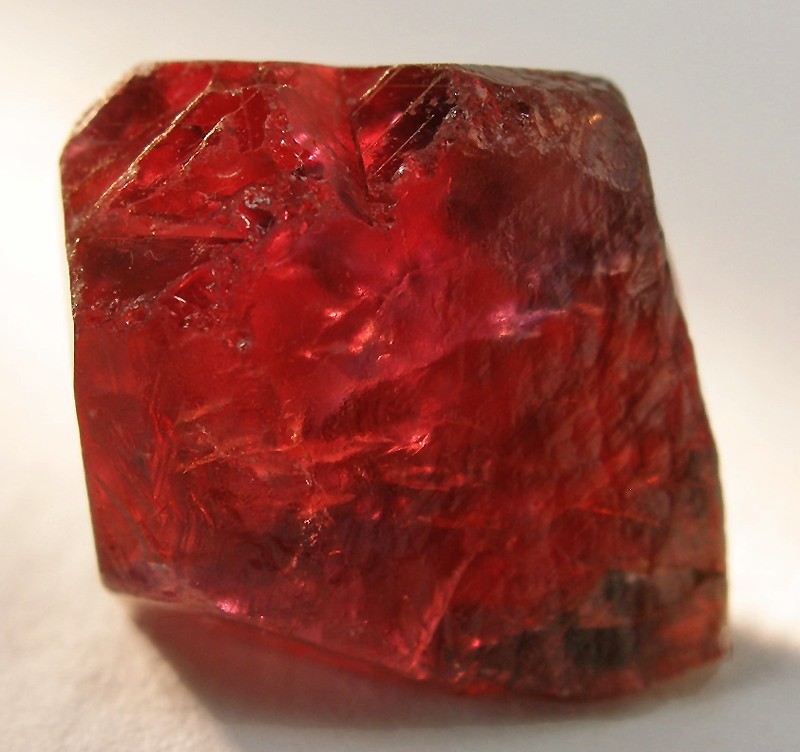
CorundumDeep red transparent crystal (ruby). Corundum is H 9, scratching everything on the list but diamond, and heavy for a nonmetallic (SG about 4); garnet is H 7–7.5.Credit: Robert M. Lavinsky, CC BY-SA 3.0, via Wikimedia Commons · source 
Corundum (barrel crystal)Blue-gray barrel-shaped crystal with a rough surface. Look for the hexagonal barrel or dipyramid shape; H 9 means no streak on the plate.Credit: James St. John, CC BY 2.0, via Wikimedia Commons · source 
Goethite/LimoniteBlack radiating sprays of needles with submetallic luster (goethite). A yellowish-brown streak separates it from hematite (red-brown) and magnetite (black, magnetic).Credit: Robert M. Lavinsky, CC BY-SA 3.0, via Wikimedia Commons · source 
Goethite/Limonite (pseudomorph)Rusty brown-black cube of limonite that replaced pyrite. Limonite is earthy and non-magnetic with a yellowish-brown streak; the cube shape came from the pyrite.Credit: Kritzolina, CC BY-SA 4.0, via Wikimedia Commons · source 
HematiteSteel-gray metallic plates (specular hematite). Whatever the color, a red to reddish-brown streak is decisive; magnetite streaks black and attracts a magnet.Credit: James St. John, CC BY 2.0, via Wikimedia Commons · source 
Hematite (botryoidal)Rounded "kidney ore" lumps with a glossy dark surface. A red-brown streak confirms hematite, which an ordinary magnet does not attract.Credit: James St. John, CC BY 2.0, via Wikimedia Commons · source 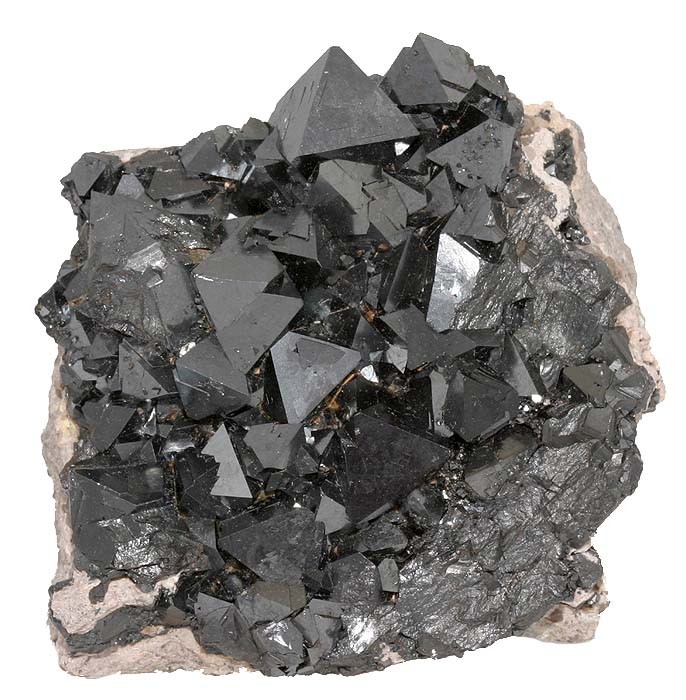
MagnetiteBlack octahedral crystals with metallic luster. Magnetite is strongly attracted to a magnet and streaks black; hematite streaks red-brown.Credit: Robert M. Lavinsky, CC BY-SA 3.0, via Wikimedia Commons · source 
Pyrolusite *Black, sooty, rough mass (pen tip for scale). Pyrolusite soils fingers, streaks black to bluish black and is not magnetic; graphite feels greasy and is lighter.Credit: Andrew Silver, Public domain, via Wikimedia Commons · source 
Rutile *Golden hair-like needles fanning across pale rock. Rutile forms striated prisms and needles with adamantine luster and a pale brown streak.Credit: Paradise Chronicle, CC BY-SA 4.0, via Wikimedia Commons · source 
Rutile * (massive)Black to reddish-brown lustrous mass. A pale brown streak and adamantine to submetallic luster separate rutile from hematite (red-brown streak).Credit: Nessa Eull, CC0, via Wikimedia Commons · source 
Zincite *Red zincite grains in gray rock with white calcite. An orange-yellow streak and the Franklin, NJ setting (with black franklinite) separate zincite from red sphalerite.Credit: Darla Sondrol, CC0, via Wikimedia Commons · source 
Zincite * (with franklinite)Dark franklinite-rich rock dotted with deep red zincite. Check the streak: orange-yellow for zincite, white to pale yellow for sphalerite.Credit: Darla Sondrol, CC0, via Wikimedia Commons · source
Photos: carbonates and borates

AragoniteSprays of pale needle-like crystals. Aragonite fizzes in cold HCl like calcite but has needle or columnar habit, poor cleavage and a higher SG (2.95).Credit: Robert M. Lavinsky, CC BY-SA 3.0, via Wikimedia Commons · source 
Aragonite (flos ferri)Matted white branching, coral-like growths (flos ferri). Fizzes in cold dilute HCl but lacks calcite's three rhombohedral cleavages.Credit: Kritzolina, CC BY-SA 4.0, via Wikimedia Commons · source 
AzuriteDeep blue rosettes of bladed crystals. Azurite has a light-blue streak and fizzes in cold HCl; sodalite streaks white and does not fizz.Credit: Photo by and (c)2015 Derek Ramsey (Ram-Man), CC BY-SA 4.0, via Wikimedia Commons · source 
Azurite (with malachite)Blue-black bladed crystals edged by green malachite. They often grow together: blue with a light-blue streak is azurite, green with a light-green streak is malachite.Credit: Robert M. Lavinsky, CC BY-SA 3.0, via Wikimedia Commons · source 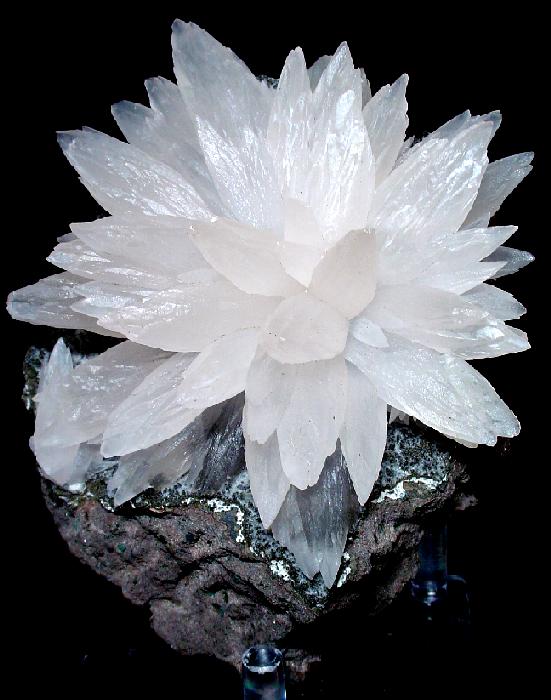
CalciteWhite pointed "dogtooth" scalenohedra in a flower-like cluster. Calcite fizzes vigorously in cold dilute HCl, is H 3 and breaks into rhombs (three cleavages not at 90°).Credit: Robert M. Lavinsky, CC BY-SA 3.0, via Wikimedia Commons · source 
DolomitePink, curved "saddle-shaped" rhombs. Dolomite fizzes only weakly in cold HCl unless powdered (calcite fizzes strongly) and is H 3.5–4.Credit: Robert M. Lavinsky, CC BY-SA 3.0, via Wikimedia Commons · source 
Dolomite (white rhombs)White glassy rhombohedral crystals. Same rhombohedral cleavage as calcite, but only a weak fizz unless scratched to powder or warmed; SG 2.85 vs 2.71.Credit: Didier Descouens, CC BY-SA 4.0, via Wikimedia Commons · source 
MalachiteDark green rounded botryoidal knobs on rock. Malachite has a light-green streak and fizzes in cold HCl; green chrysocolla and dioptase do not fizz.Credit: TheFurther21, CC BY-SA 4.0, via Wikimedia Commons · source 
Malachite (banded)Polished surface with concentric light and dark green bands. Banding, a light-green streak and a fizz in cold HCl identify malachite.Credit: Luc Viatour, CC BY-SA 3.0, via Wikimedia Commons · source 
Magnesite *Cream, porcelain-like massive magnesite with conchoidal breaks, its usual form. It fizzes only in warm HCl or when powdered, and is often dyed to imitate turquoise.Credit: Dexter Perkins, CC0, via Wikimedia Commons · source 
Magnesite * (crystalline)Creamy white crystalline crust over a rounded mass. Magnesite needs warm acid to fizz, and its SG (about 3.0) is above calcite's 2.71.Credit: Didier Descouens, CC BY-SA 4.0, via Wikimedia Commons · source 
Rhodochrosite *Rose-pink rhombohedral crystals on dark matrix. Rhodochrosite is H 3.5–4 and fizzes in warm HCl; rhodonite is harder (H 5.5–6.5) and does not fizz.Credit: JJ Harrison (https://www.jjharrison.com.au/), CC BY-SA 4.0, via Wikimedia Commons · source 
Rhodochrosite * (red)Raspberry-pink crystal aggregate. Pink color plus carbonate softness and a warm-acid fizz separate rhodochrosite from rhodonite and rose quartz.Credit: Robert M. Lavinsky, CC BY-SA 3.0, via Wikimedia Commons · source 
Siderite *Tan to brown curved rhombs coating rock. Siderite is heavy for a carbonate (SG about 3.9), fizzes in warm HCl and becomes magnetic after heating.Credit: DerHexer, Wikimedia Commons, CC BY-SA 4.0, via Wikimedia Commons · source 
UlexiteWhite rounded "cotton-ball" nodule of fine fibers. Ulexite is soft (H 2–2.5) and very light; fibrous satin spar gypsum cannot transmit an image.Credit: Robert M. Lavinsky, CC BY-SA 3.0, via Wikimedia Commons · source 
Ulexite ("TV rock")Polished fibrous block; the colored line seen on top lies underneath and is carried up the parallel fibers. This "TV rock" effect identifies ulexite.Credit: Robert M. Lavinsky, CC BY-SA 3.0, via Wikimedia Commons · source
Photos: sulfates

BariteHoney-brown bladed crystals. Barite is remarkably heavy for a light-colored mineral (SG 4.3–4.5), H 3–3.5 and does not fizz; calcite is lighter and fizzes.Credit: Robert M. Lavinsky, CC BY-SA 3.0, via Wikimedia Commons · source 
Barite (tabular)Yellow-brown tabular crystals with glassy faces. Heft is the key: barite (SG about 4.5) is much heavier than celestite (about 4.0); its flame test is green.Credit: Didier Descouens, CC BY-SA 4.0, via Wikimedia Commons · source 
CelestitePale sky-blue crystals lining a geode. Celestite is H 3–3.5, does not fizz and gives a crimson flame; it is lighter than barite.Credit: Raimond Spekking, CC BY-SA 4.0, via Wikimedia Commons · source 
Gypsum: AlabasterSmooth white fine-grained mass. Alabaster is massive gypsum: a fingernail scratches it (H 2) and it does not fizz; calcite "alabaster" fizzes.Credit: uploaded with permission from User Lanzi by Ra'ike on de.wikipedia, CC BY-SA 3.0, via Wikimedia Commons · source 
Gypsum: Alabaster (sugary)Pale sugary massive gypsum with no visible crystals. Fingernail softness (H 2) and no fizz separate it from marble (H 3, fizzes).Credit: Darla Sondrol, CC0, via Wikimedia Commons · source 
Gypsum: Satin SparSilky parallel fibers across a slab. Satin spar is fibrous gypsum, H 2 with no fizz; ulexite transmits images and tiger's eye is H 7.Credit: James St. John, CC BY 2.0, via Wikimedia Commons · source 
Gypsum: SeleniteLong clear blade with a pale green tint. Selenite peels into flexible sheets that stay bent and is fingernail-soft (H 2); muscovite sheets spring back.Credit: Twyla Baker, CC0, via Wikimedia Commons · source 
Gypsum: Selenite (cluster)Cluster of clear tabular crystals. Transparent, vitreous to pearly crystals with one perfect cleavage and H 2 are crystalline gypsum.Credit: Bryan Barnes, CC BY-SA 4.0, via Wikimedia Commons · source
Photos: phosphates

Turquoise *Sky-blue to blue-green nodule with cream matrix. Turquoise is waxy, H 5–6 and does not fizz; chrysocolla is softer (H 2–4) and sticks to the tongue.Credit: W.carter, CC BY 4.0, via Wikimedia Commons · source 
Fluorapatite (Apatite Group)Pink-violet hexagonal prism on gray matrix. Apatite is H 5 (a knife just scratches it) with a white streak; beryl looks similar but is H 7.5–8.Credit: Géry PARENT, CC BY-SA 4.0, via Wikimedia Commons · source 
Fluorapatite (Apatite Group, green)Greenish-gray hexagonal prism on pinkish-orange matrix. A green hexagonal prism that a knife scratches (H 5) points to apatite, not beryl.Credit: Didier Descouens, CC BY-SA 4.0, via Wikimedia Commons · source 
Pyromorphite *Bright green barrel-shaped hexagonal crystals. Pyromorphite is very heavy for a nonmetallic (SG 6.5–7.1) with resinous luster; vanadinite is red-orange.Credit: Robert M. Lavinsky, CC BY-SA 3.0, via Wikimedia Commons · source 
Pyromorphite * (yellow-green)Yellow-green barrel crystals in a cluster. Same habit and heft as vanadinite (SG about 7); color tells them apart.Credit: Ivar Leidus, CC BY-SA 4.0, via Wikimedia Commons · source 
Vanadinite *Red-orange hexagonal prisms with flat tops. Vivid red-orange color plus very high SG (6.8–7.1) for a nonmetallic is decisive.Credit: Didier Descouens, CC BY-SA 3.0, via Wikimedia Commons · source 
Vanadinite * (brownish red)Brownish-red flat-topped hexagonal crystals on matrix. Vanadinite has resinous luster, H 2.5–4 and a white to pale yellow streak.Credit: Raimond Spekking, CC BY-SA 4.0, via Wikimedia Commons · source
Photos: silicates, amphiboles to kyanite

Actinolite *Dark green-black bladed prisms. Actinolite is the iron-bearing green amphibole with cleavages at about 56°/124°; tremolite is white to gray, epidote pistachio with one cleavage.Credit: Rock Currier, CC BY 3.0, via Wikimedia Commons · source 
HornblendeBlack blocky prisms with lengthwise striations. Hornblende cleavages meet at about 56°/124° (augite about 87°/93°); black tourmaline has no good cleavage.Credit: Creator:Robert Lavinsky, CC BY-SA 3.0, via Wikimedia Commons · source 
Hornblende (prism)Long glossy black prism. H 5–6, amphibole cleavage and a streak lighter than the specimen; black tourmaline is harder (H 7–7.5).Credit: Robert M. Lavinsky, CC BY-SA 3.0, via Wikimedia Commons · source 
Tremolite *Silvery-white radiating fibrous sprays. Tremolite is the pale, iron-poor amphibole (actinolite is green); wollastonite looks similar but is softer (H 4.5–5).Credit: Leon Hupperichs, CC BY-SA 3.0, via Wikimedia Commons · source 
Apophyllite *Colorless pseudo-cubic square prisms. Square crystals with a pearly "fish-eye" basal face and H 4.5–5 separate apophyllite from stilbite sheaves (H 3.5–4).Credit: Robert M. Lavinsky, CC BY-SA 3.0, via Wikimedia Commons · source 
Apophyllite * (on stilbite)Pale green square-prism crystal on peach stilbite, a typical basalt-cavity pairing. Note the square cross-section and pearly top face.Credit: Robert M. Lavinsky, CC BY-SA 3.0, via Wikimedia Commons · source 
BerylPale blue hexagonal prism with a flat top (aquamarine). Beryl is H 7.5–8; quartz prisms end in points (H 7) and apatite is softer (H 5).Credit: Robert M. Lavinsky, CC BY-SA 3.0, via Wikimedia Commons · source 
Chrysocolla *Turquoise-blue knobby crust. Chrysocolla is soft (H 2–4), light and sticks to the tongue; turquoise is H 5–6, and malachite and azurite fizz in HCl.Credit: Robert M. Lavinsky, CC BY-SA 3.0, via Wikimedia Commons · source 
Dioptase *Intense teal-green crystals on matrix. Dioptase is H 5 with perfect rhombohedral cleavage and a pale green streak; emerald is H 7.5–8.Credit: Raimond Spekking, CC BY-SA 4.0, via Wikimedia Commons · source 
Dioptase * (crystals)Emerald-green crystals with rhombohedral tips. Deeper color, lower hardness (H 5) and a green streak separate dioptase from emerald.Credit: Robert M. Lavinsky, CC BY-SA 3.0, via Wikimedia Commons · source 
EpidoteYellow-green radiating blades with lengthwise striations. Pistachio green is epidote's field tell; it has one perfect cleavage and H 6–7.Credit: Robert M. Lavinsky, CC BY-SA 3.0, via Wikimedia Commons · source 
Epidote (dark)Dark green-black sheaf of deeply striated prisms. Iron-rich epidote is darker; look for lengthwise striations and pistachio tints.Credit: Darla Sondrol, CC0, via Wikimedia Commons · source 
AlbiteWhite to gray blocky crystals on dark rock. Albite, the sodium plagioclase, shows fine straight striations on cleavage faces; K-feldspar shows wavy perthite instead.Credit: Didier Descouens, CC BY-SA 3.0, via Wikimedia Commons · source 
Albite (tabular)Cream tabular crystals. White feldspar with two cleavages near 90° and H 6–6.5; straight twin striations separate it from orthoclase/microcline.Credit: Shannon Heinle, CC0, via Wikimedia Commons · source 
LabradoriteDark gray rock flashing blue-green. Labradorescence, seen only at certain angles, plus striations on cleavage faces identify labradorite.Credit: Parent Géry, CC BY-SA 3.0, via Wikimedia Commons · source 
Labradorite (polished)Polished piece with vivid blue and gold schiller. Gray to black plagioclase that flashes color as it turns is labradorite; sodalite is royal blue with white veins.Credit: Linas Juozėnas, CC BY-SA 4.0, via Wikimedia Commons · source 
AmazoniteBlue-green block with flat cleavage faces. Amazonite is green K-feldspar: two cleavages at about 90° and white perthite streaks; aventurine glitters and has no cleavage.Credit: Kaethe17, CC BY-SA 4.0, via Wikimedia Commons · source 
Amazonite (perthite streaks)Teal-green block criss-crossed with pale perthite streaks. H 6–6.5 and blocky cleavage separate it from chrysocolla (H 2–4) and turquoise.Credit: Raimond Spekking, CC BY-SA 4.0, via Wikimedia Commons · source 
Orthoclase/MicroclineTwo cleavage blocks, gray-green above and pink-tan below. Pink to tan feldspar with about 90° cleavage and wavy perthite, not straight striations, is orthoclase/microcline.Credit: James St. John, CC BY 2.0, via Wikimedia Commons · source 
AlmandineDeep red garnet with rough faces in dark rock. Almandine is H 7–7.5 with no cleavage and dense (SG 4.1–4.3); ruby is H 9.Credit: James St. John, CC BY 2.0, via Wikimedia Commons · source 
Almandine (crystals)Dark red to near-black dodecahedra and trapezohedra on pale matrix. The equant 12- or 24-faced shape is the garnet tell.Credit: Rock Currier, CC BY 3.0, via Wikimedia Commons · source 
Grossular (green)Vivid green transparent crystal (tsavorite). Green color, garnet form and no cleavage; grossular is lighter than almandine (SG 3.4–3.7).Credit: Robert M. Lavinsky, CC BY-SA 3.0, via Wikimedia Commons · source 
Grossular (green, dodecahedron)Yellow-green crystal with flat rhombic faces. A green dodecahedron points to grossular; olivine is granular and epidote forms striated prisms.Credit: Darla Sondrol, CC0, via Wikimedia Commons · source 
KaoliniteWhite, chalky, earthy lump. Kaolinite is soft (H 2–2.5), smells earthy when breathed on and is plastic when wet; chalk fizzes in acid, kaolinite does not.Credit: James St. John https://www.flickr.com/people/jsjgeology?rb=1, CC BY 2.0, via Wikimedia Commons · source 
Kaolinite (clay lump)Smooth white earthy clay with a dull luster. No fizz in HCl separates it from chalk, and it is not soapy like talc.Credit: Shannon Heinle, CC0, via Wikimedia Commons · source 
KyaniteBlue bladed crystals with white quartz. Kyanite blades have directional hardness: a knife scratches them lengthwise (H 4.5–5) but not across (H 6.5–7).Credit: Robert M. Lavinsky, CC BY-SA 3.0, via Wikimedia Commons · source 
Kyanite (in rock)Blue blades scattered through pale rock. Patchy blue color and long flat blades separate kyanite from sillimanite (white fibrous needles).Credit: Raimond Spekking, CC BY-SA 4.0, via Wikimedia Commons · source
Photos: silicates, micas to zircon

BiotiteBlack hexagonal "book" on pink calcite. Biotite peels into thin elastic sheets; its dark color separates it from muscovite (colorless to silvery).Credit: Didier Descouens, CC BY-SA 4.0, via Wikimedia Commons · source 
Lepidolite *Lilac-pink mica with glittering cleavage faces. Lilac color plus mica cleavage (thin elastic flakes) identifies lepidolite; it gives a crimson lithium flame.Credit: Robert M. Lavinsky, CC BY-SA 3.0, via Wikimedia Commons · source 
Lepidolite * (massive)Fine-grained mottled purple slab. Scaly lepidolite masses are lilac to purple and glitter as tiny flakes catch the light.Credit: Zbynek Burival, CC BY-SA 4.0, via Wikimedia Commons · source 
MuscoviteTranslucent diamond-shaped sheet. Muscovite peels into clear, flexible, elastic sheets that spring back; it is pale, unlike black biotite.Credit: Robert M. Lavinsky, CC BY-SA 3.0, via Wikimedia Commons · source 
Muscovite (sheets)Stacked pale, translucent sheets with pearly luster. Elastic flakes identify muscovite; selenite and talc flakes bend but stay bent.Credit: Dexter Perkins, CC0, via Wikimedia Commons · source 
OlivineOlive-green glassy crystal (gem peridot). Olivine has no good cleavage and a conchoidal fracture; epidote has one perfect cleavage and striated prisms.Credit: Robert M. Lavinsky, CC BY-SA 3.0, via Wikimedia Commons · source 
Prehnite *Pale green rounded botryoidal aggregate. Translucent apple-green crusts with a pearly surface and H 6–6.5 are typical prehnite.Credit: Robert M. Lavinsky, CC BY-SA 3.0, via Wikimedia Commons · source 
Prehnite * (lime green)Lime-green globular lobes. Botryoidal pale green crusts from basalt cavities, often with zeolites, point to prehnite.Credit: Bergminer, CC BY-SA 4.0, via Wikimedia Commons · source 
AugiteBlack stubby prisms on dark matrix. Augite prisms have nearly square cross-sections with cleavages at about 87°/93°; hornblende's are at 56°/124°.Credit: Robert M. Lavinsky, CC BY-SA 3.0, via Wikimedia Commons · source 
Augite (cluster)Dark brown-black blocky crystals in a dense cluster. Stubby, near-square prisms with cleavages near 90° point to augite.Credit: Shannon Heinle, CC0, via Wikimedia Commons · source 
Rhodonite *Bright pink bladed crystals. Rhodonite (H 5.5–6.5) scratches glass and does not fizz; rhodochrosite is softer (H 3.5–4) and fizzes in warm acid.Credit: CarlesMillan, CC BY-SA 4.0, via Wikimedia Commons · source 
Rhodonite * (massive)Pink massive rhodonite with black streaks and white calcite. Black manganese-oxide veins are the classic look.Credit: Shannon Heinle, CC0, via Wikimedia Commons · source 
Spodumene *Lilac-pink crystal with lengthwise striations (kunzite variety). Spodumene forms flattened striated prisms with two cleavages at about 87°/93°, H 6.5–7.Credit: Didier Descouens, CC BY-SA 4.0, via Wikimedia Commons · source 
SodaliteRoyal-blue mass with white veins. Sodalite has a white streak and low SG (2.3); lapis lazuli streaks blue with pyrite flecks, and azurite fizzes.Credit: Ra'ike (see also: de:Benutzer:Ra'ike), CC BY-SA 3.0, via Wikimedia Commons · source 
Sodalite (rough)Dark blue rough piece with white veining. Check the streak: white to very pale blue for sodalite.Credit: rockandmineralplanet.com, CC BY-SA 4.0, via Wikimedia Commons · source 
StauroliteDark brown cross-shaped twins in glittering schist. Cruciform twins ("fairy crosses") of brown prisms, H 7–7.5, identify staurolite; garnets are equant.Credit: MarchHare1977 at Russian Wikipedia, CC0, via Wikimedia Commons · source 
Staurolite (twin)Brown cross-shaped twin of stubby prisms with rough surfaces. Look for the cross and the six-sided prisms.Credit: Robert M. Lavinsky, CC BY-SA 3.0, via Wikimedia Commons · source 
Stilbite *Orange-yellow sheaf-like aggregates. Stilbite forms "bow-tie" bundles of thin pearly crystals, H 3.5–4, often with apophyllite in basalt cavities.Credit: Robert M. Lavinsky, CC BY-SA 3.0, via Wikimedia Commons · source 
Stilbite * (bow-ties)Peach bow-tie sheaves on a white crust. The wheat-sheaf shape and pearly luster separate stilbite from apophyllite's square prisms.Credit: Robert M. Lavinsky, CC BY-SA 3.0, via Wikimedia Commons · source 
TalcPale green foliated mass with a pearly sheen. Talc is H 1 (a fingernail scratches it), feels soapy, and its flakes bend but do not spring back.Credit: Shannon Heinle, CC0, via Wikimedia Commons · source 
Talc (foliated)Pale green and white flaky talc. A soapy feel and H 1 separate it from gypsum (H 2, not soapy) and muscovite (elastic flakes).Credit: Shannon Heinle, CC0, via Wikimedia Commons · source 
TopazPeach-pink prism with a wedge tip on white matrix. Topaz is H 8 (scratches quartz) with one perfect basal cleavage across the prism; SG about 3.5.Credit: Robert M. Lavinsky, CC BY-SA 3.0, via Wikimedia Commons · source 
Topaz (sherry)Honey-orange prismatic crystal. It resembles citrine, but topaz is H 8 with basal cleavage and heavier (SG 3.5 vs 2.65).Credit: Neil Kadrmas, CC0, via Wikimedia Commons · source 
TourmalineBlack striated chunks (schorl). Deep lengthwise striations, no good cleavage and H 7–7.5 separate schorl from hornblende (H 5–6, 56°/124° cleavage).Credit: Rasmita Nayak, CC BY-SA 4.0, via Wikimedia Commons · source 
Tourmaline (pink)Pink striated prism (elbaite). Tourmaline comes in every color; long striated prisms with a rounded triangular cross-section are the clue.Credit: Robert M. Lavinsky, CC BY-SA 3.0, via Wikimedia Commons · source 
Willemite *Pale yellow-green hexagonal prism on orange matrix. Willemite is H 5.5; brilliant green fluorescence under shortwave UV is the decisive test.Credit: Christian Rewitzer, CC BY-SA 3.0, via Wikimedia Commons · source 
Willemite * (under UV)Willemite glowing green on calcite glowing red under shortwave UV, the classic Franklin, NJ pairing. Calcite is H 3 and fizzes; willemite is H 5.5.Credit: Robert M. Lavinsky, CC BY-SA 3.0, via Wikimedia Commons · source 
Wollastonite *White radiating needle sprays on dark rock. Wollastonite's splintery white blades are H 4.5–5 without amphibole cleavage; tremolite is H 5–6.Credit: Leon Hupperichs, CC BY-SA 3.0, via Wikimedia Commons · source 
Wollastonite * (bladed)Silvery-gray fibrous, bladed mass. Splintery white to gray blades from contact-metamorphosed limestone are typical wollastonite.Credit: Didier Descouens, CC BY-SA 3.0, via Wikimedia Commons · source 
Zircon *Brown square prisms capped by pyramids. Zircon is H 7.5, adamantine and heavy for a gem (SG 4.6–4.7); its dipyramidal tetragonal shape is distinctive.Credit: Robert M. Lavinsky, CC BY-SA 3.0, via Wikimedia Commons · source 
Zircon * (red-brown)Reddish-brown crystal with glassy to adamantine faces. High luster, H 7.5 and high SG are clues; many zircons fluoresce yellow under shortwave UV.Credit: Robert M. Lavinsky, CC BY-SA 3.0, via Wikimedia Commons · source
Photos: quartz varieties and opal

AventurineGreen granular rock with fine glittering spangles. Aventurescence from fuchsite flakes, H 7 and no cleavage separate aventurine from amazonite (90° cleavage).Credit: Darla Sondrol, CC0, via Wikimedia Commons · source 
Aventurine (polished)Polished green stone with tiny glints. Turn it in the light: glittering platelets mark aventurine, while amazonite shows cleavage and white perthite.Credit: Maatpublishing, CC BY-SA 4.0, via Wikimedia Commons · source 
Agate/ChalcedonyGeode with a gray banded chalcedony rim lined with purple crystals. Translucent, waxy, banded silica filling a cavity is agate; H 6.5–7, no cleavage.Credit: Robert M. Lavinsky, CC BY-SA 3.0, via Wikimedia Commons · source 
Agate/Chalcedony (banded slice)Polished slice with concentric bands of white, tan and orange. Banding plus a waxy, translucent luster identify agate; jasper is opaque.Credit: James St. John, CC BY 2.0, via Wikimedia Commons · source 
AmethystCluster of violet crystal points. Amethyst is purple quartz: H 7, no cleavage, conchoidal fracture; purple fluorite is H 4 with octahedral cleavage.Credit: “Jon Zander (Digon3)", CC BY-SA 3.0, via Wikimedia Commons · source 
Amethyst (dark)Deep purple terminated points with darker tips. Color concentrated in the tips is typical of amethyst.Credit: Photo by and (c)2015 Derek Ramsey (Ram-Man), CC BY-SA 4.0, via Wikimedia Commons · source 
CitrineOrange-yellow points on white quartz. Geode-style points with orange, darker tips suggest heat-treated amethyst; citrine is H 7 with no cleavage.Credit: Shannon Heinle, CC0, via Wikimedia Commons · source 
Citrine (natural crystal)Pale yellow single crystal with a clear base. Natural citrine is pale and even; topaz is H 8 with basal cleavage and heavier (SG 3.5).Credit: Raimond Spekking, CC BY-SA 4.0, via Wikimedia Commons · source 
Jasper *Opaque red lump with a dull surface. Jasper is opaque, iron-colored microcrystalline quartz (H 6.5–7); chalcedony is translucent and waxy.Credit: No machine-readable author provided. HInBC assumed (based on copyright claims)., Public domain, via Wikimedia Commons · source 
Jasper * (picture jasper)Polished brown and cream patterned stones. Opaque, with picture-like patterns from iron-oxide impurities; H 6.5–7.Credit: Linas Juozėnas, CC BY-SA 4.0, via Wikimedia Commons · source 
Milky QuartzCloudy white lump with greasy luster. The milky color comes from countless tiny fluid inclusions; H 7 scratches glass and there is no cleavage.Credit: Feedmepaperr, CC BY-SA 4.0, via Wikimedia Commons · source 
Milky Quartz (vein quartz)Opaque white mass with conchoidal fracture and no crystal faces. Calcite would be H 3 and fizz; milky quartz does neither.Credit: James St. John, CC BY 2.0, via Wikimedia Commons · source 
OpalPolished piece flashing green, orange and pink. Play of color identifies precious opal, which is softer (H 5.5–6.5) and lighter (SG about 2.1) than quartz.Credit: James St. John, CC BY 2.0, via Wikimedia Commons · source 
Opal (fire opal in matrix)Orange-red translucent opal veins in tan rock. Without play of color, look for waxy luster, conchoidal fracture and low SG.Credit: Robert M. Lavinsky, CC BY-SA 3.0, via Wikimedia Commons · source 
Rock CrystalCluster of clear colorless six-sided prisms with pointed tips. Rock crystal is H 7 with no cleavage; calcite is H 3, cleaves into rhombs and fizzes.Credit: Robert M. Lavinsky, CC BY-SA 3.0, via Wikimedia Commons · source 
Rose QuartzMassive translucent pink lump with no crystal faces. Hazy pink quartz, H 7, no cleavage; rhodochrosite fizzes and rhodonite has black veins.Credit: Darla Sondrol, CC0, via Wikimedia Commons · source 
Rose Quartz (tumbled)Tumbled pink stone with fine internal cracks. Rose quartz is almost always massive and cloudy pink.Credit: Anders Sandberg, CC BY 2.0, via Wikimedia Commons · source 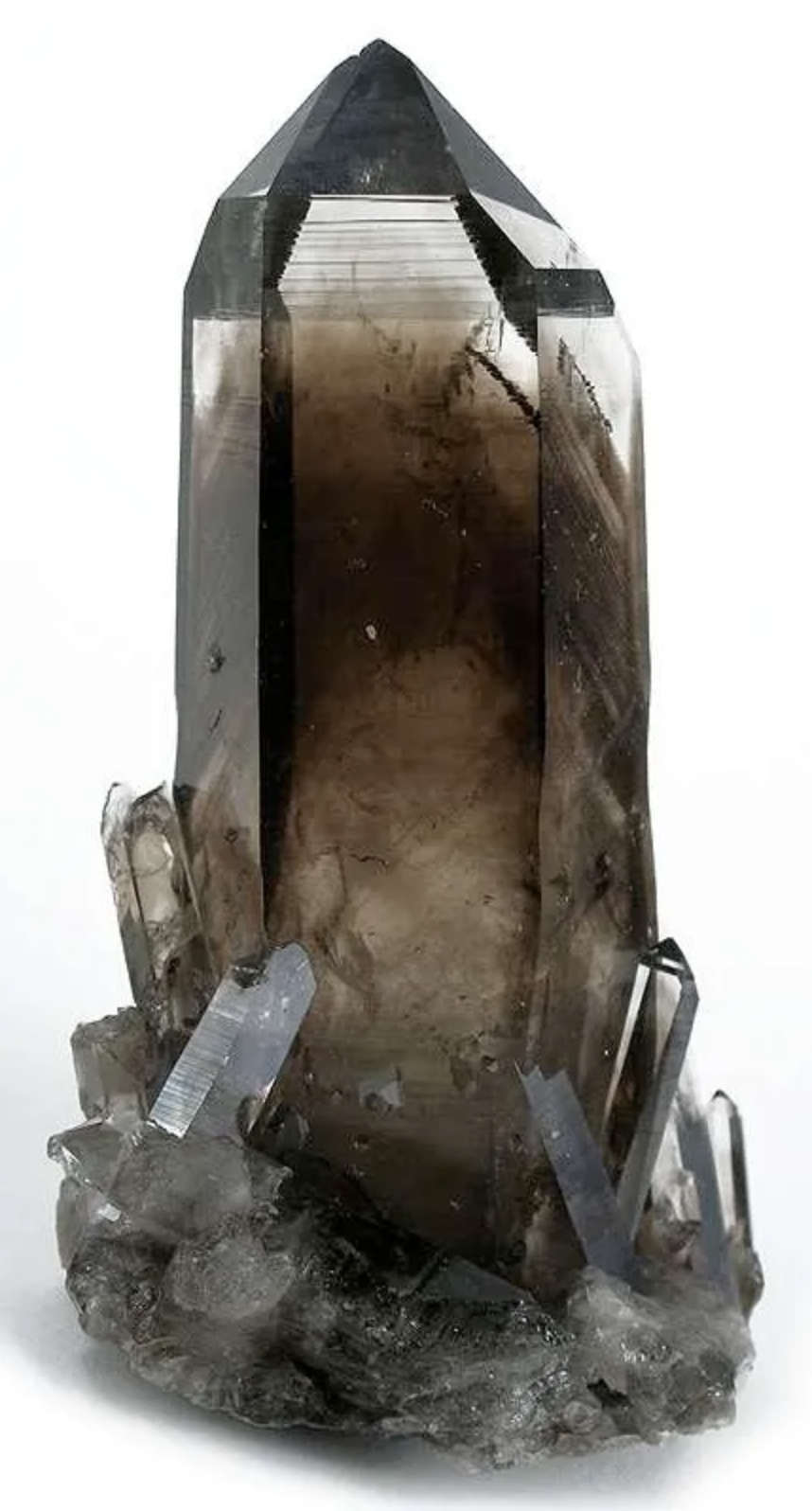
Smoky Quartz *Brown-gray translucent prism with a pointed tip. Smoky quartz has crystal faces and H 7; obsidian is a glass with no faces.Credit: Rob Lavinsky, CC BY 3.0, via Wikimedia Commons · source 
Tiger's Eye *Golden silky bands across a rough slab. Tiger's eye shows chatoyancy (a moving silky light band); satin spar is also silky but only H 2.Credit: James St. John, CC BY 2.0, via Wikimedia Commons · source 
Tiger's Eye * (fibrous)Golden-brown fibrous bands with a silky sheen. H 7 and a light band that moves as the stone turns identify tiger's eye.Credit: Darla Sondrol, CC0, via Wikimedia Commons · source
Photos: igneous rocks

AndesiteDark gray fine-grained rock with small black hornblende and pale specks. Medium-dark gray with hornblende phenocrysts is andesite; rhyolite is lighter, basalt darker.Credit: Twyla Baker, CC0, via Wikimedia Commons · source 
BasaltDark fine-grained rock with no visible crystals. Basalt is aphanitic and mafic; gabbro has the same minerals as visible crystals.Credit: Nessa Eull, CC0, via Wikimedia Commons · source 
Basalt (vesicular)Dark rock with round gas holes and rusty weathering. Vesicular basalt is still mostly solid rock; scoria is mostly holes.Credit: Nessa Eull, CC0, via Wikimedia Commons · source 
DioriteAbout half white plagioclase, half black hornblende: the "salt-and-pepper" look. Coarse grains, little or no quartz; gabbro is mostly dark, granite has glassy quartz.Credit: Amcyrus2012, CC BY 4.0, via Wikimedia Commons · source 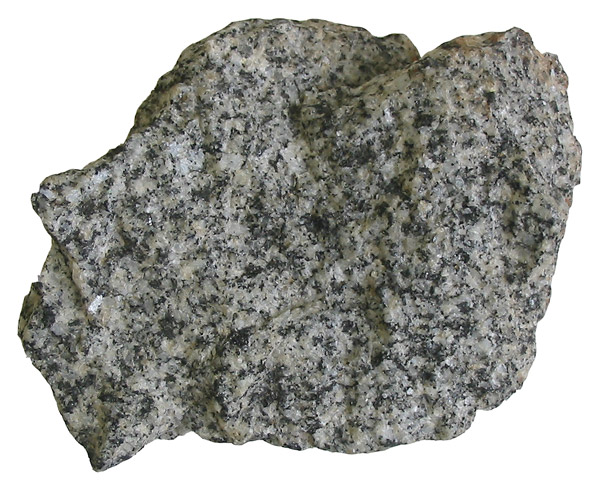
Diorite (speckled)Gray-white coarse rock evenly speckled with black grains. Diorite is the intrusive, coarse-grained equivalent of andesite.Credit: Siim Sepp (talk · contribs), CC BY-SA 3.0, via Wikimedia Commons · source 
GabbroDark coarse-grained rock of dark and gray grains. Gabbro is mostly dark minerals with gray plagioclase; diorite is lighter and basalt shows no grains.Credit: Mike Davis, CC0, via Wikimedia Commons · source 
Gabbro (hand sample)Dark gray mottled hand sample with a 2 cm scale bar. Visible crystals and a high dark-mineral content (color index about 45–85) point to gabbro.Credit: Wilson44691 (Mark A. Wilson at the Wayback Machine, Department of Geology, The College of Wooster)., Public domain, via Wikimedia Commons · source 
GraniteLight gray coarse rock of white feldspar, glassy gray quartz and black biotite. Granite has at least 20% quartz; syenite has under about 5%.Credit: Dexter Perkins, CC0, via Wikimedia Commons · source 
Granite (pink)Interlocking pink K-feldspar, gray glassy quartz and black mica. Random, unbanded coarse grains separate granite from gneiss; arkose breaks around cemented grains.Credit: S. Rae from Scotland, UK, CC BY 2.0, via Wikimedia Commons · source 
ObsidianDark brown glass with shiny curved conchoidal fractures. Obsidian is glassy, translucent on thin edges and H about 5–5.5; dark chert is waxy, opaque and H 7.Credit: Mike Davis, CC0, via Wikimedia Commons · source 
Obsidian (snowflake)Black glass with round white "snowflakes" of cristobalite. Glassy luster and conchoidal fracture identify obsidian whatever its color.Credit: Mike Davis, CC0, via Wikimedia Commons · source 
PegmatiteVery coarse chunk with large black tourmaline in white feldspar and glassy quartz. The minerals of granite, but crystals are 1 cm to meters across.Credit: Fernando Losada Rodríguez, CC BY-SA 4.0, via Wikimedia Commons · source 
Pegmatite (dike in granite)Cut slab with a band of large feldspar, quartz and black tourmaline crystals between finer granite. Crystals of 1 cm or more mean pegmatite.Credit: Mike Beauregard from Nunavut, Canada, CC BY 2.0, via Wikimedia Commons · source 
PeridotiteDense, dark granular rock. Peridotite is ultramafic: mostly olivine plus pyroxene, almost no plagioclase; serpentinite is waxy and softer.Credit: Nessa Eull, CC0, via Wikimedia Commons · source 
Peridotite (dunite)Olive-tan weathered granular rock (dunite, over 90% olivine). Olive color and high density (SG about 3.3) are the clues.Credit: Mike Davis, CC0, via Wikimedia Commons · source 
PumicePale white rock riddled with small holes. Pumice is light-colored frothy glass that usually floats; scoria is dark with larger round holes and sinks.Credit: Joseph H. Hartman, CC0, via Wikimedia Commons · source 
Pumice (gray)Gray glassy pumice with stretched, tube-like vesicles and thin glass walls. Fine froth and very low weight separate it from scoria.Credit: Mike Davis, CC0, via Wikimedia Commons · source 
RhyoliteFine-grained pink to pinkish-gray pieces with no visible crystals. Rhyolite is the light-colored extrusive equivalent of granite; andesite is darker gray.Credit: Amcyrus2012, CC BY-SA 4.0, via Wikimedia Commons · source 
Rhyolite (flow-banded)Pinkish-gray rock with faint wavy flow bands. Flow banding and a light felsic color are typical; tuff shows ash or pumice fragments instead.Credit: Mike Davis, CC0, via Wikimedia Commons · source 
ScoriaBlack rock with a rough, holey surface. Scoria is dark and mafic with large round vesicles and sinks; pale pumice usually floats.Credit: James St. John, CC BY 2.0, via Wikimedia Commons · source 
Syenite *Coarse gray rock of pale feldspar and dark green hornblende. Syenite looks like granite but has little or no quartz (under about 5%).Credit: Joseph H. Hartman, CC0, via Wikimedia Commons · source 
Syenite * (nepheline syenite)Coarse gray-blue rock with glassy pale grains and dark specks. Feldspar-rich and quartz-poor; supervisors may supply the quartz content.Credit: Joseph H. Hartman, CC0, via Wikimedia Commons · source 
Tuff *Pale tan granular rock with darker fragments. Tuff is consolidated volcanic ash, lighter than sandstone, with glass shards and pumice rather than rounded grains.Credit: Nessa Eull, CC0, via Wikimedia Commons · source 
Tuff * (layered)Pale tan, faintly layered ash rock with small fragments. Mostly ash under 2 mm means tuff; many blocks over 64 mm means tuff breccia.Credit: Darla Sondrol, CC0, via Wikimedia Commons · source 
Tuff Breccia *Angular pale, brown and red volcanic fragments in a finer matrix. Tuff breccia is angular volcanic blocks in ash; sedimentary breccia has non-volcanic clasts.Credit: Darla Sondrol, CC0, via Wikimedia Commons · source
Photos: sedimentary rocks

Banded Iron FormationFolded red, gray and silver bands. BIF alternates metallic iron-oxide bands with red jasper or chert; it is heavy and may attract a magnet.Credit: Bramfab, CC0, via Wikimedia Commons · source 
Banded Iron Formation (slab)Red and gray striped slab beside a ruler. Heft and metallic hematite or magnetite layers separate BIF from plain jasper or chert.Credit: Woudloper, CC BY-SA 1.0, via Wikimedia Commons · source 
BauxiteGray-white rock packed with round pisolites. Bauxite is earthy, light and soft and does not fizz; pisolitic limestone fizzes.Credit: James St. John, CC BY 2.0, via Wikimedia Commons · source 
Bauxite (red)Earthy red-brown fragment. Reddish, clay-like bauxite with an earthy clay smell and no fizz in HCl.Credit: saphon, CC BY-SA 1.0, via Wikimedia Commons · source 
BrecciaSharp, angular chert fragments in a fine matrix. Breccia clasts are angular (little transport); conglomerate clasts are rounded.Credit: Nessa Eull, CC0, via Wikimedia Commons · source 
Breccia (red matrix)Angular pale fragments of marble in a red matrix. Broken, poorly sorted angular pieces larger than 2 mm define breccia.Credit: Darla Sondrol, CC0, via Wikimedia Commons · source 
Chert/FlintDark gray slab with smooth conchoidal surfaces. Chert and flint are H 7, waxy to dull, opaque and do not fizz; obsidian is glassy and H about 5.5.Credit: James St. John, CC BY 2.0, via Wikimedia Commons · source 
ConglomerateRounded pebbles cemented in a finer matrix. Rounded clasts over 2 mm mean conglomerate; angular clasts mean breccia.Credit: Dexter Perkins, CC0, via Wikimedia Commons · source 
Diatomite *White, chalky, very light block. Diatomite does not fizz and is even lighter than chalk, which fizzes vigorously.Credit: James St. John, CC BY 2.0, via Wikimedia Commons · source 
DolostoneGray-buff fine crystalline rock. Dolostone fizzes only weakly or when powdered; limestone fizzes vigorously on the bare surface.Credit: James St. John, CC BY 2.0, via Wikimedia Commons · source 
Rock Salt (Halite)Clear cubic halite crystals in gray rock. Rock salt is identified as halite: cubic cleavage, H 2.5 and it dissolves in water.Credit: Raimond Spekking, CC BY-SA 4.0, via Wikimedia Commons · source 
Rock Salt (Halite), cleavage blockClear massive halite block. It breaks into 90° cubes; rock gypsum is softer (H 2) and does not noticeably dissolve.Credit: James St. John, CC BY 2.0, via Wikimedia Commons · source 
Rock GypsumWhite massive granular rock. Rock gypsum is scratched by a fingernail (H 2) and does not fizz; marble fizzes.Credit: James St. John, CC BY 2.0, via Wikimedia Commons · source 
Rock Gypsum (with selenite)Gray rock with glassy selenite blades. Fingernail softness and no fizz identify gypsum; rock salt has cubic cleavage.Credit: James St. John, CC BY 2.0, via Wikimedia Commons · source 
ShaleGray fine-grained rock splitting in layers. Shale is smooth, soft and fissile; siltstone feels gritty and slate is harder and rings when tapped.Credit: Mike Davis, CC0, via Wikimedia Commons · source 
Shale (black)Black, organic-rich shale. Very fine grained and splits along bedding; the black color comes from organic matter.Credit: Darla Sondrol, CC0, via Wikimedia Commons · source 
Siltstone *Gray-brown dull, layered rock. Siltstone feels slightly gritty and breaks into blocks; shale is smooth and fissile.Credit: Mike Davis, CC0, via Wikimedia Commons · source 
AnthraciteBlack, glassy, shiny lump with conchoidal fracture. Anthracite is hard for coal and does not soil fingers; bituminous coal is banded and dirties fingers.Credit: Darla Sondrol, CC0, via Wikimedia Commons · source 
Anthracite (lump)Gray-black chunk with bright, smooth faces. High luster and conchoidal fracture mark anthracite (about 86–97% carbon).Credit: Amcyrus2012, CC BY 4.0, via Wikimedia Commons · source 
BituminousDull black blocky lump. Bituminous coal is banded bright and dull, blocky and soils fingers; anthracite is uniformly shiny.Credit: Amcyrus2012, CC BY 4.0, via Wikimedia Commons · source 
Bituminous (banded)Black block with alternating bright and dull bands. Banding and blocky breaks are bituminous traits.Credit: James St. John, CC BY 2.0, via Wikimedia Commons · source 
LigniteBrownish-gray pieces with visible woody grain. Brown color and plant structure mark lignite, the lowest-rank coal (about 25–35% carbon).Credit: USGS, Public domain, via Wikimedia Commons · source 
Lignite (hand sample)Brown-black dull piece with woody texture. Lignite is soft, light and crumbles as it dries; bituminous coal is black and harder.Credit: James St. John, CC BY 2.0, via Wikimedia Commons · source 
ChalkWhite, soft, powdery rock. Chalk writes on surfaces and fizzes vigorously in HCl; diatomite does not fizz.Credit: James St. John, CC BY 2.0, via Wikimedia Commons · source 
CoquinaPale tan mass of loosely cemented shells. Coquina is very porous shell hash that fizzes; fossil limestone has fossils in a dense matrix.Credit: Lumasella, CC BY-SA 3.0, via Wikimedia Commons · source 
Fossil LimestoneGray limestone with shell fragments in a fine matrix. Visible fossils in a dense, well-cemented rock that fizzes means fossil limestone.Credit: James St. John, CC BY 2.0, via Wikimedia Commons · source 
Fossil Limestone (brachiopods)Gray slab crowded with brachiopod shells. Fossils sit in a dense matrix that fizzes in acid; marble has no fossils.Credit: James St. John, CC BY 2.0, via Wikimedia Commons · source 
Oolitic LimestonePale yellow grainy block. Look closely for tiny round ooids like fish roe; it fizzes, while quartz sandstone does not.Credit: Mike Davis, CC0, via Wikimedia Commons · source 
Oolitic Limestone (ooids close-up)Close-up of sand-size ooids with concentric layers (scale bar 1.5 mm). These fish-roe grains define oolitic limestone.Credit: Wilson44691 (Mark A. Wilson (Department of Geology, The College of Wooster)), Public domain, via Wikimedia Commons · source 
TravertineCream porous rock full of holes. Travertine is banded and porous with vugs and fizzes; oolitic limestone is made of tiny round grains.Credit: Nessa Eull, CC0, via Wikimedia Commons · source 
Travertine (banded)Cream slab with wavy tan bands. Banding from spring or cave deposition plus a fizz identify travertine.Credit: Darla Sondrol, CC0, via Wikimedia Commons · source 
ArkosePinkish-brown sandstone beside a ruler. Arkose has at least 25% feldspar, giving a pink to red color, with angular, gritty grains.Credit: Max.kit, CC BY-SA 4.0, via Wikimedia Commons · source 
Arkose (speckled)Gray-pink speckled sandstone. Look for pink feldspar grains among quartz; granite interlocks, arkose breaks around cemented grains.Credit: James St. John, CC BY 2.0, via Wikimedia Commons · source 
Greywacke *Dark green-gray, hard "dirty sandstone". Angular grains in a muddy matrix (over 15%); arkose is pink, and quartz sandstone is clean and light.Credit: Nessa Eull, CC0, via Wikimedia Commons · source 
Quartz SandstoneWhite slabs of clean sandstone. Quartz sandstone is over 90% rounded quartz, gritty, and breaks around grains; quartzite breaks through them.Credit: Huhulenik, CC BY 3.0, via Wikimedia Commons · source 
Quartz Sandstone (iron-stained)Orange-brown granular sandstone. Iron-oxide cement colors it; the grains feel gritty and it does not fizz unless calcite-cemented.Credit: James St. John, CC BY 2.0, via Wikimedia Commons · source
Photos: metamorphic rocks

Amphibolite *Dark green-black rock with white patches. Amphibolite is mostly shiny, aligned hornblende with plagioclase; gabbro has unaligned pyroxene.Credit: Piotr Sosnowski, CC BY-SA 4.0, via Wikimedia Commons · source 
GneissGray-pink rock with wavy light and dark bands. Gneissic banding separates gneiss from granite, and it does not split into sheets like schist.Credit: No machine-readable author provided. Zimbres assumed (based on copyright claims)., CC BY-SA 2.5, via Wikimedia Commons · source 
Gneiss (garnet gneiss)Light and dark banded rock dotted with garnets. Segregated bands of coarse grains mark gneiss; schist is platy and mica-rich.Credit: Oymtu, Public domain, via Wikimedia Commons · source 
MarbleWhite sugary crystalline rock. Marble fizzes in HCl and a knife scratches it (H 3); quartzite is H 7 and does not fizz.Credit: Nessa Eull, CC0, via Wikimedia Commons · source 
Marble (coarse)Coarse interlocking calcite crystals with sparkly cleavage faces. No fossils or grains, and it fizzes: marble, not limestone or quartzite.Credit: James St. John, CC BY 2.0, via Wikimedia Commons · source 
PhylliteSilky gray slab with a wrinkled (crenulated) surface. Phyllite has a satiny sheen and invisible grains; slate is dull and splits flat.Credit: EdwardEMeyer, CC BY-SA 4.0, via Wikimedia Commons · source Phyllite (gray-green)Gray-green rock with a silky sheen. Wavy cleavage and sheen separate phyllite from slate (dull) and schist (visible mica flakes).Credit: Amcyrus2012, CC BY-SA 4.0, via Wikimedia Commons · source 
QuartziteGray-white dense rock beside a ruler. Quartzite is H 7 (scratches glass), does not fizz and breaks through its grains.Credit: Lysippos, CC BY-SA 4.0, via Wikimedia Commons · source 
Quartzite (pink)Pink-brown dense granular rock. Fused quartz grains give a sugary, glassy break; sandstone breaks around grains and feels gritty.Credit: Nessa Eull, CC0, via Wikimedia Commons · source 
Garnet SchistGlittery foliated rock with red garnets. Red-brown garnet crystals set in shiny mica identify garnet schist; mica schist lacks garnet.Credit: James St. John, CC BY 2.0, via Wikimedia Commons · source 
Garnet Schist (garnet-mica)Gray glittery schist with dark garnets. Platy, mica-rich and splitting along foliation, with garnet crystals.Credit: James St. John, CC BY 2.0, via Wikimedia Commons · source Mica SchistBrown, flaky, shiny rock. Visible mica flakes that glitter and split readily mark mica schist; phyllite only has a sheen.Credit: Mike Davis, CC0, via Wikimedia Commons · source 
Mica Schist (silvery)Silvery, bright mica flakes. Coarse glittery mica without garnets or gneissic bands is mica schist.Credit: James St. John, CC BY 2.0, via Wikimedia Commons · source 
Talc Schist (Soapstone) *Gray-green foliated rock with a silvery sheen. Talc schist feels soapy and is H about 1 (fingernail); serpentinite is harder (H 3–5).Credit: James St. John, CC BY 2.0, via Wikimedia Commons · source 
Talc Schist (Soapstone) *, palePale, silky foliated rock. A greasy feel and fingernail softness identify talc schist.Credit: James St. John, CC BY 2.0, via Wikimedia Commons · source 
Serpentinite *Dark green polished slab with pale veins. Serpentinite is mottled green, waxy, slippery and H about 3–5; green marble fizzes.Credit: Mike Davis, CC0, via Wikimedia Commons · source 
Serpentinite * (rough)Rough dark green-black rock with tan weathering. Waxy, mottled "snakeskin" green and moderate hardness point to serpentinite.Credit: Mike Davis, CC0, via Wikimedia Commons · source SlateBlue-gray rock with smooth, flat cleavage surfaces. Slate splits into thin flat sheets, is dull and rings when tapped; shale is softer and earthy.Credit: Dexter Perkins, CC0, via Wikimedia Commons · source 
Slate (green)Dark green slate piece with flat cleavage. Very fine grained, dull and splitting flat: slate; phyllite has a silky sheen.Credit: “Jon Zander (Digon3)”, CC BY-SA 3.0, via Wikimedia Commons · source
Calculations index
Calculations are a small share of Rocks and Minerals questions (about 2% of the question bank), but they are easy points if you have the formula and one worked example in your binder. Graph reading is more common: Bowen's series, the Hjulström diagram, phase diagrams, the facies diagram and the igneous classification chart all appear as "read this chart" questions. Every type is worked in full in its own chapter; this table is the index.
| Type | Formula or method | Worked in |
|---|---|---|
| Specific gravity from weights in air and water | Density and specific gravity | |
| Density from mass and displaced volume | (g/cm³); SG is the same number without units | Density and specific gravity |
| Heft comparisons and mixtures (e.g. gold in quartz) | Volumes add: | Density and specific gravity |
| Metal content of an ore (weight %) | Chemistry, groups and polymorphs | |
| Charge balance and counting atoms in a formula | Sum of cation charges = sum of anion charges | Chemistry, groups and polymorphs |
| Si : O ratio of silicate structures | Count shared corners per tetrahedron | Silicate structures (Division C) |
| Lever rule on a two-component phase diagram | Fraction of solid | Solid solutions, ternary diagrams and phase diagrams (Division C) |
| Color index and naming a rock from mineral percentages | CI = % dark (mafic) minerals | Composition: what it is made of |
| Plate speed from a hot-spot track | speed = distance ÷ age difference | Where igneous rocks form |
| Grain-size class and Hjulström reading | Wentworth limits; read erosion and deposition curves at a velocity | Grain size: the Wentworth scale, Grain size and stream velocity |
| Depth and geothermal gradient from P–T | about 1 kbar per 3.5 km of rock; gradient = T ÷ depth | Metamorphic facies (Division C) |
| Half-lives, fraction remaining and age | ; | Age calculations |
Common pitfalls
Calling pyrite gold
Pyrite is brassy, but it is brittle and leaves a greenish-black streak; gold is malleable, leaves a yellow streak and is much denser (about 19 vs 5). Use the streak and the heft, not the color.
"Glassy" is not "fine-grained"
Obsidian is glassy, with no crystals at all. Aphanitic rocks have crystals too small to see. A glassy rock with conchoidal fracture is not the same as a fine-grained basalt.
Reading sedimentary structures as metamorphic
Ripple marks, mud cracks and graded beds are primary sedimentary structures. Foliation is a metamorphic texture. A rock that shows graded beds is sedimentary even if it has been slightly altered.
Expecting metamorphism to melt the rock
Metamorphism recrystallizes rock without making it liquid. Vesicles (gas bubbles from a melt) are not a metamorphic feature. If the question asks which change is least likely during metamorphism, bubbles and vesicles are the answer.
Splitting orthoclase and microcline at the ID station
They are polymorphs and a fair concept question, but for identification the pink/tan potassium feldspar is answered as "Orthoclase/Microcline" or "potassium feldspar", not one or the other.
Trusting color
Most minerals are allochromatic: trace elements and defects change their color (quartz can be purple, yellow, pink, smoky or milky). Streak, hardness, cleavage and heft are far more reliable. Color is decisive only for idiochromatic minerals such as malachite, azurite and sulfur.
Mixing up polymorphs and solid solutions
Polymorphs have the same formula and different structures (diamond/graphite; kyanite/andalusite/sillimanite). A solid-solution series has the same structure and a varying formula (forsterite–fayalite olivine; albite–anorthite plagioclase).
Test yourself
Real questions from past tournaments, grouped by chapter. Click an answer to check it; each shows where it came from, and most have a one-line explanation.
- 1
Which mineral reacts with acid?
Practice more Rocks and Minerals questions →
- 1
Which mineral is a polymorph of graphite?
From: Raisbeck Aviation Invitational - WA, 2025-26, Division C
Practice more Rocks and Minerals questions →
- 1
Which mineral is commonly used as a gemstone and is composed of the element aluminum oxide?
Practice more Rocks and Minerals questions →
- 1
What does it mean for a rock to be plutonic?
2 questions from this set are no longer available.
Practice more Rocks and Minerals questions →
- 1
What type of rock is most likely to contain fossils?
Practice more Rocks and Minerals questions →
- 1
Igneous and metamorphic rock can be buried and undergo tremendous heating and stress. What is the process of transformation of one rock type into another?
From: High Desert Satellite Invitational, 2022-23, Division C
Practice more Rocks and Minerals questions →
- 1
Rocks are always made of only one mineral.
1 question from this set is no longer available.
Practice more Rocks and Minerals questions →
Condensed facts
These pages condense the guide into the sheets most teams put at the front of their binder: identification keys first (metallic minerals by streak, non-metallic minerals by hardness band, habits; the rock key opens the rock pages), then the concept tables, look-alikes, formulas and gems. * = State/National only; ¹ = supervisor supplies diagnostic information. H = Mohs hardness, SG = specific gravity, LW/SW = long-/short-wave UV. For any specimen, run luster → streak → hardness → cleavage → acid → heft.
Metallic minerals by streak
Every metallic or submetallic list mineral, dark streak to light. No list silicate is metallic.
| Streak | Mineral | H | SG | Decisive test |
|---|---|---|---|---|
| Black | Magnetite | 5.5–6.5 | 5.2 | Strongly magnetic; octahedra |
| Black to bluish black | Pyrolusite* | 6–6.5 crystals; 2–6 sooty | 4.4–5.1 | Soils fingers; dendrites; not magnetic |
| Black to dark gray | Graphite | 1–2 | 2.1–2.3 | Greasy, marks paper, very light |
| Grayish black | Bornite*¹ | 3–3.25 | 5.1 | Purple-blue tarnish over coppery fresh surface |
| Lead-gray | Galena | 2.5–2.75 | 7.4–7.6 | Cubic cleavage, very heavy |
| Lead-gray to black | Stibnite* | 2 | 4.6–4.7 | Bladed, lengthwise-striated, bent crystals; 1 cleavage; melts in a flame |
| Greenish black | Chalcopyrite | 3.5–4 | 4.1–4.3 | Brassy, deeper yellow; knife scratches it |
| Greenish to brownish black | Pyrite | 6–6.5 | 4.8–5.0 | Brassy, knife cannot scratch; striated cubes |
| Red to red-brown | Hematite | 5–6 | 5.0–5.3 | Cherry-red streak from a gray/black specimen |
| Yellowish brown | Goethite/Limonite | 4–5.5 | 2.7–4.3 | Rusty; fibrous botryoidal (goethite) or earthy (limonite) |
| Pale brown | Rutile* | 6–6.5 | 4.2–4.3 | Striated reddish prisms, needles, elbow twins |
| White to pale yellow-brown | Sphalerite (dark) | 3.5–4 | 3.9–4.1 | Light streak from dark specimen; 6 cleavages; H₂S in HCl |
| Copper-red, shiny | Copper | 2.5–3 | 8.9 | Malleable; green or black tarnish; hackly |
| Golden yellow, shiny | Gold | 2.5–3 | 19.3 | Malleable, sectile, never tarnishes |
| Silver-white, shiny | Silver | 2.5–3 | 10.5 | Black tarnish; wire habit |
- Brassy trio: gold (yellow streak, dents) vs pyrite (H 6–6.5) vs chalcopyrite (H 3.5–4, iridescent tarnish).
- All can be black: red-brown streak = hematite; black + magnetic = magnetite; yellow-brown = goethite/limonite.
- Light metallic: graphite 2.2 vs galena 7.5. Heft separates them at once.
Non-metallic minerals by hardness band
Streak is white unless stated. Fingernail 2.5, glass/knife 5.5. SG = specific gravity (heft): most non-metallics are 2.6–3.0, so anything near 4 or above feels heavy.
H under 2.5: fingernail scratches it
| Mineral | H | SG | Cleavage | Decisive test |
|---|---|---|---|---|
| Talc | 1 | 2.6–2.8 | 1 basal; flakes bend, stay bent | Soapy feel |
| Sulfur | 1.5–2.5 | 2.0–2.1 | Poor; conchoidal | Bright yellow; pale-yellow streak; burns with SO₂ smell |
| Gypsum (alabaster, satin spar, selenite) | 2 | 2.3 | 1 perfect; inelastic sheets | No fizz; selenite peels clear sheets; satin spar silky fibers |
| Halite | 2–2.5 | 2.17 | 3 at 90° (cubic) | Cubes, hoppers; dissolves in water |
| Ulexite | 2–2.5 | 1.9–2.0 | 1 perfect | Fibers project an image ("TV rock") |
| Kaolinite | 2–2.5 | 2.6–2.7 | Basal (microscopic); earthy | Earthy clay smell; plastic when wet; no fizz |
| Muscovite | 2–2.5 | 2.8–2.9 | 1 basal; elastic | Clear to silvery sheets that spring back |
| Chrysocolla* | 2–4 | 1.9–2.4 | None | Blue-green; sticks to tongue; no fizz |
H 2.5 to 5.5: fingernail fails, does not scratch glass
| Mineral | H | SG | Cleavage | Decisive test |
|---|---|---|---|---|
| Biotite | 2.5–3 | 2.7–3.3 | 1 basal; elastic | Black/brown elastic sheets |
| Lepidolite* | 2.5–3 | 2.8–2.9 | 1 basal; elastic | Lilac mica; crimson Li flame |
| Calcite | 3 | 2.71 | 3 not at 90° (rhombs) | Fizzes in cold HCl; strong double refraction |
| Barite | 3–3.5 | 4.3–4.5 | 3 (1 perfect + 2) | Green flame; no fizz |
| Celestite | 3–3.5 | 3.95–4.0 | 3 (1 perfect + 2) | Pale blue; crimson flame |
| Aragonite | 3.5–4 | 2.95 | Poor | Fizzes cold; needles or pseudo-hexagonal twins |
| Dolomite | 3.5–4 | 2.85 | 3 rhombohedral | Fizzes only powdered or warm; curved saddle rhombs |
| Magnesite*¹ | 3.5–4.5 | 3.0 | Rhombohedral (crystals) | Porcelain-like nodules; warm-acid fizz |
| Rhodochrosite* | 3.5–4 | 3.5–3.7 | 3 rhombohedral | Pink, white banding; warm-acid fizz |
| Siderite* | 3.5–4.5 | 3.9–4.0 | 3 rhombohedral | Brown; warm-acid fizz; magnetic after heating |
| Azurite | 3.5–4 | 3.7–3.8 | 1 perfect + 1 fair | Deep blue; light-blue streak; fizzes |
| Malachite | 3.5–4 | 3.6–4.0 | 1 (rarely seen) | Banded green; light-green streak; fizzes |
| Sphalerite | 3.5–4 | 3.9–4.1 | 6 (dodecahedral) | Resinous; pale-yellow streak; H₂S smell in HCl |
| Pyromorphite* | 3.5–4 | 6.5–7.1 | Poor | Green barrel hex prisms |
| Vanadinite* | 2.5–4 | 6.8–7.1 | None | Red-orange flat-topped hex prisms |
| Stilbite* | 3.5–4 | 2.1–2.2 | 1 perfect | Bow-tie sheaves; pearly |
| Fluorite | 4 | 3.18 | 4 (octahedral) | Cubes; often blue-violet fluorescence; no fizz |
| Zincite* | 4 | 5.4–5.7 | 1 basal | Red; orange-yellow streak; Franklin, NJ only |
| Apophyllite* | 4.5–5 | 2.3–2.4 | 1 basal | Square pseudo-cubic prisms, pearly "fish-eye" tops |
| Wollastonite* | 4.5–5 | 2.8–3.1 | 1 perfect + 2 good (~84°) | Splintery white blades in skarn |
| Kyanite | 4.5–5 along; 6.5–7 across | 3.5–3.7 | 1 perfect + 1 good | Blue blades; two hardnesses |
| Apatite | 5 | 3.1–3.2 | Poor basal | Hex prisms; knife just scratches |
| Dioptase* | 5 | 3.3–3.4 | 3 rhombohedral | Emerald-green; pale-green streak |
| Hornblende | 5–6 | 3.0–3.5 | 2 at 56°/124° | Black elongate prisms, diamond section |
| Actinolite* | 5–6 | 3.0–3.2 | 2 at 56°/124° | Green needles and sprays |
| Tremolite* | 5–6 | 2.9–3.1 | 2 at 56°/124° | White/gray (no Fe) |
| Turquoise* | 5–6 | 2.6–2.9 | Perfect, rarely seen | Sky-blue, waxy, porous; matrix veins |
| Willemite* | 5.5 | 3.9–4.2 | Poor | Bright green SW fluorescence (Franklin) |
H over 5.5: scratches glass
| Mineral | H | SG | Cleavage | Decisive test |
|---|---|---|---|---|
| Augite | 5.5–6 | 3.2–3.6 | 2 at ~87°/93° | Stubby square-section prisms; greenish-gray streak |
| Sodalite | 5.5–6 | 2.3 | Poor (6) | Royal blue; white streak; orange LW fluorescence |
| Rhodonite* | 5.5–6.5 | 3.5–3.8 | 2 near 90° | Pink with black Mn-oxide veins; no fizz |
| Opal | 5.5–6.5 | 1.9–2.3 | None; conchoidal | Amorphous; play of color |
| Orthoclase/Microcline | 6 (6–6.5) | 2.55–2.63 | 2 at 90° | Pink/tan; Carlsbad twins; wavy perthite |
| Amazonite | 6–6.5 | 2.56 | 2 at 90° | Green K-feldspar with white perthite |
| Albite | 6–6.5 | 2.62 | 2 at ~94°/86° | White; straight striations on one cleavage face |
| Labradorite | 6–6.5 | 2.7 | 2 at ~94°/86° | Blue-green labradorescence; striations |
| Prehnite* | 6–6.5 | 2.8–2.95 | Good basal | Apple-green botryoidal; epidote needles inside |
| Epidote | 6–7 | 3.3–3.5 | 1 perfect + 1 imperfect | Pistachio green; lengthwise-striated prisms |
| Olivine | 6.5–7 | 3.2–4.4 | Poor; conchoidal | Olive-green granular grains in basalt |
| Spodumene* | 6.5–7 | 3.0–3.2 | 2 at ~87°/93° | Lath prisms in pegmatite; crimson Li flame |
| Grossular | 6.5–7.5 | 3.4–3.7 | None | Green dodecahedra |
| Almandine | 7–7.5 | 4.1–4.3 | None | Red dodecahedra |
| Quartz: rock crystal, amethyst, citrine, smoky*, rose, milky | 7 | 2.65 | None; conchoidal | Six-sided prisms striated across; piezoelectric |
| Agate/chalcedony, jasper*, aventurine, tiger's eye* | 6.5–7 | 2.6–2.7 | None | Waxy banded / opaque red / glitters / chatoyant |
| Staurolite | 7–7.5 | 3.7–3.8 | Distinct | Brown prisms; cross twins (~60°, ~90°) |
| Tourmaline | 7–7.5 | 2.9–3.3 | Indistinct | Rounded-triangle, deeply striated prisms |
| Zircon* | 7.5 | 4.6–4.7 | Indistinct | Square dipyramids; doubled facets |
| Beryl | 7.5–8 | 2.6–3.0 | Imperfect basal | Hex prism with flat top |
| Topaz | 8 | 3.5 | 1 perfect basal | Lozenge-section prisms |
| Corundum | 9 | 4.0 | None (parting) | Barrel hex prisms |
| Diamond | 10 | 3.52 | 4 (octahedral) | Adamantine |
Mohs scale and test objects
| Mohs | Mineral | Absolute | Common object |
|---|---|---|---|
| 1 | Talc | 1 | — |
| 2 | Gypsum | 2 | Fingernail 2.5 |
| 3 | Calcite | 14 | Copper coin ≈3 (US penny since 1982: 2.5–3) |
| 4 | Fluorite | 21 | Iron nail ~4.5 |
| 5 | Apatite | 48 | Glass, knife ~5.5 |
| 6 | Orthoclase | 72 | Steel file 6.5; streak plate 6.5–7 |
| 7 | Quartz | 100 | Quartz crystal 7 |
| 8 | Topaz | 200 | — |
| 9 | Corundum | 400 | — |
| 10 | Diamond | 1500 | — |
- Mnemonic: Tall Giraffes Can Fight And Often Quarrel Till Completely Defeated. Mohs is ordinal; the 9 → 10 step is the largest. Never add or take ratios of Mohs numbers.
- Minerals harder than the plate (~7) leave no streak: quartz varieties, topaz, corundum, garnet, beryl, zircon, diamond.
- Direction-dependent hardness: kyanite (4.5–5 along the blade, 6.5–7 across).
Luster, cleavage and fracture terms
| Luster | Cause | List examples |
|---|---|---|
| Metallic | Free electrons; opaque | Gold, galena, pyrite, magnetite, stibnite |
| Submetallic | Partly metallic | Specular hematite, dark sphalerite, rutile, pyrolusite |
| Adamantine | RI ≈1.9+ | Diamond, zircon, some sphalerite, rutile |
| Vitreous | RI ≈1.5–1.8 | Quartz, calcite, fluorite, halite, beryl, feldspar |
| Resinous | Moderate RI, yellow-brown | Sphalerite, sulfur |
| Greasy | Microscopic roughness | Some milky quartz, serpentine |
| Pearly | Parallel cleavage planes | Talc, muscovite, selenite, apophyllite, stilbite |
| Silky | Parallel fibers | Satin spar, tiger's eye, fibrous malachite, ulexite |
| Waxy | Very fine-grained | Chalcedony, jasper, turquoise, chrysocolla |
| Earthy/dull | Porous fine aggregate | Kaolinite, limonite, bauxite, earthy hematite |
| Cleavage directions | Shape and angles | List examples |
|---|---|---|
| 0 | Fracture only | Quartz, garnet, olivine (poor), pyrite, native metals, opal |
| 1 | Basal sheets | Micas, chlorite, talc, graphite, kaolinite, topaz, apophyllite |
| 2 at ~90° | Prismatic, blocky | Augite, spodumene (87°/93°); K-feldspar 90°; plagioclase 86°/94° |
| 2 not at 90° | Prismatic, 56°/124° | Hornblende, actinolite, tremolite |
| 3 at 90° | Cubic | Halite, galena |
| 3 not at 90° | Rhombohedral, ~75°/105° | Calcite, dolomite, magnesite, siderite, rhodochrosite |
| 3 unequal | 1 perfect + 2 good | Barite, celestite |
| 4 | Octahedral, ~71°/109° | Fluorite, diamond |
| 6 | Dodecahedral | Sphalerite |
- Fracture: conchoidal (quartz, obsidian, chert, opal); hackly (Cu, Ag, Au); splintery/fibrous (satin spar, kyanite, asbestiform amphiboles); earthy (kaolinite, limonite, bauxite, chalk).
- Parting looks like cleavage but only some specimens show it: corundum (basal, rhombohedral), magnetite (octahedral).
- Tenacity: brittle (most); malleable/ductile/sectile (Au, Ag, Cu); flexible, stays bent (chlorite, talc, selenite); elastic (muscovite, biotite, lepidolite).
Habit terms and twin types
The rules' closed list of 21 habits, one line each (descriptive extras such as fibrous or reniform are in the Mineral terms glossary).
| Habit | What it looks like | List example |
|---|---|---|
| Acicular | Very thin needles | Rutile in quartz, actinolite |
| Bladed | Flat, elongated like a knife blade | Kyanite, stibnite |
| Botryoidal | Rounded, grape-like bulges | Hematite, malachite, goethite |
| Cubic | Six square faces | Halite, pyrite, galena, fluorite |
| Dendritic | Branching, fern- or tree-like | Mn oxides (pyrolusite), native copper |
| Dodecahedral | Twelve rhomb-shaped faces | Garnet |
| Doubly terminated | Pointed at both ends | Rock crystal ("Herkimer"), selenite |
| Druzy | Crust of many tiny crystals | Quartz, calcite |
| Geodic | Crystals lining a hollow cavity | Amethyst, agate geodes |
| Hexagonal | Six-sided prisms or plates | Beryl, apatite, vanadinite |
| Hopper | Stepped, hollowed faces from fast growth | Halite |
| Massive | No visible crystal form | Rose quartz, talc, kaolinite |
| Micaceous | Thin, peelable flakes | Muscovite, biotite, lepidolite |
| Octahedral | Eight triangular faces | Magnetite, fluorite, diamond |
| Pisolitic | Pea-sized concentric spheres | Bauxite |
| Prismatic | Elongated, parallel side faces | Tourmaline, beryl, hornblende |
| Radiating | Crystals fanning from a center | Stibnite, actinolite, aragonite |
| Rosette | Platy crystals in a flower shape | Barite and gypsum "desert roses" |
| Stalactitic | Hanging cones from dripping water | Calcite, goethite, malachite |
| Tabular | Flat, thick tablets | Barite, celestite |
| Twinning | Symmetrical intergrowth of crystals | Staurolite, gypsum, feldspars |
| Twin type | Geometry | List example |
|---|---|---|
| Contact | Two crystals meet on one plane (V or arrowhead) | Swallowtail gypsum, Japan-law quartz |
| Penetration | Crystals grow through each other | Staurolite crosses, Carlsbad orthoclase, fluorite cubes |
| Polysynthetic | Many thin parallel twin layers (striations) | Plagioclase (albite law), calcite |
| Cyclic | Three or more repeat around a center | Aragonite trillings, rutile sixlings |
The eight other properties
The rules close this list at eight. Tournaments supply acid and taste results in words.
| Property | List minerals that show it |
|---|---|
| Acid (fizz, CO₂) | Cold, vigorous: calcite, aragonite. Fizz as they dissolve: malachite, azurite. Powdered or warm only: dolomite. Weak or warm only: magnesite, siderite, rhodochrosite. No fizz but H₂S (rotten egg) in HCl: galena (warm), sphalerite. Dissolves, no fizz: zincite. Rocks: limestone, chalk, marble, travertine, coquina fizz; dolostone weakly |
| Fluorescence | Fluorite blue-violet; calcite red (SW, Franklin); willemite bright green (SW); ruby red; sodalite orange (LW); halite red-orange (SW, some); opal (hyalite) green (SW); diamond blue (LW, many); sphalerite orange-yellow (some); apatite yellow or orange (some); kunzite pink-orange; wollastonite yellow-orange (some); also zircon, aragonite, dolomite, gypsum, tremolite (variable) |
| Magnetism | Strongly: magnetite (lodestone is naturally magnetized). Weakly, only with a strong (Nd) magnet: almandine, hornblende, biotite, siderite, schorl. Hematite: not attracted by an ordinary magnet, at most very weakly by a strong one. After heating in a reducing flame: hematite, siderite, goethite/limonite turn to magnetite and become strongly magnetic. Not: quartz, calcite, halite |
| Smell | Kaolinite earthy "clay" smell when breathed on; sulfur and struck or heated pyrite sulfurous; burning sulfur SO₂; galena and sphalerite in HCl H₂S |
| Taste (banned at events) | Halite salty |
| Double refraction | Calcite (Iceland spar) strongly; zircon and peridot show doubled facets; all non-cubic minerals to some degree; cubic minerals and glass never |
| Piezoelectricity | Quartz (and its varieties); tourmaline (also pyroelectric) |
| Radioactivity | Zircon (trace U, Th; old grains metamict); apatite (trace U). No list mineral is strongly radioactive |
- Related terms: phosphorescence (glow continues; some calcite, willemite, fluorite), thermoluminescence (chlorophane fluorite), triboluminescence (quartz pebbles rubbed, some sphalerite), tenebrescence (hackmanite sodalite).
Families and anion groups
| Family | Anion | List minerals |
|---|---|---|
| Native elements | None | Copper, gold, silver, diamond, graphite, sulfur |
| Sulfides | S²⁻ (S₂²⁻ in pyrite) | Galena PbS, sphalerite ZnS, pyrite FeS₂, chalcopyrite CuFeS₂, bornite Cu₅FeS₄, stibnite Sb₂S₃ |
| Halides | F⁻, Cl⁻ | Halite NaCl, fluorite CaF₂ |
| Oxides | O²⁻ | Corundum Al₂O₃, hematite Fe₂O₃, magnetite Fe₃O₄, rutile TiO₂, zincite ZnO, pyrolusite MnO₂ |
| Hydroxides | OH⁻ | Goethite FeO(OH); gibbsite Al(OH)₃ in bauxite |
| Carbonates | CO₃²⁻ | Calcite, aragonite CaCO₃; dolomite CaMg(CO₃)₂; magnesite MgCO₃; siderite FeCO₃; rhodochrosite MnCO₃; malachite Cu₂CO₃(OH)₂; azurite Cu₃(CO₃)₂(OH)₂ |
| Borates | BO₃³⁻, BO₄⁵⁻ | Ulexite NaCaB₅O₆(OH)₆·5H₂O |
| Sulfates | SO₄²⁻ | Gypsum CaSO₄·2H₂O, barite BaSO₄, celestite SrSO₄ |
| Phosphates (vanadate) | PO₄³⁻ (VO₄³⁻) | Apatite Ca₅(PO₄)₃(F,Cl,OH), pyromorphite Pb₅(PO₄)₃Cl, vanadinite Pb₅(VO₄)₃Cl, turquoise CuAl₆(PO₄)₄(OH)₈·4H₂O |
| Silicates | SiO₄⁴⁻ tetrahedra | Everything else on the list |
- Crust by mass: O 46.6, Si 27.7, Al 8.1, Fe 5.0, Ca 3.6, Na 2.8, K 2.6, Mg 2.1%. Silicates are over 90% of the crust; feldspars about half.
- Sulfide (S²⁻, metallic) ≠ sulfate (SO₄²⁻, non-metallic). Fluorite is a halide; fluorapatite is a phosphate.
- Ore grades: hematite 69.9% Fe; magnetite 72.4% Fe; galena 86.6% Pb; chalcopyrite 34.6% Cu. Gypsum is about 21% water by mass.
Silicate structure classes
| Structure | Corners shared | Unit; Si : O | Cleavage | List examples |
|---|---|---|---|---|
| Neso (isolated) | 0 | SiO₄⁴⁻; 1 : 4 | None or poor | Olivine, almandine, grossular, zircon, topaz, kyanite, staurolite, willemite (also andalusite, sillimanite) |
| Soro (pairs) | 1 | Si₂O₇⁶⁻; 2 : 7 | Variable | Epidote (SiO₄ + Si₂O₇) |
| Cyclo (rings of 6) | 2 | Si₆O₁₈¹²⁻; 1 : 3 | Poor | Beryl, tourmaline, dioptase |
| Ino, single chain | 2 | SiO₃²⁻; 1 : 3 | 2 at ~87°/93° | Augite, spodumene; rhodonite, wollastonite (pyroxenoids) |
| Ino, double chain | 2.5 | Si₄O₁₁⁶⁻; 4 : 11 | 2 at 56°/124° | Hornblende, actinolite, tremolite |
| Phyllo (sheet) | 3 | Si₂O₅²⁻; 2 : 5 | 1 basal | Micas, chlorite, talc, kaolinite, serpentine, chrysocolla, apophyllite, prehnite |
| Tecto (framework) | 4 | SiO₂; 1 : 2 | None (quartz), 2 (feldspar) | Quartz varieties, K-feldspars, albite, labradorite, sodalite, stilbite |
- O per Si = 4 − s/2; charge per Si = −(4 − s), where s = corners shared.
- Rings and single chains tie at 1 : 3. More polymerized = later in Bowen's series, more weathering-resistant.
- Sheet layers: 1 : 1 (T–O) kaolinite, serpentine; 2 : 1 (T–O–T) talc, micas; chlorite 2 : 1 + hydroxide sheet. Asbestos: chrysotile plus five amphiboles (tremolite, actinolite on the list).
Crystal systems
| System | Axes and angles | List examples |
|---|---|---|
| Cubic (isometric) | a = b = c; all 90° | Cu, Au, Ag, diamond, galena, pyrite, sphalerite, fluorite, halite, magnetite, almandine, grossular, sodalite |
| Tetragonal | a = b ≠ c; all 90° | Zircon, rutile, chalcopyrite, pyrolusite, apophyllite |
| Hexagonal | a₁ = a₂ = a₃ at 120°, c ⊥ | Beryl, apatite, pyromorphite, vanadinite, zincite, graphite |
| Trigonal | Hexagonal axes, threefold axis | Quartz varieties, calcite, dolomite, magnesite, siderite, rhodochrosite, corundum, hematite, tourmaline, dioptase, willemite |
| Orthorhombic | a ≠ b ≠ c; all 90° | Sulfur, stibnite, aragonite, barite, celestite, olivine, topaz, prehnite, goethite; bornite (pseudo-cubic) |
| Monoclinic | a ≠ b ≠ c; only β ≠ 90° | Gypsum, azurite, malachite, orthoclase, augite, spodumene, amphiboles, epidote, micas, chlorite, stilbite, staurolite |
| Triclinic | a ≠ b ≠ c; no 90° | Albite, labradorite, microcline, amazonite, kyanite, kaolinite, turquoise, rhodonite, wollastonite, ulexite |
| Amorphous | No lattice | Opal, limonite |
- Cubic = isotropic (no double refraction or pleochroism; black in XPL). Tetragonal, hexagonal, trigonal = uniaxial; the other three = biaxial.
- Monoclinic is the most common system; cubic is the most symmetrical, triclinic the least. Quartz looks hexagonal but is trigonal.
Polymorphs and solid solutions
| Polymorph set | Formula | Key differences |
|---|---|---|
| Diamond / graphite | C | H 10, SG 3.52 vs H 1–2, SG 2.2; diamond stable at ≥150 km |
| Calcite / aragonite | CaCO₃ | Trigonal, SG 2.71, rhombohedral cleavage vs orthorhombic, SG 2.95, poor cleavage; aragonite → calcite over time |
| Orthoclase / microcline (sanidine) | KAlSi₃O₈ | Monoclinic vs triclinic (tartan twins); sanidine quenched in lavas; one ID answer |
| Kyanite / andalusite / sillimanite | Al₂SiO₅ | High P (SG 3.6) / low P (SG 3.15) / high T (SG 3.24) |
| Quartz polymorphs | SiO₂ | α below 573 °C; β above; tridymite, cristobalite at higher T; coesite, stishovite at very high P (impacts) |
| Pyrite / marcasite | FeS₂ | Cubic, brassy vs orthorhombic, paler, cockscomb |
| Series (Div C) | Substitution | End members and what shifts |
|---|---|---|
| Plagioclase | Na⁺ + Si⁴⁺ ↔ Ca²⁺ + Al³⁺ (coupled) | Albite (~1118 °C) → anorthite (~1553 °C); SG 2.62 → 2.76 |
| Alkali feldspar | Na⁺ ↔ K⁺ | Complete only at high T; slow cooling unmixes to perthite |
| Olivine | Mg²⁺ ↔ Fe²⁺ | Forsterite (~1890 °C, SG 3.2) → fayalite (~1205 °C, SG 4.4); mantle ≈Fo₉₀ |
| Carbonates | Ca, Mg, Fe, Mn | Fe–Mg, Fe–Mn mix freely; Ca only partly; Ca + Mg = ordered dolomite |
| Amphiboles | Mg²⁺ ↔ Fe²⁺ | Tremolite → actinolite → ferro-actinolite; darker, denser with Fe |
| Sulfates | Ba²⁺ ↔ Sr²⁺ | Barite (~4.5) → celestite (~4.0) |
- Plagioclase by % An: albite 0–10, oligoclase 10–30, andesine 30–50, labradorite 50–70, bytownite 70–90, anorthite 90–100.
- Other series: garnets (almandine–pyrope; grossular–andradite), biotite (annite–phlogopite), sphalerite (Zn with up to ~¼ Fe), tourmaline (schorl, dravite, elbaite).
- Polymorph = same formula, different structure. Solid solution or isostructural = same structure, formula varies. Isostructural sets: calcite group (calcite, magnesite, siderite, rhodochrosite); barite–celestite; apatite–pyromorphite–vanadinite; halite–galena; almandine–grossular.
- Al₂SiO₅ triple point ≈500 °C, ≈4 kbar (0.4 GPa).
Rock identification key
Texture first, then composition. Start at 1 and follow the first line that fits; every list rock is an end point. * = State/National only; ¹ = supervisor supplies data.
| Step | If the specimen… | Then |
|---|---|---|
| 1 | Is glass: no grains, shiny, conchoidal fracture | Obsidian |
| Is full of holes (vesicular) | Go to 2 | |
| Is made of volcanic fragments: ash, glass shards, pumice, broken crystals | Go to 3 | |
| Has interlocking crystals of several minerals (igneous look) | Go to 4 | |
| Has separate grains or clasts held by cement or matrix, breaks around grains | Go to 5 | |
| Is fine-grained or crystalline but fizzes, has fossils or ooids, tastes or feels distinctive, or is coal or iron rich | Go to 6 | |
| Has foliation: parallel sheets, sheen, mica or bands | Go to 7 | |
| Is a crystalline mosaic without foliation (mostly one mineral, or metamorphic) | Go to 8 | |
| 2 Vesicular | Pale, fine glassy froth, light enough to float | Pumice |
| Dark red or black, large round holes, sinks | Scoria (few holes in dark fine rock: basalt) | |
| 3 Pyroclastic | Mostly ash under 2 mm, light for its size | Tuff*¹ |
| 25–75% angular blocks over 64 mm in ash | Tuff breccia* | |
| 4 Crystalline | Crystals 1 cm or larger (pegmatitic) | Pegmatite |
| Phaneritic, quartz ≥20%, pink or white K-feldspar | Granite | |
| Phaneritic, quartz under 5%, K-feldspar dominant | Syenite*¹ | |
| Phaneritic salt-and-pepper: white plagioclase + black hornblende, little quartz | Diorite | |
| Phaneritic, dark: gray Ca-plagioclase + augite | Gabbro | |
| Phaneritic, olive-green olivine, dense (SG ≈3.3) | Peridotite | |
| Aphanitic (or porphyritic: name by groundmass), pink, tan or pale gray, may have quartz phenocrysts | Rhyolite | |
| Aphanitic or porphyritic, medium gray with white plagioclase and black hornblende phenocrysts | Andesite | |
| Aphanitic, black, dense, may have olivine phenocrysts | Basalt | |
| 5 Clastic | Gravel clasts over 2 mm, angular | Breccia |
| Gravel clasts over 2 mm, rounded | Conglomerate | |
| Sand, over 90% rounded quartz, light colored, well sorted | Quartz sandstone | |
| Sand, ≥25% pink feldspar, angular | Arkose | |
| Sand, dark, over 15% muddy matrix with rock fragments | Greywacke* | |
| Silt: faintly gritty, not fissile | Siltstone*¹ | |
| Clay: smooth, splits into thin layers (fissile) | Shale | |
| 6 Chemical / biochemical | Fizzes; loosely cemented shell hash, porous | Coquina |
| Fizzes; whole fossils in dense matrix | Fossil limestone | |
| Fizzes; round sand-size ooids (fish roe) | Oolitic limestone | |
| Fizzes; banded, porous with vugs | Travertine | |
| Fizzes; white, soft, powdery, writes on a board | Chalk | |
| Fizzes only when powdered; sugary | Dolostone | |
| No fizz; cubic cleavage, H 2.5, salty, dissolves | Rock salt (halite) | |
| No fizz; fingernail scratches it (H 2) | Rock gypsum | |
| No fizz; waxy, conchoidal, scratches glass (H 7) | Chert/flint | |
| No fizz; white, chalky, very light | Diatomite*¹ | |
| Heavy; metallic iron-oxide bands alternating with red jasper or chert | Banded iron formation | |
| Earthy, pea-sized pisolites, clay smell, no fizz | Bauxite | |
| Coal, brown, crumbly, woody | Lignite | |
| Coal, black, banded dull and bright, soils fingers | Bituminous | |
| Coal, black, shiny, conchoidal, clean to handle | Anthracite | |
| 7 Foliated | Very fine, dull, splits into flat sheets, rings when tapped (slaty) | Slate |
| Fine, silky sheen, wavy foliation (phyllitic) | Phyllite | |
| Visible mica flakes, platy, splits (schistose) | Mica schist | |
| Schist with red garnet porphyroblasts | Garnet schist | |
| Schist that is soapy, H 1 | Talc schist (soapstone)* | |
| Light and dark bands, does not split (gneissic) | Gneiss | |
| Dark, aligned shiny hornblende needles | Amphibolite* | |
| 8 Non-foliated | Fizzes, H 3, sugary interlocking calcite | Marble |
| Scratches glass, breaks through grains | Quartzite | |
| Soapy, H 1 | Soapstone (talc schist)* | |
| Green, waxy, mottled, slippery, H 3–5 | Serpentinite* | |
| Dark, mostly hornblende with plagioclase | Amphibolite* |
Igneous classification grid
| Texture | Felsic (>≈65% SiO₂) | Intermediate (≈52–65%) | Mafic (≈45–52%) | Ultramafic (<≈45%) |
|---|---|---|---|---|
| Phaneritic (intrusive) | Granite; pegmatite if ≥1 cm | Diorite; syenite* | Gabbro | Peridotite (dunite >90% olivine) |
| Aphanitic (extrusive) | Rhyolite | Andesite; trachyte (not on list) | Basalt | Komatiite (rare, Archean; not on list) |
| Glassy | Obsidian | — | Tachylite (rare) | — |
| Vesicular | Pumice | Pumice (dacitic) or scoria | Scoria, vesicular basalt | — |
| Pyroclastic | Tuff*, tuff breccia*, welded tuff | Andesitic tuff | Basaltic tuff, cinders | — |
| Color index | ≈0–15 | ≈15–45 | ≈45–85 | >85 (usually >90) |
| Main minerals | Quartz, K-spar, Na-plag, muscovite, biotite | Andesine, hornblende, biotite | Labradorite, augite ± olivine | Olivine, pyroxene |
- Pairs: rhyolite ↔ granite, andesite ↔ diorite, basalt ↔ gabbro (diabase in dikes and sills), trachyte ↔ syenite, komatiite ↔ peridotite.
- Granite ≥20% quartz; syenite and diorite under ≈5%. Only granite, rhyolite and pegmatite on the list carry >5% visible quartz.
- Felsic → ultramafic: SiO₂, Na, K, Al fall; Fe, Mg, Ca rise; darker, denser, hotter, less viscous. Densities ≈2.6–2.7 → 2.8 → 3.0 → 3.3.
- Color-index vocabulary (IUGS, a separate scale from the working ranges above): hololeucocratic 0–10, leucocratic 10–35, mesocratic 35–65, melanocratic 65–90, holomelanocratic 90–100.
- QAPF (Div C): Q quartz, A alkali feldspar, P plagioclase, F feldspathoids; for plutonic rocks; Q and F never together.
Bowen's series order
| Temperature | Discontinuous (new mineral) | Continuous (plagioclase) | Structure | Rock |
|---|---|---|---|---|
| Highest (≈1200 °C) | Olivine | Anorthite, bytownite | Isolated | Peridotite, olivine basalt |
| High | Pyroxene (augite) | Labradorite | Single chain | Basalt, gabbro |
| Middle (≈800–1000 °C) | Amphibole (hornblende) | Andesine | Double chain | Andesite, diorite |
| Lower | Biotite | Oligoclase–albite | Sheet | Granodiorite, granite |
| Lowest (≈600–750 °C) | K-feldspar → muscovite → quartz | (merged) | Framework; sheet | Granite, rhyolite, pegmatite |
- Down the series: T falls; polymerization, Si, Na, K, Al rise; Fe, Mg, Ca fall; lighter color and density; residual melt more viscous; more weathering-resistant (Goldich).
- Discontinuous = different minerals; continuous = one mineral, changing composition. Quartz is last; biotite is last of the discontinuous branch. Amphibole and biotite need water.
- Minerals that crystallize together occur together. Olivine + quartz means two events (xenoliths, mixing, a later vein, faulting).
- Normal zoning = Ca core, Na rim. Reaction rim = pyroxene around olivine.
Igneous textures and cooling
| Texture | Cooling history |
|---|---|
| Phaneritic (fine <1, medium 1–5, coarse >5 mm) | Slow, deep (plutonic): few nuclei, large crystals |
| Aphanitic | Fast, at or near surface: many nuclei, tiny crystals |
| Porphyritic | Two stages: phenocrysts grew slowly at depth, groundmass froze fast |
| Glassy | Quenched (often viscous, dry felsic lava): no crystals |
| Vesicular | Gas exsolved on eruption, frozen in place |
| Frothy (pumiceous) | Gas-rich viscous felsic lava foamed; may float |
| Pyroclastic | Explosive fragmentation; ash, crystals, rock fragments; may be welded |
| Pegmatitic (≥1 cm) | Last water-rich melt: low viscosity, fast diffusion, few nuclei |
- Euhedral = early; anhedral = late (quartz in granite). Holocrystalline (plutonic), hypocrystalline (lavas), holohyaline (obsidian).
- Amygdules = filled vesicles. Xenolith = foreign rock fragment. Chilled margins = fast-cooled edges. Columnar joints, pillow lava (underwater), flow banding.
- Magma: basaltic ≈1000–1200 °C, low viscosity, little gas, effusive; andesitic ≈800–1000 °C; rhyolitic ≈650–800 °C, most viscous and gassy, explosive. Volcanoes: shield (basalt), composite/strato (andesite), cinder cone (gassy basalt), lava dome (degassed rhyolite), caldera (collapse).
- Ejecta: ash <2 mm, lapilli 2–64 mm, blocks >64 mm (solid), bombs >64 mm (molten).
Igneous bodies and plate settings
| Body | Concordant? | Notes |
|---|---|---|
| Batholith | Discordant | ≥100 km² exposed; granite, granodiorite, diorite |
| Stock | Discordant | <100 km² exposed |
| Dike | Discordant | Cuts across layers; chilled margins |
| Sill | Concordant | Between beds; bakes above and below |
| Laccolith | Concordant | Domes overlying strata; flat floor |
| Lopolith | Concordant | Saucer; layered mafic cumulates (Bushveld) |
| Volcanic neck | Discordant | Exposed feeder pipe (Ship Rock) |
| Pipe / diatreme | Discordant | Kimberlite, diamonds |
| Lava flow | Extrusive | Vesicular top; bakes only below |
| Pyroclastic deposit | Extrusive | Ash fall and flow sheets; tuff |
The 2027 rules name only batholith, lava flow and pyroclastic deposits.
| Setting | Melting | Rocks |
|---|---|---|
| Mid-ocean ridge | Decompression | Basalt (pillows), gabbro, sheeted diabase dikes |
| Continental rift | Decompression + heat transfer | Bimodal basalt + rhyolite; trachyte, syenite |
| Ocean–ocean subduction | Flux (water) | Basalt, andesite; island arc |
| Ocean–continent subduction | Flux + assimilation, differentiation | Andesite, rhyolite, tuff; diorite, granite batholiths |
| Continent–continent collision | Crustal thickening | Granite, pegmatite, migmatite; few volcanoes |
| Oceanic hot spot | Plume decompression | Basalt, scoria; shield volcanoes (Hawaii) |
| Continental hot spot | Plume + crustal melting | Rhyolite, obsidian, tuff, basalt (Yellowstone) |
| Transform | Little or none | — |
- Volume made: decompression (ridges) > flux (subduction) > heat transfer and hot spots.
- Ophiolite, top down: deep-sea sediment, pillow basalt, sheeted dikes, gabbro, peridotite (often serpentinized).
- Div C melt evolution: partial melting, fractional crystallization, assimilation and mixing all push a melt more felsic. Incompatible elements (K, Rb, Cs, Li, Be, B, U, Th, Zr, Nb, Ta, REE) collect in pegmatite*.
Sediment sizes, textures and cements
| Class | mm | φ | Rock |
|---|---|---|---|
| Boulder | >256 | < −8 | Conglomerate (rounded) / breccia (angular) |
| Cobble | 64–256 | −6 to −8 | Conglomerate / breccia |
| Pebble | 4–64 | −2 to −6 | Conglomerate / breccia |
| Granule | 2–4 | −1 to −2 | Conglomerate / breccia |
| Sand | 1/16–2 | 4 to −1 | Sandstone (quartz sandstone, arkose, greywacke*) |
| Silt | 1/256–1/16 | 8 to 4 | Siltstone* |
| Clay | <1/256 | >8 | Claystone; mudstone or shale (fissile) |
- φ = −log₂(d in mm); bigger grain = more negative φ. Mud = silt + clay.
- Textures (closed list of three): clastic, chemical, biochemical. Bioclastic (coquina) = biochemical origin, clastic texture.
- Grain size = energy; rounding = distance; sorting = steadiness of energy. Wind: best sorted, frosted. Ice and debris flows: unsorted, angular.
- Hjulström: sand (≈0.1–0.5 mm) is easiest to erode (≈20–30 cm/s); clay is cohesive and hard to erode, stays suspended, settles only in still water.
- Lithification = compaction (dominant for mud) + cementation (dominant for sand and gravel) + recrystallization.
| Cement | Recognize by |
|---|---|
| Calcite | Fizzes; most common; weathers fast |
| Silica | No fizz; very hard; breaks through grains; strongest |
| Iron oxide | Red (hematite) or yellow-brown (limonite); red beds, oxidizing land settings |
| Clay | Soft, crumbly; often matrix, not cement |
- Maturity: greywacke* (>15% matrix) → arkose (≥25% feldspar) → quartz sandstone (>90% quartz).
- Evaporite order: calcite (~50% water left) → gypsum/anhydrite (~20%) → halite (~10%) → K–Mg salts (<5%).
- Coal rank and carbon (USGS, as-mined basis): lignite 25–35 → sub-bituminous 35–45 → bituminous 45–86 → anthracite 86–97. Peat (not a rock) is ≈50–60% carbon only on a dry basis, so do not compare it with these figures. Practically no coal is older than the Devonian; most is Carboniferous.
Sedimentary rocks and their settings
| Rock | Setting and meaning |
|---|---|
| Breccia | Short transport: alluvial fan, talus, landslide, fault zone, cave collapse |
| Conglomerate | High-energy river channel, fan, gravel beach |
| Quartz sandstone | Mature: beach, desert dune, shallow shelf |
| Arkose | Near granite source; fans, rift basins; fast burial or dry climate |
| Greywacke* | Turbidity currents; submarine fans, trenches |
| Siltstone* | Floodplain, lake, delta, outer shelf |
| Shale | Quiet water: lake, lagoon, floodplain, deep sea; black = anoxic |
| Fossil limestone | Warm shallow shelf, reef |
| Coquina | High-energy beach, shoals |
| Chalk | Coccoliths on quiet shelf sea floor (Cretaceous) |
| Oolitic limestone | Warm, shallow, agitated, supersaturated water (Bahamas) |
| Travertine | Hot springs and caves (CO₂ loss) |
| Dolostone | Dolomitization in tidal flats, lagoons |
| Rock salt, rock gypsum | Evaporating restricted basin, sabkha, playa |
| Chert/flint | Siliceous ooze (deep sea); nodules in chalk and limestone |
| Diatomite* | Diatoms in nutrient-rich lakes or seas |
| Coal | Anoxic swamp → peat → burial |
| Banded iron formation | Precambrian ocean, Fe²⁺ oxidized; mostly 2.6–1.8 Ga (oldest about 3.8 Ga; a brief return about 0.75 Ga) |
| Bauxite | Residual tropical weathering (laterite), not transported |
| Structure | Meaning |
|---|---|
| Cross-bedding | Current direction = dip of laminae; meter-scale sets = wind dunes |
| Asymmetric ripples | One-way current; steep side faces downstream |
| Symmetric ripples | Shallow water, waves; sharp crests up |
| Graded bedding | Turbidity current; coarse base = bottom |
| Mud cracks | Exposure to air; V narrows downward |
| Raindrop impressions | Exposure to air; top of bed |
| Imbrication | Pebbles dip upstream |
| Sole marks | Current direction and way up; turbidites |
| Varves | Annual couplets in glacial lakes |
| Trace fossils | Organisms present; bioturbation erases lamination |
- Way-up indicators: graded beds, cross-beds (truncated top), mud cracks, symmetric ripples, raindrop pits, sole marks.
- Sandstone → shale → limestone upward = transgression; shale → sandstone → coal upward = regression. Division C calls the deep sea abyssal.
Weathering and mineral stability
| Goldich stability | Discontinuous side | Continuous side |
|---|---|---|
| Least stable | Olivine | Ca-plagioclase |
| ↓ | Pyroxene | Ca–Na plagioclase |
| ↓ | Amphibole | Na–Ca plagioclase |
| ↓ | Biotite | Na-plagioclase |
| ↓ | K-feldspar | (merged) |
| ↓ | Muscovite | — |
| Most stable | Quartz | — |
- First to crystallize = first to weather; that is why sand is mostly quartz.
- Mechanical: frost wedging (~9% expansion), exfoliation (unloading), salt growth, roots, abrasion, thermal. Chemical: hydrolysis, oxidation, dissolution, carbonation, hydration.
- 2KAlSi₃O₈ + 2H₂CO₃ + 9H₂O → Al₂Si₂O₅(OH)₄ + 4H₄SiO₄ + 2K⁺ + 2HCO₃⁻ (K-feldspar → kaolinite).
- Granite's fate: quartz → sand; feldspars → clay; biotite, hornblende → clay + iron oxide; muscovite weathers slowly.
Metamorphic protoliths and grade
| Protolith | Low grade | Medium | High |
|---|---|---|---|
| Shale, mudstone | Slate → phyllite | Mica, garnet, staurolite, kyanite schist | Sillimanite gneiss; migmatite |
| Granite, arkose, rhyolite | Meta-granite | Schist or gneiss | Gneiss (ortho- or para-) |
| Quartz sandstone, chert | Quartzite | Quartzite | Quartzite |
| Limestone, dolostone | Marble | Marble ± tremolite, diopside | Marble; skarn at contacts |
| Basalt, gabbro | Greenschist/greenstone; blueschist at high P | Amphibolite* | Granulite; eclogite at high P |
| Peridotite, dunite | Serpentinite*, talc schist/soapstone* | Serpentinite, talc–tremolite rock | Olivine–pyroxene rock |
| Bituminous coal | Anthracite | Graphite-bearing rock | Graphite |
- Foliation sequence (shale): slate (slaty cleavage, dull, rings) → phyllite (silky sheen, wavy) → schist (visible mica, porphyroblasts) → gneiss (light/dark bands, does not split) → migmatite (partial melt).
- Non-foliated: marble, quartzite, hornfels (contact), and any rock of equidimensional grains or formed without directed stress.
- Agents: heat (most important), confining and directed pressure, fluids (metasomatism). ≈1 kbar per 3.5 km; geotherm ≈25–30 °C/km.
| Index mineral (low → high) | ≈T | Rock |
|---|---|---|
| Chlorite | 200–400 °C | Slate, phyllite |
| Muscovite | 350–450 °C | Phyllite to fine schist |
| Biotite | 400–450 °C | Schist |
| Garnet | 450–550 °C | Garnet schist |
| Staurolite | 550–600 °C | Staurolite schist |
| Kyanite | 600–650 °C | Kyanite schist |
| Sillimanite | >650 °C | Sillimanite schist, gneiss |
- Closed list of seven. Isograd = line where an index mineral first appears. Andalusite replaces kyanite at low P (Buchan, contact). At high grade muscovite + quartz → sillimanite + K-feldspar + water.
Facies and settings (Division C)
| Facies | T | P | Mafic minerals | Setting |
|---|---|---|---|---|
| Zeolite | ≈100–250 °C | <≈3 kbar | Zeolites, clays | Burial |
| Greenschist | ≈300–500 °C | ≈2–8 kbar | Chlorite, epidote, actinolite, albite | Low-grade regional; mid-ocean-ridge alteration |
| Amphibolite | ≈500–750 °C | ≈3–10 kbar | Hornblende + plagioclase ± garnet | Collision belts, middle crust |
| Granulite | >≈700–750 °C | Moderate–high | Pyroxenes + plagioclase ± garnet | Lower crust, roots of collision belts |
| Blueschist | ≈200–450 °C | ≈6–12 kbar | Glaucophane, lawsonite | Subduction (cold slab) |
| Eclogite | ≈450–900+ °C | >≈12 kbar | Garnet + omphacite | Deep subduction, thick collision roots |
| Hornfels | Moderate–high | Lowest | Andalusite, cordierite (pelites) | Contact aureoles |
- Geotherms: steep → hornfels (contact); moderate (≈25–30 °C/km) → greenschist → amphibolite → granulite (Barrovian); low (≈10 °C/km) → blueschist → eclogite.
- Regional = large area, directed stress, foliated, convergent. Contact = aureole, high T, low P, non-foliated hornfels. Dynamic = fault breccia, mylonite. Shock = coesite, stishovite, shatter cones.
Thin-section summary (Division C, State and National)
| Mineral | PPL | XPL color | Twinning and cleavage | Clincher |
|---|---|---|---|---|
| Microcline | Colorless, low relief, cloudy | First-order gray/white (δ ≈0.007) | Tartan (two sets at ~90°); 2 cleavages ~90° | Tartan twins; orthoclase untwinned or one Carlsbad twin |
| Plagioclase | Colorless, low relief, laths | First-order gray/white (δ ≈0.01) | Parallel stripes in one direction (albite law) | One set of stripes; may be zoned |
| Calcite | Colorless; twinkles (relief changes on rotation) | Pastel high-order white (δ ≈0.17) | Lamellar twins; rhombohedral cleavage 75°/105° | Extreme birefringence + twinkling |
| Augite | Pale green to colorless, moderately high relief | Second order: bright blues, greens (δ ≈0.025) | Simple twins; 2 cleavages ~87°/93° | Inclined extinction ~35–48°; not 56°/124° |
| Garnet | Equant, very high relief, pale pink, cracked | Black at every angle (isotropic) | None; no cleavage | High relief + always black |
- PPL (one polarizer): color, pleochroism, relief, cleavage, crystal shape. XPL (crossed polarizers): interference color (birefringence), extinction, twinning.
- Section 30 µm thick; retardation Δ = d × δ. Quartz ~270 nm (first-order white), augite ~750 nm (second order), calcite ~5,160 nm (high-order white).
- Isotropic (cubic minerals, glass) = black at every angle. Anisotropic grains go black every 90° of rotation; low birefringence looks gray, not black.
- Textures: holocrystalline (all crystals) vs hypocrystalline (crystals + glass) vs glassy (black in XPL); vesicular = round holes filled with (often blue) epoxy; porphyritic = phenocrysts in fine groundmass.
- Sediments: quartz arenite = >90% rounded, sorted quartz, little matrix; arkose = ≥25% twinned or tartan feldspar, angular; ooids = concentric coated grains; skeletal fragments = shells, crinoid plates.
Rock look-alike tests
| Pair | Decisive test |
|---|---|
| Marble vs quartzite | Marble fizzes, H 3; quartzite H 7, no fizz |
| Marble vs rock gypsum | Marble fizzes, H 3; gypsum H 2, no fizz |
| Basalt vs gabbro vs diorite | Visible grains? Then CI: gabbro mostly dark; diorite salt-and-pepper |
| Rhyolite vs andesite | Pink/tan, quartz phenocrysts vs gray with hornblende and white plag |
| Granite vs syenite* | ≥20% quartz vs under ≈5% |
| Granite vs pegmatite | Pegmatite crystals ≥1 cm |
| Granite vs gneiss | Random grains vs parallel bands |
| Granite vs arkose | Interlocking, breaks through crystals vs cemented grains, pores, breaks around grains |
| Pumice vs scoria | Pale, fine froth, floats vs dark, big round holes, sinks |
| Obsidian vs chert | Glassy, translucent edges, H ≈5.5 vs waxy, opaque, H 7 |
| Tuff* vs sandstone | Glass shards, pumice, light vs rounded grains, heavier |
| Tuff vs tuff breccia* | Mostly ash <2 mm vs 25–75% blocks >64 mm |
| Breccia vs conglomerate | Angular vs rounded clasts |
| Arkose vs greywacke* vs quartz sandstone | Pink feldspar vs dark muddy matrix vs clean rounded quartz |
| Quartz sandstone vs quartzite | Breaks around grains, gritty vs through grains, sugary |
| Shale vs siltstone* | Smooth, fissile vs gritty, blocky |
| Shale vs slate vs phyllite | Soft, earthy vs dull, rings, flat sheets vs silky sheen |
| Slate vs hornfels | Splits into sheets vs no cleavage, splintery |
| Schist vs gneiss | Platy mica, splits vs bands, does not split |
| Chalk vs diatomite* | Chalk fizzes; diatomite does not and is lighter |
| Dolostone vs limestone | Limestone fizzes on surface; dolostone only as powder |
| Coquina vs fossil limestone | Loose porous shell hash vs fossils in dense matrix |
| Travertine vs oolitic limestone | Banded, vuggy vs fish-roe ooids |
| Rock salt vs rock gypsum | Cubic cleavage, H 2.5, dissolves vs H 2 |
| Anthracite vs bituminous vs lignite | Shiny, conchoidal, clean vs banded, dirties fingers vs brown, crumbly |
| Serpentinite* vs soapstone* | H ≈3–5, mottled vs H ≈1 |
| Peridotite vs serpentinite* | Granular olive-green, dense vs waxy, slippery, softer |
| Amphibolite* vs gabbro | Aligned hornblende (56°/124°) vs random pyroxene + plag |
| BIF vs jasper/chert | Heavy metallic oxide bands vs uniform, light |
| Bauxite vs pisolitic limestone | No fizz, earthy, clay smell vs fizzes |
Mineral look-alike tests
| Pair | Decisive test |
|---|---|
| Halite vs calcite | Cubic cleavage, no double refraction vs rhombs, fizz, double image |
| Halite vs fluorite | Cubic cleavage, H 2.5, dissolves vs octahedral, H 4 |
| Fluorite vs amethyst | H 4, 4 cleavages vs H 7, none |
| Gypsum vs calcite | H 2, no fizz vs H 3, fizz |
| Calcite vs aragonite | Rhombohedral cleavage, SG 2.71 vs poor cleavage, needles, SG 2.95 |
| Calcite vs dolomite vs Mg/Fe/Mn carbonates | Cold fizz vs powder or warm vs warm acid; SG 2.71, 2.85, 3.0 (magnesite), 3.6 (rhodochrosite), 3.9 (siderite) |
| Barite vs celestite | SG 4.5, green flame vs 4.0, crimson flame |
| Barite vs calcite | SG 4.5, no fizz vs SG 2.7, fizz |
| Azurite vs malachite | Blue, light-blue streak vs banded green, light-green streak |
| Ulexite vs satin spar vs fibrous calcite | Image transmission vs H 2, no fizz vs fizz |
| Selenite vs muscovite | Sheets stay bent vs spring back |
| Talc vs gypsum vs muscovite | Soapy H 1 vs H 2 vs elastic flakes |
| Micas vs chlorite | Elastic flakes vs green flakes that stay bent |
| Hornblende vs augite | 56°/124°, diamond section vs ~87°/93°, square section |
| Tourmaline (schorl) vs hornblende | Triangular, striated, no cleavage, H 7–7.5 vs 56°/124° cleavage, H 5–6 |
| Actinolite vs tremolite vs epidote | Green vs white amphibole vs pistachio, 1 cleavage |
| Plagioclase vs K-feldspar | Straight striations vs Carlsbad twins, wavy perthite, pink |
| Rhodonite vs rhodochrosite | H 5.5–6.5, black veins, no fizz vs H 3.5–4, fizzes warm |
| Sodalite vs lapis vs azurite | White streak, SG 2.3 vs blue streak, pyrite vs blue streak, fizz |
| Turquoise vs chrysocolla | H 5–6 vs H 2–4, sticks to tongue |
| Green set: amazonite, dioptase, emerald, chrysocolla | 90° cleavage + perthite; H 5, green streak; H 7.5–8; H 2–4, earthy |
| Beryl vs quartz vs apatite | Flat-topped, H 7.5–8 vs pointed, H 7 vs H 5 |
| Topaz vs quartz | H 8, basal cleavage, SG 3.5 vs H 7, none, SG 2.65 |
| Almandine vs grossular | Red, SG 4.1–4.3 vs green, SG 3.4–3.7 |
| Garnet vs ruby | Dodecahedra, H 7–7.5 vs hex prisms, H 9 |
| Staurolite vs garnet | Brown elongate prisms, cross twins vs equant dodecahedra |
| Kyanite vs sillimanite | Blue blades, two hardnesses vs white fibrous, H 6.5–7.5 |
| Olivine vs epidote vs grossular | Granular, no cleavage vs pistachio, 1 cleavage vs dodecahedra |
| Epidote vs olivine | Pistachio, 1 perfect cleavage, striated prisms, metamorphic rocks and quartz veins vs olive-green granular, no cleavage, mafic igneous rocks |
| Augite vs spodumene | Dark, heavier vs pale, pegmatite |
| Stilbite vs apophyllite | Sheaves, H 3.5–4 vs square prisms, H 4.5–5 |
| Kaolinite vs chalk vs talc | Earthy smell, plastic vs fizz vs soapy H 1 |
| Chalcedony vs jasper vs opal | Translucent waxy vs opaque iron-colored vs H 5.5–6.5, SG 2.1 |
| Willemite vs calcite (Franklin) | Green SW glow, H 5.5 vs red glow, H 3, fizz |
| Wollastonite vs tremolite | No 56° cleavage, H 4.5–5 vs amphibole cleavage, H 5–6 |
| Zincite vs red sphalerite | Orange-yellow streak vs pale streak, 6 cleavages |
| Zircon vs diamond | H 7.5, doubled facets vs H 10, singly refractive |
| Bornite vs tarnished chalcopyrite | Coppery fresh surface, gray-black streak vs brassy, green-black streak |
| Galena vs stibnite | Cubic cleavage, SG 7.5 vs blades, SG 4.6 |
| Pyrolusite vs magnetite vs graphite | Soils, not magnetic vs magnetic, harder vs greasy, SG 2.2 |
Formulas and calculations
| Quantity | Formula |
|---|---|
| Density | ρ = m ÷ V (g/cm³; 1 mL = 1 cm³) |
| SG, displacement | SG = m ÷ (V_after − V_before) |
| SG, Archimedes | SG = W_air ÷ (W_air − W_water) |
| SG, Jolly balance | SG = (S₁ − S₀) ÷ (S₁ − S₂) |
| SG, pycnometer | SG = M ÷ (M + B_w − B_wm) |
| Mixture | Volumes add: V = m₁/ρ₁ + m₂/ρ₂ |
| Metal % | n × atomic mass ÷ formula mass × 100 |
| Lever rule | Fraction solid = (C₀ − C_L) ÷ (C_S − C_L); liquid = (C_S − C₀) ÷ (C_S − C_L) |
| Si : O | O per Si = 4 − s/2 |
| Color index | % dark minerals by volume |
| Plate speed | Distance ÷ age difference |
| Depth from pressure | ≈1 kbar per 3.5 km; 1 GPa = 10 kbar |
| Roundness | r(sharpest corner) ÷ R(grain) |
| Retardation (thin section) | Δ = d × δ (30 µm = 30,000 nm) |
| Decay | N = N₀ (½)^(t/t½); n = t ÷ t½ |
| Age | t = t½ × log₂(1 + D/P) = (1/λ) ln(1 + D/P); λ = ln 2 ÷ t½ |
| Half-lives | Parent left | P : D |
|---|---|---|
| 1 | 1/2 | 1 : 1 |
| 2 | 1/4 | 1 : 3 |
| 3 | 1/8 | 1 : 7 |
| 4 | 1/16 | 1 : 15 |
| n | (½)ⁿ | 1 : (2ⁿ − 1) |
| Parent → daughter | Half-life | Range | Dates |
|---|---|---|---|
| U-238 → Pb-206 | 4.47 Gyr | ~1 Myr–4.6 Gyr | Zircon (most precise for old igneous, metamorphic) |
| U-235 → Pb-207 | 704 Myr | ~1 Myr–4.6 Gyr | Zircon, paired with U-238 (concordia) |
| K-40 → Ar-40 | 1.25 Gyr | ~10 kyr (Ar–Ar)–4.6 Gyr | Biotite, muscovite, hornblende, sanidine, volcanic rock; Ar leaks if reheated |
| Rb-87 → Sr-87 | ≈48.8 Gyr | ~10 Myr–4.6 Gyr | Micas, K-feldspar, granite and metamorphic whole rock (isochron) |
| Sm-147 → Nd-143 | 106 Gyr | 100s Myr–4.6 Gyr | Mafic and ultramafic rocks, garnet, meteorites |
| C-14 → N-14 | 5,730 yr | ~100–50,000 yr | Once-living material only (wood, bone, shell, peat) |
- Zircon: takes U⁴⁺, rejects Pb²⁺, two U clocks, closure >900 °C, survives weathering. Oldest material: Jack Hills zircon ≈4.4 Ga; oldest rock: Acasta Gneiss ≈4.0 Ga; Earth ≈4.54–4.57 Ga (meteorites).
- Closure T (Div C): zircon U–Pb >900 °C; hornblende Ar ≈500–550; muscovite ≈350–400; biotite ≈300–350; K-feldspar ≈150–300 °C.
- Relative dating: superposition, original horizontality, lateral continuity, cross-cutting (cutter younger), inclusions (older), contact baking, faunal succession. Unconformities: angular, nonconformity (on igneous/metamorphic), disconformity, paraconformity.
- Decay: α (Z −2, A −4); β⁻ (Z +1); electron capture (Z −1). K-40 → Ar-40 is electron capture (~11%); β⁻ gives Ca-40.
One-line traps
- P : D = 1 : 7 is 3 half-lives, not 7. "75% decayed" means 25% remains.
- Age = n × half-life, not n. Watch million vs billion.
- SG has no units; density does. SG uses weight lost in water.
- Pores lower measured SG. Weighing in oil does not give SG.
- Convert masses to atoms before D/P when atomic masses differ.
- C-14 never dates rocks; Rb–Sr never dates young samples.
- Lever rule: the phase closer to the bulk composition is more abundant. Tie lines are horizontal.
- Mohs numbers are never added, averaged or divided.
- 1 carat = 0.2 g; karat measures gold purity.
Gem varieties and color causes
| Variety | Species | Color and cause | H |
|---|---|---|---|
| Ruby | Corundum | Red: Cr³⁺ (also fluoresces red) | 9 |
| Sapphire | Corundum | Blue: Fe²⁺–Ti⁴⁺ charge transfer; any non-red corundum | 9 |
| Emerald | Beryl | Green: Cr³⁺ and/or V³⁺ | 7.5–8 |
| Aquamarine | Beryl | Blue to blue-green: Fe²⁺ | 7.5–8 |
| Morganite | Beryl | Pink to peach: Mn²⁺ | 7.5–8 |
| Heliodor (golden beryl) | Beryl | Yellow: Fe³⁺ | 7.5–8 |
| Amethyst | Quartz | Purple: Fe³⁺ + natural irradiation; heat turns it yellow | 7 |
| Citrine | Quartz | Yellow-orange: iron (debated); mostly heated amethyst | 7 |
| Rose quartz | Quartz | Pink: microscopic fibrous inclusions | 7 |
| Smoky quartz* | Quartz | Gray-brown: Al³⁺ for Si⁴⁺ + irradiation | 7 |
| Tiger's eye* | Quartz | Golden-brown iron oxides after crocidolite; chatoyant | 6.5–7 |
| Aventurine | Quartz | Green glitter: fuchsite platelets | 6.5–7 |
| Jasper* | Quartz (chert) | Red: hematite | 6.5–7 |
| Opal | Mineraloid | Play of color: diffraction from silica spheres | 5.5–6.5 |
| Peridot | Olivine | Yellow-green: Fe²⁺ in formula (idiochromatic) | 6.5–7 |
| Almandine | Garnet | Deep red: Fe²⁺ (idiochromatic) | 7–7.5 |
| Tsavorite | Grossular garnet | Green: V³⁺, Cr³⁺ | 6.5–7.5 |
| Kunzite | Spodumene* | Pink-lilac: Mn; fades in sunlight | 6.5–7 |
| Hiddenite | Spodumene* | Green: Cr³⁺ | 6.5–7 |
| Rubellite | Tourmaline | Red-pink: Mn³⁺ | 7–7.5 |
| Indicolite | Tourmaline | Blue: Fe²⁺ | 7–7.5 |
| Watermelon | Tourmaline | Pink core (Mn), green rind (Fe²⁺) | 7–7.5 |
| Labradorite / spectrolite | Plagioclase (An₅₀–₇₀) | Labradorescence: interference in exsolution lamellae | 6–6.5 |
| Amazonite | Microcline | Green: trace Pb + water, irradiated | 6–6.5 |
| Turquoise* | Turquoise | Sky blue: Cu²⁺ (idiochromatic) | 5–6 |
| Topaz (imperial, blue) | Topaz | Imperial: Cr³⁺ + color centers; blue: usually irradiated and heated | 8 |
| Zircon* | Zircon | Brown/red natural; blue, gold, colorless usually heat-treated; high fire | 6–7.5 |
| Diamond | Diamond | Yellow N; blue B; pink/brown lattice deformation; green radiation | 10 |
- Idiochromatic (element in formula, color survives powdering): malachite, azurite, turquoise (Cu²⁺); rhodochrosite, rhodonite (Mn²⁺); almandine, peridot (Fe²⁺); sulfur. Allochromatic: quartz, corundum, beryl, spodumene, fluorite, topaz. Pseudochromatic: opal, labradorite, bornite tarnish.
- Color clues: red/green gem → Cr; pink → Mn; blue-green → Cu (Fe in beryl); purple or smoky quartz → irradiation.
- Precious: diamond, ruby, sapphire, emerald. Pearl and amber are organic, not minerals. "Herkimer diamonds" (quartz) and "Matara diamonds" (zircon) are misleading trade names; cubic zirconia is not zircon.
- Phenomena: play of color (opal), chatoyancy (tiger's eye, satin spar), asterism (star ruby, sapphire, rose quartz; rutile needles), adularescence (moonstone), aventurescence (aventurine), fiber-optic (ulexite).
References and further reading
- Steven Earle, Physical Geology (2nd ed., open textbook): minerals, igneous, sedimentary and metamorphic rocks, weathering and geological time: https://opentextbc.ca/physicalgeology2ed/
- Handbook of Mineralogy (Mineralogical Society of America), one PDF per mineral with crystal data and physical properties: https://www.handbookofmineralogy.org
- Mindat, mineral database with photos, chemistry and physical properties: https://www.mindat.org
- Webmineral, mineral data tables: http://webmineral.com
- Smith College petrography pages (minerals in thin section): https://www.science.smith.edu/geosciences/petrology/petrography/
- USGS, mineral commodity summaries, volcano hazards and geochronology: https://www.usgs.gov
- Science Olympiad Rocks and Minerals event page (rules, National List and official resources): https://www.soinc.org
- Practice more: the Scio.ly test archive has hundreds of public Rocks and Minerals tests, and the Dynamic Planet guide covers the Earth-science background behind many of the same processes.