Dynamic Planet - Earth's Fresh Waters
On this page(16 sections)
Earth's fresh waters (rain, rivers, lakes, wetlands and groundwater) are the whole of Dynamic Planet in the 2027 rules. Questions treat them as one system. Climate decides how much water arrives, basins route it into channels, channels sort and deposit sediment, lakes and aquifers store it, and people pump, dam and pollute it. Three ideas explain most of the event. Water moves down a gradient (of elevation in a channel, of hydraulic head underground). Flow speed decides what water can carry. Storage and flux decide how long water stays anywhere.
What the rules cover
The 2027 rules manual (pages B20–B21 and C24–C25) gives one outline of eleven areas, identical for both divisions, with no level restrictions. The examples it lists are only examples, so expect related terms too.
| Rules area | What it covers | Levels | Divisions |
|---|---|---|---|
| a. Hydrologic cycle, water budgets, critical zone | Cycle processes and fluxes; reservoirs, residence times, budgets | All | B and C |
| b. Climatic controls | Precipitation inputs; orographic, rain shadow, continentality, lake effect, elevation; arid to humid landscapes (ephemeral streams, playas, evaporites) | All | B and C |
| c. Drainage basins and networks | Watersheds, divides, basin traits; stream order; drainage pattern, density, texture | All | B and C |
| d. Sediment and channel form | Channel planform and sinuosity; grain size, shape, sorting, rounding; load types, supply, competence, capacity; bedforms | All | B and C |
| e. Fluvial landforms and valleys | Long profile, gradient, base level; graded streams; knickpoints, waterfalls, V-shaped valleys; erosion processes and stream capture; floodplain landforms, deltas, fans | All | B and C |
| f. Streamflow and floods | Perennial, intermittent, ephemeral flow; discharge, velocity, load; open-channel flow equations; flood frequency and recurrence | All | B and C |
| g. Groundwater and karst | Subsurface zones; aquifer types, porosity, permeability; hydraulic gradient and flow; recharge, discharge, capillarity; surface water–groundwater exchange and saltwater intrusion; karst | All | B and C |
| h. Lakes and wetlands | Lake origins; lake water budgets; physical and chemical properties and turnover; shoreline processes; wetland types | All | B and C |
| i. Geologic and paleohydrologic record | Sedimentary structures that record flow; paleochannels; old river and lake deposits | All | B and C |
| j. Human impacts and water quality | Land-use change; dams, levees, channelization, diversion, pumping, depletion, subsidence; pollution types, sources, transport | All | B and C |
| k. Measuring and monitoring | Topographic maps; water-table maps from wells; stream gauging and hydrographs; monitoring networks and tracers, remote sensing | All | B and C |
Event format
Teams of up to 2 have about 50 minutes for an exam, timed stations, or both. Each team may bring writing utensils, up to two Class II calculators (stand-alone scientific calculators that are neither graphing nor programmable; a simpler Class I model is also fine) and one binder of any size with any content; sheet protectors, lamination, tabs and labels are allowed. At a station rotation with samples or displays, nothing may leave the binder during the event, so make pages readable in place. High score wins. Graders credit accurate answers, sound reasoning and correct scientific method, so show your setup and explain your reasoning. Preselected questions break ties.
The hydrologic cycle, water budgets and the critical zone
The hydrologic cycle moves water between reservoirs through fluxes. Evaporation and transpiration (together, evapotranspiration) lift water into the air. Condensation forms clouds, and precipitation returns water to the surface. Water on land then splits between runoff, which reaches streams within hours, and infiltration, which soaks into soil and may percolate down to groundwater and reach a stream weeks to centuries later. Sunlight drives the cycle and gravity returns the water downhill.
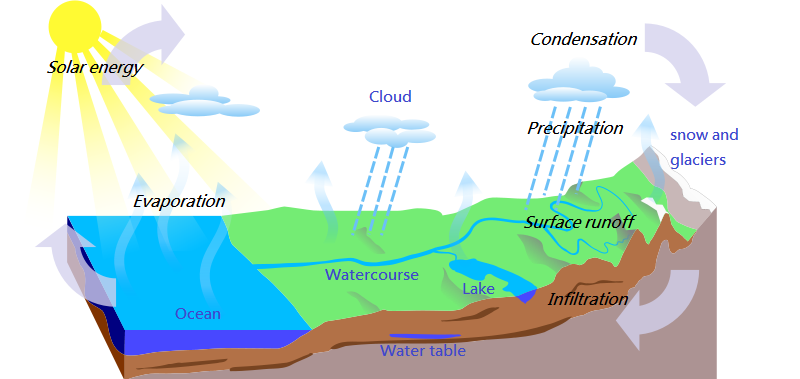
Infiltration and runoff
Infiltration capacity is the fastest rate at which soil can absorb water. If rain falls more slowly than that rate, all of it soaks in. When rain falls faster, the excess pools and runs off. Capacity depends on the soil texture, vegetation cover, compaction and how wet the soil already is. Wind and soil acidity do not affect it. Rain is classed as light below about 2.5 mm per hour, and intensity matters as much as total amount: the same 50 mm of rain soaks in over two days but floods a basin in two hours.
Reservoirs and residence time
About 97% of Earth's water is ocean. Of the roughly 2.5% that is fresh, most is ice and most of the rest is groundwater; rivers and lakes hold well under 1%. A reservoir's residence time is the average time water stays in it: volume divided by flux.
| Reservoir | Typical residence time | Why |
|---|---|---|
| Atmosphere | About 9 days | Small store, very fast fluxes |
| Rivers | Weeks to months | Water drains to the sea quickly |
| Soil moisture | Weeks to months | Lost to evapotranspiration and drainage |
| Large lakes | Years to centuries | Large volume relative to outflow |
| Groundwater | Decades (shallow) to over 10,000 years (deep) | Slow flow through pores |
| Ice sheets | Up to hundreds of thousands of years | Water locked as ice |
Published values vary by source, so treat these as orders of magnitude.
Water budgets
A water budget applies conservation of mass to a basin, lake or aquifer: what comes in, minus what goes out, equals the change in storage.
The critical zone
The critical zone is Earth's thin outer skin, from the treetops down to the base of weathered rock and groundwater, where rock, soil, water, air and life interact. Nearly every flux in the budget passes through it: roots draw soil water up for transpiration, soil pores set infiltration, and weathering supplies a river's dissolved load.
Climatic controls on fresh water
Climate sets how much water arrives and when. Seasonality decides whether streams flow all year, snowfall stores winter precipitation for a spring melt pulse, and intensity decides whether rain infiltrates or runs off. Precipitation also varies across space: totals change with latitude, distance from moisture sources and terrain, so isohyet maps (lines of equal precipitation) are a common figure.
Topography and geography
- Orographic lift. Moist air forced up a mountain range cools as it expands. Its vapor condenses, so the windward slope is wet.
- Rain shadow. After crossing the crest, the dried air sinks and warms by compression, so the leeward side is dry. Deserts east of the Sierra Nevada and the Cascades are classic rain shadows.
- Continentality. Interiors far from the ocean receive less moisture and have larger temperature swings than coasts.
- Lake effect. Cold, dry air crossing a large unfrozen lake picks up heat and moisture and drops heavy snow on the downwind shore, as on the eastern and southern shores of the Great Lakes.
Elevation adds to all four: mountains usually get more precipitation than lowlands and store it as snowpack that feeds summer rivers.
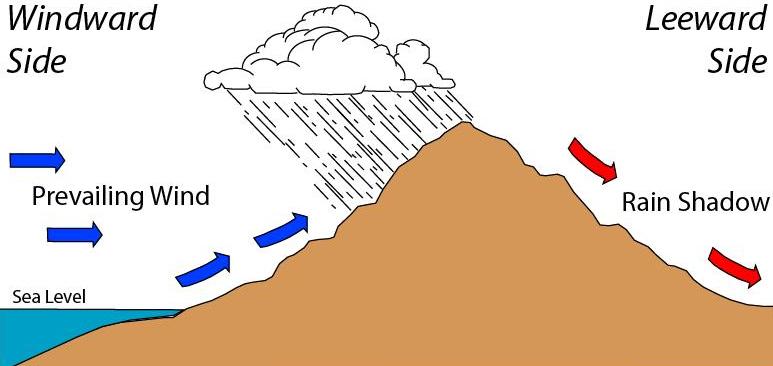
From arid to humid landscapes
The balance of precipitation against potential evaporation places a region on a spectrum from arid through semiarid to humid, and the landscape shows where it sits.
| Feature | Humid | Arid |
|---|---|---|
| Typical streams | Perennial, fed by groundwater (gaining) | Ephemeral, flowing only after storms, often losing water to the ground |
| Water table | Shallow, close to the channel bed | Deep, below the channel |
| Basins | Drain to the sea through integrated networks | Often closed (endorheic), ending in a lake or dry lake bed |
| Lakes | Freshwater with outlets | Saline lakes and playas, flat dry lake beds that flood briefly |
| Deposits | Organic-rich floodplain muds, peat | Evaporites such as halite and gypsum left by evaporating water; alluvial fans |
| Floods | Gradual rise, sustained flow | Flash floods on bare ground with low infiltration |
Endorheic basins are typical of deserts because evaporation removes water before the lake can rise to an outlet. Salts brought in by streams cannot leave, so they concentrate and precipitate as evaporites.
Drainage basins and stream networks
A drainage basin (watershed) is all the land draining to one outlet, bounded by a drainage divide, the ridge line that splits water between neighboring rivers. Basin traits set the storm response: steep, round basins with impermeable soils give high, early flood peaks, while long, narrow basins spread runoff out over time.
Stream order
Stream order ranks channels by their branching, and tests almost always use the Strahler method. A headwater channel with no tributaries is order 1. When two channels of the same order join, the channel below is one order higher. When a lower-order stream joins a higher-order one, the order does not change. Order counts branching, not length.

Low-order streams are numerous and short and high-order streams few and long, so most of a network is headwaters.
Drainage patterns
A network's map pattern records the rock structure beneath it, because streams follow the least resistant path.
| Pattern | Shape on a map | What it usually indicates |
|---|---|---|
| Dendritic | Tree-like, tributaries meet at acute angles | Rock of uniform resistance, flat-lying layers |
| Trellis | Parallel main streams, short tributaries at right angles | Alternating resistant and weak folded or tilted layers |
| Rectangular | Sharp right-angle bends | Joints or faults in the bedrock |
| Radial | Streams flow outward from a high point | A dome or volcanic cone |
| Centripetal | Streams flow inward to a low point | A basin, crater or sinkhole |
| Annular | Streams follow rings around a center | An eroded dome with rings of weak rock |
| Parallel | Streams run side by side | A steep, uniform slope |
| Deranged | Irregular, with lakes and swamps | Recently glaciated ground with no organized network yet |
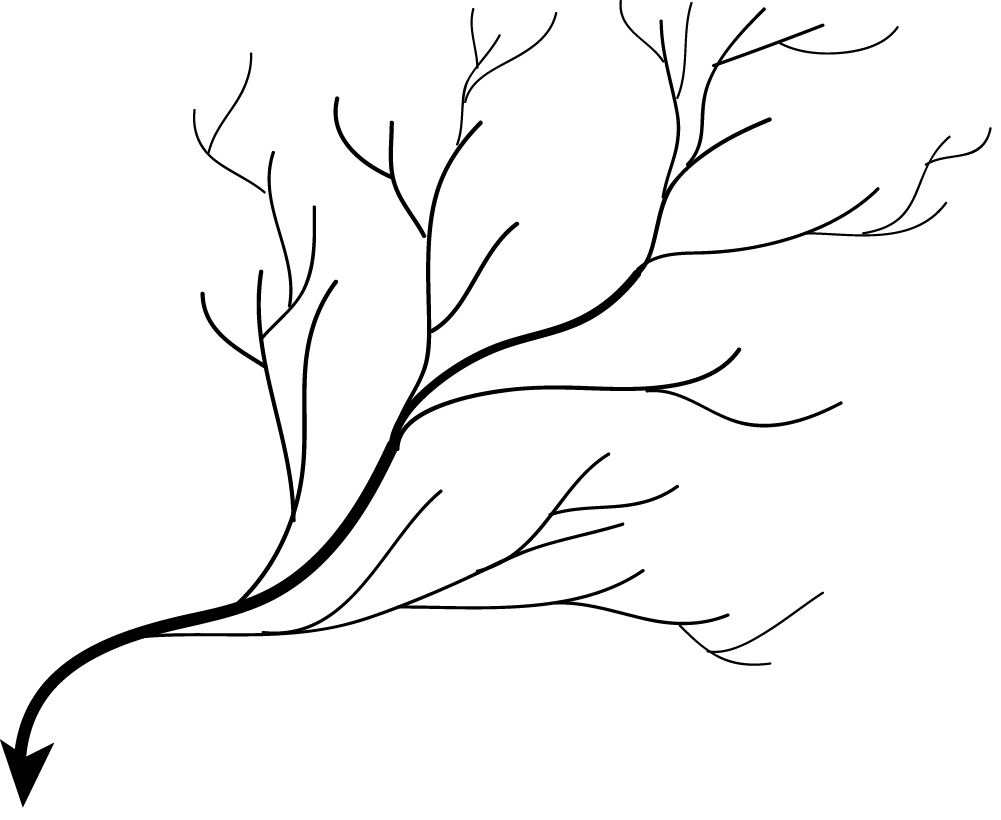
Drainage density and texture
Drainage density measures how closely the channels are spaced.
Drainage texture describes the same property qualitatively. A fine texture means many closely spaced channels, as in badlands on soft, impermeable clay with little vegetation. A coarse texture means widely spaced channels, as on permeable sandstone or limestone where most water infiltrates instead of running off.
Fluvial sediment and channel form
Sediment properties
Grain size follows the Udden-Wentworth scale: clay is finer than 1/256 mm, silt runs from 1/256 to 1/16 mm, sand from 1/16 to 2 mm, and gravel is coarser (granules, pebbles, cobbles above 64 mm, boulders above 256 mm). Sorting describes how similar the sizes are: river sand is moderately to well sorted, debris-flow and glacial deposits poorly sorted. Rounding (how worn the corners are) increases with transport distance. Shape depends partly on the source rock; slate gives flat pebbles however far it travels. Well sorted and well rounded means long transport; angular and poorly sorted means a nearby source.
Load, competence and capacity
A river carries sediment in three ways:
- Bed load rolls, slides or saltates (bounces in short hops) along the bottom. Sand and gravel travel this way.
- Suspended load is held up in the water by turbulence. Fine silt and clay in suspension are what make a river look muddy.
- Dissolved load is ions in solution. It is invisible and comes mostly from chemical weathering and groundwater inflow.
Competence is the largest grain a stream can move. A common textbook rule says the largest movable particle mass scales with about the sixth power of velocity, so doubling speed moves particles roughly 64 times heavier. Capacity is the total load a stream can carry, and it rises with discharge. Sediment supply is what the basin delivers; landslides, bare fields and construction raise it, forests and dams lower it. Supply above capacity means deposition and bars; supply below capacity means bed and bank erosion.
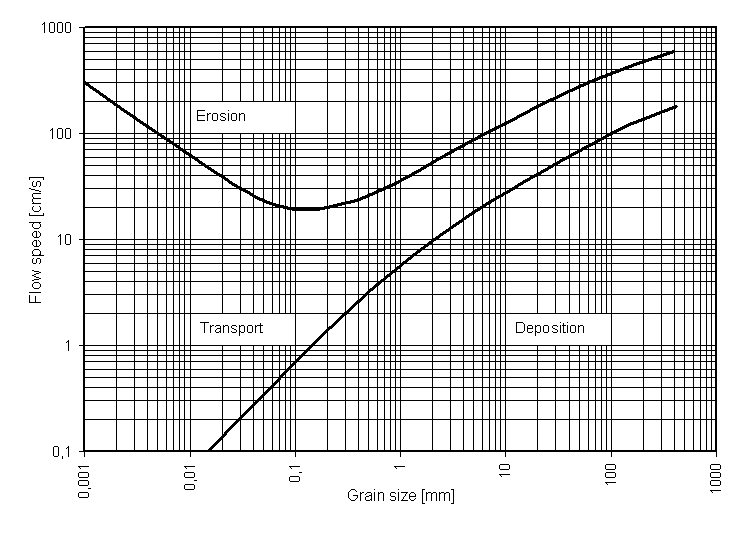
Large grains settle faster than small ones. For fine particles in still water (the Stokes regime) settling speed grows with the square of the diameter, because small grains have more surface area, and so more drag, per unit of mass.
Channel types and sinuosity
| Channel type | Look | Typical conditions |
|---|---|---|
| Straight | One channel, little bending | Short reaches, often guided by a fault or joint; rare over long distances |
| Meandering | One sinuous channel with point bars | Low gradient, fine cohesive banks, steady discharge, mostly suspended load |
| Braided | Many shallow strands around shifting bars | Steep gradient, abundant coarse bed load, erodible banks, highly variable discharge (glacial outwash, desert washes) |
| Anastomosing | Several deep, sinuous channels around stable vegetated islands | Very low gradient, fine sediment, cohesive banks, a rising base level |
The key difference between braided and anastomosing channels is stability. Braid bars shift with every flood, while anastomosing islands are vegetated and last for centuries.
Bedforms
As flow over sand strengthens, the bed changes in order. Slow flow builds small ripples, faster flow larger dunes; both have a gentle upstream side and a steep downstream side and migrate downstream as sand avalanches down the steep face. Faster still, dunes wash out to a flat plane bed. Near a Froude number of 1 the surface forms standing waves and the bed forms antidunes, in phase with the waves and able to migrate upstream. Bars are larger sand or gravel deposits: point bars in bends, mid-channel bars in braided rivers.
Fluvial landforms and valley processes
Long profile, gradient and base level
A longitudinal profile plots elevation against distance downstream. Most are concave-up, because discharge grows and sediment fines downstream, so the larger channel needs less slope to carry its load.
Base level is the lowest level a river can erode to: sea level ultimately, with lakes, reservoirs and resistant rock as local base levels. Lowering base level makes a river cut down; raising it causes deposition.
Graded streams and dynamic equilibrium
A graded stream has adjusted its slope and channel shape so that, averaged over years, it carries exactly the load supplied to it, neither eroding nor depositing overall. This is dynamic equilibrium: the river responds to any disturbance by changing in the direction that cancels it. For example, if base level drops, the river cuts down until a graded profile is restored. If supply increases, it deposits sediment and steepens until it can carry the extra load.
Erosional features and processes
Rivers erode by hydraulic action (moving water prying grains loose and forcing air into cracks), abrasion (carried grains grinding the bed) and solution. In uplands, downcutting outpaces widening and carves V-shaped valleys; lateral erosion by meandering widens valley floors.
A knickpoint is a sharp step in the profile, formed by a base-level drop, a fault or a resistant rock layer. Waterfalls are steep knickpoints that retreat upstream as weak rock under a resistant cap is undercut and the cap collapses, as at Niagara Falls. In stream capture (piracy), one stream erodes headward through a divide and steals a neighbor's headwaters. The clues are an elbow of capture (a sharp bend), a beheaded stream too small for its valley, and a dry notch in the ridge (a wind gap).
Meanders and floodplains
In a bend the fastest water swings outside and erodes a cut bank, while slower water inside deposits a point bar, so the bend migrates outward and downstream. When a narrow neck between bends is cut through, the abandoned loop becomes an oxbow lake.
The floodplain is the flat valley floor built from the river's own deposits. Floodwater overtopping the banks slows at once and drops its coarsest load beside the channel as natural levees; finer mud settles in backswamps. A river entering standing water builds a delta. A steep mountain stream reaching a flat valley loses confinement and gradient and drops its load as an alluvial fan, common in arid basins.
Streamflow and floods
Flow regimes
A perennial stream flows all year because groundwater keeps feeding it (baseflow). An intermittent stream flows for part of the year, when the water table rises above the bed in the wet season. An ephemeral stream flows only during and just after rain or snowmelt, because its bed is always above the water table.
A stream gains water where the water table slopes toward the channel and loses water where the channel sits above the water table. Humid-region streams are mostly gaining, arid-region streams mostly losing.
Discharge, velocity and load
Discharge is the volume of water passing a cross-section per second.
Velocity is fastest just below the surface mid-channel and slowest along the bed and banks, where friction acts. In a flood, discharge, velocity and depth rise together, so competence and capacity soar and most of a year's sediment can move in days. Sediment discharge (such as tonnes per day) is concentration times water discharge.
Open-channel flow equations
The rules do not name specific equations; the standard ones are Manning's and Chezy's, plus the Froude number above.
Flood frequency and recurrence intervals
Ranking each year's largest flood gives a recurrence interval, the average years between floods that size or larger.
Plotting discharge against recurrence interval on log paper gives a flood-frequency curve, from which you read the expected 50- or 100-year flood. Short records make its extreme end uncertain, and urbanization or dams shift it.
Groundwater and karst
Subsurface zones and capillarity
The zone of aeration (vadose zone) holds air and water in its pores; below it every pore in the zone of saturation is full. Their boundary is the water table, where water pressure equals atmospheric pressure. Capillarity (surface tension plus attraction to grain surfaces) draws water up into a capillary fringe above it, higher in finer pores: centimeters in coarse sand, a meter or more in silt and clay. A perched water table sits on a clay lens above the main one.
Aquifers, porosity and permeability
Porosity is the fraction of a material's volume that is open space, so it measures how much water the material holds. Permeability (for water, hydraulic conductivity K) measures how easily water moves through the connected pores. Clay has very high porosity but tiny, poorly connected pores, so it is nearly impermeable. Sand and gravel have lower porosity but high permeability. An aquifer stores and transmits useful amounts of water. An aquitard or aquiclude slows or blocks flow.
| Aquifer type | Setting | Water level in a well |
|---|---|---|
| Unconfined | Open to recharge from above; top is the water table | Stands at the water table |
| Confined | Sandwiched between aquitards; water under pressure | Rises above the top of the aquifer, to the potentiometric surface |
| Artesian (flowing) | Confined aquifer whose potentiometric surface is above the land | Flows out without pumping |
Hydraulic head and Darcy's law
Groundwater flows from high hydraulic head to low head. Head is the sum of elevation head (height above a datum) and pressure head (the height of the water column the pressure would support). The hydraulic gradient is the change in head divided by the distance between the points.
Recharge and discharge
Recharge reaches the saturated zone from infiltration and losing streams; the water table rises when recharge exceeds discharge. Groundwater discharges at springs, gaining streams, wetlands, lakes and wells. A spring forms where the water table meets the surface or an impermeable layer forces water out on a hillside. Flow paths curve from recharge to discharge areas, and the deepest paths carry the oldest water.
Saltwater intrusion
Along a coast, fresh groundwater floats on denser seawater as a lens.
Over-pumping lets saltwater advance inland as a wedge along the aquifer base and rise beneath a pumping well (upconing). Sea-level rise and reduced recharge do the same.
Karst
Karst forms where slightly acidic groundwater (rain plus soil CO₂ makes carbonic acid) dissolves soluble rock, mostly limestone, dolomite or gypsum. Dissolution widens joints into conduits and caves. Sinkholes form by dissolution or collapse, disappearing streams drop underground through swallow holes, lines of merged sinkholes form solution valleys, and large springs emerge where conduits reach the surface. Conduit flow is fast and unfiltered, so a spill can reach a spring kilometers away in hours, and underground divides may not match surface ones.
Lakes and wetlands
How lakes form
A lake needs a closed depression and enough water to fill it.
| Origin | How the basin forms | Examples |
|---|---|---|
| Tectonic | Rifting or faulting drops a block of crust (a graben) | Lake Baikal, Lake Tanganyika |
| Volcanic | A crater or collapsed caldera fills, or lava dams a valley | Crater Lake, Oregon |
| Glacial | Ice scours basins, leaves kettles from buried ice blocks, or moraines dam valleys | The Great Lakes, Finger Lakes, kettle ponds |
| Fluvial damming | A cut-off meander, or a tributary's sediment or a landslide blocking a valley | Oxbow lakes |
| Solution | Dissolution of soluble rock | Sinkhole lakes in Florida |
Lake water budgets
Lake level balances inflow (streams, rain, groundwater) against outflow (outlet, evaporation, seepage). An open lake's level is held near its outlet. A closed (endorheic) lake loses water only to evaporation and seepage, so it rises and falls with climate; when evaporation exceeds precipitation it falls and grows saltier. Residence time (V/Q) sets how fast a lake flushes pollutants.
Stratification and turnover
Fresh water is densest at about 4 °C. In summer the sun warms a light, mixed surface layer, the epilimnion. Below it, temperature drops sharply through the metalimnion, whose steepest part is the thermocline. Beneath lies the cold, dense hypolimnion, cut off from the air. In autumn the surface cools until the whole lake reaches the same temperature and density. Wind then mixes it top to bottom (fall turnover). In winter, ice caps water just above 0 °C over 4 °C water at the bottom. In spring the surface warms to 4 °C and the lake mixes again.

| Mixing regime | Mixes | Typical setting |
|---|---|---|
| Dimictic | Twice a year (spring, fall) | Temperate lakes that freeze |
| Warm monomictic | Once, in winter | Mild climates, never freezes |
| Cold monomictic | Once, in summer | Polar lakes, ice-covered most of the year |
| Polymictic | Many times | Shallow, windy lakes |
| Meromictic | Never fully | Deep lakes with a salty or solute-rich bottom layer |
Lakes that mix completely at least once a year are holomictic. A meromictic lake stays permanently layered because its bottom water is held dense by dissolved salts, not by temperature, so seasonal cooling cannot overturn it.
Chemical properties
Cold water holds more dissolved oxygen than warm water, and once the hypolimnion is sealed off, decomposition uses up its oxygen until the next turnover. Trophic state describes productivity: oligotrophic lakes are nutrient-poor, clear and oxygenated at depth; eutrophic lakes are nutrient-rich and green with oxygen-poor deep water; mesotrophic lakes lie between. The littoral zone is the shallow margin where light reaches the bottom and rooted plants grow; the profundal zone is the dark deep bottom. Most lakes are supersaturated in CO₂, so lakes overall are a net CO₂ source.
Shoreline processes
Wave size grows with wind speed, duration and fetch (the open-water distance the wind crosses). Waves cut cliffs and terraces into headlands; waves striking at an angle drive longshore drift, which builds spits and bars. Strong wind or pressure changes tilt the lake surface, which then sloshes as a seiche. Ancient lakes such as Lake Bonneville left terraces and beach ridges high on surrounding slopes that record former water levels.
Wetlands
Wetlands are areas saturated or flooded long enough to support water-adapted plants. Their hydroperiod (the pattern and length of flooding) defines them.
| Type | Vegetation | Water source and chemistry |
|---|---|---|
| Marsh | Grasses, reeds, cattails | Surface water, often flooded; nutrient-rich |
| Swamp | Trees and shrubs | Floodplains and lake margins, flooded seasonally |
| Bog | Sphagnum moss, peat | Rain only; acidic and nutrient-poor |
| Fen | Sedges, grasses, peat | Groundwater-fed; less acidic, more minerals |
Wetlands form where drainage is poor: on flat floodplains, in filled-in lakes, at groundwater discharge zones and in glacial depressions. They store floodwater, slow runoff, trap sediment and remove nutrients.
The geologic and paleohydrologic record
Water leaves fingerprints in sediment, so rocks record ancient rivers and lakes. Questions show a photo or sketch of a structure and ask what conditions it records and which way was up.
| Structure | How it forms | What it tells you |
|---|---|---|
| Asymmetric ripple marks | A one-way current drags sand into ripples with a steep downstream face | Flow direction (the steep side faces downcurrent) |
| Symmetric ripple marks | Waves rock water back and forth in shallow water | Wave action in a lake or shoreline |
| Cross-bedding | Ripples or dunes migrate and bury their sloping faces | Current direction from the dip of the inclined layers; younging direction from layers that curve into the base |
| Graded bedding | Coarse grains settle first as a current slows, then finer ones | A waning flow; the coarse base marks the bottom of the bed |
| Mud cracks | Wet mud dries, shrinks and splits into polygons | Exposure to air: an ephemeral pool, floodplain or playa |
| Raindrop imprints | Raindrops pit soft, exposed mud | Air exposure and rain on a muddy surface |

Paleochannels are abandoned or buried river channels. In rock they are lens-shaped sand or gravel bodies with an erosional base cut into floodplain mud, often fining upward, the signature of a migrating point bar. At the surface they show on aerial and satellite images as curving strips of different soil moisture or vegetation, and buried ones make good shallow aquifers. Lacustrine deposits are fine, evenly laminated mud. Glacial lakes lay down varves, a light silty summer layer and a dark clay winter layer each year, so counting couplets dates the lake. Evaporites and stranded shoreline terraces mark lakes that dried up.
Human impacts and water quality
Land-use change
Pavement and roofs cut infiltration, so runoff rises, flood peaks come sooner and higher, and baseflow falls. Land clearing and construction flood streams with sediment, and farming adds nutrients. Muddier, warmer, flashier streams then favor different species.
Engineering structures and water extraction
| Structure | Intended effect | Side effects on the river |
|---|---|---|
| Dams | Store water, generate power, control floods | Trap sediment in the reservoir, which fills over time; clear "sediment-hungry" water below the dam erodes and downcuts the bed; deltas downstream shrink; temperature and flow seasons change |
| Levees | Keep floods off the floodplain | Confine flow so flood stage rises; floodplain loses sediment and wetlands; failure floods protected land |
| Channelization | Straighten and deepen for drainage or navigation | Shorter path means steeper gradient and faster flow, which causes bed and bank erosion and passes floods downstream faster; habitat loss |
| Diversion | Move water to farms and cities | Lower flow downstream; rivers such as the Colorado often no longer reach the sea, and the Aral Sea shrank after its inflows were diverted |
Pumping faster than recharge causes aquifer depletion: water tables fall, wells must be deepened, springs and gaining streams dry up, and coastal wells turn salty. Each pumping well draws the water table into a cone of depression, deepest at the well. The cone widens as pumping continues until it captures enough recharge, or reaches a stream or lake, to balance the withdrawal. At a given pumping rate, a permeable aquifer gives a broad, shallow cone and a tight one a steep, narrow cone.

Land subsidence follows heavy pumping from aquifers with clay layers: as pore pressure falls the clay compacts, mostly permanently, so the ground sinks and storage is lost for good. Parts of California's San Joaquin Valley sank close to 9 m in the twentieth century.
Water pollution: types, sources and transport
A point source discharges from one identifiable outlet, such as a sewage or factory pipe. A nonpoint source is spread over an area: field fertilizer and manure, road salt, urban runoff. Point sources are easier to measure and regulate, so nonpoint sources now cause most U.S. impairment.
| Pollutant type | Typical sources | Effect |
|---|---|---|
| Nutrients (N, P) | Fertilizer, manure, sewage | Algal blooms, then oxygen loss (eutrophication) |
| Organic matter | Sewage, food processing | High biochemical oxygen demand (BOD), low dissolved oxygen |
| Pathogens | Sewage, livestock | Disease; indicated by fecal coliform bacteria |
| Sediment | Construction, farming, logging | Turbidity, buried habitat, filled reservoirs |
| Heat | Power-plant cooling water | Warm water holds less oxygen |
| Acid and metals | Acid mine drainage: pyrite exposed to air and water makes sulfuric acid | Low pH, dissolved heavy metals |
| Salts | Road salt, irrigation return flow, intrusion | Undrinkable water, soil salinization |
| Synthetic chemicals | Pesticides, fuels, solvents | Toxicity; some persist for decades |
Sewage shows up as high nutrients plus high BOD. Thermal pollution and eutrophication share one result: lower dissolved oxygen.
In rivers, pollutants move downstream at about the flow velocity and are diluted by tributaries. In groundwater they form a plume that is carried at the seepage velocity (advection), spreads (dispersion) and is slowed by sticking to grains (sorption). Fuels float on the water table; dense solvents sink to the aquifer base. Because groundwater is slow, contamination found today may be decades old and take as long to flush.
Measuring and monitoring fresh water
Reading topographic maps
Contours crossing a stream bend into a V that points upstream (the rule of V's). Close spacing means steep ground, and stream gradient is the contour interval divided by the channel distance between contours. Solid blue lines are perennial streams, dashed blue lines intermittent ones; marsh symbols mark wetlands, and closed contours with inward hachures mark depressions such as sinkholes. To outline a watershed, trace the high ground around the outlet, crossing contours at right angles.
Mapping the water table
Water-table elevation at a well is land-surface elevation minus depth to water. Plot it for several wells and contour equal head. In uniform material groundwater flows downhill perpendicular to the contours, so flow lines cross them at right angles. With three wells, solve the three-point problem: interpolate along the lines between wells to place a contour, draw it, and take flow perpendicular to it toward lower head.
Stream gauging and hydrographs
A gauge records stage (water-surface height) continuously. Every few weeks hydrologists measure discharge directly: they split the channel into vertical sections, measure depth and velocity in each with a current meter or acoustic profiler, and sum velocity times area. Velocity is read at 0.6 of the depth below the surface in shallow water, or as the average of readings at 0.2 and 0.8 of the depth in deeper water. A current meter measures only velocity; discharge is calculated. Stage–discharge pairs build a rating curve that converts the stage record into discharge, and it must be re-measured when floods reshape the channel.
A hydrograph plots discharge against time. A storm drives discharge up the rising limb to the peak discharge and down the recession limb. Baseflow is the slow groundwater contribution underneath; stormflow (quickflow) is the runoff above it. Lag time runs from peak rainfall to peak discharge. Pavement, steep slopes, small basins and saturated soil shorten lag and raise the peak; forests, wetlands, permeable soils and large basins do the opposite.
Monitoring networks and techniques
Observation wells (and piezometers, which read head at one depth) track water levels and quality, revealing seasonal recharge and long-term depletion. Streamgage networks record discharge at thousands of sites for flood warning and supply. Tracer studies release dye, salt or isotopes and watch where and when they appear; dye traces map karst conduits and underground divides, and salt dilution gauges turbulent mountain streams. Remote sensing covers wide areas: satellite images map lakes, floods and paleochannels, radar altimetry measures lake levels, InSAR detects subsidence, and the GRACE satellites measured groundwater depletion from tiny changes in gravity.
Common pitfalls
How tournaments test this
The Scio.ly archive holds 3,304 Earth's Fresh Waters questions from public tests (141 from 2017, 1,430 from 2022, 1,733 from 2023), and the practice bank about 7,300 more. Those tests followed older outlines; the 2027 outline names climate controls, sedimentary structures, flood frequency and monitoring explicitly, so expect more of them than the archive shows.
- Format. Free response 54% (1,793 of 3,304), multiple choice 37% (1,221), then select-all (146), true/false (74) and numeric (70). Since 2027 scoring rewards reasoning, name the mechanism in free response.
- Tasks. "Explain or why" leads (11.6%), then "which of the following" (9.7%) and graph or table interpretation (3.6%). Calculations are only 3.0% but appear on most tests: discharge, gradient, sinuosity, recurrence interval, residence time, Darcy flow. Most questions carry no single task label.
- Subtopic tags. Rivers (1,311), Groundwater (894), Lakes (578), Hydrology (526), Pollution (231).
- Recurring phrases across archive and bank: "drainage pattern" (151 questions), "karst topography" (91), "hydraulic conductivity" (82), "stream order" (78), "Darcy law" (69), "base level" (68).
- Recurring correct answers: Limestone (45), Clay (37), Meandering (24), Bed load (21), Radial (19), Suspended load (17), Porosity (16), Spring (16), Permeability (14), Trellis (13), Dendritic (12).
- Typical shapes. A drainage-pattern or stream-order figure, a topographic map, well data to contour, a hydrograph, a photo of a sedimentary structure, and a one-step calculation. Stations often hang three or four questions on one figure, so tab your binder by rules area.
Test yourself
These are real questions from public tournament tests. Click an answer to check it; each links to the full test. Each one was re-solved before inclusion, and questions whose official key could not be confirmed were left out.
- 1
Which of these is/are true about Earth’s water and hydrologic cycle?
I. In the oceans, overall precipitation balances overall evaporation II. Most freshwater is contained in glaciers and ice III. Energy from the Sun drives the hydrologic cycle
Practice more Dynamic Planet questions →
- 1
What two processes are most likely to lead to a rise in the water table?
Practice more Dynamic Planet questions →
References and further reading
- USGS Water Science School (water cycle, streamflow, groundwater, water quality): https://www.usgs.gov/special-topics/water-science-school
- USGS, How streamflow is measured: https://www.usgs.gov/water-science-school/science/how-streamflow-measured
- USGS, Land subsidence in the San Joaquin Valley: https://www.usgs.gov/centers/land-subsidence-in-california
- USGS, Floods and recurrence intervals: https://www.usgs.gov/special-topics/water-science-school/science/floods-and-recurrence-intervals
- OpenStax-style open textbook: Steven Earle, Physical Geology (chapters on streams, groundwater and sedimentary rocks): https://opentextbc.ca/physicalgeology2ed/
- NOAA National Weather Service, glossary of precipitation terms: https://www.weather.gov/
- National Science Foundation, Critical Zone Collaborative Network: https://criticalzone.org/
- USGS, How to read topographic maps: https://www.usgs.gov/faqs/how-do-i-read-topographic-maps
- SciOly Wiki, Dynamic Planet event page (another summary; compare, do not copy): https://scioly.org/wiki/index.php/Dynamic_Planet
- Practice more: the archived Dynamic Planet tests in the Scio.ly test archive.