Thermodynamics
2027 season
On this page(16 sections)
Thermodynamics is the study of energy moving as heat and work: why heat flows from hot to cold, how much energy it takes to warm or melt something, and why no engine can turn all of its heat into work. In the 2027 event you use that physics twice. A written test checks the ideas and the calculations, and a device you build before the tournament has to soak up energy from a heat lamp and pass it to a cup of room-temperature water while you predict how warm the water will get. The same habits win both parts: think about where the energy goes, and put numbers on it quickly.
Event format
Thermodynamics is a hybrid event with the same structure in Division B and Division C.
| Item | 2027 rules |
|---|---|
| Team size | Up to 2 |
| Time | About 50 minutes |
| Parts | Part I: written test. Part II: testing a heat-collecting device built before the tournament |
| Impound | Yes, for the device and spare parts only |
| Calculators | Up to two Class III calculators, usable at any point in the event |
| Notes | Unlimited paper notes in any form (binders, books, folders, sheet protectors, tabs); pages may be removed during the event |
| Also allowed | One device, spare parts, tools that help with setup, and prepared graphs or tables for predicting the device's result |
| Provided by the supervisor | Heat lamp setup, water bath, the 9 oz plastic cup with 100 mL of water, and the thermometer. Do not bring your own |
| Scoring | Exam Score (50) + Temperature Score (30) + Prediction Score (20) = 100 points |
Everything you impound has to be at room temperature, and you may not bring or use your own thermometer during Part II (or borrow the supervisor's). Your prediction comes from the data you collected at home and the graphs or tables you bring.
What the rules cover
The written test draws at least three questions from each topic area in the 2027 outline. The table paraphrases the outline and shows where each topic applies.
| Area | Topics | Division B | Division C |
|---|---|---|---|
| 1. Systems and temperature | Thermodynamic systems; intensive and extensive properties; what temperature is; the zeroth law; temperature scales and conversions; heat-related units | All levels | All levels |
| 2. Phases and gases | States of matter, phase transitions, phase diagrams, latent and sensible heat, the ideal gas law | All levels | All levels |
| 3. Heat transfer | Conduction, convection and radiation; thermal conductivity; heat capacity; specific heat | All levels | All levels |
| 4. Processes and engines | Adiabatic, isothermal, isochoric and isobaric processes; cycles; engines; efficiency; first and second laws | All levels | All levels |
| 5. History | Kelvin, Joseph Black, Joule, Carnot, Planck, Clausius, Boltzmann and Maxwell | All levels | All levels |
| 6. Radiation and the third law | Radiant exitance, blackbody radiation, Stefan-Boltzmann law, third law | State & National | State & National |
| 7. Entropy and enthalpy | Entropy and enthalpy as quantities | Not tested | State & National |
The rules also limit the math. Both divisions use arithmetic with ratios, exponents and absolute value, plus area and volume of common shapes. Division B algebra stays at solving one equation for one unknown; Division C may ask for multi-step derivations with several variables. Neither division may require trigonometry or calculus. Answers are expected in metric units with sensible significant figures unless a question says otherwise.
Systems, properties and temperature
Systems and surroundings
A system is whatever you choose to study: the water in the cup, the gas in a piston, a whole engine. Everything else is the surroundings, and the boundary separates them. Systems are classified by what can cross that boundary.
| System type | Energy crosses? | Matter crosses? | Example |
|---|---|---|---|
| Open | Yes | Yes | A pot of boiling water without a lid (steam escapes) |
| Closed | Yes | No | A sealed balloon warmed in sunlight |
| Isolated | No | No | An ideal insulated, sealed container (real ones only approximate it) |
The cup of water in Part II is close to a closed system while it heats: energy arrives by radiation, conduction and convection, but very little water leaves (a small amount evaporates, which technically makes it open).
Intensive and extensive properties
An extensive property depends on how much material you have: mass, volume, internal energy, heat capacity, and (for Division C at State and National) entropy and enthalpy. Cut the sample in half and the property halves. An intensive property does not depend on amount: temperature, pressure, density, specific heat and molar mass. Cutting the sample in half leaves it unchanged.
A quick test: the ratio of two extensive properties is intensive. Mass ÷ volume gives density; heat capacity ÷ mass gives specific heat.
Temperature is not heat
Temperature measures the average kinetic energy of the particles in a substance. For an ideal gas the link is exact: the average translational kinetic energy per molecule is , with J/K and in kelvin. Heat is energy in transit because of a temperature difference. An object does not "contain heat"; it contains internal energy, and heat is what crosses its boundary.
A swimming pool and a cup of tea can share a temperature while the pool holds vastly more internal energy. Temperature tells you which way heat will flow; how much flows depends on mass, specific heat and time.
The zeroth law and thermometers
The zeroth law says that if A is in thermal equilibrium with C, and B is in thermal equilibrium with C, then A and B are in thermal equilibrium with each other. It is what makes a thermometer meaningful: the thermometer (C) comes to equilibrium with the water (A), and its reading tells you what any other object (B) at the same reading would be. The law was named "zeroth" because it was recognized as logically more basic only after the first and second laws already had their numbers.
Temperature scales and conversions
Celsius and Fahrenheit are relative scales with arbitrary zeros. Kelvin and Rankine are absolute scales that put zero at absolute zero. One kelvin is the same size as one Celsius degree, and one Rankine degree is the same size as one Fahrenheit degree.
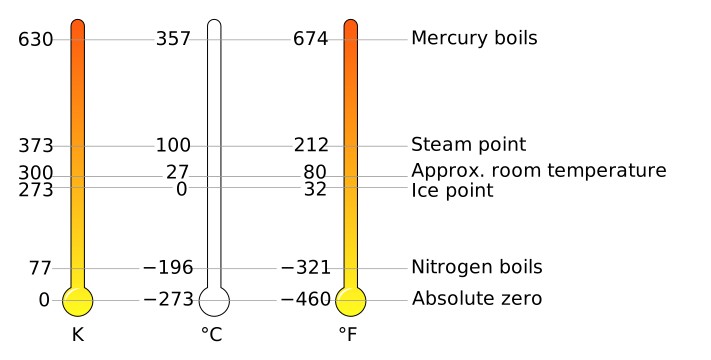
Since 2019 the kelvin has been defined by fixing the numerical value of the Boltzmann constant. Before that it was defined through the triple point of water, 273.16 K. Older tests may phrase it either way.
Heat-related units
| Unit | Meaning | Value in SI |
|---|---|---|
| Joule (J) | SI unit of energy, heat and work | 1 J = 1 N·m |
| Calorie (cal) | Heat to warm 1 g of water by about 1 °C | 4.184 J |
| Food Calorie (Cal, kcal) | 1,000 calories | 4,184 J |
| British thermal unit (BTU) | Heat to warm 1 lb of water by 1 °F | about 1,055 J |
| Watt (W) | Power: energy per second | 1 J/s |
| Kilowatt-hour (kWh) | Energy at 1 kW for 1 hour | 3.6 × 10⁶ J |
Related quantities carry their own units: specific heat in J/(kg·K) or J/(g·°C), latent heat in J/kg, thermal conductivity in W/(m·K), and pressure in pascals (1 kPa = 1,000 Pa; 1 atm = 101,325 Pa).
Phases, latent heat and the ideal gas law
Phases and phase transitions
Solids hold their particles in fixed positions; liquids let them slide past one another; gases let them move freely and fill their container. (Plasma, an ionized gas, is sometimes listed as a fourth state.) The six transitions come in pairs:
| Transition | Direction | Heat |
|---|---|---|
| Melting (fusion) / freezing | Solid ↔ liquid | Absorbed on melting, released on freezing |
| Vaporization (boiling, evaporation) / condensation | Liquid ↔ gas | Absorbed on vaporizing, released on condensing |
| Sublimation / deposition | Solid ↔ gas | Absorbed on sublimating, released on depositing |
Evaporation happens at the surface at any temperature; boiling happens throughout the liquid when its vapor pressure equals the surrounding pressure. Evaporation cools what is left behind, because the fastest molecules leave.
Sensible and latent heat
Sensible heat changes temperature without changing phase. Latent heat changes phase without changing temperature. During melting or boiling the energy goes into breaking intermolecular attractions rather than into faster particle motion, so the thermometer reading stays flat.
A heating curve plots temperature against heat added. Sloped segments are sensible heating, with slopes set by for each phase; flat segments are phase changes, with lengths set by . Because for water is almost seven times , the boiling plateau is far longer than the melting plateau.
Phase diagrams
A phase diagram maps which phase is stable at each pressure and temperature. The lines are coexistence curves where two phases are in equilibrium. They meet at the triple point, where all three coexist (for water, 0.01 °C and about 612 Pa). The liquid-vapor line ends at the critical point, beyond which liquid and gas are no longer distinct (a supercritical fluid).
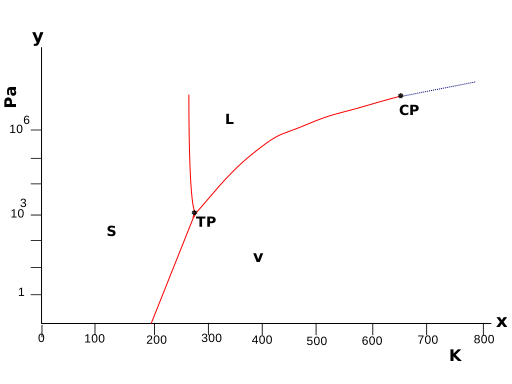
Read a diagram by asking two things: which region holds the given point, and which line a process crosses. Moving right at constant pressure is heating; moving up at constant temperature is compressing. Below the triple-point pressure a solid sublimates directly to vapor, which is why dry ice (CO₂) never melts at 1 atm.
The ideal gas law
The ideal gas model treats particles as points that collide elastically and do not attract one another. Real gases behave this way at low pressure and high temperature. The ideal gas law combines Boyle's, Charles's and Gay-Lussac's laws with Avogadro's principle.
| Law | Held constant | Relationship |
|---|---|---|
| Boyle | , | |
| Charles | , | |
| Gay-Lussac | , | |
| Avogadro | , |
Heat transfer, conductivity and heat capacity
Heat moves by three mechanisms, and tests often describe a situation in one sentence and ask which one dominates. All three matter for the Part II device.
Conduction
Conduction is energy passed through a material by particle collisions and, in metals, by free electrons. The material itself does not move. The rate through a slab follows Fourier's law.

Thermal conductivity is a material property. Approximate room-temperature values: copper about 400, aluminum about 240, glass about 1, water about 0.6, wood about 0.1 to 0.2, polystyrene foam about 0.03, and still air about 0.026 W/(m·K). Foams insulate well because they trap small pockets of air that cannot circulate.
Convection
Convection carries energy by the bulk motion of a fluid. Warmed fluid expands, becomes less dense and rises; cooler fluid sinks to replace it. In natural convection density differences alone drive the flow; in forced convection a fan, pump or wind does. Convection needs a fluid, so it cannot happen through a solid or across a vacuum.
Radiation
Thermal radiation is energy carried by electromagnetic waves, mostly infrared at everyday temperatures. It needs no medium, which is how sunlight crosses space and how a heat lamp warms your hand from half a metre away. Every object above absolute zero radiates, and hotter objects radiate much more strongly. How well a surface absorbs radiation is described by its absorptivity; a good absorber is also a good emitter at the same wavelength. Matte black surfaces absorb most visible and infrared light; shiny metal surfaces reflect most of it.
Heat capacity, specific heat and calorimetry
Heat capacity is the energy an object needs per kelvin of warming; for a single material . A material with high specific heat warms slowly for a given energy input, which is why water is such a good heat store and why 100 mL of water in Part II needs about 419 J for every 1 °C of rise ( J/(kg·K)).
| Material | Approximate in J/(kg·K) |
|---|---|
| Water (liquid) | 4,186 |
| Ice | about 2,100 |
| Aluminum | about 900 |
| Glass | about 840 |
| Iron | about 450 |
| Copper | about 385 |
Calorimetry measures heat through temperature change. In an insulated mixture, the heat lost by the warm parts equals the heat gained by the cool parts. A coffee-cup calorimeter works at constant pressure; a bomb calorimeter seals the sample in a rigid steel vessel, so it works at constant volume (isochoric).
Newton's law of cooling
For modest temperature differences, an object's rate of heat loss is roughly proportional to its temperature difference from the surroundings. That makes temperature approach room temperature along an exponential curve, fast at first and then slowly.
The idea matters for Part II in reverse: as your cup warms above room temperature it starts losing heat faster, so the temperature rise per minute shrinks over the Heating Time. A device that keeps losses low holds its warming rate up for longer.
Processes, cycles, engines and the laws
The first law
The first law is energy conservation with heat included. The change in a system's internal energy equals the heat added to it minus the work it does on its surroundings.
For a gas at constant pressure, work done by the gas is (Pa × m³ = J). On a pressure-volume (P-V) graph, the work is the area under the process curve.
The four standard processes
| Process | Held constant | First-law consequence | Ideal gas relation |
|---|---|---|---|
| Isothermal | Temperature | , so | = constant |
| Adiabatic | No heat exchange () | : expansion cools, compression warms | = constant (reversible) |
| Isobaric | Pressure | = constant | |
| Isochoric (isovolumetric) | Volume | , so | = constant |
Here , about 1.67 for a monatomic gas and 1.40 for a diatomic gas such as air. On a P-V diagram an adiabat through a point is steeper than the isotherm through the same point. A bicycle pump warming as you pump and a spray can cooling as it empties are both close to adiabatic, because the change is too fast for much heat to flow.
Cycles and heat engines
A thermodynamic cycle returns a system to its starting state, so over the whole loop and the net work equals the net heat. A heat engine runs a cycle that takes heat from a hot reservoir, does work , and rejects to a cold reservoir.

The Carnot cycle is the ideal reversible cycle: isothermal expansion at (absorbing heat), adiabatic expansion down to , isothermal compression at (rejecting heat), and adiabatic compression back to . No engine between the same two reservoirs can beat it.
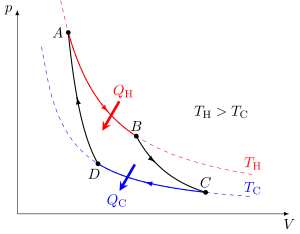
Other cycles appear as P-V diagrams on tests. The Otto cycle (gasoline engines) uses two adiabats and two isochoric steps; the Diesel cycle replaces the heat-input isochore with an isobaric step; the Rankine cycle (steam power plants) boils and condenses water. Recognize each by its shape: vertical segments are isochoric, horizontal segments isobaric.
Refrigerators and heat pumps run a cycle backwards, using work to move heat from cold to hot. Their performance is a coefficient of performance: for a refrigerator, , with a Carnot limit of . For K and K the limit is 9.
The second law
The second law has two classic statements that are logically equivalent:
- Clausius statement: heat does not flow on its own from a colder body to a hotter one. A refrigerator needs work input.
- Kelvin-Planck statement: no cyclic engine can take heat from a single reservoir and turn all of it into work. Every engine must reject some heat.
Together they explain why the Carnot limit exists and why real processes run one way. Note that mass conservation is not one of the laws of thermodynamics; a "which is not a law" question often uses it as the distractor.
History of thermodynamics
The 2027 outline names eight scientists. Learn each with a contribution and a rough date; tests usually ask who, not when.
| Scientist | Main contributions | Approximate date |
|---|---|---|
| Joseph Black | Distinguished heat from temperature; discovered latent heat and introduced specific heat (heat capacity) | 1760s |
| Sadi Carnot | Reflections on the Motive Power of Fire: the ideal reversible engine, and efficiency set by reservoir temperatures | 1824 |
| James Prescott Joule | Measured the mechanical equivalent of heat (falling weights turning a paddle wheel in water); Joule heating in wires; the joule is named for him | 1840s |
| William Thomson, Lord Kelvin | Absolute temperature scale; a statement of the second law; worked with Joule on the Joule-Thomson effect | 1848-1851 |
| Rudolf Clausius | Stated the second law (heat does not flow cold to hot unaided); coined "entropy" | 1850, 1865 |
| James Clerk Maxwell | Distribution of molecular speeds in a gas; the "Maxwell's demon" thought experiment; Maxwell relations | 1860s-1870s |
| Ludwig Boltzmann | Statistical meaning of entropy, ; derived the Stefan-Boltzmann law from theory | 1870s-1880s |
| Max Planck | Blackbody radiation law, which introduced energy quanta and Planck's constant; his wording of the second law is why the Kelvin-Planck statement carries his name | 1900 |
Some connecting threads help on "which scientist" questions. Black's latent heat is why melting takes energy without a temperature change. Joule's experiments showed heat and work are two forms of the same energy, the core of the first law. Carnot's engine analysis came before anyone understood energy conservation, and Clausius and Kelvin later reconciled it with Joule's work into the second law. Maxwell and Boltzmann connected those laws to the motion of molecules, and Planck's blackbody law closed the century by showing that classical physics alone could not explain thermal radiation.
State & National: radiation and the third law
Blackbody radiation
A blackbody is an ideal object that absorbs all radiation falling on it and emits the maximum possible thermal radiation at every wavelength for its temperature. Its spectrum depends only on temperature. As temperature rises, the curve grows taller everywhere and its peak shifts to shorter wavelengths: a stove element glows dull red, a hotter filament glows yellow-white. Planck's 1900 formula describes this curve, and it only works if energy is exchanged in discrete quanta.
Radiant exitance and the Stefan-Boltzmann law
Radiant exitance is the radiant power emitted per unit area of a surface, in W/m². For a blackbody it depends only on temperature, through the Stefan-Boltzmann law. Real surfaces emit a fraction (the emissivity, from 0 to 1) of the blackbody value.
The third law
The third law says that the entropy of a perfect crystal approaches a constant, taken as zero, as its temperature approaches absolute zero. A practical consequence is that absolute zero cannot be reached in a finite number of steps: each cooling step removes a smaller and smaller amount. The law grew out of Walther Nernst's heat theorem (1906). In Division B at State and National, expect the statement and its consequences rather than entropy calculations.
Division C, State & National: entropy and enthalpy
Entropy
Entropy is a state function that measures how spread out energy is, or statistically, how many microscopic arrangements (microstates, ) fit a given macroscopic state. The second law in entropy language: the total entropy of an isolated system never decreases, and it increases in any irreversible process.
Because the rules exclude calculus, expect entropy questions at fixed temperature (phase changes, reservoirs), sign reasoning (does entropy rise or fall?), and the statistical picture. For warming a substance over a range, some tests give as a formula to apply.
Enthalpy
Enthalpy is defined as . At constant pressure, the heat absorbed equals the enthalpy change, , which is why heats of reaction, fusion and vaporization are tabulated as enthalpy changes. A negative is exothermic (heat released); a positive is endothermic (heat absorbed). Enthalpy is a state function, so Hess's law lets you add the values of steps to get the overall change.
Internal energy, enthalpy and entropy are all state functions; heat and work are not, because their values depend on the path between two states.
The heat-collecting device (Part II)
What the device must do
Your device collects energy from a supervisor's heat lamp and delivers it to 100 mL of room-temperature water in a clear 9 oz plastic party cup. The rules treat this as a heating problem, not an insulation problem: you are scored on how much the water warms and on how well you predict its final temperature.
Construction limits
- Materials. Almost anything is allowed. The exceptions are hazardous materials such as asbestos, mineral wool and fiberglass; thermometers and probes; and commercially made thermoses, coolers or vacuum-sealed containers. A device with a hazardous material may not be set up or tested at all, and the team takes only the written test.
- No energy sources. No electrical parts, battery heaters, chemical reactions or similar. A device found to use one scores zero for both TS and PS, and the supervisor may ask you to take the device apart after testing to check.
- Size. With the cup of water in place, the whole setup must fit inside a 30.0 cm cube.
- The cup. You must be able to put the supervisor's cup into the device and take it out. Device parts may reach inside the cup, but nothing may touch the water and nothing may be added to it.
- Temperature. No part may be noticeably warmer or colder than the room at the start, so pre-heated or chilled parts are out.
- Questions. Be ready to explain how the device was designed, built and operates.
The test setup
The supervisor uses a clamp lamp with a metal reflector and a 100-125 W heat-lamp bulb that is not tinted and not an LED, halogen or ceramic bulb, hung pointing down over the table. Your device sits centered beneath it, and the lamp stand's feet stay at least 15 cm from the bulb's center. The bulb height and Heating Time are the same for every team in a tournament but change between tournaments:
| Level | Bulb height (lowest point of bulb above the table) | Heating Time |
|---|---|---|
| Regional | 40-50 cm, in 5 cm steps | 10 min |
| State | 40-55 cm, in 5 cm steps | 10-15 min, in 1 min steps |
| National | 40-65 cm, in 1 cm steps | 10-15 min, in 1 min steps |
Because the device may be at most 30 cm tall, there is always at least 10 cm between the top of a 30 cm device and the bottom of the bulb.
The testing sequence
- The supervisor announces bulb height, Heating Time, room temperature, water-bath temperature and the bulb's specifications (wattage and dimensions).
- Device Setup Time, 3 minutes. Set up or adjust the device, fix any construction problems, and start your prediction. The clock keeps running through any re-checks, and after this only inserting or removing the cup is allowed.
- The supervisor pours 100 mL from the bath into your cup, measures its starting temperature to 0.1 °C, and tells you.
- Water Setup Time, up to 1 minute. Put the cup in the device without otherwise handling the cup or water.
- The lamp turns on and the Heating Time starts. Touching the device or the lamp setup during heating zeroes both TS and PS.
- Lock in your prediction, in °C, before the Heating Time ends.
- When the lamp goes off, lift the cup fully out and set it on the table apart from the device; the supervisor reads the final temperature to 0.1 °C, aiming to finish within a minute.
- Review your recorded data with the supervisor before leaving. If you plan to appeal anything about Part II, leave your device in the competition area.
The physics of a good collector
Start with an energy budget. Warming 100 mL of water by needs joules.
Most of the lamp's 100-125 W never reaches the cup. A heat lamp radiates over a wide cone, much of it misses the cup's small mouth (about 7.5 cm across), and some of what arrives is reflected or warms device parts instead of water. A good design works on four levers:
- Capture more radiation. Reflective surfaces (for example aluminum foil on a cone or funnel) can redirect rays that would miss the cup back toward it. The wider the opening that catches light within the 30 cm limit, the more power is intercepted.
- Absorb it where it counts. Water absorbs infrared strongly, and the clear cup lets much radiation through to it. Dark, matte surfaces absorb well; a dark sleeve hugging the outside of the cup turns radiation into heat right at the cup wall. Keep absorbers thin and light: every part that warms stores energy that never reaches the water ( again).
- Stop the heat from leaving. Warm air above the water rises away by convection; a clear cover that transmits the lamp's radiation but blocks air flow traps it (the greenhouse idea). Foam under and around the lower cup cuts conduction into the table.
- Get closer, carefully. Radiation spreads out with distance, so intensity falls roughly with the square of the distance from a small source. A lamp in a reflector is not a point source, so treat the inverse-square law as a rough guide and calibrate. Plastics and paper near a 125 W bulb can soften or scorch; build with heat-tolerant materials near the top and never aim a lens or mirror's focus onto the plastic cup.
Calibrating your prediction
The Prediction Score rewards a careful testing log more than a clever design. Build the lamp setup at home with the same bulb types and a 9 oz clear cup, then:
- Run every combination you might face: heights 40, 45, 50 and 55 cm for Regionals and States (and finer steps up to 65 cm for Nationals), and Heating Times of 10 to 15 minutes.
- Record room temperature, starting water temperature, height, time, bulb wattage and final temperature for each run. Repeat each condition at least three times and note the spread.
- Plot temperature gain against height for each Heating Time, and against time for each height. Bring these graphs and tables to the event; the rules allow them.
- Note how the gain changes when the starting water is cooler or warmer than the room. Water that starts below room temperature also gains heat from the air.
During the event, find the announced height and time in your table, adjust for the announced wattage and start temperature, and write final = start + expected gain.
Scoring
All scoring uses °C, and the highest final score wins.
Penalties and special cases:
| Situation | Effect |
|---|---|
| Each competition-rule violation | TS and PS × 0.9 |
| Each construction violation still present when Setup Time ends | TS and PS × 0.7 |
| Energy source in the device | TS = 0 and PS = 0 |
| Touching the device or lamp setup during heating | TS = 0 and PS = 0 |
| No prediction before heating ends | PS = 0 |
| No device, or not allowed to test for safety reasons | TS = 0 and PS = 0; the written test still counts |
| Hazardous material in the device | Device not tested; written test only |
Ties are broken by best TS, then best Exam Score, then preselected test questions.
Two features of the formulas shape strategy. First, PE divides your miss by the final temperature in °C, so with water near 30 °C a 1 °C miss costs only about 3% of PE; most teams' PE values are close together, and the gap between teams comes mostly from TS and ES. Second, TS is relative to the best device in the room, so a strong collector that heats the water a few degrees more than the field earns a large share of the 30 points.
Strategy
Splitting the work
Decide roles before the tournament. One partner owns the device: setup, cup insertion and removal, and the prediction from the calibration tables. The other starts the written test immediately and keeps going. If the supervisor allows test work during the Heating Time, both of you can return to the test once the prediction is locked in. On the test, one partner can take calculations (gas laws, engines, calorimetry, Stefan-Boltzmann) while the other takes definitions, identification and history; swap to check any multi-step calculation.
Building the binder
Notes are unlimited, so organize for speed rather than volume:
- A formula page with units for every equation in this guide, and the constants , , , Wien's constant, and water's , and .
- Conversion tables for temperature and energy units.
- The history table with one-line contributions.
- A process table (what is constant, what is zero, the P-V shape) and labeled diagrams of the Carnot, Otto and Diesel cycles.
- A labeled phase diagram for water and one for CO₂.
- Your device calibration graphs and tables, tabbed by height and Heating Time, kept separate from the test notes so the device partner can find them in seconds.
Time management
Bank quick definition and identification questions first. For calculations, write down the given values converted to kelvin, joules, kilograms and pascals before choosing a formula; most lost points are unit slips. Leave long multi-part derivations (Division C) for the end.
Common pitfalls
How tournaments test this
The public archive holds 1,251 Thermodynamics questions from two earlier seasons (labeled 2017-18 and 2018-19): 933 tagged Division C, 288 Division B and 30 tagged for both. The practice bank adds about 5,120 questions, mostly from 2017 to 2019. Those tests were written for earlier rules, so they cover the core topics (temperature, heat transfer, laws, engines) well but rarely touch radiant exitance, blackbody radiation or the 2027 history list, and some ask about topics outside the 2027 outline.
- Format. About 59% of archived questions are multiple choice, 29% free response, 8% numeric, and the rest true/false or select-all.
- Topic tags (overlapping): laws about 43%, heat transfer about 32%, temperature about 23%, engines about 9%, efficiency about 6%.
- Tasks. About 12% of archived questions ask for a calculation, typically one formula with a short setup; others are identification ("which of the following"), definitions and short explanations.
- Recurring terms. Heat, temperature, energy, entropy, Carnot, efficiency, Kelvin and adiabatic lead the prompts; specific heat, ideal gas, heat capacity, internal energy, heat engine and Carnot cycle are the most common two-word phrases.
- Most common correct answers. Convection, Joule, radiation, conduction, adiabatic, Clausius and specific heat.
The archive reuses a handful of setups: a Carnot engine between two reservoirs, a phase change of water, two masses mixed in a calorimeter, a gas in a piston, and a "which mechanism" heat-transfer scenario. Master those and the 2027 additions (systems and properties, the history list, and the State/National radiation, third-law, entropy and enthalpy topics), and you cover nearly everything a 2027 test can ask.
Test yourself
These questions come from official keys in the public archive and fall inside the 2027 outline; each links to its full test. We re-solved each one.
- 1
You walk outside on a hot summer day, and immediately you feel the heat from the sun's rays on your face. Which of the following is the type of heat transfer you just experienced?
From: University of Texas at Austin Invitational, 2018-19, Division C
Practice more Thermodynamics questions →
- 1
The absolute temperature of an ideal gas is directly proportional to which of the following quantities?
Practice more Thermodynamics questions →
- 1
A bomb calorimeter tests samples under ____ conditions.
From: University of Texas at Austin Invitational, 2018-19, Division C
Practice more Thermodynamics questions →
- 1
Which scientist is responsible for the concept of the infamous “perfect” engine?
From: University of Georgia Invitational, 2018-19, Division C
Practice more Thermodynamics questions →
References and further reading
- Science Olympiad, 2027 rules manuals (Division B and C, Thermodynamics) and the event scoring spreadsheet: https://www.soinc.org
- OpenStax, University Physics Volume 2, chapters on temperature and heat, kinetic theory, the first law, and the second law and entropy (free online): https://openstax.org/details/books/university-physics-volume-2
- OpenStax, Chemistry 2e (thermochemistry, enthalpy, phase diagrams, gas laws): https://openstax.org/details/books/chemistry-2e
- NIST, constants and SI definitions (Boltzmann constant, Stefan-Boltzmann constant, kelvin): https://physics.nist.gov/cuu/Constants/
- NIST Chemistry WebBook, thermophysical properties of water: https://webbook.nist.gov/chemistry/fluid/
- HyperPhysics (Georgia State University), heat and thermodynamics pages, including blackbody radiation and Stefan-Boltzmann: http://hyperphysics.phy-astr.gsu.edu/hbase/thermo/thermcon.html
- SciOly Wiki, Thermodynamics (event summary from past seasons): https://scioly.org/wiki/index.php/Thermodynamics
- Practice more: the Scio.ly test archive has public Thermodynamics tests from earlier seasons.
Official references
Sample notesheet
Download a printable, rule-compliant sample notesheet. Customize with your notes.