Astronomy
2027 season
On this page(21 sections)
Astronomy is a two-person, data-heavy Division C event. For 2027 the theme is stellar evolution in normal and starburst galaxies: how stars are born, live and die, and how that life cycle plays out across whole galaxies, from quiet spirals like Andromeda to galaxies forming stars so fast they cannot keep it up for long. Teams answer questions and complete activities built on Hertzsprung–Russell (H-R) diagrams, spectra, light curves, proper motions, magnitudes, distance equations, images and data across the electromagnetic spectrum, and "multi-messenger" signals such as gravitational waves and neutrinos. The event rewards moving between a picture, a table and a physical argument, and then doing the arithmetic correctly. Teams that do well can say what a plot means, why an object looks the way it does, and what number follows from the formula, in that order.
Event format
| Rule | Detail |
|---|---|
| Team | Up to 2 students |
| Time | About 50 minutes |
| Division | Division C only |
| Calculator | Class IV. Each team may bring two stand-alone calculators; a team using a computer or tablet may use a calculator app on it instead |
| Resources | One of three options: one computer or tablet plus one three-ring binder, two computers or tablets, or two three-ring binders. The material may be in any form and from any source |
| Binders | Any size; pages must be held in by the rings, may be removed during the event, and may sit in sheet protectors or be laminated |
| Devices | Everything on a computer or tablet must be stored so it works offline |
| Forbidden | Unauthorized AI tools (chatbots and other trained models) may not be used to answer questions under any circumstances |
| Scoring | Highest score wins; preselected questions break ties |
The 2027 rules give no level-specific restrictions, so the scope below applies at invitationals, regionals, state and nationals alike. The rules do not mention any online imaging tool or supervisor-provided computer, so plan to work entirely from what you bring.
What the rules cover
The 2027 rules manual lists the data types first, then three content items. The table paraphrases each and says what to study.
| Rules item | What it asks | What to study |
|---|---|---|
| Data types (opening of item 3) | H-R diagrams, spectra, light curves, proper motions, distance equations, magnitudes and classification, observations from gamma rays to radio, and gravitational-wave, neutrino and cosmic-ray data, plus charts and graphs | Reading each format before you calculate |
| 3a: Stellar evolution | Classification, spectral features and composition, luminosity, blackbody radiation, spectroscopy, the H-R diagram, Cepheids and RR Lyrae stars, Type Ia supernovae, neutron stars, ultra-luminous X-ray sources (ULXs) and gravitational waves | The physics of stars, the remnants and explosions the list names |
| 3a: Normal and starburst galaxies | Morphological classification, galactic structure (stellar populations, globular clusters) and interactions (tidal disruption, collisions, mergers) | Galaxy types, populations, what triggers starbursts |
| 3b: Calculations | Orbital mechanics, Kepler's laws, rotation and circular motion for binary and galactic systems; distances by parallax, spectroscopic parallax, the distance modulus, Cepheid and RR Lyrae period–luminosity relations, the Tully–Fisher relation, Type Ia supernovae and Hubble's law; the Stefan–Boltzmann and Wien laws | Every formula section below |
| 3c: Listed objects | Thirteen entries (sixteen names counting M82's sub-objects): M31, the Sombrero Galaxy, M51, NGC 4536, MCG+07-33-027, NGC 1569, the Antennae, Arp 143, Arp 147, the Cartwheel, M82 (with M82 X-1, M82 X-2 and SN 2014J), GW170817 and Terzan 5 | The object table near the end of this guide |
Stars: balance, mass and the life cycle
Why a star is stable
A star stays stable for millions to billions of years because of hydrostatic equilibrium: at every layer, the outward push from hot gas and radiation balances the inward pull of gravity from the material above. If fusion slows, pressure drops, gravity compresses the core, the core heats, and fusion speeds up again. The fuel burns at whatever rate keeps the balance. Orbiting planets play no role, and a star is not stable merely because it is dense or massive.
The interstellar medium and nebulae
Stars are made from the interstellar medium (ISM), the gas and dust between the stars. By mass it is about 99% gas (roughly 70% hydrogen and 28% helium, like the stars themselves) and 1% dust (tiny grains of silicates, carbon and ices). The gas comes in phases at very different temperatures, and each phase shows up in a different band:
| Phase | Temperature | Form of hydrogen | How it is seen |
|---|---|---|---|
| Molecular clouds | 10–20 K | H₂ | Carbon monoxide (CO) millimeter lines, far-infrared dust glow, dark patches in visible light |
| Cold neutral medium | ~100 K | Neutral atoms (H I) | 21 cm radio line |
| Warm neutral and ionized medium | ~8,000 K | H I and H⁺ | 21 cm, faint H-alpha |
| H II regions | ~10,000 K | Ionized (H⁺) | Red H-alpha, forbidden lines, radio free–free emission |
| Hot ionized medium | ~10⁶ K | Ionized, shock-heated by supernovae | Soft X-rays |
Cold H₂ emits almost nothing that can be observed directly, so astronomers map molecular clouds with CO, which is about ten thousand times rarer but radiates easily. Giant molecular clouds hold roughly 10⁴ to 10⁶ solar masses across tens of parsecs and are the main star factories in a galaxy.
A nebula is any interstellar cloud you can see. Tests ask you to sort them:
| Type | Why you see it | Color in a photo | Example of where it occurs |
|---|---|---|---|
| Emission nebula (H II region) | UV from O and B stars ionizes hydrogen; recombining electrons emit H-alpha | Red/pink | Around newborn massive stars; star-forming knots in spirals and starbursts |
| Reflection nebula | Dust scatters light from a nearby star, blue more than red | Blue | Dusty clouds near B and A stars that are too cool to ionize much gas |
| Dark (absorption) nebula | Dust blocks the light behind it | Black silhouette | Cold molecular clouds and small dense Bok globules, where stars are about to form |
| Planetary nebula | UV from a dying star's hot core ionizes the envelope it shed | Green ([O III]) and red (H-alpha, [N II]) | Around a new white dwarf |
| Supernova remnant | Shock waves and synchrotron radiation from an explosion | Filaments; bright in radio and X-ray | Where a star exploded |
Emission and reflection nebulae and dark clouds mark star formation; planetary nebulae and supernova remnants mark stellar death.
An H II region is the ionized bubble around hot young stars. Only photons above 13.6 eV (shorter than 91.2 nm) ionize hydrogen, and only O and early B stars make many of them. Inside the bubble, ionization balances recombination; the equilibrium radius is the Strömgren radius, larger for hotter stars and for thinner gas. Because the O stars that power most H II regions live only a few million years (early B stars about 10 million), an H II region is proof of star formation within roughly the last 10 million years. That is why H-alpha imaging is the standard star-formation map of a galaxy.
From cloud to star
Why clouds collapse. A clump collapses when its gravity beats its internal gas pressure. The Jeans criterion puts this as a minimum mass: a clump heavier than the Jeans mass collapses.
Triggers. Something usually compresses a cloud past the Jeans limit: a supernova shock, the expanding H II region of a nearby massive star, a spiral-arm density wave, a collision between clouds, or, on the largest scale, a galaxy interaction. That last one is the bridge to starbursts.
Fragmentation. As a cloud collapses its density rises, so its Jeans mass falls and it breaks into many smaller collapsing cores. That is why stars form in clusters and associations rather than one at a time. Fragmentation stops when the cores become opaque and trap their heat.
Disks, jets and Herbig-Haro objects. A collapsing core spins faster as it shrinks (conservation of angular momentum), so infalling gas settles into a flat accretion disk around the protostar. Friction (viscosity) in the disk moves mass inward and angular momentum outward. Magnetic fields fling some gas out along the rotation axis as two opposite bipolar jets. Where a jet slams into surrounding gas at hundreds of km/s, the shock heats the gas to roughly 10,000 K and it glows in emission lines (H-alpha, [S II], [O I]). These glowing knots are Herbig-Haro (HH) objects. They are not stars; they are shock fronts, typically a fraction of a parsec from the young star, and they fade or change shape within decades to thousands of years. Finding HH objects means a protostar is actively accreting, often hidden inside a dark cloud or Bok globule.

Jet structure: the head of the jet, where it rams undisturbed gas, forms a curved bow shock (the terminal working surface); variations in the jet's speed make faster gas catch slower gas inside the jet, producing a chain of internal working surfaces that appear as evenly spaced knots. Comparing images taken years apart gives the knots' proper motions, typically 100–500 km/s.
What powers a protostar. A protostar has no fusion yet. It shines because it contracts: by the virial theorem, half of the gravitational energy released is radiated and half heats the interior ( for a bound, stable system, where is the total thermal kinetic energy of the gas and is its gravitational potential energy, which is negative). So a contracting star gets hotter inside as it loses energy, until the core reaches about 10⁷ K and hydrogen fusion starts. Protostars are wrapped in dust, so they are seen mainly in the infrared and submillimeter. Astronomers sort young stellar objects into Classes 0, I, II and III as the envelope clears: Class 0 is deeply embedded, Class II is a classical T Tauri star with a disk, Class III has lost most of its disk.
Pre-main-sequence stars, T Tauri stars and brown dwarfs
Once the envelope clears, the young star becomes visible but is still contracting toward the main sequence. On the H-R diagram it follows two kinds of path:
- The Hayashi track: a nearly vertical path downward. The young star is fully convective, its surface temperature stays almost constant (around 3,500–4,500 K for low-mass stars), and its luminosity falls as its radius shrinks. A young star is therefore more luminous than it will be on the main sequence, because it is much larger.
- The Henyey track: once a radiative core develops, the star moves almost horizontally to the left at nearly constant luminosity, heating up as it contracts, until fusion starts and it settles on the zero-age main sequence (ZAMS).
Stars below about 0.5 reach the main sequence on the Hayashi track with little or no Henyey phase (below about 0.35 they stay fully convective even on the main sequence). Massive stars have barely any Hayashi phase and are still buried in their birth cloud when fusion starts. Contraction is fast for massive stars and slow for small ones: roughly 10⁵ years for a 15 star, a few tens of millions of years for the Sun, and over a hundred million years for a 0.5 star. The Sun's contraction timescale, the Kelvin–Helmholtz time , is about 30 million years.
T Tauri variability has three main causes: variable accretion (irregular, often large changes), rotating starspots (periodic changes over a few days) and magnetic flares (brief outbursts, especially in X-rays), with dust in the disk sometimes blocking the star. T Tauri stars are also magnetically very active: their strong fields (kilogauss) make large starspots that modulate their brightness as they rotate, hot chromospheres and coronas (emission lines, X-ray flares), and magnetospheres that channel disk gas onto the star in accretion columns. Their light combines the photosphere, accretion hot spots, the disk's infrared and chromospheric emission. In a young cluster the pre-main-sequence stars often sit at a spread of positions above the main sequence; read at face value, that age spread means star formation lasted several million years or came in more than one episode (though errors in luminosity and accretion history also smear it).
| Young star | Mass | What identifies it |
|---|---|---|
| T Tauri star | Below about 2 | Spectral types F–M; age under ~10 Myr; irregular brightness changes; strong emission lines (H-alpha, Ca II); strong lithium absorption at 670.8 nm, since lithium has not yet been burned; infrared excess from the dusty disk; UV excess from gas hitting the star; strong X-ray flares; often drives jets. Classical T Tauri stars are still accreting; weak-line T Tauri stars have mostly lost their inner disks |
| Herbig Ae/Be star | About 2–8 | The intermediate-mass version: A or B spectral types with emission lines and an infrared excess from a disk |
| FU Orionis star (FUor) | Low mass | A T Tauri star whose accretion rate jumps a thousandfold; it brightens by about 5–6 magnitudes in months and stays bright for decades; in outburst its light comes from the hot inner disk, so it shows an F–G supergiant-like spectrum in visible light but a cooler, K–M-like spectrum in the infrared |
Disks evolve too: a gas-rich protoplanetary (accretion) disk lasts only a few million years; what remains around older stars is a thin debris disk of dust continually ground out of colliding rocky and icy bodies, seen as an infrared excess but with little gas and no accretion.
Lithium as a clock. Lithium is destroyed at only about 2.5 million K, so convection gradually carries it down and burns it. Strong lithium lines mean a star is young. The same fact gives the lithium test for brown dwarfs: a cool, faint object that still shows lithium when it is hundreds of millions of years old cannot be a star, because stars (and the heaviest brown dwarfs, above about 65 Jupiter masses) burn their lithium.
Brown dwarfs are objects below about 0.075–0.08 (about 75–80 Jupiter masses). They never get hot enough to sustain hydrogen fusion, so they are supported by electron degeneracy pressure and simply cool forever. Above about 13 Jupiter masses they briefly fuse deuterium, which is the usual dividing line between a brown dwarf and a planet. Their spectra define classes beyond M:
| Class | Temperature (approx.) | Defining features |
|---|---|---|
| L | ~1,300–2,400 K | Titanium oxide and vanadium oxide bands fade as those molecules condense into dust clouds; metal hydrides and alkali metals (Na, K) strong |
| T | ~500–1,300 K | Methane absorption in the near infrared (also strong water) |
| Y | Below ~500 K | Coolest; ammonia features; detected mainly by infrared telescopes |
At the other end, stars much above about 150 are rare because their own radiation pressure approaches the Eddington limit and blows off their outer layers. Nature makes far more small stars than big ones: about three-quarters of main-sequence stars are M dwarfs, and O stars are a tiny fraction of a percent. The distribution of stellar masses at birth is the initial mass function.
A striking result is that the IMF looks nearly the same almost everywhere it can be measured in the Milky Way and nearby galaxies (roughly above about 1 , the Salpeter slope, flattening below about 0.5 ). Possible variations in extreme environments, such as massive ellipticals or starburst cores, are still debated.
Molecular clouds and the H II regions they spawn are often called stellar nurseries. The theory above is backed by direct observation: infrared and submillimeter telescopes (Spitzer, JWST, ALMA) see protostars still embedded in their envelopes, ALMA images their disks (some with gaps), and Hubble and JWST film jets and Herbig-Haro objects moving.
Mass decides everything
Stars form when cold clouds of molecular gas collapse, heat up and ignite hydrogen fusion near K. The long stable phase that follows is the main sequence. Fusion turns four protons into one helium nucleus: through the proton–proton chain in Sun-like and smaller stars, and through the CNO cycle in hotter, more massive stars (crossover near 1.3 solar masses).
Luminosity climbs steeply with mass. A useful approximation is , and because lifetime scales as fuel over burn rate, . Massive stars are brilliant and short-lived; M dwarfs are faint and outlive everything. This one fact explains most of what a galaxy's light tells you: strong H-alpha emission means O stars formed within roughly the last 10 million years, and strong ultraviolet light means massive O and B stars formed within roughly the last 100 million years, because those stars cannot survive longer. (After a burst ends, A stars keep the light fairly blue for up to about a billion years; see post-starburst galaxies.)
Inside a main-sequence star
Fusion. In the proton–proton (pp) chain, the main branch runs:
- (the slow step: a proton must turn into a neutron via the weak force)
Net: four protons become one helium-4 nucleus, two positrons, two neutrinos and gamma rays, releasing 26.7 MeV, about 0.7% of the original mass (). The CNO cycle reaches the same net result using carbon, nitrogen and oxygen as catalysts: they are recycled, not consumed, though the cycle converts much of the carbon into nitrogen-14 (its slowest step is proton capture on nitrogen-14). The CNO rate climbs far more steeply with temperature (roughly against roughly for the pp chain), so it dominates in stars hotter in the core than about 17 million K, which means stars above about 1.3 . The Sun's core is about 15.7 million K and runs mostly on the pp chain. The neutrinos escape straight out of the core; detecting them (and solving the "solar neutrino problem" through neutrino flavor oscillation) confirmed that the Sun is fusion-powered.
Why fusion works at "only" 15 million K. Two protons repel each other electrically (the Coulomb barrier); classically, the core would need roughly a thousand times hotter for them to touch. Fusion happens anyway because of quantum tunneling: a proton has a small chance of passing through the barrier. The fastest protons in the Maxwell–Boltzmann distribution are rare, while slow ones rarely tunnel, so most reactions happen in a narrow energy window, the Gamow peak, well above the average thermal energy. This is why fusion rates are so sensitive to temperature, and steeper still for the CNO cycle, where the barrier of carbon and nitrogen nuclei (charge 6–7) is higher.
Fusion happens only in the hot, dense core (and, in evolved stars, in burning shells around it), never in the photosphere, which is thousands of times too cool and thin; the one exception in this guide is the surface of an accreting white dwarf, where compressed hydrogen reaches fusion conditions in a nova.
Moving the energy out. Energy travels by radiation where the gas is fairly transparent and by convection where it is opaque or the energy flux is very concentrated:
| Main-sequence mass | Core | Envelope |
|---|---|---|
| Below about 0.35 (M dwarfs) | Convective | Convective: the whole star is mixed, so it eventually burns nearly all its hydrogen |
| About 0.35 to 1.3 (Sun-like) | Radiative | Convective (the Sun's outer ~30% by radius) |
| Above about 1.3–1.5 | Convective (CNO is concentrated at the center) | Radiative |
A photon made in the Sun's core is absorbed and re-emitted so many times that the energy takes on the order of 10⁴–10⁵ years to random-walk out; the light that finally escapes comes from the photosphere, about 5,772 K. Above it lie the chromosphere and corona. The Sun's layers from the inside: core, radiative zone, convective zone, photosphere, chromosphere, corona.
Why stellar gas is opaque. In ionized gas, photons are blocked by electron (Thomson) scattering off free electrons (works at every wavelength), free–free absorption (a free electron absorbs a photon while passing an ion), bound–free absorption (photoionization), and bound–bound line absorption. In the cooler outer layers of the Sun the main source of visible opacity is the H⁻ ion (a hydrogen atom with an extra electron). Opacity is what traps energy and sets whether a layer is radiative or convective; the kappa mechanism in pulsating stars works because opacity in a partial-ionization (He II) zone rises when the layer is compressed, trapping heat.
The pp chain has side branches: in ppII, helium-3 joins helium-4 to make beryllium-7, which captures an electron to become lithium-7, which captures a proton and splits into two helium-4 nuclei; ppIII goes through boron-8 and gives the high-energy solar neutrinos. That proton capture on lithium-7 is the same reaction that destroys lithium in young stars.
Timescales. Three clocks set how stars behave:
| Timescale | Meaning | Sun |
|---|---|---|
| Dynamical (free-fall) | How fast the star would collapse with no pressure | About 30 minutes |
| Kelvin–Helmholtz (thermal) | How long gravitational contraction alone could power it, | About 30 million years |
| Nuclear | How long core hydrogen lasts, about (fusion releases 0.7% of the mass it burns, and only about the inner 10% of the star's mass gets hot enough to burn) | About 10 billion years |
The nuclear time is longest, which is why stars spend about 90% of their lives on the main sequence and why about 90% of the stars you see are main-sequence stars.
Mass–luminosity and lifetimes. For main-sequence stars only, with about 3.5–4 for Sun-like masses (flatter, about 2.3, for low-mass M dwarfs; nearly 1 for the most massive stars, which are held near the Eddington limit). Giants and white dwarfs do not follow it. With :
| Mass () | Spectral type on the main sequence | Main-sequence lifetime (approx.) |
|---|---|---|
| 0.1 | Late M | Trillions of years (longer than the age of the universe) |
| 0.5 | Early M | ~50–150 billion years (model-dependent) |
| 1 | G2 (the Sun) | ~10 billion years |
| 2 | A | ~1–2 billion years |
| 5 | B | ~100 million years |
| 10 | Early B | ~20–30 million years |
| 25 and up | O | About 3–7 million years (lifetimes stop shrinking below about 3 Myr because grows only ~linearly with at the top) |
A main-sequence star is not frozen in place. As helium builds up in the core, the core contracts slightly and heats, and the star slowly brightens: the young Sun was only about 70% as luminous as it is today. The main sequence is therefore a band, not a thin line.
Endpoints
| Initial mass (approx.) | Late stages | Remnant | Explosion? |
|---|---|---|---|
| Below about 8 | Red giant, helium burning, asymptotic giant branch, envelope expelled | White dwarf (carbon–oxygen), held up by electron degeneracy pressure, at most about 1.4 (the Chandrasekhar limit) | No, unless the white dwarf later gains mass in a binary (Type Ia) |
| About 8 to 20–25 | Fusion through carbon, neon, oxygen, silicon to an iron core | Neutron star | Core-collapse supernova |
| Above about 20–25 | Same, faster | Black hole (sometimes a neutron star, depending on mass loss) | Core collapse, sometimes faint or none |
Mass boundaries vary between textbooks and depend on composition and mass loss, so learn the pattern, not the exact numbers.
Iron is the dead end. Fusing iron absorbs energy instead of releasing it, so the iron core makes no heat of its own; silicon shell burning keeps adding iron to it until it reaches about 1.4 , and then it collapses in under a second (details below). The rebound and the flood of neutrinos drive a core-collapse supernova (Type II if hydrogen lines show, Ib or Ic if the star had lost its envelope). Core-collapse supernovae only happen where massive stars were born recently, so a starburst galaxy produces them at a high rate, while an elliptical galaxy with no young stars essentially never does.
A white dwarf has a counterintuitive property that tests love: its radius shrinks as its mass grows. More mass means stronger gravity, which squeezes the degenerate electrons harder. At the Chandrasekhar limit, degeneracy pressure cannot win at all.
After the main sequence: Sun-like stars
When core hydrogen runs out, fusion stops at the center and the helium core, no longer supported, contracts and heats. Hydrogen keeps burning in a shell around it, faster than before because the shell sits on a hotter, denser core. The extra energy puffs the envelope up: the star swells and its surface cools. It crosses the subgiant branch and climbs the red giant branch (RGB) to a few thousand solar luminosities and more than 100 solar radii (about 2,300 and 170 at the Sun's RGB tip). A red giant is cool but luminous because its surface area is enormous (). Its convective envelope deepens and dredges fusion products to the surface (the first dredge-up).
The helium flash. The core keeps contracting until it reaches about 100 million K, hot enough for the triple-alpha process: three helium-4 nuclei make carbon-12 (through short-lived beryllium-8), and some carbon captures another helium nucleus to make oxygen-16. In stars below about 2 the core is electron-degenerate by then. Degeneracy pressure does not depend on temperature, so when helium ignites, the core heats without expanding, which speeds fusion further: a runaway called the helium flash. For a few seconds the core generates enormous power, but it is all absorbed in lifting the degeneracy; nothing is seen from outside. Stars above about 2 ignite helium gently, with no flash.
Core helium burning. The star settles down, shrinks and fuses helium in its core and hydrogen in a shell. Metal-poor stars sit on the horizontal branch (where it crosses the instability strip, they pulsate as RR Lyrae stars); metal-rich ones bunch up in the red clump. This phase lasts about 100 million years for the Sun, roughly 1% of its main-sequence life (about 10 billion years).
The asymptotic giant branch (AGB). When core helium runs out, the star has an inert, degenerate carbon–oxygen core inside a helium-burning shell and a hydrogen-burning shell. It climbs the AGB, brighter and larger than before. The helium shell ignites in periodic thermal pulses (every ~10⁴–10⁵ years). Pulses drive dredge-ups that carry carbon and s-process elements (made by slow neutron capture: strontium, barium, technetium and others) to the surface. Technetium has no stable isotope, so seeing it in a star's spectrum proves the star made it recently. When carbon outnumbers oxygen in the atmosphere, the star becomes a carbon star (C type: strong C₂ "Swan bands" and CN, no TiO); with C/O near 1 it is an S-type star (ZrO bands). AGB stars pulsate as Mira variables with periods of about 100–1,000 days and huge visual amplitudes (the radius swings by tens of percent and the surface temperature by a few hundred kelvin; the bolometric luminosity changes by only about a magnitude, but cool-phase molecules such as TiO absorb so much visible light that the V magnitude swings by more than 2.5), and they shed mass in slow, dusty winds (up to 10⁻⁴ per year in the final "superwind"). This dust and gas enriches the ISM with carbon and nitrogen.
Planetary nebula and white dwarf. Once the envelope is gone, the exposed core moves left across the H-R diagram at nearly constant luminosity, heating past about 30,000 K. Its ultraviolet light ionizes the gas it shed, which glows as a planetary nebula for roughly ten to a few tens of thousands of years while expanding at about 20–30 km/s. Typical emission: green [O III] at 500.7 nm, red H-alpha and [N II]. The name is historical: through small telescopes they looked like planet disks. Many are bipolar rather than round, shaped by companions, magnetic fields or disks. The central star stops fusing and cools as a white dwarf.


Not every star takes this whole path. Red dwarfs below about 0.5 never become hot enough to fuse helium; after tens of billions of years (near 0.5 ) to trillions of years (near 0.1 ) they will fade into helium white dwarfs (none has had time to form yet from a single star). Stars of about 0.5–2 have a helium flash; about 2–8 ignite helium quietly; both end as carbon–oxygen white dwarfs. Stars of roughly 8–10 can fuse carbon and end as oxygen–neon white dwarfs or in a weak electron-capture supernova.
| Stage (Sun-like star) | Where fusion happens | Where on the H-R diagram |
|---|---|---|
| Main sequence | H → He in the core | Main sequence |
| Subgiant, red giant branch | H → He in a shell; inert He core contracts | Right, then up |
| Helium flash | He ignites in the degenerate core | Tip of the RGB |
| Horizontal branch / red clump | He → C, O in the core; H shell | Down and to the left of the RGB tip |
| AGB | He and H shells; inert C–O core; thermal pulses | Up and right, above the RGB |
| Planetary nebula phase | Fusion shuts off | Far left at high luminosity |
| White dwarf | None; cooling | Bottom left |
After the main sequence: massive stars
Stars above about 8 never become degenerate in the core until the very end, so each fuel ignites smoothly when the core contracts enough. The star moves almost horizontally across the top of the H-R diagram between blue and red supergiant (sometimes back and forth in "blue loops"; Cepheids are intermediate-mass and massive stars, about 4–20 , crossing the instability strip during these loops). Each stage burns the ashes of the last at a higher temperature and runs much faster, partly because heavier fuels release less energy per kilogram and partly because, from carbon burning on, the core loses most of its energy as neutrinos.
| Core burning stage (25 star, approx.) | Core temperature | Main products | Duration |
|---|---|---|---|
| Hydrogen | ~40 million K | Helium | ~7 million years |
| Helium | ~200 million K | Carbon, oxygen | ~0.5–1 million years |
| Carbon | ~800 million K | Neon, sodium, magnesium | ~centuries to a thousand years |
| Neon | ~1.5 billion K | Oxygen, magnesium | ~1 year |
| Oxygen | ~2 billion K | Silicon, sulfur | ~months |
| Silicon | ~3–4 billion K | Iron-peak nuclei (iron, nickel) | ~a day |
The result is an onion-shell structure: an iron core surrounded by shells burning silicon, oxygen, neon, carbon, helium and hydrogen, from the inside out. Iron-peak nuclei have the highest binding energy per nucleon, so nothing further can be gained by fusion.
Mass loss shapes the ending. Massive stars blow strong winds. The most massive can strip themselves (or be stripped by a binary companion through Roche-lobe overflow) down to their helium or carbon cores:
- Wolf–Rayet stars are hot (tens of thousands to over 100,000 K), stripped massive stars with very strong winds and broad emission lines of helium plus nitrogen (WN), carbon (WC) or oxygen (WO). They are among the most luminous stars, roughly 10⁵–10⁶ , losing about 10⁻⁵ per year. The subtypes are a sequence of stripping: WN stars show nitrogen-rich, CNO-processed material from former hydrogen burning; further mass loss exposes helium-burning products in WC (carbon) and then WO (oxygen) stars. They come from stars that started above about 20–25 (lower in binaries) and are the likely progenitors of Type Ib and Ic supernovae. A galaxy whose spectrum shows the broad He II 468.6 nm "Wolf–Rayet bump" had a starburst only a few million years ago. Some central stars of planetary nebulae show Wolf–Rayet-like spectra and are labeled [WC]; they are low-mass stars, not true Wolf–Rayet stars.
- Luminous blue variables (LBVs) are very massive, unstable stars near the Eddington limit. They sit quiet for years, then swell and change temperature (and so their spectral type) or throw off whole solar masses in giant eruptions, which makes them hard to classify. Hypergiants (luminosity class 0 or Ia⁺) are the most luminous stars, losing mass heavily for the same reason.
Core collapse. When the iron core reaches about 1.4 and temperatures near 10¹⁰ K, two processes steal the pressure that holds it up: photodisintegration (energetic gamma rays break iron nuclei into helium nuclei and neutrons, absorbing energy) and electron capture (, also called neutronization), which removes the degenerate electrons. The core falls inward at up to about a quarter of the speed of light in under a second, until it reaches nuclear density, stiffens and rebounds. The outgoing shock stalls; it is revived mainly by heating from the flood of neutrinos. A neutron star (or black hole) is left behind.
Rarer endings. Very massive, metal-poor stars (helium cores of roughly 65–130 ) reach temperatures where gamma rays turn into electron–positron pairs. The lost radiation pressure triggers collapse and explosive oxygen burning that destroys the star completely: a pair-instability supernova, with no remnant. Massive stars whose cores collapse to rapidly spinning black holes can launch jets that make a long gamma-ray burst (a "collapsar", often with a broad-lined Type Ic supernova). At least some short gamma-ray bursts come from neutron-star mergers, as GW170817 proved.
Where the elements come from. Big Bang: hydrogen, helium, a little lithium. Fusion in stars: up to iron. s-process (slow neutron capture in AGB stars): about half the elements heavier than iron, such as barium and lead. r-process (rapid neutron capture in neutron-star mergers and possibly rare supernovae): the rest, including gold, platinum and uranium. Type Ia supernovae make most of the iron; core-collapse supernovae make most of the oxygen. Each generation of stars returns enriched gas to the ISM, which is why later generations are more metal-rich.
| Star | Typical mass-loss rate (/yr) | Wind speed |
|---|---|---|
| Sun (solar wind) | ~10⁻¹⁴ | ~400–800 km/s |
| O star (radiation-driven wind) | ~10⁻⁷–10⁻⁵ | ~2,000–3,000 km/s |
| Wolf–Rayet star | ~10⁻⁵ | ~1,000–3,000 km/s |
| Red giant / supergiant | ~10⁻⁸–10⁻⁶ | ~10–30 km/s |
| AGB superwind | up to ~10⁻⁴ | ~10–20 km/s |
Hot stars drive fast winds by radiation pressure on spectral lines; cool giants lose mass in slow, dense, dusty winds because their gravity at the surface is weak.
White dwarfs and novae
A white dwarf is the exposed core of a low- or intermediate-mass star: typically about 0.6 packed into a sphere about the size of Earth (roughly 0.01 ), with an average density around 10⁹ kg/m³ (about a tonne per cubic centimeter). It is supported by electron degeneracy pressure: the Pauli exclusion principle forbids electrons from sharing a quantum state, so squeezing them into a small volume forces them into high-momentum states that push back. This pressure depends on density, not temperature, which is why a white dwarf cannot regulate itself like a normal star, and why any fusion that does start in degenerate matter runs away (helium flash, novae, Type Ia supernovae).
| Composition | Progenitor |
|---|---|
| Helium | Stars stripped in binaries (single stars would take longer than the age of the universe) |
| Carbon–oxygen | Most white dwarfs; stars of about 0.5–8 |
| Oxygen–neon | Stars of about 8–10 ; massive white dwarfs |
A white dwarf has no fuel, so it simply cools: it starts above 100,000 K, glows blue-white, and fades and reddens over billions of years. The coolest white dwarfs in a population give that population's age. A fully cooled black dwarf would take far longer than the current age of the universe, so none exist yet. White dwarf spectra are classed DA (hydrogen lines, the majority), DB (neutral helium), DO (ionized helium), DC (no lines), DQ (carbon) and DZ (metals).
Novae and their relatives. In a close binary where a white dwarf pulls gas from a companion overflowing its Roche lobe, the system is a cataclysmic variable. Hydrogen piles up on the white dwarf's surface, compressed and heated by its gravity and degenerate, until it ignites in a thermonuclear runaway (through the CNO cycle). The system brightens by roughly 8–15 magnitudes and blows off about 10⁻⁵–10⁻⁴ : a classical nova. The white dwarf survives, so the process can repeat; recurrent novae do so within decades. A dwarf nova is smaller (2–6 magnitudes) and is caused not by fusion but by an instability in the accretion disk that suddenly dumps gas onto the white dwarf.
In AM Canum Venaticorum (AM CVn) systems a white dwarf accretes helium-rich gas from a second degenerate or semi-degenerate (helium) star in an orbit of only about 5–65 minutes. They are ultracompact, helium-accreting cataclysmic variables with no hydrogen in their spectra, and strong sources for future space-based gravitational-wave detectors such as LISA.
| Event | What happens | Brightening | Star survives? |
|---|---|---|---|
| Dwarf nova | Accretion-disk instability | 2–6 mag, every weeks to months | Yes |
| Classical nova | Hydrogen fusion runaway on the white dwarf's surface | ~8–15 mag | Yes; can recur |
| Type Ia supernova | Carbon fusion runaway through the whole white dwarf | Peak absolute magnitude about −19.3 | No; nothing left |
Classification, spectra and blackbody radiation
Spectral classes and luminosity classes
Spectral class tracks surface temperature. The order is O, B, A, F, G, K, M from hottest to coolest.
| Class | Approx. temperature (K) | Color | Spectral signature | Main-sequence mass () | Share of main-sequence stars |
|---|---|---|---|---|---|
| O | above 30,000 | blue | Ionized helium (He II) lines; few, weak lines overall | above 16 | ~0.00003% |
| B | 10,000–30,000 | blue-white | Neutral helium (He I) lines; hydrogen strengthening | 2.1–16 | ~0.1% |
| A | 7,500–10,000 | white | Strongest hydrogen (Balmer) lines; ionized metals (Mg II, Si II) | 1.4–2.1 | ~0.6% |
| F | 6,000–7,500 | yellow-white | Hydrogen weakening; ionized calcium (Ca II H and K) and other metal lines strengthening | 1.04–1.4 | ~3% |
| G | 5,200–6,000 | yellow | Ca II H and K strong; many neutral and ionized metal lines; the Sun is G2V | 0.8–1.04 | ~8% |
| K | 3,700–5,200 | orange | Neutral metal lines dominate; hydrogen weak | 0.45–0.8 | ~12% |
| M | 2,400–3,700 | red | Molecular bands, especially titanium oxide (TiO) | 0.08–0.45 | ~76% |
Each class is split into subclasses 0 (hottest) to 9: A0 is hotter than A9, and the Sun is G2. Cooler than M come the brown-dwarf classes L, T and Y (see brown dwarfs). Side branches exist for unusual compositions: W for Wolf–Rayet stars, C for carbon stars and S for stars with zirconium oxide bands. "Early" and "late" types mean hot and cool (O, B, A are early; K, M are late); the words are historical and say nothing about age.
The sequence was built at Harvard around 1900. Williamina Fleming, Antonia Maury and Annie Jump Cannon classified hundreds of thousands of spectra, and Cannon reordered the original alphabetical classes into the temperature sequence O B A F G K M. In 1925 Cecilia Payne(-Gaposchkin) showed that the differences come from temperature and that stars are made overwhelmingly of hydrogen and helium.
The luminosity class (a Roman numeral) separates stars of the same temperature by size. Giants have lower surface gravity and lower atmospheric density, so collisions broaden their lines less and their lines are narrower. That is how a spectrum alone gives both temperature and size, which is the basis of spectroscopic parallax. The full Morgan–Keenan (MK) system, also called the Yerkes system after the observatory where it was devised (1943):
| Class | Name | Example of typical luminosity |
|---|---|---|
| 0 or Ia⁺ | Hypergiants | Up to ~10⁶ |
| Ia, Iab, Ib | Luminous, intermediate and less luminous supergiants | ~10⁴–10⁵ or more |
| II | Bright giants | ~10³–10⁴ |
| III | Giants | ~10–10³ for most red giants (up to a few thousand at the RGB tip) |
| IV | Subgiants | Slightly above the main sequence |
| V | Main-sequence ("dwarf") stars | From ~10⁻³ (late M) to ~10⁶ (early O) |
| VI (sd) | Subdwarfs | Slightly below the main sequence (metal-poor) |
| VII (D) | White dwarfs | ~10⁻⁴–10⁻² |
An older notation (the Mount Wilson system) put a lowercase prefix in front of the spectral type instead: d dwarf, sg subgiant, g giant, c supergiant (so cM2 ≈ M2 I), plus sd subdwarf and wd white dwarf (modern white-dwarf types use D).
The luminosity gap between classes is largest for cool stars: an M giant is about ten thousand times as luminous as an M dwarf of the same temperature, while O supergiants and O dwarfs differ much less. Peculiarity codes follow the class: e emission lines; f N III and He II emission in O stars (a step toward Wolf–Rayet stars); p peculiar spectrum; m enhanced metal lines; n or nn broad, nebulous lines from fast rotation; s sharp lines; sh shell star; k interstellar lines present; var variable spectral type; and : marks an uncertain value. So "B2 IVe" is a hot subgiant with emission lines.
Why line strengths peak where they do
Line strength depends mainly on temperature, not abundance. Stars are roughly three-quarters hydrogen by mass almost everywhere, yet Balmer lines are weak in both O and M stars. In cool stars, few hydrogen atoms have electrons in the second level (where Balmer absorption starts); in very hot stars, most hydrogen is ionized. The lines peak in A stars near 10,000 K. Emission lines come from hot, thin gas, such as the ionized hydrogen regions around young massive stars. Strong H-alpha emission (656.3 nm, red) is the standard sign of current star formation in a galaxy.
Metallicity also changes a star's colors: crowded metal lines absorb blue and ultraviolet light (line blanketing), and extra opacity makes metal-rich stars of a given mass slightly larger and cooler, so they look redder; metal-poor stars of the same mass are bluer and lie slightly below the normal main sequence (subdwarfs).
Chemical composition shows up as metallicity: the fraction of elements heavier than helium. Each generation of stars enriches the gas with metals from supernovae and stellar winds, so metallicity is a clock for a population. Old halo and globular-cluster stars are metal-poor; young disk stars are metal-rich. The very first stars formed from almost pure hydrogen and helium left by the Big Bang.

How spectra form: Kirchhoff's laws and atomic lines
Kirchhoff's three laws say what kind of spectrum a source produces:
- A hot, dense object (a solid, liquid or dense gas, like a star's interior) gives a continuous spectrum.
- A hot, thin gas gives an emission-line spectrum: bright lines at wavelengths set by its atoms.
- A cooler, thin gas in front of a hotter continuous source gives an absorption-line spectrum: dark lines at those same wavelengths.
A star's photosphere produces a continuous spectrum and its cooler outer atmosphere carves absorption lines into it. Nebulae (H II regions, planetary nebulae, Herbig-Haro objects, the gas in starbursts) are thin and hot, so they show emission lines.

Where lines come from. Electrons in an atom can only have certain energies. An electron jumping down emits a photon with exactly the energy difference; one absorbing a photon of exactly that energy jumps up. For hydrogen, the levels are , which gives the Rydberg formula.
| Series | Lower level | Region | Key lines |
|---|---|---|---|
| Lyman | n = 1 | Ultraviolet | Lyman-alpha 121.6 nm |
| Balmer | n = 2 | Visible | H-alpha 656.3 nm (red, 3→2), H-beta 486.1 nm, H-gamma 434.0 nm, H-delta 410.2 nm; series limit 364.6 nm |
| Paschen | n = 3 | Near infrared | Paschen-alpha 1875 nm |
| Brackett, Pfund | n = 4, 5 | Infrared | Brackett-gamma 2166 nm (seen through dust) |

Other lines worth knowing: Ca II H and K (396.8 and 393.4 nm, strongest in G and K stars); the sodium D doublet (589.0 and 589.6 nm); the G band of CH near 430 nm; TiO bands in M stars; He I (587.6 nm) in B stars and He II (468.6 nm) in O and Wolf–Rayet stars. Helium was discovered in 1868 as an unexplained yellow line in the Sun's spectrum before it was found on Earth.
Spectrographs split light by wavelength with a prism (refraction; bends blue more than red) or, more often, a diffraction grating (many fine lines; interference sends each wavelength to a different angle). Spectral resolution is the smallest wavelength difference the instrument can separate; the resolving power sets the smallest velocity they can measure: , so resolves about 10 km/s.
Special lines in nebulae and galaxies.
- Forbidden lines, written in brackets, such as [O III] 495.9/500.7 nm, [N II] 654.8/658.4 nm and [S II] 671.6/673.1 nm, come from transitions so slow that collisions knock the electron out of the level first in any dense gas. Seeing them means very low density: nebulae, not stellar atmospheres.
- The 21 cm line (1420 MHz) comes from the electron's spin flipping relative to the proton's in neutral hydrogen. Any one atom does this only about once in ten million years, but there is so much hydrogen that the line maps cold gas throughout galaxies, even behind dust, and gives rotation curves.
What line shapes tell you.
| Effect | What it does to a line | Cause |
|---|---|---|
| Thermal (Doppler) broadening | Wider in hotter gas and for lighter atoms | Random motion of atoms |
| Pressure (collisional) broadening | Wider in denser atmospheres | Collisions disturb the energy levels; main-sequence lines are wider than giants' |
| Rotational broadening | Broad, shallow lines in fast rotators | Approaching and receding limbs Doppler-shift in opposite directions |
| Zeeman splitting | One line splits into several | Magnetic fields |
| P Cygni profile | Emission peak with blueshifted absorption beside it | An expanding wind or shell: gas between us and the star absorbs while approaching, gas off to the sides emits |
| Line shift | Whole pattern moves | Radial velocity (Doppler), or gravitational redshift near compact objects |
A spectrum therefore gives temperature (which lines), composition and metallicity (line strengths at a known temperature), surface gravity and luminosity class (line widths), radial velocity (shifts), rotation (broadening), magnetic fields (splitting) and winds (P Cygni profiles).
Blackbody radiation
Stars radiate close to a blackbody: an idealized object that absorbs all radiation falling on it at every wavelength (so it reflects nothing) and, because it is a perfect absorber, is also the most efficient possible emitter at its temperature. Its spectrum depends only on temperature and is described by Planck's law; Wien's and the Stefan–Boltzmann laws follow from it. Everything above absolute zero radiates; at everyday temperatures the peak is in the infrared, which is why people, rooms and lava glow in thermal-infrared cameras, and why lava hot enough to glow red is still emitting mostly infrared.
Luminosity is power: the total energy a star emits per second, in watts (or erg/s, or solar luminosities, W). It does not depend on distance. Flux (apparent brightness) is the power received per square meter, which does. In cgs units, which many papers and tests use, luminosity is in erg/s (1 W = 10⁷ erg/s) and flux in erg s⁻¹ cm⁻² (1 W/m² = 10³ erg s⁻¹ cm⁻²). Radiometry vocabulary: power leaving a surface per unit area is radiant exitance (emittance; for a blackbody), power arriving per unit area is irradiance (the flux we measure), power per unit area per unit solid angle is radiance (intensity), and "spectral" versions are per unit wavelength or frequency (Planck's is a spectral radiance). A light-year is a distance, the distance light travels in one year, about m or 63,000 AU.
Adding up (integrating) Planck's law over all wavelengths and all directions gives the energy leaving each square meter of surface, ; multiplying by the surface area gives the Stefan–Boltzmann luminosity. Differentiating it to find the peak gives Wien's law.
Luminosity is intrinsic; flux is what arrives: . Many questions give two of , , and ask for the third.
Peak wavelengths to remember: the Sun about 500 nm (blue-green, though the Sun looks white because it emits strongly across the whole visible band); a 300 K object about 10 μm (thermal infrared); 3,000 K about 1 μm (near infrared, so red giants peak just outside the visible); 30,000 K about 100 nm (ultraviolet). Color tracks temperature: in order of rising temperature a blackbody glows dull red, orange, yellow-white, white, then blue-white; no star looks green, because a blackbody peaking in green still emits plenty of red and blue light. The curve of blackbody colors on a color chart is the Planckian locus.
Color index. Astronomers measure color with filters. The standard Johnson–Cousins UBVRI set: U (ultraviolet, ~365 nm), B (blue, ~445 nm), V ("visual", green-yellow, ~551 nm), R (red, ~658 nm), I (near infrared, ~806 nm); in the infrared, J, H and K (~1.2, 1.6, 2.2 μm). The B−V color index is . Because magnitudes run backwards, a hot star that is brighter in B has a smaller (even negative) B−V.
| B−V | Approx. temperature | Example type |
|---|---|---|
| −0.3 | ~30,000 K | O–B |
| 0.0 | ~10,000 K | A0 (Vega defines B−V = 0) |
| +0.3 | ~7,000 K | F |
| +0.65 | ~5,800 K | G2 (the Sun) |
| +1.0 | ~4,800 K | K |
| +1.5 | ~3,600 K | M |

Doppler shifts
The H-R diagram
The H-R diagram plots luminosity (or absolute magnitude) upward against temperature (or color, or spectral class) decreasing to the right. The main sequence runs from hot, bright stars at upper left to cool, faint stars at lower right; giants and supergiants sit above and to the right; white dwarfs sit below and to the left. Because , lines of constant radius run diagonally, which is how you read a star's size off the diagram.

| Region | Where | Stage |
|---|---|---|
| Main sequence | Diagonal band, upper left to lower right | Core hydrogen fusion; about 90% of stars |
| Subgiants (IV) | Just above the main sequence, right of the turnoff | Core hydrogen exhausted, shell burning starting |
| Red giant branch (III) | Upper right, rising steeply | Hydrogen shell burning around an inert helium core |
| Horizontal branch / red clump | Horizontal band near 50–100 | Core helium burning |
| Asymptotic giant branch | Upper right, above the RGB | Helium and hydrogen shell burning; Mira variables |
| Supergiants (I) and hypergiants (0) | Across the top | Massive stars after the main sequence |
| Instability strip | Narrow, nearly vertical band crossing the giants | Cepheids, RR Lyrae, delta Scuti stars pulsate here |
| White dwarfs (VII) | Lower left | Cooling remnants |
| Pre-main-sequence stars | Above and right of the lower main sequence | T Tauri stars on Hayashi tracks |
Reading tricks: lines of constant radius run diagonally from upper left to lower right (); at fixed temperature, luminosity ratio = radius ratio squared. The axes may be labeled luminosity or absolute magnitude (up), and temperature, B−V color or spectral class (decreasing to the right). Both are logarithmic in practice.
For a whole population, the diagram is a clock. All stars in a cluster formed together, so the most massive leave the main sequence first. The point where the cluster's main sequence bends off toward the giants, the turnoff, marks the mass whose lifetime equals the cluster's age. A globular cluster's turnoff sits just below the Sun's mass (about 0.8 ), giving ages above 10 billion years. A cluster with blue O and B stars still on its main sequence is only a few million years old. Galaxies are mixtures of many such populations, which is why their integrated colors encode their star-formation histories.

Other cluster features tests ask about: blue stragglers (stars above the turnoff that should already have evolved; they are mergers or mass-transfer products in binaries), the horizontal branch and red giant branch of globular clusters, and the gap between the main-sequence turnoff and the giants (the subgiant region is crossed quickly, so few stars are caught there). Overestimating a cluster's distance makes its stars seem more luminous, hence more massive and shorter-lived at the turnoff, so the age comes out too young.
Variable stars as standard candles
Two kinds of pulsating star, Cepheids and RR Lyrae stars, are central to this topic because they measure distance. They pulsate inside the instability strip on the H-R diagram through the kappa (κ) mechanism: a layer where helium is being ionized a second time (He II → He III) becomes more opaque when compressed (κ is the symbol for opacity). It traps heat, the pressure builds and pushes the layer outward; as it expands the gas becomes more transparent, the heat escapes, and the layer falls back. The star acts like a heat engine with a valve.
| Type | Population and stage | Period | Luminosity / amplitude | Use |
|---|---|---|---|---|
| Classical (Type I) Cepheid | Young, massive (about 4–20 ), metal-rich Population I supergiants crossing the strip | About 1 to 100 days | Thousands to tens of thousands of ; longer period means brighter; 0.5–2 mag | Distances to nearby galaxies, to about 30–40 Mpc with Hubble or JWST. Prototype: delta Cephei (5.37 days). Polaris is a low-amplitude Cepheid |
| Type II Cepheid | Old, low-mass Population II stars after the horizontal branch | Subclasses BL Herculis (about 1–4 d) and W Virginis (about 4–20 d; some sources 10–20 d), up to about 35 d in all; RV Tauri stars (about 20–150 d, alternating deep and shallow minima) are often grouped with them | About 1.5–2 magnitudes fainter than classical Cepheids at the same period | Globular clusters, halos, bulges |
| RR Lyrae | Old, low-mass horizontal-branch stars (Population II) | About 0.2 to 1 day; RRab (fundamental mode, sawtooth curve, 0.4–1 d), RRc (first overtone, nearly sinusoidal, 0.2–0.4 d), RRd (pulsating in both modes at once) | Nearly the same for all, ; about 50 | Globular clusters, the Milky Way halo, nearby galaxies |
| Delta Scuti | A–F stars on or just above the main sequence | 0.03–0.3 day | Small amplitudes | Asteroseismology |
| Mira (long-period variable) | AGB stars | About 100–1,000 days | Up to ~10⁴ ; visual amplitude above 2.5 mag | Period–luminosity relation in the infrared; AGB mass loss |
| ZZ Ceti (DAV) | Pulsating hydrogen-atmosphere white dwarfs | Minutes | Tiny | White-dwarf interiors |
Semiregular variables (SR) are red giants and AGB stars, often just below or beside the Miras, with smaller amplitudes and periods (tens to hundreds of days) that are only partly regular.
The Cepheid period–luminosity relation (the Leavitt law) was found by Henrietta Swan Leavitt in Cepheids of the Small Magellanic Cloud (published 1912): since all of them are at about the same distance, brighter ones had longer periods. Edwin Hubble used Cepheids in Andromeda (1923–25) to prove it is a separate galaxy. Confusing the two Cepheid types was why early distance estimates were off by about a factor of two (Walter Baade sorted this out in the 1950s, doubling the size of the universe).
Why the period depends on luminosity. A pulsation period is roughly the time for a sound wave to cross the star, which scales as . Bigger, more luminous stars have lower mean density, so they pulsate more slowly.

Prototypes and alternate names tests ask for: classical Cepheids are delta Cephei stars; Type II Cepheids are often called W Virginis variables after their best-known subclass; RR Lyrae stars are named after RR Lyrae; long-period variables are Mira variables after Mira (omicron Ceti), the first variable recognized as periodic (period about 332 days); luminous blue variables are also called S Doradus variables (P Cygni and eta Carinae are famous LBVs); ZZ Ceti stars are pulsating white dwarfs; W Ursae Majoris and Algol are the prototypes of contact (EW) and Algol-type (EA) eclipsing binaries.
Identifying a light curve
Variable stars are intrinsic (the star itself changes: pulsating, eruptive, cataclysmic) or extrinsic (geometry changes what we see: eclipsing binaries, rotating spotted stars). Tests often give a light curve and ask what it is.
| Shape | Period / duration | Likely object |
|---|---|---|
| Strictly periodic, fast rise, slow decline, under ~2 mag | 1–100 days | Classical Cepheid (Type II if fainter for its period) |
| Strictly periodic sawtooth or sinusoid | Under 1 day | RR Lyrae |
| Large (several magnitudes), roughly periodic, smooth | 100–1,000 days | Mira variable |
| Flat with periodic dips, one deep (primary) and one shallow (secondary) | Hours to years | Eclipsing binary |
| Continuously varying, no flat part, nearly equal minima | Under ~1 day | Contact binary (W Ursae Majoris type) |
| Sudden rise of 8–15 mag, decline over weeks to months | One-off (recurrent novae: years to decades) | Classical nova |
| Rapid rise to absolute magnitude ≈ −19.3, then a smooth fall (about 3 mag in blue light in the first month), no plateau | One-off | Type Ia supernova |
| Rise, then a flat plateau ~100 days, then a drop | One-off | Type II-P supernova |
| Irregular flickering, emission lines, infrared excess | Days to years | T Tauri star |
| Sudden fades of several magnitudes, slow recovery | Irregular | R Coronae Borealis star (carbon-rich supergiant forming dust) |
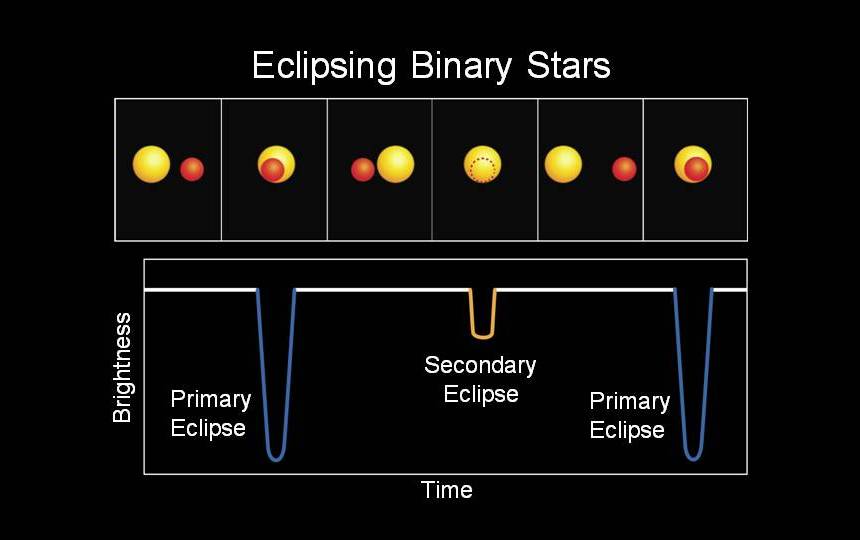
Type Ia supernovae
A Type Ia supernova is the thermonuclear explosion of a carbon–oxygen white dwarf in a binary. Either it gains mass from a companion until it approaches the Chandrasekhar limit (the single-degenerate channel), or two white dwarfs spiral together, losing orbital energy to gravitational waves, and merge (the double-degenerate channel). Carbon fusion runs away through the whole star in seconds and unbinds it completely, so no remnant is left.
| Feature | Type Ia | Core-collapse (II, Ib, Ic) |
|---|---|---|
| Progenitor | White dwarf in a binary | Massive star, above about 8 |
| Mechanism | Thermonuclear runaway | Iron core collapse and rebound |
| Spectrum near peak | No hydrogen; strong silicon absorption | Hydrogen (II) or none (Ib, Ic) |
| Light curve | Fast rise; decline powered by nickel-56 → cobalt-56 → iron-56 decay | Type II often shows a weeks-long plateau |
| Remnant | None | Neutron star or black hole |
| Where | All galaxy types, including ellipticals | Only where massive stars formed recently: spirals, irregulars, starbursts |
| Distance use | Standardizable candle | Not used as a standard candle in this event |
Type Ia supernovae are not perfectly identical, but their peak luminosity correlates with how fast they fade: brighter events decline more slowly (the Phillips relation). After that correction, the peak absolute magnitude is about , bright enough to see across billions of light-years. Their distances are calibrated using Cepheids in nearby host galaxies, which is exactly why NGC 4536 is on the list. Dust makes Type Ia events look fainter and redder, which matters for SN 2014J, which went off behind M82's dense dust.
Supernova types and light curves
Supernovae are classified by their spectra near peak, not by their mechanism. The physical split (thermonuclear versus core collapse) cuts across the letters:
| Type | Spectrum near peak | Light curve | Mechanism | Progenitor |
|---|---|---|---|---|
| Ia | No hydrogen; strong ionized silicon (Si II, 615 nm) absorption | Fast rise; peak ; smooth decline | Thermonuclear | Carbon–oxygen white dwarf in a binary |
| Ib | No hydrogen; helium lines | Peak ~−17 to −18 | Core collapse | Massive star stripped of hydrogen (Wolf–Rayet or binary-stripped) |
| Ic | No hydrogen, no helium | Similar to Ib; broad-lined Ic can accompany long gamma-ray bursts | Core collapse | Stripped of both hydrogen and helium |
| II-P | Hydrogen (Balmer) lines | Plateau for ~100 days | Core collapse | Red supergiant with its full hydrogen envelope |
| II-L | Hydrogen lines | Linear decline in magnitude | Core collapse | Supergiant with a partly stripped envelope |
| IIb | Hydrogen early, then fades to look like Ib | Double peak possible | Core collapse | Most of the hydrogen envelope lost |
| IIn | Narrow hydrogen emission lines | Often slow, bright | Core collapse | Ejecta crashing into dense gas the star shed earlier |
The plateau of a II-P happens because the expanding hydrogen envelope recombines layer by layer, releasing its stored energy at a nearly constant rate. Afterwards, every type is powered by radioactivity: nickel-56 (half-life 6.1 days) decays to cobalt-56 (half-life 77 days), which decays to stable iron-56. A Type Ia makes roughly 0.6 of nickel-56, which is why it is brighter than core-collapse events that make far less. Decay gamma rays of cobalt-56 were detected directly from SN 2014J.

Type Ia supernovae were used in 1998 to show that the expansion of the universe is accelerating: distant ones looked fainter (farther) than a constant expansion rate allowed. That work earned the 2011 Nobel Prize in Physics. The cause of the acceleration is called dark energy, which makes up roughly 70% of the energy content of the universe.
Light echoes. When a supernova or outburst flashes, some light travels straight to us and some first hits dust clouds nearby and scatters toward us. The scattered light travels farther, so it arrives later, and we see rings or arcs that seem to expand faster than light (they are not moving; successive dust is lit up). The geometry of an echo gives the dust's distance from the source, and for well-observed cases a geometric distance to the source. SN 2014J produced light echoes in M82's dust.
Ejected mass: a Type Ia throws out about 1.4 (the whole white dwarf); a core-collapse supernova ejects most of the star outside the remnant, typically a few to over ten solar masses for a Type II, less for stripped Ib/Ic progenitors.
Supernova remnants
The ejected gas sweeps up the surrounding medium. A remnant passes through a free-expansion phase (a few hundred years, ejecta coasting at thousands of km/s), a Sedov–Taylor (blast-wave) phase lasting about ten thousand years, a radiative ("snowplow") phase once the shell cools, and finally merges with the ISM after about a million years. Its shock heats gas to millions of kelvin (X-rays) and accelerates electrons that spiral in magnetic fields and emit synchrotron radio; remnants are also where most galactic cosmic rays are thought to be accelerated. Shell-type remnants are bright rims; a pulsar wind nebula (plerion) is filled from the center by a young pulsar's wind of particles; composite remnants have both. A Type Ia remnant has no compact object at its center.
Neutron stars, ULXs and gravitational waves
Neutron stars and pulsars
A neutron star is the collapsed core of a massive star: typically about 1.2 to 2 solar masses (most near 1.4) packed into a sphere about 10–13 km in radius, supported by neutron degeneracy pressure and nuclear forces. Conservation of angular momentum makes a collapsing core spin up enormously, and magnetic flux conservation concentrates its field. A neutron star whose radiation beams sweep past Earth is a pulsar.
Isolated pulsars slow down as they radiate. A neutron star in a binary can be spun back up by accreting gas from its companion, which carries angular momentum; the result is a millisecond pulsar. Dense star clusters make many such binaries through close encounters, which is why Terzan 5 has more known millisecond pulsars than any other cluster.
Numbers to know. Density near the center exceeds that of an atomic nucleus (around 10¹⁷–10¹⁸ kg/m³): a teaspoon would weigh hundreds of millions of tonnes or more. Inside, an iron-rich crust sits over neutron-rich nuclei and then a superfluid of neutrons (a quantum fluid with zero viscosity), possibly with exotic matter in the core. Magnetic fields are typically 10⁸–10¹³ gauss (10⁴–10⁹ T). The maximum mass, the Tolman–Oppenheimer–Volkoff (TOV) limit, is uncertain, roughly 2–3 ; the heaviest well-measured pulsars are about 2 (some estimates a little higher), which rules out "soft" models of nuclear matter. Above the limit, nothing stops collapse to a black hole.
Why the maximum mass is uncertain: nobody knows the equation of state (how pressure rises with density) of matter denser than an atomic nucleus. Stiffer equations of state allow heavier, larger neutron stars; measured masses near 2 , NICER radius measurements and the tidal deformation seen in GW170817 are the main constraints.
Pulsars. Jocelyn Bell Burnell and Antony Hewish discovered the first pulsar, CP 1919 (now PSR B1919+21, period 1.337 s), in 1967 (the 1974 Nobel Prize went to Hewish and Martin Ryle). In the lighthouse model, radio beams emerge along the magnetic axis, which is tilted relative to the spin axis, so the beams sweep around like a lighthouse and we see a pulse once per rotation if a beam crosses Earth. The emission is strongly polarized, as expected from charged particles moving along magnetic field lines. Periods run from about 1.4 milliseconds to tens of seconds.
The pulse argument for small size: a source cannot vary much faster than light can cross it, so a pulse lasting a few milliseconds means the emitting region is no larger than , a few hundred to a thousand kilometers. Only something as compact as a neutron star can also spin that fast without flying apart.
| Pulsar type | Spin period | Field | What powers it |
|---|---|---|---|
| Ordinary radio pulsar | ~0.1–few s | ~10¹² G | Rotation; spins down as magnetic radiation carries energy away |
| Millisecond pulsar | ~1.4–10 ms | ~10⁸–10⁹ G | Rotation, after being spun up ("recycled") by accretion in a low-mass X-ray binary; extremely stable clocks |
| Accreting X-ray pulsar | ~seconds to minutes | ~10¹² G | Gas from a companion funneled onto the magnetic poles |
| Magnetar | ~2–12 s | ~10¹⁴–10¹⁵ G | Decay of the enormous magnetic field; soft gamma repeaters and anomalous X-ray pulsars; giant flares; linked to some fast radio bursts |
Pulsars do not shine forever. As a pulsar spins down, the voltage its rotating magnetic field can generate falls; once it is too slow to create the electron–positron pairs that power the radio beam, it crosses the death line on the period–period-derivative diagram and goes quiet, after roughly 10–100 million years. A dead pulsar in a binary can be spun back up ("recycled") by accretion from its companion into a millisecond pulsar.
A newborn neutron star (about 10¹¹ K) cools first and fastest by neutrino emission from its interior (Urca reactions, in which neutrons and protons convert back and forth emitting neutrinos, plus neutrino bremsstrahlung), dropping to around 10⁹ K within days to years; after about 100,000 years surface photon emission takes over.
Binary pulsars and gravitational waves. In 1974 Russell Hulse and Joseph Taylor found a pulsar orbiting another neutron star (PSR B1913+16). Its orbit shrinks at exactly the rate general relativity predicts for energy lost to gravitational waves, the first (indirect) evidence that gravitational waves exist (Nobel Prize 1993). Arrays of millisecond pulsars, timed to within tens of nanoseconds over years, act as a galaxy-sized detector: pulsar timing arrays such as NANOGrav reported evidence in 2023 for a background of nanohertz gravitational waves, most likely from supermassive black-hole binaries.
Black holes and X-ray binaries
A black hole is a region where gravity is so strong that nothing, not even light, escapes from inside its boundary, the event horizon. For a non-spinning black hole the horizon is at the Schwarzschild radius: any mass compressed inside its own Schwarzschild radius must collapse. A black hole is fully described by just three numbers, mass, spin and electric charge (the "no-hair" idea); in practice charge is negligible. The four exact solutions are named for what they include: Schwarzschild (mass only), Kerr (mass and spin, the realistic case), Reissner–Nordström (mass and charge) and Kerr–Newman (all three).
| Class | Mass | How it forms / where found |
|---|---|---|
| Stellar-mass | ~3 to ~100 | Core collapse of massive stars; X-ray binaries; most LIGO mergers |
| Intermediate-mass (IMBH) | ~10² to 10⁵ | Uncertain; candidates in dense clusters and some ULXs (M82 X-1) |
| Supermassive | ~10⁶ to 10¹⁰ | Centers of nearly all large galaxies; the Milky Way's is about 4 million |
How we know they are there. Nothing comes from inside the horizon, so the evidence is from the surroundings: an X-ray binary whose invisible companion, weighed by the visible star's Doppler orbit, is above about 3 (too heavy to be a neutron star) and shows no surface; stars whipping around the Milky Way's center on orbits that require 4 million solar masses in a tiny volume (2020 Nobel Prize); the shadows imaged by the Event Horizon Telescope (M87's center in 2019, the Milky Way's in 2022); and gravitational waves from merging black holes. Hawking radiation, predicted by quantum theory, is far too weak to observe from any astrophysical black hole.
Accretion is the most efficient power source in astronomy. Gas spiraling through a disk toward a black hole can radiate roughly 6% (non-spinning) to over 30% (rapidly spinning) of its rest-mass energy, against 0.7% for hydrogen fusion. Tidal forces near a stellar-mass black hole stretch infalling objects ("spaghettification"). A star that wanders too close to a supermassive black hole is torn apart in a tidal disruption event, a flare that lasts months; for black holes above about 10⁸ the tidal radius lies inside the horizon, so a Sun-like star is swallowed whole without a flare.
X-ray binaries are a neutron star or black hole fed by a companion star:
| High-mass X-ray binary (HMXB) | Low-mass X-ray binary (LMXB) | |
|---|---|---|
| Donor star | O or B star, above ~10 | Below ~1–2 |
| Feeding | Stellar wind (or a Be star's disk) | Roche-lobe overflow through the inner Lagrange point (L1) into an accretion disk |
| Age | Young (tens of Myr at most) | Old (billions of years) |
| Where found | Star-forming regions, spiral arms, starbursts (their number tracks the star-formation rate) | Bulges, globular clusters, ellipticals |
| Products | Can become double neutron stars or black-hole binaries | Spin up neutron stars into millisecond pulsars |
In the Milky Way, high-mass X-ray binaries trace the young disk and spiral arms, so they lie close to the galactic plane; low-mass X-ray binaries are older and more spread out, concentrated toward the bulge and in globular clusters. At the center of a black hole, general relativity predicts a singularity, a point (or ring, if spinning) of infinite density where the theory breaks down; it is hidden behind the event horizon, and a quantum theory of gravity is expected to replace it.
Other X-ray binary labels: Be/X-ray binaries (a neutron star on an eccentric orbit flaring when it crosses a Be star's disk), supergiant X-ray binaries and supergiant fast X-ray transients, intermediate-mass X-ray binaries, soft X-ray transients (LMXBs that flare for weeks and then fade for years) and supersoft X-ray sources (white dwarfs burning accreted hydrogen steadily on their surfaces, a possible Type Ia route). Type I X-ray bursts, thermonuclear flashes of accreted helium or hydrogen lasting seconds to minutes, require a solid surface, so they prove the compact object is a neutron star, not a black hole.
Microquasars are X-ray binaries that launch relativistic jets, small-scale versions of quasars.
Accretion and the Eddington limit
Gas falling onto a compact object heats to millions of kelvin and shines in X-rays. There is a natural ceiling on how bright accretion can be: radiation pushing outward on the infalling gas eventually balances gravity pulling it in. That ceiling is the Eddington luminosity.
Ultra-luminous X-ray sources
A ULX is an X-ray source outside a galaxy's nucleus with luminosity above about erg/s ( W). That is more than 5 times the Eddington limit of a 1.4 neutron star (about erg/s) and equals the limit of a ~8 black hole (a 10 black hole's limit is about erg/s). An ordinary stellar-mass object would have to run at or beyond its limit, so something unusual is going on. The candidate explanations, all tested with M82's two famous ULXs:
- An intermediate-mass black hole (hundreds to thousands of solar masses) accreting below its own, higher Eddington limit. M82 X-1 is a leading candidate: the frequencies of its quasi-periodic X-ray oscillations suggest a mass of roughly 400 .
- Super-Eddington accretion onto a stellar-mass object, with the emission beamed toward us or the disk geometry letting radiation escape without stopping the inflow. M82 X-2 settled that this happens: NuSTAR found X-ray pulses every 1.37 s, so it is a neutron star, yet it shines at roughly 100 times its Eddington luminosity. It was the first known ULX pulsar.
ULXs cluster in star-forming regions. A starburst creates many massive stars, hence many black holes and neutron stars with massive companions feeding them. Chandra images of the Antennae, the Cartwheel ring, Arp 147 and M51 all show ULXs strung along zones of recent star formation.
Gravitational waves and multi-messenger astronomy
Accelerating masses ripple spacetime. Two compact objects in a tight orbit radiate gravitational waves, lose orbital energy, spiral inward and orbit faster. The signal is a chirp: frequency and amplitude both rise until the merger. The gravitational-wave frequency is twice the orbital frequency. Detectors such as LIGO, Virgo and KAGRA measure the stretching of space in kilometer-long laser interferometers, with fractional changes near .
What a gravitational wave is. Einstein's general relativity (1916) predicts that accelerating masses with a changing quadrupole shape, such as two stars orbiting each other, send out ripples in spacetime that travel at the speed of light. A passing wave stretches space in one direction while squeezing it in the perpendicular one, then reverses. One full stretch-and-squeeze cycle takes one wave period, which is half the orbital period, so the pattern repeats twice per orbit. It has two polarizations ("plus" and "cross"). Spherically symmetric events (a perfectly round collapse) and steadily spinning symmetric objects emit none. Like other waves, gravitational waves superpose: two signals add, and depending on their relative phase they can reinforce or partly cancel. They pass through matter almost unaffected, which is why they carry clean information from deep inside violent events, and also why they are so hard to detect.
| Detector | Arm length | Frequency band | Sources |
|---|---|---|---|
| LIGO (Hanford, Washington and Livingston, Louisiana) | 4 km | ~10 Hz to a few kHz | Stellar-mass black-hole and neutron-star mergers |
| Virgo (Italy) | 3 km | Same | Same; a third site greatly improves sky location |
| KAGRA (Japan) | 3 km, underground and cryogenic | Same | Same |
| LISA (planned space mission) | 2.5 million km | ~0.1 mHz to 1 Hz | Supermassive black-hole binaries, white-dwarf binaries |
| Pulsar timing arrays | Galactic | Nanohertz | Supermassive black-hole binaries |
Reading a chirp. A compact-binary signal has three parts. The inspiral: frequency and amplitude rise slowly, then faster (the chirp). The merger: the peak amplitude. The ringdown: the new, distorted black hole settles into a quiet sphere-like shape, the signal dying away at a frequency set by its mass and spin. Lighter systems chirp more slowly and stay in LIGO's band longer: a binary neutron star (GW170817) was tracked for about 100 seconds, a heavy binary black hole for only a fraction of a second.
In quantum terms gravity would be carried by a hypothetical massless particle, the graviton (as the photon carries electromagnetism); GW170817 showed gravitational waves travel at the speed of light to within about one part in 10¹⁵, consistent with a massless carrier. Gravitons have never been detected individually.

Merging black holes emit essentially no light, because there is no matter around them. Merging neutron stars do, because they shed neutron-rich debris; that is what made GW170817 a multi-messenger event. The glow is a kilonova, powered by radioactive decay of freshly made r-process nuclei. A fast "blue" component from lanthanide-poor ejecta fades within a day or two; a slower "red" and infrared component follows, because lanthanides are extremely opaque and trap blue light. A kilonova peaks roughly a thousand times brighter than a classical nova but much fainter than a supernova.
Three things follow directly from a chirp. The rate at which the frequency rises gives the chirp mass, a combination of the two masses. The amplitude falls as , so knowing the masses gives the distance directly, with no distance ladder: a standard siren. If light from the same event is also seen, the host galaxy's redshift plus the siren distance give the Hubble constant.
Multi-messenger astronomy combines different carriers of information:
| Messenger | Produced by | Detected by | What it adds |
|---|---|---|---|
| Electromagnetic radiation | Hot gas, stars, accretion, synchrotron | Telescopes from radio to gamma rays | Positions, spectra, composition |
| Gravitational waves | Merging compact objects | Laser interferometers | Masses, distances, merger timing |
| Neutrinos | Nuclear reactions, core collapse, high-energy particle collisions | Water or ice detectors (Super-Kamiokande, IceCube) | Escape dense cores directly; SN 1987A's neutrinos arrived hours before its light |
| Cosmic rays | Charged particles accelerated in shocks | Air-shower arrays | High-energy acceleration; directions scrambled by magnetic fields |
Neutrinos come in three flavors (electron, muon, tau), have tiny masses, and interact only through the weak force, so they stream out of the dense core of the Sun or a collapsing star where light is trapped. Detectors use huge volumes of water or ice and look for the faint Cherenkov light of the rare particles a neutrino knocks loose: Super-Kamiokande (Japan, 50,000 tonnes of water), IceCube (a cubic kilometer of Antarctic ice), and the Sudbury Neutrino Observatory, whose heavy water showed that solar neutrinos change flavor on the way to Earth. About two dozen neutrinos from SN 1987A, in the Large Magellanic Cloud, were caught by three detectors a few hours before the explosion was seen in light, confirming the core-collapse picture.
Cosmic rays are charged particles, mostly protons (about 90%) and helium nuclei (about 9%), with energies up to above 10²⁰ eV. Magnetic fields bend their paths, so their arrival directions do not point back to their sources. Supernova-remnant shocks are thought to accelerate most of those made in our galaxy. In a starburst like M82, cosmic rays from its many supernova remnants smash into the dense gas and make gamma rays (through decaying pions), which is why some starbursts glow in gamma rays.
GW170817, on the 2027 list, is the textbook case: a neutron-star merger heard in gravitational waves and seen across the spectrum.
Seeing in many wavelengths
| Band | What it traces | In galaxies and starbursts |
|---|---|---|
| Radio | Neutral hydrogen (21 cm), molecular gas, synchrotron from electrons in magnetic fields | Gas disks and rotation curves; supernova remnants in starbursts |
| Infrared | Warm dust, cool stars, objects behind dust | Dust-buried star formation; starbursts often emit most of their energy here |
| Optical | Starlight; H-alpha from ionized gas | Morphology, H II regions, dust lanes in silhouette |
| Ultraviolet | Hot young O and B stars | Recent (last ~100 Myr) star formation, ring galaxies' blue rings |
| X-ray | Million-kelvin gas, accretion onto compact objects | ULXs, hot superwinds, X-ray binaries, supernova remnants |
| Gamma ray | Most energetic processes: pulsars, cosmic-ray collisions, gamma-ray bursts | GRB 170817A; starbursts like M82 glow faintly from cosmic rays hitting gas |
Dust is the reason the infrared matters. It absorbs ultraviolet and blue light from young stars and re-emits it at tens of kelvin, so a dusty starburst can look unremarkable in visible light and blaze in the far infrared. JWST works mainly in the infrared for this reason.
Light basics. Light is an electromagnetic wave: oscillating electric and magnetic fields, perpendicular to each other and to the direction of travel, regenerating each other as they go. All electromagnetic radiation travels at , and each photon carries . From longest wavelength (lowest frequency, lowest energy) to shortest: radio, microwave, infrared, visible (red → violet), ultraviolet, X-ray, gamma ray. Visible light spans only about 400–700 nm.

The windows in numbers: the optical window (about 300 nm to 1 μm), several near- and mid-infrared windows (about 1–5 μm, plus the thermal-infrared window near 8–14 μm), and the radio window (about 1 cm to 10–20 m; longer waves are reflected by the ionosphere, shorter ones absorbed by water and oxygen).
| Band | Notable observatories (launch or first light) | Typical targets in this event |
|---|---|---|
| Gamma ray | Fermi Gamma-ray Space Telescope (2008), Swift (2004, gamma-ray bursts plus X-ray/UV follow-up), INTEGRAL (2002); ground Cherenkov arrays for the highest energies | Gamma-ray bursts (GRB 170817A), pulsars, starburst glow from cosmic rays, cobalt-56 lines from SN 2014J |
| X-ray | Chandra (1999, sharpest X-ray images), XMM-Newton (1999), NuSTAR (2012, high-energy X-rays, found M82 X-2's pulses) | ULXs, X-ray binaries, hot gas and superwinds, supernova remnants |
| Ultraviolet | GALEX (2003–2013), Hubble | Young O and B stars, recent star formation |
| Visible | Hubble (1990, 2.4 m), large ground telescopes (Keck, VLT, Gemini) | Morphology, H II regions, dust lanes, Cepheids |
| Infrared | JWST (launched 2021, 6.5 m mirror, at the Sun–Earth L2 point, 0.6–28 μm), Spitzer (2003–2020), Herschel (far infrared, 2009–2013), WISE | Dust, protostars, dust-buried starbursts, cool stars, high-redshift galaxies |
| Submillimeter and millimeter | ALMA (Atacama Desert, Chile, about 5,000 m altitude) | Cold dust and molecular gas (CO), protoplanetary disks |
| Radio | Very Large Array (VLA, New Mexico), Green Bank (West Virginia), FAST, formerly Arecibo; very-long-baseline interferometry and the Event Horizon Telescope | 21 cm hydrogen, pulsars, synchrotron jets and remnants, rotation curves |
William Herschel discovered infrared radiation in 1800 by placing a thermometer beyond the red end of a sunlight spectrum and finding it warmed; Johann Ritter found ultraviolet beyond the violet end the next year.
Spitzer ran out of liquid-helium coolant in 2009; in its "warm mission" (to 2020) only the two shortest-wavelength IRAC channels, 3.6 and 4.5 μm, kept working.
How objects emit. Knowing the mechanism tells you what you are looking at:
| Mechanism | Spectrum | Where it dominates |
|---|---|---|
| Thermal (blackbody) | Peaked; peak set by temperature | Stars, dust (infrared) |
| Line emission | Narrow lines at fixed wavelengths | Nebulae, H II regions, starburst gas, AGN |
| Free–free (bremsstrahlung) | Broad; electrons decelerated by ions | Radio from H II regions; X-rays from million-degree gas in clusters and superwinds |
| Synchrotron | Power law, polarized | Relativistic electrons in magnetic fields: supernova remnants, pulsar wind nebulae, jets, the radio glow of starbursts |
| Inverse Compton and pion decay | High-energy | Gamma rays from jets and cosmic-ray collisions |
Dust. Interstellar dust grains scatter and absorb blue light more than red, so starlight passing through dust is dimmed (extinction) and reddened. The same physics, scattering by particles smaller than the wavelength, makes Earth's sky blue (Rayleigh scattering). The absorbed energy warms the dust to tens of kelvin and is re-emitted in the far infrared. Starburst dust also shows strong infrared emission bands from polycyclic aromatic hydrocarbons (PAHs), carbon-rich molecules lit up by UV from young stars; the Cartwheel's red glow in JWST images is this emission. Infrared and radio see through dust; ultraviolet and visible do not.
Images. Astronomical images are almost always false color or representative color: each filter or band (including invisible ones like X-ray) is assigned a visible color, often in wavelength order (longest = red). Composite images combine telescopes: in a typical Chandra–Hubble–Spitzer composite, blue is X-ray hot gas, yellow/white is starlight and red is infrared dust. Detectors are mostly CCDs and similar arrays that count photons with high efficiency; photometry measures brightness through filters, spectroscopy spreads light by wavelength.
Telescope basics. Light-gathering power scales with the mirror area, : a 24 cm telescope gathers times as much light as a 4 cm one. Resolution (the smallest resolvable angle) is about radians, so radio telescopes must be enormous, or be linked into interferometers whose baseline acts as , to match optical sharpness. The VLA, for example, has 27 dishes of 25 m that can be spread along three 21 km arms, giving baselines up to about 36 km.
Galaxies: types, structure and populations
Morphological classification
Hubble's tuning fork sorts galaxies by appearance:
| Type | Notation | Appearance | Stars and gas |
|---|---|---|---|
| Elliptical | E0 (round) to E7 (most elongated); the number is from the apparent axis ratio | Smooth, featureless | Old, red; little cold gas; little current star formation |
| Lenticular | S0 | Disk and bulge but no spiral arms | Old, little gas |
| Spiral | Sa, Sb, Sc (and Sd) | Disk with arms; Sa has a large bulge and tightly wound arms, Sc a small bulge and loose arms | Mixed; gas and star formation in the arms, increasing from Sa to Sc |
| Barred spiral | SBa, SBb, SBc | Arms start from the ends of a central bar | As spirals; bars funnel gas inward |
| Irregular | Irr | No regular shape | Often gas-rich and star-forming |
Despite the old labels "early type" (ellipticals) and "late type" (spirals), the sequence is not an evolutionary path. Mergers are the main route by which spirals become ellipticals. The ellipticity of an E galaxy is apparent, not intrinsic: a flattened elliptical seen end-on looks round.

What each type is made of. Ellipticals and lenticulars are dominated by old, red stars (textbooks describe them as mostly Population II, although the old stars of giant ellipticals are fairly metal-rich) with little cold gas, so they have few H II regions, almost no young stars and essentially no core-collapse supernovae. Their stars move on random orbits (the galaxy is supported by its velocity dispersion, not rotation). Spirals mix an old bulge and halo with a young, gas-rich disk where Population I stars form. Irregulars are usually gas-rich and actively forming stars. Giant ellipticals often hold millions-of-degrees, X-ray-emitting gas and many globular clusters; the largest (cD galaxies) sit at the centers of galaxy clusters, built by mergers.
Where they live. Ellipticals and lenticulars dominate dense galaxy clusters; spirals dominate the sparse field (the morphology–density relation). Mergers, harassment by fast encounters and stripping of gas inside clusters turn spirals into red, gas-poor galaxies. By number, the most common galaxies are dwarfs (dwarf ellipticals, dwarf spheroidals and dwarf irregulars such as NGC 1569); by stellar mass, big spirals and ellipticals dominate.
Colors: red sequence and blue cloud. Plot galaxy color against stellar mass and most galaxies fall into two groups: a blue cloud of star-forming (mostly spiral and irregular) galaxies and a red sequence of galaxies that have stopped forming stars (mostly ellipticals and lenticulars), with a thinly populated green valley between. Galaxies cross the valley when star formation is quenched: the gas is used up (as after a starburst), heated or expelled by supernova or AGN feedback, or stripped by the hot gas of a cluster (ram-pressure stripping, which leaves "jellyfish" tails of gas behind infalling spirals).
Spiral arms. Stars near the center orbit faster than those farther out, so arms made of the same stars would wind up tight within a few rotations (the winding problem). Density wave theory explains long-lived grand-design arms as a slowly rotating pattern of higher density: stars and gas move through the arms, gas is compressed as it enters, and stars form there. That is why arms are lined with blue O and B stars and pink H II regions, which die before drifting far downstream. Tidal interactions can drive strong two-armed patterns (M51). Patchy flocculent spirals instead come from star formation that propagates locally.
Galactic structure and stellar populations
A spiral like the Milky Way or M31 has a thin disk of gas, dust and young-to-middle-aged stars; a central bulge of mostly old stars; often a bar; a supermassive black hole at the center; a faint stellar halo of old stars and globular clusters; and a much larger, invisible dark matter halo.
| Property | Population I | Population II |
|---|---|---|
| Location | Disk, spiral arms | Halo, globular clusters, much of the bulge |
| Age | Young to intermediate | Old (above ~10 Gyr) |
| Metallicity | High (Sun-like) | Low |
| Orbits | Nearly circular, in the plane | Elongated, randomly tilted |
| Typical members | O and B stars, classical Cepheids, open clusters, H II regions | RR Lyrae stars, Type II Cepheids, red giants in globular clusters |
(Population III, the hypothetical first metal-free stars, has never been observed directly.)
Globular clusters are dense, nearly spherical groups of to stars, typically old and metal-poor. The Milky Way has about 150–160; the Sombrero Galaxy has roughly 2,000. Their H-R diagrams show a low turnoff, a red-giant branch and a horizontal branch rich in RR Lyrae stars. Open clusters are the opposite: young, loose, in the disk. Terzan 5 is a reminder that not every "globular cluster" is simple: it holds stellar populations of different ages and iron content.
Globular clusters are also graded by how concentrated they look on the Shapley–Sawyer scale, from class I (most centrally concentrated) to XII (loosest).
Clusters and associations. Open clusters are gravitationally bound groups of tens to thousands of young-to-middle-aged disk stars (the Pleiades type); they slowly dissolve over hundreds of millions of years. OB associations are loose, gravitationally unbound groups of young O and B stars spread over tens of parsecs that drift apart within ~10 million years; their stars share a common motion and age. Globular clusters are dense, bound, old and spherical, mostly in the halo and bulge. Super star clusters in starbursts are young but as massive as globulars.
How disks form. Gas falling into a rotating dark matter halo keeps its angular momentum while radiating away energy, so it cannot collapse to the center but settles into a thin, rotating disk, where it forms Population I stars; stars that formed earlier, or arrived in mergers, stay on random halo orbits.
The Milky Way as the reference galaxy
The Milky Way is a barred spiral (roughly SBbc) containing a few hundred billion stars.
| Property | Approximate value |
|---|---|
| Stellar disk diameter | ~30 kpc (about 100,000 ly) |
| Thin disk thickness | ~0.3 kpc (about 1,000 ly) |
| Sun's distance from the center | ~8.2 kpc (about 26,000–27,000 ly) |
| Sun's orbital speed | ~230 km/s |
| Galactic year (one orbit) | ~230 million years |
| Central black hole (Sagittarius A*) | ~4 million |
| Globular clusters | ~150–160 |
| Total mass including dark matter | ~10¹² |
We live inside the disk, so dust hides the center and the far side in visible light; infrared, radio and X-rays reveal them. The innermost few hundred parsecs, the Central Molecular Zone, hold a large reservoir of dense, warm, turbulent and strongly magnetized molecular gas (and long radio filaments) around Sagittarius A*; despite all that gas, it forms stars less efficiently than its density would suggest.
The Milky Way, Andromeda (M31) and the Triangulum Galaxy (M33) are the three spirals of the Local Group, which also holds dozens of dwarf galaxies, including the Large and Small Magellanic Clouds.
Rotation curves and galactic masses
Stars and gas in a disk orbit the center. If the galaxy's mass were concentrated where the light is, orbital speed would fall as outside the bright region, as planets' speeds do. Instead, radio (21 cm) and optical measurements show flat rotation curves: speed stays roughly constant far beyond the visible disk. Since , the enclosed mass keeps growing linearly with radius. That is the main evidence for dark matter halos; Vera Rubin's rotation curves of Andromeda were a key early case.
Mass-to-light ratio. Divide a mass (from rotation, velocity dispersion or lensing) by the luminosity, both in solar units: . The Sun's is 1; young, blue populations are below 1; old stellar populations are about 2–10; whole galaxies measured out into their dark halos reach tens, and galaxy clusters a few hundred. For example, with a luminosity of gives . A value far above what old stars can supply is the dark-matter signal.
More evidence for dark matter. Fritz Zwicky first argued for unseen mass in the 1930s: galaxies in the Coma cluster move too fast for the cluster's visible mass to hold them. Later: flat rotation curves (Vera Rubin and Kent Ford, 1970s); the hot X-ray gas in clusters, which needs a deep gravitational well to stay bound; gravitational lensing masses of clusters; the Bullet Cluster, where lensing shows most of the mass has passed through a collision while the X-ray gas (most of the ordinary matter) lagged behind; and the pattern of fluctuations in the cosmic microwave background. Dark matter makes up about 85% of all matter. It is thought to be cold (slow-moving) particles that do not emit, absorb or reflect light; candidates include WIMPs and axions. Compact dark objects (MACHOs: faint stars, black holes) were searched for by microlensing and cannot account for most of it, and neutrinos are too fast ("hot") to build small structures. A minority view, MOND, modifies gravity instead.

Gravitational lensing. Mass bends light (general relativity), so a massive foreground galaxy or cluster acts as a lens for objects behind it. Strong lensing makes multiple images, arcs and, for exact alignment, Einstein rings; the images arrive with time delays because their paths differ in length, and they are magnified, which lets telescopes study galaxies too faint to see otherwise. Weak lensing slightly distorts the shapes of many background galaxies and maps dark matter statistically. Microlensing by a single star briefly brightens a background star without visibly splitting it. Lensing measures total mass, dark matter included, without any assumption about light.
Starbursts and galaxy interactions
What a starburst is
A starburst galaxy forms stars far faster than it could sustain over its lifetime. A useful test is the gas depletion time: the gas mass divided by the star-formation rate. The Milky Way forms roughly 1–2 solar masses of stars per year and would take a few billion years to use its gas; a starburst may form tens to hundreds of solar masses per year and exhaust its gas in some tens to hundreds of millions of years. A starburst can be galaxy-wide or concentrated in the nucleus.
Signatures of a starburst, and why each appears:
- Blue, UV-bright regions and super star clusters: many short-lived massive stars.
- Strong H-alpha emission: their UV ionizes surrounding hydrogen.
- Huge far-infrared luminosity: dust absorbs the UV and re-radiates it.
- Radio synchrotron: electrons accelerated in supernova remnants.
- A high core-collapse supernova rate and many ULXs and high-mass X-ray binaries.
- Galactic superwinds: supernovae and stellar winds together blow hot, metal-rich gas out of the disk, seen as X-ray-bright, H-alpha-bright plumes along the minor axis (M82 is the prototype).
The wind is feedback: it removes and heats the gas that fuels star formation, which is one reason starbursts end.
What triggers them: interactions
Most strong starbursts are triggered by gravity from a neighbor. Tidal forces, the difference in a companion's pull across a galaxy, stretch it, launch long tidal tails and bridges, and disturb gas orbits. Gas clouds collide, lose angular momentum and fall toward the center, where they are compressed into new stars. Bars do something similar internally. The stars themselves almost never collide during a galaxy collision; the space between them is enormous. Gas clouds, which fill far more volume, do collide.
| Interaction | What happens | Examples on the 2027 list |
|---|---|---|
| Tidal encounter | A close pass raises tides, draws out arms and tails, triggers star formation | M51 with NGC 5195; M82 disturbed by M81 |
| Merger in progress | Two disks plunge together; tails, shocked gas, super star clusters | The Antennae |
| Head-on collision through a disk | A compact galaxy passes near the center of a disk; a density wave expands outward as a ring of star formation | The Cartwheel, Arp 147, Arp 143 |
| Future merger | Two galaxies on a collision course | M31 and the Milky Way |
| Tidal disruption | A smaller system is torn apart by a larger one's tides | Dwarf galaxies and clusters stripped into streams; a star torn apart near a black hole (a tidal disruption event) |
The Roche limit idea, the distance inside which tides beat a body's self-gravity, applies at every scale: a moon near a planet, a star near a black hole, a globular cluster or dwarf galaxy near a large galaxy.

More interaction vocabulary.
- Major vs minor merger: comparable masses (ratio closer than about 1:3 or 1:4) versus a big galaxy eating a small one. Major mergers of two spirals can scramble the disks into an elliptical; minor mergers thicken disks and build stellar halos and streams. A big galaxy steadily absorbing small ones is galactic cannibalism.
- Wet vs dry merger: gas-rich (fuels a starburst and possibly an AGN) versus gas-poor (no starburst; grows ellipticals).
- Dynamical friction: a satellite moving through a halo of stars and dark matter pulls a wake behind it whose gravity slows it, so it spirals in.
- Tidal tails form from the far sides of disks during slow, prograde passes; bridges link the pair. New star clusters and even tidal dwarf galaxies can form in the tails.
- Ring galaxies (Cartwheel, Arp 147, Arp 143) need a nearly head-on, central passage; polar-ring galaxies form when captured gas settles into an orbit perpendicular to the disk.
- Galaxy harassment: repeated fast encounters in a cluster that heat and strip disks.
- The Toomre sequence orders merging pairs by stage, from separated disks with tails (the Antennae near the start) to a single remnant that looks like an elliptical with faint shells and ripples.
- Merger timescales are of order hundreds of millions to a billion years; a starburst lasts about 10–100 million years.
- Luminous and ultraluminous infrared galaxies (LIRGs above 10¹¹ , ULIRGs above 10¹² in the infrared) are dusty galaxies powered mainly by starbursts; nearly all ULIRGs (and many LIRGs) are mergers, often with buried AGN too.
How star formation is measured. H-alpha (ionizing photons from stars younger than ~10 Myr), ultraviolet (stars younger than ~100 Myr), far-infrared (UV re-radiated by dust), radio continuum (supernova electrons), and X-ray binaries (high-mass X-ray binaries trace recent star formation). Each misses something: UV and H-alpha are hidden by dust, while the infrared misses unobscured stars, so careful estimates combine them. Tests may give a conversion such as Kennicutt's H-alpha calibration, with in erg/s: erg/s gives about 10 per year, an M82-like rate. Such conversions assume an initial mass function, usually Salpeter's : per unit mass range there are about times as many 1 stars as 10 stars. The Kennicutt–Schmidt law, (star formation and gas per unit area of disk), says that denser gas forms stars disproportionately faster, which is why gas driven into a galaxy's center ignites a starburst.
After the burst. When star formation stops abruptly, the O stars die within ~10 Myr and the B stars within a few hundred Myr, but A stars survive for ~1 Gyr. The galaxy then shows strong Balmer absorption lines from A stars but no emission lines: a post-starburst ("E+A" or "K+A") galaxy.
When two galaxies with central supermassive black holes merge, dynamical friction drags the black holes to the center, where they form a binary. Stars passing close by carry off energy and shrink the binary, but around a separation of about a parsec the supply of such stars can run out before gravitational waves become strong enough to finish the job: the final parsec problem. Gas, triaxial galaxy shapes or a third black hole probably solve it in practice; such binaries are thought to produce the nanohertz background seen by pulsar timing arrays.
Active galactic nuclei and how to tell them from starbursts
Nearly every large galaxy has a central supermassive black hole. When it is accreting heavily, the nucleus becomes an active galactic nucleus (AGN), which can outshine the rest of the galaxy from a region smaller than the solar system. The unified model says most AGN have the same parts, an accretion disk, fast-moving clouds near the black hole (the broad-line region), slower clouds farther out (the narrow-line region), a dusty torus and sometimes jets, and that what we see depends on viewing angle and power:
| Type | What is seen | Why |
|---|---|---|
| Seyfert 1 | Bright point-like nucleus in a spiral; broad and narrow emission lines | We see past the torus into the broad-line region |
| Seyfert 2 | Only narrow lines | The torus hides the broad-line region |
| Quasar (QSO) | Star-like point, extremely luminous, usually at high redshift; broad lines | The most powerful AGN; the host galaxy is swamped |
| Radio galaxy | Huge radio lobes fed by jets | Jets in the plane of the sky |
| Blazar | Rapidly variable, featureless, polarized continuum | A jet pointed almost straight at us |
Quasar distances come from their redshifts through Hubble's law (or a cosmological model at high ), not from treating them as standard candles, because their luminosities vary enormously. Variability on timescales of days means the emitting region is light-days across or smaller, the same light-travel-time argument as for pulsars. Quasars were recognized in 1963 when the emission lines of 3C 273 turned out to be ordinary hydrogen lines at a redshift of 0.16.
Starburst or AGN? Both make a galaxy's center bright, both are fed by gas driven inward (often by an interaction), and many galaxies host both. The diagnostics:
| Clue | Starburst | AGN |
|---|---|---|
| Size of the bright region | Extended: knots, super star clusters across hundreds of parsecs | A compact point source |
| Emission-line ratios ([O III]/H-beta against [N II]/H-alpha, the BPT diagram) | Lower: ionized by stars | Higher: ionized by a harder (more energetic) spectrum; high-ionization lines such as [Ne V] |
| Line widths | Narrow | Broad lines (thousands of km/s) in type 1 AGN |
| X-rays | Many point sources (X-ray binaries, ULXs) plus soft thermal gas | One bright, hard X-ray nucleus, often variable |
| Infrared | Strong PAH emission bands, cool dust | Hot dust, weaker PAHs |
| Radio | Diffuse synchrotron tied to star formation | Compact core, often jets |
| Variability | None on short timescales | Common |
The mass of the central black hole correlates with the velocity dispersion of the host's bulge (the M–σ relation), so black holes and galaxies grow together; AGN feedback (winds and jets heating or expelling gas) is thought to quench star formation in massive galaxies, just as supernova-driven superwinds regulate starbursts.
Magnitudes, distances and the distance ladder
Magnitudes and proper motion
Magnitudes are logarithmic and run backwards: smaller is brighter, and 5 magnitudes is a factor of 100 in flux. Apparent magnitude is what we see; absolute magnitude is what the object would show at 10 pc.
The scale goes back to Hipparchus, who ranked naked-eye stars from 1st magnitude (brightest) to 6th (faintest). In 1856 Norman Pogson made it exact: a difference of 5 magnitudes is a flux ratio of exactly 100, so 1 magnitude is . The zero point was historically set by Vega (magnitude about 0 in every band in the "Vega system"); Polaris was an early reference until it turned out to be variable. Anchors: the Sun , the full Moon about , Sirius , Vega , the naked-eye limit about , the faintest Hubble and JWST detections around and fainter.
Absolute magnitude and luminosity. The Sun has and bolometric (all-wavelength) magnitude . The bolometric correction is about zero for Sun-like stars and large and negative for very hot and very cool stars, which emit mostly outside the V band.
Where the parsec comes from. Picture a long, thin triangle: its base is the radius of Earth's orbit (1 AU) and its apex is the star. The small angle at the star is the parallax . One parsec ("parallax of one arcsecond") is the distance at which 1 AU subtends exactly 1″, so follows from the small-angle formula: .
1 pc = 206,265 AU = 3.086 × 10¹⁶ m = 3.26 light-years. Hipparcos measured parallaxes to about a milliarcsecond; Gaia reaches tens of microarcseconds for bright stars, which takes geometric distances across a large part of the Milky Way.
Proper motion is an object's angular drift across the sky, in arcseconds per year. Combined with distance it gives the tangential velocity; the Doppler shift gives the radial velocity; together they give the true space velocity.
Color indices such as B−V measure temperature (larger B−V means redder, cooler), but dust reddens and dims light too. An object that looks redder than its spectral class predicts is probably behind dust. This matters for M82, Terzan 5 and SN 2014J.
Dust changes the distance modulus. Extinction (in magnitudes) makes an object look fainter, so it must be subtracted:
The ladder, rung by rung
| Rung | How it works | Range (approx.) |
|---|---|---|
| Parallax | Geometry from Earth's orbit | Hundreds of pc from the ground; several kpc with Gaia |
| Spectroscopic parallax | Spectrum gives class and luminosity class → from the H-R diagram → distance modulus | Throughout the Milky Way |
| RR Lyrae stars | Nearly constant | To the nearest galaxies (M31 with Hubble) |
| Cepheids | Period → luminosity | To about 30–40 Mpc |
| Tully–Fisher relation | Rotation speed → luminosity of a spiral | To about 100+ Mpc |
| Type Ia supernovae | Standardized peak luminosity; rare (about one per galaxy every century or two) and unpredictable, so you must catch one, and dust and calibration limit accuracy | Billions of light-years |
| Hubble's law | Redshift → distance | Large distances, where peculiar motions are small by comparison |
| Standard sirens | Gravitational-wave amplitude | Independent of the ladder |

Other rungs you may meet: the tip of the red giant branch (old red giants all ignite helium at about the same luminosity, ; this method revised NGC 1569's distance); Faber–Jackson for ellipticals (, the elliptical cousin of Tully–Fisher); surface brightness fluctuations; the brightest planetary nebulae and globular clusters; and masers orbiting a galaxy's central black hole, which give geometric distances. Each method is calibrated on the rung below it, so errors propagate upward; that is why NGC 4536's Cepheids, which link a Type Ia supernova (SN 1981B) to the Cepheid scale, matter.
The Tully–Fisher relation
In spiral galaxies, the maximum rotation speed and the luminosity are tightly linked: (roughly; the exponent depends on the waveband). The reason: a faster rotation speed means more mass (), and more mass means more stars. Astronomers measure from the width of the 21 cm line (a spinning disk smears the line by its rotation, corrected for inclination), read or from the calibrated relation, and compare with .
Hubble's law
Hubble's law is what an expanding universe looks like from inside if the universe is homogeneous and isotropic on large scales (the cosmological principle): if all distances scale up by the same factor, every observer sees every other galaxy receding at a speed proportional to its distance, so no galaxy is at the center. Georges Lemaître (1927) and Edwin Hubble (1929) found the relation, now often called the Hubble–Lemaître law; Hubble's first value, about 500 km/s/Mpc, was far too high, mostly because of the Cepheid mix-up. The actual age of the universe, about 13.8 billion years (from the cosmic microwave background plus a cosmological model), happens to be close to the Hubble time Gyr, but the two are different quantities. Today two precise methods disagree: about 67 km/s/Mpc from the cosmic microwave background and about 73 from Cepheids plus Type Ia supernovae (the Hubble tension).
The Hubble distance is the distance at which Hubble's law would give a recession speed equal to : for km/s/Mpc, Mpc km (about 14 billion light-years). The Hubble time : convert 1 Mpc km, so s s Gyr.
Orbits in binary and galactic systems
Item 3b asks you to use Kepler's laws and circular motion for both binary stars and galaxies.
Kepler's three laws, stated the way tests ask for them:
- Orbits are ellipses with the center of mass at one focus.
- The line joining the bodies sweeps out equal areas in equal times, so a body moves fastest at closest approach (periapsis) and slowest at the farthest point (apoapsis). This is conservation of angular momentum.
- (the "harmonic law"); Newton's version adds the masses, below.
At periapsis and apoapsis the velocity is entirely perpendicular to the line joining the bodies, so the separation is momentarily not changing. Triple the orbit size and the period grows by .
Ellipse geometry. Semimajor axis , semiminor axis , eccentricity : ; the focus sits from the center; periapsis , apoapsis , so ; the semi-latus rectum is .
Deriving orbits from force balance. For a circular orbit, gravity supplies the centripetal force: , so ; with this gives Kepler's third law, . The same method works for any force law a question invents: set the given force equal to and solve for or .
Kinds of binary star.
| Type | How it is found | What it gives |
|---|---|---|
| Visual binary | Both stars seen orbiting in images | Period, angular separation → with distance, → total mass; motions about the center of mass → mass ratio |
| Astrometric binary | One star seen wobbling around an unseen companion | Companion's existence and mass |
| Spectroscopic binary | Spectral lines shift back and forth periodically (SB2: two sets of lines moving oppositely; SB1: one set) | Period and velocity amplitudes → mass ratio; masses times (only lower limits unless the inclination is known) |
| Eclipsing binary | Periodic dips in a light curve | Inclination near 90°, so combined with spectroscopy gives true masses; eclipse durations times the orbital speed (from spectroscopy) give radii |
Spectroscopic binaries are the easiest to detect at large distances because they do not need to be resolved. Eclipsing spectroscopic binaries are the gold standard for stellar masses and radii.
Close binaries and mass transfer. Each star in a binary has a teardrop-shaped Roche lobe, the region where its gravity dominates; the lobes touch at the inner Lagrange point (L1). A star that swells past its lobe (as it becomes a giant) spills gas through L1 onto its companion. Detached binaries have both stars inside their lobes, semidetached have one filling it (Algols, cataclysmic variables, X-ray binaries), contact binaries share an envelope (W Ursae Majoris stars). Mass transfer explains the Algol paradox: the less massive star in an Algol system is the more evolved one, because it was originally the more massive and has given much of its mass away. Unstable transfer can engulf both stars in a common envelope, shrinking the orbit drastically; this is how compact double white dwarfs and double neutron stars, the progenitors of some Type Ia supernovae and of GW170817-like mergers, are made. Stripping by a companion is also the main way stars lose their hydrogen envelopes before exploding as Type Ib, Ic or IIb supernovae.

The five Lagrange points are where a small body can stay fixed relative to two orbiting masses. L1 lies between them (mass transfer), L2 beyond the smaller one (JWST orbits near the Sun–Earth L2, about 1.5 million km from Earth, where it can keep the Sun, Earth and Moon on one side of its sunshield), and L4 and L5, 60° ahead of and behind the smaller body, are the stable ones (provided the larger mass is more than about 25 times the smaller, as for the Sun and Jupiter).
Both bodies orbit the center of mass, and the heavier one sits closer to it.
For circular orbits, , so orbital speed falls as around a point mass, and escape speed is times circular speed. Orbit shape follows eccentricity: circle, ellipse, parabola (exactly escape energy), hyperbola (unbound). Galaxy encounters are usually on near-parabolic or bound orbits; the more slowly two galaxies pass, the stronger the tidal damage.
Binary stars give masses through eclipses and Doppler shifts: an eclipsing binary's light curve gives the period and the inclination, and with the orbital speed from spectroscopy it gives the radii; a spectroscopic binary's opposite-moving line sets give the velocity ratio, hence the mass ratio. Gravitational-wave binaries are the extreme case, with orbital periods of milliseconds just before merger.
The 2027 listed objects
Learn what each object is, which rules topic it illustrates, and which observation identifies it. Distances are approximate; published values vary by method, so quote a range or the value a question gives.
ReferenceListed objects at a glance· 16 rows
No rows match.
| Object | Type and location | Distance (approx.) | What tests ask about it |
|---|---|---|---|
| Andromeda Galaxy (M31) | Large spiral (Sb) in Andromeda; the nearest big galaxy and the largest member of the Local Group | ~2.5 million ly (≈ 770 kpc) | Hubble's Cepheid V1 (1923–25) proved galaxies lie outside the Milky Way; Vera Rubin's rotation curve points to dark matter; blueshifted, approaching at roughly 110 km/s relative to the Milky Way, with a collision in roughly 5–10 billion years possible but not certain (recent estimates of the odds differ widely) (the merged galaxy is nicknamed "Milkomeda"); satellites M32 and M110; hundreds of globular clusters; a giant stellar stream and a dusty star-forming ring from past encounters; naked-eye visible; SN 1885A (S Andromedae) is the only supernova seen in it |
| Sombrero Galaxy (M104) | Bright, nearly edge-on galaxy in Virgo with a huge bulge and a dark dust lane | ~30 million ly | Usually classed Sa (or S0/Sa); infrared data suggest a giant elliptical with a disk embedded in it; roughly 2,000 globular clusters; a central black hole near a billion and a low-luminosity active nucleus; little current star formation (a "normal" galaxy); one of the first galaxies whose large redshift (about 1,000 km/s) was measured, by Vesto Slipher |
| Whirlpool Galaxy (M51) | Grand-design spiral interacting with its small companion NGC 5195, in Canes Venatici | ~25–30 million ly | Textbook tidal interaction: the encounter sharpened its two arms and triggered star formation along them; the first galaxy whose spiral shape was seen (Lord Rosse, 1845); several recent core-collapse supernovae; many X-ray binaries and ULXs |
| NGC 4536 | Barred (intermediate) spiral in the Virgo cluster region | ~50 million ly | Hubble measured Cepheids in it to calibrate the Type Ia supernova SN 1981B, a rung in the Hubble-constant ladder; star-forming inner ring and nucleus |
| MCG+07-33-027 | Face-on spiral starburst galaxy imaged by Hubble | ~300 million ly | Forms stars at an extraordinary rate, yet is an isolated field galaxy with no obvious partner, so its starburst was probably not triggered by a collision; the trigger is still debated |
| NGC 1569 | Dwarf irregular starburst galaxy in Camelopardalis | ~11 million ly | Starburst lasting ~100 million years; super star clusters of over a million stars each sitting in a central cavity blown out by supernovae; a galactic wind carrying metal-rich gas out of a small galaxy; Hubble's red-giant measurements put it about 1.5 times farther than thought, which made the starburst more intense |
| Antennae Galaxies (NGC 4038/4039) | Two colliding spirals partway through a merger, in Corvus | ~45–65 million ly | Long tidal tails (the "antennae"); thousands of young star clusters and super star clusters, some likely to become globular clusters; Chandra found many ULXs and hot gas enriched with elements such as neon, magnesium, silicon and iron from supernovae; an early stage of the Toomre merger sequence |
| Arp 143 | Interacting pair: NGC 2445 (distorted, star-forming) and NGC 2444 (older, gas-poor companion) | ~190 million ly | A head-on passage set off a ring- or triangle-shaped burst of star formation in NGC 2445, bright in UV, infrared and X-rays (X-ray sources in the star-forming regions) |
| Arp 147 | Pair shaped like the number "10": a relatively undisturbed galaxy (the "1") and a blue ring galaxy (the "0"), in Cetus | ~400+ million ly | The "1" passed through the "0", sending out a density wave that formed a ring of star formation; a reddish knot in the ring probably marks the old nucleus; Chandra found ULXs in the ring, likely black holes in young binaries |
| Cartwheel Galaxy | Ring galaxy in Sculptor | ~500 million ly | A smaller galaxy plunged through its disk a few hundred million years ago (estimates range from about 200 to 440 million years); a bright inner ring and a colorful outer ring expand like ripples, joined by "spokes"; JWST's infrared images show hydrocarbon-rich (PAH) dust and young star clusters; Chandra found many ULXs in the outer ring |
| M82 (Cigar Galaxy) | Prototype starburst, an edge-on disk in Ursa Major, disturbed by M81 | ~12 million ly | Star formation in the core roughly ten times the Milky Way's total rate, triggered by the M81 encounter; a bipolar superwind of million-degree gas seen in X-rays and H-alpha along the minor axis; very bright in the infrared; super star clusters; a high supernova rate; faint gamma-ray glow from cosmic rays |
| M82 X-1 | ULX in M82 | Same as M82 | Intermediate-mass black hole candidate, about 400 from the frequencies of its X-ray oscillations |
| M82 X-2 | ULX in M82 | Same as M82 | NuSTAR found 1.37 s pulsations in 2014: it is a neutron star, the first ULX pulsar, shining roughly 100 times its Eddington luminosity |
| SN 2014J | Type Ia supernova in M82, discovered January 2014 | Same as M82 | One of the nearest Type Ia events in decades; heavily reddened and dimmed by M82's dust (with unusual dust properties); gamma-ray lines from cobalt-56 decay were detected, confirming the radioactive power source; light echoes off dust |
| GW170817 | Merger of two neutron stars, detected 17 August 2017 | ~130 million ly (≈ 40 Mpc), in the lenticular galaxy NGC 4993 | First gravitational waves from neutron stars (LIGO/Virgo), followed about 1.7 s later by a short gamma-ray burst (Fermi, INTEGRAL) and within hours by a kilonova seen across the spectrum; showed that at least some short GRBs come from neutron-star mergers, saw heavy r-process elements forming, showed gravity travels at the speed of light, and gave the first standard-siren (about 70 km/s/Mpc) |
| Terzan 5 | Globular-cluster-like stellar system in the Milky Way's bulge, in Sagittarius | ~20,000 ly | Hidden behind heavy dust, so studied in infrared and X-rays; contains stellar populations of different ages and iron content, so it is probably a surviving building block of the bulge rather than an ordinary globular cluster; hosts more known millisecond pulsars (dozens) than any other cluster, including the fastest-spinning pulsar known (716 times per second) |
The 2027 listed objects

Andromeda Galaxy (M31)M31 with its satellite galaxies M32 (just beside the disk) and M110 (below). The tilt makes the round disk look like a long oval.Credit: Adam Evans, CC BY 2.0, via Wikimedia Commons · source 
Sombrero Galaxy (M104)The bright bulge and halo full of globular clusters, crossed by the dust lane seen almost edge-on.Credit: NASA/ESA and The Hubble Heritage Team (STScI/AURA), Public domain, via Wikimedia Commons · source 
Whirlpool Galaxy (M51)Grand-design arms with pink H II regions; the companion NGC 5195 at the end of one arm.Credit: NASA and European Space Agency, Public domain, via Wikimedia Commons · source 
NGC 4536Part of NGC 4536 in Hubble data, showing blue star-forming regions and dust in its arms. Hubble Cepheids in this galaxy calibrate SN 1981B.Credit: Judy Schmidt from Fresh Meadows, NY, USA, CC BY 2.0, via Wikimedia Commons · source 
MCG+07-33-027An isolated field starburst seen face-on; the bright star at right is in our own galaxy.Credit: ESA/Hubble & NASA and N. Grogin (STScI), CC BY 4.0, via Wikimedia Commons · source 
NGC 1569A dwarf irregular starburst: blue young stars, super star clusters and pink filaments of gas pushed out by supernovae.Credit: NASA, ESA, the Hubble Heritage Team (STScI/AURA), and A. Aloisi (STScI/ESA), Public domain, via Wikimedia Commons · source 
Antennae GalaxiesChandra (blue: hot gas and X-ray point sources, many of them ULXs), Hubble (gold/brown) and Spitzer (red: dust).Credit: NASA, ESA, SAO, CXC, JPL-Caltech, and STScI, Public domain, via Wikimedia Commons · source 
Arp 143NGC 2444 (left) and the star-forming NGC 2445 (right) after a head-on passage.Credit: IMAGE: NASA, ESA, STScI, Julianne Dalcanton Center for Computational Astrophysics, Flatiron Inst. / UWashington) IMAGE P, Public domain, via Wikimedia Commons · source 
Arp 147The "1" passed through the "0"; the blue ring is newly formed stars, the red knot probably the old nucleus.Credit: NASA, ESA, and M. Livio (STScI), Public domain, via Wikimedia Commons · source 
Cartwheel GalaxyJWST near- and mid-infrared view: red is PAH-rich dust, blue dots are young stars and clusters in the expanding rings.Credit: NASA, ESA, CSA, STScI, Public domain, via Wikimedia Commons · source 
M82The superwind: X-ray gas (blue) and infrared dust (red) blowing out of the disk along the minor axis.Credit: James Webb Space Telescope, CC BY 4.0, via Wikimedia Commons · source 
SN 2014J in M82Discovery-era image of SN 2014J (arrow) in M82's disk; dust in the disk dims and reddens it.Credit: D. Harbeck/WIYN M82 Team/WIYN/NOAO/AURA/NSF, CC BY 4.0, via Wikimedia Commons · source 
GW170817 kilonova in NGC 4993The kilonova from GW170817 beside the core of the lenticular galaxy NGC 4993, fading over days.Credit: NASA and ESA. Acknowledgment: A.J. Levan (U. Warwick), N.R. Tanvir (U. Leicester), and A. Fruchter and O. Fox (STScI), CC BY 4.0, via Wikimedia Commons · source 
Terzan 5Terzan 5 imaged with adaptive optics in the near infrared, which penetrates the dust of the bulge.Credit: ESO/F. Ferraro, CC BY 4.0, via Wikimedia Commons · source
Breadth reference
The chapters above teach the ideas. This section is the lookup shelf for the many short questions that test a single term, class, constant, instrument or name. Every table has a filter box: type a word to find the row.
Astronomy glossary
ReferenceAstronomy glossary· 378 rows
Filter by any word.
No rows match.
| Term | Definition | Topic |
|---|---|---|
| 21-cm line | Radio line at 1420 MHz from the spin-flip of neutral hydrogen's electron; maps H I gas and galaxy rotation curves. | Spectra |
| Absolute bolometric magnitude | Absolute magnitude counting all wavelengths; the Sun's is +4.74. | Photometry |
| Absolute magnitude | Apparent magnitude an object would have at 10 pc; written . The Sun's . | Photometry |
| Absorption line | Dark line where cooler gas in front of a hotter continuum source absorbs photons at one specific wavelength. | Spectra |
| Accretion | Growth of an object by infalling matter, which turns gravitational energy into heat and radiation. | Compact objects |
| Accretion disk | Flattened, rotating disk of gas spiralling onto a young star or compact object, heated by friction (viscosity) until it glows, up to X-rays near compact objects. | Compact objects |
| Accretion efficiency | Fraction of infalling rest-mass energy radiated: ~6% for a non-spinning black hole, up to ~42% for maximal spin, versus 0.7% for hydrogen fusion. | Compact objects |
| Adaptive optics | Deformable mirror and wavefront sensor that correct atmospheric blurring in real time, often using a laser guide star. | Instruments |
| Age of the universe | About 13.8 billion years (from the CMB); close to, but not the same quantity as, the Hubble time . | Cosmology |
| Algol paradox | In Algol the less massive star is the more evolved one, explained by mass transfer from the originally more massive star. | Binaries |
| Algol variable | Eclipsing binary (EA type) with nearly constant light between sharp, distinct eclipses; prototype Algol (Beta Persei). | Binaries |
| ALMA | Atacama Large Millimeter/submillimeter Array: 66 antennas at ~5,000 m in Chile's Atacama Desert, imaging cold dust, molecular gas and protoplanetary disks. | Instruments |
| Alpha process | Successive helium-4 captures in massive stars building O, Ne, Mg, Si, S, Ar and Ca ("alpha elements"). | Evolution |
| AM CVn star | Double-degenerate cataclysmic variable: a white dwarf accreting helium from a degenerate or semi-degenerate helium donor; orbital periods roughly 5–65 minutes, no hydrogen lines. | Binaries |
| Angular momentum | Rotational "quantity of motion" ( for an orbit), conserved; why collapsing clouds spin up into disks and collapsing cores become fast pulsars. | Stars |
| Angular resolution | Smallest angular separation an instrument can distinguish; diffraction limit , or for an interferometer of baseline . | Instruments |
| Angular size | Angle an object subtends on the sky; physical size = distance × angle in radians (small-angle formula). | Distances |
| Apastron | Point of a binary orbit where the stars are farthest apart and moving slowest; velocity there is perpendicular to the line joining the stars. | Binaries |
| Apparent magnitude | Brightness as seen from Earth on a reversed logarithmic scale (); smaller is brighter, 5 magnitudes = factor 100, 1 mag ≈ 2.512. | Photometry |
| Arcsecond | 1/3,600 of a degree, about radian. | Distances |
| Astronomical unit | Roughly the mean Earth–Sun distance; since 2012 defined as exactly 149,597,870,700 m ≈ km. | Distances |
| Asymptotic giant branch | Late stage of low and intermediate-mass stars: inert C–O core inside helium- and hydrogen-burning shells; very luminous, cool, pulsating, losing mass fast. | Evolution |
| Atmospheric window | Wavelength band that reaches the ground: visible/near-UV (~300–1,000 nm), parts of the near-IR, thermal IR ~8–14 µm, and radio (roughly 1 cm to 10–20 m, edges site- and ionosphere-dependent). | Instruments |
| Baade–Wesselink method | Combines a pulsating star's radial-velocity curve (change in radius) with its light and color curves to find its radius and distance. | Distances |
| Balmer series | Hydrogen lines from transitions to or from level , mostly visible: H-alpha 656.3 nm, H-beta 486.1 nm; strongest in A stars (~10,000 K). | Spectra |
| Barred spiral galaxy | Spiral (type SB) whose arms start from the ends of a central bar of stars; the Milky Way is one. | Galaxies |
| Baryonic matter | Ordinary matter made of protons and neutrons (atoms, gas, stars); about 5% of the universe's energy density. | Cosmology |
| Be star | B star showing hydrogen emission lines from a gaseous decretion disk flung out by very fast rotation. | Stars |
| Be X-ray binary | High-mass X-ray binary in which a neutron star on an eccentric orbit accretes from a Be star's disk, giving periodic X-ray outbursts near periastron. | Binaries |
| Beta Cephei variable | Hot O8–B6 stars pulsating with periods ~0.1–0.6 days and small amplitudes, driven by the kappa mechanism in iron-group opacity. | Variables |
| Big Bang | Hot, dense early state from which the universe has expanded for ~13.8 Gyr; evidence: Hubble flow, CMB, light-element abundances. | Cosmology |
| Binary star | Two stars bound by gravity, orbiting their common center of mass with equal and opposite forces on each (Newton's third law). | Binaries |
| Bipolar outflow | Pair of oppositely directed jets or flows from a protostar along its disk's rotation axis. | Formation |
| Black dwarf | Hypothetical cold, dark end state of a white dwarf; none exist yet because cooling takes far longer than the universe's age. | Compact objects |
| Black hole | Region where gravity is so strong that nothing, not even light, escapes from inside its event horizon; the most compact end state of a massive star's core. | Compact objects |
| Blackbody | Ideal object that absorbs all radiation falling on it and emits a thermal spectrum set only by its temperature (Planck spectrum). | Radiation |
| Blazar | AGN whose relativistic jet points nearly at us; rapidly variable and highly polarized; includes BL Lac objects (nearly featureless spectra) and flat-spectrum radio quasars (broad lines). | AGN |
| Blue straggler | Cluster star lying above the turnoff that should already have evolved away; made by mass transfer or a merger in a binary. | Evolution |
| Blue supergiant | Hot (O–B), very luminous supergiant such as Rigel; SN 1987A's progenitor (Sk −69 202) was one. | Stars |
| Blueshift | Shift of spectral lines to shorter wavelengths because the source moves toward the observer. | Spectra |
| Bok globule | Small, isolated dark cloud, typically ~2–50 M☉ about a light-year across, seen as a silhouette against bright nebulae; forms one or a few stars. | Formation |
| Bolometric correction | BC = ; converts a visual magnitude to an all-wavelength one; largest for very hot and very cool stars. | Photometry |
| Bolometric luminosity | A star's total power output at all wavelengths, as opposed to luminosity in one band. | Photometry |
| Bow shock | Curved shock front ahead of an object or jet moving supersonically through surrounding gas. | Formation |
| Bremsstrahlung | "Braking radiation" (free-free emission) from free electrons deflected by ions; thermal X-rays from hot cluster gas, radio from H II regions. | Radiation |
| Broad-line region | Fast-moving gas clouds close to an AGN's black hole producing emission lines thousands of km/s wide; hidden by the torus in type 2 AGN. | AGN |
| Brown dwarf | Substellar object of ~13 to ~75–80 Jupiter masses (below ~0.075–0.08 M☉): fuses deuterium briefly but never sustains hydrogen fusion; degeneracy-supported, cools forever. | Stars |
| Bulge | Central, roughly spheroidal concentration of mostly old stars in a spiral galaxy. | Galaxies |
| Carbon star | Cool giant, usually on the AGB, with more carbon than oxygen (C/O > 1) after dredge-up (or mass transfer from a companion); spectral class C, with C₂ and CN bands, no TiO. | Stars |
| Cataclysmic variable | Close binary in which a white dwarf accretes from a Roche-lobe-filling companion; includes novae, dwarf novae, polars and nova-likes. | Variables |
| Central Molecular Zone | Dense, turbulent, strongly magnetized molecular gas in the Milky Way's inner few hundred parsecs around Sgr A*. | Galaxies |
| Cepheid variable | Classical (Type I) Cepheid: young Population I yellow supergiant (~4–20 M☉) pulsating with periods ~1–100 days; longer period means more luminous. | Variables |
| Chandra X-ray Observatory | NASA X-ray telescope launched 1999 with ~0.5″ resolution, used to image X-ray binaries, ULXs, supernova remnants and hot gas. | Instruments |
| Chandrasekhar limit | Maximum mass a white dwarf can have while supported by electron degeneracy pressure, ≈ 1.4 M☉ (1.44 for a C–O composition). | Compact objects |
| Chirp | Rising frequency and amplitude of a gravitational-wave signal as a compact binary spirals in toward merger. | Gravitational waves |
| Chirp mass | Mass combination that sets how fast a binary's GW frequency rises; the best-measured inspiral parameter. | Gravitational waves |
| Chromosphere | Thin layer above the photosphere where temperature rises; glows in H-alpha; very active in T Tauri and flare stars. | Stars |
| CNO cycle | Hydrogen-to-helium fusion using C, N and O as catalysts; dominates above ~1.3 M☉ (core above | Stars |
| Color excess | E(B−V): observed minus intrinsic color, measuring dust reddening; visual extinction . | Photometry |
| Color index | Magnitude difference between two filters, e.g. B−V; smaller or negative means hotter. B−V ≈ 0 near 10,000 K, Sun ≈ 0.65. | Photometry |
| Color–magnitude diagram | Observational H-R diagram plotting apparent or absolute magnitude against color index, used for star clusters. | Photometry |
| Common envelope | Phase when a binary companion is engulfed by an expanding giant; drag shrinks the orbit, ejecting the envelope or merging the stars. | Binaries |
| Compact object | Collective term for white dwarfs, neutron stars and black holes, the stellar remnants supported by degeneracy or collapsed entirely. | Compact objects |
| Contact binary | Binary in which both stars overfill their Roche lobes and share a common envelope (W Ursae Majoris type); may end in a merger. | Binaries |
| Continuous spectrum | Unbroken spread of all wavelengths emitted by a hot, dense object (Kirchhoff's first law). | Spectra |
| Convection | Energy transport by rising hot and sinking cool gas; in cores of massive stars and envelopes of cool stars; stars below ~0.35 M☉ are fully convective. | Stars |
| Core collapse | Implosion of a massive star's iron core once it exceeds what degeneracy pressure can support, forming a neutron star or black hole. | Evolution |
| Core-collapse supernova | Explosion of a star above ~8 M☉ after core collapse (Types II, Ib, Ic); about 99% of the energy leaves as neutrinos. | Evolution |
| Corona | Hot (~1–2 million K), tenuous outer atmosphere of the Sun or a star, emitting X-rays. | Stars |
| Cosmic microwave background | Relic radiation from ~380,000 years after the Big Bang, now a 2.725 K blackbody peaking near 1 mm. | Cosmology |
| Cosmic rays | High-energy charged particles (mostly protons), many accelerated in supernova remnant shocks. | Radiation |
| Cosmological constant | Constant energy density of empty space (Λ) in Einstein's equations; simplest model of dark energy. | Cosmology |
| Cosmological principle | Assumption that the universe is homogeneous and isotropic on large scales; uniform expansion of such a universe yields Hubble's law. | Cosmology |
| Cosmological redshift | Stretching of light's wavelength by the expansion of space while it travels: = factor by which the universe expanded. | Cosmology |
| Coulomb barrier | Electrostatic repulsion between positive nuclei that fusion must overcome; at stellar temperatures it is crossed by quantum tunneling. | Stars |
| Dark energy | Unknown component (~68–70% of the energy density) driving the accelerating expansion discovered with distant Type Ia supernovae in 1998. | Cosmology |
| Dark matter | Matter detected only through gravity (flat rotation curves, lensing, cluster motions); emits and absorbs no radiation at any wavelength; ~85% of all matter. | Galaxies |
| Dark nebula | Dense cloud of gas and dust that blocks light behind it (e.g., Horsehead Nebula); a site of star formation. | Formation |
| De Vaucouleurs law | Surface-brightness profile fitting elliptical galaxies and bulges; the Sérsic case. | Galaxies |
| Debris disk | Gas-poor dusty disk around a star, replenished by colliding planetesimals after the gas-rich protoplanetary disk has dispersed. | Formation |
| Degenerate matter | Matter so compressed that Pauli exclusion, not heat, supplies the pressure; pressure barely depends on temperature. | Compact objects |
| Delta Scuti variable | A0–F5 stars in the instability strip near the main sequence pulsating with periods ~0.01–0.2 days and small amplitudes. | Variables |
| Density wave theory | Spiral arms are slowly rotating compression waves; gas piles up as it passes through them, triggering star formation. | Galaxies |
| Deuterium burning | Fusion of deuterium with a proton into helium-3 at ~10⁶ K; occurs in protostars and in brown dwarfs above ~13 Jupiter masses. | Formation |
| Diffraction grating | Dispersing element with many fine, parallel lines that spreads light by wavelength through interference; standard in spectrographs. | Instruments |
| Distance ladder | Chain of distance methods, each calibrating the next: parallax → Cepheids/RR Lyrae → Tully–Fisher, Type Ia supernovae → Hubble's law. | Distances |
| Distance modulus | , plus extinction if dust is present; so pc. | Distances |
| Doppler broadening | Line widening from random thermal or turbulent gas motions (and rotation); wider for hotter gas and faster rotators. | Spectra |
| Doppler effect | Wavelength shift from line-of-sight motion: for ; red if receding, blue if approaching. | Spectra |
| Double-lined spectroscopic binary | Spectroscopic binary in which both stars' lines are visible and shift in opposite directions, giving the mass ratio. | Binaries |
| Dwarf galaxy | Small, low-luminosity galaxy (dwarf elliptical, spheroidal or irregular); the most numerous galaxy type. | Galaxies |
| Dwarf nova | Cataclysmic variable (U Geminorum type) whose accretion disk periodically flares by several magnitudes for days to weeks via a disk instability, not fusion. | Variables |
| Dynamical friction | Gravitational drag on a massive body moving through a sea of stars and dark matter; makes merging galaxies and black holes sink together. | Galaxies |
| Eccentricity | Measure of an orbit's elongation, ; 0 is a circle, near 1 very elongated; . | Binaries |
| Eclipsing binary | Binary seen nearly edge-on so the stars pass in front of each other, producing dips in the light curve; gives radii and inclination. | Binaries |
| Eddington luminosity | Luminosity at which radiation pressure on electrons balances gravity on infalling gas: ≈ W ≈ L☉ per solar mass. | Compact objects |
| Effective temperature | Temperature of a blackbody with the same radius and luminosity, from ; the Sun's is 5,772 K. | Radiation |
| Electromagnetic wave | Self-sustaining oscillation of electric and magnetic fields, perpendicular to each other and to the direction of travel, moving at . | Radiation |
| Electron capture | Proton plus electron → neutron plus neutrino; neutronizes a collapsing stellar core. | Evolution |
| Electron degeneracy pressure | Pressure from Pauli exclusion forcing electrons into high-momentum states; supports white dwarfs and brown dwarfs. | Compact objects |
| Elliptical galaxy | Smooth, featureless galaxy (E0–E7 by flattening) of mostly old stars with little gas, dust or star formation. | Galaxies |
| Emission line | Bright line at a specific wavelength emitted by hot, low-density gas (Kirchhoff's second law). | Spectra |
| Emission nebula | Glowing cloud of ionized gas, usually an H II region excited by hot young stars; red from H-alpha. | Formation |
| Energy flux | Power received per unit area, (W/m²); falls as the inverse square of distance. | Radiation |
| Equation of state | Relation between pressure, density and temperature; the unknown one for ultra-dense matter is why the neutron-star maximum mass is uncertain. | Compact objects |
| Erg | cgs energy unit, J; 1 W/m² = 1,000 erg s⁻¹ cm⁻². | Radiation |
| Ergosphere | Region just outside a spinning (Kerr) black hole's horizon where spacetime drags everything around; nothing can stay still there. | Compact objects |
| Escape velocity | Minimum speed to escape a body's gravity, ; equals at the Schwarzschild radius. | Compact objects |
| Event horizon | Boundary around a black hole from inside which nothing can escape; at the Schwarzschild radius for a non-spinning hole. | Compact objects |
| Extinction | Dimming of starlight by interstellar dust absorption and scattering, in magnitudes (); stronger at shorter wavelengths. | Photometry |
| Faber–Jackson relation | For elliptical galaxies, luminosity grows as roughly the fourth power of stellar velocity dispersion (); a distance indicator. | Distances |
| Fermi Gamma-ray Space Telescope | NASA gamma-ray observatory (2008); its GBM detected GRB 170817A about 1.7 s after the GW170817 merger signal. | Instruments |
| Final parsec problem | Theoretical stall of a supermassive black-hole binary near ~1 pc separation, where star scattering runs out before gravitational waves take over. | Galaxies |
| Flare star | Red dwarf (UV Ceti type) that brightens suddenly by up to several magnitudes for minutes from magnetic flares. | Variables |
| Forbidden line | Emission line from a metastable level, seen only in very low-density gas, written in brackets: [O III] 500.7 nm, [N II] 658.4 nm. | Spectra |
| Fraunhofer lines | Dark absorption lines in the solar spectrum, e.g. sodium D (589.0/589.6 nm) and Ca II H and K (396.8/393.4 nm). | Spectra |
| Free-fall time | Time for a pressureless cloud to collapse, ; independent of size, shorter for denser clouds. | Formation |
| FU Orionis object | Young star whose disk accretion surges, brightening ~5–6 mag in months and staying bright for decades; spectral type looks later in the IR. | Formation |
| Galactic halo | Roughly spherical outer component of a galaxy holding old Population II stars, globular clusters and the dark matter. | Galaxies |
| Galactic superwind | Outflow of hot, metal-rich gas driven by many supernovae and stellar winds in a starburst, seen along the minor axis (M82 is the prototype). | Galaxies |
| Galaxy cluster | Gravitationally bound group of hundreds to thousands of galaxies in hot, X-ray-emitting gas and dark matter. | Galaxies |
| Gamma-ray burst | Brief, intense gamma-ray flash: long (>2 s) from collapsing massive stars, short (<2 s) from neutron-star mergers. | Compact objects |
| Gamow peak | Narrow energy range where fusion actually happens: the falling Maxwell–Boltzmann tail times the rising tunneling probability. | Stars |
| General relativity | Einstein's 1915 theory of gravity as spacetime curvature; predicts black holes, gravitational lensing, redshift and gravitational waves. | Gravitational waves |
| Giant molecular cloud | Cold (~10–20 K) cloud of H₂ and dust, ~10⁴–10⁶ M☉ and tens of parsecs across; the main birthplace of stars ("stellar nursery"). | Formation |
| Globular cluster | Dense, spherical cluster of ~10⁵–10⁶ old (~10–13 Gyr), metal-poor stars in a galaxy's halo or bulge; the Milky Way has ~150–160. | Galaxies |
| Grand-design spiral | Spiral galaxy with two prominent, well-defined arms (e.g., M51), as opposed to a patchy flocculent spiral. | Galaxies |
| Gravitational binding energy | Energy needed to disperse a body; for a uniform sphere. | Stars |
| Gravitational lensing | Bending of light by mass, producing deflection, magnification, multiple images, arcs or Einstein rings, and time delays between images. | Galaxies |
| Gravitational redshift | Lengthening of light's wavelength as it climbs out of a gravitational well; extreme near neutron stars and black holes. | Compact objects |
| Gravitational wave | Ripple in spacetime curvature traveling at , made by accelerating masses; transverse, with two polarizations (plus and cross). | Gravitational waves |
| Gravitational-wave interference | Waves from different sources superpose linearly, adding in phase or canceling out of phase, like other waves. | Gravitational waves |
| Graviton | Hypothetical massless quantum (force carrier) of gravity, analogous to the photon; never detected. | Gravitational waves |
| GW150914 | First direct gravitational-wave detection (LIGO, 14 Sept 2015): two black holes of ~36 and ~29 M☉ merging ~410 Mpc away, radiating ~3 M☉c². | Gravitational waves |
| GW170817 | Binary neutron-star merger (17 Aug 2017) in NGC 4993 ~40 Mpc away; GWs plus a short GRB 1.7 s later and a kilonova. | Gravitational waves |
| H I region | Cloud of cold neutral atomic hydrogen, mapped with the 21-cm line; surrounds the ionization front of H II regions. | Formation |
| H II region | Cloud of hydrogen ionized by UV from hot O and B stars; glows red in H-alpha (e.g., Orion Nebula); marks recent star formation. | Formation |
| H-alpha | Hydrogen's red Balmer line at 656.3 nm (); tracer of ionized gas and star formation. | Spectra |
| Hawking radiation | Predicted quantum thermal emission from black holes; negligibly weak for stellar-mass and larger holes. | Compact objects |
| Hayashi track | Nearly vertical pre-main-sequence path of a fully convective contracting star: luminosity falls at almost constant cool surface temperature. | Formation |
| Helium flash | Runaway ignition of helium in the degenerate core of a ~0.5–2 M☉ star at the red-giant-branch tip (~10⁸ K); a brief runaway (peak far shorter than a year), absorbed by the core and invisible outside. | Evolution |
| Henyey track | Nearly horizontal leftward pre-main-sequence path at roughly constant luminosity, once a radiative core forms (stars above ~0.5 M☉). | Formation |
| Herbig Ae/Be star | Pre-main-sequence star of ~2–8 M☉ with A or B spectral type, emission lines and infrared excess from a disk. | Formation |
| Herbig–Haro object | Small bright nebula where a protostellar jet shocks surrounding gas; glows in H-alpha and [S II], moves at hundreds of km/s. | Formation |
| Hertzsprung gap | Sparsely populated H-R diagram region between the main sequence and red giants, crossed quickly by intermediate and massive stars. | Evolution |
| Hertzsprung–Russell diagram | Plot of luminosity (or absolute magnitude) against temperature (or spectral type, color), hot on the left; shows main sequence, giants, white dwarfs. | Stars |
| High-mass X-ray binary | X-ray binary with an O or B donor (above ~10 M☉) feeding a neutron star or black hole, mostly by its wind; young, in the disk. | Binaries |
| Horizontal branch | Core-helium-burning stage of metal-poor low-mass stars, ~50–100 L☉; RR Lyrae stars lie where it crosses the instability strip. | Evolution |
| Hubble constant | Present expansion rate , about 67–73 km/s/Mpc (CMB vs Cepheid–supernova values: the "Hubble tension"); often taken as 70. | Cosmology |
| Hubble distance | , the distance where Hubble's law gives recession speed : ≈ 4,300 Mpc ≈ km for . | Cosmology |
| Hubble flow | General recession of galaxies caused by cosmic expansion, apart from their own peculiar velocities. | Cosmology |
| Hubble Space Telescope | 2.4 m NASA/ESA orbiting telescope launched 1990, observing in UV, visible and near-IR. | Instruments |
| Hubble time | , about 14 Gyr for ; a rough expansion age, not exactly the age of the universe. | Cosmology |
| Hubble tuning fork | Hubble's galaxy scheme: ellipticals E0–E7, lenticulars S0 at the junction, then normal (Sa–Sc) and barred (SBa–SBc) spirals. | Galaxies |
| Hubble's law | Recession velocity is proportional to distance, (Hubble–Lemaître law); used to get distances to distant galaxies and quasars. | Cosmology |
| Hydrostatic equilibrium | Balance between inward gravity and outward pressure gradient, , that keeps a star stable. | Stars |
| Hypergiant | Most luminous stars (class 0 or Ia⁺, up to ~10⁶ L☉) near the Eddington limit; unstable, heavy mass loss, P Cygni profiles. | Stars |
| Hypernova | Unusually energetic core-collapse supernova (broad-lined Type Ic) from a collapsar, linked to long gamma-ray bursts. | Evolution |
| Inclination | Tilt of an orbit's plane relative to the sky plane; 90° is edge-on (eclipses possible); spectroscopy alone gives binary masses only as ( for a planet). | Binaries |
| Infrared | Radiation from ~700 nm to ~1 mm; discovered by William Herschel in 1800; room-temperature objects peak near 10 µm. | Radiation |
| Infrared excess | More infrared light than a star's photosphere should emit, revealing warm dust in a disk or shell (young stars, AGB stars). | Formation |
| Initial mass function | Distribution of stellar masses at birth; Salpeter slope above ~1 M☉; appears largely universal across environments. | Formation |
| Instability strip | Narrow, nearly vertical H-R diagram band where stars pulsate via the kappa mechanism: Cepheids, RR Lyrae, Delta Scuti, ZZ Ceti. | Variables |
| Interacting galaxies | Galaxies distorting each other gravitationally, producing tidal tails, bridges, rings and starbursts. | Galaxies |
| Interferometry | Combining signals from separated telescopes to reach the resolution of one as large as their baseline. | Instruments |
| Intermediate polar | Magnetic cataclysmic variable whose moderate field truncates the inner accretion disk; the white dwarf spins faster than the orbit. | Binaries |
| Intermediate-mass black hole | Black hole of ~10²–10⁵ M☉; candidates in dense clusters and some ULXs (e.g., M82 X-1). | Compact objects |
| Intermediate-mass X-ray binary | X-ray binary whose donor is of intermediate mass, roughly 1–10 M☉ (often quoted ~1.5–8), between LMXB and HMXB donors. | Binaries |
| Interstellar medium | Gas (~99% by mass) and dust (~1%) between stars, in phases from cold molecular clouds to million-kelvin gas. | Formation |
| Interstellar reddening | Stars look redder than their spectral type because dust scatters and absorbs blue light more than red. | Photometry |
| Inverse-square law | Flux from a point source falls as : double the distance, one-quarter the brightness. | Radiation |
| Ionization | Removal of electrons from atoms; Roman numerals mark the state (H I neutral, H II ionized hydrogen; He II singly ionized helium). | Spectra |
| Iron core | End product of silicon burning; iron-group nuclei have nearly the highest binding energy per nucleon, so fusing them yields no energy. | Evolution |
| Irradiance | Power received per unit area (W/m²); falls as from a point source. | Radiation |
| Irregular galaxy | Galaxy with no regular shape (Irr), usually gas-rich and actively forming stars, e.g. the Magellanic Clouds. | Galaxies |
| James Webb Space Telescope | 6.5 m infrared telescope (0.6–28 µm) launched December 2021, at Sun–Earth L2. | Instruments |
| Jeans mass | Minimum mass a cloud needs for gravity to beat thermal pressure and collapse; grows as . | Formation |
| Jet | Narrow, collimated outflow along a rotation axis, from protostars, X-ray binaries or AGN; AGN jets are relativistic plasma. | AGN |
| Kappa mechanism | Pulsation driver: a partially ionized layer (He II in Cepheids, iron-group in Beta Cephei stars) becomes more opaque when compressed, trapping heat that pushes it outward, then cycles. | Variables |
| Kelvin–Helmholtz timescale | Time a star could shine on gravitational contraction alone, ; ~30 million years for the Sun. | Stars |
| Kepler's third law | with in years, in AU, masses in M☉; gives binary and galaxy masses. | Binaries |
| Kerr black hole | Black hole solution with spin and no charge; Kerr–Newman adds charge, Reissner–Nordström is charged but non-spinning. | Compact objects |
| Kilonova | Optical/IR glow from radioactive decay of r-process elements ejected in a neutron-star merger; ~1,000 times a nova (AT 2017gfo). | Gravitational waves |
| Kirchhoff's laws | Hot dense body → continuous spectrum; hot thin gas → emission lines; cool thin gas before a hot source → absorption lines. | Spectra |
| L dwarf | Spectral class below M (~1,300–2,400 K): TiO and VO fade into dust clouds; metal hydrides and Na, K lines strong. | Stars |
| Leavitt law | Cepheid period–luminosity relation, found by Henrietta Leavitt (1912) from Cepheids in the Small Magellanic Cloud. | Distances |
| Lenticular galaxy | Disk galaxy with a bulge but no spiral arms and little gas (S0); between ellipticals and spirals on the tuning fork. | Galaxies |
| Light curve | Graph of brightness (magnitude) versus time for a variable star, binary or supernova. | Variables |
| Light echo | Light from an outburst scattered off dust and arriving later; the delay and geometry give the dust's distance (e.g., V838 Mon). | Distances |
| Light-travel-time argument | A source varying in time Δt can be no larger than ~; sets sizes of pulsars and quasars. | AGN |
| Light-year | Distance light travels in one year, ≈ km ≈ 0.307 pc. | Distances |
| LIGO | Laser Interferometer Gravitational-Wave Observatory: two 4 km L-shaped detectors (Hanford, WA; Livingston, LA) sensing strain ~10⁻²¹. | Gravitational waves |
| Limb darkening | A star's disk looks darker toward its edge because there we see cooler, higher layers. | Stars |
| Line blanketing | Many metal absorption lines removing blue and UV flux, making metal-rich stars redder than metal-poor ones of equal temperature. | Photometry |
| LINER | Low-ionization nuclear emission-line region: a galaxy center with weak, low-ionization lines, from low-power AGN or shocks. | AGN |
| LISA | Planned ESA space gravitational-wave detector (launch ~2035) with ~2.5 million km arms, sensitive to millihertz waves. | Gravitational waves |
| Lithium test | Lithium (670.8 nm) in a cool object means it is young or substellar; stars and brown dwarfs above ~65 Jupiter masses destroy it. | Stars |
| Local Group | Gravitationally bound group of ~80+ galaxies (Milky Way, Andromeda, M33 and dwarfs) spanning about 3 Mpc. | Galaxies |
| Long-period variable | Cool red giant or AGB star varying over ~100–1,000 days; Miras and semiregulars. | Variables |
| Lookback time | How long ago light left an object; equals its distance in light-years only for nearby objects. | Cosmology |
| Low-mass X-ray binary | X-ray binary with a donor of about 1 M☉ or less overflowing its Roche lobe onto a neutron star or black hole; old. | Binaries |
| Luminosity | Total power an object emits, in watts; ; the Sun's is W. | Stars |
| Luminosity class | MK Roman numeral for size: 0/Ia⁺ hypergiant, I supergiant, II bright giant, III giant, IV subgiant, V dwarf, VI subdwarf, VII white dwarf. | Spectra |
| Luminous blue variable | Very massive, unstable star near the Eddington limit (S Doradus variable) with irregular eruptions; e.g., Eta Carinae, P Cygni. | Variables |
| Lyman series | Hydrogen lines from transitions to or from , in the ultraviolet; Lyman-alpha at 121.6 nm. | Spectra |
| Magellanic Clouds | Two irregular satellite galaxies of the Milky Way (~50 and ~60 kpc); Leavitt's Cepheids and SN 1987A were found there. | Galaxies |
| Magnetar | Neutron star with a field ~10¹⁴–10¹⁵ G, spin periods ~2–12 s, powered by field decay; soft gamma repeaters, anomalous X-ray pulsars. | Compact objects |
| Magnitude | Logarithmic brightness scale in which 5 magnitudes is a factor of 100 and smaller numbers are brighter. | Photometry |
| Main sequence | Diagonal H-R band from hot, luminous upper left to cool, dim lower right where stars fuse hydrogen in their cores; ~90% of stars. | Stars |
| Main-sequence fitting | Cluster distance by sliding its color–magnitude diagram vertically to match a calibrated main sequence; the cluster form of spectroscopic parallax. | Distances |
| Main-sequence lifetime | Time spent fusing core hydrogen, roughly ; massive stars live only millions of years. | Stars |
| Maser | Microwave amplification by stimulated emission (e.g., water, OH); bright spots mapping star-forming regions and orbits around galactic nuclei. | Spectra |
| Mass function | For a single-lined binary, ; a minimum mass for an unseen companion. | Binaries |
| Mass loss | Shedding of a star's outer layers in winds or eruptions; the Sun loses ~10⁻¹⁴ M☉/yr, O and Wolf–Rayet stars 10⁻⁶–10⁻⁵. | Evolution |
| Mass transfer | Flow of gas from one binary star to the other, mainly by Roche-lobe overflow through the inner Lagrange point or by winds. | Binaries |
| Mass–luminosity relation | For main-sequence stars with ≈ 3–4 (3.5 typical; some keys use 4). | Stars |
| Metallicity | Fraction of a star's mass in elements heavier than helium (all called "metals"); often [Fe/H], log ratio to the Sun. | Stars |
| Microlensing | Brightening of a background star as a foreground compact mass passes in front, without resolved separate images. | Galaxies |
| Microquasar | X-ray binary with relativistic radio jets, a small-scale analog of a quasar (e.g., SS 433, GRS 1915+105). | Binaries |
| Millisecond pulsar | Old neutron star spun up to periods of ~1–10 ms by accretion in an LMXB; very stable; common in globular clusters like Terzan 5. | Compact objects |
| Mira variable | Pulsating AGB star with periods ~100–1,000 days (GCVS: 80–1,000) and visual amplitudes over 2.5 mag; radius and temperature both change; prototype Mira (omicron Ceti, ~332 d). | Variables |
| MK system | Morgan–Keenan (Yerkes) two-dimensional spectral classification (1943): temperature type plus luminosity class, e.g. G2 V. | Spectra |
| Molecular cloud | Cold, dense interstellar cloud where hydrogen is mostly H₂, traced by CO emission; where stars form. | Formation |
| Mount Wilson prefixes | Older luminosity notation placing d (dwarf), sg (subgiant), g (giant) or c (supergiant) before the spectral type. | Spectra |
| M–sigma relation | Correlation between a galaxy's central black-hole mass and its bulge's stellar velocity dispersion. | AGN |
| Multi-messenger astronomy | Studying one event through different carriers: light, gravitational waves, neutrinos and cosmic rays (e.g., GW170817, SN 1987A). | Gravitational waves |
| Narrow-line region | Slower gas clouds farther from an AGN's black hole producing narrower emission lines (hundreds of km/s); seen in both Seyfert types. | AGN |
| Neutrino | Nearly massless, neutral particle barely interacting with matter; made in fusion and core collapse; ~two dozen detected from SN 1987A. | Radiation |
| Neutron degeneracy pressure | Pauli-exclusion pressure of neutrons, with nuclear forces, that supports neutron stars. | Compact objects |
| Neutron star | Collapsed core of ~1.2–2 M☉ in ~10–13 km radius, near nuclear density (~10¹⁷ kg/m³); neutron degeneracy plus nuclear forces support it. | Compact objects |
| Neutron-star cooling | Young neutron stars cool first by neutrino emission (Urca processes, bremsstrahlung), later by surface photons. | Compact objects |
| No-hair theorem | An isolated black hole is fully described by only mass, spin and electric charge. | Compact objects |
| Nova | Thermonuclear runaway in hydrogen accreted onto a white dwarf's surface; brightens ~7–19 mag, ejects the layer, white dwarf survives. | Variables |
| OB association | Loose, gravitationally unbound group of young O and B stars spread over tens of parsecs, drifting apart within ~10 Myr. | Formation |
| Opacity | How strongly gas absorbs or scatters radiation; ionized gas is opaque because free electrons scatter (Thomson) and free-free absorb photons. | Stars |
| Open cluster | Loosely bound group of ~10²–10⁴ young-to-middle-aged Population I stars in a galaxy's disk (e.g., Pleiades). | Galaxies |
| Optical depth | Number of photon mean free paths through a medium; intensity drops as ; the photosphere is near . | Radiation |
| Optical double | Two stars that look close on the sky only by chance alignment; they lie at different distances and are not bound. | Binaries |
| P Cygni profile | Emission line with a blueshifted absorption trough, the signature of an expanding wind or shell. | Spectra |
| Pair-instability supernova | Explosion of a very massive, low-metallicity star (~140–260 M☉) when pair production softens core pressure; leaves no remnant. | Evolution |
| Parallax | Apparent shift of a nearby star against background stars as Earth orbits; . | Distances |
| Parsec | Distance at which 1 AU subtends 1 arcsecond: 3.26 ly, 206,265 AU, km. | Distances |
| Pauli blocking | In degenerate matter, beta decay of neutrons is blocked because all low-energy electron states are filled, so neutrons stay stable. | Compact objects |
| Pauli exclusion principle | No two identical fermions (electrons, neutrons) can share a quantum state; source of degeneracy pressure and of Pauli blocking. | Compact objects |
| Peculiar velocity | A galaxy's motion relative to the Hubble flow, from local gravity; dominates for nearby galaxies (Andromeda approaches). | Cosmology |
| Peculiarity codes | Suffixes on spectral types: e emission, p peculiar, m metallic, n nebulous (fast rotation), s sharp, sh shell, var variable, : uncertain. | Spectra |
| Periastron | Point of a binary orbit where the stars are closest and moving fastest; velocity there is perpendicular to the line joining the stars. | Binaries |
| Period–luminosity relation | For Cepheids and RR Lyrae-like pulsators, pulsation period fixes luminosity, so period plus apparent magnitude gives distance. | Distances |
| Phillips relation | Brighter Type Ia supernovae fade more slowly; peak standardizes them. | Distances |
| Photodisintegration | Gamma rays breaking iron nuclei into helium and nucleons in a collapsing core, absorbing energy and speeding collapse. | Evolution |
| Photometry | Measurement of brightness through standard filters. | Photometry |
| Photon | Quantum of light with energy ; eV nm. | Radiation |
| Photosphere | Visible "surface" of a star where light escapes (optical depth ~2/3); no fusion occurs there; Sun 5,772 K. | Stars |
| Planckian locus | Path a blackbody's color traces with temperature: red → orange → white → blue-white as rises. | Radiation |
| Planck's law | Spectrum of blackbody intensity versus wavelength at temperature ; integrating over wavelength and angles gives . | Radiation |
| Planetary nebula | Glowing shell ejected by an AGB star and ionized by its hot exposed core; lasts ~10⁴ years, unrelated to planets. | Evolution |
| Polar | Magnetic cataclysmic variable (AM Herculis type): a strong white-dwarf field (~10 to ~230 MG) prevents a disk, funnels gas, locks spin to orbit; polarized light. | Binaries |
| Population I | Young, metal-rich stars in the disk and spiral arms: O and B stars, classical Cepheids, open clusters. | Galaxies |
| Population II | Old (>10 Gyr), metal-poor halo, bulge and globular-cluster stars; old (though often metal-rich) stars also dominate elliptical galaxies. | Galaxies |
| Population III | Hypothetical first, metal-free stars, thought very massive (tens to hundreds of M☉), hot, luminous and short-lived; never observed directly. | Galaxies |
| Pre-main-sequence star | Young star still contracting toward the main sequence, more luminous than a main-sequence star of the same mass. | Formation |
| Pressure broadening | Line widening from collisions in dense atmospheres; broad lines mean dwarfs, narrow lines mean giants (luminosity class). | Spectra |
| Prism | Dispersing element that spreads light by refraction because glass bends blue light more than red. | Instruments |
| Proper motion | A star's angular motion across the sky, in arcseconds per year; tangential speed km/s. | Distances |
| Proton–proton chain | Main hydrogen fusion route in the Sun and lower-mass stars; branches ppI, ppII (lithium-7 destroyed by proton capture) and ppIII. | Stars |
| Protoplanetary disk | Gas-rich dusty disk around a young star from which planets form; lasts a few million years. | Formation |
| Protostar | Collapsing core still gaining mass from its envelope, powered by gravitational contraction and seen in the infrared (Class 0/I). | Formation |
| Pulsar | Rapidly spinning, magnetized neutron star whose beams sweep past Earth; first found 1967 by Jocelyn Bell (CP 1919, now PSR B1919+21). | Compact objects |
| Pulsar death line | Boundary in the period–spin-down diagram beyond which a slowed pulsar can no longer make pairs and its radio emission stops. | Compact objects |
| Pulsar timing array | Network of millisecond pulsars whose arrival times reveal nanohertz gravitational waves; evidence for a background reported in 2023. | Gravitational waves |
| Pulsar wind nebula | Nebula of relativistic particles and magnetic field blown by a young pulsar, glowing by synchrotron (e.g., Crab Nebula). | Compact objects |
| Quasar | Most luminous AGN, star-like with broad emission lines at large redshift; distances from redshift and Hubble's law (3C 273, = 0.158). | AGN |
| R Coronae Borealis star | Hydrogen-poor, carbon-rich supergiant that fades irregularly by 1–9 mag when carbon soot forms. | Variables |
| Radial velocity | Line-of-sight component of a star's velocity, from Doppler shifts; positive (redshift) when receding. | Spectra |
| Radiance | Power per area per steradian (W m⁻² sr⁻¹); surface brightness, independent of distance for resolved objects. | Radiation |
| Radiant exitance | Power emitted per unit surface area (W/m²), also called emittance; for a blackbody. | Radiation |
| Radiation pressure | Pressure from photon momentum; supports massive stars, sets the Eddington limit and helps disperse H II region gas. | Radiation |
| Radiative zone | Stellar layer where energy moves outward by photons slowly diffusing; Sun's inner ~70% of radius. | Stars |
| Radio galaxy | AGN host with huge radio lobes fed by jets lying near the plane of the sky (e.g., Cygnus A). | AGN |
| Radio-mode feedback | Low-accretion AGN putting energy into jets that inflate X-ray cavities in cluster gas and stop cooling; contrast with radiative quasar mode. | AGN |
| Rayleigh–Jeans law | Long-wavelength limit of Planck's law (): intensity ∝ . | Radiation |
| Recurrent nova | Nova seen to erupt more than once, 10–80 years apart (e.g., T CrB, RS Oph). | Variables |
| Red clump | Metal-rich core-helium-burning giants forming a compact clump on the H-R diagram; a standard candle. | Evolution |
| Red dwarf | Main-sequence M star of ~0.08–0.6 M☉; the most common stars (~3/4) and the longest-lived. | Stars |
| Red giant | Star that has exhausted core hydrogen, burning hydrogen in a shell around a contracting helium core; envelope swells and cools. | Evolution |
| Red giant branch | H-R path of shell-hydrogen-burning stars rising up and to the right, ending at helium ignition. | Evolution |
| Red supergiant | Cool (K or M) Ia/Ib supergiant, roughly 10–30 M☉, such as Betelgeuse; typical Type II-P supernova progenitor. | Stars |
| Redshift | Fractional wavelength increase, ; for . | Spectra |
| Reflection nebula | Dust cloud scattering light from nearby stars, looking blue (e.g., around the Pleiades). | Formation |
| Relativistic beaming | Light from matter moving near is concentrated forward, so jets aimed at us look far brighter. | AGN |
| Resolving power | Spectral resolution : ability to separate closely spaced wavelengths. | Instruments |
| Ring galaxy | Galaxy with a ring of new stars made when a smaller galaxy plunged through its disk (e.g., Cartwheel, Arp 147). | Galaxies |
| Ringdown | Final gravitational-wave phase as the merged black hole settles to a stable shape, after inspiral and merger. | Gravitational waves |
| Roche lobe | Teardrop-shaped region around a binary star inside which matter is bound to it; lobes meet at the inner Lagrange point L1. | Binaries |
| Roche-lobe overflow | Mass transfer when a star expands past its Roche lobe; can strip envelopes, leading to Type Ib/Ic progenitors. | Binaries |
| Rotation curve | Orbital speed versus radius in a galaxy; flat curves far out reveal dark matter. | Galaxies |
| r-process | Rapid neutron capture making the heaviest elements (gold, platinum, uranium); observed in a neutron-star merger via GW170817's kilonova (other sites possible). | Evolution |
| RR Lyrae variable | Old Population II horizontal-branch pulsators, periods ~0.2–1.2 days, ; subtypes RRab, RRc, RRd. | Variables |
| RRab, RRc and RRd | RR Lyrae subtypes: RRab fundamental mode (asymmetric, 0.3–1.2 d), RRc first overtone (sinusoidal, 0.2–0.5 d), RRd both modes. | Variables |
| RV Tauri variable | Pulsating supergiants (F–G at maximum, K–M at minimum) with alternating deep and shallow minima, formal periods ~30–150 days; post-AGB stars. | Variables |
| Sagittarius A* | Milky Way's central supermassive black hole, ~4×10⁶ M☉, imaged by the Event Horizon Telescope (2022). | Galaxies |
| Saha equation | Gives the fraction of atoms in each ionization stage versus temperature and density; explains why Balmer lines peak in A stars. | Spectra |
| Schwarzschild radius | Event-horizon radius of a non-spinning black hole, km per M☉; any mass inside it must collapse. | Compact objects |
| Seeing | Blurring of star images by atmospheric turbulence, typically ~0.5–2″ at good sites. | Instruments |
| Semi-latus rectum | Ellipse parameter , the distance from focus to orbit measured perpendicular to the major axis. | Binaries |
| Semi-major axis | Half the longest diameter of an elliptical orbit; for a binary, the sum with . | Binaries |
| Semiregular variable | Red giant or AGB star (SR) with partly regular periods of ~20–2,000 days and smaller amplitudes than Miras. | Variables |
| Seyfert galaxy | Spiral with a bright compact AGN; Seyfert 1 shows broad and narrow lines, Seyfert 2 only narrow (torus hides the broad-line region). | AGN |
| Shapley–Sawyer class | Globular-cluster concentration scale from I (most centrally concentrated) to XII (loosest). | Galaxies |
| Shell burning | Fusion in a thin shell around an inert core, as in red giants and AGB stars; fusion never happens at the photosphere. | Evolution |
| Singularity | Point (or ring, if spinning) of predicted infinite density at a black hole's center, where general relativity breaks down. | Compact objects |
| Soft X-ray transient | Low-mass X-ray binary, often hosting a black hole, that is usually quiet but erupts in X-rays for weeks to months, years or decades apart. | Binaries |
| Solar luminosity | L☉ = W (IAU nominal). | Stars |
| Solar mass | M☉ = kg; standard unit for stellar and galaxy masses. | Stars |
| Spectral class | Temperature sequence O, B, A, F, G, K, M (hot to cool), each split 0–9, plus L, T, Y brown dwarfs. | Spectra |
| Spectrograph | Instrument that disperses light with a prism or grating and records the spectrum on a detector. | Instruments |
| Spectroscopic binary | Binary detected by periodic Doppler shifts of spectral lines, even when unresolved. | Binaries |
| Spectroscopic parallax | Distance from spectral type and luminosity class (giving ) compared with ; involves no parallax. | Distances |
| Spiral arms | Bright, star-forming lanes in a disk, lit by young O and B stars and H II regions. | Galaxies |
| Spiral galaxy | Disk galaxy with a bulge and spiral arms (Sa–Sc, tighter arms and larger bulge for Sa). | Galaxies |
| Spitzer Space Telescope | NASA infrared telescope (2003–2020); after its cryogen ran out in 2009 its warm mission kept IRAC's 3.6 and 4.5 µm channels. | Instruments |
| s-process | Slow neutron capture in AGB stars making elements such as Sr, Ba and technetium, which marks S stars as active. | Evolution |
| Sérsic profile | Galaxy surface-brightness law ; for ellipticals (de Vaucouleurs), exponential disks. | Galaxies |
| Standard candle | Object of known luminosity (Cepheids, RR Lyrae, Type Ia supernovae) whose apparent brightness gives distance. | Distances |
| Standard siren | Compact-binary merger whose gravitational waveform gives its distance directly; with a host redshift it measures . | Gravitational waves |
| Star formation rate | Mass of new stars formed per year in a galaxy (M☉/yr), estimated from H-alpha, UV or far-infrared light. | Galaxies |
| Starburst galaxy | Galaxy forming stars far faster than it can sustain, often tens to hundreds of M☉/yr versus the Milky Way's ~1–2; gas lasts only ~10⁷–10⁸ years. | Galaxies |
| Starspot | Cool, dark, magnetically active region on a star's surface; rotating spots make periodic variability, as in T Tauri stars. | Stars |
| Stefan–Boltzmann law | Blackbody flux , so ; W m⁻² K⁻⁴. | Radiation |
| Stellar nursery | Informal name for a star-forming molecular cloud or region. | Formation |
| Stellar wind | Outflow from a star's surface: Sun ~10⁻¹⁴ M☉/yr; O stars ~10⁻⁶ M☉/yr at ~2,000 km/s; cool giants slow (10–30 km/s) but dense. | Stars |
| Steradian | SI unit of solid angle; a full sphere is sr. | Radiation |
| Strain | Fractional change of length caused by a gravitational wave; ~10⁻²¹ for detected events. | Gravitational waves |
| Subdwarf | Luminosity class VI: metal-poor stars lying slightly below the main sequence. | Stars |
| Subgiant | Luminosity class IV star leaving the main sequence after core-hydrogen exhaustion. | Evolution |
| Super star cluster | Very massive young cluster (up to ~10⁶ M☉) formed in starbursts; possible young globular clusters. | Galaxies |
| Supergiant | Luminosity class I (Ia, Iab, Ib), ~10⁴–10⁵ L☉ or more; evolved massive stars. | Stars |
| Supergiant fast X-ray transient | HMXB with an OB supergiant donor showing hours-long X-ray flares roughly 10²–10⁵ times its quiescent level. | Binaries |
| Superluminal motion | Apparent faster-than-light motion of jet blobs moving near almost toward us; an illusion of light-travel time. | AGN |
| Supermassive black hole | Black hole of ~10⁶–10¹⁰ M☉ at a galaxy's center; powers AGN when accreting. | AGN |
| Supernova remnant | Expanding shell of ejecta (≈1.4 M☉ for Ia, up to ~10 M☉ for core collapse) and swept-up gas; radio synchrotron and X-rays for ~10⁴–10⁵ yr. | Evolution |
| Supersoft X-ray source | White dwarf steadily burning accreted hydrogen on its surface, emitting very soft X-rays (photon energies below ~0.5 keV). | Binaries |
| Symbiotic star | Binary of a red giant and a hot white dwarf in a shared nebula (Z Andromedae type), showing combined cool and hot spectra. | Variables |
| Synchrotron radiation | Nonthermal, polarized radiation from relativistic electrons spiralling in magnetic fields; in pulsar nebulae, supernova remnants and AGN jets. | Radiation |
| T dwarf | Brown-dwarf class (~500–1,300 K) defined by methane absorption in the near-infrared, plus strong water bands. | Stars |
| T Tauri star | Pre-main-sequence star below ~2 M☉: irregular variability (accretion, spots, flares), emission lines, lithium, IR excess, strong magnetic fields, outflows ~10⁻⁸–10⁻⁷ M☉/yr. | Formation |
| Thermal pulse | Periodic runaway ignition of the helium shell in an AGB star; drives dredge-up and mass loss. | Evolution |
| Thomson scattering | Wavelength-independent scattering of photons off free electrons, cross section m²; sets the Eddington limit. | Radiation |
| Tidal acceleration | Difference in gravity across a body of size at distance , ≈ ; grows sharply as shrinks. | Galaxies |
| Tidal disruption event | Flare when a star passing too close to a supermassive black hole is torn apart and partly accreted. | AGN |
| Tidal tails | Long streams of stars and gas pulled out of interacting galaxies by tides (e.g., the Antennae). | Galaxies |
| TOV limit | Tolman–Oppenheimer–Volkoff maximum neutron-star mass, roughly 2–3 M☉; heaviest measured pulsars are ~2 M☉. | Compact objects |
| Triple-alpha process | Fusion of three helium-4 nuclei into carbon-12 via unstable beryllium-8, at ~10⁸ K. | Evolution |
| Tully–Fisher relation | Spiral galaxies' luminosity scales with rotation speed (~), measured from 21-cm line width; gives distances to ~100+ Mpc. | Distances |
| Turnoff point | Point where a cluster's main sequence bends toward the giants; its stars' lifetime equals the cluster's age. | Evolution |
| Type I X-ray burst | Thermonuclear flash of accreted helium/hydrogen on a neutron-star surface lasting seconds to minutes; proves a surface, ruling out a black hole. | Compact objects |
| Type Ia supernova | Thermonuclear explosion of a white dwarf near 1.4 M☉; no hydrogen, strong Si II; peak ; occurs in all galaxy types. | Evolution |
| Type Ib supernova | Core collapse of a star stripped of hydrogen (not helium); helium lines, no hydrogen; Wolf–Rayet or binary-stripped progenitor. | Evolution |
| Type Ic supernova | Core collapse of a star stripped of both hydrogen and helium; neither line in its spectrum. | Evolution |
| Type II Cepheid | Old, low-mass Population II pulsators (W Virginis and BL Herculis variables), ~1–35 days; fainter than classical Cepheids of equal period by ~0.7–2 mag. | Variables |
| Type II supernova | Core collapse of a massive star that kept its hydrogen; hydrogen lines; subtypes II-P (plateau), II-L, IIn, IIb. | Evolution |
| UBVRI system | Johnson–Cousins filters: U ~365 nm, B ~440 nm, V (visual) ~550 nm, R ~650 nm, I (near-IR) ~800–900 nm. | Photometry |
| Ultraluminous X-ray source | Off-nuclear X-ray source above ~10³⁹ erg/s, beyond a stellar black hole's Eddington limit; some are neutron stars (M82 X-2). | Compact objects |
| Unified model | Idea that AGN types are the same engine (disk, broad and narrow-line regions, torus, jets) seen at different angles and powers. | AGN |
| Urca process | Neutrino-emitting cycle of beta decay and electron capture that rapidly cools young neutron stars. | Compact objects |
| Very Large Array | 27 radio dishes (25 m) on a Y in New Mexico; largest configuration has a ~36 km maximum baseline. | Instruments |
| Virial theorem | For a bound, steady system, : half of released gravitational energy heats it, half is radiated. | Stars |
| Visual binary | Binary whose two stars are resolved in a telescope, with orbital motion seen over time. | Binaries |
| White dwarf | Earth-sized remnant (~0.6 M☉ typical) of a low-mass star, held up by electron degeneracy; radius shrinks with mass (). | Compact objects |
| Wien approximation | Short-wavelength limit of Planck's law (), where intensity falls exponentially. | Radiation |
| Wien's law | Peak wavelength of a blackbody, ; hotter means bluer peak. | Radiation |
| WN and WC stars | Wolf–Rayet subtypes: WN show nitrogen (CNO-processed) layers; WC, later, expose carbon and oxygen from helium burning. | Stars |
| Wolf–Rayet star | Hot, stripped massive star with broad He, N or C emission lines; ~10⁵–10⁶ L☉, winds ~10⁻⁵ M☉/yr at 1,000–3,000 km/s. | Stars |
| X-ray binary | Binary in which a neutron star or black hole accretes from a companion, emitting X-rays; concentrated toward the galactic plane. | Binaries |
| Y dwarf | Coolest brown-dwarf class, below ~500 K, with ammonia, methane and water bands; found mainly by infrared surveys (WISE, JWST). | Stars |
| Zeeman effect | Splitting of spectral lines by a magnetic field; measures stellar and starspot field strengths. | Spectra |
| Zero-age main sequence | Position on the H-R diagram where a newly formed star begins steady core hydrogen fusion. | Formation |
| ZZ Ceti variable | Pulsating hydrogen-atmosphere (DA) white dwarf near ~11,000–12,500 K with periods ~30 s to 25 min. | Variables |
Variable stars and special stellar classes
ReferenceVariable-star and special stellar-class catalog· 68 rows
Ranges follow the General Catalogue of Variable Stars (GCVS) definitions where it gives them; "typical" values are rounded; amplitudes are in V unless stated.
No rows match.
| Class | Prototype | Type (pulsating / eruptive / cataclysmic / eclipsing / rotating / spectral) | Period or timescale | Amplitude | Physical cause and where on the H-R diagram |
|---|---|---|---|---|---|
| Classical (Type I) Cepheid | δ Cephei (5.37 d) | Pulsating (radial) | About 1–100 d (GCVS allows up to 135 d) | 0.1–2 mag (Polaris only a few hundredths); fast rise, slow decline | κ mechanism in the He II ionization zone; young Population I F–K supergiants (about 4–20 ) crossing the instability strip on blue loops; longer period = brighter (Leavitt law) |
| Type II Cepheid, W Vir subclass | W Virginis | Pulsating (radial) | GCVS: above 8 d (all Type II: 0.8–35 d); modern split about 4–20 d | 0.3–1.2 mag; often a hump on the decline | Old, low-mass (about 0.5–0.6 ) Population II stars after the horizontal branch; fainter than classical Cepheids of the same period; globular clusters and halo |
| BL Herculis star | BL Herculis | Pulsating (radial) | 1–4 d (GCVS: shorter than 8 d) | 0.3–1.2 mag | Shortest-period Type II Cepheids: low-mass stars leaving the blue horizontal branch toward the AGB, crossing the strip above the RR Lyrae stars |
| RV Tauri star | RV Tauri (RVb); AC Her (RVa) | Pulsating (radial) | Formal period (deep minimum to deep minimum) 30–150 d, so about 15–75 d between successive minima; RVb also varies in mean light over 600–1,500 d | Up to 3–4 mag; alternating deep and shallow minima | Post-AGB yellow supergiants (F–G at maximum, K–M at minimum), the longest-period Type II Cepheids, crossing the strip at high luminosity on the way to becoming white dwarfs |
| RR Lyrae RRab | RR Lyrae (0.567 d) | Pulsating (radial, fundamental mode) | 0.3–1.2 d (typically 0.4–1 d) | 0.5–2 mag; sawtooth curve with steep rise | Old Population II horizontal-branch A–F giants inside the instability strip; , about 50 ; globular clusters and halo |
| RR Lyrae RRc | SX UMa | Pulsating (radial, first overtone) | 0.2–0.5 d (typically 0.2–0.4 d) | At most 0.8 mag; nearly sinusoidal | Same stars as RRab, on the hotter (bluer) side of the horizontal-branch part of the strip |
| RR Lyrae RRd (double-mode) | AQ Leonis | Pulsating (fundamental + first overtone at once) | Smaller than RRab; beating light curve | Horizontal-branch stars in the zone where both modes are unstable; the period ratio constrains mass and metallicity | |
| Delta Scuti star | δ Scuti | Pulsating (radial and non-radial p modes) | About 0.01–0.3 d (GCVS 0.01–0.2 d), i.e. under 1 h to several h | 0.003–0.9 mag, usually a few hundredths; high-amplitude subgroup (HADS) above 0.3 mag | κ mechanism (He II zone) in A0–F5 stars on or just above the main sequence where the strip crosses it; Population I; asteroseismology targets |
| SX Phoenicis star | SX Phoenicis | Pulsating | 0.04–0.08 d | Up to 0.7 mag | Population II analog of delta Scuti stars: metal-poor A2–F5 stars, mostly blue stragglers in globular clusters; obey a period–luminosity relation |
| Gamma Doradus star | γ Doradus | Pulsating (non-radial g modes) | About 0.3–3 d (GCVS: few tenths of a day to just over 1 d) | Usually under 0.1 mag | F-type (about A7–F5) main-sequence stars at the cool edge of the strip; driven by convective blocking at the base of the outer convection zone |
| Beta Cephei star | β Cephei (also called β CMa stars) | Pulsating (mostly p modes, some radial) | 0.1–0.6 d | 0.01–0.3 mag; much larger in UV | κ mechanism on the iron-group opacity bump (≈ 200,000 K layer); early B (GCVS O8–B6) stars of 8–20 near the upper main sequence; brightest at minimum radius |
| Slowly pulsating B (SPB) star | 53 Persei | Pulsating (non-radial g modes) | About 0.5–5 d, multiperiodic | Usually under 0.1 mag | Same iron-bump κ mechanism in mid-to-late B (about B3–B9 V, 3–8 ) main-sequence stars, below the β Cephei region |
| Mira (long-period variable) | Mira = ο Ceti (about 332 d) | Pulsating (radial) | About 100–1,000 d (GCVS 80–1,000 d) | Above 2.5 mag (up to 11) in V; under 1 mag in K band | Large-amplitude pulsation of cool AGB giants (Me, Ce, Se emission spectra); visual swing amplified by TiO forming at cool phases; upper right of the H-R diagram; heavy dusty mass loss; infrared period–luminosity law |
| Semiregular SRa | Z Aquarii | Pulsating | 35–1,200 d, persistent periodicity | Usually under 2.5 mag; shape varies | M, C or S giants that differ from Miras mainly by smaller amplitude; upper red giant and AGB region |
| Semiregular SRb | AF Cygni; RR CrB | Pulsating | Mean cycles 20–2,300 d, poorly defined; periodic spells alternate with irregular or constant spells | Usually 1–2 mag | M, C or S giants on the red giant branch and AGB, often with two or more periods at once |
| Semiregular SRc and SRd | μ Cephei (SRc); SX Her, SV UMa (SRd) | Pulsating | SRc 30 d to several thousand d; SRd 30–1,100 d | SRc about 1 mag; SRd 0.1–4 mag | SRc: late-type red supergiants (Betelgeuse is usually listed here); SRd: F, G, K giants and supergiants, sometimes with emission lines |
| Slow irregular (L, LB, LC) | CO Cygni (LB); TZ Cassiopeiae (LC) | Pulsating (poorly periodic) | No clear period; changes over weeks to years | Up to about 1 mag (LC); often small | LB: late-type (K, M, C, S) giants; LC: late-type supergiants; many turn out to be poorly studied semiregulars |
| ZZ Ceti (DAV) | ZZ Ceti (= R548) | Pulsating (non-radial g modes) | 30 s to 25 min (typically 100–1,200 s) | 0.001–0.2 mag | Hydrogen-atmosphere (DA) white dwarfs at about 11,000–12,500 K, driven where hydrogen is partly ionized; the white-dwarf cooling track crossing the instability strip, bottom left |
| DBV (V777 Her star) | V777 Herculis (= GD 358) | Pulsating (non-radial g modes) | Several minutes (about 100–1,000 s) | Up to about 0.1–0.2 mag | Helium-atmosphere (DB) white dwarfs at roughly 22,000–30,000 K, driven by partial helium ionization; hotter part of the white-dwarf track |
| GW Virginis (DOV / PG 1159 star) | GW Virginis (= PG 1159−035) | Pulsating (non-radial g modes) | About 5–80 min | Hundredths of a magnitude | Very hot (about 80,000–180,000 K) hydrogen-deficient pre-white dwarfs rich in He, C, O; driven by partial ionization of carbon and oxygen; at the "knee" where post-AGB stars join the white-dwarf track; some are planetary-nebula nuclei |
| Rapidly oscillating Ap (roAp) | DO Eridani (= HR 1217); first found in HD 101065 | Pulsating (high-overtone p modes) on top of rotational variation | About 5–25 min | About 0.01 mag or less | Cool, strongly magnetic Ap stars on the main sequence; pulsation axis aligned with the magnetic axis, so amplitude varies with rotation (oblique pulsator model) |
| T Tauri star: classical (CTTS) and weak-line (WTTS) | T Tauri | Eruptive (Orion variables; irregular plus spot-modulated) | Hours to years; spot periods of a few days | Up to several magnitudes (CTTS); WTTS mostly a few tenths from spots | Pre-main-sequence stars below about 2 (F–M) on Hayashi tracks, above the main sequence; CTTS are accreting from a disk (H-alpha equivalent width above about 10 Å, UV and IR excess); WTTS have weak H-alpha and little inner disk; both show lithium 670.8 nm and X-ray flares |
| FU Orionis star (FUor) | FU Orionis (1937 outburst) | Eruptive | Rise over months to a year; stays bright for decades | About 5–6 mag | Disk accretion rate jumps about a thousandfold onto a young low-mass star; the hot inner disk outshines the star (F–G supergiant-like optical spectrum, cooler in the IR); associated with reflection nebulae |
| EX Lupi star (EXor) | EX Lupi | Eruptive | Outbursts lasting weeks to months, recurring every few years | About 1–5 mag | Smaller, shorter accretion bursts on T Tauri stars; spectrum keeps T Tauri emission lines (unlike FUors) |
| Herbig Ae/Be star | AB Aurigae (example); UX Orionis for the deep-fading subgroup | Eruptive (Orion type, INA) | Irregular; days to years | Up to about 2–3 mag in UX Ori-type dust dimmings | Pre-main-sequence A–B stars of about 2–8 with emission lines and IR excess from disks; on Henyey tracks above the upper main sequence |
| UV Ceti flare star | UV Ceti (Proxima Cen is one) | Eruptive (flares) | Rise in seconds to tens of seconds; decay in minutes to tens of minutes | Several tenths up to 6 mag in V; larger in UV | Magnetic reconnection in the coronae of K Ve–M Ve dwarfs with deep convection zones; lower right of the main sequence; often also BY Dra spotted stars |
| BY Draconis star | BY Draconis | Rotating (starspots) | Fraction of a day to 120 d (the rotation period); quasi-periodic | Several hundredths to 0.5 mag | Large cool starspots and chromospheric activity on rapidly rotating dKe–dMe dwarfs; lower main sequence |
| RS Canum Venaticorum star | RS Canum Venaticorum | Eruptive in GCVS; really rotating (spots) in close binaries | Close to the orbital period (days to weeks); spot "distortion wave" migrates slowly | Up to 0.2 mag | Tidally locked, fast-rotating G–K subgiant or giant in a close detached binary, with strong Ca II H and K emission, radio and X-ray emission; just above the main sequence and lower giant branch |
| R Coronae Borealis star | R Coronae Borealis | Eruptive (plus small pulsations) | Sudden fades lasting a month to several hundred days, at irregular intervals; pulsations 30–100 d | Fades of 1–9 mag; pulsations a few tenths | Carbon (soot) dust condensing in clouds ejected toward us from a hydrogen-poor, carbon- and helium-rich supergiant (spectral types Bpe–R, mostly F–G); possibly a merged double white dwarf; upper H-R diagram |
| Luminous blue variable (S Doradus variable) | S Doradus (also P Cygni, η Carinae) | Eruptive | S Dor cycles over years to decades; rare giant eruptions (η Car in the 1840s) | 1–2 mag at nearly constant bolometric luminosity in S Dor cycles; GCVS full range 1–7 mag | Very massive stars near the Eddington limit at the top left of the H-R diagram (near the Humphreys–Davidson limit); radius and temperature swing so the spectral type changes; heavy mass loss and nebulae |
| Wolf–Rayet variable | γ² Velorum (brightest; example) | Eruptive (also spectral class W) | Irregular, hours to days | Up to about 0.1 mag | Clumpy, unsteady winds of hot, stripped massive-star cores (WN, WC, WO; broad He, N, C, O emission lines); far upper left of the H-R diagram; progenitors of Type Ib/Ic supernovae |
| Gamma Cassiopeiae (Be) variable | γ Cassiopeiae | Eruptive | Days to decades, irregular | Up to 1.5 mag | Rapidly rotating B III–Ve stars losing mass into an equatorial decretion disk; disk building and dispersal changes light and emission lines; upper main sequence |
| Classical nova | GK Persei (fast, 1901); RR Pictoris (slow) | Cataclysmic (explosive) | Rise in days; fades 3 mag within 100 d (fast) or 150+ d (slow), then months to years; orbit typically hours | Typically 8–15 mag (GCVS full range 7–19) | Thermonuclear (CNO) runaway in hydrogen accreted onto a white dwarf from a Roche-lobe-filling companion; ejects about –; the white dwarf survives |
| Recurrent nova | T Coronae Borealis (1866, 1946); RS Oph, U Sco | Cataclysmic (explosive) | Repeat outbursts every 10–80 yr; each fades within weeks | About 6–10 mag (T CrB from about 10 to 2) | Same runaway on a massive white dwarf (near the Chandrasekhar limit) with a high accretion rate; T CrB and RS Oph have red-giant donors (symbiotic recurrent novae) |
| Dwarf nova, U Gem (SS Cyg) type | U Geminorum; SS Cygni | Cataclysmic (novalike) | Rise in 1–2 d, outburst lasts days; mean cycle 10 d to thousands of days; orbits 0.05–0.5 d | 2–6 mag | Thermal–viscous instability in the accretion disk around a white dwarf (no fusion); longer cycles give bigger outbursts |
| Dwarf nova, Z Cam type | Z Camelopardalis | Cataclysmic (novalike) | Cycles 10–40 d, interrupted by standstills lasting months or longer | 2–5 mag; standstills sit between maximum and minimum | Mass-transfer rate near the critical value for disk stability, so the disk sometimes stays in a steady, partly bright state |
| Dwarf nova, SU UMa type | SU Ursae Majoris (WZ Sge is an extreme subtype) | Cataclysmic (novalike) | Normal outbursts plus rarer superoutbursts about 5× longer (about 2 weeks); orbits under 0.1 d (about 2.4 h) | Superoutbursts brighter than normal ones (usually by about 0.5–1 mag; GCVS says 2 mag); superhumps 0.2–0.3 mag | Short-period systems with low-mass M-dwarf donors; the disk grows to the 3:1 resonance and precesses, giving superhumps a few percent longer than the orbital period |
| Polar (AM Her star) | AM Herculis | Cataclysmic (magnetic; X-ray) | Orbits about 1–4 h; high and low states over months to years | Total range up to 4–5 mag | White dwarf field about – G prevents a disk; gas flows along field lines onto the poles; the white dwarf spins in step with the orbit; strong circular polarization (cyclotron light), X-rays |
| Intermediate polar (DQ Her star) | DQ Herculis (Nova Her 1934; spin 71 s) | Cataclysmic (magnetic; X-ray) | White-dwarf spin seconds to about an hour, much shorter than the orbit (hours) | Small pulsations at the spin period; nova or dwarf-nova outbursts possible | Weaker field (roughly – G) truncates the inner disk; accretion curtains onto the poles give X-ray pulses at the spin period |
| AM CVn star | AM Canum Venaticorum (orbit 17.1 min) | Cataclysmic | Orbits about 5–65 min; some show dwarf-nova outbursts | Outbursts a few magnitudes in longer-period systems | White dwarf accreting helium from a degenerate or semi-degenerate helium donor; no hydrogen lines; ultracompact; gravitational-wave sources for LISA |
| Symbiotic star | Z Andromedae | Cataclysmic (Z And type) | Orbits hundreds to thousands of days; outbursts last years | Irregular, up to 4 mag | Red giant (often a Mira) losing mass to a hot white dwarf inside a shared ionized nebula; spectrum combines cool TiO absorption with high-ionization emission (He II) |
| Type Ia supernova | SN 1572 (Tycho) and SN 2014J are well-known examples | Cataclysmic (explosive, thermonuclear) | Rise about 2–3 weeks; fades about 3 mag in blue in the first month, then a radioactive tail (⁵⁶Ni → ⁵⁶Co, half-life 6.1 d → ⁵⁶Fe, 77 d) | Peak ; no plateau | Carbon–oxygen white dwarf near the Chandrasekhar limit explodes completely (single- or double-degenerate); no H, strong Si II; occurs in all galaxy types; standard candle after Phillips correction |
| Type II supernova (II-P, II-L, IIn, IIb) | SN 1987A (peculiar II); SN 1999em (II-P example) | Cataclysmic (explosive, core collapse) | II-P: plateau about 100 d then a drop; II-L: steady linear decline; IIn: slow decline | Peaks typically to (II-P plateau about −16 to −17) | Iron-core collapse of a star above about 8 that kept its hydrogen; hydrogen lines; leaves a neutron star or black hole; only where massive stars formed recently (spirals, starbursts) |
| Type Ib and Ic supernova | SN 2008D (Ib) and SN 1998bw (broad-lined Ic with GRB 980425) | Cataclysmic (explosive, core collapse) | Rise 2–3 weeks; faster decline than II-P | Peak about −17 to −18 | Core collapse of a massive star stripped of hydrogen (Ib, helium lines) or of hydrogen and helium (Ic) by winds (Wolf–Rayet) or a binary companion; broad-lined Ic linked to long gamma-ray bursts |
| Kilonova | AT 2017gfo (with GW170817) | Explosive transient (compact-object merger) | Blue component peaks within about a day; red/infrared component lasts about a week or more | Peak luminosity of order – erg/s (the name means roughly 1,000× a nova); well below a supernova | Radioactive decay of r-process nuclei in neutron-rich ejecta from a neutron-star merger; lanthanides make the red, long-lived component |
| Algol-type eclipsing binary (EA) | Algol = β Persei (2.87 d) | Eclipsing | 0.2 to over 10,000 d | Anywhere from tiny to several magnitudes (Algol 2.1 → 3.4) | Nearly spherical stars; light nearly constant between eclipses, so eclipse start and end are clear; secondary minimum may be absent; Algol paradox (less massive star is the more evolved) from mass transfer |
| Beta Lyrae-type eclipsing binary (EB) | β Lyrae (12.94 d) | Eclipsing | Mostly longer than 1 d | Usually under 2 mag; secondary minimum always seen, shallower | Tidally distorted (ellipsoidal) early-type (B–A) stars, often semidetached with mass transfer; light changes continuously, so eclipse edges cannot be timed |
| W UMa-type eclipsing binary (EW) | W Ursae Majoris (0.33 d) | Eclipsing | Shorter than 1 d (typically 0.2–0.8 d) | Usually under 0.8 mag; nearly equal minima | Contact binary: two F–K main-sequence stars sharing a common envelope, so both have about the same temperature |
| Ellipsoidal variable (ELL) | b Persei; Spica (α Virginis) | Rotating (non-eclipsing binary) | Two equal-ish dips per orbit (light period = orbital period with a double wave) | Under 0.1 mag | Tidally stretched star in a close binary shows changing projected area as it orbits; no eclipses |
| Pulsar | CP 1919 (PSR B1919+21, 1.337 s); Crab pulsar (33 ms) | Rotating (GCVS PSR) | About 1.4 ms to tens of seconds; very steady, slowly lengthening | Pulsed; optical pulses up to 0.8 mag for the few seen optically | Rotating, magnetized ( G; millisecond pulsars – G) neutron star whose beams along the tilted magnetic axis sweep past Earth (lighthouse model); not on the H-R diagram proper |
| Magnetar (SGR / AXP) | SGR 0526−66 (1979 burst); SGR 1806−20 (2004 giant flare) | Eruptive (X-ray and gamma-ray bursts) and rotating | Spin periods about 2–12 s; bursts last milliseconds to seconds; giant flares very rare | Bursts reach huge X-ray/gamma luminosities; little optical light | Neutron stars with – G fields powered by field decay; crustal "starquakes" release bursts; linked to some fast radio bursts |
| X-ray burster | V801 Ara and V926 Sco (GCVS examples); Rapid Burster for Type II | X-ray binary (GCVS class of its own) | Type I: rise about 1–10 s, decay 10–100 s, repeat every hours to days | X-ray flux rises many times; optical about 0.1 mag | Type I: thermonuclear flash of accreted H/He on a neutron star's surface in a low-mass X-ray binary (can reach the Eddington limit); Type II: accretion instability |
| Of star | ζ Puppis (O4 I(n)fp; example) | Spectral | Not a variable class; strong, variable winds | Not applicable (spectral class) | O stars with N III (463–464 nm) and He II (468.6 nm) emission from dense winds; very luminous, top left of the H-R diagram; a step toward Wolf–Rayet |
| Be star | γ Cassiopeiae | Spectral (often γ Cas variable) | Disk changes over days to decades | Up to 1.5 mag when variable | Non-supergiant B star that shows (or has shown) Balmer emission from an equatorial decretion disk; rotates near breakup; "shell star" when seen edge-on |
| Ap / Bp star | α² Canum Venaticorum | Spectral; rotating (α² CVn variable) | Rotation period 0.5–160 d or more | 0.01–0.1 mag; line strengths and field vary with rotation | Main-sequence B8p–A7p stars with strong (kilogauss) ordered magnetic fields; Si, Sr, Cr, Eu and rare earths concentrated in surface patches; oblique-rotator model; slow rotators |
| Am star (metallic-line) | Sirius A (A1 Vm; example) | Spectral | Not a variable class | Not applicable (spectral class) | Slowly rotating A and early F main-sequence stars, often in close tidally locked binaries; weak Ca and Sc but strong iron-group and heavy-element lines; atomic diffusion in calm atmospheres; no strong field |
| Carbon star C-R (old R type) | No single prototype (former Harvard class R) | Spectral | Usually not strongly variable | Not applicable (spectral class) | Warmer carbon stars (about 4,000–5,000 K, overlapping K) with C₂ and CN bands but little s-process enhancement; many are red-clump giants, not AGB stars; possibly merger products |
| Carbon star C-N (old N type) | Y Canum Venaticorum (La Superba; example) | Spectral (often SR, L or Mira variable) | Often semiregular or Mira-type, hundreds of days | Not applicable as a class; follows its variable type | Cool AGB stars where dredge-up made C/O above 1: strong C₂ Swan bands and CN, no TiO, blue light strongly suppressed, s-process elements and technetium; upper right of the H-R diagram |
| S star | χ Cygni (an S-type Mira; example) | Spectral (often Mira or SR variable) | Follows its variable type | Not applicable as a class | AGB stars with C/O close to 1: ZrO (also LaO, YO) bands in place of or beside TiO; s-process enhanced; "intrinsic" S stars show technetium (self-made), "extrinsic" ones lack it (binary mass transfer) |
| MS star | No single prototype (transitional) | Spectral | Follows its variable type | Not applicable (spectral class) | Intermediate between M and S: TiO bands with weak ZrO; AGB stars just beginning to show dredged-up s-process material |
| Barium star | ζ Capricorni (example) | Spectral | Orbits of years in a binary; not intrinsically variable | Not applicable (spectral class) | G–K giants with very strong Ba II (455.4 nm) and Sr II lines and enhanced carbon, but no technetium; the s-process material came from a former AGB companion that is now a white dwarf (all are binaries); Population I disk |
| CH star | No single prototype (Keenan's metal-poor high-velocity class) | Spectral | Orbits of years in a binary | Not applicable (spectral class) | Population II (halo) analog of barium stars: metal-poor giants with strong CH G band (430 nm) and s-process lines from mass transfer by a former AGB companion |
| Hot subdwarf sdB / sdO | Examples: V361 Hya (pulsating sdB); class VI cool subdwarfs are a different group | Spectral (some pulsating) | sdB pulsators: p modes of minutes (V361 Hya type), g modes of about 1–2 h (V1093 Her type) | Pulsations of hundredths of a magnitude | sdB: helium-core-burning stars of about 0.5 with almost no hydrogen envelope (extreme horizontal branch), about 20,000–40,000 K; sdO hotter; between the main sequence and white dwarfs, lower left; most lost their envelopes to a binary companion. Cool subdwarfs (class VI) are metal-poor stars just below the main sequence |
| White dwarfs DA, DB, DO | Sirius B (DA); GD 358 (DB) | Spectral (some pulsate: ZZ Ceti, DBV, GW Vir) | Cooling over billions of years | Not applicable (spectral class) | DA: hydrogen Balmer lines only (the majority, about 80%); DB: neutral helium (He I) lines, about 12,000–30,000 K; DO: ionized helium (He II), hotter than about 45,000 K; all at the bottom left of the H-R diagram |
| White dwarfs DC, DQ, DZ | van Maanen's star (DZ); Procyon B (DQ-type) | Spectral | Cooling over billions of years | Not applicable (spectral class) | DC: no lines (too cool to show them: helium atmospheres below about 11,000 K, hydrogen atmospheres below about 5,000 K); DQ: carbon features (C₂ bands or atomic C) dredged from the core; DZ: only metal lines (Ca, Mg, Fe) from accreted planetary debris; lower left, cooler end of the track |
| L dwarf | GD 165B (first recognized; example) | Spectral | Not a variable class (weather can cause small changes over hours) | Not applicable (spectral class) | About 1,300–2,400 K; TiO and VO fade as they condense into dust; metal hydrides (FeH, CrH) and alkali lines (Na, K, Rb, Cs) strong; lowest-mass stars and young/massive brown dwarfs; far lower right, off the visible H-R diagram |
| T dwarf | Gliese 229B (first; example) | Spectral | Not a variable class | Not applicable (spectral class) | About 500–1,300 K; methane (CH₄) and strong water absorption in the near-infrared; brown dwarfs only |
| Y dwarf | WISE 0855−0714 (coldest known; example) | Spectral | Not a variable class | Not applicable (spectral class) | Below about 500 K; ammonia (NH₃) features, water-ice clouds predicted in the coolest; discovered by WISE, characterized with JWST |
Constants and unit conversions
ReferenceConstants and unit conversions· 49 rows
Values from CODATA 2018 and the IAU 2015 nominal solar values, rounded to what a test needs; cgs equivalents in the last column.
No rows match.
| Quantity | Symbol | Value (SI) | Other units / handy form |
|---|---|---|---|
| Speed of light | m/s (exactly 299,792,458) | cm/s; 1 light-second ≈ 300,000 km | |
| Gravitational constant | m³ kg⁻¹ s⁻² | cm³ g⁻¹ s⁻² | |
| Planck constant | J s | erg s; eV s; eV nm | |
| Boltzmann constant | J/K | erg/K; eV/K; 1 eV ↔ 11,600 K | |
| Stefan–Boltzmann constant | W m⁻² K⁻⁴ | erg s⁻¹ cm⁻² K⁻⁴; | |
| Radiation constant | J m⁻³ K⁻⁴ | erg cm⁻³ K⁻⁴; radiation pressure | |
| Wien displacement constant | m K | ; Sun 5,772 K → 502 nm | |
| Proton mass | kg | g; 1.00728 u; MeV | |
| Neutron mass | kg | 1.00866 u; MeV | |
| Electron mass | kg | g; MeV; | |
| Atomic mass unit | u (amu) | kg | 1/12 of a carbon-12 atom; MeV; ¹H atom = 1.00783 u |
| Elementary charge | C | Sets the electron-volt: 1 eV = J | |
| Thomson cross-section | m² | cm²; electron scattering in the Eddington limit | |
| Rydberg constant | m⁻¹ | Hydrogen () m⁻¹; ; ionization 13.6 eV; H-alpha 656.3 nm, Lyman-alpha 121.6 nm | |
| Hubble constant | ≈ 70 km s⁻¹ Mpc⁻¹ (measurements 67–73) | Gyr for 70; | |
| Solar mass | kg | g; m³/s² (known far better than itself) | |
| Solar luminosity | W | erg/s; | |
| Solar radius | m | cm; 109 Earth radii; 0.00465 AU (1 AU = 215 ) | |
| Solar effective temperature | 5,772 K | Spectral type G2 V; core about K | |
| Solar magnitudes | , , | ; | Apparent ; color ; |
| Other solar values | , , | Mean density 1,410 kg/m³; surface gravity 274 m/s² | Escape speed from the surface 617.7 km/s; solar constant at 1 AU 1,361 W/m²; J |
| Earth mass | kg | m³/s²; (≈ 1/333,000) | |
| Earth radius | 6,378 km (equatorial); 6,371 km (mean) | Surface m/s²; escape speed 11.2 km/s; orbital speed around the Sun 29.8 km/s | |
| Moon | , | kg; mean distance m | 1/81.3 of Earth's mass; radius 1,737 km; sidereal month 27.32 d, synodic month 29.53 d |
| Jupiter mass | kg | 317.8 ; (≈ 1/1,048); brown dwarfs ≈ 13–80 | |
| Astronomical unit | AU | m (exactly 149,597,870,700 m) | cm; light takes 499 s (8.3 min); Earth's mean distance from the Sun |
| Light-year | ly | m | Distance light travels in a Julian year; 63,241 AU; 0.3066 pc |
| Parsec | pc | m | cm; 206,265 AU; 3.262 ly; distance at which 1 AU subtends 1″; |
| Kiloparsec, megaparsec | kpc, Mpc | 1 kpc = m; 1 Mpc = m | 1 kpc = 3,262 ly; 1 Mpc = ly; Gpc = pc |
| Kilometer, speed handy forms | km | m = cm | 1 km/s ≈ 1.02 pc/Myr; 1 AU/yr = 4.74 km/s, so (km/s, ″/yr, pc) |
| Year | yr | Julian year = 365.25 d = s | ≈ s; sidereal year 365.256 d; tropical year 365.242 d |
| Day | d | Mean solar day = 86,400 s | Sidereal day = 23 h 56 m 4.1 s = 86,164 s (one spin relative to the stars) |
| Radian, degree | rad, ° | 1 rad = 57.30° | rad = 180°; small-angle rule: size = distance × angle (in rad) |
| Arcminute, arcsecond | ′, ″ | 1″ = rad | 1° = 60′ = 3,600″; 1 rad = 206,265″; size (AU) = angle (″) × distance (pc) |
| Milli- and micro-arcsecond | mas, μas | 1 mas = ″; 1 μas = ″ | Gaia DR3 parallax errors ≈ 0.02–0.03 mas (G < 15) to ≈ 0.5 mas (G = 20); parallax 1 mas ↔ 1 kpc |
| Steradian | sr | Solid angle subtended by area on a sphere of radius | Whole sky 4π sr = 41,253 deg²; 1 sr = 3,283 deg²; 1 deg² = sr |
| Joule, erg | J, erg | 1 erg = J | 1 W = 1 J/s = erg/s |
| Electron-volt | eV, keV, MeV | 1 eV = J = erg | 1 MeV = J; photon , so 1 keV ↔ 1.24 nm (X-ray), 2 eV ↔ 620 nm; : 1 keV ↔ K |
| Flux (energy) | W/m² | 1 W/m² = erg s⁻¹ cm⁻²; | |
| Jansky (flux density) | Jy | W m⁻² Hz⁻¹ | erg s⁻¹ cm⁻² Hz⁻¹; mJy = Jy; AB magnitude zero point = 3,631 Jy; |
| Ångström | Å | m | 0.1 nm; H-alpha = 6,563 Å = 656.3 nm |
| Nanometer, micrometer | nm, μm | 1 nm = m; 1 μm = m | 1 μm = 1,000 nm = 10,000 Å; visible ≈ 400–700 nm; near-IR ≈ 0.7–5 μm |
| Temperature scales | K, °C, °F | K = °C + 273.15 | °F = 1.8 °C + 32; −40 °C = −40 °F; 0 K = −273.15 °C; Wien and Stefan–Boltzmann need kelvin |
| Magnitude ↔ flux ratio | : 1 mag = 2.512×, 2.5 mag = 10×, 5 mag = 100× (exact), 10 mag = ×, 15 mag = × | ||
| Distance modulus | ( in pc) | pc; at 10 pc, 10 at 1 kpc, 25 at 1 Mpc, 30 at 10 Mpc | |
| Eddington luminosity per solar mass | W × | erg/s × ≈ × ; | |
| Chandrasekhar limit | ≈ 1.4 ( kg) | 1.44 is the figure usually quoted; maximum mass of a white dwarf (and of a collapsing iron core) | |
| Schwarzschild radius per solar mass | 2.95 km × | Earth's mass → 8.9 mm; → km ≈ 0.08 AU | |
| Neutron-star scale | , | Typically 1.2–2 (most near 1.4); radius 10–13 km | Heaviest measured pulsars ≈ 2 ; white dwarf ≈ 0.6 at about Earth's size |
Orbital mechanics formulas and worked examples
ReferenceOrbital mechanics and binaries: formulas with worked examples· 23 rows
SI units unless the row says "solar units" (AU, years, ); every example was recomputed with m³/s² and m³/s².
No rows match.
| Relation | Formula () | Units / notes | Worked example |
|---|---|---|---|
| Kepler's first and second laws | Orbit is an ellipse with the central mass at one focus; = constant | Equal areas in equal times means fastest at periapsis, slowest at apoapsis; at both apsides the velocity is purely sideways (radial velocity zero) | For : |
| Kepler's third law, solar units | in years, in AU, masses in ; with a planet, star's mass | Jupiter, AU: yr. Visual binary with separation 2.0″ at parallax 0.10″: AU; with yr, | |
| Kepler's third law, Newton's SI form | in m, in s, in kg; tripling multiplies by | Earth: m, s gives kg | |
| Centripetal balance, circular speed | , so and | is the mass inside the orbit; works for galaxies (rotation curves) | Earth: km/s. Galaxy: km/s at kpc gives |
| Period from speed and radius | Circular orbits; keep units consistent | Sun around the Galaxy: kpc m, km/s, s ≈ 223 Myr | |
| Vis-viva equation | Speed anywhere on an orbit; reduces to when and to when | Comet with AU passing AU: km/s | |
| Escape speed | Independent of the escaping mass and of direction (ignoring drag) | Earth's surface: km/s. Sun's surface: 617.7 km/s | |
| Center of mass | , , so | Both bodies orbit the barycenter with the same period; speeds also scale as | Sun–Jupiter: m ≈ 1.07 (just outside the Sun); the Sun moves at about 12.5 m/s |
| Reduced mass | Turns a two-body problem into one body of mass orbiting the total mass at the separation | Two 1 stars: . Earth–Moon: kg (just under the Moon's mass) | |
| Mass ratio from velocity amplitudes | Needs both stars' spectra (SB2); independent of inclination | km/s, km/s: (star 1 is heavier and moves less) | |
| Total mass, double-lined binary | Circular orbit; only times the mass unless eclipsing () | d, km/s: | |
| Mass function, single-lined binary | A strict lower limit on the unseen companion's mass; above about 3 suggests a black hole | d s, km/s: kg ≈ 0.245 | |
| Projected orbit size | Circular orbit; for the separation use | km/s, d: m ≈ 5.9 ≈ 0.028 AU | |
| Ellipse geometry | ; ; ; semi-latus rectum | Focus lies from the center; ; | Halley-like orbit, AU, : AU, AU, AU, AU, yr |
| Specific orbital energy | J/kg; negative = bound, zero = parabolic escape, positive = unbound | 400 km orbit ( m): J/kg | |
| Specific angular momentum | m²/s; conserved, which gives Kepler's second law and | Circular 400 km orbit: m²/s | |
| Roche lobe (Eggleton approximation) | ; is the radius of a sphere with the lobe's volume; accurate to about 1% | : . : . : . A star swelling past transfers mass through L1 | |
| Hill sphere | Region where a small body's gravity controls satellites against the larger body's tides | Earth: AU ≈ km (the Moon at km is well inside) | |
| Tidal acceleration | Difference in pull across a body of size at distance ; falls as | Moon across Earth's radius: m/s²; the Sun's is , about 0.46 of the Moon's | |
| Roche limit | Fluid: ; rigid: | , : primary's radius and density; : satellite's density; inside it tides tear apart a self-gravitating body | Moon-like satellite (3,344 kg/m³) near Earth (6,371 km, 5,514 kg/m³): fluid limit km; rigid 9,500 km |
| Synodic vs sidereal period | Sidereal = relative to the stars; synodic = between repeat alignments as seen from a moving body | Mars ( yr) from Earth: yr = 780 d. Solar day from the sidereal day: s | |
| Geostationary orbit | with = sidereal day | Must be circular, prograde and over the equator (a polar orbit cannot stay over one spot) | s: km from Earth's center, altitude 35,786 km, speed 3.07 km/s |
| Low Earth orbit | , | + altitude, not altitude alone | 400 km altitude: km, s ≈ 92.6 min, km/s |
Missions, telescopes and instruments
ReferenceMissions, telescopes and instruments· 83 rows
Grouped by band from gamma rays to radio, then CMB, gravitational-wave, neutrino and cosmic-ray facilities, then detector and instrument terms. Status is as of October 2026; LEO = low Earth orbit, L2 = the Sun–Earth L2 point about 1.5 million km from Earth.
No rows match.
| Name | Type / band | Launched or first light (status) | Location or orbit | Known for |
|---|---|---|---|---|
| Compton Gamma Ray Observatory (CGRO) | Space, gamma ray (BATSE, OSSE, COMPTEL, EGRET) | 1991 (deorbited 2000) | LEO | Second of NASA's four Great Observatories; BATSE showed gamma-ray bursts come evenly from all directions, so they are far outside the Milky Way; EGRET found gamma-ray pulsars and blazars |
| Fermi Gamma-ray Space Telescope | Space, gamma ray (LAT about 20 MeV to over 300 GeV; GBM for bursts) | 2008 (operating) | LEO | Mostly surveys the whole sky every few hours; GBM caught GRB 170817A 1.7 s after GW170817; gamma-ray glow of starbursts M82 and NGC 253; pulsars; the Fermi bubbles |
| Neil Gehrels Swift Observatory | Space, gamma ray + X-ray + UV/optical | 2004 (orbit decaying; 2026 commercial reboost attempt failed, reentry expected) | LEO | Fast gamma-ray burst response: BAT finds the burst, the craft slews within minutes, XRT and UVOT catch the X-ray and UV/optical afterglow; pointed follow-up rather than survey |
| INTEGRAL | Space, gamma ray and hard X-ray (ESA) | 2002 (science ended February 2025) | Highly elliptical orbit | Gamma-ray spectroscopy: the 511 keV positron line from the Galactic center, cobalt-56 decay lines from SN 2014J; also saw GRB 170817A |
| H.E.S.S. | Ground, very-high-energy gamma ray (Cherenkov array; four 12 m + one 28 m) | 2002–2003 (operating) | Khomas Highland, Namibia | Survey of TeV sources along the southern Galactic plane; TeV gamma rays from starburst NGC 253 (2009) |
| VERITAS | Ground, very-high-energy gamma ray (four 12 m Cherenkov telescopes) | 2007 (operating) | Fred Lawrence Whipple Observatory, Arizona | Northern TeV sky; TeV gamma rays from starburst M82 (2009), evidence for dense cosmic rays |
| MAGIC | Ground, very-high-energy gamma ray (two 17 m Cherenkov telescopes) | 2004 (second telescope 2009; operating) | Roque de los Muchachos, La Palma, Canary Islands | Low energy threshold; first TeV photons from a gamma-ray burst (GRB 190114C, 2019) |
| CTAO (Cherenkov Telescope Array Observatory) | Ground, gamma ray (next-generation Cherenkov arrays) | — (under construction) | La Palma (north) and Paranal, Chile (south) | Planned to be about ten times more sensitive than H.E.S.S., VERITAS and MAGIC |
| Uhuru (SAS-A, Explorer 42) | Space, X-ray | 1970 (ended 1973) | LEO; launched from the San Marco platform off Kenya | First X-ray survey satellite (339 sources); Cen X-3 shown to be a pulsing neutron star in a binary; helped make Cyg X-1 a black-hole candidate |
| Einstein Observatory (HEAO-2) | Space, X-ray | 1978 (ended 1981) | LEO | First fully imaging (focusing) X-ray telescope in orbit; showed ordinary stars, galaxies and clusters emit X-rays |
| ROSAT | Space, soft X-ray (Germany, US, UK) | 1990 (ended 1999) | LEO | First all-sky survey with an imaging X-ray telescope, over 100,000 sources |
| RXTE (Rossi X-ray Timing Explorer) | Space, X-ray timing | 1995 (ended 2012) | LEO | Microsecond timing of X-ray binaries: first accreting millisecond X-ray pulsar (1998), kilohertz oscillations from neutron stars |
| Chandra X-ray Observatory | Space, X-ray (Wolter grazing-incidence mirrors; ACIS, HRC, gratings) | 1999 (operating on a reduced budget) | Highly elliptical orbit reaching about a third of the way to the Moon | Sharpest X-ray images (about 0.5″); ULXs in the Antennae, Cartwheel and M82; hot gas and remnants; third Great Observatory; named for Chandrasekhar |
| XMM-Newton | Space, X-ray (ESA) | 1999 (operating) | Highly elliptical 48-hour orbit | Largest X-ray collecting area (three mirror modules); X-ray spectra of hot gas, ULXs and AGN |
| NuSTAR | Space, high-energy (hard) X-ray, 3–79 keV | 2012 (operating) | LEO | First focusing hard-X-ray telescope; found 1.37 s pulses from M82 X-2 (2014), so that ULX is a neutron star |
| NICER | Space, X-ray timing | 2017 (light leak patched January 2025; science paused since June 2025 by a pointing-motor fault) | International Space Station | Neutron-star radii and masses from the shape of X-ray pulses (e.g., PSR J0030+0451) |
| eROSITA (on Spektr-RG) | Space, X-ray all-sky survey (German telescope on a Russian–German craft) | 2019 (eROSITA idle since February 2022) | L2 | Deepest all-sky X-ray survey; first data release 2024; the eROSITA bubbles above and below the Galactic center |
| XRISM | Space, X-ray spectroscopy (JAXA with NASA) | 2023 (operating; detector's protective gate valve stuck closed) | LEO | Resolve microcalorimeter gives very high-resolution X-ray spectra (gas motions, element abundances); replaces Hitomi (lost 2016) |
| IUE (International Ultraviolet Explorer) | Space, UV spectroscopy (NASA, ESA, UK) | 1978 (ended 1996) | Geosynchronous orbit | Long-lived UV spectrograph: hot-star winds; UV data showing SN 1987A's progenitor was a blue supergiant |
| FUSE | Space, far-UV spectroscopy (about 90–120 nm) | 1999 (ended 2007) | LEO | Deuterium abundance; O VI lines tracing hot gas in the Galactic halo |
| GALEX | Space, UV imaging survey | 2003 (ended 2013) | LEO | UV maps of recent star formation (young O and B stars) in nearby galaxies; UV star-formation rates |
| Hubble Space Telescope | Space, UV–visible–near-IR, 2.4 m mirror | 1990 (operating; one-gyro mode since 2024) | LEO, now below 500 km and slowly decaying | First Great Observatory; 1993 servicing fixed the flawed mirror (five shuttle servicing missions, last 2009); Cepheid distances and H₀; deep fields; WFC3, ACS, COS, STIS |
| James Webb Space Telescope (JWST) | Space, infrared 0.6–28 μm, 6.5 m mirror of 18 gold-coated beryllium segments | 2021 (Dec 25; science from July 2022; operating) | Halo orbit around L2 | Earliest galaxies; protostars and dust-buried star formation (Cartwheel); sunshield keeps it cold; NIRCam, NIRSpec, MIRI, NIRISS |
| Spitzer Space Telescope | Space, infrared about 3.6–160 μm, 0.85 m | 2003 (liquid helium ran out 2009; ended January 2020) | Earth-trailing solar orbit | Fourth and last Great Observatory; IRAC, IRS, MIPS; dusty star formation, protostars, Herbig-Haro objects; warm mission kept only the 3.6 and 4.5 μm channels |
| Herschel Space Observatory | Space, far-IR/submillimeter 55–672 μm, 3.5 m (ESA) | 2009 (helium ran out 2013) | L2 | Largest infrared mirror in space before JWST; cold dust, filaments in molecular clouds where stars form; PACS, SPIRE, HIFI |
| IRAS | Space, infrared all-sky survey at 12, 25, 60, 100 μm (US, UK, Netherlands) | 1983 (about 10 months) | LEO | First infrared all-sky survey; discovered ultraluminous infrared galaxies, the dust disk around Vega and infrared cirrus |
| WISE / NEOWISE | Space, mid-infrared all-sky survey at 3.4, 4.6, 12, 22 μm | 2009 (coolant ran out 2010; NEOWISE asteroid mission 2013–2024) | LEO, Sun-synchronous polar orbit | Coldest brown dwarfs (Y dwarfs, WISE 0855−0714); all-sky dusty galaxies and AGN |
| SOFIA | Airborne infrared, 2.5 m telescope in a Boeing 747SP | 2010 (ended 2022) | Stratosphere, about 12–14 km up | Flew above most atmospheric water vapor to see far-infrared light |
| Kepler / K2 | Space photometry (transit light curves), 0.95 m | 2009 (March; K2 from 2014 after reaction-wheel failures; retired 2018) | Earth-trailing solar orbit; managed by NASA Ames | Thousands of transiting exoplanets; ultra-precise light curves for asteroseismology and eclipsing binaries |
| TESS | Space photometry, nearly all-sky | 2018 (operating) | 13.7-day elliptical orbit in 2:1 resonance with the Moon | Transits around bright nearby stars; light curves of variable stars |
| Hipparcos | Space astrometry (ESA) | 1989 (ended 1993) | Stranded in a highly elliptical transfer orbit after its apogee motor failed | Parallaxes of about 118,000 stars to about 1 milliarcsecond (catalogue 1997) |
| Gaia | Space astrometry and photometry (ESA) | 2013 (observations ended January 2025; Data Release 4 due December 2026) | L2 | Parallaxes, proper motions and colors of nearly 2 billion stars; finely detailed H-R diagrams (DR2, 2018; DR3, 2022) |
| Euclid | Space, visible and near-IR wide survey (ESA) | 2023 (operating) | L2 | Shapes and redshifts of over a billion galaxies to map dark matter and dark energy |
| Nancy Grace Roman Space Telescope | Space, near-IR wide field, 2.4 m | 2026 (launched August 30; science after commissioning) | L2 | Hubble-like sharpness over a field about 100 times larger (300-megapixel Wide Field Instrument); dark energy, microlensing planets |
| Mount Wilson Observatory | Ground, optical: 60-inch (1908) and 100-inch Hooker (1917) | 1904 (founded) | San Gabriel Mountains near Pasadena, California | Hubble's Cepheids in M31 and the expansion law; Shapley's globular-cluster distances; Mount Wilson luminosity prefixes (d, sg, g, c) |
| Yerkes Observatory | Ground, optical; 40-inch (1.02 m) refractor | 1897 | Williams Bay, Wisconsin | Largest refractor ever used for research; Morgan–Keenan (Yerkes) spectral classification, 1943 |
| Palomar Observatory | Ground, optical: 200-inch (5.1 m) Hale and 48-inch Oschin Schmidt | 1949 (Hale first light; dedicated 1948) | Palomar Mountain, California | World's leading large telescope for decades; Palomar Sky Survey; Maarten Schmidt's quasar redshift (1963); Zwicky's supernova searches |
| W. M. Keck Observatory | Ground, optical/IR; twin 10 m mirrors of 36 hexagonal segments | 1993 (Keck I), 1996 (Keck II) | Mauna Kea, Hawaii | Pioneered segmented mirrors and laser adaptive optics; Ghez's stellar orbits around Sgr A* |
| Very Large Telescope (VLT) | Ground, optical/IR; four 8.2 m telescopes, combinable as VLTI (ESO) | 1998 (first unit) | Cerro Paranal, Atacama Desert, Chile | Genzel's group tracked stars around Sgr A* (GRAVITY instrument); MUSE spectroscopy of galaxies |
| Gemini Observatory | Ground, optical/IR; twin 8.1 m | 1999 (North), 2000 (South) | Mauna Kea, Hawaii, and Cerro Pachón, Chile | One identical telescope in each hemisphere covering the whole sky |
| Subaru Telescope | Ground, optical/IR, 8.2 m (Japan) | 1999 | Mauna Kea, Hawaii | Very wide-field imaging (Hyper Suprime-Cam) |
| Gran Telescopio Canarias (GTC) | Ground, optical/IR, 10.4 m segmented (Spain) | 2007 | Roque de los Muchachos, La Palma | Largest single-aperture optical telescope |
| Sloan Digital Sky Survey (SDSS) | Ground, optical imaging + spectroscopic survey with a 2.5 m wide-field telescope | 2000 (survey start; SDSS-V ongoing) | Apache Point Observatory, New Mexico | 3-D map of millions of galaxies and quasars; ugriz filters; galaxy color–type statistics |
| Vera C. Rubin Observatory (LSST) | Ground, optical survey; 8.4 m telescope with a 3.2-gigapixel camera | 2025 (first images); 10-year LSST began the night of June 29, 2026 (announced June 30) | Cerro Pachón, Chile | Images the whole southern sky every few nights: supernovae, variable stars, transients, asteroids |
| Extremely Large Telescope (ELT) | Ground, optical/IR, 39 m mirror of 798 segments (ESO) | — (under construction; first light planned 2029) | Cerro Armazones, Chile | Will be the largest optical/IR telescope |
| Giant Magellan Telescope (GMT) | Ground, optical/IR, seven 8.4 m mirrors (25.4 m effective) | — (under construction; first light planned 2030s) | Las Campanas Observatory, Chile | US-led extremely large telescope chosen by NSF for final design (2025) |
| Thirty Meter Telescope (TMT) | Ground, optical/IR, 30 m segmented | — (proposed; stalled) | Mauna Kea, Hawaii (La Palma as alternative) | Delayed by site opposition; NSF's 2026 budget request did not advance it |
| Parkes (Murriyang) | Ground, radio, 64 m dish | 1961 | New South Wales, Australia | Many pulsars, including the double pulsar (2003); first fast radio burst (reported 2007); received Apollo 11 TV |
| Arecibo Observatory | Ground, radio, 305 m fixed dish | 1963 (collapsed 2020) | Puerto Rico | Hulse–Taylor binary pulsar (1974); first exoplanets, around a pulsar (1992); radar astronomy |
| Green Bank Telescope | Ground, radio, 100 × 110 m fully steerable dish | 2000 | Green Bank, West Virginia (National Radio Quiet Zone) | Largest fully steerable dish; pulsar timing for NANOGrav; a 2 M☉ pulsar (PSR J1614−2230, 2010) |
| Very Large Array (VLA) | Ground, radio interferometer; 27 dishes of 25 m on a Y | 1980 (completed) | Plains of San Agustin near Socorro, New Mexico | Configurations A (widest, baselines to about 36 km) to D (most compact); 21 cm gas, jets, CO in distant galaxies |
| Very Long Baseline Array (VLBA) | Ground, radio VLBI; ten 25 m dishes | 1993 | Hawaii to St. Croix (U.S. Virgin Islands), baselines to about 8,600 km | Milliarcsecond images; parallaxes of masers and pulsars |
| ALMA (Atacama Large Millimeter/submillimeter Array) | Ground, millimeter/submillimeter interferometer; 66 antennas | 2011 (early science; inaugurated 2013) | Chajnantor plateau, Atacama Desert, Chile, about 5,000 m | Cold dust and molecular gas (CO); gaps in protoplanetary disks (HL Tauri, 2014); partners ESO, NRAO/NSF, NAOJ with Chile |
| LOFAR (Low-Frequency Array) | Ground, low-frequency radio, about 10–240 MHz | 2010 | Core in the Netherlands, stations across Europe | Fixed antennas steered electronically; old synchrotron-emitting electrons, the early universe |
| FAST | Ground, radio, 500 m fixed dish | 2016 (completed; full operations 2020) | Guizhou, China | Largest single-dish radio telescope; over 1,000 new pulsars, fast radio bursts |
| Square Kilometer Array (SKA) | Ground, radio arrays: SKA-Low (antennas) and SKA-Mid (dishes) | — (under construction; SKA-Low first image 2025) | Western Australia (Low) and Karoo, South Africa (Mid); headquarters Jodrell Bank, UK | Will be the largest radio telescope; neutral hydrogen across cosmic time, pulsars |
| Event Horizon Telescope (EHT) | Ground, VLBI at 1.3 mm (230 GHz) linking dishes worldwide (including ALMA) | Images released 2019 (M87*) and 2022 (Sgr A*) | Earth-sized virtual dish | About 20 microarcsecond resolution; first images of black-hole shadows |
| COBE | Space, microwave/IR (CMB) | 1989 (ended 1993) | LEO | CMB is a near-perfect 2.725 K blackbody (FIRAS) with tiny anisotropies (DMR); 2006 Nobel (Mather, Smoot) |
| WMAP | Space, microwave (CMB) | 2001 (ended 2010) | L2 | Precise CMB maps: age about 13.7 Gyr, flat geometry |
| Planck | Space, microwave/submillimeter (CMB, ESA) | 2009 (ended 2013) | L2 | Best CMB maps: age 13.8 Gyr, H₀ ≈ 67 km/s/Mpc (low side of the Hubble tension) |
| LIGO | Ground, gravitational waves; two laser interferometers with 4 km arms | 2002 (initial); Advanced LIGO 2015 | Hanford, Washington, and Livingston, Louisiana | First direct detection, GW150914 (September 14, 2015; announced February 2016); GW170817; 2017 Nobel |
| Virgo | Ground, gravitational waves, 3 km arms | 2007 (first science run; Advanced Virgo joined August 2017) | Cascina near Pisa, Italy | Third site sharpened sky positions (GW170814, GW170817) |
| KAGRA | Ground, gravitational waves, 3 km, underground and cryogenic | 2020 (first observing run) | Kamioka mine, Gifu, Japan | First large detector underground with cooled sapphire mirrors |
| LISA | Space, gravitational waves (ESA with NASA); three craft with 2.5 million km arms | — (adopted 2024; launch planned about 2035) | Earth-trailing solar orbit | Millihertz waves: supermassive black-hole mergers, white-dwarf binaries |
| Pulsar timing arrays (NANOGrav, EPTA, PPTA and others) | Radio timing of dozens of millisecond pulsars | Evidence for a nanohertz background announced June 2023 | Galaxy-sized detector timed with GBT, VLA, CHIME and other dishes | Correlated timing shifts (Hellings–Downs pattern), likely from supermassive black-hole binaries |
| Kamiokande(-II) | Underground water Cherenkov detector, about 3,000 tonnes | 1983 | Kamioka mine, Japan | 11 neutrinos from SN 1987A; solar neutrinos; 2002 Nobel (Koshiba) |
| IMB (Irvine–Michigan–Brookhaven) | Underground water Cherenkov detector | 1982 (ended 1991) | Salt mine near Cleveland, Ohio, under Lake Erie | 8 neutrinos from SN 1987A |
| Super-Kamiokande | Underground water Cherenkov detector, 50,000 tonnes | 1996 | Kamioka mine, Japan | Neutrino oscillation (1998; 2015 Nobel, Kajita); would see thousands of neutrinos from a Galactic supernova |
| Sudbury Neutrino Observatory (SNO) | Underground heavy-water detector, 1,000 tonnes | 1999 (ended 2006; now SNO+) | Creighton mine, Sudbury, Ontario, 2 km down | Showed solar neutrinos change flavor (2001–2002), solving the solar neutrino problem; 2015 Nobel (McDonald) |
| IceCube Neutrino Observatory | Ice Cherenkov detector, 1 km³ with 5,160 sensors | 2010 (completed) | South Pole | High-energy astrophysical neutrinos (2013); blazar TXS 0506+056 (2017); Seyfert NGC 1068 (2022); Milky Way plane (2023) |
| Pierre Auger Observatory | Cosmic-ray air showers: about 1,600 water-Cherenkov tanks + fluorescence telescopes over 3,000 km² | 2008 (completed) | Near Malargüe, Argentina | Highest-energy cosmic rays come from outside the Milky Way (2017) |
| CCD (charge-coupled device) | Silicon pixel detector | 1969 (invented at Bell Labs; 2009 Nobel) | Focal plane of nearly every optical telescope | Up to about 90% quantum efficiency vs a few percent for photographic plates; linear response, digital output |
| Photometer | Measures brightness through a filter | — | — | Magnitudes, colors and light curves; early ones used photomultiplier tubes, now CCDs |
| Spectrograph | Slit + dispersing element + detector | — | — | Splits light by wavelength: composition, temperature, radial velocity; resolving power R = λ/Δλ |
| Prism vs diffraction grating | Dispersing elements | — | — | Prism refracts and bends blue most (uneven spread); grating diffracts, bends red most, spreads nearly evenly and gives several orders |
| Bolometer | Thermal detector of total absorbed power | 1878 (Langley) | — | Measures heating, not individual photons; cooled versions used for far-IR, submillimeter and CMB (Herschel, Planck) |
| Coronagraph | Mask blocking a bright central source | 1930 (Lyot, for the Sun) | — | Solar corona without an eclipse; faint disks and planets next to bright stars |
| Adaptive optics | Deformable mirror reshaped hundreds of times a second | 1953 (proposed by Babcock); routine from the 1990s | Ground telescopes | Corrects atmospheric twinkling using a bright guide star or a laser guide star (sodium layer about 90 km up); near-diffraction-limited infrared images |
| Interferometer / VLBI | Combines light or signals from separated telescopes | — | — | Resolution set by baseline B: θ ≈ λ/B; VLBI records each dish with atomic clocks and correlates later (VLBA, EHT) |
| Imaging atmospheric Cherenkov telescope | Ground, very-high-energy gamma ray | — | — | A gamma ray makes a particle shower in the air; particles faster than light in air give a nanosecond blue Cherenkov flash that mirrors image |
| Wolter (grazing-incidence) mirror | X-ray optics | 1952 (Wolter design) | — | X-rays reflect only at shallow angles, so nested paraboloid–hyperboloid shells focus them (Chandra, XMM-Newton, NuSTAR) |
| Schmidt camera | Wide-field telescope with a thin corrector plate | 1930 (Bernhard Schmidt) | — | Wide sky surveys (Palomar 48-inch Schmidt); Kepler's optics are a Schmidt design |
| Photometric filters UBVRI and JHK | Broadband filters | UBV system 1953 (Johnson and Morgan) | — | U ~365 nm, B ~445 nm, V ~551 nm ("visual"), R ~658 nm, I ~806 nm; J ~1.2 μm, H ~1.6 μm, K ~2.2 μm; B−V color index |
People and discoveries
ReferencePeople and discoveries· 61 rows
Roughly chronological by key work. Years are birth–death (b. = living); the last column gives the year of the work named.
No rows match.
| Person | Years | Discovery or contribution | Year of key work |
|---|---|---|---|
| Hipparchus | c. 190–c. 120 BCE | Star catalogue ranking naked-eye stars from 1st (brightest) to 6th magnitude; discovered precession | 2nd century BCE |
| Charles Messier | 1730–1817 | Catalogue of fuzzy objects (M1 Crab, M31, M51, M82…) listed so comet hunters would not mistake them for comets | 1774 (first list); 1781 (final) |
| William Herschel | 1738–1822 | Discovered Uranus; mapped the Milky Way's shape by star counts; showed some double stars orbit each other (true binaries); discovered infrared with a thermometer beyond the red | 1781; 1785; 1802–1803; 1800 |
| Caroline Herschel | 1750–1848 | Discovered eight comets and several nebulae; first woman paid as an astronomer | 1786 (first comet) |
| John Herschel | 1792–1871 | Charted the southern sky from the Cape of Good Hope; General Catalogue of nebulae and clusters, the basis of the NGC | 1834–1838; 1864 |
| John Goodricke | 1764–1786 | Measured Algol's period and suggested eclipses; discovered δ Cephei's variability | 1782–1783; 1784 |
| Joseph von Fraunhofer | 1787–1826 | Mapped hundreds of dark lines in the solar spectrum, labeling the strongest A–K (D = sodium); pioneered diffraction gratings | 1814 |
| Friedrich Bessel | 1784–1846 | First stellar parallax (61 Cygni); predicted Sirius's unseen companion (Sirius B) from its wobbling motion | 1838; 1844 |
| Norman Pogson | 1829–1891 | Made magnitudes exact: 5 magnitudes = factor of 100 in brightness (1 mag ≈ 2.512×) | 1856 |
| Gustav Kirchhoff & Robert Bunsen | 1824–1887 & 1811–1899 | Each element has its own set of spectral lines; solar dark lines are absorption by elements in the Sun; Kirchhoff's three laws of spectra | 1859–1860 |
| William Huggins | 1824–1910 | Stars contain Earth's elements; a planetary nebula's bright-line spectrum showed some nebulae are glowing gas, not unresolved stars; first attempt at a stellar radial velocity (Sirius) | 1864; 1868 |
| Charles Wolf & Georges Rayet | 1827–1918 & 1839–1906 | Found hot stars with broad emission lines, now Wolf–Rayet stars | 1867 |
| Edward C. Pickering | 1846–1919 | Harvard College Observatory director; organized the Henry Draper Catalogue and the "Harvard computers"; first spectroscopic binary (Mizar) | 1889 |
| Williamina Fleming | 1857–1911 | Classified over 10,000 stars in an A–Q letter scheme; found the Horsehead Nebula, 310 variables and 10 novae; noted 40 Eridani B's oddly hot spectrum (first white dwarf recognized) | 1888; 1890; 1910 |
| Antonia Maury | 1866–1952 | Classification adding line sharpness; her narrow-line "c" stars proved to be giants, which Hertzsprung used; orbit of the spectroscopic binary β Aurigae | 1897; 1889 |
| Annie Jump Cannon | 1863–1941 | Reordered the classes into the temperature sequence O B A F G K M; classified about 350,000 stars (Henry Draper Catalogue) | 1901; 1918–1924 |
| James Jeans | 1877–1946 | Jeans criterion: a gas cloud collapses if its mass exceeds the Jeans mass | 1902 |
| Henrietta Swan Leavitt | 1868–1921 | Found 1,777 variables in the Magellanic Clouds; Cepheid period–luminosity relation (Leavitt law) from SMC Cepheids | 1908; 1912 |
| Ejnar Hertzsprung | 1873–1967 | Separated giants from dwarfs; first color–magnitude diagrams (Pleiades, Hyades); first Cepheid distance calibration | 1905–1911; 1913 |
| Henry Norris Russell | 1877–1957 | Absolute magnitude vs spectral type plot (H-R diagram); confirmed the Sun is mostly hydrogen | 1913–1914; 1929 |
| Vesto Slipher | 1875–1969 | First spiral-nebula radial velocities at Lowell Observatory: Andromeda approaching (~300 km/s), most spirals receding | 1912; 1917 |
| Karl Schwarzschild | 1873–1916 | First exact solution of general relativity, for a point mass; Schwarzschild radius R = 2GM/c² (event horizon of a non-rotating black hole) | 1916 |
| Albert Einstein | 1879–1955 | General relativity; predicted gravitational waves and gravitational lensing | 1915–1916; 1936 |
| Harlow Shapley | 1885–1972 | Distances to globular clusters put the Sun far from the Galactic center; argued spirals lie inside the Milky Way in the Great Debate; Shapley–Sawyer cluster concentration classes | 1918; 1920; 1927 |
| Heber Curtis | 1872–1942 | Great Debate: argued spiral nebulae are separate "island universes" (correct) | 1920 |
| Arthur Eddington | 1882–1944 | Proposed hydrogen-to-helium fusion powers stars; mass–luminosity relation; radiation-pressure (Eddington) limit; valve mechanism for Cepheids; 1919 eclipse test of relativity | 1920; 1924; 1926 |
| Meghnad Saha | 1893–1956 | Ionization equation linking line strengths to temperature | 1920 |
| Cecilia Payne-Gaposchkin | 1900–1979 | Thesis: spectral types reflect temperature, and stars are made mostly of hydrogen and helium | 1925 |
| Edwin Hubble | 1889–1953 | Cepheid V1 in M31 proved spirals are galaxies outside the Milky Way; galaxy classification (tuning fork); velocity–distance law | 1923–1925; 1926/1936; 1929 |
| Georges Lemaître | 1894–1966 | Expanding-universe solution with a velocity–distance relation, before Hubble; "primeval atom" (Big Bang) idea | 1927; 1931 |
| Milton Humason | 1891–1972 | Measured faint galaxy redshifts extending Hubble's law; began at Mount Wilson as a mule driver and janitor | 1929–1931 |
| Subrahmanyan Chandrasekhar | 1910–1995 | Maximum white-dwarf mass ≈ 1.4 M☉ (Chandrasekhar limit); 1983 Nobel | 1930–1931 |
| Fritz Zwicky | 1898–1974 | Coma cluster needs unseen mass (dark matter); with Baade named supernovae and proposed neutron stars and cosmic-ray origin; predicted galaxy lensing | 1933; 1934; 1937 |
| Walter Baade | 1893–1960 | Stellar Populations I and II (from M31 during wartime blackouts); two Cepheid types, which doubled the distance scale | 1944; 1952 |
| Hans Bethe | 1906–2005 | pp chain (with Critchfield) and CNO cycle as the energy sources of stars; 1967 Nobel | 1938–1939 |
| J. Robert Oppenheimer & George Volkoff | 1904–1967 & 1914–2000 | With Tolman, maximum neutron-star mass (TOV limit; their ideal-gas value ~0.7 M☉, modern ~2–3 M☉); Oppenheimer–Snyder collapse to a black hole | 1939 |
| Rudolph Minkowski | 1895–1976 | Split supernovae into Type I (no hydrogen lines) and Type II (hydrogen lines) | 1941 |
| William W. Morgan & Philip Keenan | 1906–1994 & 1908–2000 | With Edith Kellman, the MK (Yerkes) system: spectral type plus luminosity class (0/Ia to V); Morgan later traced the Milky Way's spiral arms with OB stars | 1943 |
| Carl Seyfert | 1911–1960 | Spirals with bright, star-like nuclei and broad emission lines (Seyfert galaxies) | 1943 |
| Alfred Joy | 1882–1973 | Defined T Tauri stars: irregular variables with emission lines in dark clouds | 1945 |
| Lyman Spitzer Jr. | 1914–1997 | Proposed a large space telescope (led to Hubble); physics of interstellar gas and dust; Spitzer Space Telescope named for him | 1946 |
| George Herbig | 1920–2013 | Herbig–Haro objects (with Haro); Herbig Ae/Be stars, intermediate-mass pre-main-sequence stars | 1951; 1960 |
| Guillermo Haro | 1913–1988 | Herbig–Haro objects found independently; flare stars; compact blue (Haro) galaxies | 1952; 1956 |
| Fred Hoyle | 1915–2001 | Predicted the carbon-12 energy level (7.65 MeV) that makes triple-alpha fusion work; coined "Big Bang"; steady-state theory | 1953; 1949; 1948 |
| Louis Henyey | 1910–1970 | Henyey track: nearly horizontal leftward pre-main-sequence path once a radiative core forms; Henyey method for computing stellar models | 1955; 1959 |
| B²FH: Margaret & Geoffrey Burbidge, William Fowler, Fred Hoyle | 1919–2020, 1925–2010, 1911–1995, 1915–2001 | How stars build the elements: hydrogen and helium burning, alpha, s-, r- and p-processes; Fowler shared the 1983 Nobel | 1957 |
| Chushiro Hayashi | 1920–2010 | Hayashi track: fully convective pre-main-sequence stars drop almost straight down at nearly constant cool temperature; forbidden zone to its right | 1961 |
| Riccardo Giacconi | 1931–2018 | Rocket found Sco X-1, the first X-ray source beyond the Sun; led Uhuru and Einstein; 2002 Nobel | 1962 |
| Maarten Schmidt | 1929–2022 | Redshift of 3C 273 (z = 0.158) showed quasars are distant and enormously luminous; Schmidt law of star formation vs gas density | 1963; 1959 |
| Roy Kerr | b. 1934 | Exact solution for a rotating black hole (Kerr metric) | 1963 |
| Jocelyn Bell Burnell & Antony Hewish | b. 1943 & 1924–2021 | First pulsar, CP 1919 (period 1.337 s); the 1974 Nobel went to Hewish (with Ryle), not Bell Burnell | 1967 |
| Vera Rubin & Kent Ford | 1928–2016 & 1931–2023 | Flat rotation curves of M31 and many spirals: evidence for dark-matter halos | 1970; 1978–1980 |
| Alar & Juri Toomre | Alar b. 1937; Juri (his brother) | Simulations showing tidal tails and bridges (Antennae, Mice) come from close encounters; Toomre merger sequence; Toomre Q disk-stability criterion (Alar) | 1972; 1977; 1964 |
| Halton Arp | 1927–2013 | Atlas of Peculiar Galaxies (338 objects, including Arp 143 and Arp 147) | 1966 |
| J. L. E. Dreyer | 1852–1926 | New General Catalogue (NGC, 7,840 objects) and Index Catalogues (IC) | 1888; 1895, 1908 |
| Stephen Hawking | 1942–2018 | Black holes emit thermal (Hawking) radiation; horizon area theorem; singularity theorems with Penrose | 1974; 1971; 1970 |
| Russell Hulse & Joseph Taylor | b. 1950 & b. 1941 | Binary pulsar PSR B1913+16 (Arecibo); its orbital decay matches gravitational-wave losses; 1993 Nobel | 1974 |
| R. Brent Tully & J. Richard Fisher | b. 1943 & b. 1943 | Spiral luminosity rises with rotation speed (L ∝ v⁴) measured from 21 cm line widths: a distance method | 1977 |
| Saul Perlmutter, Brian Schmidt & Adam Riess | b. 1959, b. 1967, b. 1969 | Type Ia supernovae show the expansion is accelerating (dark energy); 2011 Nobel | 1998 |
| Reinhard Genzel & Andrea Ghez | b. 1952 & b. 1965 | Orbits of stars such as S2 around Sgr A* reveal a ~4 million M☉ black hole; 2020 Nobel (with Penrose) | 1990s–2000s |
| Rainer Weiss, Barry Barish & Kip Thorne | 1932–2025, b. 1936, b. 1940 | Conceived, built and led LIGO; first direct detection of gravitational waves; 2017 Nobel | 2015 |
Common pitfalls
Magnitudes run backwards
Smaller is brighter; one magnitude is a factor of about 2.512 in flux. Write the sign of each difference before you substitute.
Mixing apparent and absolute magnitude
Questions about intrinsic brightness or H-R position use . Distance comes from .
Assuming a star is held up by planets or density
Stars are stable because pressure from fusion-heated gas and radiation balances gravity. The archive tests this directly.
Getting the white dwarf mass–radius relation backwards
More massive white dwarfs are smaller, up to about 1.4 .
Unit errors
Kepler's convenient form needs years, AU and solar masses. Parallax needs arcseconds. Rotation-curve masses need m/s and m. Galaxy distances mix pc, kpc, Mpc and light-years.
Orbital velocity scales as
around a point mass
Choosing is a classic error. And a flat galactic rotation curve is not Keplerian at all.Thinking stars collide when galaxies collide
Stars almost never hit each other; gas clouds do, and that is what drives the starburst.
Treating ULX luminosity as proof of a huge black hole
Super-Eddington accretion and beaming can make a stellar-mass object, even a neutron star like M82 X-2, look ultra-luminous.
Hayashi tracks are vertical, Henyey tracks horizontal
A contracting young low-mass star first moves almost straight down the H-R diagram (constant temperature, falling luminosity), then left toward the main sequence. Young stars are more luminous than the main-sequence stars they will become.
Herbig-Haro objects are not stars
They are shock-heated knots where a protostar's jet hits surrounding gas. T Tauri and Herbig Ae/Be stars are the young stars themselves.
Nova is not a small supernova
A nova is hydrogen fusing on a white dwarf's surface; the white dwarf survives and can repeat. A Type Ia supernova destroys the whole white dwarf.
Narrow lines mean a bigger star
At the same spectral type, narrower absorption lines mean lower surface gravity and density: a giant or supergiant, not a dwarf.
How tournaments test this
Our archive of public tournament tests holds 7,046 Astronomy questions, of which 6,977 are tagged Division C. The practice bank holds 21,370 Astronomy questions (18,692 Division C): about 8,300 match questions in the archive, and most of the rest come from older tournament tests the archive does not have. Most archived questions come from seasons that emphasized single-star evolution, so the archive under-represents galaxies; use it for the stellar physics and calculation skills, and expect 2027 tests to shift weight toward the galaxy material above.
Format. Free-response questions dominate, which suits an event built on explaining and calculating.
| Question type | Archived questions | Share of archive |
|---|---|---|
| Free response (frq) | 4,217 | 59.8% |
| Multiple choice (mcq) | 2,239 | 31.8% |
| Numeric | 301 | 4.3% |
| True or false | 173 | 2.5% |
| Multi-select | 112 | 1.6% |
| Matching | 4 | 0.1% |
Subtopics. Questions may carry several tags. Stars (4,201 questions, 59.6%) and stellar evolution (3,026, 42.9%) dominate; deep-sky objects follow at 8.2%, galaxies 5.8%, instruments 4.7%, solar system 2.1% and cosmology 0.7%. Earlier galaxy-themed seasons supply most of the galaxy questions, and those are the ones to seek out for practice.
Task profile. Task labels cover about 27% of questions, so treat these as minimums: explain-or-why prompts lead at 9.8%, then which-of-the-following items (5.2%), calculations (4.8%), interpreting a graph, table or curve (3.5%) and compare-and-contrast (1.6%). Most tasks ask for reasoning; calculation is a substantial minority.
Recurring vocabulary. The most frequent words in prompts are "star" (in 7,060 documents), "mass" (2,256), "distance" (1,560), "temperature" (1,439), "radius" (1,204), "magnitude" (1,126), "luminosity" (1,059) and "supernova" (1,034). The commonest phrases are main sequence, apparent magnitude, white dwarf, solar masses, absolute magnitude, black hole, neutron star and binary system.
Most common correct answers. White dwarf (101 questions), hydrogen (66), infrared (56), mass (55), iron (49), temperature (46), red giant (43), electron degeneracy pressure (41), neutron star (37), luminosity (34), planetary nebula (30), main sequence (29), radio (28), carbon and helium (27 each). The pattern still applies in 2027: tests reward the endpoint of a process, the element that dominates a stage, and the wavelength that reveals a structure (infrared for dust-buried starbursts, radio for gas disks, X-rays for ULXs).
Quizzes. Of the archived questions, 2,959 meet the site's trust rule (answer from an official key, not flagged). The quizzes below use only questions inside the 2027 scope, each re-solved before inclusion.
Strategy
Split by skill, then check each other. One partner owns stars and spectra (classification, H-R diagrams, variables, remnants, ULXs, gravitational waves); the other owns galaxies and calculations (morphology, populations, interactions, rotation curves, the distance ladder). Both should know every formula, and each should check the other's units.
Build the resources around formulas and objects. One formula page with a worked example each: magnitude difference, distance modulus, parallax, proper motion, Wien, Stefan–Boltzmann, Doppler, Kepler, enclosed mass from rotation, Tully–Fisher, Hubble's law and Eddington luminosity. One page per listed object with its images in several wavelengths, its distance, its classification and its "story". A tuning-fork diagram, a population I/II table and a ladder diagram round it out. Binder pages can be removed during the event, so tab them by topic.
If you use computers, prepare offline. Download every image, paper and press release you might need. No internet, and no AI tools under any circumstances.
Practice reading data. Expect light curves (identify a Type Ia decline or a Cepheid period), spectra (identify lines, measure a shift), H-R diagrams (find the turnoff), rotation curves, X-ray images and gravitational-wave chirps. Read the axes and units first, every time.
Manage time in two passes. Answer the short items first, mark long calculations and multi-part data sets, and return to them. Tiebreakers are preselected questions, so do not skip anything entirely.
Show work a grader can follow. Formula, substitution with units, answer with units. For explain-or-why answers, one clear cause-and-effect sentence, such as "the encounter compressed the gas, so the star-formation rate rose".
Rehearse on your actual calculator. Logarithms and powers of ten drive almost every distance question.
Test yourself
These questions come from public tournament tests in our archive. Choose an answer to check it; each link goes to the full test.
- 1
What is the upper mass limit of a white dwarf known as?
Practice more Astronomy questions →
- 1
A star with an apparent magnitude of 2 and absolute magnitude of –3 is
From: University of Michigan Invitational - MI, 2025-26, Division C
1 question from this set is no longer available.
Practice more Astronomy questions →
- 1
In what kind of galaxy[ies] would you be able to observe a Type 1a supernova?
Practice more Astronomy questions →
- 1
Which observational feature distinguishes Mira variables from other red giants?
1 question from this set is no longer available.
Practice more Astronomy questions →
Condensed facts
| Quantity | Formula | Notes |
|---|---|---|
| Wien peak | m | Sun ≈ 500 nm |
| Luminosity | ; | |
| Flux | Inverse square | |
| Magnitudes | 5 mag = 100×; 1 mag = 2.512× | |
| Distance modulus | in pc; | |
| Luminosity from | ||
| Parallax | pc and arcsec | |
| Tangential velocity | km/s, ″/yr, pc | |
| Doppler | ||
| Hubble's law | ||
| Tully–Fisher | Spirals | |
| Kepler III | yr, AU, | |
| Center of mass | ; | |
| Circular / escape speed | ; | |
| Enclosed mass | Rotation curves | |
| Eddington luminosity | W | erg/s per |
| Schwarzschild radius | km | |
| Mass–luminosity (MS) | ; | Gyr |
| White dwarf | ; limit ≈ 1.4 | |
| Jeans mass | ||
| Pulsation | const | |
| Pulsar age | ||
| Hydrogen lines | m⁻¹ | |
| Photon energy | ; | |
| Chirp mass | ||
| Small angle | in radians; 1 rad = 206,265″ | |
| Expansion parallax | pc, km/s, ″/yr; age | |
| Virial mass | Ellipticals, clusters; factor-of-a-few | |
| Mass function | Minimum companion mass | |
| Kelvin–Helmholtz time | Sun ≈ 30 Myr | |
| Relativistic redshift | ||
| Tully–Fisher width | Correct for inclination first | |
| Mass-to-light | Sun = 1; old stars ~2–10 |
References and further reading
- Science Olympiad, event pages and the 2027 rules manual: https://www.soinc.org
- SciOly Wiki, Astronomy event page (for orientation only): https://scioly.org/wiki/index.php/Astronomy
- OpenStax, Astronomy 2e (stellar evolution, galaxies, the distance ladder, active galaxies): https://openstax.org/details/books/astronomy-2e
- NASA Science, Universe section (galaxies, stars, black holes): https://science.nasa.gov/universe/
- ESA/Hubble picture releases (M82, NGC 1569, the Antennae, Arp 147, MCG+07-33-027): https://esahubble.org
- NASA Chandra X-ray Observatory (ULXs, the Antennae, the Cartwheel, M82): https://chandra.harvard.edu
- NASA Webb Space Telescope (the Cartwheel and dusty star formation): https://webb.nasa.gov
- LIGO Caltech, GW170817 overview: https://www.ligo.caltech.edu/page/press-release-gw170817
- NuSTAR, M82 X-2 pulsar discovery: https://www.nustar.caltech.edu
- ESA Gaia mission (parallax and proper motion): https://www.cosmos.esa.int/web/gaia