Solar System
2027 season
On this page(20 sections)
Solar System in 2027 is about habitability: where in our Solar System and around other stars liquid water, energy and the right chemistry could come together, and how we would know. You will be shown an image of an icy moon, a spectrum, a light curve or a mission diagram and asked what it shows, which process made it, and what it means for life. Calculators are not allowed, so every number must come from algebra, ratios and careful estimation. Strong teams can explain why Europa may hold an ocean despite sitting far outside the Sun's habitable zone, how a plume sample from Enceladus tells us about chemical energy, and what a transit depth reveals about a TRAPPIST-1 planet, each in a few precise sentences.
Event format
| Rule | Detail |
|---|---|
| Division | Division B only. There is no Division C version of this event in 2027 |
| Team | Up to 2 students |
| Time | About 50 minutes |
| Allowed | Writing utensils, plus two 8.5" × 11" sheets of paper per team. Both sides may be used, with information from any source in any form. The sheets may be laminated or sealed in a tape-closed sheet protector, but nothing may be stuck onto them |
| Calculators | Not allowed. Questions are written so they can be solved by hand |
| Format | A written exam. The 2027 rules ask writers to stress mathematical reasoning, conceptual understanding and the interpretation of maps, graphs, images, photographs, charts and tables, and to keep trivia to a minimum |
| Scoring | Points for the quality and accuracy of each answer. Highest score wins |
| Ties | Preselected questions break ties |
| Levels | One scope for every level. The 2027 rules have no State-only or National-only items |
Two sheets used on both sides give you four pages. That is enough for the formulas in this guide, a one-line card for each named object and mission, a table of the three exoplanet systems and a short list of biology terms. Lay them out so you can find any item in a few seconds.
What the rules cover
The 2027 rules (Solar System B, section 3) combine a list of named worlds with six topic areas. The table paraphrases every item; the numbers match the section numbers in the 2027 rules manual.
| Rules item | What it covers | How to prepare |
|---|---|---|
| 3.a Features and processes | Identify and explain surface and atmospheric features, processes such as cryovolcanism, and properties of the named objects, always tied to the habitability topics | Practice "identify, explain, then say why it matters for life". See Reading past water from landforms and each world below |
| 3.a.i Solar System objects | Nine bodies: Venus, Mars, Ganymede, Europa, Enceladus, Titan, the dwarf planet Makemake, asteroid 101955 Bennu and comet 67P/Churyumov–Gerasimenko | These get the most weight. Know each one's environment, evidence for liquids and energy sources. See The named Solar System worlds |
| 3.a.ii Extrasolar systems | Three systems: TRAPPIST-1, Kepler-452 and LHS 1140 | Know the star type, how the planets were found and what makes each one a habitability target. See The extrasolar systems |
| 3.b.i Conditions for habitability | Temperature, atmospheric composition and how well a world holds its atmosphere, stable surface or subsurface liquids, tidal heating, chemical disequilibrium | Explain each condition as a cause-and-effect chain. See Conditions for habitability |
| 3.b.ii Geologic and chemical evidence | Reading past water from landforms, identifying composition from spectral features, and water and organics delivered by small bodies | Practice reading images and spectra. See Geologic and chemical evidence and Small bodies of the Solar System |
| 3.b.iii Biology and chemistry | The building blocks of life (proteins, nucleic acids, lipids, carbohydrates), the phases and forms of water (liquid, amorphous and crystalline ice, brines, clathrates) and extremophiles such as chemolithoautotrophs and tardigrades | Learn definitions and one planetary example for each. See Biology and chemistry of life |
| 3.b.iv Exoplanet detection | Four methods only: transits, radial velocity, microlensing and direct imaging | Know the signal each method measures and its bias. See Exoplanet detection |
| 3.b.v Missions and instruments | Engineering principles, science goals, instruments and design tradeoffs. Specific questions only about 16 named missions and telescopes (listed in the missions section) | Learn each mission's target, key instruments and the tradeoff it illustrates. See Missions and telescopes |
| 3.b.vi Mathematics | Light and temperature (Doppler shift, flux, inverse-square law, albedo, Stefan–Boltzmann law, Wien's law, equilibrium temperature); gravity, orbits and tides (kinetic and potential energy, Newton's gravitation, Kepler's laws, escape speed, tidal forces); chemistry (ideal gas law, reaction rates such as the Arrhenius equation, chemical equilibrium and disequilibrium) | Practice rearranging and deriving equations, order-of-magnitude estimates, dimensional analysis, sketching graphs and proportions, all without a calculator. See Light, temperature and the math of habitability, Math without a calculator and the Formula sheet |
General Solar System literacy (planet data, orbit vocabulary, asteroids and comets) is not a separate rules item, but tests lean on it constantly as context, so the guide starts with Solar System basics.
Archived tests come from earlier themes, so many old prompts are about objects that are no longer listed. Use them for general skills (reading images, Kepler's laws, detection methods) and spend most of your study time on the lists above.
Solar System basics
Most 2027 questions are about the listed habitable worlds, but almost every test also checks general Solar System literacy: planet order and data, orbit vocabulary, what makes a planet a planet, and how interiors and magnetic fields work. These facts are also the yardstick for everything else. "Europa is a bit smaller than our Moon" or "Titan's air is 1.5 times Earth's surface pressure" only mean something if you know the reference values. This chapter gives those reference values in compact tables. The physics behind them (Kepler's laws, gravity, escape speed) is worked out in Gravity, orbits and energy.
Solar System scale and layout
The Solar System is a flat disk: all eight planets orbit the Sun in the same direction (counterclockwise seen from above Earth's north pole, the same direction the Sun spins), and their orbits lie within a few degrees of the ecliptic, the plane of Earth's orbit. Mercury's 7° tilt is the largest among the planets. The disk shape is a fossil of the spinning cloud of gas and dust (the solar nebula) that collapsed to form the Sun and planets about 4.6 billion years ago.
From the inside out:
| Zone | Distance from Sun | What lives there |
|---|---|---|
| Inner (terrestrial) planets | 0.39–1.52 AU | Mercury, Venus, Earth, Mars: rock and metal |
| Main asteroid belt | about 2.1–3.3 AU | Rocky and metallic leftovers; dwarf planet Ceres |
| Giant planets | 5.2–30 AU | Jupiter and Saturn (gas giants), Uranus and Neptune (ice giants) |
| Kuiper Belt | about 30–50 AU | Icy bodies, including Pluto, Haumea and Makemake |
| Scattered disk and detached objects | perihelia beyond about 30 AU, orbits reaching hundreds of AU | Eris, Sedna |
| Oort Cloud | roughly 2,000 to 100,000 AU (hypothesized) | Trillions of icy comet nuclei in a spherical shell |
The two kinds of planets reflect temperature in the early disk. Inside the snow line (about 2.7 AU then, near the middle of today's asteroid belt) only rock and metal could condense, so the inner planets are small and rocky. Beyond it, water ice added mass, cores grew big enough to capture hydrogen and helium gas, and giant planets formed. Delivery by small bodies explains why this matters for where Earth's water came from.
Units. Within the Solar System, distances are measured in astronomical units, kilometers or miles. The light-year (about 63,000 AU) is far too large and is used for distances to stars. One AU is defined as exactly 149,597,870.7 km; for tests, 150 million km or 93 million miles is enough.
Planet data at a glance
The first table gives each planet's size, mass and structure in Earth units, so you can compare without big numbers. Values are from the NASA Planetary Fact Sheet, rounded. Pluto, Ceres and the Moon are included only for comparison.
| Body | Diameter (Earth = 1) | Mass (Earth = 1) | Density (g/cm³) | Surface gravity (g) | Known moons* | Main atmosphere | Mean temp. |
|---|---|---|---|---|---|---|---|
| Mercury | 0.38 | 0.055 | 5.43 | 0.38 | 0 | Almost none (thin exosphere: O, Na, H, He, K) | 167 °C (−180 to 430) |
| Venus | 0.95 | 0.82 | 5.24 | 0.90 | 0 | 96.5% CO₂, 3.5% N₂; 92 bar | 464 °C |
| Earth | 1 (12,756 km) | 1 (6.0 × 10²⁴ kg) | 5.51 | 1 (9.8 m/s²) | 1 | 78% N₂, 21% O₂; 1 bar | 15 °C |
| Mars | 0.53 | 0.107 | 3.93 | 0.38 | 2 | 95% CO₂, ~3% N₂, ~2% Ar; 0.006 bar | −63 °C (210 K) |
| Jupiter | 11.2 | 318 | 1.33 | 2.36 | 95 | ~90% H₂, ~10% He | −110 °C (1-bar level) |
| Saturn | 9.45 | 95 | 0.69 | 0.92 | 274 | ~96% H₂, ~3% He | −140 °C |
| Uranus | 4.0 | 14.5 | 1.27 | 0.89 | 28 | ~83% H₂, 15% He, 2% CH₄ | −195 °C |
| Neptune | 3.9 | 17.1 | 1.64 | 1.12 | 16 | ~80% H₂, 19% He, 1.5% CH₄ | −200 °C |
| Moon | 0.27 | 0.012 | 3.34 | 0.17 | n/a | None | −20 °C |
| Ceres (dwarf) | 0.074 | 0.00016 | 2.16 | 0.03 | 0 | None | about −105 °C |
| Pluto (dwarf) | 0.19 | 0.0022 | 1.85 | 0.07 | 5 | Thin N₂, CH₄, CO | −225 °C |
*Moon counts change almost every year as surveys find small irregular moons; these are NASA's early-2025 counts. Know that Saturn has the most and that Mercury and Venus have none.
The second table gives orbits and spin. Negative rotation periods mean retrograde rotation (the planet spins opposite to its orbital motion).
| Planet | Distance (AU) | Orbital period | Rotation period | Eccentricity | Orbit tilt to ecliptic | Axial tilt | Global magnetic field | Rings |
|---|---|---|---|---|---|---|---|---|
| Mercury | 0.39 | 88 d | 58.6 d | 0.206 (largest) | 7.0° | ~0° | Yes, weak | No |
| Venus | 0.72 | 225 d | −243 d | 0.007 (smallest) | 3.4° | 177° | No | No |
| Earth | 1.00 | 365.25 d | 23.9 h | 0.017 | 0° | 23.4° | Yes | No |
| Mars | 1.52 | 687 d (1.88 yr) | 24.6 h | 0.094 | 1.8° | 25.2° | No (crustal remnants only) | No |
| Jupiter | 5.20 | 11.9 yr | 9.9 h (shortest) | 0.049 | 1.3° | 3.1° | Yes, strongest | Yes, faint |
| Saturn | 9.58 | 29.4 yr | 10.7 h | 0.052 | 2.5° | 26.7° | Yes | Yes, bright |
| Uranus | 19.2 | 84 yr | −17.2 h | 0.047 | 0.8° | 98° | Yes, tilted | Yes, dark |
| Neptune | 30.1 | 165 yr | 16.1 h | 0.010 | 1.8° | 28.3° | Yes, tilted | Yes, faint |
How to use the tables: most "which planet..." questions are a single lookup. The patterns worth memorizing are listed below.
- Size order: Jupiter > Saturn > Uranus > Neptune > Earth > Venus > Mars > Mercury. Earth is the largest terrestrial planet; Venus is closest to Earth in size (95% of its diameter). About two Mars fit across Earth, and Mars has about 1/10 of Earth's mass.
- Mass order is different: Neptune is slightly smaller than Uranus but more massive. Jupiter alone has more than twice the mass of all the other planets combined.
- Density: Earth (5.51) > Mercury (5.43) > Venus (5.24) > Mars (3.93) among rocky planets. Saturn (0.69 g/cm³) is the only planet less dense than water, so it "would float". Low density means light elements (H, He, ices); high density means rock plus an iron core. Mercury's density is almost Earth's despite its small size, so it must have a very large iron core.
- Gravity traps: Mercury and Mars have the same surface gravity (0.38 g) because Mercury is smaller but denser. Saturn's and Uranus's "surface" gravity (at the 1-bar level) is a little less than Earth's even though they are far more massive, because their radii are so large ().
- Days: Jupiter has the shortest day (under 10 h). Venus has the longest rotation (243 d, retrograde), which is longer than its 225-day year; its solar day (sunrise to sunrise) is about 117 Earth days. Ordering Venus, Mars and Earth by day length, Venus > Mars > Earth.
- Temperature: Venus, not Mercury, is the hottest planet, because its thick CO₂ atmosphere traps heat. Mercury's airless surface swings from about −180 °C at night to 430 °C by day.
- Orbits: Venus has the most circular orbit (e = 0.007), Mercury the most eccentric (0.206). The Moon's e = 0.055 is close to Jupiter's and Saturn's.
- Tilts: Uranus spins on its side (98°), giving extreme 21-year-long seasons at the poles. Venus's 177° tilt means it is effectively upside down, which is the same thing as spinning backwards.
- Inferior vs superior: Mercury and Venus orbit inside Earth's orbit (inferior planets) and show a full set of phases like the Moon. Mars and beyond are superior planets.
- Inner vs outer: "inner planets" = the four terrestrial planets; "outer planets" = the four giants. The asteroid belt separates the two groups.
Moons and the dwarf planet on the 2027 list
These are the reference numbers for the four listed moons and Makemake. Full profiles are in The named Solar System worlds and Makemake. Earth's Moon (radius 1,737 km, density 3.34 g/cm³) is the comparison.
| Body | Parent | Radius (km) | Density (g/cm³) | Orbital period | Distance from parent | Distinctive fact |
|---|---|---|---|---|---|---|
| Ganymede | Jupiter | 2,631 | 1.94 | 7.15 d | 1.07 million km | Largest moon in the Solar System (bigger than Mercury, about half its mass); only moon with its own magnetic field |
| Titan | Saturn | 2,575 | 1.88 | 15.9 d | 1.22 million km | Second-largest moon; only moon with a thick atmosphere (1.5 bar, mostly N₂) and surface liquids (methane/ethane) |
| Europa | Jupiter | 1,561 | 3.01 | 3.55 d | 0.67 million km | Slightly smaller than our Moon; ice shell over a global salty ocean on a rocky seafloor |
| Enceladus | Saturn | 252 | 1.61 | 1.37 d | 0.24 million km | Small (504 km across) but jets of ocean water erupt from its south pole and feed Saturn's E ring |
| Makemake | Sun (Kuiper Belt) | about 715 | about 1.7–2.1 (uncertain) | about 305 yr | 45.5 AU (semi-major axis) | Dwarf planet; bright, reddish methane-ice surface; one small dark moon |
How to use it: densities near 1.9 g/cm³ (Ganymede, Titan) mean roughly half rock, half ice by mass; Europa's 3.0 g/cm³ means mostly rock with a thin (~100 km) water layer; Enceladus is mostly rock by mass despite its icy surface. Size order: Ganymede > Titan > Mercury (2,440 km radius) > Moon > Europa > Makemake > Enceladus > Bennu. Ganymede, Europa, Io and Callisto are the four Galilean moons, discovered by Galileo in 1610 (in order outward from Jupiter: Io, Europa, Ganymede, Callisto); Io, Europa and Ganymede are locked in a 1:2:4 orbital resonance (see Tidal heating).
Orbit vocabulary
Tests constantly use these terms in passing, so learn them precisely. Formulas and worked calculations (Kepler's three laws, orbital speed, period from distance) are in Gravity, orbits and energy; here are the definitions.
| Term | Meaning |
|---|---|
| Orbit | The path of one body around another under gravity. Bound orbits are ellipses (Kepler's first law, the "law of ellipses") |
| Satellite | Any object orbiting a planet or other body; natural satellites are moons |
| Revolution / rotation | One trip around the parent / one spin on the axis |
| Perihelion / aphelion | Closest / farthest point from the Sun. A planet moves fastest at perihelion and slowest at aphelion (Kepler's second law, equal areas in equal times). Earth reaches perihelion in early January |
| Periapsis / apoapsis | The general terms for closest / farthest point from any central body (perigee/apogee for Earth, perijove/apojove for Jupiter) |
| Semi-major axis (a) | Half the longest diameter of the ellipse; equals the average of perihelion and aphelion distances, . It sets the period (Kepler's third law, for P in years and a in AU) |
| Eccentricity (e) | How stretched the ellipse is: distance between the foci divided by the major axis. e = 0 circle; 0 < e < 1 ellipse; e = 1 parabola; e > 1 hyperbola (unbound, passes once). Perihelion , aphelion |
| Inclination (i) | Tilt of an orbit relative to the ecliptic (or to the parent's equator for moons) |
| Axial tilt (obliquity) | Tilt of the spin axis relative to the orbit; causes seasons. Different from inclination |
| Prograde / retrograde | Moving (or spinning) in the same / opposite direction as most of the Solar System. Retrograde rotation: Venus, Uranus. Triton orbits Neptune retrograde |
| Sidereal period | Time for one orbit or spin measured against the distant stars (the "true" period) |
| Synodic period | Time to return to the same Sun–Earth–object alignment, e.g. opposition to opposition; . Mars: about 780 days. For any superior planet it is longer than a year; the Moon's synodic month (29.5 d) exceeds its sidereal month (27.3 d) |
| Conjunction / opposition | Object lined up with the Sun as seen from Earth / on the opposite side of the sky from the Sun. Superior planets are closest and brightest near opposition. Inferior planets have inferior conjunction (between Earth and Sun) and superior conjunction (behind the Sun), and are best seen near greatest elongation (Venus up to about 47° from the Sun) |
| Barycenter | The common center of mass two bodies both orbit; the Sun–Jupiter barycenter lies just outside the Sun's surface. Its wobble is the basis of the radial-velocity method |
| Lagrange points L1–L5 | Five points where the gravity of two large bodies plus the motion of a small body balance, so the small body keeps a fixed position relative to the pair. L1, L2, L3 lie on the line through both bodies and are unstable (spacecraft need small station-keeping burns); L4 and L5 lie 60° ahead of and behind the smaller body on its orbit and are stable |
| Hill sphere | The region around a body where its own gravity, not its parent's, controls satellites. Earth's reaches about 1.5 million km (0.01 AU); moons must orbit well inside it |
| Roche limit | The distance inside which tidal stretching from a planet exceeds a moon's self-gravity, so a fluid or loosely held moon is pulled apart (about 2.4 planet radii for equal densities). Planetary rings lie inside their planet's Roche limit; Mars's moon Phobos will cross it and break up in a few tens of millions of years |
| Orbital resonance | Orbital periods in a simple whole-number ratio, so the same gravitational tug repeats at the same spot. It can stabilize (Pluto's 3:2 with Neptune, the 1:2:4 Laplace resonance of Io–Europa–Ganymede) or clear out orbits (Kirkwood gaps) |
| Tidal locking | Rotation period equals orbital period, so the same face always points at the parent (our Moon, the Galilean moons, Titan, Enceladus). See Tidal heating |
Spacecraft use L1 for an unbroken view of the Sun and L2 for cold, stable telescopes such as JWST, while natural Trojan asteroids collect at L4 and L5; see Lagrange points and the Hill sphere for the diagram and details.
Worked examples that turn perihelion and aphelion into a, e and a period are in Orbit geometry: eccentricity, perihelion and aphelion.
Planet types and the IAU definition
In August 2006 the International Astronomical Union (IAU) defined a planet (for our Solar System) as a body that:
- orbits the Sun;
- has enough mass that its self-gravity overcomes rigid-body (material) strength and pulls it into hydrostatic equilibrium, a nearly round shape where inward gravity is balanced by outward pressure;
- has cleared the neighborhood around its orbit, meaning it dominates its zone gravitationally and other objects there are either its satellites or under its control.
A dwarf planet meets criteria 1 and 2 but not 3, and is not a moon. Pluto was reclassified as a dwarf planet under this definition, triggered by the 2005 discovery of Eris, which is about Pluto's size. The IAU recognizes five dwarf planets: Ceres, Pluto, Haumea, Makemake and Eris (dwarf planets beyond Neptune are also called plutoids). Everything else orbiting the Sun that is not a planet, dwarf planet or moon is a small Solar System body (asteroids, comets, most trans-Neptunian objects). "Minor planet" is the older catalog term for asteroids, dwarf planets and other non-comet small bodies. Many moons (our Moon, Titan, Triton) are round too, but they are satellites, so they are not planets.
| Type | Members | Composition | Typical traits |
|---|---|---|---|
| Terrestrial (rocky) planet | Mercury, Venus, Earth, Mars | Silicate rock over an iron-rich core; solid surface | Small, dense (3.9–5.5 g/cm³), close to the Sun, few or no moons, no rings, thin or no secondary atmospheres |
| Gas giant | Jupiter, Saturn | Mostly hydrogen and helium, close to the Sun's composition; small dense core | Huge, low density, no solid surface, fast rotation, strong banding and long-lived storms, strong magnetic fields, many moons, rings |
| Ice giant | Uranus, Neptune | Mostly "ices" (water, ammonia, methane) as a hot, dense fluid mantle over a rocky core, under an H/He envelope that is only ~10–20% of the mass | Mid-size (about 4 Earth radii), higher density than Saturn, blue-green color from methane absorbing red light, tilted off-center magnetic fields |
| Dwarf planet | Ceres, Pluto, Haumea, Makemake, Eris | Rock and ice | Round but has not cleared its orbit; Ceres is in the asteroid belt, the rest are beyond Neptune |
| Moon (natural satellite) | 400+ known, almost all around the giant planets | Rock, ice or both | Orbits a planet or other body rather than the Sun |
"Jovian planets" is an older name for all four giants. In loose, everyday usage all four are called "gas planets" or "gas giants" because none has a solid surface (you would sink through ever-denser fluid); planetary scientists now separate Uranus and Neptune as ice giants. So a question asking how many planets lack a solid surface, or how many are giant planets, expects four. In astronomy, an ice is any volatile compound with a fairly high condensation temperature, mainly water (H₂O), ammonia (NH₃) and methane (CH₄), regardless of whether it is actually frozen. Inside Uranus and Neptune these are hot, high-pressure fluids. Gases are H₂ and He. Rock means silicates plus metals.

Bulk composition as a comparison point. Jupiter's composition is closest to the Sun's: by mass roughly three-quarters hydrogen and one-quarter helium, with a few percent heavier elements. Deep inside Jupiter and Saturn, pressures of millions of bars squeeze hydrogen into metallic hydrogen, a liquid in which electrons move freely, so it conducts electricity like a metal. That layer generates their strong magnetic fields. Uranus and Neptune hold much larger fractions of heavy elements. Terrestrial planets kept almost no primordial H/He because their gravity was too weak and they were too warm to hold it; their atmospheres were outgassed or delivered later. Icy moons and Kuiper Belt objects sit in between: roughly half rock, half water ice by mass. When a question asks why terrestrial planets are denser than giants, the answer is composition (rock and metal vs H, He and ices), not compression.
Giants that glow. Jupiter radiates about 1.7 times as much energy as it absorbs from the Sun (often rounded to "about twice"). The extra heat comes from slow gravitational contraction (the Kelvin–Helmholtz mechanism) and leftover heat of formation. Saturn has a similar excess, partly from helium rain sinking through its metallic hydrogen. Neptune also emits much more than it absorbs; Uranus emits almost no excess. This internal heat, not sunlight, drives much of the giant planets' weather. Rapid rotation flattens the giants at the poles: Saturn is about 10% wider at the equator than pole to pole, the most oblate planet. Earth is also an oblate spheroid, but only by 0.3%.
Bulk density alone tells you the rock-to-ice ratio of an unvisited world; the method is worked in Mass, density and composition.
Layered interiors and magnetic fields
Rocky and icy worlds are differentiated: separated into layers of different composition. While a young planet is largely molten, dense iron and nickel sink to the center and lighter silicates float upward, just as oil separates from water. The result is three compositional layers:
| Layer | Earth's version | Made of |
|---|---|---|
| Crust | Thin outer skin, 5–70 km | Low-density silicate rock (basalt under oceans, granite-like rock in continents) |
| Mantle | Down to 2,900 km, about 84% of Earth's volume | Dense silicate rock rich in olivine and pyroxene (Mg, Fe silicates) |
| Core | Liquid outer core and solid inner core, radius about 3,500 km | Iron–nickel metal |
Core, mantle and crust are defined by composition. A separate set of layers is defined by strength: the rigid lithosphere (crust plus uppermost mantle), the weak, slowly flowing asthenosphere, and so on. Differentiation needs three things: internal heat (enough to melt or soften the interior), gravity (to pull dense material down), and a mixed composition (something to separate). Iron meteorites and metal-rich asteroids are the cores of small bodies that differentiated and were later shattered (see Meteorite classes and what they record).
Heat sources. Planetary interiors are heated by:
- leftover heat of accretion (impacts while the planet formed) and of core formation (falling iron releases gravitational energy);
- radioactive decay of long-lived uranium, thorium and potassium-40 (and, in the first few million years, short-lived aluminum-26, which melted many small asteroids);
- tidal heating from a nearby giant planet (the main heat source for Io, Europa and Enceladus).
Small worlds cool faster because heat escapes through the surface but is stored in the volume, and surface-to-volume ratio scales as 3/R. Mars, with about half Earth's radius, loses heat roughly twice as fast per unit volume, so its volcanism and dynamo shut down billions of years ago. The Moon and Mercury are even more geologically quiet. Large or tidally heated worlds stay active longer.
How we know what is inside. Bulk density (mass ÷ volume) gives the average composition. The moment of inertia factor shows how concentrated mass is toward the center: 0.4 for a uniform sphere, 0.33 for Earth, and about 0.31 for Ganymede, the most centrally concentrated solid body known. Seismometers on Earth, the Moon (Apollo) and Mars (InSight, which found Mars's core is liquid and roughly 1,650–1,850 km in radius, depending on the model) map layers directly. Gravity fields measured by orbiting spacecraft and induced magnetic fields (Galileo at Europa) reveal hidden oceans.
Magnetic fields and dynamo theory. A global magnetic field is generated by a dynamo, which needs three ingredients:
- a large volume of electrically conducting fluid (liquid iron–nickel in rocky planets, metallic hydrogen in gas giants, salty ionic water–ammonia fluid in ice giants);
- convection in that fluid, driven by heat escaping from the interior;
- rotation, which organizes the swirling flows (through the Coriolis effect) so their electric currents add up to a large-scale field.
| Body | Field | Why |
|---|---|---|
| Jupiter | Strongest planetary field | Huge, fast-spinning metallic hydrogen layer |
| Saturn | Strong, almost perfectly aligned with spin axis | Metallic hydrogen dynamo |
| Uranus, Neptune | Strongly tilted (59° and 47°) and offset from the center | Generated in a relatively thin shell of conducting water–ammonia fluid, not in the core |
| Earth | Moderate, roughly aligned | Convecting liquid outer core |
| Mercury | Weak (about 1% of Earth's) | Partly liquid iron core |
| Venus | None | Probably no core convection (perhaps because without plate tectonics heat escapes too slowly); its slow rotation does not help |
| Mars | None today; magnetized ancient crust | Dynamo died about 4 billion years ago as the core stopped convecting |
| Ganymede | Yes, the only moon with its own field | Convecting liquid iron core |
Ranking surface field strength for three planets often asked together: Mercury < Earth < Jupiter. A magnetic field deflects the solar wind, which protects an atmosphere from being stripped and shields the surface from charged particles. That is why the field matters for habitability; see Atmospheres: composition and retention. A planet that hardly spun would be unlikely to sustain a strong, organized dynamo field.
Conditions for habitability
A world is habitable if life as we know it could survive and grow there, whether or not anything actually lives there. Habitable does not mean inhabited, and it does not mean comfortable for humans. Life as we know it needs four things at once:
- A liquid solvent, in practice liquid water, in which molecules can dissolve, meet and react.
- An energy source that organisms can tap: sunlight, or chemical energy from molecules that react with each other (chemical disequilibrium).
- The right elements, especially carbon, hydrogen, nitrogen, oxygen, phosphorus and sulfur (CHNOPS), plus trace metals such as iron.
- Stability over time: the environment must last for millions to billions of years, long enough for chemistry to become biology and for biology to evolve. On Earth, the first fossil evidence of life is about 3.5 billion years old in a planet 4.5 billion years old. Life appeared within roughly the first billion years, which suggests it can start fairly quickly once conditions allow.
Scientists who study whether life exists or could exist beyond Earth are astrobiologists, and the field is astrobiology. The usual search strategy is "follow the water", lately broadened to "follow the energy" and "follow the chemistry". Every condition in the rules asks whether a world meets these needs. The sections below take the conditions in the order the rules list them: temperature and the habitable zone, atmospheres, stable liquids, tidal heating and chemical disequilibrium.
Temperature and the habitable zone
Temperature controls habitability in two ways. It sets the phase of water (ice, liquid or vapor), and it sets the speed of chemistry: reactions slow enormously in the cold (see Chemistry math: gases, rates and equilibrium for the Arrhenius numbers). Life on Earth is known to grow from about −15 °C (in salty brines; metabolic activity to about −20 °C) to 122 °C (under pressure at deep-sea vents). Ordinary liquid water at 1 atm spans 0–100 °C, the range most tests quote for "temperature suitable for life".
Defining the habitable zone
The habitable zone (HZ), also called the circumstellar habitable zone (CHZ) or Goldilocks zone, is the range of orbital distances around a star where a rocky planet with an Earth-like atmosphere (N₂, CO₂ and H₂O) could keep liquid water on its surface. The name comes from the fairy tale: not too hot, not too cold, "just right". The idea is sometimes called the Goldilocks principle. A separate, broader idea, the galactic habitable zone, is the part of a galaxy with enough heavy elements to build rocky planets but far enough from the crowded center to avoid frequent nearby supernovae.
The edges are set by climate physics, not by a simple temperature cut-off:
| Edge | Model name | What happens there | Sun's HZ (Kopparapu et al. 2013) |
|---|---|---|---|
| Optimistic inner edge | "Recent Venus" | Venus appears to have had no surface water for about the last billion years; any closer is surely too hot | about 0.75 AU |
| Conservative inner edge | Runaway / moist greenhouse | Water vapor reaches the upper atmosphere, UV splits it and hydrogen escapes, so the planet loses its oceans | about 0.95–0.99 AU |
| Conservative outer edge | Maximum greenhouse | Adding more CO₂ no longer warms the planet, because the extra CO₂ reflects (scatters) more sunlight than it traps and starts to condense | about 1.67–1.7 AU |
| Optimistic outer edge | "Early Mars" | Mars had flowing water about 3.8 billion years ago when the Sun was fainter; that flux is taken as the limit | about 1.77 AU |
How to use the table: "conservative" limits are what climate models trust; "optimistic" limits are calibrated on Venus and Mars history. A planet "in the optimistic habitable zone" (as is said of many exoplanets) is less secure than one in the conservative zone. The Sun's HZ is roughly 0.95 to 1.7 AU, about 0.7–0.8 AU wide; an older, still-quoted estimate (Kasting 1993) is 0.95–1.37 AU. Only Earth lies safely inside. Mars lies near the outer edge (inside it in the newer models), and Venus lies inside the inner edge, outside the HZ.
How the habitable zone scales with luminosity
A planet's temperature depends on the starlight it absorbs per square meter, the flux . To get the same flux as Earth, a planet around a star of luminosity must sit at
Why the star's temperature matters too. The HZ edges, measured in flux, shift slightly with the star's color. A cool red star emits mostly near-infrared light. Water vapor and CO₂ absorb near-infrared well, while Rayleigh scattering (which reflects blue light) and ice reflect red light poorly. So a planet around a red dwarf absorbs more of the light it gets, and its HZ begins at a lower flux than Earth's (about 0.9 S⊕ instead of 1.0 at the inner edge, about 0.2–0.25 instead of 0.35 at the outer). This also makes ice-albedo feedback weaker around red dwarfs, while around hot F stars blue light is reflected more, so planets need more flux.

The habitable zone around different kinds of stars
Main-sequence stars are classified O, B, A, F, G, K, M from hottest to coolest. The table shows how the HZ and the time available for life change across the types that matter for habitability.
| Star type | Surface temperature | Luminosity (Sun = 1) | Earth-equivalent HZ distance | Main-sequence lifetime | Habitability notes |
|---|---|---|---|---|---|
| A | about 7,500–10,000 K | about 10–50 | about 3–7 AU | under about 1–2 billion years | Too short-lived for complex life; strong UV. HR 8799 is an A star |
| F | about 6,000–7,500 K | about 1.5–5 | about 1.2–2.2 AU | about 2–7 billion years | Wide HZ, but more UV |
| G (Sun: G2V) | about 5,200–6,000 K | about 0.6–1.5 | about 0.8–1.2 AU | about 10 billion years | Kepler-452 is a G2 star |
| K | about 3,900–5,200 K | about 0.1–0.6 | about 0.3–0.8 AU | about 15–50 billion years | Often called the best compromise ("Goldilocks stars"): long-lived, calmer than M dwarfs |
| M (red dwarf) | about 2,400–3,900 K | about 0.0001–0.08 | about 0.01–0.3 AU | hundreds of billions to trillions of years | About three-quarters of all stars. TRAPPIST-1 (M8V) and LHS 1140 (M4.5V) |
How to use it: if a question says a star is "smaller", "cooler", "dimmer" or "red", its HZ is closer in. The cause to name is lower luminosity. Size and temperature matter only because (see Luminosity of a star). Closer planets also have shorter periods (Kepler's third law), which is why HZ planets of red dwarfs have "years" of days to weeks.
Red dwarfs: flares, tidal locking and long lives
Red dwarfs (M dwarfs) are the most common stars and the easiest hosts for finding small HZ planets (deep transits, large wobbles, short periods; see Exoplanet detection). Whether their planets are actually habitable is one of the central open questions.
| For habitability | Against habitability |
|---|---|
| Very long lives (hundreds of billions to trillions of years) give life plenty of time to start and evolve | Flares and coronal mass ejections (CMEs): young M dwarfs flare often and strongly, blasting close-in planets with X-rays, UV and energetic particles that can erode atmospheres and damage surface life |
| Very common, so most HZ planets in the galaxy probably orbit them | Long pre-main-sequence phase: M dwarfs are much brighter when young (for up to about a billion years), so today's HZ planets may have had a runaway greenhouse early and lost their water |
| Stable luminosity once mature (little change over billions of years, unlike the Sun, which brightens about 10% per billion years) | Tidal locking: HZ planets sit so close that tides lock one face toward the star (see Tidal locking and synchronous rotation). Without heat transport, the dayside bakes and the nightside freezes. A thick atmosphere or ocean can spread heat; a temperate ring may survive at the terminator ("eyeball planet") |
| Tidal heating may keep interiors active (volcanism, outgassing) | Little visible and near-UV light: less energy for photosynthesis, and possibly too little UV for the prebiotic chemistry discussed in Building blocks of life |
Other factors that set a planet's temperature
The HZ assumes an Earth-like atmosphere. A real planet's surface temperature also depends on:
- Albedo: a reflective (icy, cloudy) planet absorbs less light and is colder (see Albedo: Bond and geometric).
- Greenhouse effect: Earth's surface (288 K) is about 33 K warmer than its equilibrium temperature (255 K); Venus is about 500 K warmer. See The greenhouse effect.
- Energy balance: a planet whose incoming and outgoing energy are equal (a neutral energy balance) keeps a steady temperature. If more energy comes in than goes out (positive balance), it warms; if more goes out (negative balance), it cools. A stable climate needs a neutral balance over the long term.
- Water content: a dry planet ("land planet") has little water vapor greenhouse and fewer clouds, so the inner edge of its HZ moves closer to the star; it can also resist a runaway greenhouse longer.
- Axial tilt and orbital eccentricity: they set seasons. A large or chaotically changing tilt (as on Mars, whose tilt has varied from about 15° to over 40° because it has no large moon) drives big climate swings. An eccentric orbit can carry a planet in and out of the HZ; the time-averaged flux matters most.
- Internal heat: radioactive decay and tides drive plate tectonics and volcanism, which recycle carbon, release water and gases from the mantle (outgassing), and keep a molten core convecting to make a magnetic field that shields the atmosphere. Internal heat does not speed up radioactive decay; decay rates are fixed by physics.
The carbonate–silicate cycle: Earth's thermostat. CO₂ dissolves in rain to make weak carbonic acid, which weathers silicate rocks; rivers carry the products to the sea, where they end up in carbonate rocks (limestone). Plate tectonics carries carbonates down into the mantle, and volcanoes return the CO₂. The cycle is a negative feedback. If the planet warms, more rain and faster weathering pull CO₂ out of the air and cool it. If it cools (or freezes over), weathering stops, volcanic CO₂ builds up and warms it. It needs liquid water and active geology. That is why it cannot work on Venus (too hot, no surface water: CO₂ stays in the air) or on Mars today (too cold and geologically quiet: CO₂ stays frozen or escapes). It is also why the outer edge of the HZ is set by a CO₂-rich atmosphere, and why an exoplanet with plate tectonics is expected to have regulated CO₂.
Atmospheres: composition and retention
An atmosphere does several jobs for habitability. It raises surface pressure, which lets water stay liquid instead of boiling or sublimating; it traps heat through the greenhouse effect; it carries heat from day side to night side and from equator to poles; and it shields the surface from ultraviolet light, cosmic rays and small meteoroids. A world without one, such as Mercury or the Moon, swings between scorching days and frigid nights (Mercury: about 430 °C to −180 °C). Too much atmosphere has costs too: Venus's crushing, heat-trapping air makes the surface uninhabitable, and thick haze or cloud can block the light photosynthesis would need.
Where atmospheres come from and where they go
A planet's air is a running balance of sources and sinks. The terrestrial planets are too small and were too warm to hold the hydrogen and helium of the solar nebula, so their present atmospheres are secondary: released from the interior or delivered later.
| Process | Adds or removes | How it works | Example |
|---|---|---|---|
| Volcanic outgassing | Adds | Magma releases dissolved H₂O, CO₂, N₂, SO₂ | Source of Venus's, Earth's and Mars's air; Venus's SO₂ |
| Impacts of comets and asteroids | Adds | Volatile-rich bodies deliver water, CO₂, N₂, organics | Late delivery of water to the inner planets |
| Sublimation | Adds (seasonally) | Ice turns directly to gas when warmed | Mars's CO₂ caps; Triton, Pluto |
| Radiolysis | Adds (thin) | Charged particles split surface ice into H₂ and O₂; H₂ escapes, O₂ lingers | Europa's and Ganymede's thin oxygen exospheres |
| Biology | Changes composition | Photosynthesis adds O₂; microbes add CH₄ | Earth's 21% O₂ |
| Chemical weathering and carbonate burial | Removes | CO₂ dissolves in rain and oceans and ends up in carbonate rock | Earth's CO₂ locked in limestone |
| Condensation | Removes (reversibly) | Gas freezes out where it is cold | Mars's winter pole freezes about a quarter of the air |
| Escape to space | Removes | See the escape table below | Hydrogen from all three rocky planets; much of Mars's air |
How to use it: "explain how this atmosphere evolved" questions want at least one source and one sink, with the mechanism.
Atmospheres of Venus, Earth, Mars and Titan compared
The table collects the numbers tests ask most. Values are from the NASA planetary fact sheets; percentages are by volume.
| Property | Venus | Earth | Mars | Titan |
|---|---|---|---|---|
| Surface pressure | 92 bar (about 90 times Earth's) | 1.01 bar | 0.006 bar (about 0.6% of Earth's) | 1.5 bar |
| Mean surface temperature | 737 K (464 °C) | 288 K (15 °C) | about 210 K (about −60 °C) | 94 K (−179 °C) |
| Main gases | CO₂ 96.5%, N₂ 3.5% | N₂ 78%, O₂ 21%, Ar 0.9%, CO₂ 0.04% | CO₂ 95%, N₂ 2.6%, Ar 1.9%, O₂ 0.16% | N₂ ~95–98%, CH₄ ~1.5–5% |
| Notable trace gases | SO₂ 150 ppm, Ar, H₂O 20 ppm, CO | H₂O (variable, up to a few %), CH₄ | H₂O ~200 ppm, CO, CH₄ (traces) | H₂, ethane, acetylene, HCN |
| Clouds | Sulfuric acid droplets, 45–70 km up | Water droplets and ice | Water-ice and CO₂-ice clouds, dust | Methane clouds, orange organic haze |
| Greenhouse warming | About +500 K | About +33 K | About +5 K | Net about +12 K |
| Global magnetic field | None | Yes | None (crustal remnants) | None |
How to use it: CO₂ is the main gas on both Venus and Mars; nitrogen is the main gas on Earth and Titan. In order of nitrogen fraction: Titan (and Pluto) > Earth > Venus > Mars. Venus has a small N₂ fraction but so much air that it holds about three times more nitrogen in total than Earth. Mercury has only a thin exosphere (sodium, potassium, helium, oxygen atoms knocked off or boiled from its surface), not a true atmosphere.
The greenhouse effect
The Sun is hot (about 5,800 K), so most of its energy arrives as visible and near-infrared light, which passes through CO₂ and water vapor almost freely. The ground absorbs it, warms, and re-radiates the energy as thermal infrared (a 288 K surface peaks near 10 µm). Molecules that bend or stretch asymmetrically, such as CO₂, H₂O, CH₄, N₂O and O₃, absorb infrared at those wavelengths and re-emit it in all directions, so part of it returns to the ground. The surface must warm until the energy leaving the top of the atmosphere again balances the energy absorbed. N₂, O₂ and Ar are not greenhouse gases: symmetric two-atom molecules and single atoms have no vibration that changes their electric dipole, so they barely absorb infrared. (H₂ and N₂ can absorb weakly when molecules collide in very dense atmospheres, called collision-induced absorption, which is how hydrogen helps warm Titan and may have warmed early Mars; light H₂ escapes too easily to matter on the rocky planets today.)
The size of the effect is the difference between the actual surface temperature and the equilibrium temperature a bare planet with the same albedo would have (worked in Flux, albedo and equilibrium temperature). Earth's equilibrium temperature is about 255 K and its surface is 288 K, so +33 K. Venus's equilibrium temperature is only about 230 K, colder than Earth's, because its clouds reflect about three-quarters of sunlight; its surface is 737 K, so about +500 K. Mars's thin CO₂ adds only about 5 K: there is plenty of CO₂ per molecule of air, but so little air that the infrared escapes.
Feedbacks. A positive feedback amplifies a change: warming puts more water vapor (a greenhouse gas) in the air, which warms further; melting ice exposes darker ground or sea that absorbs more sunlight (ice–albedo feedback). A negative feedback damps it: on Earth, warmer, wetter climates speed up chemical weathering, which pulls CO₂ out of the air into carbonates (the carbonate–silicate cycle, described with the habitable zone in Temperature and the habitable zone).
Runaway greenhouse. If a planet receives enough sunlight, the water-vapor feedback has no stopping point: oceans evaporate entirely, water vapor reaches the upper atmosphere, UV splits it (photodissociation), and hydrogen escapes, leaving the planet dry. This is the leading explanation for Venus. A milder version, the moist greenhouse, loses water the same way without boiling the oceans.
Thermal escape and the escape-speed rule
Molecules in a gas have a spread of speeds (the Maxwell–Boltzmann distribution). Even when the average speed is far below escape speed, a few molecules in the fast tail exceed it. High in the atmosphere, at the exobase (where the air is so thin that a molecule moving upward is unlikely to hit another), those fast molecules leave for good. This leak is thermal or Jeans escape. Because average speed rises with temperature and falls with molecular mass, light gases (H, H₂, He) escape first and hot worlds lose gas faster. Escape speed does not depend on the molecule's mass, only on the planet.
The derivation of escape speed is in Orbital energy and escape speed.
The same logic answers several classic comparisons. Mercury (weak gravity, very hot) and the Moon (weak gravity, hot by day) hold almost nothing, while cold Neptune with its strong gravity holds hydrogen easily. Pluto, though tiny, keeps a thin nitrogen atmosphere because it is so cold (about 40 K). Titan and Ganymede have similar gravity (Ganymede's is in fact slightly stronger) and similar surface temperatures, yet only Titan has thick air. Titan formed in a colder environment and captured nitrogen-bearing ices (probably ammonia, later broken down into N₂), while Ganymede's surroundings were warmer and any thin gas is sputtered away by Jupiter's intense magnetosphere.
Nonthermal escape processes
Thermal escape explains why the rocky planets lost hydrogen and helium, but heavier gases such as oxygen, nitrogen, carbon and argon leave mainly by other routes that give individual atoms or ions extra energy.
| Process | Mechanism | What it removes | Where it matters |
|---|---|---|---|
| Jeans (thermal) escape | Fast tail of the speed distribution at the exobase exceeds escape speed | Light gases: H, He | Hydrogen from Earth, Venus, Mars; Titan's H₂ |
| Hydrodynamic escape ("blow-off") | Intense stellar X-ray/extreme-UV heating makes the whole upper atmosphere flow outward as a wind, dragging heavier gases along | Bulk hydrogen plus entrained heavier gases | Young Venus and Earth under the young, active Sun; close-in exoplanets |
| Photoevaporation | Hydrodynamic escape driven by a star's high-energy radiation on a close-in planet | Hydrogen–helium envelopes | Mini-Neptunes stripped to rocky super-Earths; hot Jupiters; the "Neptune desert" of few Neptune-mass planets in very short orbits |
| Photochemical escape | UV-driven chemistry releases energetic atoms; e.g. an O₂⁺ ion recombining with an electron splits into two fast O atoms | O, N, C | Mars (strong because of its low escape speed) |
| Sputtering | Energetic ions crash into the upper atmosphere and knock atoms out like billiard balls | All species, including heavy argon | Mars (traced by argon isotopes); icy surfaces of Europa and Ganymede |
| Ion pickup / solar-wind stripping | UV ionizes upper-atmosphere gas; the solar wind's electric and magnetic fields grab the ions and sweep them away | Ions: O⁺, CO₂⁺, H⁺ | Unmagnetized Venus and Mars; comet-like ion tails behind both |
| Impact erosion | A large impact blasts part of the atmosphere above escape speed | Bulk gas | Early Mars and other small bodies during heavy bombardment |
How to use it: "Which process explains the loss of hydrogen?" → Jeans escape. "Why did Mars lose its CO₂ and argon too?" → sputtering, ion pickup and photochemical escape, which work best on a small planet with no global magnetic field. "Which planets suffer significant hydrodynamic escape?" → hot Jupiters and mini-Neptunes close to their stars, and young terrestrial planets under a young active star. Stars that flare often (most red dwarfs, such as Proxima Centauri) drive these processes hard, which threatens the atmospheres of their planets; see The extrasolar systems.
Isotopes as a record of escape. Lighter isotopes escape a little more easily than heavier ones, so a planet that has lost a lot of gas is left enriched in the heavy isotope. Venus's water is about 100–150 times richer in deuterium (D, heavy hydrogen) than Earth's, and Mars's about 5–6 times richer: both lost most of their water. MAVEN measured the ratio of argon-38 to argon-36 in Mars's upper atmosphere and estimated that about two-thirds of Mars's argon has been sputtered away. Argon is used because it is a noble gas: it does not react or get locked into rocks, so its isotope ratio changes only through physical processes like escape.
Magnetic fields, magnetospheres and aurorae
The solar wind is a stream of charged particles (mostly protons and electrons, with some helium nuclei), not light. It flows outward at roughly 400 km/s. A planet with a global magnetic field carves out a protected bubble, the magnetosphere. Where the supersonic solar wind first meets it, the wind is abruptly slowed and heated at a standing bow shock; the boundary where the field's pressure balances the wind's pressure is the magnetopause; the field is stretched downwind into a long magnetotail. The magnetosphere deflects most solar-wind particles around the planet, so they cannot pick up and strip the upper atmosphere.
Venus and Mars have no global field. The solar wind hits their ionospheres directly, and currents induced in the ionosphere make a weak induced magnetosphere that still lets ions be picked up and lost down a tail. This is the main reason the field matters for habitability. (Researchers note that magnetized Earth also loses ions through its polar regions, so a field is not a perfect shield; but for a small planet like Mars its absence clearly contributed to atmospheric loss.)
An aurora is light emitted when charged particles guided by a magnetic field strike atoms in an atmosphere. It needs both a magnetic field and an atmosphere: Earth, Jupiter, Saturn and Ganymede have auroral ovals around their magnetic poles. (Mars has patchy "discrete" aurorae above its magnetized crust, and diffuse ones during solar storms.)
What generates a global field (a liquid, electrically conducting, convecting layer plus rotation) is covered in Layered interiors and magnetic fields. The short version for this section: Earth's liquid iron outer core convects and makes a strong field; Mars's core stopped convecting about 4 billion years ago as the small planet cooled; Venus's core apparently does not convect today.
Why Venus, Earth and Mars diverged
All three planets formed from similar rock, outgassed CO₂, N₂ and water, and probably had liquid water early on. Three factors sent them down different paths: distance from the Sun (how much energy they receive), size (how long they stay geologically active) and water (which enables CO₂ removal).
| Factor | Venus | Earth | Mars |
|---|---|---|---|
| Sunlight (Earth = 1) | 1.9 | 1 | 0.43 |
| Where most of the CO₂ is | In the atmosphere (92 bar) | Locked in carbonate rocks (roughly as much CO₂ as Venus's air) | Lost to space; some in polar ice and carbonates |
| Water today | Almost none (vapor 20 ppm); D/H about 100–150× Earth | Oceans | Polar caps, ground ice, hydrated minerals; D/H about 6× Earth |
| What happened | Too much sunlight: runaway greenhouse, water split and hydrogen escaped; without water, CO₂ could not be drawn into rocks | Liquid water and plate tectonics run the carbonate–silicate thermostat; life added O₂ | Too small: interior cooled, dynamo stopped about 4 Gyr ago, solar wind and low gravity let the air escape; water froze or was lost |
| Magnetic field | None (no core dynamo) | Strong | None since about 4 Gyr ago |
Stable liquids, surface and subsurface
Why water is the solvent of choice
Life needs a liquid because chemistry needs molecules that can move and meet. In a gas they are too dilute and in a solid they are locked in place. Water is the best known solvent for life for several reasons that tests ask about:
| Property of water | Why it matters for life |
|---|---|
| Polar molecule (bent shape, oxygen end partly negative, hydrogen ends partly positive) that forms hydrogen bonds | Dissolves salts and polar molecules ("universal solvent"), carries nutrients and wastes; makes oily molecules cluster, which drives membranes and protein folding |
| High specific heat (4.18 J/(g·K)) and high heat of vaporization | Oceans resist temperature swings and moderate climate; evaporation cools |
| Wide liquid range: 0–100 °C (273–373 K) at 1 atm, a 100 K window | Stays liquid over a broad range of conditions |
| Ice floats (ice Ih, density about 0.92 g/cm³, versus 1.00 for liquid) | Ice forms a lid that insulates the water below, so lakes and oceans freeze from the top and do not freeze solid. This is exactly the structure of icy moons |
| Abundant: hydrogen and oxygen are the 1st and 3rd most common elements in the universe | Water is common throughout the cosmos, mostly as ice and vapor rather than liquid |
| Amphoteric: acts as both acid and base | Takes part in many reactions (hydrolysis, condensation) |
| Greenhouse gas as vapor | Helps warm planets, but also drives a runaway greenhouse if too hot |
Most water in the universe is ice or vapor, not liquid; liquid water needs a narrow window of temperature and pressure.
Alternative solvents
Titan's lakes and the search for "life as we don't know it" raise the question of other liquids.
| Solvent | Liquid range at 1 atm | Where it occurs | Advantages | Disadvantages |
|---|---|---|---|---|
| Water, H₂O | 273–373 K | Earth; subsurface oceans of Europa, Enceladus, Ganymede, Titan | Polar, excellent solvent, ice floats, high heat capacity | Needs relatively warm conditions |
| Ammonia, NH₃ | about 195–240 K | Mixed with water in Titan's and other icy moons' oceans (antifreeze) | Polar, dissolves many organics, liquid when water is frozen | Narrow range at 1 atm; solid ammonia sinks, so ponds could freeze solid |
| Methane, CH₄ | about 91–112 K | Titan's lakes and seas (with ethane), at about 94 K and 1.5 bar | Abundant on Titan | Nonpolar: poor solvent for polar molecules; reactions are very slow at 94 K |
| Ethane, C₂H₆ | about 90–185 K | Titan's lakes (Ontario Lacus is ethane-rich) | Wider liquid range than methane | Nonpolar, cold |
| Sulfuric acid, H₂SO₄ (concentrated) | liquid over a wide range | Venus's cloud droplets | Polar, liquid at high temperatures | Destroys most Earth biomolecules |
Any life on Titan's surface would have to use liquid methane or ethane as its solvent, with completely different biochemistry (cell membranes could not be made of Earth-type lipids). Titan's subsurface ocean, by contrast, is thought to be water with ammonia (see Titan).
Reading a phase diagram
A phase diagram plots pressure against temperature and shows which phase (solid, liquid or gas) is stable. Learn to read three features:
- Triple point: the one pressure and temperature where solid, liquid and vapor coexist. For water it is 273.16 K (0.01 °C) and 611.657 Pa (about 6.1 mbar or 0.006 atm). Below this pressure, liquid water cannot be stable at any temperature: ice warmed at low pressure sublimes straight to vapor.
- Critical point: 647 K (374 °C) and 22.1 MPa (about 218 atm). Above it there is no distinction between liquid and gas (a supercritical fluid).
- Phase boundaries: crossing a line means a phase change. The ice–liquid line for ordinary ice tilts slightly to the left (higher pressure lowers the melting point), because ice is less dense than water. The liquid–vapor line shows that boiling point falls as pressure falls.

Keeping water liquid: pressure, salts and heat
There are three ways to keep water liquid where a simple temperature argument says it should freeze.
- Pressure from an ice lid. Under kilometers of ice the pressure is far above the triple point, so water cannot boil away. The ice shell also insulates: heat flows out only slowly by conduction, so a modest heat source keeps the water below liquid for billions of years.
- Heat sources other than sunlight: tidal heating (Europa, Enceladus, partly Ganymede and Titan) and radioactive decay of uranium, thorium and potassium-40 in rocky cores.
- Antifreeze solutes. Dissolved salts or ammonia lower the freezing point (freezing point depression).
Subsurface oceans and how we detect them
A subsurface ocean is shielded from radiation, impacts and the vacuum of space, and is in contact with rock below (on Europa and Enceladus) where water–rock reactions can supply energy and nutrients. It is also hidden, so it must be inferred. Worlds with a global liquid-water ocean, surface or subsurface, are called ocean worlds.
| Evidence | What is measured | Worlds |
|---|---|---|
| Induced magnetic field | A salty, electrically conducting ocean responds to Jupiter's changing field by generating its own field | Europa, Ganymede (also Callisto) (Galileo) |
| Libration (rotational wobble) | A shell floating on liquid wobbles more than a solid body | Enceladus (Cassini) |
| Gravity / tidal flexing | How much the body deforms under tides (Love number) | Titan, Enceladus (Cassini) |
| Plumes | Salty water ice and gases venting from the interior | Enceladus (Cassini); possible plumes at Europa (Hubble) |
| Auroral oval rocking | Ocean's field damps the swing of the aurora | Ganymede (Hubble) |
| Surface geology | Chaos terrain, cracks and young, lightly cratered surfaces | Europa, Enceladus |
Stable surface liquids today
Earth is the only body with stable surface water. Titan is the only other body with stable surface liquids: lakes and seas of liquid methane and ethane at about 94 K and 1.5 bar, fed by a methane "hydrological" cycle with clouds, rain and rivers (see The methane cycle, lakes and seas). Mars has ice in its polar caps and ground, Venus has essentially no water, and Mercury and the Moon hold ice only in permanently shadowed polar craters.
Tidal heating
Tidal forces and the two bulges
Gravity weakens with distance, so the side of a moon nearest its planet is pulled harder than the moon's center, and the center is pulled harder than the far side. Subtract the pull on the center from the pull at each point and what is left is the tidal force: outward on the near side, outward (away from the planet) on the far side, and inward around the "waist" at right angles. The body is stretched into a slightly elongated shape with two tidal bulges. The far-side bulge is not caused by anything "pushing" there; the far side is simply pulled less than the center, so it is left behind.

Spring and neap tides
Earth rotates under the two bulges, so most coasts see two high and two low tides in each lunar day of about 24 hours 50 minutes (the extra 50 minutes is because the Moon moves along its orbit while Earth turns). The Sun raises its own, smaller pair of bulges.
| Tide | Sun–Earth–Moon geometry | Moon phase | Result |
|---|---|---|---|
| Spring tide | Aligned (in a line; "syzygy") | New moon and full moon | Solar and lunar bulges add: highest highs, lowest lows, largest tidal range |
| Neap tide | At right angles (90°) | First and third quarter | Solar bulge partly fills the lunar low: smallest tidal range |
"Spring" has nothing to do with the season; spring tides happen twice a month.
Tidal locking and synchronous rotation
A rotating body drags its tidal bulges slightly ahead of or behind the line to its partner, because rock and ice do not respond instantly. The partner's gravity pulls back on the misaligned bulges, producing a torque, while internal friction from the constant reshaping turns rotational energy into heat. The spin changes until the bulges stop moving through the body: the body is tidally locked, in synchronous rotation, with its rotation period equal to its orbital period (1:1). It then always shows the same face to its partner. Locking happens through gravitational interaction, but only for bodies close enough and given enough time; locking time grows very steeply with distance (roughly as ), so it is not inevitable for every satellite.
- The Moon is locked to Earth: it does rotate, once per orbit (27.3 days), which is why we always see the same face. Io, Europa, Ganymede, Titan and Enceladus are locked to their planets.
- Pluto and Charon are mutually locked: each always shows the same face to the other.
- Mercury is not tidally locked. Tides trapped it in a 3:2 spin–orbit resonance (3 rotations per 2 orbits), helped by its eccentric orbit. Mars is not locked to the Sun, and no planet is locked to Earth.
- Earth–Moon evolution: Earth's bulge runs ahead of the Moon, so the Moon's pull on it slows Earth's spin (the day lengthens by roughly 2 milliseconds per century) and transfers angular momentum to the Moon, which recedes about 3.8 cm per year, so the month lengthens too.
- Exoplanets: red dwarfs are dim, so their habitable zones lie very close in, where tides are strong. Habitable-zone planets of TRAPPIST-1 and LHS 1140 are expected to be tidally locked; a planet of the same temperature around a Sun-like star orbits far enough out to keep its own spin. Hot Jupiters are also expected to be locked.
Resonances that keep moons heated
Tidal flexing needs a changing tide. In a perfectly circular, synchronous orbit the bulge sits still and nothing flexes. In an eccentric orbit, the distance and therefore the bulge height rise and fall each orbit, and the bulge rocks back and forth because orbital speed varies (Kepler's second law) while the spin is steady. That repeated flexing produces friction, which converts orbital energy into heat. Heating rises with eccentricity squared and falls very steeply with distance.
Tidal heating also circularizes orbits, which would switch the heating off on timescales short compared with the age of the Solar System. It keeps going only if something keeps forcing the eccentricity, and that is an orbital resonance: two or more bodies whose orbital periods form a ratio of small whole numbers, so they line up at the same points over and over and their regular tugs add up instead of averaging out.
| Resonance | Ratio | Effect |
|---|---|---|
| Io : Europa : Ganymede (Laplace resonance) | Periods 1.77 d : 3.55 d : 7.15 d ≈ 1 : 2 : 4 (Io makes 4 orbits per 2 of Europa and 1 of Ganymede, often written 4:2:1) | Forces eccentricity of Io and Europa: Io's volcanism, Europa's ocean |
| Enceladus : Dione | 2:1 (1.37 d and 2.74 d) | Keeps Enceladus eccentric: south-polar heat and plumes |
| Neptune : Pluto | 3:2 (3 Neptune orbits per 2 of Pluto) | Protects Pluto from close approaches although its orbit crosses Neptune's |
| Jupiter : Saturn | Near 5:2 (11.9 yr and 29.5 yr), not exact | Not a true resonance; causes the ~900-year "Great Inequality" wobble in their positions |
| Asteroids : Jupiter | 3:1, 5:2, 7:3, 2:1 | Repeated tugs pump up eccentricities and clear the Kirkwood gaps (identified by Daniel Kirkwood) |
| TRAPPIST-1 planets | Chain of near-resonances between neighbors | Can keep inner planets slightly eccentric and tidally heated |
The Laplace resonance is stable: the three-way locking keeps the moons from ever lining up all on one side. Resonances can also destabilize: the same repeated kicks that pump a moon's eccentricity can throw an asteroid onto a planet-crossing orbit, which is how the Kirkwood gaps empty. Small shepherd moons use the same gravity to confine narrow rings (Prometheus and Pandora on either side of Saturn's F ring), and Saturn's Cassini Division lies at a 2:1 resonance with Mimas.
The same resonance logic places the Kirkwood gaps in the asteroid belt (3:1 at 2.5 AU, 2:1 at 3.3 AU); the calculation is worked in The main asteroid belt.
The Roche limit and planetary rings
The Roche limit is the closest distance at which a moon held together only by its own gravity can orbit a planet; closer in, the planet's tidal force exceeds the moon's self-gravity and pulls it apart. Inside the limit, loose material cannot gather into a moon, so it stays as rings.
All four giant planets have ring systems, with their main rings inside (or near) their Roche limits; faint dusty rings such as Saturn's E ring extend farther out. Mars's inner moon Phobos is spiralling inward because of tides and is expected to be torn apart within roughly 30 to 50 million years, perhaps forming a ring. A comet torn apart by Jupiter's tides (Shoemaker–Levy 9 in 1992, which then hit Jupiter in 1994) shows the same process.
Tidal heating across the named worlds
Tidal heating competes with other internal heat sources: radioactive decay (the main source for Earth today, along with primordial heat from formation), heat of accretion and differentiation, irradiation by the star, and slow gravitational contraction (Kelvin–Helmholtz mechanism, important for giant planets). For small icy bodies far from a giant planet, radioactive decay alone is too weak to keep a large ocean liquid, which is why tides matter so much for the 2027 theme.
| Body | Tidal partner and forcing | What tides do there |
|---|---|---|
| Io (context) | Jupiter; Laplace resonance | Most volcanically active body known; heat flow tens of times Earth's |
| Europa | Jupiter; Laplace resonance | Keeps a global salty ocean liquid under ice; cracks, ridges and chaos terrain from tidal stress |
| Ganymede | Jupiter; Laplace resonance (weaker today) | Deep ocean between ice layers; grooved terrain may record stronger past tidal heating |
| Enceladus | Saturn; 2:1 resonance with Dione | South-polar "tiger stripe" fractures vent water plumes; heat concentrated at the south pole |
| Titan | Saturn; own eccentricity (e ≈ 0.03) | Measurable tidal flexing by Cassini, evidence for a subsurface ocean |
| Exoplanets near red dwarfs | Host star; neighboring planets | Can heat interiors (and drive volcanism) even outside the classic habitable zone |
| Pluto, Makemake | No large eccentric, resonant partner | Little or no present tidal heating; Pluto–Charon are already locked on a circular orbit, so nothing flexes |
Chemical disequilibrium
Life is a chemical engine that needs an energy source. Phototrophs use light; in the dark (under ice, deep in rock, at the seafloor) the only source is chemistry. A mixture of chemicals is in chemical disequilibrium when its substances could react and release energy but have not yet done so, because the reaction is slow or the reactants are constantly resupplied. Organisms make a living by catalyzing such reactions with enzymes and keeping part of the released energy. The quantitative tools (equilibrium constant, Gibbs energy, Arrhenius rate law) are in Chemistry math: gases, rates and equilibrium; this section covers the ideas.
Redox chemistry: the energy that life uses
Most metabolic energy comes from redox (reduction–oxidation) reactions, in which electrons move from an electron donor (a reductant, "food") to an electron acceptor (an oxidant, the thing you "breathe"). The bigger the gap between how strongly the donor gives up electrons and the acceptor takes them, the more energy is released. Remember "OIL RIG": oxidation is loss of electrons, reduction is gain.
| Metabolism | Electron donor | Electron acceptor | Products | Where it matters |
|---|---|---|---|---|
| Aerobic respiration | Organic matter (sugar) | O₂ | CO₂ + H₂O | Animals, most life in oxygenated (oxic) settings |
| Methanogenesis | H₂ | CO₂ | CH₄ + 2H₂O | Archaea at hydrothermal vents; the leading model for Enceladus: CO₂ + 4H₂ → CH₄ + 2H₂O |
| Sulfate reduction | H₂ or organics | SO₄²⁻ | H₂S | Anoxic sediments; possible on Europa if surface sulfates reach the ocean |
| Sulfide oxidation | H₂S | O₂ | SO₄²⁻ | Vent bacteria (symbionts of giant tube worms) |
| Iron oxidation | Fe²⁺ | O₂ or NO₃⁻ | Fe³⁺ (rust minerals) | Iron bacteria; possible on Mars |
| Photosynthesis | H₂O (light provides energy) | CO₂ | Sugar + O₂ | Surface life; source of Earth's O₂ |
An environment with free oxygen is oxic; one without it is anoxic. Reducing vent fluids rich in H₂ and CH₄ imply anaerobic metabolism (no O₂ needed), as discussed for Europa in Europa's chemistry and plumes.
Sources of disequilibrium on the named worlds
| World | Reductants (electron donors) | Oxidants (electron acceptors) | What keeps it out of equilibrium |
|---|---|---|---|
| Enceladus | H₂ (about 1% of plume gas), CH₄, organics | CO₂ (and possibly others) | Serpentinization: water reacting with olivine-rich rock in a warm core makes H₂ continuously (see What Cassini found in the plume) |
| Europa | H₂, Fe²⁺, sulfides from the seafloor | O₂ and H₂O₂ made at the surface by radiolysis (Jupiter's radiation splitting ice), possibly carried down through the shell | Surface oxidants + seafloor reductants meeting in the ocean |
| Titan | H₂, acetylene (C₂H₂), ethane from atmospheric photochemistry | (little oxygen) | Sunlight and Saturn's magnetospheric particles drive chemistry high in the atmosphere. One hypothesis: methane-based life could consume H₂ and acetylene, depleting them near the surface |
| Mars | Fe²⁺ in basalt, H₂, possibly CH₄ | Perchlorates, sulfates, iron oxides, O₂ traces | UV photochemistry at the surface; water–rock reactions in the past |
| Venus clouds | SO₂, possibly H₂S | O₂, sulfuric acid | Photochemistry; the reported phosphine (PH₃) would be far out of equilibrium if confirmed |
Biosignatures
A biosignature is any substance, object or pattern whose origin specifically requires life. Examples are gases in an atmosphere, fossils, chiral excesses or isotope ratios. A technosignature is the equivalent for technology (radio signals, industrial gases such as CFCs, artificial lights).
Disequilibrium as a biosignature. Earth's atmosphere contains about 21% O₂ and about 1.9 parts per million CH₄. These two gases react with each other (CH₄ + 2O₂ → CO₂ + 2H₂O, helped by sunlight), so methane lasts only about a decade in our air. Both persist only because life keeps producing them (photosynthesis for O₂; methanogens, cattle and wetlands for CH₄). A planet whose atmosphere is far from chemical equilibrium is therefore a candidate for life. James Lovelock proposed this test in the 1960s; it is the logic behind looking at exoplanet spectra. An atmosphere at thermochemical equilibrium is the expected lifeless state.
| Candidate biosignature gas | Biological source on Earth | False positives (non-biological ways to make it) |
|---|---|---|
| O₂ (oxygen) | Photosynthesis | Water photolysis + hydrogen escape: UV splits H₂O, H escapes, O₂ builds up (especially on planets that lost oceans during an M dwarf's bright youth); CO₂ photolysis on dry planets |
| O₃ (ozone) | Made from O₂ by UV; a proxy for O₂ that is easier to see in the infrared (9.6 µm) | Same as O₂ |
| CH₄ (methane) | Methanogens | Volcanism, serpentinization (water–rock reactions), comet impacts; present on Titan with no life implied |
| N₂O (nitrous oxide) | Microbial nitrogen cycle | Lightning, UV chemistry (small amounts) |
| PH₃ (phosphine) | Anaerobic microbes; industry | Hot giant-planet interiors (Jupiter, Saturn); unknown chemistry in Venus's clouds |
| DMS (dimethyl sulfide) | Marine plankton | Found on comet 67P and in interstellar space, so not unique to life. A 2023–2025 claim for K2-18 b is unconfirmed and disputed |
| O₂ + CH₄ together | The strongest combination: two gases that destroy each other can only coexist if both are being supplied rapidly | Hard to make together abiotically |
Why a biosignature might not be detected or believed
- Abiotic sources (see the false-positive column above).
- Instrument limits: Earth's own biosignatures would be hard to see in a transmission spectrum from many light-years away, because absorption features from a thin N₂–O₂ atmosphere are tiny (see Reading composition from spectra).
- Stellar contamination: starspots and bright faculae on M dwarfs imprint water and other features that can masquerade as planetary signals.
- Life without detectable gases: subsurface ocean life on Europa or Enceladus would barely change any atmosphere; it would have to be found by sampling plumes or ice.
- Contamination in sample-return and lander studies (Earth microbes or organics), which is why planetary protection rules exist.
Geologic and chemical evidence
Reading past water from landforms
Running water leaves shapes that wind and lava rarely make, but to read them you first need to recognize the other three processes that shape surfaces, and to put features in order of age.
Impact craters and relative dating
An impact happens in three stages. In contact and compression, the impactor (typically 10–70 km/s) slams into the ground and a shock wave races outward, vaporizing and melting rock. In excavation, the shock throws material up and out, opening a bowl and scattering ejecta. In modification, gravity makes the walls slump into terraces and, in bigger craters, the floor rebounds into a central peak. Because the explosion is driven by the impactor's kinetic energy (), velocity matters most: doubling the speed quadruples the energy. A crater is typically 10–20 times wider than the object that made it, and nearly always round, because the explosion is roughly symmetric unless the impact is very shallow. Crater size therefore does not scale only with impactor size; speed, angle, gravity and target material all matter.
| Crater part or type | Description |
|---|---|
| Rim | Raised ring of uplifted and overturned rock around the bowl |
| Floor | Bottom of the crater, often covered in melt or fallen debris |
| Ejecta blanket | Material thrown out and deposited around the crater |
| Rays | Bright streaks of ejecta reaching far from young craters; they fade with age |
| Secondary craters | Small craters made by chunks of ejecta |
| Terraces | Stair-step walls formed by slumping and landslides |
| Central peak | Mountain at the center of a complex crater from rebound of the floor |
| Simple crater | Small bowl-shaped crater, no central peak |
| Complex crater | Larger; flat floor, terraces, central peak or peak ring |
| Impact basin | Very large crater (hundreds to thousands of km) often ringed by circular mountain chains (multi-ring basin): Hellas on Mars |
| Rampart crater | Ejecta that flowed like mud, suggesting ground ice melted on impact (Mars) |
| Catena | Chain of craters, often from a comet torn apart by tides (Enki Catena on Ganymede) |
Relative dating. Impacts accumulate steadily, so a surface with many craters has been exposed longer: more craters = older surface. Surfaces with few craters have been recently resurfaced by lava, ice flows, erosion or tectonics. Three geologic rules order individual features: superposition (something on top is younger than what it covers), cross-cutting (a feature that cuts another is younger) and embayment (lava that floods into a crater is younger than the crater). Crater counts become absolute ages only when calibrated with radiometrically dated samples, mostly Apollo and Luna samples from the Moon. Earth has few craters because plate tectonics, erosion, sediment and vegetation erase them; Venus has few because its surface was repaved by lava; Europa, Enceladus and Titan have few because ice and active processes renew their surfaces. Gas giants have no solid surface to crater.
The Late Heavy Bombardment (also called the lunar cataclysm), about 4.1–3.8 billion years ago, was a proposed spike in large impacts across the inner Solar System that formed many of the Moon's big basins. Whether it was a true spike or the tail of a declining rate is debated, but tests treat it as a period about 4 billion years ago when many large objects struck the planets and moons.
Volcanic landforms
The shape of a volcano is set mainly by how runny the lava is (viscosity), and viscosity is set by silica content and temperature. Low-silica basalt is hot and runny, so it spreads into broad, gently sloping shield volcanoes and vast lava plains. High-silica lava is thick and pasty, so it piles up into steep domes. Explosive cones and stratovolcanoes need lots of dissolved water and gas, which on Earth comes from subducted ocean plates. Since no other world has plate tectonics, shield volcanoes and lava plains are the most common volcanoes elsewhere, and the largest volcanoes on Mars and Venus (Olympus Mons; Maat Mons, Venus's tallest) are shields. Rocky planets without plate tectonics have a single rigid shell (a stagnant lid), so a mantle hot spot stays under the same patch of crust and keeps feeding one volcano, letting it grow enormous. Lower gravity (Mars) lets the pile grow taller before its own weight stops it.
| Volcanic feature | Description | Examples |
|---|---|---|
| Shield volcano | Broad, gentle slopes built by many runny basalt flows | Olympus Mons, Tharsis Montes (Mars); Maat Mons, Sapas Mons, Gula Mons (Venus); Hawaii (Earth) |
| Lava plains / flood basalts | Huge areas flooded by fluid lava from fissures | About 80% of Venus; Mars's northern plains; lunar maria |
| Stratovolcano (composite) | Steep cone of alternating lava and ash; needs water-rich magma | Common on Earth only (Mount Fuji) |
| Cinder (scoria) cone | Small, steep cone of loose, gas-blown fragments | Earth; small examples suspected on Mars |
| Lava dome / pancake dome | Steep-sided dome of viscous, silica-rich lava; Venus's flat-topped "pancakes" | Venus (Eistla and Alpha regions) |
| Caldera | Collapse crater at a volcano's summit after magma drains | Summit of Olympus Mons (about 80 km across) |
| Patera | Irregular or complex volcanic crater without a tall cone; can form by slow outpouring of lava | Paterae on Venus, Mars and Io |
| Corona | Oval of fractures and ridges, hundreds of km across, from a mantle plume pushing up and then sagging | Characteristic of Venus (Artemis Corona); the IAU term is also used on Miranda |
| Lava channel | Long sinuous channel carved by flowing lava | Baltis Vallis on Venus, over 6,800 km long |
| Cryovolcano | Erupts water, ammonia or methane instead of molten rock | Enceladus (active); candidates on Titan, Europa, Ceres, Triton |
Bodies thought to be volcanically active today, besides Earth: Io (silicate lava, the most volcanic body known), Venus (strong evidence), and the cryovolcanic Enceladus and Triton.
Tectonic landforms
Tectonics is the deformation of a planet's crust by internal forces. Extension (pulling apart) drops blocks down between faults to make grabens, rifts and canyons; compression (pushing together) makes ridges, folds and thrust-fault cliffs; shear slides blocks past each other. Only Earth has true plate tectonics, with many plates that move, are created at ridges and destroyed by subduction. Venus and Mars are one-plate (stagnant-lid) planets, though their crusts have been heavily stretched and squeezed in place. Europa may have a form of ice-shell plate tectonics, with spreading bands and possible "subsumption" of ice plates.
| Tectonic feature | Stress | Description | Examples |
|---|---|---|---|
| Graben, fossa, rima | Extension | Long trough dropped between two faults | Fossae around Tharsis, e.g. Memnonia Fossae (Mars); rimae on the Moon |
| Rift valley, chasma | Extension | Huge canyon where the crust split | Valles Marineris (Mars); Devana Chasma (Venus) |
| Wrinkle ridge (dorsum) | Compression | Low, sinuous ridge on lava plains, formed when the plains cooled, contracted or sagged | Lunar maria; Hesperia Planum (Mars) |
| Lobate scarp (rupes) | Compression | Long cliff from a thrust fault as the planet cooled and shrank | Mercury (Discovery Rupes) |
| Tessera | Both | Crust folded and fractured in several directions; oldest terrain on Venus | Alpha Regio, Fortuna Tessera (Venus) |
| Groove terrain, sulci | Extension | Sets of parallel ridges and troughs | Ganymede's bright terrain; Enceladus's tiger stripes |
| Bands, double ridges, cycloids | Extension and tidal flexing | Ice-shell cracks and spreading | Europa |
How to use it: earthquakes, active volcanism and fresh faults indicate tectonic activity; impact craters do not. A lack of plate tectonics is why Mars has no large earthquakes like Earth's, though InSight did detect smaller marsquakes.
Erosion, weathering and regolith
Weathering breaks rock down in place (physically, by temperature swings, frost or impacts; chemically, by water and acids). Erosion moves the pieces, by four agents: water, wind, ice and gravity (landslides, slumping, mass wasting). Water carves valleys and deposits layered sediment; wind (aeolian processes) builds dunes, streaks and grooved ridges called yardangs; glaciers leave moraines and lobate debris aprons. Venus is the special case: no liquid water or ice survives at 737 K, so wind (plus chemical weathering) is its only erosional agent, and slow surface winds make even that weak. Mars today is shaped mostly by wind (dust storms, dunes), with ice at high latitudes; liquid water mattered billions of years ago. Gale crater shows both: its layers were deposited in water and later carved by wind into Mount Sharp.
Regolith is the layer of loose, broken rock, dust and soil covering bedrock. It exists on Earth, the Moon, Mars, Venus, Mercury, asteroids and moons; on airless bodies it is made mostly by billions of years of impacts.
Naming surface features
The International Astronomical Union names features with Latin descriptor terms, and tests ask what they mean.
| Term (plural) | Meaning | Example |
|---|---|---|
| Mons (montes) | Mountain (range) | Olympus Mons, Maxwell Montes |
| Planitia | Low plain | Hellas Planitia, Utopia Planitia |
| Planum | Plateau, high plain | Lakshmi Planum, Hesperia Planum |
| Terra | Large highland, "continent" | Ishtar Terra, Aphrodite Terra |
| Regio | Large region of distinct color or albedo | Galileo Regio, Xanadu (region), Tara Regio |
| Vallis (valles) | Valley | Valles Marineris, Neretva Vallis |
| Chasma | Deep, elongated, steep-sided depression | Ganis Chasma (Venus) |
| Fossa | Long, narrow trough | Memnonia Fossae, Cerberus Fossae (Mars) |
| Sulcus (sulci) | Parallel grooves and ridges | Tiger stripes (Baghdad Sulcus), Uruk Sulcus |
| Linea (lineae) | Long dark or bright line | Europa's lineae |
| Macula | Dark spot | Thera Macula (Europa) |
| Lenticula | Small dark spot ("freckle") | Europa |
| Chaos | Jumbled, broken terrain | Conamara Chaos (Europa) |
| Corona | Oval feature of rings of ridges | Artemis Corona (Venus) |
| Tessera | Tile-like, highly deformed terrain | Fortuna Tessera (Venus) |
| Patera | Irregular volcanic crater | Sacajawea Patera (Venus) |
| Farrum (farra) | Pancake-like dome | Venus |
| Catena | Chain of craters | Enki Catena (Ganymede) |
| Dorsum (dorsa) | Ridge | Wrinkle ridges |
| Rupes | Scarp, cliff | Discovery Rupes (Mercury) |
| Mare, lacus, flumen | Sea, lake, river (of liquid, on Titan) | Kraken Mare, Ontario Lacus, Vid Flumina |
| Vastitas | Extensive plain | Vastitas Borealis (Mars) |
| Undae | Dune field | Mars polar dunes |
Water landforms and water-formed minerals
The table expands the evidence list. The left two columns are what an orbiter or rover sees; the right column is what you should infer.
| Landform or deposit | What it looks like | What it implies |
|---|---|---|
| Valley network | Branching channels that join downstream, like a river system | Rain or snowmelt flowing over long periods (mostly Noachian Mars) |
| Outflow channel | Very wide, deep channels with teardrop-shaped streamlined islands, often starting at chaos terrain | Sudden catastrophic floods from released groundwater (Hesperian Mars; Ares Vallis) |
| Delta | Fan of layered sediment where a channel enters a basin, with branching distributary channels | A standing lake that lasted long enough to collect sediment (Jezero, Eberswalde) |
| Alluvial fan | Cone of sediment at the base of a slope | Water carrying debris down a slope and spreading out |
| Paleolake basin and layered sediments | Flat-lying beds in crater floors, walls and mounds; fine mudstones | Deposition in standing water over long periods (Gale crater) |
| Inverted channel | Ridge shaped like a riverbed | Gravels in an old channel resisted erosion after the surrounding soil blew away |
| Knickpoints (nick points) and possible shorelines | Steps in river profiles at the same elevation; benches along the lowlands' edge | A shared base level, possibly an ancient northern ocean (debated) |
| Rounded pebbles and conglomerates | Smooth pebbles cemented in rock | Pebbles tumbled in a flowing stream (Curiosity in Gale; also Huygens's ice pebbles on Titan) |
| Gullies | Small channels with alcoves and fans on steep slopes | Recent flows, possibly melting ice or CO₂ frost avalanches |
| Recurring slope lineae | Dark streaks that grow downhill in warm seasons | First read as seeping brines; many now explained as dry sand and dust flows |
| Polygonal ground, glaciers, lobate debris aprons | Cracked patterned ground; ice-cored flows | Ground ice and ice ages driven by changes in Mars's tilt |
| Clays (phyllosilicates, e.g. smectite, montmorillonite) | Mapped from orbit by infrared spectra | Long contact with neutral-to-alkaline water: the most habitable signal |
| Sulfates (gypsum, jarosite) | Bright veins and layered deposits | Acidic, evaporating water (later Mars) |
| Carbonates | Mg–Fe carbonate at Jezero | Water reacting with olivine-rich rock under near-neutral conditions; also stores CO₂ |
| Hematite concretions ("blueberries") | Small gray spheres weathering out of rock | Groundwater flowing through sediment (Opportunity at Meridiani) |
| Opaline silica | Nearly pure silica deposits | Hot springs or steam vents (Spirit at Gusev) |

Reading rock types from mineral maps. Orbital and rover spectrometers identify minerals by the wavelengths they absorb (how this works is in Reading composition from spectra). Two groups of minerals tell different stories. Primary igneous minerals formed from cooling lava: olivine and pyroxene (iron–magnesium silicates) and plagioclase feldspar make up basalt, which covers most of Mars and Venus. Olivine weathers quickly in water, so finding fresh olivine means the rock has stayed dry since it formed. Secondary (alteration) minerals formed when water changed those primary minerals: clays, sulfates, carbonates, serpentine, hematite. Jezero shows both side by side: olivine-rich igneous rock on the crater floor (the Séítah unit) partly altered to carbonate, a sign that water reacted with it.
Mars has all of these landforms. Jezero crater, Perseverance's landing site, holds a delta built into an ancient lake, which made it a prime place to search for preserved signs of past life. On icy moons, the "water" evidence looks different: chaos terrain on Europa, where blocks of ice have broken apart and refrozen, suggests liquid water or slush close to the surface.

Other icy-moon evidence: fresh, crater-free ridges and bands (Europa), warm fractures venting plumes (Enceladus's tiger stripes), and on Titan a whole landscape carved by liquid methane: river channels, rounded pebbles, lakes and seas.
Reading composition from spectra
Spectroscopy is the study of how matter absorbs, emits or reflects light as a function of wavelength. It is the main way to learn the composition of anything we cannot touch. It reveals what something is made of, plus its temperature, density, pressure, motion (Doppler shift) and magnetic field (line splitting called the Zeeman effect). A spectrometer (spectrograph) spreads light into a spectrum. Photometry, by contrast, measures only total brightness (in one or a few wide bands), which is what transit light curves use.
The electromagnetic spectrum
From shortest wavelength (highest frequency, highest energy) to longest (lowest frequency, lowest energy): gamma rays, X-rays, ultraviolet, visible, infrared, microwaves, radio. Photon energy is : halve the wavelength and the energy doubles.
| Band | Wavelength | Planetary-science use |
|---|---|---|
| Ultraviolet | 10–400 nm | Atmospheric gases and aurorae; ozone absorbs 200–300 nm; UV sterilizes surfaces and drives photochemistry |
| Visible | about 400–700 nm | Reflected sunlight; the hydrogen-alpha line at 656 nm is visible red light; sodium at 589 nm; the O₂ A-band at 760 nm |
| Near-infrared | 0.7–5 µm | Reflectance spectra of ices and minerals; most molecular bands; JWST's NIRSpec and NIRISS |
| Mid/thermal infrared | 5–30 µm | Planets' own heat glow (planets near 300 K peak near 10 µm, by Wien's law); CO₂ at 15 µm, O₃ at 9.6 µm; JWST's MIRI |
| Microwave/radio | mm to m | Radar sees through clouds and haze (Magellan at Venus, Cassini at Titan); radio is the least harmful to organisms |
Kirchhoff's laws: three kinds of spectra
- A hot, dense object (solid, liquid or dense gas) emits a continuous spectrum (all wavelengths, a blackbody-like curve).
- A hot, thin (low-density) gas emits an emission (bright-line) spectrum: light only at wavelengths specific to its atoms and molecules.
- A continuous source seen through a cooler gas shows an absorption (dark-line) spectrum: dark lines at the same wavelengths the gas would emit.

Stars show absorption spectra: the hot dense interior shines through the cooler outer atmosphere. Lines are at fixed wavelengths because atomic energy levels are quantized (in hydrogen, ): an electron jumping between two levels absorbs or emits a photon of exactly the energy difference. Molecules add vibrational and rotational energy levels, which give the infrared bands used for planets.
Reflectance, emission and transmission spectra
| Spectrum type | Light source | What you see | Used for |
|---|---|---|---|
| Reflectance | Sunlight reflected off a surface | Dips (absorption bands) where the surface material absorbs | Ices, minerals, organics on surfaces: Europa's salts, Bennu's clays, Mars minerals, asteroid classes |
| Emission (thermal) | The body's own heat glow | Brightness vs wavelength; gases appear as absorption or emission bands depending on whether the atmosphere gets colder or warmer with height | Planet temperatures; exoplanet daysides by secondary eclipse; Venus's night-side windows |
| Transmission | Starlight passing through a transiting planet's atmosphere (the thin ring around the planet's silhouette) | Transit depth vs wavelength: the planet looks bigger at wavelengths its gases absorb, so absorption shows up as peaks in transit depth | Exoplanet atmospheres (Hubble, JWST): water, CO₂, CH₄, SO₂ |

Why some atmospheres are easier to read. The size of a transmission feature scales with the atmosphere's scale height, : a hot, low-gravity atmosphere made of light hydrogen (low mean molecular weight μ) is puffy and gives big features. A cool N₂ or CO₂ atmosphere on a rocky planet is thin and compact and gives features roughly 10 to 20 times smaller. A flat, featureless spectrum means one of three things: high clouds or haze, a heavy (high-μ) atmosphere, or no atmosphere. This is the central difficulty for TRAPPIST-1 and LHS 1140.
Secondary eclipse and phase curves. When the planet passes behind its star (secondary eclipse), the total light drops by the planet's own contribution. Comparing light just before and during the eclipse isolates the planet's dayside emission, giving its temperature. A phase curve follows the brightness around the whole orbit. A large day–night difference means little heat transport (likely no thick atmosphere), while a small one means winds or an ocean are moving heat.
Key spectral bands to recognize
Each molecule has a fingerprint set of bands. You do not need every number, but tests ask which molecule a labeled feature belongs to and which region to observe.
| Molecule | Main bands (µm) | Notes |
|---|---|---|
| H₂O (vapor) | 0.94, 1.1, 1.4, 1.9, 2.7, 6.3 | Many bands across the near-IR; ubiquitous in transmission spectra |
| Water ice | 1.5, 2.0, 3.0 (also 1.65 for crystalline ice) | The 1.65 µm band appears only in crystalline ice, so it distinguishes crystalline from amorphous ice; band shapes also reveal grain size and temperature |
| CO₂ | 2.0, 2.7, 4.3 (strongest), 15 | 4.3 µm: WASP-39 b; 15 µm: used to test TRAPPIST-1 b and c for CO₂ atmospheres |
| CH₄ | 1.7, 2.3, 3.3, 7.7 | Titan, giant planets, K2-18 b |
| O₃ | 0.2–0.3 (Hartley band, UV), about 0.6 (Chappuis, visible), 9.6 | Strong infrared proxy for O₂ |
| O₂ | 0.76 (A-band), 1.27 | Weak; best seen in visible/near-IR |
| NH₃ | 1.5, 2.0, 3.0, 10.5 | Surface ammonia hydrates hint at subsurface liquids |
| CO | 2.3, 4.6 | Hot exoplanet atmospheres, comets |
| N₂ | No strong infrared bands | Seen only indirectly (pressure effects, Rayleigh scattering slope) |
| Hydrated minerals / OH | 1.4, 1.9, about 2.7–3.0 | Clays (also 2.2–2.3 metal–OH bands) on Mars, Bennu, Ceres |
| Carbonates | 2.3, 2.5, 3.4–4.0 | Mars (Jezero), Enceladus plume salts |
| Olivine | Broad band near 1.05 | Caused by Fe²⁺ in the crystal; the band shifts and deepens as composition changes from Mg-rich forsterite to Fe-rich fayalite |
| Pyroxene | Two bands, near 0.9–1.0 and 1.9–2.0 | Band positions distinguish low- and high-calcium pyroxene; used in mineral maps of Mars and Vesta |
| Sodium (Na) | 0.589 | First gas detected in an exoplanet atmosphere (HD 209458 b, Hubble, 2001) |
How to use it: if a spectrum shows a feature at 1.4 µm in transmission, think water vapor. At 4.3 µm, think CO₂. At 1.5 and 2.0 µm in a reflectance spectrum of a moon, think water ice. A broad band near 1 µm in rock means olivine or pyroxene, the minerals of basalt (rock types are covered in Water landforms and water-formed minerals).
Sensors and image products
- Multispectral sensors record a handful of broad bands; hyperspectral sensors record hundreds of narrow, contiguous bands, enough to give each pixel a full spectrum. Hyperspectral is best for identifying an unknown material.
- A false-color image maps wavelengths (often infrared or ultraviolet, or chosen bands) onto the red, green and blue display colors, so the colors do not match what the eye would see. Its purpose is to make compositional or temperature differences visible.
- Tholins are reddish-brown organic compounds made when UV light or charged particles irradiate simple ices and gases (methane, nitrogen). They color Titan's haze and many outer Solar System surfaces (Makemake, Kuiper Belt objects, comet nuclei).
Delivery by small bodies
Where did Earth's water and organic material come from? Earth formed in a hot part of the disk, so the question is how a rocky planet ended up with oceans.
The snow line
The snow line (or frost line, or ice line) is the distance from a young star beyond which it was cold enough (about 150–170 K in the low-pressure disk) for water vapor to condense into solid ice grains. Other volatiles (ammonia, methane, CO, CO₂) have their own, more distant condensation lines. In the solar nebula the water snow line lay at about 2.7 AU, between Mars and Jupiter, in the middle of today's asteroid belt. Some multiple-choice answers round this to "about 5 AU" or "near Jupiter".
The snow line explains the layout of the Solar System:
- Inside the snow line only refractory materials (rock: silicates; metal: iron, nickel) could condense. Solids were scarce, so planets stayed small and rocky: Mercury, Venus, Earth, Mars, and the mostly rocky inner asteroid belt.
- Beyond it, ices joined the rock. The surface density of solids jumped (by a factor of about two to four), so planetary cores grew faster and larger (the "isolation mass" jumps). The biggest cores reached about 10 Earth masses quickly enough to capture hydrogen and helium gas before the disk dissipated, according to the core accretion model. So gas giants form beyond the snow line.
- A body's composition records where it formed: a planetesimal formed at 0.5 AU would be silicates and metals; one formed at 5 AU would be rich in water ice, ammonia and methane. The icy surface of Ceres and the C-types of the outer belt suggest they formed at or beyond the snow line.
The D/H fingerprint
Deuterium (D) is hydrogen with a neutron in its nucleus, about twice as heavy as ordinary hydrogen. Water containing deuterium (HDO or D₂O, "heavy water") forms preferentially in very cold environments, so the deuterium-to-hydrogen ratio (D/H) of water is a fingerprint of where and how it formed. If Earth's water came mainly from one kind of body, that body's water should match Earth's D/H.
| Reservoir | D/H (×10⁻⁴) | Relative to Earth's ocean | Meaning |
|---|---|---|---|
| Protosolar nebula gas (H₂) | about 0.2 | about 1/7 | Starting value before ice chemistry |
| Earth's oceans (VSMOW standard) | 1.56 | 1 | The value to match |
| Carbonaceous chondrites (CI, CM) | about 1.4–1.8 | about 1 | Close match: favors carbon-rich asteroids like Bennu as a main source |
| Comet 103P/Hartley 2, comet 46P/Wirtanen | about 1.6 | about 1 | Some Jupiter-family comets do match |
| Oort Cloud comets (e.g. Halley, Hale-Bopp) | about 3 | about 2 | Too deuterium-rich |
| Comet 67P/Churyumov–Gerasimenko (Rosetta, 2014) | about 5.3 | about 3.4 | Comets like 67P could not have supplied most of Earth's water |
| Mars atmosphere | about 8–9 | about 5–6 | Mars lost much of its water (H escapes faster than D) |
| Venus atmosphere | about 160–240 | about 100–150 | Venus lost almost all its water |
How to use it: a body whose D/H matches Earth's is a plausible water source; a much higher ratio rules it out as the main source. A very high ratio in a planet's own atmosphere (Venus, Mars) means it lost a lot of water, because light hydrogen escapes more easily than heavy deuterium, concentrating D in what remains (see How Mars lost its air and water).
Current picture. Most of Earth's water probably came from carbonaceous (C-type) asteroid material from the outer asteroid belt, scattered inward by Jupiter's growth and migration and accreted while Earth was forming or in late impacts. Comets contributed some water and noble gases, and some water may have been in Earth's building blocks from the start (enstatite chondrite-like material holds some hydrogen). Rosetta's measurement at 67P (2014) was the key evidence against a mainly cometary source.
Delivery of organics
Small bodies delivered organic molecules as well as water. Carbonaceous meteorites such as Murchison (fell in Australia, 1969) contain more than 90 amino acids, nucleobases and sugars. NASA's Stardust mission returned dust from comet Wild 2, in which glycine, the simplest amino acid, was confirmed in 2009; Rosetta's ROSINA instrument detected glycine and phosphorus in the coma of 67P (2016). Samples of Bennu returned by OSIRIS-REx contain amino acids, all five nucleobases and evaporated brine minerals (see What the Bennu sample contains). The idea that life's ingredients formed in space and were delivered to planets is supported by this evidence. The stronger claim that life itself traveled between worlds is panspermia; it is a hypothesis without direct evidence.
The same early impacts that delivered water and organics, including the debated Late Heavy Bombardment about 4.1–3.8 billion years ago (see Impact craters and relative dating), could also have sterilized surfaces or vaporized oceans.
Biology and chemistry of life
To judge whether another world could host life, you need to know what life on Earth is made of, how its molecules might have formed without life, which forms water takes, and how far organisms can push the limits of temperature, salt, acid, pressure and radiation.
Building blocks of life
CHNOPS and why carbon
Living things are built mostly from Carbon, Hydrogen, Nitrogen, Oxygen, Phosphorus and Sulfur.
| Element | Main roles in life |
|---|---|
| Carbon | Backbone of every biomolecule. Valency 4: forms four bonds, including double and triple bonds, long chains and rings |
| Hydrogen | In water and every organic molecule; H⁺ gradients power ATP synthesis |
| Nitrogen | Amino groups of amino acids; nucleobases. Organisms need fixed nitrogen: N₂ gas is very unreactive, so it must be converted (by microbes, lightning or industry) into usable forms such as ammonia (NH₃) or nitrate (NO₃⁻) |
| Oxygen | Water; sugars, carboxyl groups, phosphates; the electron acceptor in aerobic respiration |
| Phosphorus | Phosphate backbone of DNA and RNA; ATP (energy currency); phospholipid membranes. Often the scarcest; phosphates in Enceladus's plume grains (reported 2023) and phosphorus at 67P were notable finds |
| Sulfur | Amino acids cysteine and methionine (disulfide bridges that hold proteins in shape); iron–sulfur clusters in enzymes |
Silicon as an alternative? Silicon sits under carbon in the periodic table and also forms four bonds, so it is the most popular alternative proposed. It is a poor substitute. Si–Si bonds are weaker than C–C bonds, so long silicon chains are unstable, especially in water. Silicon forms few stable double bonds. Its oxide, SiO₂, is a solid (quartz, sand), so a silicon organism could not breathe out its waste the way we exhale CO₂. Silicon-based molecules also break apart in water. Carbon is far more versatile and is cosmically abundant. Silicon is not a building block of life on Earth.
The four classes of biomolecules
Large biological molecules (polymers) are built from small units (monomers) by condensation (dehydration) reactions, which release a water molecule for each link. They are broken down by hydrolysis, which uses water. This creates the "water paradox" of the origin of life: water is required, but too much water favors breaking polymers apart. Wet–dry cycles (pools that dry and refill) or mineral surfaces may have helped polymers form.
| Class | Monomer (building block) | Bond between monomers | Main job | Where it shows up in this event |
|---|---|---|---|---|
| Proteins | Amino acids (20 used by life) | Peptide bond | Enzymes (catalysts), structure, transport | Amino acids in meteorites (Murchison), Stardust comet dust (glycine), 67P, Bennu samples |
| Nucleic acids (DNA, RNA) | Nucleotides: a sugar (deoxyribose or ribose) + a phosphate + a nitrogen base (A, G, C, T; U replaces T in RNA) | Phosphodiester bond | Store and copy genetic information; RNA also catalyzes reactions | All five nucleobases reported in Bennu samples and in carbonaceous meteorites |
| Carbohydrates | Monosaccharides (glucose, ribose) | Glycosidic bond | Energy (glucose, starch), structure (cellulose), RNA backbone (ribose) | Ribose found in meteorites; sugars reported in Bennu samples |
| Lipids | Fatty acids + glycerol (not true polymers) | Ester bonds | Cell membranes (water-loving head, water-fearing tails); energy storage | Membranes self-assemble only in liquid water |
All amino acids contain carbon, hydrogen, oxygen and nitrogen (two also contain sulfur). Each has an amino group (–NH₂), a carboxyl group (–COOH) and a side chain (R) on a central carbon. Glycine is the simplest (R = H).

Chirality
A molecule is chiral if it cannot be superimposed on its mirror image, like left and right hands. The two mirror forms are enantiomers, labeled L and D. Life on Earth uses almost exclusively L-amino acids and D-sugars (homochirality). Non-biological chemistry (Miller–Urey experiments, most synthesis) produces racemic mixtures, with equal amounts of both. So a strong excess of one hand is a potential biosignature. Some meteorites (Murchison) show small L-excesses in certain amino acids such as isovaline, so a slight bias may have been delivered from space and amplified on Earth.
Prebiotic chemistry and the origin of life
Abiogenesis is life arising from non-living chemistry. Several lines of evidence and hypotheses come up on tests.
| Idea | What it proposes | Key evidence or example |
|---|---|---|
| Miller–Urey experiment (Stanley Miller and Harold Urey, 1952–1953) | A reducing atmosphere of CH₄, NH₃, H₂ and H₂O with electric sparks (lightning) makes organic building blocks | Produced amino acids (glycine, alanine and more; re-analysis in 2008 found over 20). Caveat: Earth's early air was probably less reducing (more CO₂ and N₂), which gives lower yields |
| Primordial soup / warm little pond (Darwin, Oparin, Haldane) | Organics accumulate in water; wet–dry cycles in shallow pools concentrate them and drive polymerization | Volcanic hot-spring pools; clays as catalysts |
| RNA world | RNA came before DNA and proteins, because RNA can both store information and catalyze reactions (ribozymes) | The ribosome's catalytic core is RNA; self-copying RNA molecules made in the lab. Many sources summarize life's start as "amino acids and RNA" |
| Hydrothermal vent origin | Life began at seafloor vents, especially alkaline vents (like the Lost City field in the Atlantic, discovered 2000) | Vents supply H₂ from serpentinization, natural pH and proton gradients across thin mineral walls (like the gradients cells use to make ATP), and iron–sulfur minerals that resemble enzyme cofactors ("iron–sulfur world"). This model is the direct link to Enceladus and Europa |
| Delivery from space | Organics made in space (comets, asteroids, interstellar ices) seeded planets | Amino acids and nucleobases in meteorites, Stardust glycine, Bennu samples |
| Panspermia | Life itself spread between planets or systems in rocks or dust | Untested; microbes and tardigrades survive some space exposure |
Key prebiotic molecules:
- Hydrogen cyanide (HCN), abundant in space and in comets, is a starting point for synthesizing nucleobases (adenine is chemically five HCN units), amino acids and RNA precursors.
- Formaldehyde (H₂CO) forms sugars, including ribose, via the formose reaction.
- Polycyclic aromatic hydrocarbons (PAHs) are ring-shaped carbon molecules common in interstellar space and meteorites; one proposed starting material.
- Tholins are complex organics made by irradiating simple gases (Titan's haze, outer Solar System surfaces).
UV light: builder and destroyer
Ultraviolet light plays a double role.
- Builder: UV photons break bonds and drive reactions that simple heating cannot. In laboratory "cyanosulfidic" chemistry (John Sutherland's group, from 2009), UV light helps convert HCN-derived compounds into RNA nucleotides and precursors of amino acids and lipids. UV also selectively destroys unwanted side products, so it may have helped pick out the stable building blocks of life. Some researchers argue that planets around M dwarfs, which give off little near-UV, might get too little UV for this chemistry.
- Destroyer: UV damages DNA (it fuses neighboring bases) and sterilizes exposed surfaces, which is why Mars's surface is hostile today. On early Earth, before the oxygen-based ozone layer, surface UV was much stronger. Life could shelter under water, ice, rock or mineral coatings.
A balance is needed: enough UV to drive prebiotic chemistry, but shielding (water, ice, an atmosphere) for living cells.
Timeline of early life
| Event | Approximate time |
|---|---|
| Solar System and Earth form | 4.57–4.54 billion years ago |
| First oceans (zircon crystals) | by about 4.4–4.3 billion years ago |
| Earliest possible chemical traces of life (debated) | about 3.7–4.1 billion years ago |
| LUCA (last universal common ancestor) of all life | roughly 4 billion years ago (recent estimates 3.8–4.2); probably a single-celled microbe that used H₂ and CO₂, likely without oxygen, possibly near hydrothermal vents |
| Oldest widely accepted fossils (stromatolites, microfossils) | about 3.5 billion years ago |
| Great Oxidation Event: O₂ builds up in the air (cyanobacteria) | about 2.4 billion years ago |
Life appeared within roughly the first billion years of Earth's history, about as soon as the surface was stable. This suggests that, given the right conditions, life might arise quickly elsewhere.
Phases and forms of water
In astronomy an ice is any volatile compound that is solid at the low temperatures of the outer Solar System, not just water. The main ices are water (H₂O), ammonia (NH₃), methane (CH₄), carbon dioxide (CO₂), carbon monoxide (CO) and nitrogen (N₂). Most melt or sublime below a few hundred kelvin, and the more volatile ones below about 100 K. (How these "ices" build the ice giants is in Planet types and the IAU definition.)
Water itself has more known solid phases than almost any other substance: about 20 crystalline ice phases (numbered with Roman numerals) plus several amorphous forms.
| Form | What it is | Conditions | Planetary example |
|---|---|---|---|
| Liquid water | The solvent life needs | Above the triple point pressure, between the melting and boiling curves | Subsurface oceans of Europa, Enceladus, Ganymede and Titan; Earth |
| Ice Ih (hexagonal) | Ordinary ice; open hexagonal lattice held by hydrogen bonds, less dense than water (0.92 g/cm³), so it floats | Normal pressures, below 273 K | Almost all ice on Earth; outer shells of icy moons |
| Ice Ic (cubic) | Metastable cubic form | Forms from vapor at about 130–200 K | Earth's upper atmosphere, some cold planetary surfaces |
| Amorphous ice | Molecules frozen without long-range order, like a glass | Vapor depositing onto very cold grains (below about 130 K) | The most common form in the universe: interstellar grains, comets, some outer-Solar-System surfaces. When it warms and crystallizes it can release trapped gases and drive comet outbursts |
| High-pressure ices (ice III, V, VI, VII and more) | Denser crystal structures that sink in water | Thousands of bar and up | Deep layers beneath Ganymede's ocean (and Titan's, Callisto's), possibly in layered "club sandwich" structures with liquid between them; ice VII inside water-world exoplanets |
| Brine | Water with dissolved salts, which lowers the freezing point | Liquid below 0 °C | Salts on Europa's surface; Enceladus's salty plume (NaCl, carbonates); possible brines on Mars; Ceres's Occator crater |
| Clathrate hydrate | A cage of water molecules trapping gas molecules (methane, CO₂, N₂) | Cold and moderate pressure | Possible methane store in Titan's crust (which could resupply the atmosphere); comets; Earth's seafloor and permafrost |
| Supercooled water | Liquid below its freezing point, with nothing to nucleate ice | Pure water down to about −40 °C | Clouds; small droplets |
| Vapor | Gas phase | Above the boiling curve or by sublimation at low pressure | Plumes of Enceladus; Mars's thin atmosphere; Venus's runaway greenhouse |
Brines and eutectics
Adding salt lowers the freezing point, but not without limit. The lowest temperature at which a salt–water mixture stays liquid is its eutectic temperature; there the remaining liquid freezes all at once into ice plus salt crystals.
| Solution | Eutectic temperature | Relevance |
|---|---|---|
| Sodium chloride (NaCl) | about −21 °C (252 K) | Earth's seawater salts; Enceladus's plume; Europa's surface (yellowish NaCl in chaos terrain) |
| Magnesium sulfate (MgSO₄) | about −4 °C (269 K) | Europa's surface salts (Epsom salt) |
| Magnesium perchlorate (Mg(ClO₄)₂) | about −57 to −67 °C (216–206 K; measurements differ) | Mars soil (Phoenix lander); best candidate for brines in Mars's ground |
| Calcium perchlorate (Ca(ClO₄)₂) | about −74 °C (199 K) | Mars |
| Ammonia–water (NH₃–H₂O) | about −97 °C (176 K) | Titan's and other icy moons' oceans |
Deliquescence is when a salt absorbs water vapor from the air until it dissolves into a liquid brine; perchlorates can do this on Mars. Water activity (aw) measures how available water is to organisms: pure water is 1.0. Most microbes need aw above about 0.9; the most tolerant fungi and halophiles reach about 0.6. Many Martian brines fall below 0.6 and are probably too salty for known life.
Extremophiles
Extremophiles are organisms that thrive in conditions once thought too harsh for life: extreme heat, cold, salt, acidity, alkalinity, pressure, radiation or dryness. Most are microbes (bacteria and especially archaea). They define the known limits of life, and each type is a model for a planetary environment. Two terms used in the table: pH measures acidity on a 0–14 scale (7 neutral, lower acidic, higher basic or alkaline), and an autotroph makes its own organic carbon from CO₂, while a heterotroph eats carbon compounds made by others; phototrophs get energy from light and chemotrophs from chemical reactions.
| Type | Extreme condition | Known limit | Example organism | Planetary analog |
|---|---|---|---|---|
| Thermophile / hyperthermophile | Heat: optimum above about 45 °C / above about 80 °C | Growth at 122 °C (under pressure) | Methanopyrus kandleri strain 116; Pyrolobus fumarii (113 °C) | Hydrothermal vents on Enceladus and Europa; early Earth |
| Psychrophile (cryophile) | Cold: grows at or below 0 °C | Growth at about −15 °C, activity to about −20 to −25 °C in brine | Planococcus halocryophilus (Arctic permafrost); Colwellia psychrerythraea | Icy moon oceans and brine pockets; Mars ground ice |
| Halophile | High salt | Grows in saturated salt (about 5 M NaCl, roughly 30%) | Halobacterium salinarum (archaeon); Dead Sea and Great Salt Lake microbes | Salty oceans of Europa and Enceladus; Mars brines |
| Acidophile | Low pH | Grows at about pH 0 | Picrophilus torridus; Rio Tinto (Spain) microbes | Venus's sulfuric-acid clouds (though Venus's droplets are far more acidic); acidic ancient Mars water |
| Alkaliphile | High pH | Grows up to about pH 11–12 | Microbes of Mono Lake and the Lost City vents | Enceladus's ocean (estimated pH about 8.5–11) |
| Piezophile (barophile) | High pressure | Growth above 1,000 bar | Microbes from the Mariana Trench (about 1,100 bar at the bottom) | Deep oceans of Europa (on the order of 1,000 bar at the seafloor) and Ganymede |
| Radioresistant | Ionizing radiation | Survives about 5,000 Gy with no loss and over 10,000 Gy partially (a few gray kill a human) | Deinococcus radiodurans ("Conan the Bacterium"), repairs shattered DNA | Mars surface radiation; Europa's surface |
| Xerophile | Dryness (low water activity) | Grows at water activity about 0.6 | Fungus Xeromyces bisporus; Atacama Desert microbes | Dry Mars; Venus's cloud droplets are also very dry |
| Endolith | Lives inside rock | Inside rock pores and cracks, km deep | Antarctic Dry Valley cryptoendoliths; deep-crust bacteria | Shielded life beneath Mars's surface |
| Chemolithoautotroph | No sunlight: energy from inorganic chemistry (litho = rock), carbon from CO₂ (autotroph) | Lives entirely on H₂, H₂S, Fe²⁺ etc. | Methanogens such as Methanocaldococcus jannaschii (vent archaeon) | The model for life in Enceladus's and Europa's dark oceans |
| Polyextremophile | Several extremes at once | — | Many archaea; D. radiodurans (radiation + dryness + cold) | Most real planetary environments combine extremes |
How to use it: match the environment to the organism type. "Salty" → halophile. "Acidic clouds" → acidophile. "Seafloor vents with H₂ and no light" → chemolithoautotroph (methanogen), thermophile, piezophile. "Radiation" → Deinococcus. Watch for made-up types in multiple choice: "megalophile" is not a real category. Extremophiles do not all need liquid water at every moment. Some survive dry periods dormant, and xerophiles tolerate very low water availability. They still need water to grow.
Venus's cloud habitable layer. Between about 48 and 60 km up, Venus's clouds have Earth-like pressures (roughly 0.2–1.3 bar) and temperatures (about 0–60 °C in the middle of the layer), so any cloud life would be a polyextremophile: acidophile, xerophile and UV-tolerant. The details and the phosphine claim are in Life in Venus's clouds and phosphine.
Tardigrades
Tardigrades ("water bears") are microscopic animals (about 0.1–1.5 mm long, eight clawed legs, roughly 1,300 known species) that live in moss, lichens, soil and sediments worldwide. They are not true extremophiles: they do not grow in extreme conditions. They are extremotolerant, because they survive extremes by entering a dormant state.
- Under drying (anhydrobiosis), a tardigrade curls into a dehydrated "tun", replaces water with protective sugars (trehalose) and special proteins, and nearly stops its metabolism. It can revive years later when rehydrated.
- In the tun state, tardigrades have survived temperatures from near absolute zero to short exposures well above 100 °C (old reports claim about 150 °C; a 2020 study found half of one species' tuns die after an hour at about 83 °C), pressures of about 6,000 atm, thousands of gray of radiation, and open space: in 2007 the ESA TARDIS experiment on the FOTON-M3 capsule exposed them to vacuum and solar UV in low Earth orbit, and some survived.
- They show that complex animals can endure space-like conditions, and they feed the panspermia debate. They cannot reproduce or grow in those conditions.

The named Solar System worlds
The 2027 rules list six worlds where habitability questions concentrate (Venus, Mars, Ganymede, Europa, Enceladus, Titan) and three small bodies (Makemake, Bennu, 67P). For each, know its basic data, its named surface features, the evidence for liquids, the energy source, and the main obstacle to life. The summary table is the one-line version of each world; the sections below give the full profile.
| World | Liquids | Energy for life | Obstacle or key fact |
|---|---|---|---|
| Venus | Possibly early oceans, now gone; sulfuric acid cloud droplets | Sunlight | Runaway greenhouse; 737 K, 92 bar surface |
| Mars | Ancient rivers, lakes, deltas; ice today; possible brines | Sunlight, rock–water chemistry | Thin cold air (0.6% of Earth's), UV and radiation, perchlorates |
| Ganymede | Salty ocean sandwiched between ice layers | Weak tides, radioactive decay | Ocean may not touch rock; deep under ~150 km of ice |
| Europa | Global salty ocean on a rocky seafloor | Tides; radiation-made oxidants from the surface | Ice shell ~10–30 km thick; intense radiation at the surface |
| Enceladus | Global ocean, sampled in plumes | Tides, hydrothermal vents (H₂) | Tiny (500 km); its heat depends on the 2:1 resonance with Dione |
| Titan | Methane–ethane seas on top; water–ammonia ocean below | Organic chemistry driven by sunlight; internal heat | 94 K surface; ocean probably sealed under high-pressure ice |
| Makemake | Probably none | Little | A cold, methane-ice end member |
| Bennu | None today; water-altered minerals | None | Records the ingredients delivered to planets |
| 67P | None; ices sublimate | Sunlight near perihelion | Records primitive ices and organics |
The four ocean moons are tested together so often that a side-by-side comparison is worth memorizing. Masses and radii are from the NASA satellite fact sheets.
| Property | Europa | Ganymede | Enceladus | Titan |
|---|---|---|---|---|
| Planet | Jupiter | Jupiter | Saturn | Saturn |
| Radius | 1,561 km (0.9 × Moon) | 2,631 km (largest moon) | 252 km | 2,575 km (second largest) |
| Density (g/cm³) | 3.0 (mostly rock) | 1.9 (rock + ice) | 1.6 (rock + ice) | 1.9 (rock + ice) |
| Surface gravity (Earth = 1) | 0.13 | 0.15 | 0.012 | 0.14 |
| Ice shell over ocean | About 10–30 km | About 150 km | About 20 km average, a few km at the south pole | About 50–100 km |
| Ocean touches rock? | Yes | Probably not (high-pressure ice below) | Yes (hydrothermal) | Probably not |
| Main heat source | Tidal (Laplace resonance) | Radiogenic; weak tides | Tidal (2:1 with Dione) | Radiogenic; some tides |
| Key ocean evidence | Induced magnetic field | Aurora rocking, induced field | Plumes, libration, gravity | Tidal flexing (gravity), radio signal |
| Atmosphere | Trace O₂ | Trace O₂ | Plume vapor near south pole | Thick N₂ (1.5 bar) |
| Signature features | Lineae, double ridges, chaos, lenticulae | Dark and bright grooved terrain, Galileo Regio | Tiger stripes, E ring | Methane lakes, dunes, haze |
| Key missions | Galileo, Europa Clipper, JUICE flybys | Galileo, Juno, JUICE (orbiter) | Cassini | Cassini–Huygens, Dragonfly |
How to use it: ranking questions ("which has the highest density?", "which ocean touches rock?") come straight from this table. Europa's density is close to the Moon's because it is mostly rock with a thin water layer; Ganymede and Titan are roughly half ice.
Venus
Venus at a glance
| Quantity | Value | Compared with Earth |
|---|---|---|
| Radius | 6,052 km | 0.95 |
| Mass | 4.87 × 10²⁴ kg | 0.82 |
| Density | 5.24 g/cm³ | 0.95 (third densest planet, after Earth and Mercury) |
| Surface gravity | 8.87 m/s² | 0.90 |
| Escape speed | 10.4 km/s | 0.93 |
| Distance from Sun | 0.72 AU (108 million km, 67 million miles) | Comes closer to Earth than any other planet: about 38 million km at closest |
| Orbital period (year) | 224.7 days | 0.62 |
| Rotation (sidereal day) | 243.0 days, retrograde | Longest of any planet |
| Solar day (sunrise to sunrise) | About 117 Earth days | |
| Axial tilt | 177° (equivalent to 3° but spinning backwards) | |
| Orbital eccentricity | 0.007 (most circular planetary orbit) | |
| Surface temperature | 737 K (464 °C), nearly the same day and night, pole and equator | |
| Surface pressure | 92 bar (about 91 atm) | Like 900 m deep in Earth's ocean |
| Atmosphere | CO₂ 96.5%, N₂ 3.5%; SO₂ 150 ppm, Ar 70 ppm, H₂O 20 ppm, CO 17 ppm | |
| Bond albedo | 0.77 | Highest of the planets |
| Magnetic field | None intrinsic; weak induced magnetosphere | |
| Moons, rings | 0, none |
Venus's atmosphere and climate
Venus's atmosphere is about 90 times as massive as Earth's, mostly carbon dioxide released by volcanoes (outgassing) over its history. At the surface the air is so dense (about 65 kg/m³, some 50 times Earth's air) that it behaves almost like a fluid ocean. It spreads heat so effectively that the surface is nearly isothermal: the night side, the poles and the equator are all near 737 K. The only places notably cooler are mountain tops: Maxwell Montes's summit is near 650 K.
Clouds. A thick deck of clouds between about 45 and 70 km altitude hides the surface, with haze above and below. The droplets are concentrated sulfuric acid (H₂SO₄), made when sunlight drives reactions between volcanic sulfur dioxide and water vapor. Sulfuric acid "rain" falls from the cloud base but evaporates in the hot lower air long before reaching the ground (virga), and the acid breaks back down into SO₂ and water. Sunlight also splits CO₂ high in the atmosphere into carbon monoxide and oxygen (photodissociation, triggered by UV), which is why CO is present. The clouds reflect about three-quarters of sunlight, so Venus has the highest albedo of any planet and is the brightest object in the night sky after the Moon. Because the surface was invisible, early 20th-century observers imagined a warm, swampy world; radio measurements in 1958–62 and the Soviet Venera landers (Venera 7 made the first landing on another planet in 1970; Venera 9 sent the first surface photos in 1975) revealed the furnace.
Superrotation. Venus's solid body turns once in 243 days, but the atmosphere at cloud-top level (about 65–70 km) races around the planet in about 4 Earth days, at about 100 m/s (360 km/h), roughly 60 times faster than the ground turns. This is superrotation. Winds weaken steadily with depth: near the surface they are only about 0.3–1 m/s, though at that air density even a slow breeze pushes hard. Both poles have huge swirling vortices. Superrotation is thought to be maintained by thermal tides (waves driven by the Sun heating the cloud layer) and large-scale circulation carrying momentum upward.
Volcanic gases. Pioneer Venus (1978 onward) and Venus Express (2006–2014) saw the amount of sulfur dioxide above the clouds rise sharply and then decline over years, which is read as evidence of recent volcanic eruptions.
Metal "snow". The highest mountains appear unusually bright to radar. The leading explanation is a coating of metal compounds (such as lead and bismuth sulfides): metals vaporize in the hot lowlands, are carried upward, and condense as a frost where it is cooler at high elevation.
Venus's water history and the runaway greenhouse
Venus probably began with water, perhaps even shallow oceans. Because it is closer to the Sun, it receives about twice Earth's sunlight, and the Sun has brightened by about 30% since then. The positive feedback ran away:
- Warming evaporated more water.
- Water vapor, a greenhouse gas, trapped more heat, causing more evaporation.
- Water vapor rose high enough for UV sunlight to split it into hydrogen and oxygen.
- The light hydrogen escaped to space (by thermal and hydrodynamic escape, helped later by the solar wind on an unmagnetized planet); the oxygen reacted with surface rock or was also lost.
- With no liquid water, CO₂ from volcanoes could no longer be dissolved and locked into carbonate rocks, so it accumulated in the air, locking in the heat.
The evidence is isotopic. Water containing deuterium (HDO) is heavier and loses its hydrogen less readily than ordinary H₂O, so as Venus lost water the remainder became enriched in deuterium. Venus's D/H ratio is about 100–150 times Earth's, which means it once had at least hundreds of times more water than now. Venus Express also detected hydrogen and oxygen ions escaping from the night side in roughly a 2:1 ratio, the signature of water still being lost today.
Venus's rotation and interior
Venus rotates retrograde: viewed from above its north pole (the side above the plane where most planets spin counterclockwise), Venus spins clockwise, opposite to its orbital motion. Its axial tilt is listed as 177°, which is the same as a 3° tilt with the spin reversed. Venus and Uranus are the only planets that rotate retrograde; all eight planets orbit the Sun in the same (prograde) direction. Because Venus spins slowly backwards while orbiting forwards, a solar day (sunrise to sunrise) is about 117 Earth days, so the Sun rises in the west and sets in the east about twice per Venus year. The sidereal rotation (243 days) is longer than the year (225 days): Venus is the only planet whose rotation period exceeds its orbital period. Two main hypotheses explain the backwards spin: a giant impact early in its history flipped or reversed its rotation, or the Sun's tides on the solid planet together with atmospheric thermal tides (the Sun heating the thick atmosphere) gradually slowed the original spin and drove it to its present retrograde state.
Venus is thought to be built like Earth: an iron–nickel core (it formed early, about 4.5 billion years ago, as iron sank during differentiation), a silicate rock mantle, and a basaltic crust, consistent with Venera and Vega lander analyses. It has no intrinsic magnetic field. Hypotheses for why: without plate tectonics, the mantle removes heat from the core too slowly, so the liquid core does not convect; Venus may lack a growing solid inner core, whose freezing helps drive convection in Earth's core; or the core may be entirely solid or entirely stagnant. Its slow rotation is often mentioned too, but rotation alone does not explain the absence of a dynamo. Without a field, the solar wind interacts directly with the ionosphere, forming an induced magnetosphere and stripping ions.
Venus surface features
Venus's surface is mapped by radar, which penetrates the clouds. Pioneer Venus and the Venera 15/16 orbiters made early maps; Magellan (1990–1994) mapped about 98% of the surface. In radar images, bright means rough at the radar wavelength (fresh lava, fractured ground), dark means smooth. Almost all features are named after women or goddesses (Maxwell Montes, Alpha Regio and Beta Regio are the historical exceptions).

| Feature | What it is | Notes |
|---|---|---|
| Volcanic plains | Lava plains covering about 80% of the surface | Basalt; wrinkle ridges; the longest lava channel in the Solar System, Baltis Vallis (over 6,800 km) |
| Ishtar Terra | Northern highland "continent", about the size of Australia | Contains the high plateau Lakshmi Planum and Maxwell Montes |
| Maxwell Montes | Highest mountain range on Venus, about 11 km above mean radius | On the east side of Ishtar Terra; the impact crater Cleopatra sits on its slope |
| Aphrodite Terra | Equatorial highland, roughly the size of South America; largest highland | Much of it tessera and rift terrain |
| Maat Mons | Tallest volcano on Venus, about 8 km; a shield volcano | In Atla Regio, east of Aphrodite Terra. Magellan images taken about eight months apart in 1991 show a vent on its flank that changed shape, evidence of an eruption |
| Sapas Mons, Gula Mons, Sif Mons | Other large shield volcanoes | Sif Mons and plains in Niobe Planitia show flows that changed between Magellan cycles |
| Tesserae | Highly deformed, tile-like terrain folded and faulted in several directions | Oldest terrain on Venus (it lies under the plains); Alpha Regio, Fortuna Tessera; a target for DAVINCI and VERITAS because it may preserve rock from a wetter past |
| Coronae | Ovals (typically 100–300 km, Artemis about 2,000 km) of concentric ridges and fractures around a raised or sunken center | Mantle plumes push the crust up, then it sags; characteristic of Venus (Miranda's coronae are different) |
| Arachnoids | Concentric ovals with radial fractures, like a spider web | About 250 known; probably related to coronae (upwelling magma) |
| Pancake domes (farra) | Flat-topped, steep-sided domes about 25 km wide and under 1 km high | Viscous, silica-rich lava that piled up instead of flowing |
| Paterae | Irregular volcanic craters without tall cones | Formed by slow leaks of lava (e.g. Sacajawea Patera) |
| Novae, ticks | Star-shaped radial fracture sets; domes with ridged, "leggy" margins | Magma pushing up from below |
| Rift zones (chasmata) | Long troughs where the crust stretched | Devana Chasma, Ganis Chasma |
| Impact craters | About 1,000, none smaller than about 2 km | Evenly spread; largest is Mead (about 270 km) |

Craters and resurfacing. Venus has only about 1,000 impact craters, far fewer than the Moon or Mercury, and they are spread almost randomly over the globe, with few of them partly flooded by lava. Two effects combine. First, the thick atmosphere filters impactors: small meteoroids are slowed, crushed or burned up, so there are no craters smaller than about 2 km and small ones are rare, irregular or clustered (pieces of a broken-up impactor); some airbursts leave only dark radar "splotches". Second, the whole surface is young: crater counts give an average age of roughly 300–750 million years (about half a billion), so Venus was largely repaved by lava, either in one global episode or by continual patchy volcanism. Venus has more volcanoes than any other planet: over 1,600 major volcanoes and volcanic features, and probably hundreds of thousands of small ones.
How Venus's volcanoes form. Venus has no plate tectonics. In the stagnant-lid picture, heat builds up under the single rigid lithosphere and escapes through mantle plumes that rise to make shield volcanoes, coronae and domes, or in rare global overturns that resurface the planet. With no water-rich subducting plates, the volcanoes are shields and lava plains, not stratovolcanoes.
Is Venus active now? Several lines of evidence say yes: SO₂ spikes above the clouds; Venus Express infrared maps showing unusually warm, fresh-looking lava near Idunn Mons and transient hot spots in Ganis Chasma; and reanalysis of Magellan radar (published 2023–2024) showing a vent near Maat Mons and lava flows at Sif Mons and Niobe Planitia that changed within months. DAVINCI, VERITAS and ESA's EnVision are meant to settle the question (see Missions and telescopes).
Life in Venus's clouds and phosphine
The surface is sterile, but about 50–60 km up the conditions are surprisingly mild: at 50 km the pressure is about 1 bar and the temperature about 75 °C; at 55 km, about 0.5 bar and 27 °C. Some scientists have proposed that microbes could live in the cloud droplets, perhaps explaining an unidentified ultraviolet absorber in the clouds. The obstacles are severe: the droplets are concentrated sulfuric acid, and the clouds are far drier than any place on Earth where life is active. Any cloud organism would have to be a polyextremophile: an acidophile (extreme acid), a xerophile (extreme dryness) and, in the warmer lower cloud deck (about 60–75 °C near 48–50 km), a thermophile. Proposals usually picture it surviving dry, hot periods as dormant spores that sink and are carried back up.
In 2020 a team led by Jane Greaves reported phosphine (PH₃) in the clouds, first with the James Clerk Maxwell Telescope and then with ALMA, at about 20 parts per billion. On Earth phosphine is made by anaerobic microbes and industry, and no known non-biological process should make it in Venus's oxidizing air, so it was suggested as a possible biosignature. Reanalysis lowered the amount to a few parts per billion or attributed the signal to sulfur dioxide, and the claim remains disputed. Note what "unfit for life" questions want: extreme temperature, crushing pressure, acidity and dryness are real obstacles; the lack of sunlight is not, because the cloud tops are brightly lit.
Mars
Mars at a glance
| Quantity | Value | Compared with Earth |
|---|---|---|
| Radius | 3,390 km (equatorial 3,396 km) | 0.53 |
| Mass | 6.42 × 10²³ kg | 0.107 |
| Density | 3.93 g/cm³ | 0.71 |
| Surface gravity | 3.73 m/s² | 0.38 (same as Mercury) |
| Escape speed | 5.0 km/s | 0.45 |
| Distance from Sun | 1.52 AU (228 million km, 142 million miles); eccentricity 0.094 (1.38–1.67 AU) | |
| Orbital period (year) | 687 Earth days (1.88 Earth years) | Kepler: , |
| Rotation | 24 h 37 min; solar day ("sol") 24 h 40 min | 1.03 |
| Axial tilt | 25.2° | Similar to Earth, so Mars has seasons about twice as long |
| Surface pressure | 6.4 mbar average (about 4–9 mbar at typical sites through the seasons; about 12 mbar in Hellas) | About 0.6% (roughly 1/160) |
| Temperature | Mean about 210 K (−60 °C); about −140 °C at the winter poles to about +20 °C at noon in summer | |
| Atmosphere | CO₂ 95.1%, N₂ 2.6%, Ar 1.9%, O₂ 0.16%, CO 0.06%; H₂O about 210 ppm | Older textbooks: CO₂ 95.3%, N₂ 2.7%, Ar 1.6% |
| Magnetic field | None global; magnetized ancient crust in the south | |
| Moons | 2: Phobos and Deimos |
Mars's atmosphere, weather and seasons
Mars's air is mostly carbon dioxide but so thin that its surface pressure, about 6 millibars, sits close to the triple point of water (6.1 mbar). Below that pressure liquid water cannot exist stably at any temperature; even slightly above it, liquid water would boil or freeze within a very narrow window. So exposed ice sublimates (turns directly to vapor) rather than melting. Only in the deepest basins such as Hellas (about 12 mbar at the bottom) and with dissolved salts (brines, which can stay liquid far below 0 °C) can liquid water survive briefly. Before 2001, Mars's "sea level" (zero-elevation datum) was even defined as the altitude where the average pressure equals 6.105 mbar; today it is defined by the planet's gravity field: an equipotential surface called the areoid (Mars's counterpart of Earth's geoid), set at the mean equatorial radius. Elevations from MOLA are measured relative to the areoid.
Thin air holds little heat, so the temperature swings by 50–80 °C between day and night, more than on Earth. The thin air also makes flight hard: the Ingenuity helicopter had to spin its rotors at about 2,400 rpm, several times faster than an Earth helicopter, because thin air gives little lift per turn (Mars's lower gravity helps only a little).
The CO₂ cycle and polar caps. Each pole has a permanent (residual) cap and a seasonal cap. The north residual cap is water ice, about 1,000 km across. The south residual cap is water ice with a permanent veneer of CO₂ ice about 8 m thick. In each hemisphere's winter, so much CO₂ freezes out as frost on the dark pole that about a quarter of the entire atmosphere condenses, and global pressure drops by roughly 25%. In spring the CO₂ sublimates back into the air. Both caps sit on thick polar layered deposits of ice and dust, a record of climate cycles driven by changes in Mars's axial tilt. Water ice is also found in the ground at mid and high latitudes, in buried glaciers, and exposed by fresh impacts; the Phoenix lander (2008) dug into ice just beneath the soil near the north pole.
Dust storms. Sunlight heats the ground unevenly (day versus night, dark versus bright ground, the edge of the polar cap), creating pressure differences and winds. Where winds are strong enough they lift fine dust; dust absorbs sunlight and warms the air around it, which strengthens the winds and lifts more dust, a positive feedback. Most big storms start in southern spring and summer, when Mars is near perihelion and receives about 45% more sunlight than at aphelion. Every few Mars years, local storms merge into a global (planet-encircling) dust storm, such as the 2018 storm that ended the solar-powered Opportunity rover. Dust devils sweep the surface, and electrostatic charging helps lift particles.
The red color. Mars's surface and dust are reddish because of iron oxides (ferric oxide, essentially rust). Iron is abundant in Mars's basaltic crust and mantle; oxygen from water and from UV-split water and CO₂ oxidized it over billions of years, and wind spreads the fine rusty dust everywhere. Fine dust kept aloft by frequent storms makes the daytime sky butterscotch; at sunset the sky near the Sun turns blue because dust grains scatter blue light forward. Mars does not look redder when it is closer to Earth; it only looks brighter.
How Mars lost its air and water
Early Mars had a thicker, warmer atmosphere that allowed rivers and lakes. Today's thin air is what remains after several losses, all traceable to Mars's small size.
- Small planet, fast cooling. Mars has about half Earth's radius, so it loses internal heat faster for its volume (see Layered interiors and magnetic fields). Its core stopped convecting and its dynamo shut down about 4 billion years ago. Magnetized stripes in the old southern crust, mapped by Mars Global Surveyor, record the ancient field; the giant basins Hellas and Argyre are not magnetized, so they formed after the dynamo died.
- No shield, solar-wind stripping. Without a global magnetic field, the solar wind ionizes and picks up gas from the upper atmosphere and sputters away neutral atoms. MAVEN (Mars Atmosphere and Volatile EvolutioN, operating 2014–2025) measured a present loss of about 100 grams per second, rising 10–20 times during solar storms, and concluded that most of the early atmosphere was lost to space this way, mostly when the young Sun was more active.
- Low gravity. Escape speed is only 5 km/s, so photochemical escape of oxygen, carbon and nitrogen, and Jeans escape of hydrogen, work well.
- Locking up and freezing. Some CO₂ went into carbonate rocks and polar ice; much of the water froze into the caps and the ground, and some is bound in hydrated minerals.
Tests disagree about which reason is "primary": answers keyed to low gravity (small mass) and answers keyed to the lost magnetic field and solar-wind stripping both appear. A full answer gives the chain: small mass → cooled quickly → dynamo stopped → no magnetosphere → solar wind stripped the air, while low gravity made every escape process easier.
Mars's mean pressure (about 6.4 mbar, 0.6% or roughly 1/160 of Earth's) sits almost exactly at water's triple point (6.1 mbar). Reading this off the phase diagram is worked in Reading a phase diagram.
Mars landforms and regions

| Feature | Type | Key facts |
|---|---|---|
| Olympus Mons | Shield volcano | Tallest volcano and mountain in the Solar System: about 22 km (21.9 km) above datum, about 2.5 times Everest's height above sea level; about 600 km wide (the size of Arizona); summit calderas form a depression about 60 × 80 km across; bounded by cliffs up to 8 km high; built of runny basalt; on the northwest edge of Tharsis, not on its crest |
| Tharsis (Tharsis rise or bulge) | Volcanic plateau | About 5,000 km across and about 7–10 km high (not counting its volcanoes); holds the three Tharsis Montes (Arsia, Pavonis and Ascraeus Mons) in a line, with Alba Mons (largest by area) to the north; few craters, so relatively young lava |
| Valles Marineris | Rift canyon system | About 4,000 km long (roughly the width of the USA), up to 7 km deep and up to 200 km wide (600 km in the central troughs); largest canyon in the Solar System; named for Mariner 9, which found it in 1971–72 |
| Hellas Planitia | Impact basin | About 2,300 km across and about 7 km deep; its floor (Badwater crater, 8.2 km below datum) is the lowest point on Mars; air pressure there is about twice the average |
| Argyre and Isidis Planitiae | Impact basins | Argyre about 1,800 km, Isidis about 1,500 km across |
| Crustal dichotomy | Global asymmetry | Southern highlands: old, heavily cratered, 1–3 km higher, thicker crust. Northern lowlands: smooth, younger plains (Vastitas Borealis, Utopia Planitia), possibly the floor of an ancient ocean |
| Elysium | Volcanic province | Second volcanic region (Elysium Mons) |
| Polar caps (Planum Boreum and Planum Australe) | Ice caps over layered deposits | Water ice; CO₂ ice seasonally and as a thin permanent layer in the south |
| Gale crater and Aeolis Mons (Mount Sharp) | Crater with a 5-km layered mound | Ancient lake site; Curiosity's study area |
| Jezero crater | 45-km crater with a delta | Ancient lake fed by Neretva Vallis; Perseverance's site |
| Airy-0 | Small crater (0.5 km) inside Airy crater | Defines Mars's prime meridian |
Total relief on Mars is about 30 km, from Olympus Mons's summit (about 21.3–21.9 km above datum, depending on the MOLA analysis) to the floor of Hellas (−8.2 km), much more than Earth's 20 km (Everest to the Mariana Trench). Smaller planets can have taller mountains because weaker gravity lets a pile grow higher before it collapses under its own weight, and a stagnant lid keeps the volcano fixed over its magma source.

How Tharsis, Olympus Mons and Valles Marineris formed. These are tested as a group with competing hypotheses.
- Tharsis and its volcanoes: mantle plume (hot spot). The leading model is one or more long-lived mantle plumes rising under the same region. Because Mars has a single stagnant lid instead of moving plates, the crust stayed over the plume, so lava piled up for billions of years into a bulge and giant shield volcanoes. On Earth a plume under a moving plate makes a chain instead (the Hawaiian Islands, the usual Earth analogue). The Tharsis Montes line up along a crustal weakness above the plume. The enormous load of Tharsis also bent the whole lithosphere and may have shifted Mars's poles (true polar wander).
- Valles Marineris: rifting. The most widely accepted explanation is extension: as Tharsis rose and loaded the crust, the crust east of it stretched and cracked radially, opening grabens that grew into a rift system like Africa's East African Rift. The canyons were then widened by enormous landslides, collapse into withdrawn magma or ice, and some water erosion (outflow channels start at its eastern end in chaos terrain). A minority hypothesis treats it as a plate boundary from a brief early phase of plate tectonics (a strike-slip fault); another stresses collapse more than rifting.
- The dichotomy. Three hypotheses: one giant impact that excavated the northern lowlands (the "Borealis basin"); several large impacts; or internal processes, such as mantle convection with one huge upwelling on one side, or early crustal recycling. The giant-impact idea is popular because the boundary fits an ellipse, but the question is open.
Mars's geologic periods
Mars's history is divided into periods named for regions whose surfaces formed then, and dated by crater counts.
| Period | Approximate time | Conditions | Typical rocks and landforms |
|---|---|---|---|
| Pre-Noachian | 4.5–4.1 billion years ago | Crust forms; dynamo active; Borealis basin may form | Little preserved |
| Noachian (Noachis Terra) | 4.1–3.7 Gyr | Heavy bombardment; warmer and wetter; magnetic field fading | Valley networks, lakes, deltas; clay minerals (neutral water); southern highlands |
| Hesperian (Hesperia Planum) | 3.7–about 3.0 Gyr | Extensive volcanism; climate cooling and drying; catastrophic floods | Outflow channels, lava plains, sulfates (acidic water), wrinkle ridges |
| Amazonian (Amazonis Planitia) | About 3.0 Gyr to today | Cold, dry, thin air; slow volcanism (young Tharsis flows); wind and ice dominate | Dunes, polar layered deposits, glaciers, few new craters, iron oxides (dry oxidation) |
How to use it: if a question gives a mineral or landform and asks when or under what conditions it formed, clays → Noachian and neutral water; sulfates → Hesperian and acidic water; anhydrous iron oxides and wind landforms → Amazonian. "Chondrian" is not a Mars period.
Water on Mars today
Most of Mars's surviving water is frozen: in the polar caps and layered deposits, and as ground ice and buried glaciers beneath the soil at mid and high latitudes, and even at depth near the equator. The atmosphere holds only traces of water vapor, enough for thin water-ice clouds and morning frost. Liquid water today is at most transient or hidden:
- Recurring slope lineae (RSL): dark streaks a few meters wide and up to hundreds of meters long that appear and lengthen on steep, warm slopes in summer and fade in winter. In 2015 hydrated salts were detected at some of them, suggesting flowing brine. Later studies found they occur mainly on slopes steep enough for dry sand to slide and that very little water is available, so many scientists now favor dry granular flows. Tests may still key them as brine flows; know both readings.
- Subglacial brine: in 2018, radar on Mars Express (MARSIS) reported a bright reflector about 1.5 km beneath the south polar ice, interpreted as a salty lake about 20 km across. Other explanations (clays, frozen brines, volcanic rock) are still debated.
- Deep groundwater: analysis of InSight's seismic data (2024) suggested water-saturated rock 11–20 km down in the crust; this is also unconfirmed.
Mars landing sites and what they found
| Site | Mission (year) | Key result |
|---|---|---|
| Chryse Planitia, Utopia Planitia | Viking 1 and 2 (1976) | First successful landers; biology experiments gave puzzling, mostly negative results |
| Ares Vallis | Pathfinder and Sojourner (1997) | Outflow-channel flood deposits; rounded rocks |
| Gusev crater | Spirit (2004) | Opaline silica near "Home Plate": ancient hot springs or steam vents |
| Meridiani Planum | Opportunity (2004–2018) | Hematite "blueberries" and jarosite: acidic groundwater; gypsum veins at Endeavour crater |
| Vastitas Borealis (north polar plains) | Phoenix (2008) | Water ice just under the soil; perchlorate salts; snow falling from clouds |
| Gale crater | Curiosity (2012–) | Ancient freshwater lake (Yellowknife Bay mudstone with clays, near-neutral pH); stream pebbles; organic molecules (thiophenes, long-chain alkanes) in 3- to 3.7-billion-year-old rock; seasonal methane; water deposited the layers, wind eroded Mount Sharp |
| Elysium Planitia | InSight (2018–2022) | Marsquakes; liquid iron core (rich in sulfur and other light elements) about half Mars's radius (first ~1,830 km, revised in 2023 to about 1,650 km) under a silicate mantle of olivine- and pyroxene-rich rock (peridotite, like Earth's upper mantle) and a basaltic crust about 24–72 km thick |
| Jezero crater | Perseverance (2021–) with Ingenuity | Delta and lake deposits; olivine-rich igneous rock altered to carbonate; caching samples; "Cheyava Falls" rock (2024) with organic carbon and "leopard spot" iron-phosphate and iron-sulfide minerals, announced in 2025 as a potential biosignature |
| Utopia Planitia | Zhurong (China, 2021) | Evidence of water-altered sediments in the northern lowlands |
Questions about the missions themselves (instruments, dates, design) are in Missions and telescopes.
Mars habitability: methane, perchlorates and radiation
Mars has several hurdles for surface life, but its subsurface and ancient rocks remain the best Solar System places to look for fossil microbes.
- Radiation and UV. With no magnetic field and only a thin atmosphere, the surface receives UV that would sterilize exposed microbes and a cosmic-ray dose of about 0.7 mSv per day (Curiosity's measurement), more than 100 times the average on Earth's surface. A few meters of rock or soil shield against it.
- Perchlorates. The Phoenix lander found perchlorate salts (ClO₄⁻) at about 0.5% of the soil. They are toxic to humans (they disrupt the thyroid), so crops like potatoes grown in raw Martian soil would be unsafe. In UV light they become strongly bactericidal. They also lower the freezing point of water, allowing brines down to about −70 °C, and when soil is heated for analysis they destroy organic molecules, which may have hidden organics from the Viking experiments.
- Methane. Curiosity measures a low background (about 0.4 parts per billion) that rises and falls with the seasons, with occasional spikes up to about 20 ppb; ESA's Trace Gas Orbiter sees essentially none higher up (below 0.05 ppb). Because sunlight destroys methane in a few centuries, any detected methane needs a recent source: microbes (methanogens), or water–rock reactions such as serpentinization (water altering olivine releases H₂, which can make CH₄), or old methane released from ice (clathrates). The discrepancy and the source are unresolved.
- Organics. Curiosity found organic molecules preserved in ancient mudstones; Perseverance found organic signals and possible biosignatures at Jezero. Neither is proof of life, because organics also form without life.
Ganymede
Ganymede at a glance
| Quantity | Value | Comparison |
|---|---|---|
| Radius | 2,631 km (diameter 5,262 km) | 0.41 Earth; 1.08 Mercury; 1.5 Moon |
| Mass | 1.48 × 10²³ kg | 0.025 Earth; about 2 Moons; 0.45 Mercury |
| Density | 1.94 g/cm³ | Roughly half rock, half ice |
| Surface gravity | 1.43 m/s² | 0.15 g, a bit less than the Moon's |
| Surface area | 8.7 × 10⁷ km² | 0.17 of Earth's |
| Orbit | 1.07 million km from Jupiter; 7.15 days; tidally locked | 1:2:4 Laplace resonance with Io and Europa |
| Surface temperature | About 110 K mean (70–152 K) | |
| Magnetic field | About 720 nT at the equator, 1,440 nT at the poles | About 1/40 of Earth's surface field; Jupiter's field there is about 120 nT |
| Atmosphere | Extremely thin oxygen exosphere (from radiolysis) | |
| Geometric albedo | 0.44 | Darker than Europa |
Ganymede's magnetic field and ocean
Galileo's 1996 flyby found that Ganymede generates its own dipole magnetic field, which carves a small magnetosphere inside Jupiter's much larger one. A dynamo needs a convecting, electrically conducting liquid, so Ganymede must have a molten iron or iron-sulfide core that is still convecting, surprising for a moon. Its moment of inertia factor (about 0.31) shows it is the most centrally concentrated solid body known: a fully differentiated world with a metallic core, a rocky mantle and a thick outer shell of ice and water.

Two lines of evidence point to an ocean. First, Galileo detected an induced magnetic component on top of Ganymede's own field, like Europa's (see Europa's ice shell, ocean and induced magnetic field for how induction works). Second, in 2015 Hubble watched Ganymede's two auroral ovals. As Jupiter's tilted field sweeps past, the ovals should rock back and forth by about 6°; they rocked only about 2°, because currents in a salty, conducting ocean create a secondary field that resists the change. The ocean is estimated at about 100 km deep under roughly 150 km of ice, and may hold more water than all of Earth's oceans. Some models stack several ocean and ice layers like a club sandwich. Beneath the ocean, pressure is high enough to form dense high-pressure ices, which would separate the water from the rocky mantle. That reduces the minerals and chemical energy that water–rock reactions could supply, which is why Ganymede is usually ranked a weaker habitability candidate than Europa or Enceladus. Tidal heating of Ganymede is weak today (it is farther from Jupiter; see Tidal heating); radioactive decay in its rocky interior is the main heat source.
Ganymede's surface
Ganymede's surface is a patchwork of two terrain types:
- Dark terrain covers about one-third of the surface. It is old (about 4 billion years), heavily cratered and darkened by dust and impact debris. The largest dark region is Galileo Regio (about 3,200 km across), crossed by curved furrows that may be the remnants of an ancient giant impact.
- Bright (light) grooved terrain covers about two-thirds. It is younger, with fewer craters, and is cut by parallel ridges and grooves called sulci (Uruk Sulcus, Harpagia Sulcus) up to hundreds of meters high. They formed by extensional tectonics: the icy crust was pulled apart and faulted into tilted blocks, possibly with fresh water–ice "lava" flooding the lows.
Other features: palimpsests, ancient craters flattened by the flow of warm ice until only a pale circular "ghost" remains (Memphis Facula); bright young rayed craters (Osiris, Tros); crater chains such as Enki Catena, made by a comet torn apart by Jupiter's tides; and bright polar frost caps, where Ganymede's magnetic field funnels charged particles onto the high latitudes. Ganymede is covered in craters and grooves while Earth is not because it lacks erosion by liquid water and a substantial atmosphere, and its geologic activity largely stopped billions of years ago.
Ganymede was discovered by Galileo Galilei in January 1610 with the other Galilean moons. Juno flew past in 2021. JUICE (JUpiter ICy moons Explorer, launched 2023) will reach Jupiter in 2031 and enter orbit around Ganymede in the mid-2030s.
Europa
Europa at a glance
| Quantity | Value | Comparison |
|---|---|---|
| Radius | 1,561 km (diameter 3,122 km) | 0.25 Earth; 0.9 Moon |
| Mass | 4.8 × 10²² kg | 0.008 Earth; 0.65 Moon |
| Density | 3.01 g/cm³ | Mostly rock with a thin (~100 km) water layer |
| Surface gravity | 1.31 m/s² | 0.13 g |
| Orbit | 671,000 km (417,000 miles) from Jupiter; 3.55 days; eccentricity 0.009; tidally locked | Twice Io's period, half Ganymede's |
| Distance from Sun | 5.2 AU | Equilibrium temperature about 90–100 K |
| Surface temperature | About 110 K at the equator, about 50 K at the poles | |
| Geometric albedo | 0.68 | One of the brightest moons |
| Atmosphere | Thin oxygen exosphere, about 10⁻¹² bar, from radiolysis | |
| Magnetic field | Induced only, about 120 nT | |
| Discovered | Galileo Galilei, 1610 |
Europa's ice shell, ocean and induced magnetic field
Europa's density (3.0 g/cm³) means it is mostly rock and metal, but gravity data from the Galileo spacecraft show a low-density outer layer about 80–170 km thick: water, frozen on top. Most geologists favor a "thick ice" model with a rigid shell about 10–30 km thick over a liquid ocean (Juno microwave data, published December 2025, give about 29 ± 10 km for the cold, rigid outer layer in the region it sampled; any warmer layer below would add to that), though some models allow parts of the shell to be only a few kilometers thick.
The strongest evidence that the water below is liquid and salty is magnetic. Jupiter's magnetic field is tilted about 10° from its spin axis, so as Jupiter rotates (about every 10 hours), the field direction at Europa swings back and forth. A changing magnetic field drives electric currents in any conductor (Faraday's law of induction). Salty water conducts well, so currents flow in the ocean and produce an induced magnetic field of their own, which Galileo's magnetometer measured in 1996–2000. The induced field flipped direction as Jupiter's field did, exactly as predicted for a conducting shell near the surface. Ice and rock conduct too poorly to explain it. The induced field's strength depends on the ocean's salinity and depth, which Europa Clipper's magnetometer will measure. Europa has no dynamo of its own.

The ocean stays liquid because of tidal heating: Europa's orbit is kept slightly eccentric by its resonance with Io and Ganymede, so Jupiter's tide flexes it every orbit and friction turns that flexing into heat (see Tidal heating). Radioactive decay in its rocky interior adds some heat but is not the dominant source.
Europa's surface features
Europa's surface is almost pure water ice, very bright, and has very few craters compared with the other Galilean moons, so it is young: about 20–180 million years old (often quoted as about 60 million). Its features record an ice shell that is stretched, cracked and churned by tides and by warmer ice rising from below.
| Feature | Description | Formation |
|---|---|---|
| Lineae (singular linea) | Long dark lines and bands crossing the globe, some thousands of km long and over 20 km wide; often reddish-brown edges with a lighter center | Cracks opened by tidal stress; warmer ice or water rose and refroze, possibly like spreading at Earth's mid-ocean ridges. The reddish material is thought to be salts and sulfur compounds altered by radiation; older bands are darker |
| Double ridges | The most common landform: two parallel ridges (up to a few hundred meters high) with a central trough | Repeated tidal opening and closing of a crack pumped material up; or water intruding into the shell and refreezing |
| Bands (pull-apart bands) | Wide, smooth to striped strips where the shell spread apart | Spreading like a mid-ocean ridge; together with possible "subsumption" zones, suggests ice-shell plate tectonics |
| Cycloids | Chains of curved arcs joined at cusps | Cracks that grow slowly while the daily tidal stress pattern rotates as Europa orbits |
| Chaos terrain | Regions where the shell has broken into rafts of ice (tilted, rotated, often standing higher) set in a lumpy, hummocky matrix | Melting or warm ice beneath the shell: rising diapirs of warm ice, or lenses of liquid water within the shell (proposed under Thera Macula, 2011), let blocks break off, drift and refreeze. The matrix is younger than the rafts it surrounds. Conamara Chaos is the best-known example |
| Lenticulae ("freckles") | Small domes, pits and dark spots about 10 km across | Diapirs of warm ice rising by convection in the shell, pushing up or melting the surface |
| Maculae | Large dark spots | Thera Macula, Thrace Macula |
| Impact craters | Few; Pwyll (young, rayed), Tyre and Callanish (multi-ring) | Multi-ring structures suggest a weak or liquid layer below the ice |
Europa's chemistry and plumes
Europa's habitability depends on getting chemical energy into its ocean. Two sources could combine:
- From below: if the ocean floor is rock, water–rock reactions (including serpentinization of olivine, described with Enceladus) and possible hydrothermal vents would release reduced chemicals such as H₂, CH₄ and H₂S, and dissolve minerals and salts.
- From above: Jupiter's magnetosphere bombards the surface with charged particles. This radiolysis splits water ice into oxidants such as O₂ and hydrogen peroxide (H₂O₂); the hydrogen escapes and the oxygen forms Europa's thin exosphere. If ice-shell overturn or chaos formation carries oxidants down into the ocean, they could meet reduced vent fluids.
Vent fluids rich in H₂ and CH₄ are reducing and anoxic (no free oxygen), the kind of setting where Earth microbes use anaerobic metabolism such as methanogenesis or sulfate reduction. If enough surface oxidants reach the ocean, Europa's ocean could even support more energy-rich metabolism. The pairing of reductants and oxidants is a chemical disequilibrium, discussed in Chemical disequilibrium. The same radiation that makes the oxidants (about 5.4 sieverts per day, a lethal human dose within a day) sterilizes the top centimeters to meters of ice, so life would need to be in the ocean.
Telescopes have also seen what may come from the ocean. Hubble spectra of chaos regions on the leading hemisphere show sodium chloride (table salt) darkened by radiation (2019, Tara Regio), and JWST detected carbon dioxide concentrated in Tara Regio (2023), probably sourced from inside. Plumes are less certain: Hubble reported hydrogen and oxygen emission consistent with water-vapor plumes near the south pole in 2012 and possible plume silhouettes against Jupiter in 2014–2016; a 2018 reanalysis of Galileo data suggested a 1997 flyby passed through one; and a Keck telescope study reported water vapor in 2019. Other searches, including JWST's, found none, so treat Europa's plumes as possible and intermittent at most. Enceladus is the moon with confirmed plumes.
Europa Clipper (NASA, launched October 2024, arriving 2030) will make 49 close flybys, using ice-penetrating radar to measure the shell's thickness and a magnetometer to measure the ocean's salinity and depth. Its instruments are listed in Missions and telescopes.
Enceladus
Enceladus at a glance
| Quantity | Value | Comparison |
|---|---|---|
| Radius | 252 km (diameter about 504 km) | 0.04 Earth; about the width of Arizona |
| Mass | 1.08 × 10²⁰ kg | About 1/680 of the Moon |
| Density | 1.61 g/cm³ | Rock core plus ice and water |
| Surface gravity | 0.11 m/s² | About 1% of Earth's |
| Escape speed | 0.24 km/s | Plume grains easily escape |
| Orbit | 238,000 km from Saturn; 1.37 days (33 hours); 2:1 resonance with Dione; tidally locked | Inside the E ring |
| Surface temperature | About 75 K average; tiger stripes locally about 180–200 K | |
| Albedo | Bond about 0.8; geometric about 1.0–1.4 | Highest of any large Solar System body |
| Ice shell | About 20 km average; only a few km at the south pole | |
| Ocean | Global, about 26–31 km deep | |
| Discovered | William Herschel, 1789 |
Tiger stripes and the plume
The south polar region is smooth, nearly crater-free and crossed by four parallel fractures nicknamed the tiger stripes, formally Alexandria, Cairo, Baghdad and Damascus Sulci. Each is about 130 km long, 2 km wide and 500 m deep, flanked by ridges and spaced about 35 km apart. Cassini's infrared spectrometer found them much warmer than their surroundings (up to about 180–200 K versus about 75 K), and more than 100 individual jets erupt from them. Together the jets release about 200–250 kg of water vapor and ice grains per second. This eruption of water and volatiles instead of molten rock is cryovolcanism. The heat comes from tidal flexing: Dione's 2:1 resonance keeps Enceladus's orbit slightly eccentric, so Saturn's tides squeeze it every 33 hours, and the stripes open and close with the tide (the jets are brightest when Enceladus is farthest from Saturn and the cracks are pulled open).

Because Enceladus's escape speed is only about 240 m/s, much of the plume leaves the moon and spreads around Saturn as the faint, wide E ring, Saturn's outermost major ring, densest near Enceladus's orbit. E-ring grains are water ice like the main rings, but very fine (micrometer-sized), and the ring would disperse within tens of thousands to a million years if the plume did not resupply it. Plume frost also coats Enceladus and nearby moons, which is why Enceladus reflects almost all the sunlight that hits it: its fresh, fine-grained snow gives it the highest albedo of any large body.
What Cassini found in the plume
Cassini flew directly through the plume several times, sampling it with its mass spectrometers (INMS for gas, CDA for dust grains).
| Plume component | Significance |
|---|---|
| Water vapor and ice grains (over 90% of the gas) | The plume is ocean water, not just surface frost |
| Salts (NaCl, sodium carbonate and bicarbonate) in many ice grains | The water has been in long contact with rock; the ocean is salty and alkaline (pH roughly 8.5–11) |
| Silica nanoparticles | They form when water hotter than about 90 °C cools: evidence of hydrothermal activity on the seafloor |
| Molecular hydrogen, H₂ (about 1%) | Ongoing water–rock reactions (serpentinization); food for methanogens: CO₂ + 4H₂ → CH₄ + 2H₂O |
| CO₂, CH₄, NH₃ | Carbon and nitrogen sources; ammonia acts as antifreeze; methane may be hydrothermal or biological |
| Organic molecules, including complex ones over 200 atomic mass units | Building blocks for prebiotic chemistry |
| Phosphates (reported 2023 from E-ring grains) | Phosphorus, the rarest CHNOPS element, is abundant in the ocean |
Serpentinization is the reaction behind the hydrogen. Water percolating through hot, olivine-rich rock oxidizes the iron in olivine ((Mg,Fe)₂SiO₄) to magnetite and turns the silicate into serpentine; the oxygen comes from water, so hydrogen gas is released, all without life. On Earth the same reaction feeds microbes at alkaline hydrothermal vents such as the Lost City field. In Enceladus, Saturn's tides are thought to heat water flowing through a porous, rubbly rock core, driving this chemistry.
How we know the ocean is global. Gravity measurements on close flybys (2014) first showed a regional sea beneath the south pole. Then images showed that Enceladus wobbles slightly as it orbits (libration) by more than a solid moon would; the wobble is only that large if the ice shell floats freely on a global ocean (2015). Gravity and shape data give an ocean about 26–31 km deep under a shell averaging about 20 km, thinning to a few km at the south pole, which is why the jets erupt there. Hubble has also imaged Enceladus's plume from Earth orbit, and JWST mapped a huge water-vapor halo around it in 2023.
Titan
Titan at a glance
| Quantity | Value | Comparison |
|---|---|---|
| Radius | 2,575 km (diameter 5,150 km) | 0.40 Earth; 1.06 Mercury; 1.5 Moon |
| Mass | 1.35 × 10²³ kg | 0.023 Earth; 1.8 Moons |
| Density | 1.88 g/cm³ | About half rock, half ice |
| Surface gravity | 1.35 m/s² | 0.14 g, slightly less than the Moon's and Ganymede's |
| Escape speed | 2.6 km/s | |
| Orbit | 1.22 million km from Saturn; 15.9 days; tidally locked | Saturn's year is 29.5 Earth years, so each season lasts about 7 years |
| Surface temperature | 94 K (−179 °C) | |
| Surface pressure | 1.5 bar (1.45 atm) | Surface air about 4–5 times denser than Earth's |
| Atmosphere | N₂ about 95% near the surface (98% higher up); CH₄ about 5% near the surface (1.4% in the stratosphere); H₂ about 0.1–0.2% | |
| Geometric albedo | 0.22 | Dark orange haze |
| Magnetic field | None intrinsic |
Titan's atmosphere and haze
Titan's atmosphere extends roughly ten times higher than Earth's because its gravity is weak, and at the surface it is denser than Earth's air. Titan can hold this nitrogen atmosphere despite being a moon because it is very cold (slow molecules) and massive enough (escape speed 2.6 km/s); the ratio of escape speed to nitrogen's thermal speed is about 9 (worked in Atmospheres: composition and retention). The nitrogen probably came from ammonia ices that were broken apart early in Titan's history, according to its nitrogen isotope ratio.
High in the atmosphere, solar ultraviolet light and energetic electrons from Saturn's magnetosphere break apart methane and nitrogen. The fragments recombine into ethane, acetylene, propane, benzene, hydrogen cyanide and larger organic molecules, which clump into a thick orange haze of complex organic particles called tholins. The haze hides the surface in visible light and gives Titan its orange color; Cassini saw through it with radar and at infrared "windows". The haze also creates an anti-greenhouse effect, while nitrogen, methane and hydrogen create a stronger greenhouse effect (net warming about +12 K; see the worked example in The greenhouse effect). The hydrogen made by methane photolysis escapes to space, so the chemistry runs one way: methane is used up irreversibly. At the present rate, sunlight would destroy all the atmospheric methane in roughly 10–100 million years, so methane must be resupplied, probably by outgassing from the interior (cryovolcanism) or release from methane clathrate ices in the crust. Huygens's detection of argon-40, made by radioactive decay of potassium-40 in rock, supports outgassing from the interior.
The methane cycle, lakes and seas
At 94 K and 1.5 bar, methane and ethane are liquids, so Titan has a methane cycle analogous to Earth's water cycle: methane evaporates from lakes, forms clouds, falls as rain (large, slow drops in the low gravity and dense air), carves river channels and drains back into lakes and seas. Liquids cover only a percent or two of the surface, almost all near the poles, because the poles are colder and receive less sunlight, so evaporation is slow. Most are in the north, probably because Saturn's eccentric orbit makes southern summers shorter and more intense, which over long cycles shifts liquid northward.

| Body of liquid | Location | Facts |
|---|---|---|
| Kraken Mare | North polar | Largest sea, roughly 400,000 km² (about the size of the Caspian Sea); possibly more ethane-rich |
| Ligeia Mare | North polar | Second largest, larger than Lake Superior; up to about 160–200 m deep; mostly methane (about 70%) with ethane and dissolved nitrogen; transient bright "magic islands" (waves or bubbles) |
| Punga Mare | Next to the north pole | Third largest sea |
| Ontario Lacus | Largest southern lake | About the size of Lake Ontario; Cassini identified liquid ethane in it in 2008, the first confirmed extraterrestrial surface liquid; ethane-rich |
| Vid Flumina | Flows into Ligeia Mare | River system about 400 km long, compared to the Nile |
Seas (maria) are named for sea monsters, lakes (lacus) for Earth lakes. A few lakes have been seen near the equator, where conditions are drier; they may be fed by methane from underground reservoirs ("aquifers"), much as oases on Earth are.
Titan's surface features
| Feature | Description |
|---|---|
| Dunes | Vast fields of long, parallel (longitudinal) dunes within about 30° of the equator, about 100 m tall, 1–2 km wide and up to hundreds of km long, made of organic (hydrocarbon) grains; e.g. Belet and Shangri-La sand seas |
| Xanadu | Bright equatorial region about the size of Australia, first seen by Hubble in 1994; rugged hills of water-ice "bedrock" |
| Impact craters | Few (fewer than about 100 known), shallow, because of erosion, burial by sediment and atmospheric shielding; largest is Menrva (about 400 km); Selk (about 90 km) is Dragonfly's target |
| Mountains | Mithrim Montes reach about 3 km |
| Cryovolcano candidates | Sotra Patera and Doom Mons (debated) |
| Rivers and valleys | Channels carved by methane rain, many draining into the polar seas |
Titan is not heavily cratered; its surface is young and constantly reworked by rain, wind and sediment.
Titan's interior
Titan's density (1.88 g/cm³) shows it is roughly half rock, half ice. Cassini's gravity measurements found that Saturn's tide raises and lowers Titan's surface by up to about 10 m during each eccentric orbit, too much for a solid ice shell resting on rock: a liquid layer must decouple the shell. The ocean is thought to be water with dissolved ammonia (which acts as antifreeze) and perhaps salts, lying beneath an ice shell about 50–100 km thick and above a layer of high-pressure ice that probably separates it from the rocky core. A 2025 reanalysis of Cassini's data argued for a slushy layer rather than a fully liquid ocean, so the details are debated. Other hints: Huygens recorded a low-frequency radio wave that may reflect off a buried conducting ocean, and surface features shifted by up to 30 km between 2005 and 2007, as if the crust slid over a liquid layer.

What Huygens found
ESA's Huygens probe, carried by NASA's Cassini, landed on Titan on 14 January 2005 near the bright region Adiri. It was the first landing on a moon other than our own and the first in the outer Solar System, and it remains the most distant landing ever made. It parachuted down for about two and a half hours and sent data from the surface for over an hour.
- The surface temperature was 94 K and pressure about 1.5 bar, confirming the models.
- Images during descent showed bright hills cut by dark, branching drainage channels running to a dark flat plain, like a dry lakebed or floodplain: evidence of erosion by liquid.
- At the landing site, rounded "pebbles" of water ice, up to about 15 cm, lay on a damp, sand-like surface; rounding means they had been tumbled by flowing liquid. The ground was firm on top and soft beneath (likened to crème brûlée), and the probe's warmth released methane from it.
- Methane humidity near the surface was high (about 50%), so methane rain is possible.
- Winds blew in the same direction as Titan's rotation (prograde), strongest (about 120 m/s) at about 120 km altitude and weak near the ground.
- Argon-40 in the air pointed to outgassing from the interior; the haze extended all the way down.
Titan's lack of an intrinsic magnetic field was established by Voyager 1 and Cassini, not by Huygens.
Titan and habitability
Titan offers two quite different habitability questions.
- Surface life in liquid methane or ethane? Titan has abundant organic molecules and a liquid on its surface, but at 94 K. Water-based biochemistry cannot work there, so any surface life would have to use liquid methane or ethane as a solvent, with very different molecules (one proposal is membranes built from acrylonitrile, detected in Titan's atmosphere). Chemistry would be extremely slow: reaction rates fall exponentially as temperature drops (the Arrhenius relation, see Chemistry math: gases, rates and equilibrium), and nonpolar methane dissolves far fewer substances than water does. The phase matters too. In a liquid, molecules are close together yet free to move, so they meet often; in a solid they are locked in place, and in a thin gas they meet rarely. Reactions between a liquid and a solid or gas happen only at the interface, which limits contact. Titan's lakes and seas are therefore the most promising surface environments.
- Life in the deep water ocean? The water–ammonia ocean could support familiar chemistry, but it is cold, deep and probably cut off from rock by high-pressure ice, limiting energy and minerals. Organics from the surface might reach it where impacts melted the crust.
Dragonfly (NASA, planned launch 2028, arrival 2034) is a nuclear-powered rotorcraft that will fly between sites in the Shangri-La dunes and Selk crater, where impact melt water may once have mixed with surface organics. It will study prebiotic chemistry: hydrocarbons and other organics, and how far chemistry has progressed toward life. Titan's thick air and low gravity make flying easier than on Earth.
Makemake
Makemake (minor planet 136472 Makemake, provisional designation 2005 FY9) is a dwarf planet in the Kuiper Belt and the coldest, most distant world on the 2027 list. It is the second-brightest Kuiper Belt object after Pluto and is one of the five IAU dwarf planets.

Makemake's discovery, name and orbit
Makemake was found by Mike Brown's team on images from the Samuel Oschin telescope at Palomar Observatory taken on 31 March 2005, shortly after Easter, which is why the team nicknamed it "Easterbunny". It was announced in July 2005, alongside Eris and Haumea. In 2008 the IAU recognized it as a dwarf planet and named it after Makemake, the creator of humanity and god of fertility in the mythology of the Rapa Nui people of Easter Island, keeping the Easter connection.
Makemake is bright and not unusually far away, yet it was found late. The reason is its high orbital inclination of about 29°: early Kuiper Belt surveys searched mostly near the ecliptic, and Makemake was far above that plane. Its orbit has semi-major axis about 45.5 AU, eccentricity about 0.16 (perihelion about 38 AU, aphelion about 53 AU) and period about 305 years. It is currently near aphelion. It does not cross Neptune's orbit and is not in resonance with Neptune, so it is a classical Kuiper Belt object (cubewano), and its high inclination puts it in the dynamically "hot" classical population (see The Kuiper Belt and trans-Neptunian objects).
Makemake's size, surface and moon
Makemake is slightly flattened (from a 2011 stellar occultation, about 1,430 × 1,500 km) with a mean diameter of about 1,430 km. Its density is uncertain, roughly 1.7–2.1 g/cm³, which suggests a rocky core under thick ice. Its rotation period is also uncertain: brightness variations allow about 22.8 hours or half that.
Its surface is one of the brightest in the outer Solar System (geometric albedo about 0.8), dominated by large-grained methane ice, with ethane and other hydrocarbons. Ultraviolet light and cosmic rays break methane into heavier hydrocarbons and reddish-brown organic residues called tholins, which give Makemake its reddish tint (it has been described as having "red snow"). Unlike Pluto, it shows little nitrogen or carbon monoxide ice. Its surface is about 30–40 K (around −240 °C). No surface features have been resolved, because no spacecraft has visited and telescopes see it only as a point.
The 2011 occultation showed no substantial global atmosphere. In 2025, JWST detected faint fluorescence from methane gas just above the surface. That makes Makemake the second trans-Neptunian object with confirmed gas, after Pluto. The gas is either an extremely thin atmosphere (around 10 picobars, a million times thinner than Pluto's) or plume-like outgassing.
Makemake's one known moon, S/2015 (136472) 1 (MK2), is about 175 km across and very dark. Hubble found it in April 2015 images, and the discovery was announced in 2016. The moon is so dark (like charcoal) and so close to its bright parent that earlier searches missed it. Measuring its orbit gives Makemake's mass through Kepler's third law.
Makemake and habitability
Makemake is the cold end member of the list. It has no liquid water at the surface, almost no atmosphere, sunlight about 1/2,000 of Earth's, and little tidal heating. It is still relevant to habitability for two reasons. First, it preserves primitive volatiles (methane and organics) from the outer solar nebula, the same reservoir that supplied comets. Second, JWST measurements of deuterated methane (CH₃D) found a D/H ratio in Makemake's methane lower than expected for primordial methane. This has been interpreted, together with possible thermal anomalies and the 2025 methane gas, as a sign that some methane may be produced or released by warm internal geochemistry, perhaps even from a past subsurface water layer. If correct, even a 1,400 km world far from the Sun can have had a warm, chemically active interior.
101955 Bennu
Bennu is a small, dark, carbon-rich near-Earth asteroid. NASA's OSIRIS-REx mission mapped it, collected a sample from its surface and returned that sample to Earth. Because the sample was never exposed to Earth's air or biosphere, Bennu is the best direct record we have of the raw material asteroids delivered to the early Earth.

Bennu's orbit and impact risk
Bennu orbits the Sun every 1.2 years (437 days) on a mildly eccentric orbit (e ≈ 0.20, inclination 6°) with semi-major axis 1.13 AU, perihelion 0.90 AU and aphelion 1.36 AU. Because its semi-major axis is larger than 1 AU and its perihelion is inside Earth's orbit, it is an Apollo asteroid: an Earth-crosser. It passes near Earth about every 6 years. Close approaches are predicted in 2060 and 2135 (the 2135 pass comes closer than the Moon), and the greatest single impact chance, still small at about 1 in 2,700, is on 24 September 2182. The cumulative chance through 2300 is about 1 in 1,750. An impact would release roughly 1,200 megatons of energy: a regional disaster, not a global extinction.
The biggest uncertainty in Bennu's future orbit is the Yarkovsky effect. The asteroid absorbs sunlight on its day side but re-emits the heat as infrared slightly later, after rotation has carried that surface toward the evening side. The delayed emission gives a tiny, steady thrust that changes Bennu's orbit by a few hundred meters per year. OSIRIS-REx's precise tracking measured this push and sharpened the impact prediction.
Bennu's shape, surface and named sites
Bennu's spinning-top shape with an equatorial ridge is typical of fast-spinning rubble piles. Sunlight also exerts a tiny twisting torque, the YORP effect, which has gradually spun Bennu up (its rotation is still speeding up, by about 1 second per century). Loose material migrated toward the equator, where the spin makes the effective gravity weakest, building the ridge. Its density of about 1.19 g/cm³ against rock grains near 2.4 g/cm³ means a porosity of about 50%.
Before arrival, Bennu was expected to have smooth, sandy patches. Instead it is covered in boulders (some tens of meters across, such as Benben Saxum), with few open areas, which made choosing a sample site hard. All named features on Bennu are birds or bird-like mythological creatures. The team chose four candidate sample sites, all named after birds: Nightingale (primary), Osprey (backup), Kingfisher and Sandpiper. Nightingale lies at about 56° N, inside a small crater within a larger one, where fine-grained, dark material was most likely to be fresh.
In January 2019 OSIRIS-REx discovered that Bennu is an active asteroid: it sometimes throws off small rocks (up to about 10 cm) in particle ejection events. The leading explanations are thermal fracturing (rocks cracking from the extreme day–night temperature swings) and small meteoroid impacts; some particles fall back, and others escape or briefly orbit.
Touch-and-go (TAG). On 20 October 2020 the spacecraft's sampling arm touched Nightingale for about 6 seconds and fired a burst of nitrogen gas to stir up material into its collector head. The surface offered almost no resistance; the arm sank about half a meter, as if pushing into a ball pit, showing that the surface particles are barely bound to each other. So much material was collected that rocks jammed the collector's lid open, and the team stowed the sample early. The capsule landed at the Utah Test and Training Range on 24 September 2023, holding 121.6 g, more than twice the 60 g goal.
What the Bennu sample contains
| Finding | What it means |
|---|---|
| Water-bearing (hydrated) clay minerals (serpentine, smectite), magnetite, carbonates, sulfides | Bennu's parent body had liquid water flowing through its rock early in Solar System history. OSIRIS-REx first detected hydrated minerals from orbit |
| Sodium-rich salts (phosphates, carbonates and other evaporite minerals) | Brines evaporated on the parent body, much like a drying salt lake on Earth |
| Ammonia and nitrogen-rich organics | Ingredients for amino acids and nucleobases |
| 14 of the 20 amino acids used in Earth proteins, with both left- and right-handed forms | Formed without life; life on Earth uses only left-handed amino acids |
| All five nucleobases of DNA and RNA (A, G, C, T, U) | Information-carrying building blocks formed in space |
| Sugars including ribose (the sugar in RNA) and glucose, but not deoxyribose (reported late 2025) | Supports the idea that RNA came first ("RNA world") |
| Presolar grains (stardust older than the Sun) | Some of Bennu's material is older than the Solar System |
None of this is life; it is the chemistry that precedes life. Bennu shows that water-altered, organic-rich asteroid material, the kind that fell on the early Earth, already contained a rich prebiotic toolkit. That is why an uninhabitable asteroid is a priority for habitability science. How this fits with the D/H evidence on Earth's water is in Delivery by small bodies.
Bennu itself is young as an object but old in material. Its minerals formed about 4.6 billion years ago on a much larger parent asteroid. That parent was shattered in a collision in the inner main belt, perhaps 1–2 billion years ago, and Bennu reassembled from the rubble. The Yarkovsky drift then carried it into a resonance that delivered it to near-Earth space.
OSIRIS-REx becomes OSIRIS-APEX
OSIRIS-REx stands for Origins, Spectral Interpretation, Resource Identification, and Security–Regolith Explorer. After dropping off its capsule, the spacecraft was renamed OSIRIS-APEX (APophis EXplorer) and sent toward asteroid 99942 Apophis, an S-type near-Earth asteroid about 340 m across. Apophis will pass about 32,000 km above Earth's surface on 13 April 2029, closer than geostationary satellites and visible to the naked eye. OSIRIS-APEX will arrive just after the flyby and study for about 18 months how Earth's tides changed Apophis's spin and surface.
67P/Churyumov–Gerasimenko
Comet 67P/Churyumov–Gerasimenko ("67P") is the comet that ESA's Rosetta orbited for two years and onto which the Philae lander made the first-ever soft landing on a comet nucleus. Its name means it was the 67th periodic comet ("P") to be numbered, discovered by Klim Churyumov and Svetlana Gerasimenko.

67P's discovery and orbit
Svetlana Gerasimenko photographed comet 32P at the Alma-Ata Astrophysical Institute in September 1969. In October 1969, Klim Churyumov of Kyiv University noticed a different comet near the edge of one plate: 67P.
67P is a Jupiter-family comet: a short-period comet (period under 20 years) whose orbit is controlled by Jupiter, with low inclination (a few degrees). Like other Jupiter-family comets, it most likely began in the Kuiper Belt or scattered disk and was handed inward from planet to planet. Its present orbit is recent. Before February 1959, its perihelion was about 2.7 AU, too far from the Sun for strong activity, so it would have been faint and hard to discover. A close pass by Jupiter that year moved its perihelion in to about 1.3 AU, so it began to heat up, sprout a coma and tail, and become observable. Its 2015 perihelion, during Rosetta's visit, was on 13 August 2015 at about 1.24 AU, when it was most active. Each orbit takes about 6.45 years.
67P's shape, structure and surface
67P's double-lobed "rubber duck" shape is a contact binary: two separate bodies that touched at walking speed (about 1 m/s or less) early in Solar System history and stuck. Evidence: each lobe has its own set of onion-like layers that wrap around that lobe's own center, which would not happen if one body had been eroded into a duck shape. Such a gentle merger could only happen in the cold, calm outer disk. The Kuiper Belt object Arrokoth, flown past by New Horizons in 2019, is another contact binary that formed the same way.
The nucleus is extremely porous (about 70% empty), weak, and darker than charcoal, because its surface is coated in dust rich in organic, carbon-bearing compounds. Ice is exposed only in small patches. Its 26 named regions are named after Egyptian deities (gods on the large lobe, goddesses on the small lobe), following the Egyptian theme of the mission names (Rosetta Stone, the Philae obelisk). Examples: Hapi (the smooth, dusty neck), Seth (with deep, circular pits that emitted jets), Ma'at, Imhotep, Hathor, Anuket and Bastet. Rosetta also saw cliffs collapse, boulders, dune-like ripples, fractures across the neck, and outbursts of gas and dust near perihelion.

Rosetta and Philae
Rosetta launched on 2 March 2004 and needed ten years and four gravity assists (three from Earth, one from Mars) to match orbits with the comet. On the way it flew past asteroids Šteins (2008) and Lutetia (2010), then hibernated for 31 months in the cold far from the Sun before waking in January 2014. It arrived on 6 August 2014, the first spacecraft to orbit a comet, and rode along through perihelion as the comet woke up, peaked and quieted again.
Philae separated on 12 November 2014 and touched down at its chosen site, Agilkia (formerly "site J"), on the small lobe. Its anchoring harpoons did not fire and its hold-down thruster failed, so in the very weak gravity it bounced. It flew for about two hours, touched again, and came to rest at Abydos, tilted in the shadow of a cliff. There its solar panels got too little light. Philae ran its science instruments for about 2.5 days on its primary battery, then fell silent. It briefly reconnected in June–July 2015 and was finally spotted wedged in a crack in Rosetta images in September 2016. Rosetta ended its mission on 30 September 2016 with a controlled descent onto the Ma'at region, taking close-up data until impact.
67P's composition and habitability
| Finding | Instrument | Significance |
|---|---|---|
| Water D/H about 3.4 times Earth's ocean value | ROSINA mass spectrometer | Comets like 67P were probably not the main source of Earth's oceans (see Delivery by small bodies) |
| Abundant molecular oxygen (O₂), a few percent relative to water | ROSINA | Probably trapped in ice grains before the Sun formed, so some of the comet's ice is older than the Solar System |
| Molecular nitrogen (N₂), noble gases (argon, xenon) | ROSINA | The comet formed at very low temperatures in the outer disk |
| Glycine (simplest amino acid) and phosphorus | ROSINA | Two key ingredients of proteins and of DNA/RNA backbones and cell membranes in one icy body |
| 16 organic compounds on the surface, 4 never before seen in comets (including methyl isocyanate, acetone, propionaldehyde, acetamide) | Philae COSAC and Ptolemy | Comets carry complex carbon–nitrogen chemistry |
| Surface harder than expected below a dusty layer; nucleus not magnetized | Philae MUPUS, ROMAP | Magnetic fields did not help assemble comet-sized bodies |
| Dust richer than ice ("icy dirtball" rather than "dirty snowball") | Rosetta dust instruments | Comets deliver more refractory organics and dust than once thought |
For habitability, 67P shows that the raw materials of life (water, organics, amino acids, phosphorus) were widespread and preserved in the cold outer Solar System, and that comet impacts would have delivered them to young planets. Its D/H ratio also shows that comets are chemically diverse: some, but not all, match Earth's water.
Small bodies of the Solar System
Asteroids, comets, Kuiper Belt objects and meteorites are the leftover building blocks of planet formation, about 4.6 billion years old. Planets melted, differentiated and were reworked by geology and weather. Many small bodies never melted at all, so they preserve the original ingredients: the rock, metal, water ice and organic molecules that became planets and, on Earth, life. This chapter sorts small bodies by where they live and what they are made of. Small bodies make up about 13% of the archived questions that still fit the 2027 rules, and most are short identifications.
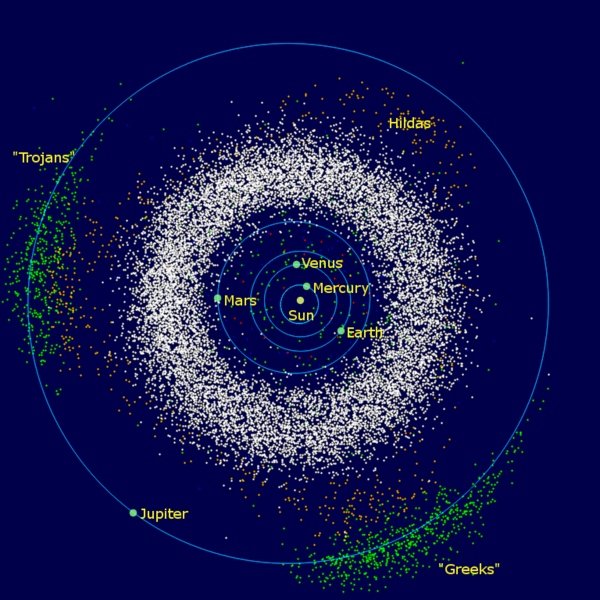
Asteroids versus comets
| Property | Asteroid | Comet |
|---|---|---|
| Made of | Rock and/or metal; some contain water-bearing minerals | Ices (water, CO, CO₂, methane, ammonia) mixed with dust and organics |
| Where most live | Main belt, inside or near the snow line | Kuiper Belt/scattered disk and Oort Cloud, beyond the snow line |
| Near the Sun | Usually inactive | Ices sublimate (outgas), producing a coma and tails |
| Typical orbit | Low eccentricity, low inclination | Often highly eccentric; long-period comets at any inclination |
| Albedo | Dark (C) to moderately bright (S, E) | Very dark nuclei (a few percent) |
The boundary is blurry. Active asteroids (like Bennu, or main-belt comets) shed dust; extinct comets that have lost their surface ice look like asteroids; dark comets show small non-gravitational accelerations from outgassing but no visible coma. Most small bodies are irregular, not round, because their gravity is too weak to overcome the strength of their material and pull them into a sphere. Roughly 600 km is the dividing line for rocky bodies (Vesta, 525 km, is not round), and about 400 km for icy ones.
The main asteroid belt
The main asteroid belt lies between Mars and Jupiter, at about 2.1 to 3.3 AU from the Sun (some textbooks quote 2.2–3.2 AU), so it is roughly 1.2 AU (about 180 million km or 110 million miles) wide. It holds an estimated 1.1–1.9 million asteroids larger than 1 km, and more than a million asteroids of all sizes have now been catalogued. It is mostly empty space: neighboring asteroids are typically about a million kilometers apart, so spacecraft cross the belt without danger.
Key facts:
- First asteroid: Ceres, discovered 1 January 1801 by Giuseppe Piazzi. At about 940 km across, it is the only object in the belt in hydrostatic equilibrium and is now classed as a dwarf planet.
- Total mass: only about 3–4% of the Moon's mass, far less than any planet and only about a fifth of Pluto's mass. Ceres alone is about 40% of it. The four largest bodies (Ceres, Vesta, Pallas, Hygiea) together hold about half or more.
- Why no planet formed here: Jupiter's gravity stirred the belt so that asteroids collided too fast to merge; they shattered instead. Resonances then removed more than 99% of the original mass. Even reassembled, the belt would make a body much smaller than the Moon.
- Asteroid families are groups with similar orbits and spectra, fragments of one parent body broken up by a collision (Bennu probably came from such a family).
- Many asteroids have moons (e.g. Ida's moon Dactyl, seen by Galileo in 1993), and some are binaries.
Kirkwood gaps. In the 1860s Daniel Kirkwood noticed that almost no asteroids have orbits at certain distances. These Kirkwood gaps sit where an asteroid's period would be a simple fraction of Jupiter's 11.9-year period, a mean-motion resonance. An asteroid in the 3:1 resonance at 2.5 AU orbits three times for every Jupiter orbit, so Jupiter tugs it at the same point again and again. The repeated kicks add up, pumping its eccentricity until it crosses the orbit of Mars or Earth and is removed by a collision or close encounter. Such resonances are the main source of near-Earth asteroids and meteorites. Not every resonance clears a gap: at the 3:2 resonance (about 4.0 AU) the Hilda asteroids are protected and cluster instead.

| Resonance with Jupiter | Location | Effect |
|---|---|---|
| 4:1 | 2.06 AU | Marks the inner edge of the belt |
| 3:1 | 2.50 AU | Major gap; important meteorite source |
| 5:2 | 2.82 AU | Major gap |
| 7:3 | 2.95 AU | Gap |
| 2:1 | 3.27 AU | Marks the outer edge of the main belt |
| 3:2 | 3.97 AU | Hilda group (stable, clustered) |
| 1:1 | 5.2 AU (Jupiter's orbit) | Jupiter Trojans at L4/L5 |
Asteroid spectral classes
Asteroids are classified by their reflectance spectra (how reflectivity changes with wavelength in visible and near-infrared light) and their albedo. Spectra reveal minerals: absorption near 1 and 2 μm means olivine and pyroxene silicates; a flat, dark spectrum means carbon-rich material; a 3 μm feature means water-bearing minerals. Three classes cover most asteroids.
| Class | Stands for | Composition | Albedo | Share | Where | Meteorite link |
|---|---|---|---|---|---|---|
| C-type | Carbonaceous | Carbon compounds, hydrated clays, silicates, organics | Very low (about 0.03–0.10), the darkest | About 75% (most common) | Outer belt (beyond ~2.7 AU) | Carbonaceous chondrites |
| S-type | Silicaceous (stony) | Silicates (olivine, pyroxene) plus nickel–iron metal | Moderate (about 0.10–0.25), brighter | About 17% | Inner belt | Ordinary chondrites (confirmed by Hayabusa's Itokawa sample) |
| M-type | Metallic | Mostly nickel–iron | Moderate | About 8% | Middle belt | Iron meteorites (cores of shattered differentiated bodies); example: 16 Psyche, target of NASA's Psyche mission |
Other classes appear on tests occasionally: B-type (a bluish C-subtype; Bennu and Pallas), V-type (basaltic crust from Vesta, the source of the HED meteorites; visited by Dawn), D- and P-types (very dark and red, organic-rich, common in the outer belt and among Jupiter Trojans), E-type (enstatite-rich, very high albedo, common among the inner Hungaria asteroids) and the rare olivine-rich A-type and R-type. The letters come from the Tholen and later SMASS classification schemes.
Why the pattern matters. The belt is zoned: S-types dominate the warmer inner belt, C-types the cooler outer belt. This is a fossil of the temperature gradient in the young disk. S-types formed closer to the Sun, where it was hotter and water ice could not survive, and many were heated enough to dry out or even melt. C-types formed farther out, near or beyond the snow line, where water ice could be incorporated. Gentle internal heating then melted that ice, and the water reacted with rock to make clays and carbonates, with organics preserved. C-type asteroids are therefore primitive: little altered since formation apart from that low-temperature water chemistry, which is exactly what Bennu's sample shows. Primitive here means the object's composition has stayed largely unchanged since the Solar System formed.
Near-Earth objects
A near-Earth object (NEO) is an asteroid or comet whose perihelion is less than 1.3 AU, so its orbit brings it into Earth's neighborhood. Most were nudged out of the main belt by Jupiter's resonances, helped by the Yarkovsky drift. They do not have tails: a near-Earth asteroid is still rock. More than 35,000 near-Earth asteroids are known. They live only about 10 million years before hitting a planet or the Sun or being ejected, so the population is constantly resupplied from the belt.
Near-Earth asteroids are grouped by the size and shape of their orbits (semi-major axis a, perihelion q, aphelion Q), not by composition:
| Group | Orbit | Crosses Earth's orbit? | Example |
|---|---|---|---|
| Atiras | Entirely inside Earth's orbit (Q < 0.983 AU) | No | 163693 Atira |
| Atens | a < 1 AU, but Q > 0.983 AU | Yes | 99942 Apophis (before 2029) |
| Apollos | a > 1 AU, q < 1.017 AU | Yes | 101955 Bennu, 1685 Toro |
| Amors | Entirely outside Earth's orbit, 1.017 < q < 1.3 AU | No (but may cross Mars's) | 433 Eros |
A potentially hazardous object (PHO) or asteroid (PHA) comes within 0.05 AU (about 7.5 million km, roughly 20 Moon distances) of Earth's orbit and is larger than about 140 m. Bennu and Apophis are both PHAs. Hazardous does not mean an impact is likely; it means the orbit deserves tracking. In 2022 NASA's DART spacecraft hit the small moonlet Dimorphos and shortened its orbit, the first test of deflecting an asteroid.
Trojans and other resonant asteroids
Trojans share a planet's orbit, clustered around its L4 and L5 Lagrange points, 60° ahead of and behind the planet, where the planet, the Sun and the Trojan form an equilateral triangle. The combined pull of the Sun and planet, together with the Trojan's orbital motion, keeps it there. Trojans do not sit exactly at the points. They librate, tracing slow tadpole-shaped loops around L4 or L5, and a few follow larger horseshoe orbits.
- Jupiter Trojans are by far the largest group (more than 10,000 known). By tradition the swarm at L4, ahead of Jupiter, is named for Greek heroes (the "Greek camp") and the swarm at L5, behind, for Trojan heroes (the "Trojan camp"). Most are dark D- and P-types, possibly captured from the outer Solar System. NASA's Lucy mission is flying past several of them.
- Other planets have Trojans too: Neptune (dozens), Mars, Uranus, and Earth. The first Earth Trojan, 2010 TK7, was announced by NASA in 2011.
Centaurs
Centaurs are icy small bodies orbiting between Jupiter and Neptune, often crossing one or more giant planets' orbits. They are named after the half-human, half-horse creatures of Greek myth because they are half asteroid, half comet: asteroid-sized and asteroid-like in orbit, but comet-like in composition, and some (like 2060 Chiron, found in 1977) grow a coma. Their orbits are unstable. Close encounters with the giant planets scatter them within a few million years: they are thrown inward to become Jupiter-family comets, thrown outward, ejected, captured or crash into a planet. That short lifetime is why relatively few exist at any time. Centaurs are thought to come from the Kuiper Belt and scattered disk, so they are primordial material in transit. They split into two color groups: gray and very red. The centaur Chariklo has rings.
The Kuiper Belt and trans-Neptunian objects
A trans-Neptunian object (TNO) is anything orbiting the Sun with an average distance greater than Neptune's (30 AU). The Kuiper Belt is a thick, disk-shaped (flattened torus) region of icy bodies from about 30 to 50 AU, with a sharp drop in numbers (the "Kuiper cliff") near 50 AU. It was proposed by Kenneth Edgeworth and Gerard Kuiper. Its first member after Pluto, 1992 QB1 (now Albion), was found in 1992 by David Jewitt and Jane Luu. Kuiper Belt objects are icy (water, methane, ammonia and nitrogen ices mixed with rock and dark organics). They are remnants of the outer disk that never grew into a planet, and Neptune's outward migration sculpted the belt. Because they formed far out and have been undisturbed and cold since, their composition is close to that of the original solar nebula. Pluto, Haumea, Makemake and Eris all live in or beyond it.

| Population | Orbit | Examples | Notes |
|---|---|---|---|
| Classical KBOs (cubewanos) | About 42–48 AU, not in resonance with Neptune, never come close to Neptune | Makemake, Quaoar, Arrokoth, Albion | Named after 1992 QB1 ("Q-B-1-os"). Cold classicals: low inclination (under about 5°), nearly circular, red, often binaries; thought pristine "living fossils" that formed where they are. Hot classicals: higher inclination and eccentricity, likely scattered there. "Cold" and "hot" describe orbits, not temperature |
| Resonant KBOs | Locked in resonance with Neptune | Plutinos (3:2, about 39.4 AU): Pluto, Orcus. Twotinos (2:1, about 47.8 AU) | The resonance protects them: Pluto crosses Neptune's orbit but is never near Neptune when it does. Only some TNOs are resonant |
| Scattered disk objects (SDOs) | Very eccentric and often inclined; perihelia about 30–40 AU, aphelia up to hundreds of AU | Eris | Scattered outward by Neptune and still occasionally perturbed by it. Main source of centaurs and Jupiter-family comets |
| Detached objects and extreme TNOs | Perihelia beyond about 40 AU, so Neptune no longer controls them; extreme TNOs have semi-major axes beyond about 150 AU | 90377 Sedna (perihelion 76 AU), 2012 VP113 | Sednoids are the most detached, often grouped with the scattered disk. Their clustered orbits motivate the "Planet Nine" hypothesis (unconfirmed) |
Kuiper Belt versus asteroid belt. Both are disks of leftover planetesimals, so "contains leftover planetesimals" is a similarity, not a difference. The differences:
| Main asteroid belt | Kuiper Belt | |
|---|---|---|
| Location | 2.1–3.3 AU, between Mars and Jupiter, near the snow line | 30–50 AU, beyond Neptune, far outside the snow line |
| Composition | Rock and metal (some hydrated minerals) | Mostly ices plus rock and organics |
| Size and mass | Narrow; total mass about 3–4% of the Moon | About 20 times wider; many times more massive than the asteroid belt (still a small fraction of Earth's mass) |
| Dwarf planets | One (Ceres) | Several (Pluto, Haumea, Makemake; Eris in the scattered disk) |
| Sculpted by | Jupiter | Neptune |
| Comets supplied | None (a few main-belt comets) | Short-period (Jupiter-family) comets |
The Oort Cloud
The Oort Cloud is a hypothesized, roughly spherical shell of perhaps trillions of icy comet nuclei surrounding the Solar System, from roughly 2,000 AU out to about 100,000 AU (over a light-year). Its denser, disk-like inner part (roughly 2,000–20,000 AU) is called the Hills cloud (inner Oort Cloud); the outer, spherical part is the source of most long-period comets. Jan Oort proposed it in 1950 to explain why long-period comets arrive from every direction with orbits reaching enormous distances. It has never been observed directly; its objects are too small and faint. Its icy bodies formed among the giant planets and were flung outward by them, then had their orbits randomized into a sphere by passing stars and the tide of the Milky Way. Those same gentle nudges occasionally send a comet back inward as a new long-period comet. The Oort Cloud is still bound by the Sun's gravity, and its outer edge is usually taken as the outer edge of the Solar System. It lies far beyond the heliopause (about 120 AU, which Voyager 1 crossed in 2012), where the solar wind meets interstellar space.

Comets: anatomy and orbits
A comet (from Greek komētēs, "long-haired", from kómē, hair) is an icy small body that becomes active near the Sun. Far from the Sun it is just a nucleus, a dark, porous lump of ice, dust and organics, usually a few kilometers or less across (most are 10 km or smaller; 67P is about 4 km). Fred Whipple's 1950 "dirty snowball" model described this; Rosetta found 67P to be more of an "icy dirtball", with more dust than ice.
How activity works. Inside about 3 AU, sunlight warms the surface enough for water ice to sublimate (turn directly from solid to gas); more volatile CO and CO₂ ices can drive activity farther out. The escaping gas drags dust with it (outgassing), building:
| Part | What it is | Size and appearance |
|---|---|---|
| Nucleus | The solid body of ice, rock, dust and organics | About 1–10 km; very dark (albedo about 0.04); usually hidden inside the bright coma |
| Coma | Cloud of gas and dust around the nucleus; the comet's fuzzy "head" | Up to about 100,000 km or more across |
| Hydrogen envelope (cloud) | Hydrogen atoms from water molecules split by sunlight; seen only in ultraviolet | Up to about 10 million km, larger than the Sun |
| Ion (plasma, gas) tail | Ionized gas (e.g. CO⁺, H₂O⁺) picked up and carried by the solar wind and its magnetic field | Straight, narrow, bluish (glowing CO⁺); points directly away from the Sun; can be over 100 million km long |
| Dust tail | Dust grains pushed by the pressure of sunlight | Broad, curved, yellowish-white (reflected sunlight); bends back along the comet's orbit |

Why tails point away from the Sun. Both tails are pushed by the Sun, not left behind by the comet's motion. The solar wind blows outward at about 400 km/s, far faster than the comet moves, so ions are swept straight out along the Sun–comet line. Dust grains feel only the gentle push of sunlight (radiation pressure) and keep much of their orbital speed, so they spread into a curved tail that lags behind the comet's motion. Facing the ion tail, with the comet moving to your left, the dust tail curves off to the right. When the comet heads back out after perihelion, its tails go in front of it. Tails grow longer as the comet approaches the Sun and shrink as it leaves. A comet seen with a spike pointing toward the Sun has an anti-tail: a perspective effect when Earth crosses the plane of the comet's orbit and sees the dust tail edge-on.

Comet orbit classes.
| Class | Period | Orbit | Source | Examples |
|---|---|---|---|---|
| Jupiter-family comets | Under 20 years | Low inclination, prograde; aphelion near Jupiter's orbit; controlled by Jupiter | Kuiper Belt / scattered disk (via centaurs) | 67P, 9P/Tempel 1 |
| Halley-type comets | 20–200 years | Any inclination, some retrograde | Probably the Oort Cloud (possibly scattered disk) | 1P/Halley (about 76 years), 109P/Swift–Tuttle |
| Long-period comets | Over 200 years (up to millions) | Very eccentric, random inclinations, about half retrograde | Oort Cloud | Hale–Bopp, C/2020 F3 (NEOWISE) |
| Non-periodic (single-visit) comets | None | Parabolic or hyperbolic (e ≥ 1); pass once | Oort Cloud (perturbed) or interstellar | Many "new" comets |
Short-period comets are those with periods under 200 years (Jupiter-family plus Halley-type); their low inclinations point to a disk-shaped source, the Kuiper Belt. Long-period comets come in from all directions, which points to a spherical source, the Oort Cloud. Comet names encode type: P/ periodic, C/ non-periodic or long-period, D/ defunct, I/ interstellar, plus a number and the discoverers' names (67P/Churyumov–Gerasimenko).
How comets end. Comets lose mass every orbit by sublimation. A comet can end by:
- volatile exhaustion: it becomes a dormant or extinct, asteroid-like body;
- breaking apart (fragmenting, or being torn up inside a planet's Roche limit, as Shoemaker–Levy 9 was by Jupiter before hitting it in 1994);
- colliding with a planet or the Sun (sungrazers);
- ejection from the Solar System by a giant planet.
A comet does not just stay in place.
Meteoroids, meteors and meteorites
| Term | Meaning |
|---|---|
| Meteoroid | A small rocky or metallic body in space, from dust size up to about 1 m; most are fragments of asteroids or debris shed by comets |
| Meteor | The streak of light when a meteoroid hits the atmosphere at 11–72 km/s and burns up (ablates), typically 80–120 km up; a "shooting star" |
| Fireball | An unusually bright meteor, brighter than Venus |
| Bolide | A fireball that explodes in the atmosphere (e.g. Chelyabinsk, 2013) |
| Meteorite | A meteoroid that survives the passage and lands on the ground. A fall is seen arriving; a find is discovered later |
| Meteor shower | Many meteors per hour when Earth crosses a stream of debris left along a comet's (or asteroid's) orbit; they occur on the same dates each year |
| Radiant | The point in the sky that shower meteors appear to come from. The debris paths are parallel, and perspective makes them seem to diverge from one point, as railroad tracks do. Showers are named for the constellation of the radiant |
Meteorites that land are usually not hot. Only their outer skin melts, forming a dark glassy fusion crust, and the cold interior cools the rock quickly. Most meteorites come from asteroids (via resonances in the belt); a few come from the Moon and Mars. Comet debris is fragile and makes meteors but rarely meteorites.
| Shower | Peak | Parent body |
|---|---|---|
| Quadrantids | Early January | Asteroid 2003 EH1 (possibly an extinct comet) |
| Eta Aquariids | Early May | 1P/Halley |
| Perseids | Mid-August | 109P/Swift–Tuttle |
| Orionids | Late October | 1P/Halley |
| Leonids | Mid-November | 55P/Tempel–Tuttle |
| Geminids | Mid-December | Asteroid 3200 Phaethon |
Meteorite classes and what they record
Meteorites are free samples of asteroids. Their textures show whether their parent body ever melted and differentiated.
| Class | Share of observed falls | Made of | What it records |
|---|---|---|---|
| Chondrites (stony, undifferentiated) | About 86% | Silicates with chondrules (mm-sized once-molten droplets), metal grains and fine matrix | From parent bodies that never melted. Chondrules were flash-heated in the disk, perhaps by shock waves. White CAIs (calcium–aluminum-rich inclusions) in them are the oldest solids, 4.567 billion years old, which dates the Solar System |
| Carbonaceous chondrites (a chondrite subgroup) | About 4% | Hydrated clays, carbonates, magnetite, a few percent carbon, organics including amino acids (Murchison, 1969) | The most primitive meteorites: their bulk chemistry nearly matches the Sun's (minus gases). Water-altered at low temperature; linked to C-type asteroids and to Bennu |
| Achondrites (stony, differentiated) | About 8% | Igneous rocks like basalt; no chondrules | Crust or mantle of a body that melted. HED meteorites come from Vesta; Martian and lunar meteorites are achondrites |
| Iron meteorites | About 5% | Iron–nickel metal; etched slices show a criss-cross Widmanstätten pattern of metal crystals | Cores of differentiated asteroids later shattered by impacts. Large crystals mean very slow cooling deep inside a body |
| Stony-iron meteorites | About 1% | Roughly half metal, half silicate. Pallasites: olivine crystals in metal; mesosiderites: metal and basalt breccia | Pallasites may sample the core–mantle boundary of a differentiated body |
How to use it: chondrites mean undifferentiated, primitive parent bodies; achondrites, irons and stony-irons mean the parent body melted and separated into crust, mantle and core. A fragment containing both metallic and stony parts is the best sign of differentiation. Irons are overrepresented among finds because they look unusual and resist weathering, but among observed falls stony meteorites dominate (about 94%).
Rubble piles, YORP and Yarkovsky
Many asteroids larger than about 200 m are rubble piles: collections of boulders, pebbles and dust held together by weak gravity and slight cohesion, not solid monoliths. They form when a larger asteroid is shattered and the pieces reassemble. Evidence: low bulk densities (high porosity, e.g. Bennu about 50%, Itokawa about 40%), surfaces covered in boulders, and a spin barrier. Almost no asteroid larger than about 200 m spins faster than once every 2.2 hours, because a faster rubble pile would fly apart. Itokawa (Hayabusa), Ryugu (Hayabusa2) and Bennu (OSIRIS-REx) were all confirmed as rubble piles by visiting spacecraft.
Sunlight changes small asteroids in two related ways, both caused by the delayed re-emission of absorbed heat as infrared:
- the Yarkovsky effect gives a tiny thrust that slowly changes the orbit (semi-major axis), carrying asteroids into resonances and eventually to near-Earth space;
- the YORP effect (Yarkovsky–O'Keefe–Radzievskii–Paddack) is a twisting torque that changes the spin rate and axis. Spun-up rubble piles shed material, form equatorial ridges and top shapes like Bennu and Ryugu, and can split to form binary asteroids.
Dwarf planets of the Solar System
| Dwarf planet | Location | Distance (AU) | Diameter | Moons | Notes |
|---|---|---|---|---|---|
| Ceres | Asteroid belt | 2.8 | 940 km | 0 | The only dwarf planet in the inner Solar System; Dawn (2015–2018) found bright salt (sodium carbonate) deposits from brine |
| Pluto | Kuiper Belt (plutino, 3:2) | 39.5 | 2,377 km | 5 (Charon largest) | Reclassified 2006; New Horizons flyby 2015 found nitrogen-ice plains (Sputnik Planitia) and a likely subsurface ocean |
| Haumea | Kuiper Belt | 43 | about 1,600 km (elongated) | 2 | Spins in about 4 hours, stretching it into an egg shape; has a ring |
| Makemake | Kuiper Belt (classical) | 45.5 | about 1,430 km | 1 | See Makemake |
| Eris | Scattered disk | 68 | 2,326 km | 1 (Dysnomia) | Most massive known dwarf planet; its 2005 discovery triggered the 2006 planet definition |
Several other large TNOs (Gonggong, Quaoar, Sedna, Orcus) are probably round enough to qualify but have not been officially designated.
Interstellar objects
Three objects from other planetary systems have been seen passing through the Solar System. All were on hyperbolic orbits (e > 1, unbound to the Sun):
- 1I/ʻOumuamua (2017): elongated, no visible coma, with a slight non-gravitational acceleration;
- 2I/Borisov (2019): a clearly active comet much like Solar System comets;
- 3I/ATLAS (discovered July 2025): an active comet.
They show that other planetary systems also make and eject icy planetesimals, so the building blocks of planets and the ingredients of life are not unique to our system.
Why small bodies matter for habitability
- Primitive material. Carbonaceous asteroids, comets and Kuiper Belt objects preserve the original mix of rock, water and organic molecules. Studying them (Bennu's sample, 67P's gases, meteorites like Murchison) shows what ingredients the young planets started with. Comets are among the most pristine remnants of all.
- Delivery of water and organics. Earth formed inside the snow line, so much of its water and carbon was probably delivered afterwards by impacts. Isotopes (D/H) suggest carbonaceous asteroids contributed more than comets like 67P. The full argument, with the D/H numbers, is in Delivery by small bodies.
- Proof that prebiotic chemistry is common. Amino acids, nucleobases, sugars and phosphorus form without life in asteroid parent bodies and comet ices.
- Impacts as a hazard and a reset. Large impacts can sterilize surfaces or vaporize oceans (the early bombardment of the inner Solar System), and they cause mass extinctions on Earth. Jupiter's gravity both scatters small bodies inward and ejects many from the Solar System, so it shapes how often planets are hit.
- Small icy worlds can be active. Ceres's brines, Pluto's probable ocean and Makemake's methane chemistry suggest that liquid water and internal chemistry may persist in surprisingly small, cold bodies, widening the list of places to look.
The extrasolar systems
The 2027 rules name three planetary systems outside the Solar System. Each is a different kind of habitability target. TRAPPIST-1 is a compact family of seven Earth-sized worlds around an ultracool red dwarf. Kepler-452 b is a possible "older cousin" of Earth around a Sun-like star. LHS 1140 b is a well-measured super-Earth or water world around a quiet red dwarf. Planets are named for their star plus a lowercase letter starting at b, assigned in order of discovery (planets announced together are lettered outward from the star). Planet parameters below come from the NASA Exoplanet Archive. Values for small planets are revised often, so learn the round numbers and the ranges.
| TRAPPIST-1 | Kepler-452 | LHS 1140 | |
|---|---|---|---|
| Star type | M8V ultracool red dwarf | G2V (Sun-like, slightly larger) | M4.5V red dwarf |
| Star temperature | about 2,570 K | about 5,760 K | about 3,100 K |
| Star mass | 0.09 (about 94 Jupiter masses) | 1.04 | 0.18 |
| Star radius | 0.12 (only about 20% larger than Jupiter) | 1.11 | 0.22 |
| Luminosity | about 0.00055 | about 1.2 | about 0.0038 |
| Age | about 7.6 ± 2.2 billion years (older than the Sun) | about 6 billion years (about 1.5 billion years older than the Sun) | over 5 billion years |
| Distance | about 40 light-years (12.4 parsecs), in Aquarius | about 1,800 light-years (Gaia; first published as 1,400), in Cygnus | about 49 light-years (15.0 parsecs), in Cetus |
| Planets | 7 (b, c, d, e, f, g, h) | 1 (b) | 2 (b, c) |
| Discovery method | Transit (ground-based TRAPPIST; then Spitzer, VLT, others) | Transit (Kepler space telescope) | Transit (MEarth-South) + radial velocity (HARPS) |
| Discovery dates | b, c, d announced May 2016; seven planets announced Feb 2017 | Announced July 23, 2015 | b in 2017; c in 2018 (published 2019) |
TRAPPIST-1
Discovery and name. TRAPPIST stands for TRAnsiting Planets and PlanetesImals Small Telescope, a 60 cm robotic telescope at ESO's La Silla Observatory in Chile, run by the University of Liège (Belgium). The name also nods to the Belgian Trappist monks' beer. In 2016 Michaël Gillon's team announced three Earth-sized planets transiting the star. In February 2017, after a 20-day near-continuous watch by NASA's Spitzer infrared space telescope plus ground telescopes, they announced seven transiting Earth-sized planets, the most Earth-sized planets known around a single star. All seven transit, which means we see the system almost exactly edge-on.
The star. TRAPPIST-1 is an ultracool dwarf of spectral type M8V, just massive enough to fuse hydrogen. It is barely larger than Jupiter, about 2,570 K, and about 1/1,800 as luminous as the Sun. It is older than the Solar System and will shine for trillions of years. It is magnetically active and flares frequently.
| Planet | Period (days) | Distance from star (AU) | Radius (Earth = 1) | Mass (Earth = 1) | Flux received (Earth = 1) | Equilibrium temp. (K, zero albedo) | Habitable-zone status |
|---|---|---|---|---|---|---|---|
| b | 1.51 | 0.012 | 1.12 | 1.37 | 4.2 | about 400 | Too hot (inside inner edge) |
| c | 2.42 | 0.016 | 1.10 | 1.31 | 2.2 | about 340 | Too hot (Venus-like flux) |
| d | 4.05 | 0.022 | 0.79 | 0.39 | 1.1 | about 290 | Near the inner edge; in the optimistic HZ only |
| e | 6.10 | 0.029 | 0.92 | 0.69 | 0.65 | about 250 | In the HZ (best candidate for liquid water) |
| f | 9.21 | 0.038 | 1.05 | 1.04 | 0.37 | about 220 | In the HZ |
| g | 12.35 | 0.047 | 1.13 | 1.32 | 0.25 | about 200 | In the HZ (near the outer edge) |
| h | 18.77 | 0.062 | 0.76 | 0.33 | 0.14 | about 170 | Too cold (outside outer edge) |
Values from Agol et al. (2021) and Ducrot et al. (2020) via the NASA Exoplanet Archive. How to use the table: e, f and g are the three usually listed as HZ planets; d is sometimes included under optimistic limits. Notice that every period is shorter than three weeks and every orbit fits well inside Mercury's (0.39 AU). The whole system would fit inside a circle about one-sixth the size of Mercury's orbit.

A resonant chain. Neighboring periods form near-whole-number ratios: 8:5 (b:c), 5:3 (c:d), 3:2 (d:e), 3:2 (e:f), 4:3 (f:g) and 3:2 (g:h). This resonance chain probably formed as the planets migrated inward together in the young gas disk. The repeated, regular gravitational tugs keep the orbits stable for billions of years and keep them slightly eccentric, which drives some tidal heating (see Resonances that keep moons heated).
Masses from transit timing. The star is too faint and active for precise radial velocities, so the planets' masses come from transit timing variations (TTVs): the planets tug on each other, so transits arrive minutes early or late. Modeling the timing pattern gives each planet's mass. Combined with radii from transit depths, this gives densities.
Composition. The seven planets have similar densities to one another, about 4–5.5 g/cm³. That is slightly lower than an Earth-like rock–iron mix would give at the same masses. Possible explanations are a smaller iron core than Earth's, or a few percent of their mass in water (ice or ocean) or other volatiles, especially for the outer planets. All seven are rocky worlds; none is a gas planet.
JWST results (2023–2025). JWST measured the dayside heat of b and c at 15 µm, where CO₂ absorbs strongly, during secondary eclipses, and took transmission spectra of d and e during transits:
- TRAPPIST-1 b (2023): dayside about 500 K, about what a dark bare rock would give with no heat carried to the nightside. This is consistent with no substantial atmosphere, although later observations left open a hazy atmosphere as an alternative.
- TRAPPIST-1 c (2023): dayside about 380 K, which rules out a thick, Venus-like CO₂ atmosphere; a thin atmosphere or bare rock remains possible.
- TRAPPIST-1 d (2025, NIRSpec transmission spectra): no water, methane or CO₂ detected, so no Earth-like atmosphere; a very thin atmosphere, high clouds or bare rock remain possible.
- TRAPPIST-1 e (2025, transmission spectra): a hydrogen-rich (primary) atmosphere is ruled out. A secondary atmosphere (for example nitrogen-rich with traces of CO₂ or methane) is still possible, and so is bare rock. Starspots and flares on the star contaminate the spectra, so many more transits are needed.
The key open question is whether planets this close to a flaring red dwarf could keep any atmosphere. The star was much brighter during its first several hundred million years and still flares, so atmospheres may have been stripped. If e, f or g kept an atmosphere, they would be among the best targets for habitability anywhere. The planets are almost certainly tidally locked.
Kepler-452
Discovery. NASA announced Kepler-452 b on July 23, 2015 (Jon Jenkins and colleagues), from four years of data from the Kepler space telescope, which stared at about 150,000 stars in Cygnus and Lyra. It was the first near-Earth-size planet found in the habitable zone of a G2 star like the Sun and was widely called "Earth 2.0" or "Earth's bigger, older cousin".
The star. Kepler-452 is a G2V star like the Sun but about 1.5 billion years older (about 6 billion years), about 4% more massive, about 10% larger and about 20% more luminous. It is about 1,800 light-years away according to Gaia (the 2015 paper estimated 1,400 light-years) and faint (magnitude about 13.4).
The planet.
| Property | Value | Notes |
|---|---|---|
| Orbital period | 385 days | About 5% longer than Earth's year |
| Orbital distance | about 1.05 AU | |
| Radius | about 1.5–1.6 Earth radii (1.63 in the discovery paper) | Depends on the star's radius, which has been revised |
| Flux received | about 1.1 times Earth's (10% more) | In the conservative HZ, but nearer the inner edge than Earth |
| Equilibrium temperature | about 265 K | Similar to Earth's 255 K |
| Mass | Unknown (never measured) | A rocky planet of this size would be about 5 Earth masses with about twice Earth's surface gravity |
| Rocky? | Discovery paper: roughly a 50–60% chance of being rocky | A planet of 1.6 Earth radii is near the size where planets typically start to keep thick gas envelopes |
Why its mass is unknown. The star is far away and faint, and a 5-Earth-mass planet in a one-year orbit would make it wobble by only about 0.4 m/s, below what radial-velocity spectrographs can measure on such a faint star. So we know the planet's size and orbit but not its density or composition.
Uncertainty about its status. Kepler saw only about four transits, each a small dip (about 0.02%). A 2018 re-analysis (Mullally and colleagues) found that, with Kepler's final, more careful assessment of its false-positive rate, the signal could no longer be confirmed at the usual statistical confidence. It might be a false positive. The NASA Exoplanet Archive still lists it as confirmed, but treat it as "probably a planet, not certain". JWST atmospheric study is impractical: the star is too faint and the transit too shallow and rare.
Its future. Because its star is older and brightening, Kepler-452 b may be entering a runaway greenhouse now, giving a possible preview of Earth's future as the Sun brightens.
LHS 1140
Discovery. LHS 1140 b was announced in 2017 (Jason Dittmann and colleagues, in Nature). It was found by the MEarth-South project, an array of small robotic telescopes at Cerro Tololo, Chile, that watches nearby M dwarfs for transits. Its mass was measured by radial velocity with the HARPS spectrograph at ESO's La Silla Observatory. A second, inner planet, LHS 1140 c, was found in 2018 (published 2019). The name comes from the Luyten Half-Second catalog of stars with large proper motion.
The star. LHS 1140 is an M4.5V red dwarf about 49 light-years away in Cetus, about 0.18 solar masses, 0.22 solar radii and 3,100 K. Unlike TRAPPIST-1 it is old, rotates slowly and is quiet (few flares). That makes it one of the best stars for studying a temperate small planet.
| Planet | Period | Distance | Radius | Mass | Density | Flux (Earth = 1) | Eq. temp. | HZ status |
|---|---|---|---|---|---|---|---|---|
| LHS 1140 b | 24.7 days | 0.095 AU | 1.73 R⊕ | 5.6 M⊕ | about 5.9 g/cm³ | about 0.43 | about 226 K | In the conservative HZ (outer half) |
| LHS 1140 c | 3.78 days | 0.027 AU | 1.27 R⊕ | 1.9 M⊕ | about 5.1 g/cm³ | about 5.3 | about 420 K | Too hot |
(Values from Cadieux et al. 2024.)
How the numbers changed. The 2017 discovery paper gave a radius of 1.43 R⊕ and a mass of 6.6 M⊕, a very dense, clearly rocky "super-Earth". Better data from TESS, Spitzer, ESPRESSO and JWST revised this to 1.73 R⊕ and 5.6 M⊕. That is the same planet but larger and lighter, so its density fell and the interpretation changed. Questions written before 2024 may describe it as a dense rocky planet.
Water world? A rocky planet with Earth's iron-to-rock ratio and 5.6 Earth masses would be about 1.6 R⊕ and denser, about 7–8 g/cm³ (gravity compresses big rocky planets). LHS 1140 b is too big for its mass. The two leading explanations:
- A water world: roughly 10–20% of its mass is water (far more than Earth's 0.02%), probably as a deep ice or ocean layer over rock.
- A mini-Neptune with a thin hydrogen envelope (about 0.1% of its mass).
JWST results (2024). Transmission spectra from JWST's NIRISS instrument ruled out a hydrogen-rich atmosphere with high confidence (more than 10σ), disfavoring the mini-Neptune option. The data showed a tentative hint (about 2.3σ, far from a confirmed detection) of a nitrogen-dominated atmosphere, like Earth's or Titan's. The analysis also had to correct for bright spots (faculae) on the star. If the planet is a water world with an atmosphere and is tidally locked, climate models suggest it could be mostly frozen with a liquid "bullseye" ocean under the permanent noon of its dayside. Confirming an atmosphere and detecting CO₂ will take years of further JWST observations, because the planet transits only about once every 25 days and is observable only a few times a year.
Other exoplanets you may meet in questions
Tests often mix in well-known systems from earlier rule sets. One line each, for recognition only:
| Planet or system | Why it is famous |
|---|---|
| 51 Pegasi b (1995) | First planet found around a Sun-like star (radial velocity; Mayor and Queloz, Nobel Prize 2019); the first hot Jupiter |
| HD 209458 b (1999) | First planet seen to transit; first exoplanet atmosphere detected (sodium, 2001, Hubble) |
| HR 8799 (2008) | First multi-planet system directly imaged: four young giant planets (b, c, d, e) |
| Proxima Centauri b (2016) | Nearest exoplanet (4.2 light-years), in its red dwarf's HZ; found by radial velocity; star flares strongly |
| Kepler-186 f (2014) | First Earth-size planet found in a star's HZ (transit, Kepler); red dwarf host |
| TOI-700 d and e (2020, 2023) | Earth-size HZ planets of a red dwarf, found by TESS (TOI = TESS Object of Interest) |
| K2-18 b (2015) | Sub-Neptune in its red dwarf's HZ; Hubble found water vapor (2019); JWST found CH₄ and CO₂ (2023); claimed DMS is unconfirmed |
Light, temperature and the math of habitability
Blackbodies
A blackbody is an ideal object that absorbs all radiation falling on it and re-emits energy with a spectrum that depends only on its temperature. Stars are close to blackbodies; planets are approximately blackbodies in the infrared. A hot object emits a continuous spectrum: the curve rises steeply at short wavelengths, peaks, and falls off with a long tail toward long wavelengths.

Two laws describe the curve. Wien's displacement law gives the peak wavelength: it is inversely proportional to absolute temperature. The Stefan–Boltzmann law gives the total power emitted per square meter (the area under the curve): it is directly proportional to the fourth power of absolute temperature. A hotter blackbody emits more at every wavelength, so its curve lies entirely above a cooler one; that is why, of several stars, the hottest emits the most even at a long wavelength like 5 mm.
Luminosity of a star
Luminosity L is the total power a star emits (W). Multiply the power per square meter by the surface area of a sphere, :
Flux, albedo and equilibrium temperature
The inverse-square law
Starlight spreads over the surface of an ever-larger sphere as it travels. The total power L is fixed, and a sphere's area is , so the flux S (power per square meter, also called intensity or irradiance) falls with the inverse square of distance. Gravity obeys an inverse-square law for the same geometric reason: its influence spreads over the same growing sphere.
Albedo: Bond and geometric
Albedo measures reflectivity: the fraction of incident light a surface reflects. Fresh ice and bright clouds have high albedo; dark rock, carbon-rich dust and open ocean have low albedo. A planet absorbs the fraction of the light that hits it, and only the absorbed part warms it. If two otherwise identical planets differ only in albedo, the more reflective one is cooler.
- Bond albedo is the fraction of all incoming stellar power reflected in all directions at all wavelengths. It lies between 0 and 1 and is the one used in energy balance.
- Geometric albedo compares the body's brightness seen face-on (full phase) with a perfectly diffusing flat white disk of the same size. It describes how bright the object looks, and for strongly backscattering icy surfaces it can exceed 1: Enceladus, coated in fresh plume frost, has a geometric albedo near or above 1 and is the most reflective large body in the Solar System.
| Body | Approximate Bond albedo | Why |
|---|---|---|
| Venus | 0.77 | Thick sulfuric acid clouds |
| Earth | 0.30 | Clouds, ice, oceans mixed |
| Mars | 0.25 | Dusty red rock |
| Moon | 0.11 | Dark basalt and regolith |
| Mercury | ~0.07–0.09 | Dark surface; lowest of the terrestrial planets |
| Europa | ~0.6–0.7 | Water-ice surface |
| Enceladus | ~0.8 | Fresh ice and frost from plumes |
| Titan | ~0.27 | Orange organic haze |
| Bennu, 67P (geometric) | ~0.04–0.06 | Carbon-rich, among the darkest surfaces known |
How to use it: high albedo means bright, cold for its distance; low albedo means dark and warmer. C-type (carbonaceous) asteroids are dark (low albedo); S-type (stony) are brighter.
Deriving the equilibrium temperature
A planet is in radiative (thermal) equilibrium, or has a balanced energy budget, when the rate at which it absorbs energy equals the rate at which it radiates energy. For Earth, Venus and Mars this balance holds on average (net energy balance ≈ 0). Setting the two rates equal gives the equilibrium temperature, a calculated, idealized temperature, not a measured one, that ignores the greenhouse effect and internal heat.
- Absorbed power. The planet intercepts starlight over its cross-section, a disk of area , and keeps the fraction : .
- Emitted power. A rapidly rotating planet radiates from its whole surface, : .
- Balance. . The planet's radius cancels, so size does not matter.
- Solve. , and with , .
The same scaling sets the habitable zone: a star with gives Earth's flux at AU. It is worked for TRAPPIST-1 in How the habitable zone scales with luminosity.
Doppler shift
The Doppler effect is the change in observed wavelength (and frequency) of a wave caused by relative motion of the source and observer along the line of sight. A source moving toward you has its waves bunched up: shorter wavelength, higher frequency, a blueshift. A source moving away has stretched waves: longer wavelength, lower frequency, a redshift. The shift reveals motion, not temperature or composition: spectral lines keep their pattern but slide together.
In the radial-velocity method the star's lines shift blue and red as it circles the barycenter; the curve's period is the planet's period and its amplitude sets the minimum mass. The size of the signal is worked in Center of mass, the barycenter and stellar wobble.
Gravity, orbits and energy
Newton's laws of motion
- Inertia: an object keeps moving in a straight line at constant speed unless a net force acts. A planet would fly off along a straight line if gravity vanished.
- F = ma: net force equals mass times acceleration. Gravity supplies the centripetal force that bends an orbit into a curve.
- Action–reaction: forces come in equal and opposite pairs. The planet pulls the star exactly as hard as the star pulls the planet, so the star moves too (the basis of the radial-velocity method).
Momentum is conserved when no outside force acts; in a star–planet pair, the star's momentum about the center of mass always balances the planet's. An astronaut on the space station is "weightless" not because gravity is absent (it is about 90% of surface gravity there) but because the station and astronaut are in free fall together: gravity is the only force acting. A satellite is a projectile moving sideways fast enough that the ground curves away as fast as it falls.
Newton's law of universal gravitation
Every mass attracts every other mass with a force proportional to the product of the masses and inversely proportional to the square of the distance between their centers. The constant G is the universal gravitational constant. Gravity is the force that holds planets, moons and satellites in orbit.
Mass, density and composition
Density is mass divided by volume, , and for a sphere . Because mass can be measured from orbits and radius from images or transits, bulk density is usually the first clue to what a world is made of.
| Material or body | Density (g/cm³) | What it implies |
|---|---|---|
| Water ice / liquid water | 0.92 / 1.00 | Reference points |
| Saturn | 0.69 | Less than water: Saturn would "float." Mostly H and He gas |
| Jupiter / Uranus / Neptune | 1.33 / 1.27 / 1.64 | H/He envelopes (Jupiter) or ices plus H/He (Uranus, Neptune) |
| 67P | ~0.5 | Very porous ice–dust rubble |
| Bennu | ~1.2 | Porous rubble pile of carbon-rich rock |
| Enceladus | 1.61 | Rock core plus thick ice/ocean layer |
| Titan / Ganymede | 1.88 / 1.94 | Roughly half rock, half ice by mass |
| Europa | 3.01 | Mostly rock, thin (~100 km) water layer |
| Moon / Io | 3.34 / 3.53 | Rock; Moon has only a small iron core, Io a moderate iron–iron sulfide core |
| Mars | 3.93 | Rock with a modest iron core |
| Venus / Mercury / Earth | 5.24 / 5.43 / 5.51 | Rock plus large iron cores; Earth is the densest planet |
How to use it: about 1–2 g/cm³ means ice-rich (or, for a large planet, gas-rich); about 3–4 means rock; above 5 means rock with a lot of iron, or a large body compressed by its own gravity. A large exoplanet with density near 0.5 g/cm³ must be mostly hydrogen and helium around a small core.
Small bodies do not fully differentiate (separate into an iron core, rocky mantle and icy crust) unless they get hot enough to melt; large bodies heated by accretion and radioactive decay do. Gravity's squeeze also matters: central pressure scales roughly as , so doubling density at the same size raises interior pressure about four times.
Surface gravity and weight on other worlds
Setting gives the surface gravitational acceleration. Mass (kg) is the amount of matter and is the same everywhere; weight (N) is the gravitational force and changes from world to world.
| Body | Mass (Earth = 1) | Radius (Earth = 1) | Surface gravity (Earth = 1) | Escape speed (km/s) |
|---|---|---|---|---|
| Earth | 1 | 1 | 1 (9.8 m/s²) | 11.2 |
| Venus | 0.82 | 0.95 | 0.90 | 10.4 |
| Mars | 0.107 | 0.53 | 0.38 (3.7 m/s²) | 5.0 |
| Moon | 0.012 | 0.27 | 0.17 | 2.4 |
| Jupiter | 318 | 11.2 | ~2.4 | 59.5 |
| Ganymede | 0.025 | 0.41 | 0.15 | 2.7 |
| Titan | 0.023 | 0.40 | 0.14 | 2.6 |
| Europa | 0.008 | 0.25 | 0.13 | 2.0 |
| Enceladus | 0.00002 | 0.04 | 0.012 | 0.24 |
How to use it: weight on a world = Earth weight × the gravity column. Venus has slightly weaker gravity than Earth because it has less mass. Enceladus's escape speed is so low that its plume particles readily escape to form Saturn's E ring.
Kepler's laws of planetary motion
Johannes Kepler found three empirical laws (published 1609 and 1619) by fitting Tycho Brahe's careful observations of Mars. Newton later showed all three follow from his law of gravitation. They apply to anything orbiting a much larger mass: planets around stars, moons around planets, binary stars around each other.
| Law | Common names | Statement |
|---|---|---|
| First | Law of ellipses (law of orbits) | Each planet's orbit is an ellipse with the Sun at one focus. The other focus is empty. |
| Second | Law of equal areas (law of areas) | A line from the Sun to a planet sweeps out equal areas in equal times, so the planet moves fastest at perihelion and slowest at aphelion. |
| Third | Law of harmonies (law of periods) | The square of the orbital period is proportional to the cube of the semi-major axis: . |

Why the second law holds. The Sun's pull points straight at the Sun, so it exerts no twisting force (torque) on the planet, and the planet's angular momentum (for the perpendicular part of the velocity) is conserved. The area swept per unit time is , a constant. Close in (small r), the planet must move faster to keep that product fixed. This holds for any force that points toward the center, so if gravity followed instead, the second law would still hold but the first and third would not. Two orbits with the same angular momentum sweep area at the same rate regardless of their shape.
Newton's explanation of the speed change. Approaching the star, gravity has a component along the direction of motion and speeds the planet up; receding, it slows the planet. Energy trades between kinetic and potential, so the planet is fastest at perihelion.
Orbit geometry: eccentricity, perihelion and aphelion

- The major axis is the longest line across the ellipse (through both foci); the semi-major axis a is half of it and equals the average of the closest and farthest distances. The semi-minor axis b is half the shortest width.
- Eccentricity e measures how far the orbit departs from a circle: e = 0 is a circle, 0 < e < 1 an ellipse. It equals the distance between the foci divided by the major axis, , where c is the center-to-focus distance.
- Perihelion is the closest point to the Sun; aphelion the farthest. The general words are periapsis/apoapsis; for Earth orbits, perigee/apogee; for other stars, periastron/apastron.
- Revolution is one trip around the orbit; rotation is spinning on the axis.
| Orbit type | Eccentricity | Bound? | Total energy |
|---|---|---|---|
| Circle | e = 0 | Yes | Negative |
| Ellipse | 0 < e < 1 | Yes | Negative |
| Parabola | e = 1 | No (exactly escape speed) | Zero |
| Hyperbola | e > 1 | No (faster than escape) | Positive |
These four are the conic sections; whether an orbit is bound or unbound is set by its total orbital energy.
Solar System eccentricities are small: Venus 0.007 (most circular), Neptune 0.010, Earth 0.017, Mars 0.094, and Mercury 0.206, the most eccentric planet. Comets and many Kuiper Belt objects have large eccentricities. Earth is closest to the Sun (about 147 million km) in early January and farthest (about 152 million km) in early July; Earth's seasons come from its axial tilt, not its distance. A planet whose climate shows no yearly temperature cycle from distance changes must have a nearly circular orbit.
Kepler's third law in practice
Derivation for a circular orbit. Gravity provides the centripetal force: , so . One orbit covers the circumference in one period, . Substitute: , which rearranges to . For all bodies orbiting the same central mass, is the same constant, so . The satellite's mass m cancels, which is why a feather and a planet at the same distance orbit with the same period. For two bodies of comparable mass, M becomes .
Orbital speed, the standard gravitational parameter and weighing a planet
Orbital speed depends only on the central mass and the distance, never on the orbiting body's mass: two asteroids at the same distance move at the same speed. Speed falls as , so closer planets move faster (Mercury 47 km/s, Earth 30 km/s, Neptune 5.4 km/s).
Orbital energy and escape speed
Deriving escape speed. To just escape, an object launched from the surface must arrive at infinity with zero speed, so total energy must be zero: , giving . The launched object's mass cancels. Comparing with : escape speed is always times the circular orbital speed at the same distance.
Center of mass, the barycenter and stellar wobble
Two bodies do not orbit each other's centers; both orbit their common center of mass, the barycenter. They share the same orbital period and the same orbital eccentricity, and the heavier body sits closer to the barycenter and moves more slowly.
| Pair | Where the barycenter is |
|---|---|
| Earth–Moon | About 4,700 km from Earth's center, inside Earth (radius 6,371 km) |
| Sun–Jupiter | About 1.07 solar radii from the Sun's center, just outside the Sun's surface |
| Pluto–Charon | Outside Pluto, in the space between the two; they orbit as a "double" body |
Lagrange points and the Hill sphere
In a system of two large bodies (Sun and Earth, say), there are five Lagrange points (named for Joseph-Louis Lagrange) where a small third body can stay fixed relative to the two large ones, because the two gravitational pulls plus the centripetal requirement of co-rotating balance exactly.

| Point | Location | Stability | Use |
|---|---|---|---|
| L1 | Between the two bodies (~1.5 million km sunward of Earth) | Unstable | Uninterrupted view of the Sun (SOHO) |
| L2 | Beyond the smaller body, on the side away from the larger one (~1.5 million km from Earth) | Unstable | Sun, Earth and Moon all on one side, so one sunshield blocks them and the telescope stays cold: JWST, Gaia; the Roman Space Telescope also targets L2 |
| L3 | On the far side of the larger body | Unstable | None in practice |
| L4, L5 | 60° ahead of and behind the smaller body on its orbit (equilateral triangles) | Stable | Natural collections of Trojan asteroids, e.g. Jupiter's Trojans |
Spacecraft near L1 and L2 fly loops (halo orbits) around the point and need only small, occasional thruster burns (low station-keeping fuel) to stay, while keeping a nearly fixed geometry relative to the Sun and Earth, which simplifies communication and thermal design.
The Hill sphere is the region where a body's own gravity dominates over the larger body it orbits, so it can hold moons: . For Earth, AU ≈ 1.5 million km, and the Moon (0.38 million km) is comfortably inside. L1 and L2 sit near the edge of the Hill sphere.
Synodic period and transfer orbits
The sidereal period is the true orbital period measured against the stars. The synodic period is the time between repeats of the same alignment as seen from Earth (for example, opposition to opposition).
A Hohmann transfer orbit is the usual fuel-efficient way to move between two circular orbits: an ellipse that touches the inner orbit at its perihelion and the outer orbit at its aphelion, with one engine burn at each end. The trip takes half the transfer ellipse's period.
Going inward is costly too: a spacecraft must shed much of Earth's 30 km/s orbital speed to fall toward the Sun, then match a fast inner planet. Reaching Mercury needs more velocity change than reaching any other planet, which is why missions there use many gravity-assist flybys.
Chemistry math: gases, rates and equilibrium
Habitability questions also use three pieces of physical chemistry: the ideal gas law (how dense an atmosphere is), the Arrhenius equation (how fast chemistry runs in the cold) and equilibrium (which direction chemistry wants to go). The biology and disequilibrium ideas behind them are in Chemical disequilibrium; the math lives here.
Equilibrium versus rate. The equilibrium constant K tells which way a reaction wants to go (products favored if K > 1); it is related to the standard Gibbs energy change by . Its temperature dependence follows the van 't Hoff relation, , which matches Le Chatelier's principle: for an exothermic reaction (ΔH < 0, such as many catabolic reactions that release energy), cooling shifts equilibrium toward products, so K is larger at low temperature; for an endothermic reaction K shrinks in the cold. But cold also makes the reaction slower (Arrhenius). On icy moons, chemistry can be thermodynamically favorable yet kinetically stalled, which is exactly the niche life fills by using enzymes (catalysts lower without changing K).
Phase changes the rules. Reaction rates depend on how often reactant molecules meet. In a gas, molecules move freely and collide often, but are dilute. In a liquid, molecules are crowded and keep moving, so a solvent like water (or Titan's methane–ethane) lets dissolved reactants find each other; liquids are why "follow the liquid" is the search strategy. In a solid, molecules are locked in place, so reactions happen only at surfaces and grain boundaries and run extremely slowly. Reactions between phases (gas over a lake, liquid against ice) are limited to the interface area. So lab rates and equilibrium constants measured with everything as a gas at high temperature cannot simply be extrapolated to Titan's 94 K surface: methane is near its boiling point there and heavier hydrocarbons such as ethane are liquid or frozen, and once a species changes phase the reaction itself changes.
Math without a calculator
The 2027 rules say questions must not need a calculator and should stress algebra, estimation, dimensional analysis, graph sketching and proportions. Almost every calculation above becomes easy once you think in ratios.
Proportional reasoning
Write the dependence, cancel everything that stays the same, and plug in a ratio. This is faster and safer than computing each value separately.
| Relationship | Dependence | Change → result |
|---|---|---|
| Gravitational force | 2× distance → 1/4; 3× distance → 1/9 | |
| Tidal acceleration | 2× distance → 1/8; 1/2 distance → 8× | |
| Flux | 10× distance → 1/100 | |
| Equilibrium temperature | 4× distance → 1/2; 16× luminosity → 2× | |
| Emitted flux | 2× temperature → 16× | |
| Luminosity | 2× radius and 2× temperature → 64× | |
| Peak wavelength | 2× temperature → 1/2 wavelength | |
| Orbital period | 4× distance → 8× period | |
| Orbital speed | 4× distance → 1/2 speed | |
| Escape speed | 2× mass, 1/2 radius → 2× | |
| Surface gravity | Same mass, 2× radius → 1/4 | |
| Density | Same mass, 2× radius → 1/8 | |
| Doppler shift | 1% shift → 1% of c |
Scientific notation and estimation
- Multiply: add exponents, . Divide: subtract, .
- Powers and roots: ; ; for a root of an odd exponent, rewrite first: .
- Round early, keep one or two digits. ; ; ; ; .
- Check the order of magnitude against something you know. Example: the Sun's luminosity with m and K: , ; W, close to the true W (the rounding of T up to 6000 K inflated it).
| Value | Approx. | Value | Approx. |
|---|---|---|---|
| 1.41 | 1.26 | ||
| 1.73 | 1.44 | ||
| 2.24 | 1.59 | ||
| 3.16 | 2.08 | ||
| 2.83 | 2.15 | ||
| 5.20 | 1.19 | ||
| 11.2 | 0.84 | ||
| 31.6 | 0.915 | ||
| 2.30 | 0.69 |
A fourth root is a square root of a square root: . A 3/2 power is "square root, then cube": . A 2/3 power is "square, then cube root": .
Constants and reference values worth copying onto your sheet (tests usually supply G and σ, but not always):
| Constant | Value |
|---|---|
| G | 6.67 × 10⁻¹¹ N·m²/kg² |
| c | 3.0 × 10⁸ m/s |
| σ (Stefan–Boltzmann) | 5.67 × 10⁻⁸ W m⁻² K⁻⁴ |
| b (Wien) | 2.9 × 10⁻³ m·K |
| k (Boltzmann) / R (gas) | 1.38 × 10⁻²³ J/K / 8.31 J/(mol·K) |
| 1 light-year / 1 parsec | 9.46 × 10¹² km ≈ 63,000 AU / 3.26 light-years |
| 1 AU | 1.50 × 10¹¹ m ≈ 150 million km ≈ 93 million miles; light takes ~8.3 min |
| 1 year | 3.16 × 10⁷ s ≈ π × 10⁷ s |
| Sun | = 2.0 × 10³⁰ kg; = 7.0 × 10⁵ km; = 3.8 × 10²⁶ W; T ≈ 5,800 K |
| Earth | = 6.0 × 10²⁴ kg; = 6,371 km; g = 9.8 m/s²; orbital speed ≈ 30 km/s |
| Moon | 7.3 × 10²² kg; 384,000 km from Earth |
| Jupiter | ≈ 1/1000 ≈ 318 ; ≈ 11 ; 5.2 AU |
Dimensional analysis
Every term in a correct equation has the same units, so units catch mistakes and can even rebuild a forgotten formula.
- Check: has units m/s, a speed. ✓ and are both joules. ✓
- Rebuild: an orbital period can depend only on G (m³ kg⁻¹ s⁻²), M (kg) and a (m). The only combination with units of seconds is , so : Kepler's third law up to the .
- Convert: density in kg/m³ ÷ 1000 = g/cm³. km/s × 1000 = m/s. Days ÷ 365 = years. Use AU, years and solar masses together in , or SI throughout; never mix (a period in seconds with a in AU gives nonsense).
Sketching graphs
Know these shapes and what changes them:
- Inverse square (flux or gravity vs distance): starts high, drops steeply, flattens; never reaches zero. An inverse cube (tides) drops even faster.
- Blackbody curves: steep rise, single peak, long tail to long wavelengths. A hotter curve lies above at every wavelength and peaks to the left.
- Kepler's third law: P vs a curves upward (); on log–log axes it is a straight line with slope 3/2.
- Orbital speed vs distance: falls as (a gentler curve than inverse square).
- Transit light curve: flat, then a flat-bottomed dip whose depth is . Radial-velocity curve: a sine wave for a circular orbit, skewed for an eccentric one. Microlensing: a smooth symmetric brightening, sometimes with a brief extra spike from a planet.
- Arrhenius: rate vs T rises ever more steeply; ln k vs 1/T is a straight line with slope .
Formula sheet
A one-page summary of every formula in this guide. Read across: the variables, then the one scaling fact most questions test.
ReferenceSolar System formula sheet· 30 rows
Units: SI unless noted; "solar units" = AU, years, solar masses; temperatures always in kelvin.
No rows match.
| Quantity | Formula | Key scaling |
|---|---|---|
| Gravitational force | 2× distance → 1/4 | |
| Surface gravity | Earth units: | |
| Weight | Mass is constant | |
| Density | Ice ~1, rock ~3, iron-rich ~5.5 g/cm³ | |
| Circular orbital speed | ||
| Kepler's third law | Solar units: | |
| Mass from an orbit | Satellite mass cancels | |
| Ellipse | , , | |
| Speed ratio | Fastest at perihelion | |
| Energies | , , | E < 0 bound |
| Escape speed | Earth 11.2 km/s | |
| Vis-viva | Speed anywhere on an orbit | |
| Barycenter | Heavier body closer | |
| Stellar reflex speed | ||
| Synodic period | Mars ≈ 780 d | |
| Hill sphere | Earth ≈ 0.01 AU | |
| Tidal acceleration | 2× distance → 1/8 | |
| Roche limit (fluid) | Rings lie inside | |
| Wien's law | , m·K | Inverse |
| Stefan–Boltzmann | 2× T → 16× | |
| Luminosity | ||
| Flux | Inverse square | |
| Absorbed power | Bond albedo A | |
| Equilibrium temperature | 278 K at 1 AU, A = 0 | |
| Doppler shift | Red = away, blue = toward | |
| Ideal gas | , | Denser when cold |
| Scale height | Earth ~8.5 km, Titan ~20 km | |
| Thermal speed | Keep a gas if | |
| Arrhenius | Slower when cold | |
| Equilibrium constant | Exothermic: K larger when cold |
Exoplanet detection
An exoplanet (extrasolar planet) is a planet orbiting a star other than the Sun, or drifting free in space. Planets are tiny, faint and lost in their stars' glare, so most are found indirectly, through their effect on the star's light or motion. The 2027 rules cover four methods: transits, radial velocity, microlensing and direct imaging.
How the methods compare
| Method | Signal measured | What it gives | Biased toward | Main limitations and false positives | Famous examples | Share of discoveries |
|---|---|---|---|---|---|---|
| Transit | Periodic dip in brightness (photometry, light curve) | Radius (needs star's radius), period, orbital distance (with Kepler's third law), inclination; atmosphere by transmission spectroscopy | Large planets, short periods, small stars, edge-on orbits | Only works if the orbit is aligned edge-on; eclipsing binary stars, background blends, starspots; no mass by itself | HD 209458 b (first, 1999); Kepler-452 b; TRAPPIST-1; LHS 1140 b; TOI-700 | About 74% (about 4,800 planets) |
| Radial velocity | Periodic Doppler shift of the star's spectral lines | Minimum mass , period, eccentricity, orbital distance | Massive planets, short periods, low-mass and quiet stars | Stellar activity (spots, pulsations, convection) mimics signals; true mass unknown unless i is known; needs bright stars | 51 Pegasi b (1995); Proxima Centauri b; LHS 1140 masses | About 19% (about 1,200) |
| Microlensing | Temporary brightening of a background star, with a short extra spike from the planet | Planet-to-star mass ratio and projected separation | Planets about 1–10 AU from their stars; distant systems; free-floating planets | One-time event, no follow-up; host often too faint to study | OGLE-2005-BLG-390Lb (a cold super-Earth); Roman survey planned | About 4.5% (about 290) |
| Direct imaging | Light from the planet itself | Brightness, colors, spectrum, orbit traced over years; mass from models | Young, hot, massive planets far from their stars (tens of AU), nearby systems | Star outshines planet by millions to billions; background stars mimic planets (checked by shared motion over years) | HR 8799 b–e (2008); Beta Pictoris b; 2M1207 b (2004) | About 1.5% (about 100) |
Counts are from the NASA Exoplanet Archive as of October 2026, when about 6,450 exoplanets were confirmed. How to use the table: questions like "which method would best find X" are answered from the "biased toward" column, and "which method can measure Y" from the "what it gives" column. Transits have found the most planets, radial velocity the second most.
Transits
A transit happens when a planet passes in front of its star as seen from Earth, blocking a little of its light. The same geometry gives eclipses: a transit is a tiny partial eclipse of the star. Observers record the star's brightness over time (a light curve) by photometry and look for dips that repeat with the same depth, shape and spacing.
Transit depth and planet size
The planet blocks a fraction of the star's disk equal to the ratio of their areas, . That is why the ratio of radii is squared.
Period, orbit size and duration
- The time between transits is the orbital period. At least two, usually three, transits are needed to confirm a period.
- With the star's mass, Kepler's third law gives the orbit size: (a in AU, P in years, in solar masses). See Kepler's third law in practice.
- The duration of a transit depends on how long the planet takes to cross the star's disk.
The geometric bias: why most planets do not transit
A transit is seen only if the orbit is tilted almost exactly edge-on to us (inclination near 90°). The probability that a randomly oriented orbit transits is about
For Earth around the Sun that is : an alien astronomer would have about a 1-in-200 chance of seeing Earth transit. A hot Jupiter at 0.05 AU has about a 10% chance. TRAPPIST-1 e has about 2%. So close-in planets are much more likely to transit, and a transit survey must watch many thousands of stars to find Earth analogs. A planet whose orbit we see face-on (orbital plane perpendicular to our line of sight) can never transit and also shows no radial-velocity signal; only direct imaging (or astrometry) can find it.
Reading a light curve

- Ingress and egress are the sloped parts while the planet is partly on the disk. Their length relative to the flat bottom depends on the planet's size and the impact parameter (how far from the star's center it crosses).
- Limb darkening: a star's edge (limb) looks darker than its center, because near the limb we see higher, cooler layers. So the transit bottom is not flat but rounded (U-shaped): the planet blocks more light when it is over the bright center.
- A V-shaped dip, or alternating deep and shallow dips, usually means an eclipsing binary star, not a planet.
- Multiple planets produce dips of different depths at different periods. When two planets transit at once, their depths add. For example, if three successive dips leave the flux at fractions x, y and z of normal with x > y > z, the shallowest dip (x) is the smaller planet, y the larger planet, and the deepest (z) both at once.
- Separating several overlapping periodic signals uses a periodogram or Fourier transform, which breaks a time series into its component frequencies (the same tool separates multiple radial-velocity signals).
What else transits reveal
- Transit timing variations (TTVs): in multi-planet systems, planets tug each other, so transits come early or late. TTVs reveal unseen planets and give masses without radial velocity (this is how the TRAPPIST-1 masses were measured).
- Transmission spectroscopy: during transit, starlight filters through the planet's atmosphere; the transit depth changes slightly with wavelength where gases absorb (see Reading composition from spectra). This is how water vapor was found on K2-18 b and HD 209458 b.
- Secondary eclipse: the dip when the planet goes behind the star measures the planet's own dayside light (thermal emission or reflected light), as JWST did for TRAPPIST-1 b and c.
- Phase curves: the gradual change in total light around the orbit as we see more or less of the planet's lit side; it maps day–night temperature differences.
- Exomoons would add tiny extra dips and timing shifts, but moons are so small that none has been confirmed (a few candidates exist).
False positives and confirmation
A transit-like dip can come from:
- an eclipsing binary star system (grazing eclipses look shallow; a background eclipsing binary blended with the target star is diluted to look planet-sized);
- starspots rotating into view, or stellar variability;
- instrument noise, or a passing asteroid or cosmic ray in one image.
Candidates are confirmed by measuring the mass with radial velocity (or TTVs), by checking that dips have the same depth at all wavelengths (a planet blocks all colors equally), by high-resolution imaging to rule out nearby stars, or by statistical "validation". Kepler and TESS first produce candidates (KOIs, TOIs); only follow-up turns them into confirmed planets.
Radial velocity
A planet does not orbit the exact center of its star. Star and planet both orbit their common center of mass, the barycenter, with the same period. The star's orbit is tiny because it is so much more massive (see Center of mass, the barycenter and stellar wobble). As the star moves toward us its spectral lines are blueshifted; moving away, they are redshifted (the Doppler effect; see Doppler shift). Astronomers measure the star's radial velocity (speed along the line of sight) from these tiny shifts with a very stable spectrograph. This is also called the wobble method or Doppler spectroscopy.

Reading a radial-velocity curve
- The period of the velocity curve is the planet's orbital period.
- The semi-amplitude K (half the peak-to-peak swing) sets the planet's mass.
- The shape gives the eccentricity: a circular orbit gives a pure sine wave; an eccentric orbit gives a skewed, lopsided curve, because the star (and planet) speed up near periastron. So radial velocity can measure eccentricity.
- Several planets add their signals together; a periodogram separates them. Radial velocity can find several planets around one star.
Why each factor: a heavier planet pulls the star harder (bigger reflex motion). A closer planet moves faster (), and by momentum balance () so does the star. A lighter star is pulled around more easily. Close-in planets also give short periods, so many full cycles can be observed in a short campaign.
Minimum mass and the inclination problem
Radial velocity sees only the component of the star's motion along our line of sight. An orbit tilted at inclination i shows only of the true velocity, so the method measures , a minimum mass. If the orbit is face-on () there is no radial motion at all and no signal. If the planet also transits, , , and the true mass is known. Combining that mass with the transit radius gives the planet's density, as for LHS 1140 b.
Biases and false positives
- Favors: massive planets (hot Jupiters were the first found), short periods, low-mass stars.
- Disfavors: small planets, long periods (a full orbit must be observed: Jupiter's needs 12 years), hot massive stars (they have few, broad spectral lines because of high temperature and fast rotation, and are heavy, so their wobble is small; this is why radial-velocity planets are rare around stars hotter than about 6,000–6,500 K), and faint stars (too little light for precise spectra).
- False positives: stellar activity. Starspots rotating across the disk, pulsations, convection (granulation) and magnetic cycles shift or distort spectral lines and can mimic or hide a planet. Checks include confirming that the signal's period differs from the star's rotation period and that the line shapes do not change with it.
- It works from ground-based telescopes (HARPS, ESPRESSO, Keck HIRES), unlike most precise transit work.
Microlensing
Gravitational microlensing relies on general relativity: mass bends light. When a foreground star (the lens) passes almost exactly in front of a more distant background star (the source), the lens's gravity focuses the source's light, and the source brightens and then fades in a smooth, symmetric curve over days to weeks (typically about a month). If the lens star has a planet near the right distance, the planet's own gravity adds a brief extra spike or dip lasting hours (Earth-mass) to a few days (Jupiter-mass).

- What it measures: the planet-to-star mass ratio and the planet's projected separation in units of the lens's Einstein radius (the ring radius at which perfect alignment would focus light, typically a few AU for a star halfway to the galactic center).
- Strengths: it needs no light from the planet and little from the lens, so it works for stars thousands of light-years away. It is most sensitive to planets about 1–10 AU from their stars, the cold region (near and beyond the snow line) where transits and radial velocity struggle. It can find low-mass planets (even Earth-mass) and free-floating (rogue) planets that have no star at all. A microlensing brightening is the same in all colors (achromatic), which helps tell it apart from variable stars.
- Weaknesses: each alignment happens only once, so it cannot be repeated or followed up; the host is usually too faint to study; distances and masses often stay uncertain.
- How it is done: survey telescopes such as OGLE and MOA monitor hundreds of millions of stars toward the crowded galactic bulge, where chance alignments are most likely. NASA's Nancy Grace Roman Space Telescope is designed to run a large microlensing survey there and is expected to find over a thousand such planets, including many free-floating ones.
Direct imaging
Direct imaging means taking a picture of the planet itself, by separating its faint light from the star's glare. It is the only method that collects light from the planet directly as a separate point, which also gives the fewest false positives.
Why it is hard. The contrast is extreme. A Jupiter-like planet reflects about a billionth () of its Sun-like star's visible light, and an Earth about . The planet also sits extremely close to the star on the sky: at 10 parsecs (33 light-years), Earth would be only 0.1 arcsecond from the Sun. Distance from the star matters more than size: a planet tucked close to the star is lost in its glare or hidden behind the mask.
How it is done:
- A coronagraph is a mask (or set of masks) inside the telescope that blocks the star's light, creating an artificial eclipse, as Bernard Lyot first did in the 1930s to see the Sun's corona. A starshade would block the starlight with a separate spacecraft flying tens of thousands of kilometers in front of the telescope.
- Adaptive optics on ground telescopes uses a deformable mirror to cancel the blurring of Earth's atmosphere in real time.
- Observing in the infrared helps: young giant planets still glow from the heat of formation, so the planet-to-star contrast is far smaller in infrared (about to ) than in reflected visible light. Most images are taken in the near- and mid-infrared; future Earth-imaging missions plan to work in reflected visible and near-infrared light.
- Image processing (for example, letting the field rotate and subtracting the star's pattern) removes residual starlight "speckles".
- Confirmation: a true companion moves across the sky together with its star over years (common proper motion) and slowly orbits it; a background star does not.

HR 8799 is the standard example. It is a young (roughly 30–60 million years) A-type star about 130 light-years away. Its four giant planets (b, c, d imaged in 2008 with the Keck and Gemini telescopes by Christian Marois's team; e added in 2010) orbit at about 68, 38, 24 and 16 AU. They are self-luminous: young, still hot (about 900–1,300 K) and several Jupiter masses each. Spectra show water, methane and carbon monoxide in their atmospheres, with clouds. Their orbits have been traced for more than a decade.
- Favors: young, hot, massive planets on wide orbits (tens to hundreds of AU) around nearby stars. One example (HD 106906 b) orbits roughly 650–740 AU from its star, far beyond the reach of any other method.
- Gives: the planet's brightness, colors and spectrum (atmospheric composition), and its orbit directly as it moves. Mass is estimated from brightness and age using cooling models.
- Weaknesses: few planets are bright and far enough; small, old or close-in planets are invisible with today's technology.
- Future: JWST images young giants in infrared; the Roman coronagraph instrument is a technology demonstration; a future NASA flagship (the Habitable Worlds Observatory concept) aims to image Earth-like planets around Sun-like stars and take their spectra to search for biosignatures. Direct imaging is the method most likely to someday read an Earth twin's atmosphere.
Exoplanet types and detection biases
NASA groups exoplanets into four broad categories, and tests often add a few named classes.
| Type | Size or mass | Description | Examples |
|---|---|---|---|
| Terrestrial (rocky) | About 0.5–1.5 Earth radii (up to about 2 Earth masses) | Rock and metal, Earth-sized or smaller | TRAPPIST-1 planets, Proxima b, TOI-700 d |
| Super-Earth | About 1–2 Earth radii; more massive than Earth but lighter than Neptune (17 M⊕), usually under about 10 M⊕ | No Solar System equivalent; can be rocky (high density, "terrestrial") or water-rich, or have some gas | LHS 1140 b, Kepler-452 b (size only) |
| Mini-Neptune (sub-Neptune) | About 1.7–4 Earth radii | Rocky/icy core with a thick hydrogen–helium envelope; low density | K2-18 b, Kepler-11 planets (densities as low as about 0.6 g/cm³, gas-rich) |
| Hycean planet (proposed class) | Up to about 2.6 Earth radii | A hypothetical ocean-covered planet under a hydrogen-rich atmosphere ("hydrogen" + "ocean"); proposed in 2021 as a possible habitable mini-Neptune | K2-18 b is the best-known candidate; JWST claims of dimethyl sulfide there are disputed |
| Water world | Super-Earth to mini-Neptune size | A large fraction (10–50%) of water by mass; deep ocean or high-pressure ice | Candidates: LHS 1140 b, some TRAPPIST-1 outer planets |
| Neptune-like | Similar to Uranus or Neptune (about 4 R⊕, 15–17 M⊕) | Hydrogen–helium atmosphere over a core of rock and ices | "Hot Neptunes" are close-in Neptunes that still retain their atmospheres despite strong radiation |
| Gas giant | Saturn size and larger | Mostly hydrogen and helium | Jupiter analogs |
| Hot Jupiter | Jupiter-like mass and size | Gas giant on a very short orbit: period under about 10 days, well under 0.1 AU; very hot (about 1,000–2,000 K) | 51 Pegasi b, HD 209458 b |
| Cold Jupiter | Jupiter-like | Gas giant on a wide, cool orbit, like our Jupiter | Directly imaged and microlensing planets |
| Puffy planet (super-puff) | Jupiter-sized or larger radius but low mass | A gas giant with an inflated radius and very low density (some under 0.1 g/cm³), often a hot Jupiter puffed up by heating | Kepler-51 planets, WASP-17 b |
| Rogue (free-floating) planet | Any | Not bound to any star; ejected from its system | Found by microlensing |
How to use it: classify by density when you have both mass and radius. A high-density super-Earth is terrestrial; a low-density one is probably a mini-Neptune or water world. There is a radius gap (the "Fulton gap") at about 1.5–2 R⊕: few planets have these sizes. A leading explanation is photoevaporation: X-ray and UV light from the young star heats and strips the hydrogen envelopes of close-in planets, leaving bare, denser, smaller rocky cores. A planet observed to shrink and become denser over time is losing its envelope this way.
A super-Earth is not necessarily a heavier place to stand: with 3 Earth masses and 2 Earth radii, surface gravity is g (more cases in Surface gravity and weight on other worlds).
Detection biases. The planets we know are not a fair sample of the planets that exist. Each method favors certain planets:
- Hot Jupiters were found first and are over-represented among early discoveries even though only about 1 in 100 Sun-like stars has one. They are massive (large wobble) and large (deep transit), and their short orbits give frequent, strong signals and a high chance of transiting. This is an observational bias, not a sign that they are common. The first hot Jupiter (51 Pegasi b) came from radial velocity, but today transit surveys (ground-based WASP and HATNet, then Kepler and TESS) find far more of them than any other method, because a planet that close has a high chance of transiting and makes a deep, frequent dip.
- Transit surveys find planets close to their stars and large compared with their stars, and they miss planets whose orbits are not edge-on.
- Radial velocity finds massive planets close to bright, quiet, low-mass stars.
- Microlensing finds planets at a few AU (cold planets) and distant ones.
- Direct imaging finds young giant planets far from nearby stars.
- Red dwarfs host many of the known small HZ planets partly because they are the most common stars and partly because small stars give deeper transits and larger wobbles, and their HZ planets have short periods.
Choosing a method
| Situation | Best method | Why |
|---|---|---|
| Massive planet very close to its star | Radial velocity (and transit if aligned) | Large, fast, frequent signals |
| Large planet on a close orbit, edge-on | Transit | Deep, frequent dips |
| Need the planet's radius | Transit | Only transits measure size directly |
| Need the planet's mass | Radial velocity (or TTVs) | Measures the gravitational tug |
| Massive young planet far from a nearby star, glowing in infrared | Direct imaging | Wide separation and self-luminosity beat the contrast |
| Orbit seen face-on, planet at 15 AU | Direct imaging | No transit and no line-of-sight wobble |
| Planet a few AU from a faint star thousands of light-years away, or no star at all | Microlensing | Needs no light from the planet or host |
| Planet's atmosphere | Transmission spectroscopy during transit, secondary eclipse, or direct imaging spectra | Light that has passed through or come from the planet |
Missions and telescopes
The 2027 rules allow mission-specific questions only on 16 missions: Venus Express, DAVINCI, VERITAS, Perseverance, MRO, MAVEN, Galileo, Europa Clipper, JUICE, Cassini-Huygens, Dragonfly, OSIRIS-REx, Rosetta, Kepler, JWST and the Roman Space Telescope. General engineering questions (power, orbits, telescopes) can draw on any mission. Tests ask three kinds of question: identification ("which spacecraft orbited Saturn 2004–2017?"), instrument-to-measurement matching ("what does REASON measure?"), and explanations of design choices ("why did Galileo use RTGs?"). For each mission, learn its target, its dates and how it ended, its power source, two or three instruments, and the habitability question it answers.
Mission quick-reference
The table gives each listed mission's identity at a glance; the sections below add instruments and results. Use it for "which mission…" and "what does the acronym stand for" questions. Statuses are as of October 2026.
ReferenceThe 16 listed missions· 16 rows
RTG = radioisotope thermoelectric generator; MMRTG = multi-mission RTG. Dates are launch / arrival / end.
No rows match.
| Mission (name meaning) | Agency | Launch (vehicle) | Target and mission type | Power | Status (Oct 2026) |
|---|---|---|---|---|---|
| Venus Express | ESA | 9 Nov 2005 (Soyuz-Fregat, Baikonur) | Venus; polar, highly elliptical 24-hour orbit from Apr 2006 | Solar | Ran out of propellant late 2014; mission ended Dec 2014 and the craft burned up in the atmosphere |
| DAVINCI (Deep Atmosphere Venus Investigation of Noble gases, Chemistry, and Imaging) | NASA (Goddard) | Planned early 2030s | Venus; carrier spacecraft plus descent probe into Alpha Regio tessera | Solar (carrier); battery (probe) | In development; the 2026 budget request proposed canceling it, but Congress funded it for 2026 |
| VERITAS (Venus Emissivity, Radio science, InSAR, Topography, And Spectroscopy) | NASA (JPL), with ASI, DLR, CNES | No earlier than 2031 | Venus; low circular polar orbiter | Solar | In development; same budget story as DAVINCI (cancellation proposed, Congress funded it for 2026) |
| Perseverance (Mars 2020) + Ingenuity | NASA (JPL) | 30 Jul 2020 (Atlas V 541) | Mars, Jezero crater; rover; landed 18 Feb 2021 by sky crane | MMRTG | Rover operating; Ingenuity ended Jan 2024 after 72 flights |
| MRO (Mars Reconnaissance Orbiter) | NASA (JPL) | 12 Aug 2005 (Atlas V) | Mars; low, near-polar, Sun-synchronous orbit (~250–320 km) reached by aerobraking after arrival on 10 Mar 2006 | Solar | Operating; HiRISE is aging |
| MAVEN (Mars Atmosphere and Volatile EvolutioN) | NASA (Goddard; LASP, Colorado) | 18 Nov 2013 (Atlas V) | Mars; elliptical orbit from 21 Sep 2014 that dips into the upper atmosphere | Solar | Contact lost 6 Dec 2025; NASA declared the mission over on 3 Jun 2026 |
| Galileo | NASA (JPL; probe managed by Ames); West Germany supplied the propulsion module | 18 Oct 1989 (Space Shuttle Atlantis, STS-34) | Jupiter; orbiter plus atmospheric probe; arrived 7 Dec 1995; Venus-Earth-Earth gravity assists | 2 RTGs | Deliberately plunged into Jupiter on 21 Sep 2003 |
| Europa Clipper | NASA (JPL, APL) | 14 Oct 2024 (Falcon Heavy) | Jupiter orbit with 49 close Europa flybys | Solar (largest arrays of any NASA planetary craft, ~30 m span) | Cruising: Mars assist 1 Mar 2025, Earth assist due Dec 2026, Jupiter arrival Apr 2030 |
| JUICE (JUpiter ICy moons Explorer) | ESA | 14 Apr 2023 (Ariane 5, Kourou) | Jupiter system, then Ganymede orbit | Solar (~85 m² of panels) | Cruising: lunar-Earth assist Aug 2024, Venus Aug 2025, Earth 28 Sep 2026, Earth again Jan 2029; Jupiter Jul 2031; Ganymede orbit Dec 2034 |
| Cassini-Huygens | NASA, ESA (Huygens), ASI (Italy) | 15 Oct 1997 (Titan IVB/Centaur) | Saturn orbiter (from 30 Jun/1 Jul 2004) plus Titan lander (14 Jan 2005); Venus-Venus-Earth-Jupiter assists | 3 RTGs | Plunged into Saturn on 15 Sep 2017 after the 22-orbit Grand Finale |
| Dragonfly | NASA New Frontiers (APL) | Window 5–25 Jul 2028 (Falcon Heavy) | Titan; rotorcraft lander, arriving 2034 at Selk crater | MMRTG charging a battery | Under construction |
| OSIRIS-REx (Origins, Spectral Interpretation, Resource Identification, Security–Regolith Explorer) | NASA (Goddard; Univ. of Arizona; Lockheed Martin) | 8 Sep 2016 (Atlas V 411) | Bennu; rendezvous, touch-and-go sample return | Solar | Sample landed in Utah on 24 Sep 2023; spacecraft now OSIRIS-APEX, heading for Apophis in 2029 |
| Rosetta + Philae | ESA (Philae: DLR-led consortium) | 2 Mar 2004 (Ariane 5, Kourou) | Comet 67P; orbiter plus lander; arrived 6 Aug 2014 | Solar (first deep-space mission past the asteroid belt on solar power alone) | Ended 30 Sep 2016 by a controlled descent onto 67P |
| Kepler (after Johannes Kepler) + K2 | NASA (Ames) | 6 Mar 2009 US time / 7 Mar UTC (Delta II) | Earth-trailing orbit around the Sun; transit photometry | Solar | Retired 30 Oct 2018, out of fuel |
| JWST (James Webb Space Telescope, after NASA administrator James E. Webb) | NASA, ESA, CSA | 25 Dec 2021 (Ariane 5, Kourou, French Guiana) | Halo orbit around Sun–Earth L2, ~1.5 million km from Earth | Solar | Operating |
| Roman (Nancy Grace Roman Space Telescope, after NASA's first chief of astronomy, the "mother of Hubble") | NASA (Goddard, JPL) | 30 Aug 2026 (Falcon Heavy, Kennedy LC-39A) | Orbit around Sun–Earth L2 | Solar | Commissioning on the way to L2; science operations expected to begin in 2027 |
Venus missions
Venus Express orbited Venus from April 2006 to late 2014 on a polar orbit that swung low over the north pole and out to about 66,000 km. Its instruments included the VIRTIS imaging spectrometer (visible and infrared, including the near-infrared "windows" where heat from the surface leaks through the clouds), SPICAV/SOIR (ultraviolet and infrared spectrometers that watch sunlight or starlight pass through the atmosphere), the VMC camera, VeRa radio science (radio signals bent by the atmosphere give temperature and pressure profiles), ASPERA-4 (ions escaping to space) and a magnetometer. Its main results:
- Hydrogen and oxygen ions escape from the night side in about a 2:1 ratio, the signature of water still being lost (see Venus's water history and the runaway greenhouse).
- A chaotic double vortex over the south pole.
- Sulfur dioxide above the clouds rose and fell over years, and VIRTIS saw unusually bright (high-emissivity) lava flows. Both hint at recent volcanism.
- Lightning-like radio "whistlers", a thin ozone layer and a surprisingly cold layer near 125 km altitude.
In 2014 controllers lowered the orbit to dip into the upper atmosphere (an aerobraking experiment). Its propellant ran out soon after, and the mission ended in December 2014.
DAVINCI has two parts. A carrier spacecraft makes two Venus flybys, imaging the night side in the infrared and the clouds in the ultraviolet. Then it drops a titanium probe about 1 m across, which descends for roughly an hour over Alpha Regio tessera. On the way down, the probe measures:
- noble gases (neon, argon, krypton, xenon) and their isotopes, which record where Venus's air came from and how much has been lost;
- the D/H ratio (a record of lost water);
- trace gases, pressure and temperature;
- the oxygen content of the deep air.
Its instruments are a mass spectrometer (VMS), a tunable laser spectrometer (VTLS), a structure package (VASI), an oxygen sensor (VfOx) and the VenDI descent imager, which photographs the tessera from below the clouds. Most of the science happens during the descent, because the surface (about 460 °C and 92 bar) quickly destroys electronics.
VERITAS is an orbiter. Its VISAR interferometric synthetic-aperture radar makes global, high-resolution topography and images through the clouds. Comparing passes can show surface motion. Its VEM (Venus Emissivity Mapper) reads the surface's infrared glow through the night-side windows to map rock type. Felsic (granite-like) tesserae would suggest water was present when they formed, because granite on Earth needs water to form. A gravity experiment (Ka-band radio tracking) probes the interior.
Magellan (NASA, 1990–1994) is not on the list but is the radar-mapping benchmark: it mapped about 98% of the surface. ESA's EnVision is the next European Venus orbiter.
Mars missions
Perseverance and Ingenuity

Perseverance landed on 18 February 2021 in Jezero crater. Jezero held a lake about 3.5 billion years ago, and the rover is studying the river delta that fed it. Its design copies Curiosity's: about 1,025 kg, six wheels, an MMRTG, and a "sky crane" that lowered it on cables. Terrain-relative navigation let the descent stage compare camera images with an onboard map and steer away from hazards, which is why a rugged delta site was possible. The rover's seven instruments:
| Instrument | Name | What it measures |
|---|---|---|
| Mastcam-Z | Mast camera with zoom | Stereo, color, zoomable images: geology and context |
| SuperCam | (France, Spain, US) | Fires a laser at rocks up to ~7 m away and reads the spark (LIBS) for elements; Raman and infrared spectroscopy for minerals; a microphone |
| PIXL | Planetary Instrument for X-ray Lithochemistry | X-ray fluorescence maps of the elements in a rock, at the scale of a grain of sand |
| SHERLOC | Scanning Habitable Environments with Raman & Luminescence for Organics & Chemicals | Deep-ultraviolet Raman and fluorescence to map organic molecules and minerals; its WATSON camera takes close-ups |
| MOXIE | Mars Oxygen In-Situ Resource Utilization Experiment | Split CO₂ from the air into O₂ and CO. It made 122 g of oxygen in 16 runs (2021–2023), proving in-situ resource use |
| MEDA | Mars Environmental Dynamics Analyzer (Spain) | Weather: temperature, wind, pressure, humidity, dust and radiation |
| RIMFAX | Radar Imager for Mars' Subsurface Experiment (Norway) | Ground-penetrating radar showing buried layers down to about 10 m |
Ingenuity (1.8 kg, two counter-rotating rotors 1.2 m across spinning at about 2,400 rpm) made the first powered, controlled flight on another planet on 19 April 2021. Mars's air is only about 1% as dense as Earth's, so the rotors must spin far faster than a helicopter's to make lift. Mars's lower gravity (0.38 g) helps a little. Ingenuity was planned for 5 test flights and made 72, ending in January 2024 when a rotor blade was damaged.
Perseverance seals rock cores in tubes, 33 of 43 filled by mid-2025, and left a backup depot of 10 tubes at "Three Forks". Its "Cheyava Falls" rock (sample "Sapphire Canyon") holds organic carbon and "leopard spot" minerals that NASA called a potential biosignature in 2025 (see Mars landing sites and what they found). NASA's Mars Sample Return campaign, which would have brought the tubes to Earth, lost its funding in the 2026 budget, so no return flight is scheduled.
Mars Reconnaissance Orbiter
MRO reached Mars in March 2006 and used about five months of aerobraking (dipping into the upper atmosphere to shed speed) to reach a low, nearly circular orbit. Its instruments:
- HiRISE (High Resolution Imaging Science Experiment): a 0.5 m telescope camera that resolves about 30 cm per pixel, the sharpest camera ever sent to another planet. It has photographed landers descending under their parachutes and rovers' tracks.
- CTX (Context Camera): 6 m per pixel, and has covered nearly all of Mars.
- CRISM (Compact Reconnaissance Imaging Spectrometer for Mars): visible and infrared spectra that mapped clays (phyllosilicates), carbonates, sulfates and other water-formed minerals. It was retired in 2023.
- SHARAD (Shallow Radar, Italy): radar sounding that finds buried ice sheets and layering in the polar caps.
- MCS (Mars Climate Sounder) and MARCI (Mars Color Imager): atmosphere profiles and daily global weather maps.
MRO identified landing sites for Phoenix, Curiosity, InSight and Perseverance and found exposed ice cliffs. It also found the seasonal dark streaks called recurring slope lineae, first read as brine flows and now mostly attributed to dry sand and dust flows. It is the main high-rate relay for surface missions.
MAVEN
MAVEN (Mars Atmosphere and Volatile EvolutioN) arrived in September 2014. Its elliptical orbit dipped to about 150 km, and occasionally to about 125 km, to sample the upper atmosphere directly. It carried eight instruments in three packages:
- a particles-and-fields package: SWEA, SWIA, STATIC and SEP for solar-wind and escaping ions, LPW for the ionosphere and solar ultraviolet, and a magnetometer;
- IUVS, an ultraviolet imaging spectrograph;
- NGIMS, a neutral gas and ion mass spectrometer.
MAVEN's main findings:
- Mars loses gas to space today, roughly 100 g/s of ions in quiet times, and much more during solar storms.
- Argon isotope ratios show that about two-thirds of Mars's argon, and by extension most of its early atmosphere, was lost to space. The main processes were sputtering and ion pickup by the solar wind (see Nonthermal escape processes).
- It discovered diffuse and proton aurorae on Mars.
In 2019 MAVEN aerobraked to shrink its orbit, which let it relay data more often for Perseverance. On 6 December 2025 it emerged from behind Mars spinning unexpectedly and fell silent. NASA judged it unrecoverable and declared the mission over in June 2026. Mars orbiters still operating in 2026 include MRO, Mars Odyssey, ESA's Mars Express and the ExoMars Trace Gas Orbiter.
Jupiter-system missions
Galileo
Galileo was launched from the Space Shuttle in 1989. It was too heavy to send straight to Jupiter, so it took a VEEGA route (Venus–Earth–Earth gravity assists). On the way it made the first close flyby of an asteroid (Gaspra, 1991), discovered the first asteroid moon (Dactyl, orbiting Ida, 1993) and watched comet Shoemaker–Levy 9 hit Jupiter in 1994.
Its 4.8 m umbrella-like high-gain antenna failed to open fully in 1991. The likely cause was that dry lubricant on a few ribs' pins wore away during transport, so the ribs stuck. Engineers recovered by sending everything through the small low-gain antenna, which could return only about 10 bits per second at first, raised to a maximum of about 160, instead of the planned ~134,000. To get the most from that trickle, they rewrote the flight software to compress data and upgraded the Deep Space Network receivers. Most of the planned science was still achieved (often quoted as about 70%).
The probe entered Jupiter's atmosphere on 7 December 1995. It sent data for 58 minutes, down to about 22–23 bar, before the heat and pressure destroyed it. It measured composition, winds and lightning, and found less water than expected because it fell into a dry "hot spot". The orbiter made 34 orbits (some sources count 35) over almost eight years. Its instruments included the SSI camera (Solid State Imager), the NIMS near-infrared mapping spectrometer (ices, salts and minerals on the moons' surfaces), the UVS and EUV ultraviolet spectrometers, the PPR photopolarimeter-radiometer (temperatures and cloud properties), the magnetometer (MAG), plasma and particle instruments (PLS plasma subsystem, PWS plasma wave subsystem, EPD energetic particles detector, HIC heavy ion counter), the DDS dust detector and radio science. Names from other missions are common distractors: Ralph (visible and infrared camera/spectrometer) and Alice (ultraviolet spectrometer) belong to New Horizons, not Galileo (Rosetta carried a sister ultraviolet spectrometer also named ALICE).
Galileo's key results:
- Europa's induced magnetic field changes in step with Jupiter's tilted field. That requires a global electrical conductor near the surface: a salty liquid ocean (see Europa's ice shell, ocean and induced magnetic field). Similar evidence pointed to oceans in Ganymede and Callisto.
- Ganymede has its own internally generated magnetic field (1996), the only moon known to have one.
- Io's volcanism is intense, Europa has an ionosphere above its thin oxygen atmosphere (the oxygen itself was first detected by Hubble), and Jupiter's thunderstorms and lightning dwarf Earth's.
On 21 September 2003, nearly out of propellant, Galileo was steered into Jupiter so it could never crash into and contaminate Europa.
Europa Clipper

Europa Clipper is NASA's largest planetary spacecraft (about 6,000 kg at launch). Its goal is to decide whether Europa has the ingredients for life: liquid water, the right chemistry and an energy source. Europa lies deep in Jupiter's radiation belts, where an orbiter would receive a lethal dose within months. So Clipper orbits Jupiter on long, looping, elliptical orbits. It dives past Europa (as close as 25 km) for a few hours, then retreats to send data home. Its electronics sit in a titanium-and-aluminum radiation vault. The 5.5-year cruise relies on two gravity assists, from Mars (1 March 2025) and Earth (early December 2026). The science phase runs about four years, from 2030 to 2034. Its nine instruments and the gravity experiment:
| Instrument | Type | What it tells us about Europa |
|---|---|---|
| EIS (Europa Imaging System) | Narrow- and wide-angle visible cameras | Maps the surface and its topography (stereo), at best about 0.5 m per pixel; looks for plume deposits and recent activity |
| E-THEMIS (Europa Thermal Emission Imaging System) | Thermal-infrared imager | Temperature maps; warm spots mark recent activity or thin ice |
| MISE (Mapping Imaging Spectrometer for Europa) | Near-infrared imaging spectrometer | Maps salts, ices, acids and organics on the surface |
| Europa-UVS | Ultraviolet spectrograph | Detects plumes and the thin atmosphere |
| REASON (Radar for Europa Assessment and Sounding: Ocean to Near-surface) | Ice-penetrating radar (HF and VHF) | Ice-shell thickness and structure, water pockets within the ice, possibly the ice–ocean interface |
| ECM (Europa Clipper Magnetometer) | Magnetometer on an 8.5 m boom | The induced field gives ocean depth and salinity |
| PIMS (Plasma Instrument for Magnetic Sounding) | Plasma detector | Measures charged particles so their currents can be removed from the magnetometer data |
| MASPEX (MAss Spectrometer for Planetary EXploration) | Gas mass spectrometer | Composition of the thin atmosphere and any plume gas |
| SUDA (SUrface Dust Analyzer) | Dust mass analyzer | Composition of grains knocked off the surface or vented in plumes |
| Gravity and radio science | Doppler tracking of the radio signal | How much Europa flexes in Jupiter's tides, which confirms the ocean and constrains the shell |
REASON matters for heat flow: radar reflections reveal how thick the ice is and where it is warm, briny or convecting. Thin ice or shallow water pockets mark places where ocean heat is reaching the surface.
JUICE
ESA's JUICE launched in 2023. Its 2024 flyby of the Moon and then Earth was the first ever lunar–Earth double gravity assist. After the Venus (2025) and Earth (September 2026) assists and a final Earth assist in January 2029, it reaches Jupiter in July 2031. It will make 35 flybys of the icy moons, including two of Europa in 2032, then enter orbit around Ganymede in December 2034. Its 10 instruments include:
- JANUS camera.
- MAJIS (Moons And Jupiter Imaging Spectrometer): visible and infrared surface composition.
- RIME (Radar for Icy Moons Exploration): ice-penetrating radar to about 9 km. Its antenna was stuck after launch and freed in May 2023.
- GALA (Ganymede Laser Altimeter): measures how much Ganymede's surface rises and falls with the tides. A large tidal flexing means a liquid layer below.
- J-MAG magnetometer: induced fields from the ocean and Ganymede's own field.
- 3GM radio science (gravity), plus UVS, SWI (submillimeter), PEP (particles) and RPWI (radio and plasma waves).
Clipper focuses on Europa as a possibly habitable world. JUICE focuses on Ganymede as an ocean world and on the Jupiter system as a whole.
Saturn-system missions
Cassini-Huygens

Cassini was named for Giovanni Domenico Cassini, who discovered four of Saturn's moons and the Cassini Division in its rings. Huygens was named for Christiaan Huygens, who discovered Titan in 1655. At launch (15 October 1997) the spacecraft weighed about 5,600 kg, one of the heaviest interplanetary craft ever. It took nearly 7 years to reach Saturn using four gravity assists. Its first targeted moon flyby was distant Phoebe (June 2004), just before orbit insertion.

The orbiter carried 12 instruments and Huygens carried 6. The ones tests name most:
| Instrument | Type | Key result |
|---|---|---|
| ISS (Imaging Science Subsystem) | Visible cameras | Enceladus's plume (2005), ring structure, several new small moons |
| VIMS (Visual and Infrared Mapping Spectrometer) | Imaging spectrometer | Titan's surface through infrared windows in its haze; ices, and organics on Enceladus |
| RADAR | Synthetic-aperture radar, altimeter and radiometer (used the main dish) | Mapped Titan's hydrocarbon lakes and seas (2006 onward), dunes and river channels |
| INMS (Ion and Neutral Mass Spectrometer) | Gas mass spectrometer | Water, CO₂, CH₄, NH₃, organics and, in 2017, molecular hydrogen (H₂) in Enceladus's plume |
| CDA (Cosmic Dust Analyzer) | Dust mass spectrometer | Salty ice grains (an ocean in contact with rock), complex organics, silica nanograins pointing to hydrothermal vents, and (in 2023 analyses) phosphates |
| MAG (magnetometer) | Magnetic field | Bent field lines near Enceladus revealed its atmosphere and plume (2005) |
| CIRS, UVIS | Thermal-infrared and ultraviolet spectrometers | Tiger stripes are warm; plume structure; Titan's atmospheric chemistry |
| RSS (radio science) | Doppler tracking | Gravity fields showing oceans under Enceladus and Titan |
| Huygens DISR (Descent Imager/Spectral Radiometer) | Cameras and spectrometers | Images of drainage channels and rounded ice pebbles at the landing site |
| Huygens GCMS, HASI, ACP, SSP, DWE | Gas analyzer, atmosphere structure, aerosol collector, surface science package, Doppler wind experiment | Atmospheric composition, the temperature and pressure profile, a "damp sand" surface and the wind profile (see What Huygens found) |
Huygens separated in December 2004 and parachuted onto Titan on 14 January 2005. It descended for about 2.5 hours and transmitted from the surface for about 72 minutes, until Cassini, which was relaying its signal, set below the horizon. Cassini made 127 targeted Titan flybys and 23 of Enceladus, flying through the plume as close as about 25 km. It also tracked Saturn's seasons, its north-polar hexagon and its giant storms, and measured the structure of Saturn's magnetosphere.
In its Grand Finale (April–September 2017), a last Titan flyby bent Cassini's orbit so that it made 22 dives through the gap between Saturn's cloud tops and the innermost rings. These measured the planet's gravity and magnetic field, the mass of the rings and ring particles falling into Saturn. On 15 September 2017, almost out of fuel, Cassini plunged into Saturn, sending data until it burned up. Once out of fuel, Cassini could not have been steered and might one day have hit Enceladus or Titan. Deliberate entry guaranteed it could never carry Earth microbes to them.
Dragonfly
Dragonfly is a car-sized (about 875 kg) rotorcraft lander with eight rotors in four coaxial pairs (an "octocopter"). Titan suits flight: its air is about four times denser than Earth's at the surface and its gravity is only one-seventh of Earth's (0.14 g), so flying takes far less power than on Earth. An MMRTG recharges a battery during the long Titan nights; each Titan day lasts 16 Earth days. Dragonfly flies on battery power by day. Each hop covers up to several kilometers (about 8 km at most), and over the mission it may travel more than 100 km.
It will land in the dunes near Selk crater, where an impact may once have melted ice into liquid water that mixed with Titan's organics. Its instruments are:
- DraMS (mass spectrometer): organic molecules and their chirality in drilled samples.
- DraGNS (gamma-ray and neutron spectrometer): bulk elements under the lander.
- DraGMet: meteorology and a seismometer to probe the subsurface ocean.
- DragonCam cameras.
Dragonfly's habitability question is how far prebiotic chemistry has gone where organics met water. Light for solar power is too weak at Saturn (about 1/90 of Earth's) and is dimmed further by Titan's haze, so solar panels are not an option.
Small-body missions
OSIRIS-REx and Rosetta are covered with their targets in 101955 Bennu and 67P/Churyumov–Gerasimenko; this section adds the hardware.

OSIRIS-REx got an Earth gravity assist in 2017 and arrived at Bennu in December 2018. Its instruments:
- OCAMS (PolyCam, MapCam and SamCam cameras).
- OLA (OSIRIS-REx Laser Altimeter, from Canada): a scanning lidar that built a 3-D shape model.
- OVIRS (visible and infrared spectrometer): minerals and organics.
- OTES (thermal emission spectrometer): minerals and temperature.
- REXIS (student-built X-ray imaging spectrometer): elements.
Sampling used the TAGSAM (Touch-And-Go Sample Acquisition Mechanism) arm, which fired nitrogen gas to blow regolith into its collector head; the touch-and-go at Nightingale and the 121.6 g return are told in Bennu's shape, surface and named sites. The renamed OSIRIS-APEX will reach Apophis in 2029.
Rosetta's ten-year, four-assist cruise and Philae's bouncing landing are told in Rosetta and Philae. Its instruments:
- OSIRIS (narrow- and wide-angle cameras).
- ROSINA (mass spectrometers): measured a D/H ratio in the water about 3.4 times Earth's, abundant molecular oxygen, the amino acid glycine and phosphorus.
- VIRTIS and MIRO: infrared and microwave spectrometers.
- ALICE: ultraviolet spectrometer.
- COSIMA and GIADA: dust analyzers.
- CONSERT: a radio-sounding experiment, shared with Philae, that probed the inside of the nucleus.
- RPC: plasma package.
The 100 kg Philae lander carried 10 instruments, including:
- COSAC and Ptolemy: gas analyzers that found 16 organic compounds, 4 never before seen on a comet.
- MUPUS: a thermal probe hammered into the surface, which met a hard crust.
- SESAME: acoustic and dust sensors.
- APXS: an alpha-particle X-ray spectrometer.
- CIVA and ROLIS: cameras.
- SD2: a drill.
Rosetta's firsts were the first spacecraft to orbit a comet, the first soft landing on a comet nucleus, and the first to follow a comet through perihelion.
Space telescopes
Kepler and K2

Kepler was a 0.95 m-aperture Schmidt telescope (1.4 m primary mirror) feeding a single photometer of 42 CCDs (95 megapixels). It flew in an Earth-trailing orbit around the Sun rather than around Earth, so Earth never blocked its view and the thermal environment stayed steady. Its job was a census: what fraction of Sun-like stars have Earth-size planets in the habitable zone. Transits of an Earth analog last hours and repeat only once a year, so Kepler had to stare continuously at the same field for years, measuring brightness to about 20 parts per million.
Kepler pointed using reaction wheels, spinning flywheels that turn the spacecraft without fuel. The first failed in 2012 and the second in May 2013, leaving two working wheels. With only two, it could not hold steady on three axes. In the K2 mission ("Second Light", 2014–2018), engineers balanced the spacecraft against the gentle push of sunlight pressure by pointing along the ecliptic. Each field lasted about 80 days (19 campaigns), and pointing was less precise. Kepler was retired on 30 October 2018 when its fuel ran out.
Its results include more than 2,600 confirmed planets and the finding that small planets are common. Notable discoveries:
- Kepler-22b (2011), the first planet found in the habitable zone of a Sun-like star.
- Kepler-186f (2014), the first Earth-size planet in a habitable zone.
- Kepler-452b (2015), a planet about 1.6 Earth radii in a 385-day orbit around a G star (see The extrasolar systems).
TESS (2018–), which surveys nearly the whole sky for transits of bright nearby stars, is Kepler's successor.
JWST

JWST launched on an Ariane 5 from Kourou, French Guiana (about 5° N of the equator) on 25 December 2021 and reached L2 a month later. It unfolded in space: the 6.5 m mirror is made of 18 hexagonal segments that fold like a drop-leaf table to fit inside the 5 m rocket fairing. Hexagons tile into a nearly circular mirror with no gaps. The segments are beryllium, which is light, stiff and keeps its shape at cryogenic temperatures. They are coated with gold, which reflects about 98% of infrared light. The mirror's collecting area is about 25 m², roughly six times Hubble's 4.5 m². The tennis-court-sized sunshield has five layers of Kapton. The Sun-facing side is above 80 °C while the mirror side stays near 40 K (about −233 °C). MIRI needs extra cooling from a cryocooler, to about 7 K. Being cold matters because a warm telescope glows in exactly the infrared it is trying to measure.
| Instrument | Partner | Role |
|---|---|---|
| NIRCam (Near-Infrared Camera) | Univ. of Arizona | Primary imager, 0.6–5 µm; coronagraphs for direct imaging; also senses mirror alignment |
| NIRSpec (Near-Infrared Spectrograph) | ESA | Spectra 0.6–5 µm, up to ~100 objects at once through a micro-shutter array; exoplanet transmission spectra |
| MIRI (Mid-Infrared Instrument) | ESA consortium and JPL | Imaging and spectroscopy 5–28 µm; thermal emission from rocky planets |
| NIRISS + FGS | CSA (Canada) | Slitless spectroscopy for exoplanet transits; aperture masking; fine guidance for pointing |
JWST's exoplanet and Solar System results:
- the first clear detection of CO₂ in an exoplanet atmosphere (WASP-39b, 2022);
- methane and CO₂ on K2-18b (2023);
- TRAPPIST-1b and c thermal emission showing no thick CO₂ atmosphere on b (see The extrasolar systems);
- directly imaged planets;
- a water plume from Enceladus about 10,000 km long (2023);
- methane gas at Makemake (2025).
Its headline astrophysics results are bright galaxies in the very early universe. It sees them because their light is redshifted into the infrared, and infrared also passes through dust that blocks visible light. JWST is NASA's successor to Hubble. Hubble works mainly in the ultraviolet and visible, while JWST works in the infrared.
Roman Space Telescope
Roman's 2.4 m mirror is the same size as Hubble's, so its images are about as sharp. But its Wide Field Instrument (WFI, 288 megapixels, 18 detectors, near-infrared) sees about 0.28 square degrees per shot, at least 100 times Hubble's infrared field. Roman keeps Hubble-like sharpness while surveying the sky far faster. Its Galactic Bulge Time Domain Survey will watch hundreds of millions of stars toward the Milky Way's center, expecting more than 1,000 microlensing planets. These include cold planets far from their stars, analogs of Jupiter and Saturn, and free-floating planets, which transit and radial-velocity surveys miss (see Exoplanet detection). The same data may yield more than 100,000 transiting planets.
The Coronagraph Instrument is a technology demonstration. It uses deformable mirrors that correct starlight in real time to image giant planets and debris disks about a billion times fainter than their stars, a step toward imaging Earth-like planets. Roman launched on 30 August 2026 on a Falcon Heavy and is heading to L2. Its primary mission is 5 years.
Mission instrument reference
Tests often give an instrument name and ask what it measures or which mission carried it. Instruments come in families: cameras, spectrometers (named by wavelength), radar, altimeters, magnetometers, mass spectrometers and dust analyzers. Once you know the family, the measurement follows. Use the filter box to search by acronym.
ReferenceInstruments by type· 54 rows
No rows match.
| Instrument | Mission | Type | Measures |
|---|---|---|---|
| VIRTIS | Venus Express, Rosetta | Visible–IR imaging spectrometer | Cloud and surface composition; surface temperature through IR windows |
| SPICAV/SOIR | Venus Express | UV and IR spectrometers | Atmospheric gases (SO₂, H₂O, HDO, ozone) |
| ASPERA-4 | Venus Express | Ion analyzer | Escaping ions (H⁺ and O⁺, 2:1) |
| VMS, VTLS | DAVINCI | Mass and laser spectrometers | Noble gases, isotopes, D/H, trace gases |
| VenDI | DAVINCI | Descent camera | Tessera images from below the clouds |
| VISAR | VERITAS | Interferometric synthetic-aperture radar | Global topography, radar images, surface change |
| VEM | VERITAS | Near-IR emissivity mapper | Rock type (felsic vs basaltic) |
| Mastcam-Z | Perseverance | Zoom stereo camera | Color 3-D images |
| SuperCam | Perseverance | Laser-induced breakdown, Raman and IR spectroscopy | Elements and minerals from a distance |
| PIXL | Perseverance | X-ray fluorescence | Fine-scale element maps |
| SHERLOC | Perseverance | Deep-UV Raman and fluorescence | Organics and minerals |
| MOXIE | Perseverance | Solid-oxide electrolysis | Made O₂ from CO₂ |
| MEDA | Perseverance | Weather station | Temperature, wind, pressure, humidity, dust |
| RIMFAX | Perseverance | Ground-penetrating radar | Buried layers |
| HiRISE | MRO | Telescope camera | About 30 cm/pixel images |
| CTX | MRO | Context camera | 6 m/pixel regional maps |
| CRISM | MRO | Visible–IR imaging spectrometer | Clays, carbonates, sulfates |
| SHARAD | MRO | Sounding radar | Buried ice, polar layers |
| IUVS | MAVEN | UV imaging spectrograph | Upper-atmosphere composition, aurora, hydrogen corona |
| NGIMS | MAVEN | Mass spectrometer | Neutral gases and ions in the upper atmosphere |
| SWIA, STATIC, SEP, MAG | MAVEN | Particles and fields | Solar wind and escaping ions |
| NIMS | Galileo | Near-IR mapping spectrometer | Surface ices and salts; Jupiter's clouds |
| Magnetometer | Galileo | Magnetic field | Induced fields (oceans); Ganymede's own field |
| EIS | Europa Clipper | Narrow- and wide-angle cameras | Surface and topography |
| E-THEMIS | Europa Clipper | Thermal-IR imager | Warm spots, recent activity |
| MISE | Europa Clipper | Near-IR imaging spectrometer | Salts, organics, ices |
| REASON | Europa Clipper | Ice-penetrating radar | Ice-shell thickness, water pockets |
| ECM, PIMS | Europa Clipper | Magnetometer and plasma | Ocean depth and salinity |
| MASPEX | Europa Clipper | Mass spectrometer | Gas composition |
| SUDA | Europa Clipper | Dust analyzer | Grain composition |
| RIME | JUICE | Ice-penetrating radar | Ice structure to ~9 km |
| MAJIS | JUICE | Visible–IR imaging spectrometer | Surface composition |
| GALA | JUICE | Laser altimeter | Topography and tidal flexing |
| J-MAG | JUICE | Magnetometer | Ganymede's field and induced ocean field |
| INMS | Cassini | Mass spectrometer | Plume gases including H₂ |
| CDA | Cassini | Dust analyzer | Salty grains, silica, organics, phosphates |
| RADAR | Cassini | Synthetic-aperture radar | Titan's lakes, dunes, channels |
| VIMS | Cassini | Visible–IR spectrometer | Titan's surface, ices |
| DISR | Huygens | Imager and spectral radiometer | Descent images, light levels |
| GCMS | Huygens | Gas chromatograph–mass spectrometer | Titan's atmospheric composition |
| DraMS | Dragonfly | Mass spectrometer | Organics, chirality |
| DraGNS | Dragonfly | Gamma-ray and neutron spectrometer | Bulk elements |
| OCAMS | OSIRIS-REx | Three cameras | Imaging and site selection |
| OLA | OSIRIS-REx | Scanning lidar | 3-D shape model |
| OVIRS | OSIRIS-REx | Visible–near-IR spectrometer | Minerals, organics |
| OTES | OSIRIS-REx | Thermal-IR spectrometer | Minerals, temperature |
| TAGSAM | OSIRIS-REx | Sampler arm | Collected 121.6 g of regolith |
| OSIRIS | Rosetta | Cameras | Nucleus imaging |
| ROSINA | Rosetta | Mass spectrometers | D/H, O₂, glycine |
| COSAC, Ptolemy | Philae | Gas analyzers | Organics on the surface |
| Photometer | Kepler | Light meter (CCDs) | Brightness dips from transits |
| NIRCam, NIRSpec, MIRI, NIRISS | JWST | IR camera and spectrographs | Imaging, exoplanet spectra |
| WFI | Roman | Wide-field IR camera | Microlensing, surveys |
| Coronagraph Instrument | Roman | Starlight-blocking imager | Direct images of giant planets and disks |
Design tradeoffs
Every spacecraft design is a set of compromises among mass, power, cost, distance and the environment. Each subsection below names a constraint and shows how the listed missions dealt with it.
Power: solar, RTG and batteries
Sunlight weakens with the inverse square of distance from the Sun (derived in The inverse-square law). A panel that makes 100 W at 1 AU makes about 100/5.2² ≈ 4 W at Jupiter and 100/9.5² ≈ 1 W at Saturn.
| Source | How it works | Advantages | Drawbacks | Listed users |
|---|---|---|---|---|
| Solar arrays | Photovoltaic cells | No fuel to run out, light, cheap, safe | Output falls as 1/d²; useless in shadow, at night or under thick haze; panels degrade with radiation and dust; large arrays are heavy and flexible | Venus Express, MRO, MAVEN, Clipper, JUICE, Rosetta, OSIRIS-REx, Kepler, JWST, Roman |
| RTG / MMRTG | Heat from plutonium-238 decay → electricity via thermocouples (thermoelectric effect) | Works at any distance, day or night, in dust or haze; waste heat warms the spacecraft | Low power (~100 W for an MMRTG); output falls as Pu-238 decays (half-life 88 years); expensive and scarce; launch-safety reviews | Galileo, Cassini, Perseverance, Dragonfly |
| Batteries | Stored chemical energy | High peak power for short tasks | Limited lifetime unless recharged | Huygens and the Galileo probe ran on primary batteries; Philae had a primary battery plus a solar-recharged one; Ingenuity and Dragonfly recharge theirs |
Europa Clipper and JUICE show that solar power now works at Jupiter, thanks to efficient cells and huge arrays. At Saturn and Titan, RTGs are still needed. Venus is close to the Sun but its surface is dark and hot, so a probe like DAVINCI's runs on batteries for its short descent. Near the Sun, as for a Mercury mission, panels give plenty of power but must be tilted or shielded so they do not overheat.
Thermal control
A spacecraft must keep its electronics near room temperature while one side faces the Sun and the other faces 3 K space. Passive methods include multilayer insulation blankets (the gold or silver foil on spacecraft), white or reflective coatings, radiators that face cold space, and sunshades (JWST's sunshield is the extreme case). Active methods include electric heaters, louvers that open to dump heat, pumped fluid loops (Europa Clipper, Perseverance) and cryocoolers. RTG waste heat is often piped around to keep the spacecraft warm. Infrared telescopes are kept cold on purpose. Venus landers face the opposite problem: they can only delay overheating, which is why surface missions there have lasted at most about two hours.
Radiation
Jupiter's strong magnetic field traps energetic electrons and ions in belts far more intense than Earth's Van Allen belts. Europa sits inside them. Missions cope in three ways:
- Shielding: Clipper's titanium-aluminum vault; Juno's titanium vault.
- Radiation-hardened electronics.
- Orbit design: long elliptical orbits that dip into the worst region only briefly, which is why spacecraft orbiting giant planets often use highly elliptical orbits.
Galileo survived well beyond its planned dose with shielded electronics and an orbit that stayed mostly outside the inner belts. Beyond the magnetospheres, cosmic rays and solar storms still flip bits in memory, so spacecraft carry error-correcting memory and a safe mode that shuts down to a minimal, Sun-pointed state when something goes wrong.
Communications and the Deep Space Network
NASA's Deep Space Network (DSN) has three antenna complexes about 120° apart in longitude: Goldstone (California), Madrid (Spain) and Canberra (Australia). As Earth turns, at least one can always see a deep-space craft. Each complex has a 70 m dish and several 34 m dishes. ESA runs its own deep-space antennas (ESTRACK). Signal strength also falls with the inverse square of distance, so the data rate depends on antenna size, transmitter power and distance. Galileo's antenna failure showed what happens when one link fails: the data rate drops by a factor of thousands. Orbiters such as MRO relay data for landers, which have small antennas and little power.
Radio waves travel at the speed of light, so commands are delayed by the light-time. A round trip to Mars takes about 6 to 44 minutes depending on where the planets are, and to Saturn nearly 3 hours. Real-time joystick control is impossible. Spacecraft run stored command sequences and handle critical events on their own: Mars landing ("seven minutes of terror"), orbit insertion, hazard avoidance and Ingenuity's flights.
Altimeters turn a signal's travel time into a distance in the same way. Radar altimeters (radio) and laser altimeters (lidar, such as OLA and GALA) fire a pulse from an aircraft or spacecraft and time the echo. The distance is half the round-trip time multiplied by the speed of light.
Propulsion, gravity assists and orbit insertion
Chemical rockets give large thrusts for short burns and are needed for launch, orbit insertion and landing. Cassini's two 445 N main engines were one plus a spare. Ion (electric) propulsion uses electric fields to accelerate charged xenon ions to very high exhaust speeds. Its thrust is tiny, but it is extremely fuel-efficient over months of continuous operation (Dawn, Psyche). Attitude, meaning which way the spacecraft points, is controlled by small thrusters and by reaction wheels, flywheels whose spin changes turn the spacecraft without propellant. Losing wheels ended Kepler's original mission.
A gravity assist (slingshot) is a close flyby of a moving planet. In the planet's own frame the spacecraft leaves at the same speed it arrived, only turned. But because the planet is moving around the Sun, that turn adds velocity relative to the Sun when the craft passes behind the planet, or subtracts it when passing in front. The planet loses or gains an immeasurably small amount of orbital momentum in exchange. Assists replace propellant the rocket could never carry: Galileo's VEEGA, Cassini's VVEJGA, Clipper's Mars–Earth and JUICE's Moon–Earth–Venus–Earth–Earth sequence. The price is a longer trip. Assists also work in reverse: Titan flybys reshaped Cassini's orbit dozens of times, and JUICE will use moon flybys to slow down before entering orbit around Ganymede.
The basic fuel-efficient route between two planets is the Hohmann transfer ellipse. It takes about 8.5 months to Mars, and launch windows repeat every 26 months (worked in Synodic period and transfer orbits). Orbit insertion is a braking burn at arrival, done on autopilot because of the light delay. Examples include Cassini's 96-minute burn in 2004 and Clipper's planned six-hour burn in 2030. Aerobraking then uses many passes through the upper atmosphere to lower the orbit without fuel (MRO; MAVEN in 2019; Venus Express in 2014).
Landing depends on the atmosphere:
- Venus: the air is thick enough that parachutes and even the bare hull slow a probe. The problem is about 460 °C heat and 92 bar pressure, so probes need pressure vessels and last only hours.
- Mars: the air is about 1% of Earth's, too thin to stop a lander with a parachute alone but thick enough to need a heat shield. Perseverance used a heat shield, a supersonic parachute and a rocket-powered sky crane.
- Titan: thick air and low gravity make parachute descent slow and gentle; Huygens fell for 2.5 hours.
- Comets and asteroids: gravity is so weak that the problem is staying down. Philae bounced; OSIRIS-REx only touched for seconds.
Launch sites and Earth orbits
Launch sites near the equator give a free eastward boost from Earth's rotation, about 465 m/s at the equator. Florida (28° N) and especially Kourou, French Guiana (5° N), where JWST, JUICE and Rosetta launched, benefit. Launching over an ocean also keeps falling stages away from people.
For Earth-observing satellites:
- A low Earth orbit (a few hundred km) gives the sharpest images, for example of farm fields.
- A polar or Sun-synchronous orbit passes over every latitude, including Antarctic glaciers, at the same local time each day.
- A geostationary orbit (35,786 km, 24-hour period) stares at one hemisphere, which suits weather and communications.
Lagrange points are described in Lagrange points and the Hill sphere.
Mission types
Missions are a ladder: each step gives more detail about less of the target, at more cost and risk.
| Type | What it does | Strengths | Limits | Listed examples |
|---|---|---|---|---|
| Flyby | Passes once | Cheapest; can visit several targets | Hours of close data | (Gravity-assist flybys by all) |
| Orbiter | Circles the body for years | Global maps; change over time; relays | Remote sensing only | Venus Express, VERITAS, MRO, MAVEN, Galileo, Cassini, JUICE |
| Multiple-flyby "orbiter" | Orbits the planet, flies past a moon repeatedly | Avoids radiation or fuel cost of orbiting the moon | Coverage only near flyby tracks | Europa Clipper |
| Atmospheric probe | Falls through an atmosphere | Direct sampling of gases | Short life; one location | Galileo probe, Huygens, DAVINCI |
| Lander | Stationary on the surface | Ground truth: composition, seismology | One spot | Huygens, Philae |
| Rover | Drives on the surface | Chooses its targets over kilometers | Slow; power-limited | Perseverance |
| Aerial (helicopter, rotorcraft, balloon) | Flies between sites | Reaches many sites far apart | Needs an atmosphere; complex | Ingenuity, Dragonfly |
| Sample return | Brings material to Earth | Full laboratories; samples kept for future techniques | Most complex and costly | OSIRIS-REx (Perseverance's caching was step 1 of one) |
| Space telescope | Observes from orbit | Above the atmosphere | Cannot visit; distant | Kepler, JWST, Roman |
Active and passive remote sensing
Passive instruments record radiation the target already reflects or emits: cameras, and spectrometers in the ultraviolet, visible, infrared (reflected near-IR for minerals, thermal IR for temperature) and microwave ranges. They need little power, but they depend on sunlight or the target's own heat and cannot see through clouds at most wavelengths. Active instruments send out their own signal and measure the return:
- radar: imaging, altimetry and ice-penetrating sounders (VISAR, Cassini RADAR, SHARAD, REASON, RIME, RIMFAX);
- lidar or laser altimeters (OLA, GALA);
- laser spectroscopy (SuperCam's LIBS).
Active instruments work day or night, through clouds (radar on Venus and Titan) and into ice or soil, and they measure distance directly. The cost is much more power and mass, and a weaker return at greater range. That is why they fly on close orbiters or rovers.
In situ instruments measure what they touch or swallow:
- mass spectrometers (INMS, MASPEX, NGIMS, DraMS) sort gas molecules or ions by mass;
- dust analyzers (CDA, SUDA) vaporize grains that hit them and identify the pieces;
- magnetometers measure magnetic fields, including induced fields from salty oceans;
- seismometers (InSight, Dragonfly) record quakes that reveal interior layers;
- X-ray and Raman spectrometers on rover arms.
Measuring the spacecraft's radio Doppler shift reveals a body's gravity field without any dedicated instrument.
Planetary protection
Under the international COSPAR policy, missions must avoid forward contamination: Earth microbes could ruin the search for life and might survive in an ocean. Returned samples must avoid back contamination of Earth. The cleaning and disposal required depends on the target and mission type:
| Category | Mission and target | Example requirement |
|---|---|---|
| I | Bodies of no interest for life (e.g., Io) | None |
| II | Bodies of interest but with little chance of contamination (Venus, the Moon, comets, Jupiter, Titan) | Documentation; Rosetta, Venus missions, Dragonfly |
| III | Flybys and orbiters of Mars, Europa, Enceladus | Limits on accidental impact (the reason Galileo and Cassini were sent into their planets) |
| IV | Landers and probes to Mars, Europa, Enceladus | Sterilized hardware (Perseverance's sample system was among the cleanest ever built) |
| V | Earth return | "Unrestricted" for bodies with no possible life (OSIRIS-REx/Bennu); "restricted" with sealed containment for Mars or Europa samples |
This is why the Galileo and Cassini end-of-mission plunges are not wasteful. A dead, unsteerable spacecraft could one day crash onto Europa, Enceladus or Titan. Burning it up in the giant planet eliminates that risk, and Cassini's Grand Finale returned new science on the way in.
Telescope design
A telescope's two most important numbers both come from its aperture D (mirror diameter):
Space versus ground. Earth's atmosphere absorbs most ultraviolet, X-ray and much infrared light. Water vapor and CO₂ block large parts of the mid- and far-infrared. Turbulence (seeing) also blurs images, and the warm sky glows in the infrared. Space telescopes avoid all three. Ground telescopes are far cheaper, can be much larger, and are easy to repair and upgrade. They fight seeing with adaptive optics (deformable mirrors that correct the blur in real time) and high, dry sites. Interferometry combines light from several separated telescopes to reach the resolution of one telescope as wide as their spacing. X-rays and gamma rays are hard to focus because they pass through or are absorbed by ordinary mirrors instead of reflecting. X-ray telescopes use grazing-incidence mirrors that the rays skim at shallow angles.
Why L2 and the shield. At the Sun–Earth L2 point, the Sun, Earth and Moon always lie in roughly the same direction. One sunshield can block all three, giving a cold, stable thermal environment and an unobstructed view of half the sky, with small station-keeping burns. Hubble, in low Earth orbit, needs a tube-shaped light baffle because Earth and the Sun swing around it every 95 minutes. JWST's open design works only because everything hot is behind the shield.
Direct imaging hardware. A star can be a billion or more times brighter than an Earth-like planet beside it. A coronagraph is a mask inside the telescope that blocks the star's light, like an artificial eclipse; JWST's NIRCam and MIRI and Roman's Coronagraph Instrument carry them. A starshade is a proposed separate, flower-shaped spacecraft flying tens of thousands of kilometers in front of a telescope to cast the star's shadow on it.
Survey design. Kepler and Roman show the tradeoff between field of view and depth. Transits and microlensing events are rare and brief, so these telescopes watch huge numbers of stars continuously, trading spectral detail for statistics. JWST does the opposite: it points at one target at a time for deep spectra. Detection methods themselves are covered in Exoplanet detection.
Strategy
Split by strength, then check each other. One partner takes the math, detection methods and missions; the other takes the named worlds, evidence for water, and biology and chemistry. Swap at the end to check algebra, because a wrong power of ten is the most common way to lose points you had earned.
Build the sheets around the lists. One row per named world (liquids, energy source, obstacle, key mission), one per extrasolar system, one per mission, and every formula in this guide with its units. Put the small math table in a corner.
Read every image the same way. Find the scale, name the feature, state the process, then say what it means for habitability. That last sentence is often what separates full credit from partial.
Take the quick points first. Fifty minutes is short. Answer identification items fast, mark long derivations, and come back. Show steps on every calculation, since scoring rewards quality.
Practice without a calculator. Do at least three timed sets by hand and note where you reached for a button.
Common pitfalls
The habitable zone is not the only place for life
It describes where surface water could be liquid. Europa, Enceladus, Ganymede and Titan lie far outside it, yet probably have oceans heated by tides.
Titan's lakes are not water
Titan's seas are liquid methane and ethane at about 94 K. Its water ocean, mixed with ammonia, lies deep underground.
Cryovolcanism is not just "cold lava"
On Enceladus the eruptions are water vapor and ice grains carrying salts, silica and organics from the ocean. Name what erupts and where it comes from.
Hotter Venus, farther from the Sun
Venus is hotter than Mercury despite being farther out, because its thick CO₂ atmosphere traps heat. Its equilibrium temperature without a greenhouse would be about 226 K.
Ingredients are not life
Amino acids and nucleobases in Bennu samples or organics in Enceladus's plume are building blocks, not evidence of life. Keep "habitable", "inhabited" and "biosignature" distinct.
Kepler-452b's mass is unknown
It was found by transit only, so its radius is known but its mass and composition are not. LHS 1140 b, with both mass and radius, is the system on the list with a measured density.
Comet 67P's water does not match Earth's
Its D/H ratio is about 3.4 times Earth's ocean value, which argues against 67P-like comets as Earth's main water source (a 2024 reanalysis suggests dust contamination inflated the value, so this is still debated).
How tournaments test this
The site's archive holds 520 Solar System questions from the two seasons of the earlier Habitability theme (414 from 2023 and 106 from 2024), all Division B. The practice bank holds 908 Habitability questions, almost all from 2022-23 and 2023-24 tests: about 300 are exported from or match these archive tests, and about 600 come from tournament tests the archive does not have. Those seasons had their own named lists, which differ from 2027, but their format and favorite skills carry over.
What still applies in 2027. When we sorted the older Solar System bank questions from all themes against the 2027 rules, about half tested something the 2027 rules still cover. By share of those, the biggest blocks are gravity and orbit math (15%, Kepler's laws, density, escape speed), small bodies including Bennu, 67P and Makemake (13%), missions and spacecraft design (9%), exoplanet detection (9%), general Solar System facts used as context (9%), Venus (8%), Mars (6%), tides and resonances (6%) and light and temperature math (5%). The habitability-specific topics (habitable zone, liquids, biology, extremophiles, spectra) are a smaller share of old questions only because older themes did not stress them; expect 2027 writers to ask more of them.
Format. Free response dominates: 66.3% of archived questions (345) are free response, 27.7% multiple choice (144), 2.7% numeric (14), 2.3% multiple select (12) and 1.0% true or false (5). Prepare to write explanations, not just pick letters.
Subtopics. Atmospheric features is the largest tag (21.0% of archived questions), followed by orbital mechanics (19.8%), surface features (19.6%), spacecraft and telescopes (15.2%), detection techniques (13.3%) and Solar System objects (12.3%). All of these remain central in 2027, now framed around habitability.
Task types. The most common demand is to explain why (18.7%), then "which of the following" items (10.4%) and interpreting data from a graph, table or curve (2.7%). The 2027 rules put more weight on math and data interpretation than older tests did, so expect more derivations and figures.
Recurring terms and answers. Venus is the most common correct answer in the archive and bank (42 questions), and Mars (25) and Titan (20) are close behind. "Habitable zone" already appears in 49 prompts, "radial velocity" in 80, "transit method" in 38 and "direct imaging" in 35. Expect older prompts on exoplanet detection and on Venus, Mars and Titan to remain useful practice.
Where to practice. The most-represented archived tournaments are Rickards SO Invitational (2023, 101 questions), Sierra Vista Invitational (2024, 63) and High Desert Satellite Invitational (2023, 55). Of all archived questions, 265 (51.0%) meet the site's rule for trusting the answer key; the quizzes below come from that subset and were chosen for 2027 scope.
Test yourself
These are real tournament items, re-solved for this guide and chosen because their content falls inside the 2027 rules. Try each before reading the explanation.
- 1
For the following characteristics, list Venus or Mars in order. a. Larger diameter b. Smaller relative mass c. Shorter period of rotation d. Denser, on average e. More spherical f. More moons
1 question from this set is no longer available.
Practice more Solar System questions →
- 1
What term is used to describe the area around a particular star in which a planet could theoretically support life?
1 question from this set is no longer available.
Practice more Solar System questions →
- 1
Which planet's atmosphere is made of 96% Carbon dioxide and 3.5% Nitrogen?
From: Great Lakes Invitational 2018, Division B
Practice more Solar System questions →
- 1
The Galileo spacecraft discovered that Jupiter's moon Europa likely has:
From: Blue Dragon Invitational - NY 2025-26, Division B
1 question from this set is no longer available.
Practice more Solar System questions →
- 1
The "Frost Line" (or Snow Line) in a protoplanetary disk refers to:
From: Iolani Invitational - HI 2025-26, Division B
Practice more Solar System questions →
- 1
Which of these is a red dwarf star? (Mark ALL correct answers)
From: Georgia Scrimmage 2023, Division B
Practice more Solar System questions →
- 1
Which mission's job was to use high-resolution imaging and spectroscopy to uncover potentially habitable environments on Mars, and was used to determine landing zones for rovers?
From: Great Lakes Invitational 2023, Division B
1 question from this set is no longer available.
Practice more Solar System questions →
Condensed facts
A condensed version of this guide for your two allowed sheets. Every value here is explained in the chapters above; print this page and add your own worked examples in the margins.
| World | Key numbers | Liquids | Energy | Signature facts |
|---|---|---|---|---|
| Venus | 0.72 AU; 0.95 Earth diameter; 737 K; 92 bar; 96.5% CO₂ | Early oceans lost | Sunlight | Runaway greenhouse; D/H ≈ 100–150× Earth; retrograde 243-day rotation; superrotating clouds (≈ 4 days); H₂SO₄ clouds; Maxwell Montes, Maat Mons, tesserae, coronae; young surface |
| Mars | 1.52 AU; 0.53 Earth diameter; 0.38 g; 687-day year; 0.6% Earth pressure | Ancient rivers, lakes, deltas; ice; brines? | Sunlight, chemistry | Olympus Mons, Tharsis, Valles Marineris, Hellas; Noachian → Hesperian → Amazonian; lost field ≈ 4 Gyr ago; perchlorates; methane; Jezero (Perseverance), Gale (Curiosity) |
| Ganymede | Largest moon, 5,262 km | Ocean under ≈ 150 km ice, maybe sealed by high-pressure ice | Tides (weak), radioactivity | Only moon with its own magnetic field; aurora shifts show ocean; dark and bright grooved terrain; JUICE |
| Europa | 3,120 km; 3.55-day orbit | Global salty ocean under ≈ 10–30 km ice, on rock | Tidal (Laplace 1:2:4) | Induced magnetic field (Galileo); chaos terrain, double ridges, lenticulae; radiolytic oxidants; Europa Clipper 2030 |
| Enceladus | ≈ 500 km; Bond albedo ≈ 0.8 | Global ocean (libration) | Tidal (2:1 Dione); hydrothermal | Tiger stripes; plume feeds E ring; salts, silica, H₂, CO₂, organics, phosphates; serpentinization |
| Titan | 5,150 km; 1.5 bar N₂; 94 K | Methane–ethane seas; water–ammonia ocean below | Photochemistry; internal heat | Kraken, Ligeia, Punga Maria; Ontario Lacus; tholin haze, dunes, Xanadu; Huygens 2005; Dragonfly |
| Makemake | ≈ 1,430 km; a ≈ 45.5 AU; ≈ 305 yr | None | Little | Hot classical KBO (i ≈ 29°); methane ice; found 2005; moon MK2 (2015) |
| Bennu | ≈ 490 m; 1.19 g/cm³; 4.3 h spin | None (water-altered minerals) | None | B-type rubble pile; Apollo NEO; Nightingale site; 121.6 g returned 2023; amino acids, all 5 nucleobases |
| 67P | Contact binary; 0.53 g/cm³; P ≈ 6.4 yr | None (ices sublimate) | Sunlight | Jupiter-family comet; D/H ≈ 3.4× Earth; O₂, glycine, phosphorus; Philae at Agilkia → Abydos |
| System | Star | Planets | Found by |
|---|---|---|---|
| TRAPPIST-1 | M8V ultracool dwarf, ≈ 40 ly, ≈ 2,570 K | 7 Earth-sized (b–h); e, f, g in HZ; resonance chain; masses from TTVs | Transits (TRAPPIST 2016, Spitzer 2017) |
| Kepler-452 | G2, ≈ 6 Gyr old, ≈ 1,800 ly | b: ≈ 1.6 R⊕, 385-day orbit, mass unknown, confirmation questioned | Kepler transits (2015) |
| LHS 1140 | M4.5 dwarf, ≈ 49 ly | b: ≈ 1.7 R⊕, ≈ 5.6 M⊕, 24.7 days, low density (water world?) | MEarth transits + HARPS radial velocity (2017) |
| Method | Measures | Gives | Favors |
|---|---|---|---|
| Transit | Dip in starlight, depth | Radius, period, atmosphere (transmission spectra) | Big planets, close orbits, small stars, edge-on |
| Radial velocity | Doppler wobble | Minimum mass , period, eccentricity | Massive planets, close orbits, low-mass stars |
| Microlensing | Brightening of a background star | Mass ratio, separation | Cold planets at a few AU, free-floating planets; one-time |
| Direct imaging | Planet's own light, star blocked | Spectrum, orbit | Young, hot, massive planets far out; infrared |
| Mission | One line |
|---|---|
| Venus Express | ESA orbiter 2006–2014; atmosphere, polar vortices, H and O escape, hints of recent lava |
| DAVINCI | NASA descent probe (early 2030s); noble gases, D/H, tessera imaging |
| VERITAS | NASA radar orbiter (early 2030s); topography, rock composition, active volcanism |
| Perseverance | Rover in Jezero crater since 2021; SHERLOC, PIXL, SuperCam, MOXIE; sample caching; Ingenuity helicopter |
| MRO | Mars orbiter since 2006; HiRISE, CRISM, SHARAD, CTX; data relay |
| MAVEN | Mars upper atmosphere and escape; orbited from 2014, contact lost December 2025, mission declared over June 2026 |
| Galileo | Jupiter orbiter 1995–2003; Europa induced field, Ganymede's magnetic field; atmospheric probe; ended in Jupiter |
| Europa Clipper | Launched 2024, arrives 2030; 49 Europa flybys; REASON radar, MASPEX, SUDA, magnetometer, EIS |
| JUICE | ESA, launched 2023, arrives 2031; will orbit Ganymede |
| Cassini-Huygens | Saturn 2004–2017; Enceladus plume, Titan seas; Huygens landed on Titan 2005; Grand Finale plunge |
| Dragonfly | Nuclear rotorcraft to Titan; launch July 2028 |
| OSIRIS-REx | Bennu sample (TAGSAM) returned 2023; now OSIRIS-APEX to Apophis |
| Rosetta | First comet orbiter, 67P 2014–2016; Philae lander; ROSINA measured D/H |
| Kepler | Transit photometer 2009–2018; Cygnus–Lyra field; then K2 |
| JWST | 6.5 m infrared telescope at L2 since 2021; NIRCam, NIRSpec, MIRI, NIRISS; exoplanet spectra |
| Roman | 2.4 m wide-field infrared telescope, launched 30 August 2026; microlensing survey; coronagraph |
References and further reading
- Science Olympiad (soinc.org): the 2027 rules manual and any official clarifications.
- SciOly Wiki, Solar System: community notes on the event. Link only.
- NASA Science: Solar System: pages for Venus, Mars, Europa, Enceladus, Ganymede, Titan, Makemake, Bennu and comets.
- NASA Astrobiology: habitability, biosignatures and extremophiles.
- NASA Exoplanet Exploration: detection methods and the TRAPPIST-1, Kepler-452 and LHS 1140 systems.
- NASA Exoplanet Archive: planet and star parameters for the three named systems.
- NASA planetary fact sheets: masses, radii, distances and albedos used in the worked examples.
- ESA Rosetta, ESA JUICE and ESA Venus Express: mission pages.
- NASA Europa Clipper, Dragonfly, OSIRIS-REx and Roman Space Telescope: mission pages.
- OpenStax, Astronomy 2e: free chapters on planetary atmospheres, icy moons, small bodies, exoplanets and life in the universe.