Codebusters - Caesar
On this page(9 sections)
The Caesar cipher is the simplest code you will meet in Codebusters. Every letter in the message moves the same number of places along the alphabet, and that number is the entire key. With only 25 useful shifts to try, a Caesar message can be broken in a minute or two with nothing but a pencil once you know what to look for. The event rewards speed and accuracy: recognize the shift quickly, then check the whole message so one slipped letter does not cost points.
What the rules allow
Under the 2027 rules manual, the Caesar cipher (the rules also call it a shift cipher) appears only in Division B. It is item 3.e.x on the Division B Regional code list, and the State and National list (3.f.i) carries over every Regional code type, so a Caesar question can appear at any Division B level. Unlike Porta, Nihilist and Checkerboard, it gains no harder cryptanalysis version at State and National. The Division C list (C18) includes neither Caesar nor Atbash.
| Level | Division B | Division C |
|---|---|---|
| Regional | Allowed (3.e.x) | Not listed |
| State | Allowed (3.f.i carries over all Regional types) | Not listed |
| National | Allowed (3.f.i carries over all Regional types) | Not listed |
The event parameters shape how you work. Teams bring only writing utensils, and no other resources or tools are allowed, so there are no calculators and no notes of any kind. Every team member gets a copy of a resource sheet that may include the Morse Code Table, English and Spanish letter frequencies, the Porta Table, the Atbash Table and Baconian mappings, each included as needed for the questions on that exam. There is no Caesar-specific table. The exam packet is printed single-sided so teammates can split the pages; do your shift arithmetic and alphabet strips in the space on the packet itself.
How the cipher works
Number the letters A = 0, B = 1, up to Z = 25. A shift of k adds k to each letter number. Any result of 26 or more wraps around to the start of the alphabet, which the modulus does automatically.
Because the same shift applies to every letter, each plaintext letter always maps to the same ciphertext letter. That makes the Caesar cipher a monoalphabetic substitution. As a result, letters that repeat in the plaintext repeat in the ciphertext, so a double letter in the cipher marks a double letter in the message. The frequency pattern also survives, only rotated, so the most common cipher letter is probably the shifted E.

Encryption, step by step
- Write the plaintext and replace each letter with its number from 0 to 25.
- Add the shift k to each number.
- If the sum is 26 or more, subtract 26. (The largest possible sum is 25 + 25 = 50, so one subtraction is always enough.)
- Convert each result back to a letter.
- Copy spaces and punctuation unchanged.
Worked example: encrypt MEET ME AT NOON with k = 7.
| Plain | Number | Number + 7 | Result after wrap | Cipher |
|---|---|---|---|---|
| M | 12 | 19 | 19 | T |
| E | 4 | 11 | 11 | L |
| E | 4 | 11 | 11 | L |
| T | 19 | 26 | 26 − 26 = 0 | A |
| N | 13 | 20 | 20 | U |
| O | 14 | 21 | 21 | V |
| O | 14 | 21 | 21 | V |
| N | 13 | 20 | 20 | U |
The ciphertext is TLLA TL HA UVVU. The double E in MEET became a double L, and the double O in NOON became a double V, so the repeated letters survived. The only wrap is T: 19 + 7 = 26, and 26 mod 26 = 0, so T becomes A.
Decryption, step by step
- Replace each ciphertext letter with its number.
- Subtract the shift k from each number.
- If the result is negative, add 26.
- Convert each result back to a letter.
- Copy spaces and punctuation unchanged.
Worked example: decrypt WKH TXLFN with k = 3.
| Cipher | Number | Number − 3 | Result after wrap | Plain |
|---|---|---|---|---|
| W | 22 | 19 | 19 | T |
| K | 10 | 7 | 7 | H |
| H | 7 | 4 | 4 | E |
| T | 19 | 16 | 16 | Q |
| X | 23 | 20 | 20 | U |
| L | 11 | 8 | 8 | I |
| F | 5 | 2 | 2 | C |
| N | 13 | 10 | 10 | K |
The plaintext is THE QUICK. Each ciphertext letter moved back three places. The wrap case would appear if a cipher letter were A, B or C: A − 3 = −3, and −3 + 26 = 23, which is X.
Solving under tournament conditions
The skill is choosing which shift to test first. Work in this order.
1. Test the single-letter word. English has only two single-letter words in common use, A and I. If a one-letter word in the ciphertext is X with letter number n, try k = n (if the word is A) and k = n − 8 (if the word is I), reduced mod 26. For a single J (number 9), the candidates are k = 9 and k = 1.
2. Use the frequency table. Find the most common ciphertext letter and assume it is E, the most common letter in English. When the exam needs it, the Division B resource sheet includes an English letter-frequency table, so you can confirm the ranking. If the most common cipher letter is L (number 11), the first candidate is k = 11 − 4 = 7. If that fails, try the next most common letters in order: T, A, O, I, N. In a short message this is only a first guess.
3. Use the doubles. Double letters survive the shift. A double in the ciphertext points to a common English double in the message, such as EE, LL, SS or OO. In the MEET example, the double L was the clue that led back to EE.
4. Test on short words, then confirm. Apply a candidate shift to one or two short words. Two-letter words fit many shifts by chance, so confirm on a longer word, then on the whole message.
Worked solve: break WKLV LV D VHFUHW with no shift given.
- Single-letter word: D has number 3. If it stands for A, then k = 3. If it stands for I, then k = 3 − 8 = −5, which is 21.
- Test k = 3 on WKLV: W → T, K → H, L → I, V → S. That reads THIS.
- Confirm on the rest: LV → IS, D → A, VHFUHW → SECRET.
The message is THIS IS A SECRET. The frequency shortcut would have misled you here. V appears three times, so assuming V = E gives k = 21 − 4 = 17, and WKLV under k = 17 comes out as FTUE, which is nonsense. In a message this short, the single-letter word is the better first move.
5. Brute force as a fallback. There are only 25 shifts. If nothing else works, write the first word under each candidate shift in the packet margin and look for English.
6. Make a shifted alphabet. You cannot bring a prepared strip or a calculator, so write A to Z in a row on the exam packet, then write the same alphabet shifted by k underneath. Reading through the strip is faster and safer than per-letter arithmetic.
Time management. Caesar questions are fast to check, so it is usually worth doing them early. The timed question is always an Aristocrat with spaces (3.h.i), and its bonus clock runs from the start of the event until the team signals a correct answer with two or fewer errors, or until 10 minutes pass (3.h.v). Keep at least one teammate on the timed question. A free teammate can take the Caesar question meanwhile, since the packet pages can be separated, but do not pull everyone off the Aristocrat for it: every second on the timed question is worth 2 bonus points.
Scoring and timing
The final score is the exam score plus the timing bonus plus the special bonus (4.b). Unless a question says otherwise, it is scored by the number of errors in the decoded plaintext. Two or fewer errors earn full credit, and each additional error costs 100 points, but a question never goes below zero (4.d).
The timing bonus applies only to the timed Aristocrat. It equals 2 × (600 − seconds), so solving the timed question in 300 seconds earns 2 × (600 − 300) = 600 points, and anything after 600 seconds earns 0.
Up to three questions that are not Aristocrats, Patristocrats or Xenocrypts may be marked as special bonus questions (3.i). A Caesar question is eligible, but in 2027 at least one of the marked questions must be a Homophonic cipher, so at most two slots are left for other cipher types. Marked questions count toward the bonus only when solved with no penalty points: one solved earns 150 points, two earn 400 and three earn 750 (4.g).
Common pitfalls
Decoding in the wrong direction
Encryption adds k and decryption subtracts k. If the question describes the key as the way the message was encoded, reverse that direction to decode. Test the direction on a short word before you apply it to the whole message.
Forgetting the wrap
Z shifted forward by 1 is A, and A shifted back by 1 is Z. Any result outside 0 to 25 must be reduced mod 26.
Off-by-one numbering
The formulas above use A = 0. If you number the letters A = 1 to Z = 26, the formulas become and . Mixing the two numberings shifts every letter by one place.
Confusing Caesar with ROT13
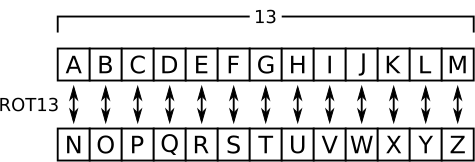
ROT13 is a Caesar cipher with k = 13. Since 13 is half of 26, applying it twice returns the original text, so the same operation encrypts and decrypts.
Confusing Caesar with Atbash
Atbash is not a shift. It reverses the alphabet (A and Z swap, B and Y swap), and the Division B list gives it its own item (3.e.ix), with an Atbash Table on the resource sheet when needed. A quick test: in Atbash, a cipher letter and its plaintext letter always sum to 25 (A = 0); in Caesar, they always differ by the same amount k.
Treating a Caesar as a full Aristocrat
A Caesar alphabet is a monoalphabetic substitution, so frequency and pattern tricks from Aristocrats work on it. But one confirmed letter pair fixes all 26 letters at once. Once a single pair is certain, stop guessing letter by letter and read the whole message through the shifted alphabet.
Trusting one short word
Many two- and three-letter ciphertext words fit more than one shift. Confirm a candidate on a longer word or on the full message before you commit to it.
Changing word breaks or punctuation
Only letters are shifted. Keep the word breaks, punctuation and capitalization exactly as they appear in the question, because they are the cheapest clues in the message.
Practice
Each ciphertext below was made with a single Caesar shift. Solve them by hand before you open the answers. The answers and the shifts used are listed in the callout.
References and further reading
- Science Olympiad, 2027 Division B Codebusters rules (B14-B15): section 2 (event parameters, resource sheet), section 3 (code types, timed question, special bonus) and section 4 (scoring); the 2027 Division C rules (C18-C19) for comparison: soinc.org
- SciOly Wiki, Codebusters event page: scioly.org
- Caesar cipher, overview of the shift and its history: Wikipedia
- ROT13, the k = 13 special case: Wikipedia
- Letter frequency in English, for the frequency-based first guess: Wikipedia
- Simon Singh, The Code Book (1999), a general introduction to classical ciphers and their solution.