Codebusters
2027 season
On this page(10 sections)
Subsections
Codebusters is a timed cryptanalysis exam. Your team gets one packet of encrypted messages, each built with a cipher from a fixed list, and about 50 minutes to recover as many plaintexts (or keywords) as possible. Points come from correct answers, from solving the first question quickly, and from up to three special bonus puzzles. Winning teams recognize a cipher from its shape in seconds, use the rules' constraints to discard wrong guesses early, and keep all three members on different questions.
Event format
| Item | Detail |
|---|---|
| Team | Up to 3 students |
| Time | About 50 minutes |
| Format | Written exam (the rules also allow a computer-based exam), split into numbered questions that can be done in any order |
| What you bring | Writing utensils only |
| Calculators | None. No calculator of any class is allowed in 2027 |
| Resources | Nothing of your own. Each member gets a copy of a resource sheet in the packet with the Morse code table, English and Spanish letter frequencies, the Porta table and the Baconian mappings, as needed for that exam. Division B's sheet also has an Atbash table |
| Packet | Printed single-sided so members can separate pages and work in parallel |
| Start | Teams begin together on the supervisor's signal and may not open the packet or write before "start", or write after "stop" |
Because there are no calculators, every piece of arithmetic (cryptarithm columns, Nihilist subtraction, Homophonic band offsets) is done by hand. Practice that way from the start.
What the rules cover
"Crib" below means a piece of known plaintext the exam gives you as a starting point. For every crib-based question except the complete columnar, the exam shows you where the crib sits in the ciphertext.
| Code family | Division B, Regional | Division C, Regional | Added at State and National |
|---|---|---|---|
| Aristocrats | K1 or random alphabets, with or without a hint | K1, K2, K3 or random alphabets, with or without a hint. A K1, K2 or K3 aristocrat may ask for the keyword or key phrase instead of the plaintext | Same as Regional |
| Patristocrats (unspaced, groups of 5) | K1 alphabet only | K1 or K2 alphabet | Same as Regional |
| Xenocrypt (Spanish) | At most 1, K1 English keyword alphabet | At most 2, K1 or K2 English keyword alphabet | Division B: 1 to 2. Division C: 2 to 3 |
| Baconian | Yes; word Baconians carry a crib of 4+ letters | Same | None |
| Fractionated Morse | Cryptanalysis, crib of 4+ characters | Same | None |
| Cryptarithms (base 10) | Yes | Yes | None |
| Porta | Key given | Key given | Cryptanalysis, crib of 3+ characters |
| Complete columnar transposition | Up to 9 columns, crib of at least (columns − 1) | Same | Division C only: up to 11 columns, crib of at least (columns − 3). Division B stays at 9 |
| Nihilist | Keys given | Keys given | Cryptanalysis, crib at least twice the keyword length |
| 5×5 checkerboard | Polybius key given | Polybius key given | Cryptanalysis: two 5-letter keywords plus a Polybius key, crib of 5+ characters |
| Homophonic (new) | Cryptanalysis; the crib reveals 3+ keyword letters | Cryptanalysis; the crib reveals 2+ keyword letters | Also decryption when 3+ keyword letters (B) or 2+ keyword letters (C) are simply given |
| Atbash (English) | Yes | No | None |
| Caesar (shift) | Yes | No | None |
Two more rules apply in both divisions. In aristocrats, patristocrats and Xenocrypts, no letter ever decrypts to itself. And up to three questions that are not aristocrats, patristocrats or Xenocrypts are marked as special bonus questions.
How the exam is scored
Your final score is the exam score plus the timing bonus plus the special bonus.
Each question has a point value. For plaintext answers, two or fewer errors earn full credit, every additional error costs 100 points, and a question never drops below zero. Cryptarithm answers are stricter in both divisions, and so are Division C keyword or key-phrase answers: zero errors for full credit, 100 points per error, same floor of zero.
A special bonus question counts toward the bonus only if it earns no penalty points at all. The timed first question is always an aristocrat with spaces. Its clock runs from the start of the event until your answer has at most two errors, or until ten minutes pass. Wrong attempts cost nothing, so submit as soon as you think you have it.
Special bonus steps are uneven: one to two adds 250 points, two to three adds 350. Because at least one bonus is guaranteed to be a Homophonic, that cipher is now the most valuable one to master. Ties are broken on questions the supervisor picks in advance, by score, then degree of correctness, then number attempted.
Strategy: splitting the work
With three members and one packet, the biggest mistake is three people reading the same question. Spend the first two minutes scanning every question and tagging it ("aristocrat, 26 letters," "columnar, crib," "Homophonic, bonus"). Then assign roles.
- Give the timed first question to your fastest substitution solver.
- Give number ciphers to one member. Homophonic, Nihilist, checkerboard and cryptarithms all reward careful hand arithmetic and a steady pace.
- Give transposition and Morse-family questions to another. These depend on crib placement and separator rules, and they eat time without a plan.
- Set a timebox. If a question makes no progress in about five minutes, rotate. Fresh eyes often see the crib placement quickly.
- Read what each aristocrat asks for. In Division C, a keyed aristocrat may ask for the keyword or key phrase. That answer needs zero errors, so recover the keyword exactly.
Core cipher families
Each family has a fingerprint you can spot before you decode anything. Learn the fingerprint first, then the algorithm.
Monoalphabetic substitution
Every plaintext letter always becomes the same ciphertext letter. Aristocrats keep the spaces; patristocrats remove them and group letters in fives. Because the mapping never changes, word shape and frequency do most of the work: one-letter words are usually A or I, and THE, AND and OF are common.
A keyed alphabet (K1, K2 or K3, the American Cryptogram Association's standard forms) is built from a keyword followed by the remaining letters. Division B uses only K1 and random alphabets; Division C adds K2 and K3. Keep a list of excluded pairs for every substitution, since no letter maps to itself.

E is the most common letter in ordinary English, at roughly 12 to 13 percent, followed by T, A, O and I. On a short aristocrat the structural clues matter more: doubled letters, and endings such as ING, ION, ED and LY. Xenocrypts are Spanish, so use the Spanish column of the frequency sheet (E and A lead, and short words such as DE, LA, QUE and EL are everywhere).
Homophonic cipher (new in 2027)
A homophonic cipher gives each plaintext letter several possible ciphertext symbols, which flattens the frequency counts that break ordinary substitution. In the standard American Cryptogram Association form, the alphabet has 25 letters (I and J share a slot) and the numbers 01 to 100 (written 00) are split into four bands of 25. A four-letter keyword sets where each band starts: the first keyword letter receives 01, the second 26, the third 51 and the fourth 76, and each band then counts up through the alphabet, wrapping from Z back to A. Every plaintext letter therefore has four numbers, one per band, and the encipherer picks any of them.
How to break one. Sort the numbers into their four bands first; each band is just a shifted alphabet, so each band behaves like a small Caesar cipher. Inside a band, the difference between two numbers equals the alphabet distance between their letters (counting in the 25-letter alphabet and wrapping past Z), which lets you test guesses without knowing the key. The crib fills in keyword letters: each crib letter sitting on a number tells you that band's starting letter. Division B cribs reveal at least three keyword letters and Division C cribs at least two, so you then have one (B) or two (C) bands left to solve from word shapes in the partly decoded text. State and National exams can also hand you the keyword letters directly (at least three in B, two in C) and ask only for the decryption. Because the keyword has four different letters, no two bands share a shift, which rules out guesses that would duplicate a band.
Polybius-based ciphers: checkerboard and Nihilist
A Polybius square is a 5×5 grid of the alphabet with I and J sharing a cell. Each letter becomes a row digit and a column digit, so the letter in row 2, column 4 becomes "24."

In the 5×5 checkerboard, the rows and columns are labeled with the letters of two 5-letter keywords, so each plaintext letter becomes a pair of label letters (row, then column). At Regional the Polybius key is given; at State and National you recover two keywords and the Polybius key from a crib of at least five characters. The 2027 rule that every keyword letter must appear in the ciphertext is a gift: list the distinct letters in the ciphertext and you have every label letter. Letters seen in the first position of each pair belong to the row keyword and letters in the second position to the column keyword, which narrows the keyword guesses quickly.
In the Nihilist, each letter's two-digit Polybius number is added to the number of the matching keyword letter, so ciphertext values run up to 110. Both keys are given at Regional. At State and National, a crib at least twice the keyword length pins down the keyword digits. Split the numbers carefully before subtracting, because a misread three-digit sum shifts every later group.
Porta
The Porta cipher uses 13 fixed reciprocal alphabets. Each key letter picks one of them (A and B share the first, C and D the second, and so on), and each plaintext letter swaps with its partner in that alphabet, so the same step encrypts and decrypts. At Regional the key is given. At State and National you recover the key from a crib of at least 3 characters. Use the Porta table on the resource sheet.
Morse-based ciphers: Fractionated Morse and Baconian
Fractionated Morse turns plaintext into Morse with separators between letters, cuts the stream of dots, dashes and separators into blocks of three, and maps each block to a ciphertext letter through a keyed alphabet. A crib of 4 or more characters is your entry point.
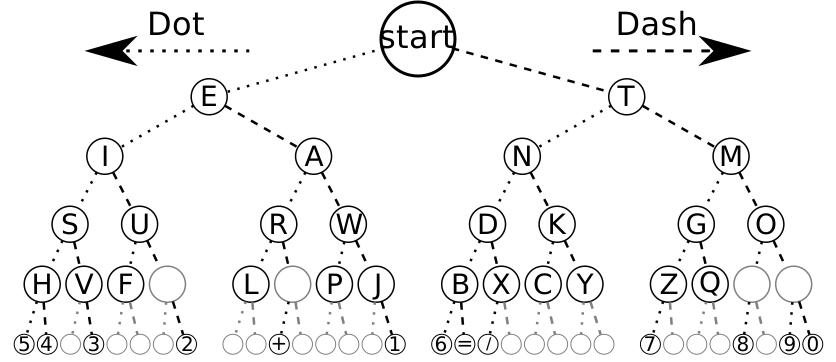
The Baconian cipher encodes each letter as a five-symbol group built from two kinds of symbol, which may be letters, glyphs, or styles such as bold and italic. Split the text into the two classes, group by five, and apply the mapping from the resource sheet.
Transposition: complete columnar
A columnar transposition changes no letters. It writes the plaintext in rows of a fixed width, then reads the columns in the alphabetical order of a keyword.
To decrypt without the key, try each column count up to the limit, split the ciphertext into equal columns, and rearrange until the crib reads across the rows. This is the one crib cipher where the crib's position is not shown.
Cryptarithms
A cryptarithm assigns a digit from 0 to 9 to each letter so an arithmetic statement is true, then uses that mapping to decode a word or phrase. Start with the rightmost column: its units digit fixes one letter, and each carry narrows the next column. Leading letters usually cannot be zero. Verify the whole sum by hand before answering, because credit requires zero errors.
Division B only: Atbash and Caesar
Number the alphabet A = 0 to Z = 25. Caesar is y = x + k (mod 26), so there are only 26 keys to try. Atbash is y = 25 − x: A↔Z, B↔Y, and it is its own inverse; the Division B resource sheet carries its table. Division C does not test either one.
Common pitfalls
- Forgetting the no-self-decrypt rule. It removes whole branches of wrong answers in aristocrats, patristocrats and Xenocrypts.
- Using frequency on a short message, or on a Homophonic. A 20-letter message will not follow the chart, and a Homophonic is designed to defeat it. Use word shape and band structure instead.
- Mixing the Homophonic bands. Sort numbers into 01–25, 26–50, 51–75 and 76–00 before decoding; 00 means 100 and belongs to the fourth band.
- Ignoring crib placement. Write the crib on the ciphertext before testing anything (except the columnar, where you must find it).
- Studying last season's list. Affine and Hill ciphers are not on the 2027 exam, and no calculator is allowed.
- Mixing up the divisions. Do not prepare Atbash or Caesar for Division C, or K2 and K3 alphabets for Division B.
How tournaments test this
The archive does not yet hold published Codebusters tests, so this section describes how the exam is built from the 2027 rules rather than from question counts.
- The first question is always timed and always an aristocrat with spaces. Practice that one more than any other.
- At least one special bonus question is a Homophonic, and bonus questions are never aristocrats, patristocrats or Xenocrypts.
- State and National exams turn key-given ciphers into cryptanalysis: Porta (crib of 3+), Nihilist (crib at least twice the keyword), checkerboard (crib of 5+). They also require more Spanish Xenocrypts (1 to 2 in Division B, 2 to 3 in Division C), wider columnar grids in Division C, and Homophonic decryption from given keyword letters.
Cipher guides
Each cipher on the 2027 list has its own guide with the algorithm, a worked decode and practice problems.
| Family | Guides | Divisions |
|---|---|---|
| Aristocrats | K1, random | B, C |
| Aristocrats, keyed | K2, K3 | C |
| Patristocrats | K1 (B, C), K2 (C) | B, C |
| Spanish | Xenocrypt | B, C |
| Polybius-based | 5×5 checkerboard, Nihilist | B, C |
| Keyed polyalphabetic | Porta | B, C |
| Homophonic | Homophonic | B, C |
| Morse and Baconian | Fractionated Morse, Baconian | B, C |
| Transposition | Complete columnar | B, C |
| Arithmetic | Cryptarithms | B, C |
| Simple ciphers | Caesar, Atbash | B |
Test yourself
No archived Codebusters questions are available to link yet, so these practice problems are written for this guide.
References and further reading
- Science Olympiad, Codebusters event page and the 2027 rules manual: soinc.org.
- SciOly Wiki, Codebusters: scioly.org/wiki/index.php/Codebusters.
- American Cryptogram Association, source of the K1, K2 and K3 alphabet conventions and the standard cipher type definitions, including the Homophonic: cryptogram.org.
- Simon Singh, The Code Book (1999), a readable history of classical ciphers.
- David Kahn, The Codebreakers (1967), the standard reference on the history of cryptanalysis.