Codebusters - Fractionated Morse
On this page(12 sections)
Fractionated Morse hides a message in Morse code, then cuts the Morse into groups of three symbols and replaces each group with one letter. At Codebusters you will not be asked to encrypt anything. You get ciphertext and a crib (a run of known plaintext characters, at least four) and must recover the rest. The 2027 rules list it as a Regional code type in both Division B and Division C, so it can appear at every tournament level.
What the rules cover
The 2027 rules define one task for this cipher, cryptanalysis from a crib, the same in both divisions and at every level.
| Level | Division B (2027 rules) | Division C (2027 rules) |
|---|---|---|
| Regional | Decrypt Morse-based ciphertext written as letters and spaces, given a crib of at least 4 plaintext characters (item 3.e.iv) | Same task, same 4-character minimum (item 3.e.v) |
| State and National | Carries over with all Regional types (item 3.f.i); no extra Fractionated Morse rule | Same (item 3.f.i) |
| All levels | Crib placement is clearly marked on the ciphertext (item 3.j) | Same (item 3.j) |
| All levels | Morse Code Table on each member's resource sheet (item 2.d) | Same (item 2.d) |
Resources and tools. Under the 2027 rules each team brings only writing utensils, and no other resources or tools are allowed beyond what the Event Supervisor hands out (items 2.a and 2.b). That means no notes, no binder and no calculator of any class. The resource sheet carries the Morse Code Table, so practice reading it fast rather than memorizing it. The packet is printed single-sided (item 2.c), so the blank backs and margins are your work space.
Scoring. The default rule in item 4.d applies: two or fewer errors in the decoded plaintext earn full credit, and each further error costs 100 points, never dropping the question below zero. (The zero-tolerance exceptions in item 4.e do not include this cipher.) The timing bonus belongs to question 1, always an Aristocrat, so it never involves Fractionated Morse. A Fractionated Morse question can be one of the up to three special bonus questions (item 3.i), though in 2027 at least one of those slots must be a Homophonic Cipher. A special bonus counts only with zero penalty points; one, two or three such solves add 150, 400 or 750 points (item 4.g).
What the cipher is
International Morse code writes each letter as dots (.) and dashes (-). Fractionated Morse adds a third symbol, x, and uses it in two ways:
- A single x separates two Morse letters inside a word.
- A double xx separates two words.
So the message becomes one long string over three symbols: ., - and x. That string is then read in triplets, groups of three consecutive symbols. There are 27 possible triplets. The encryption table assigns one cipher letter to each of the 26 triplets that are used, so the table is a substitution over triplets.
xxx is left out because it can never occur: letters are joined by x or xx, and padding adds at most two x's after a letter.
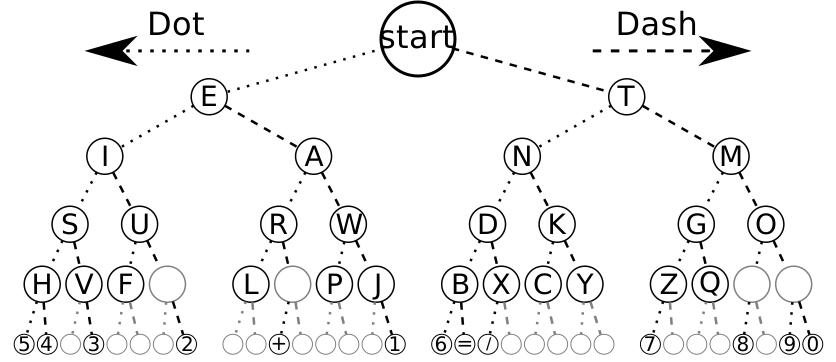
The Morse code tree shows the structure you rely on. Each letter is a path from the top, with a dot going left and a dash going right.
Encryption, step by step
Knowing how the message was built lets you check your work.
- Clean the plaintext. Practice messages keep only the letters A to Z and the word breaks; the 2027 rules do not say how exam writers treat punctuation or numbers.
- Write the Morse. Convert each letter to its Morse code. Put a single
xbetween letters of a word andxxbetween words. - Pad to a multiple of three. If the total number of symbols is not divisible by 3, add
xsymbols at the end until it is. Padding never encodes a letter. - Cut into triplets. Read the stream left to right and group every three symbols.
- Substitute. Replace each triplet with its cipher letter from the table.
Worked encryption: SEND HELP
The table is the 26 triplets in a fixed order, matched to a 26-letter sequence built from the keyword MORSE followed by the remaining letters in alphabetical order. Read down each column pair.
| Triplet | Letter | Triplet | Letter |
|---|---|---|---|
... | M | --- | J |
..- | O | --x | K |
..x | R | -x. | L |
.-. | S | -x- | N |
.-- | E | -xx | P |
.-x | A | x.. | Q |
.x. | B | x.- | T |
.x- | C | x.x | U |
.xx | D | x-. | V |
-.. | F | x-- | W |
-.- | G | x-x | X |
-.x | H | xx. | Y |
--. | I | xx- | Z |
Now encrypt SEND HELP:
- Morse: S
..., E., N-., D-..; H...., E., L.-.., P.--.. - Join with separators. SEND becomes
...x.x-.x-.., then the word breakxx, then HELP becomes....x.x.-..x.--.. - Full stream:
...x.x-.x-..xx....x.x.-..x.--.That is 30 symbols, which is already a multiple of three, so no padding is needed. - Cut into ten triplets and look each one up:
| Symbols | Triplet | Cipher letter |
|---|---|---|
| 1–3 | ... | M |
| 4–6 | x.x | U |
| 7–9 | -.x | H |
| 10–12 | -.. | F |
| 13–15 | xx. | Y |
| 16–18 | ... | M |
| 19–21 | x.x | U |
| 22–24 | .-. | S |
| 25–27 | .x. | B |
| 28–30 | --. | I |
The ciphertext is MUHFYMUSBI. Both Ms come from ... and both Us from x.x, because the same triplet always gives the same letter.
Decryption, step by step
- Map each cipher letter to its triplet using the table.
- Concatenate the triplets into one string of symbols, in order.
- Split on x. A single
xends one Morse letter. A doublexxends a word, and the empty piece between the two x's is the word break. - Drop trailing x's. Padding at the end does not begin a letter, so ignore it.
- Translate each run of dots and dashes with the Morse table. Join the letters and put a space at each word break.
Worked decryption: JVZQWU
Decrypt the ciphertext JVZQWU.
| Cipher letter | Triplet | Symbols |
|---|---|---|
| J | --- | 1–3 |
| V | x-. | 4–6 |
| Z | xx- | 7–9 |
| Q | x.. | 10–12 |
| W | x-- | 13–15 |
| U | x.x | 16–18 |
Concatenate: ---x-.xx-x..x--x.x (18 symbols).
Split on x: --- | -. | (empty, so word break) | - | .. | -- | . | trailing x.
Translate: --- is O, -. is N, - is T, .. is I, -- is M, . is E.
Plaintext: ON TIME. The original message had 17 symbols, so one trailing x was added to reach 18.
Solving tactics for tournament conditions
You will rarely have the full table. The crib is what makes the problem solvable.
- Write the crib in Morse first, with its
xandxxseparators. That is the part of the stream you know. - Try three alignments. The crib's starting position mod 3 decides how its symbols group into triplets. Cut the crib's Morse at each of the three offsets; the wrong ones usually contradict a cipher letter that repeats elsewhere.
- Check repeats. Every instance of a cipher letter must decode to the same triplet.
- Use the Morse run limit. A Morse letter has at most four symbols. If a run of dots and dashes between two x's is longer than four, your alignment or triplet assignment is wrong.
- Watch the word-break triplets. Only four triplets of the 26 contain two x's in a row:
.xx,-xx,xx.andxx-. A word break often lands inside one of them, so those cipher letters are good candidates for word boundaries. Some word breaks straddle two triplets, though, so treat this as a hint, not a rule. - Anchor on E and T. E is a single dot and T is a single dash. Short runs between x's are often E or T, so a triplet that yields a lone
.or-can be a fast first guess.
Worked crib example
Suppose the ciphertext is MUHFYMUSBI and the marked crib is HELP, the last four plaintext letters. You do not know the table.
- Write the crib's Morse with separators:
....x.x.-..x.--.(16 symbols). - The crib ends the message. Try the no-padding case first: the stream is 30 symbols, so the crib fills symbols 15–30. Symbol 15 is the last symbol of ciphertext letter 5, and letters 6 to 10 are fully inside the crib.
- Cut symbols 16–30 into triplets:
...x.x.-..x.--.. So M =..., U =x.x, S =.-., B =.x., I =--.. Letter 5 (Y) ends in.. - Reuse what you learned on the unknown front. Letters 1 and 2 are also M and U, so they read
...x.x, which splits into S, E. - Assume the crib starts a word, so a word break
xxsits just before it. That makes symbols 13–14xx, so Y =xx.. Symbols 7–12 (letters 3 and 4) must finish a word that starts SE. SEND fits:-.x-..is N, x, D, so H =-.xand F =-... Check each guess against later occurrences of the same letters.
Filling gaps when the table is keyed
A short crib rarely reveals every entry you need. If the table was built like the practice table (a keyword, then the unused letters alphabetically, against triplets in a fixed order), known entries predict missing ones. The rules do not promise this construction, so confirm every prediction against the Morse.
Write the 26 triplets in order and place the letters you solved. From the crib example above you know M = ..., S = .-., B = .x., F = -.., H = -.x, I = --., U = x.x and Y = xx.. In triplet order, B, F, H, I, U and Y climb alphabetically, which suggests they lie in the alphabetical tail after the keyword. B sits in slot 7 and F in slot 10, with two slots between them, so those slots are probably C (.x-) and D (.xx), with E missing because it is in the keyword. The slot between F and H is then G (-.-). Confirm each guess by substituting it everywhere and checking that the Morse still gives real words.
Timing tips
Work outward from the crib on one line so word breaks stand out. If an alignment yields no valid Morse after a few minutes, switch offsets or move on.
Common pitfalls
A single x is not a word break
A single
xseparates letters and a doublexxseparates words. Readxas a letter boundary, and only a pair as a space.Triplets are counted from the start of the stream
A one-symbol slip early in the stream moves every later triplet. After any error, recheck the count from the first symbol.
Trailing x's are padding, not letters
If the stream ends with extra
xsymbols, they only complete the last triplet. Do not read them as a Morse letter.One wrong entry corrupts many letters
Every occurrence of a cipher letter decodes the same way. A wrong table entry can ruin several words at once, which can push a question past the two-error allowance.
Do not apply the Aristocrat rule
The rule that no letter decrypts to itself applies to Aristocrats, Patristocrats and Xenocrypts. It is not part of the Fractionated Morse rules, so do not use it to rule out a candidate here.
How tournaments test this
Every question gives ciphertext as letters, a marked crib of at least four plaintext characters, and the Morse table on the resource sheet. You rebuild the triplet table from the crib and extend the decode outward. With no calculator or notes, a clean, repeatable paper layout for the stream, triplet boundaries and table is part of the skill.
Practice
Decode these with the worked-encryption table. Each has a word break and ends with padding.
- MTTPRP
- APHJWND
References and further reading
- Science Olympiad 2027 rules manuals, Codebusters B (items 2, 3.e.iv, 3.f.i, 3.i, 3.j, 4) and Codebusters C (items 2, 3.e.v, 3.f.i, 3.i, 3.j, 4), available from soinc.org.
- International Morse code, ITU-R Recommendation M.1677, the standard for the Morse table on the resource sheet.
- Morse code on Wikipedia, for the code table and history.
- The American Cryptogram Association at cryptogram.org, for cryptanalysis practice and general solving technique.