Food Science
2027 season
On this page(33 sections)
In 2027 Food Science is a dairy event. Everything you are scored on is about milk and the products made from it: you run experiments at home and record them in a notebook, you make ice cream, curds or butter at the tournament, and you take a written test whose topics are all dairy science. The teams that do well treat the three parts as one subject. The chemistry that explains why acid curdles milk (casein losing its charge), why shaking cream makes butter (fat globules breaking and clumping) and why salty ice freezes ice cream (freezing point depression) is the same chemistry the written test asks about. Learn the mechanisms once and you can use them in the lab, in the notebook and on the test.
Event format
Food Science is a Division B event for teams of up to two, and it runs about 50 minutes. It is a hybrid: part of your score is earned before the tournament (the notebook), part with your hands (the lab tasks) and part on paper (the written test).
| Item | 2027 rule (in brief) |
|---|---|
| Division | B only |
| Team size and time | Up to 2 students, about 50 minutes |
| Impound | Yes: the notebook is impounded before the tournament starts and returned at the end |
| Calculators | Up to two per team, Class III or lower (graphing and programmable calculators are allowed; phone or watch apps are not) |
| Notes | One 8.5″ × 11″ sheet per participant, both sides, any content; it may be in a taped-shut sheet protector or laminated, but nothing may be stuck onto it |
| Lab equipment you bring | Any item from the soinc.org equipment list for Division B chemistry events |
| Items you must bring for the labs | A 1-pint plastic bag, a 1-gallon plastic bag, a 500–600 mL container with a lid, and a piece of cheesecloth about 30 cm square |
| Supplied by the supervisor | Milk products (possibly powdered), salts, lemon juice, vinegar, ice if needed, thermometers and any other reagents or equipment |
| Eye protection | Category C (indirect-vent chemical splash goggles marked Z87) |
The supervisor will not lend you the bags, the lidded container or the cheesecloth. A team that forgets them may be unable to do a lab task properly, so put them on your packing list next to the goggles.
The milk product for a lab is handed out in equal amounts to every team, somewhere between 120 and 150 mL depending on the task. You may not know in advance exactly what it is (the rules call it an "unknown" liquid milk product for two of the tasks), so your notebook experiments should cover several kinds of milk and cream.
What the rules cover
The 2027 rules (Division B rules manual, pages B27–B28) split the event into three graded parts.
| Part | Regional / Invitational | State | National |
|---|---|---|---|
| Notebook (done before the tournament) | 3 or more experiments for each of the 3 lab tasks; first 3 per task graded | Same | Same |
| Lab tasks (at the tournament) | 1 task | 1 or 2 tasks | 2 or 3 tasks |
| Written test | Dairy food science topics (list below) | Same list | Same list |
The three possible lab tasks are ice cream formation (scored on the height of a self-standing scoop), curd mass (scored by comparing your curd mass with the supervisor's) and milk fat mass from cream (making butter, scored by comparing your butter mass with the supervisor's). You do not know in advance which task or tasks you will get, so you must prepare all three.
The written test is limited to dairy food science. The rules list these topics, which this guide groups into sections:
| Topic in the 2027 rules | Where it is covered below |
|---|---|
| Role of lipids, carbohydrates and proteins in dairy foods | Milk composition; Carbohydrates; Lipids; Proteins; Calories and nutrition math |
| Chemical structure of sugars, starches, fats and proteins | Chemistry basics; Carbohydrates; Lipids; Proteins; Food tests |
| Basic organic reactions such as esterification and fat bonding | Chemistry basics; Lipids |
| Saturated and unsaturated fats; essential fats | Lipids |
| Essential vitamins and proteins; RDAs of minerals and vitamins in dairy and the effects of deficiency | Proteins; Vitamins and minerals |
| How cooking changes dairy foods chemically | Cooking and dairy chemistry |
| Emulsification | Emulsions |
| Freezing point depression | Lab task 1 |
| Pasteurization; dairy food preservation | Pasteurization and preservation; Food microbiology and food safety |
| Probiotics | Cultured dairy and probiotics; Cheese and cheesemaking |
| Low-fat and fat-free milk, lactose-free milk, organic dairy, non-dairy "milks" | Milk types |
| Lactose intolerance; allergens in dairy foods | Lactose intolerance and milk allergy |
| Standard labeling regulations | Labels and standards |
| Health benefits of dairy foods | Health benefits |
| Casein and whey proteins | Proteins; Cheese and cheesemaking |
Written tests for this event have always mixed the dairy topics with the general food chemistry and food safety they depend on: what pH and water activity mean, how to test a food for sugar or protein, how bacteria grow, what each vitamin does, how a Nutrition Facts label works. This guide teaches that background too, because a dairy test cannot ask about yogurt without asking about lactic acid bacteria, or about pasteurization without asking about pathogens.
Food Science has no Division C version in 2027.
Scoring
The final score is the sum of the notebook, lab and test scores, minus any penalties. High score wins.
| Component | How it is scored | Maximum |
|---|---|---|
| Notebook | Up to 2 points per complete experiment; incomplete ones earn less; only the first 3 per task count | 18 |
| Ice cream | 0.1 point per millimeter of height (rounded) | No stated cap |
| Curd mass | (your mass ÷ supervisor's mass) × 10 | 10 |
| Milk fat (butter) mass | (your mass ÷ supervisor's mass) × 10 | 10 |
| Written test | Percent correct ÷ 2 | 50 |
| Penalty | Up to 10% of the total possible score for not cleaning up as told | Minus up to 10% of total possible |
Ties are broken by preselected test questions.
Two things follow from the math. First, the written test is worth up to 50 points, more than everything else combined at a regional, so the test deserves at least half your preparation time. Second, the notebook is the easiest 18 points in the event: they are earned at home, with no time pressure, and lost only through incomplete or careless entries.
The notebook
Before the tournament you must do at least three experiments for each of the three lab tasks (at least nine in total), record each on the official Food Science Experiment Form from soinc.org, and put them together in the notebook. You may do more, but only the first three for each task are graded, so put your best, most complete entries first.
Each experiment must change only one independent variable. That is the rule that most often costs points. "We used cream instead of milk and also added more salt" is two variables, and the result cannot tell you which change mattered.
A good entry has a clear question, a hypothesis with a reason, the one variable you changed, the variables you held constant, a numbered procedure, a data table with units, a graph if it helps, and a conclusion that answers the question and says what you would change in the lab task. Repeat trials (three per condition is a sensible minimum) show whether a difference is real or just noise.
| Lab task | Independent variables worth testing | Dependent variable |
|---|---|---|
| Ice cream | Fat content of the dairy (skim, whole, half and half, cream); amount of salt in the ice; amount of sugar; shaking time; temperature of the mix at the start | Height of a self-standing scoop (mm); time to freeze |
| Curd mass | Acid type (vinegar or lemon juice); number of drops of acid; milk temperature; milk type (skim, whole, powdered and reconstituted); rest time before draining | Mass of curds (g); percent curd |
| Butter (milk fat) | Cream temperature; fat content of the cream; shaking time; how full the container is; shaking speed | Mass of butter (g); time until butter forms |
Use the same equipment at home that you will bring to the tournament. A different bag, container or cheesecloth changes heat transfer, shaking and draining, and your notebook results will not carry over.
Lab task 1: ice cream formation
You get the same amount of an unknown liquid milk product as every other team, plus the other ingredients. You make ice cream in bags, then shape it on a surface. It has to stand on its own for 5 seconds before the supervisor measures its height, and you may shape it by hand. You may use any amount of what is provided.
The procedure in the rules, summarized:
- Mix up to 125 mL of milk, cream or half and half with up to 15 mL of sugar, and up to 1.2 mL of vanilla if you like.
- Half fill the gallon bag with ice, add up to 90 mL of salt, seal it and shake to mix.
- Seal the mix in the pint bag.
- Put the pint bag inside the gallon bag and shake hard so the mix chills and stays mixed.
- After roughly 5 to 10 minutes, take the ice cream out of the small bag.
Why salt and ice freeze ice cream: freezing point depression
Ice cream mix freezes a little below 0 °C, because dissolved sugar and lactose lower its freezing point. Plain ice at 0 °C cannot freeze it at all: heat only flows from warmer to colder, and the mix must be cooled below its own freezing point. Salt fixes that. When salt dissolves in the thin film of water on the ice, the brine has a lower freezing point than pure water, so ice keeps melting into it. Melting absorbs heat (the heat of fusion, about 334 J/g), and that heat comes from the brine itself, which cools well below 0 °C. The cold brine then pulls heat out of the pint bag through the plastic.
The size of the effect depends on the number of dissolved particles, not on what they are. That makes it a colligative property.
A NaCl brine cannot go below about −21 °C (its eutectic point), however much salt you add. More salt helps up to the point where the ice melts too fast and the bag runs out of ice.
Coarse rock salt is traditional for ice cream freezers because it is cheap and dissolves a little more slowly, but any salt works by the same colligative effect. Calcium chloride (CaCl₂) gives three ions per formula unit (i ≈ 3), so per mole it lowers the freezing point more than NaCl.
Boiling point elevation is the sister colligative property: dissolved particles also raise the boiling point, by ΔT_b = i · K_b · m with K_b = 0.512 °C·kg/mol for water. That is why a sugar syrup's boiling temperature climbs as water boils off and the syrup gets more concentrated, and why candy makers read concentration from a thermometer.
Supercooling. Water can be cooled a few degrees below 0 °C without freezing if nothing starts the first crystal: pure water, a smooth container and no shaking. Freezing needs nucleation, the formation of a tiny seed crystal, and the first one is the hardest to make. A scratch, a speck of dust, a seed crystal or a sharp tap triggers sudden freezing. Shaking the ice cream bag prevents supercooling and creates many nuclei at once.
What makes a tall, self-standing scoop
Ice cream is a frozen foam: ice crystals, fat globules and air bubbles held in a thick sugar syrup. Height depends on how stiff that structure is.
- Fat makes ice cream stand. During shaking, fat globules partly break and stick together (partial coalescence), forming a network that holds air bubbles and supports the shape. Cream and half and half have far more fat than milk, which is why they usually give firmer ice cream. Test this in your notebook rather than assuming it, because very high-fat cream can turn buttery if overshaken.
- Sugar softens ice cream. It lowers the freezing point, so at any given temperature more of the water stays liquid. Up to 15 mL is allowed; less sugar can mean a firmer scoop, though it also changes texture.
- Small ice crystals come from fast freezing with constant shaking. Many small crystals form when the mix is cooled quickly, and shaking breaks growing crystals. Large crystals give an icy, crumbly product.
- Temperature at measurement matters. Ice cream softens within minutes at room temperature. Shape quickly, keep your hands cold, and present it as soon as it is firm.
Ice cream composition, overrun and ice crystals
Commercial ice cream is a carefully balanced mix. A typical US ice cream mix is roughly 10–16% milkfat, 9–12% milk solids-not-fat (casein, whey proteins, lactose, minerals), 12–16% sugar, a fraction of a percent of stabilizers and emulsifiers, and about 60% water. The federal standard of identity requires at least 10% milkfat and 20% total milk solids, and at least 4.5 pounds per gallon, which caps how much air can be whipped in. Frozen custard (French ice cream) must also contain egg yolk solids; sherbet has only 1–2% milkfat; gelato has no federal standard and is usually denser, with less air.
Ice cream is a partly frozen foam: four phases at once.
| Phase | What it is | What it does |
|---|---|---|
| Ice crystals | Frozen water, ideally under about 50 µm | Make it solid and cold; large ones feel icy |
| Air cells | Bubbles whipped in during freezing | Lightness and volume ("fluffiness"); without air it is a hard, dense block |
| Fat globules | Partly coalesced into a network | Hold the air cells, give dryness, stiffness and slow melting |
| Unfrozen serum | Concentrated syrup of sugar, lactose, proteins, stabilizers | Keeps it scoopable; more sugar means more unfrozen serum and a softer product |
The clustering and clumping of fat globules into a continuous network is called fat destabilization (or partial coalescence). Emulsifiers promote it; shaking or dashing drives it.
Overrun is the percentage increase in volume caused by the air:
Ice crystal size decides smoothness. Freezing has two steps: nucleation (new crystals form) and crystal growth (existing crystals get bigger). Fast freezing with constant agitation produces a huge number of nuclei, so the water is shared among many crystals and each stays small and smooth. Slow freezing makes few nuclei that grow large and icy. Liquid nitrogen (−196 °C) ice cream is extra smooth for exactly this reason. In storage, temperature swings (heat shock) melt the smallest crystals and refreeze that water onto larger ones, so ice cream that has been thawed and refrozen turns coarse. Stabilizers (guar, locust bean gum, carrageenan and other polysaccharides, including those from edible seaweeds) thicken the unfrozen serum and slow this growth.
Two other textural defects are tested: sandiness (lactose crystallizing because there is too much milk solids-not-fat or the product has been stored too long) and shrinkage (loss of air and volume in storage).
For comparison: ice cream, ordinary (sweet cream) butter and milkshakes are not fermented foods, while yogurt, cultured buttermilk, sour cream, kefir, cultured butter and cheese are (see Cultured dairy and probiotics).
Lab task 2: determining curd mass
You get the same amount of an unknown liquid milk product as everyone else. You curdle it with acid, drain the curds and weigh them. The supervisor does the same, and your score is the ratio of your mass to theirs.
The procedure, summarized: weigh 120 mL of milk in a beaker; make sure it is near room temperature; add drops of vinegar or lemon juice, swirl or stir for 30 seconds and let it stand about 5 minutes; pour it through cheesecloth tied over a beaker; let it drain for 15 minutes; weigh the curds.
Why acid makes curds
About 80% of the protein in cow's milk is casein. Casein molecules cluster into micelles, tiny spheres held together by calcium phosphate and covered with a "hairy" outer layer of κ-casein. At milk's normal pH of about 6.7, the micelles carry a net negative charge, so they repel each other and stay dispersed.
Adding acid lowers the pH. Hydrogen ions neutralize the negative charges and dissolve the calcium phosphate that binds the micelle together. As the pH approaches 4.6, casein's isoelectric point (the pH at which the protein has no net charge), the micelles stop repelling each other and clump into a gel that breaks into curds. The liquid left behind is whey, which holds the whey proteins, most of the lactose and many minerals. Whey proteins do not curdle at pH 4.6 at room temperature, so they drain away.

Cheesemakers also curdle milk with rennet, whose enzyme chymosin cuts off the hairy κ-casein layer. Rennet curds are firmer and springier than acid curds; the lab uses acid only.
Variables that change the curd mass
- Amount of acid. Too little and the pH never reaches 4.6, so some casein stays in the whey. Your notebook should find the number of drops that maximizes curd for each milk type.
- Temperature. The rules want milk near room temperature. Warmer milk curdles faster and makes firmer curds; cold milk curdles slowly.
- Milk type. Curds trap fat, so whole milk gives heavier curds than skim. Powdered milk reconstituted at the usual strength behaves much like fluid skim milk.
- Handling. Stir gently. Hard stirring breaks curds into fine pieces that pass through the cheesecloth. Scrape every curd off the cloth onto the balance.
Curd mass includes the water trapped in the curd, so a consistent draining time (15 minutes in the rules) is what makes results comparable.
Lab task 3: milk fat mass from cream
Everyone gets the same amount of cream and makes butter; your butter mass is compared with the supervisor's. The procedure, summarized: put 150 mL of heavy cream in your 500–600 mL plastic container and weigh it; the cream should be about 13 °C; cap the container and shake until butter grains clearly separate; pour off the liquid; weigh the butter.
Why shaking makes butter
Cream is an oil-in-water emulsion: fat droplets (globules) dispersed in watery serum, each globule wrapped in a thin milk fat globule membrane of phospholipids and proteins. Shaking whips air into the cream and the globules collect at the bubble surfaces. The collisions strip the membranes, and partly solid fat crystals poking out of one globule pierce the next, so they stick together. The clumps grow until the fat separates as butter grains, and the emulsion inverts: butter is a water-in-oil emulsion, with tiny water droplets inside a continuous fat phase. The liquid left behind is buttermilk.
The cream temperature is set at about 13 °C because churning needs some of the milk fat to be solid and some liquid. Very cold cream has fat that is too hard to fuse; warm cream gives soft, greasy butter that holds a lot of buttermilk and loses fat into the liquid.
Things to test in your notebook: cream temperature on either side of 13 °C, how full the container is (a half-empty container gives the cream room to slosh, which speeds churning), shaking style, and whether pressing extra buttermilk out of the butter changes the mass. Butter that still holds a lot of buttermilk weighs more, but follow the steps as written and ask the supervisor if a step is unclear.
Cream, whipped cream and butter
Cream is the fat-rich layer skimmed or centrifuged off milk. US standards of identity name the creams by milkfat:
| Product | Milkfat (US standard) | Notes |
|---|---|---|
| Half-and-half | 10.5% to under 18% | Will not whip |
| Light (coffee) cream | 18% to under 30% | Coffee and table cream; does not whip well |
| Light whipping cream | 30% to under 36% | Whips |
| Heavy cream (heavy whipping cream) | 36% or more | Whips best; the lab task uses it |
| Sour cream | 18% or more | Cream cultured with lactic acid bacteria |
| Butter | 80% or more | About 16–18% water, 1–2% milk solids |
If you shake or whip cream, it passes through stages: liquid → soft foam → whipped cream → grainy over-whipped cream → butter grains plus buttermilk. Whipped cream and butter come from the same process stopped at different points. In whipped cream (needs at least about 30% fat) the partly coalesced fat globules surround air bubbles and hold them in a stable foam; the continuous phase is still water. In butter, coalescence has gone so far that the fat becomes the continuous phase and the air and most of the water are expelled.
Traditional buttermilk is the liquid left after churning. The "buttermilk" sold in stores today is usually cultured buttermilk: low-fat milk fermented with lactic acid bacteria, so both are thin and slightly acidic, but only the second is deliberately fermented. Cultured butter is churned from cream that was fermented first, which gives it the buttery-smelling compound diacetyl.
Salting butter (usually 1–2% salt) adds flavor and controls bacterial growth. The salt dissolves only in butter's tiny water droplets, so each droplet becomes a strong brine with low water activity. Butter's water is also split into droplets too small for many bacteria to spread between, which is why butter keeps far longer than cream.
Ghee or clarified butter is butter heated until the water evaporates and the milk solids separate and are removed. With no water or protein, it keeps well and can be heated hotter before it smokes, because in whole butter the milk solids are the first thing to burn.
Milk composition
Cow's milk is about 87–88% water. The rest is the milk solids, which the rules' topics keep returning to:
| Component | Approximate share of whole milk | Form in milk | Lab or test relevance |
|---|---|---|---|
| Water | 87–88% | Continuous phase | Freezing point, curd moisture |
| Fat | 3.25% minimum in US whole milk | Emulsified globules | Butter, ice cream structure, labeling |
| Lactose | About 4.8% | Dissolved | Sweetness, lactose intolerance, browning |
| Casein | About 2.6% | Micelles | Curds, cheese |
| Whey proteins | About 0.6% | Dissolved | Heat changes, whey |
| Minerals | About 0.7% | Dissolved and bound to casein (calcium, phosphorus, potassium) | Nutrition |
Total protein is about 3.3–3.4%. One cup (240 mL) of milk, whatever its fat level, carries about 8 g of protein and about 12 g of lactose. Skim milk is not "watered down": removing fat leaves the protein, lactose and calcium.
When a test asks for the "four major components" of milk, the answer is water, fat, protein and lactose (minerals are the fifth, smaller one).
Milk is a complex mixture that is three kinds of mixture at once:
- a true solution of lactose, soluble salts and water-soluble vitamins;
- a colloidal dispersion of casein micelles (about 0.1 µm across), which is why skim milk is white rather than clear: the micelles scatter light;
- an emulsion of fat globules (about 1–10 µm in raw milk), which carry the fat-soluble vitamins and give whole milk its creamy color.
Fresh cow's milk has a pH of about 6.6–6.7, slightly acidic. Its density is about 1.03 g/mL and it freezes at about −0.53 °C. When bacteria ferment lactose to lactic acid the pH falls, which is why soured milk, yogurt, sour cream and buttermilk all have lower pH than fresh milk.
| Milk (per 100 g, approximate) | Water | Fat | Protein | Lactose |
|---|---|---|---|---|
| Cow | 87–88 g | 3.3–4 g | 3.3 g | 4.8 g |
| Goat | 87 g | 3.5–4 g | 3.3 g | 4.3 g |
| Sheep | 81–83 g | 6–7 g | 5.5–6 g | 4.8 g |
| Human | 87–88 g | 4 g | 1 g | 7 g |
Sheep milk is richer in fat and protein (so it has less water) and makes more cheese per liter; human milk has much more lactose and much less protein than cow's milk, which is why infant formula is adjusted. Goat milk still contains lactose and casein, so it is not a safe swap for someone with milk allergy.
The most abundant amino acid in milk protein is glutamic acid (glutamate), and milk is rich in calcium phosphate, much of it bound inside the casein micelles.
Milk production, processing and testing
From cow to carton
Milk is made in the cow's mammary gland: secretory cells build lactose from blood glucose (lactose is made only there), assemble casein and whey proteins from amino acids, and release fat as membrane-wrapped globules. The first milk after calving, colostrum, is rich in antibodies (immunoglobulins) and protein. Breed affects composition:
| Breed | Milk |
|---|---|
| Holstein (black and white) | Most milk per cow; lowest fat (about 3.5–4%); most US dairy cows |
| Jersey | Less volume, highest fat and protein (about 4.5–5% fat); yellowish cream from beta-carotene |
| Guernsey | High fat; golden color from beta-carotene |
| Brown Swiss, Ayrshire | Intermediate; Brown Swiss milk is valued for cheese |
A dairy plant handles milk in a standard order: receiving (testing and cooling the raw milk, which must be kept cold), clarification (a centrifuge removes sediment and cells), separation (a centrifugal separator splits cream from skim), standardization (cream is added back to reach exactly 3.25%, 2% or 1% fat), homogenization, pasteurization, rapid cooling, and packaging. Vitamins A and D are added before pasteurization. Homogenization usually comes just before or after pasteurization, while the milk is warm, because fat must be liquid to be broken up.
Color clues: skim milk looks slightly bluish because its casein micelles scatter blue light and there is no fat to whiten it; whey looks greenish-yellow because of riboflavin. Typical off-flavors: light-oxidized (cardboard or burnt-feather flavor from riboflavin-driven oxidation in clear containers), rancid (lipase), cooked (heat), and feed or weedy flavors from what the cow ate.
Standardization and the Pearson square
To make milk or a mix with a target fat percentage from two components, use the Pearson square:
Cheese yield follows the same mass-balance logic: cheddar yield is roughly 10 kg per 100 kg of milk, and it rises with the milk's casein and fat content (cheese yield formulas such as the Van Slyke formula are built from casein and fat percentages). That is also why whole milk gives more curd than skim in the lab task.
Milk quality tests
| Test | Measures | How it works |
|---|---|---|
| Babcock test (Stephen Babcock, 1890) | Milk fat % | Sulfuric acid digests the proteins and frees the fat; centrifuging and adding hot water float the fat into the calibrated neck of a Babcock bottle, where its height is read as % fat |
| Gerber test | Milk fat % | Similar, with sulfuric acid plus amyl alcohol in a butyrometer (common in Europe) |
| Infrared and other instrumental methods | Fat, protein, lactose | Modern plants scan milk with mid-infrared light |
| Kjeldahl method | Protein | Measures total nitrogen; protein = nitrogen × 6.38 for dairy (6.25 for most foods), since milk protein is about 15.7% nitrogen |
| Titratable acidity | Acid (as % lactic acid) | Titrate with NaOH to a phenolphthalein end point; fresh milk about 0.14–0.16%, rising as bacteria sour it |
| Lactometer | Specific gravity (density) | A hydrometer floated in milk; a low reading suggests added water |
| Cryoscope | Freezing point | Milk freezes near −0.52 to −0.54 °C; added water raises it toward 0 °C |
| Somatic cell count (SCC) | White blood cells in milk | High counts indicate mastitis (udder infection) and lower quality |
| Standard plate count | Bacteria per mL | Measures sanitation and cooling |
| Antibiotic residue tests | Drug residues | Every tanker is tested; contaminated milk is discarded |
| Alkaline phosphatase test | Proof of pasteurization | Enzyme gone = pasteurized |
| Coliform count | Post-pasteurization contamination | Pasteurized milk should have very few |
Under the Pasteurized Milk Ordinance, Grade "A" milk comes from farms and plants that meet sanitation, bacterial-count, somatic-cell and temperature standards. USDA grades butter as AA, A or B by flavor, body and color.
Dairy history milestones
| Year | Milestone |
|---|---|
| About 7000–5500 BCE | Earliest evidence of dairying and cheesemaking (milk-fat residues in pottery; cheese-strainer pots) |
| 1856 | Gail Borden patents sweetened condensed milk |
| 1864 | Pasteur's heat treatment (pasteurization), first for wine |
| 1890 | Babcock test for milk fat |
| 1908 | Chicago passes the first US law requiring pasteurization of most milk |
| 1924 | First US Public Health Service model milk ordinance (forerunner of today's Grade "A" Pasteurized Milk Ordinance) |
| 1930s | Vitamin D fortification of milk begins, nearly eliminating rickets in the US |
Chemistry basics for food science
Every later section leans on a few chemistry ideas. Learn them here once.
Macromolecules, monomers and the two key reactions
Foods are built from four classes of biological molecules. Three are polymers made of repeating monomers; lipids are not true polymers.
| Class | Elements | Monomer (building block) | Bond joining monomers | Energy |
|---|---|---|---|---|
| Carbohydrates | C, H, O (about 1 C : 2 H : 1 O) | Monosaccharides (glucose, galactose, fructose) | Glycosidic bond | 4 kcal/g |
| Proteins | C, H, O, N (and S in cysteine and methionine) | Amino acids | Peptide bond | 4 kcal/g |
| Lipids (fats and oils) | C, H, O (much less O than carbohydrates) | Not a polymer; a triglyceride is glycerol + 3 fatty acids | Ester bond | 9 kcal/g |
| Nucleic acids | C, H, O, N, P | Nucleotides | Phosphodiester bond | — |
Nitrogen is the element found in every amino acid but not in sugars or fats. Minerals and water are nutrients too, but they are inorganic (they do not contain carbon–hydrogen frameworks). Every organic compound contains carbon.
Two reactions build and break all of these:
- Dehydration synthesis (condensation): two molecules join and release one water molecule. Glycosidic, peptide and ester bonds all form this way. Building large molecules from small ones uses energy, so it is an anabolic process.
- Hydrolysis: water is added to split a bond. Digestion is hydrolysis: lactase hydrolyzes lactose, proteases hydrolyze peptide bonds, lipase hydrolyzes ester bonds. Breaking molecules down is catabolic.
Hydrolysis and condensation are opposites.
Functional groups
A functional group is a cluster of atoms that gives a molecule its typical reactions. Tests ask you to spot them in structures.
| Group | Formula | Found in | Notes |
|---|---|---|---|
| Hydroxyl (alcohol) | −OH | Sugars, glycerol, sugar alcohols | Polar; makes sugars water-soluble; the −OH groups bind to sweet-taste receptors through hydrogen bonds |
| Carbonyl: aldehyde | −CHO (at the end of a chain) | Glucose, galactose (aldoses) | Gives reducing-sugar reactions |
| Carbonyl: ketone | C=O inside a chain | Fructose (a ketose) | Fructose still gives a positive Benedict's test because hot alkali rearranges it to an aldose |
| Carboxyl | −COOH | Fatty acids, amino acids, lactic, acetic and citric acids | Acidic: releases H⁺ to become −COO⁻ |
| Amino | −NH₂ | Amino acids, proteins | Basic; supplies the nitrogen in protein |
| Ester | −COO− linking two carbons | Triglycerides, flavor esters | Formed from a carboxylic acid and an alcohol |
| Phosphate | −PO₄ | Phospholipids, ATP, casein (phosphoserine) | Very polar |
| Methyl | −CH₃ | The "omega" end of a fatty acid | Nonpolar |
A carboxylic acid and its ionized form have paired names: lactic acid / lactate, citric acid / citrate, acetic acid / acetate. Acetic acid (CH₃COOH) is the acid in vinegar; its sodium salt, sodium acetate, is a preservative.
Isomers
Isomers have the same molecular formula but different structures. Glucose, galactose and fructose are all C₆H₁₂O₆:
- Structural (constitutional) isomers have atoms connected differently. Glucose (an aldose) and fructose (a ketose) are structural isomers.
- Stereoisomers have the same connections but a different 3D arrangement. Glucose and galactose are stereoisomers that differ only at carbon 4.
- D and L forms are mirror-image configurations. Nearly all natural sugars are D sugars and nearly all amino acids in proteins are L. Enzymes are shaped for one form, which is why the other form is not digested the same way.
- α and β are the two ring forms (anomers) of a sugar: in a Haworth drawing the −OH on carbon 1 points down in α and up in β. Starch is built from α-glucose and cellulose from β-glucose, which is why we digest one and not the other.
Cis and trans describe groups on the same or opposite sides of a double bond (see Lipids).
Acids, bases and pH
pH measures how acidic a solution is: it is the negative logarithm of the hydrogen-ion (H⁺) concentration in mol/L. The scale usually runs 0–14; 7 is neutral at 25 °C, below 7 is acidic and above 7 is basic (alkaline). Because the scale is logarithmic, each step of 1 pH unit is a tenfold change in [H⁺]: pH 4 is ten times as acidic as pH 5 and a hundred times as acidic as pH 6.
| Food | Typical pH |
|---|---|
| Lemon juice | 2.0–2.6 |
| Vinegar | 2.4–3.4 |
| Yogurt | 4.0–4.6 |
| Cultured buttermilk, sour cream | about 4.4–4.8 |
| Cottage cheese | about 4.8–5.0 |
| Cheddar cheese | about 5.0–5.5 |
| Fresh milk | 6.6–6.7 |
| Pure water | 7.0 |
| Egg white (aging egg) | 7.6–9 |
| Baking soda solution | about 8.3 |
Indicators change color with pH. Litmus paper turns red in acid and blue in base. A pH meter gives a numerical reading. A food with pH above 7 (such as pH 8) is basic. Acetic and lactic acids are weak acids: in water only a small fraction ionizes, in an equilibrium such as CH₃COOH(aq) + H₂O(l) ⇌ H₃O⁺(aq) + CH₃COO⁻(aq). The hydronium ion (H₃O⁺) is what "H⁺" means in the pH formula; strong acids such as HCl ionize completely.
In food safety, the key number is pH 4.6. Foods at or below it are "acid" or "acidified" foods, in which the botulism bacterium cannot grow (see Pasteurization and dairy preservation). Most bacteria grow best near neutral pH (about 6.5–7.5); molds and yeasts tolerate much more acid.
Polarity, solubility and water
Water is a polar molecule: oxygen pulls electrons more strongly than hydrogen, so the oxygen end is slightly negative and the hydrogen ends slightly positive. Water molecules attract each other through hydrogen bonds, which gives water its high boiling point, high specific heat (4.18 J/g·°C) and ability to dissolve so many polar and ionic substances that it is called the universal solvent.
"Like dissolves like": polar and ionic substances (sugars, salt, many vitamins) are hydrophilic ("water-loving") and dissolve in water; nonpolar substances (fats, oils, fat-soluble vitamins) are hydrophobic ("water-fearing") and do not. Liquids that do not mix, such as oil and water, are immiscible; they separate unless an emulsifier holds one dispersed in the other. Osmosis is the movement of water across a semipermeable membrane from where solute is less concentrated to where it is more concentrated; it stops when the concentrations (more strictly, the water potentials) on both sides are equal. Salt and sugar preserve food partly by pulling water out of microbial cells by osmosis.
The same rule explains why milk, not water, soothes the burn of chili peppers: capsaicin is nonpolar and fat-soluble, so it dissolves in milk fat (and is also bound by casein), while water just spreads it around. Even skim milk works well in taste tests, so milk's protein matters, not just its fat.
Carbohydrates: lactose, sugars and starches
Carbohydrates are built from carbon, hydrogen and oxygen in roughly a CH₂O ratio. The simplest are monosaccharides (glucose, galactose, fructose). Two monosaccharides joined by a glycosidic bond form a disaccharide. Long chains form polysaccharides such as starch.
Lactose, the sugar of milk, is a disaccharide of galactose and glucose joined by a β(1→4) glycosidic bond. Milk is nearly the only natural source of it. Lactose is a reducing sugar (its glucose end can open into a free aldehyde), which matters for browning when milk is heated. It is only about one-fifth to two-fifths as sweet as sucrose, and it dissolves poorly in cold water. In ice cream stored too long, lactose can crystallize into gritty "sandy" crystals.

Classifying sugars
Carbohydrates are classified by how many sugar units they contain:
| Class | Units | Examples | Notes |
|---|---|---|---|
| Monosaccharides ("simple sugars") | 1 | Glucose, fructose, galactose (hexoses, 6 C); ribose, xylose (pentoses, 5 C) | Cannot be hydrolyzed further; general formula (CH₂O)ₙ |
| Disaccharides | 2 | Sucrose, lactose, maltose, trehalose | Formula C₁₂H₂₂O₁₁ (two C₆H₁₂O₆ minus one H₂O) |
| Oligosaccharides | 3–10 | Raffinose (3), stachyose (4) in beans; galacto-oligosaccharides; milk oligosaccharides | Mostly not digested by human enzymes; fermented by gut bacteria (gas) |
| Polysaccharides ("complex carbohydrates") | Hundreds to thousands | Starch, glycogen, cellulose, chitin, pectin, gums | Storage or structure |
The empirical formula of the common simple sugars (glucose, galactose, fructose, ribose) is CH₂O; deoxy sugars such as deoxyribose are the exception. Glucose, galactose and fructose are all C₆H₁₂O₆; lactose and sucrose are both C₁₂H₂₂O₁₁. "Saccharide" is the chemical name for any sugar unit, so "monosaccharide" means "one sugar".
Monosaccharides are named by their carbonyl group and carbon count. An aldose has an aldehyde (−CHO) at carbon 1; a ketose has a ketone (C=O) at carbon 2. Glucose and galactose are aldohexoses (aldehyde, six carbons); fructose is a ketohexose. Ribose (C₅H₁₀O₅, in RNA) is an aldopentose; Mannose is another aldohexose (C₆H₁₂O₆, differing from glucose only at carbon 2), a reducing sugar found in fruits and in plant gums; xylose is a five-carbon aldose (aldopentose), so it is not a hexose; deoxyribose (C₅H₁₀O₄, in DNA) is ribose missing the oxygen on carbon 2 ("deoxy" means "without oxygen"). In water, these sugars exist mostly as rings, in equilibrium with a small amount of the open chain. An aldohexose such as glucose can therefore be drawn several ways: as an open (straight) chain (Fischer projection, aldehyde at carbon 1, −OH groups on carbons 2–6), as a six-membered pyranose ring (five carbons and one oxygen; carbon 1 bonds to the oxygen on carbon 5) or, less often, a five-membered furanose ring; each ring has α and β anomers, and each sugar exists as D and L enantiomers (mirror images). Fructose is usually drawn as a five-membered furanose ring (its form in sucrose), although free fructose in water is mostly the six-membered pyranose. In a Haworth drawing of β-D-glucose, every −OH alternates up and down around the ring with the −CH₂OH group (carbon 6) above it; sucrose is an α-glucose ring joined through its carbon 1 to carbon 2 of a β-fructose ring.
A reducing sugar has a free aldehyde or ketone group (or a ring that can open to one), so it can donate electrons and reduce a mild oxidizing agent such as the Cu²⁺ in Benedict's reagent; the sugar's aldehyde is oxidized to a carboxylic acid in the process. All monosaccharides and most disaccharides (lactose, maltose) are reducing sugars. Sucrose is not, because its glycosidic bond joins the carbonyl carbons of both glucose and fructose, so neither ring can open. Trehalose is also non-reducing.

Common sugars compared
| Sugar | Type | Units and bond | Reducing? | Enzyme that splits it | Where you meet it |
|---|---|---|---|---|---|
| Glucose | Monosaccharide (aldose) | — | Yes | — | Half of lactose, sucrose and maltose; "dextrose" is glucose; the body's main fuel and the most abundant monosaccharide |
| Galactose | Monosaccharide (aldose) | — | Yes | — | Half of lactose; much less sweet than glucose |
| Fructose | Monosaccharide (ketose) | — | Yes | — | Half of sucrose; fruit and honey; the sweetest and most hygroscopic common sugar |
| Lactose | Disaccharide | Galactose + glucose, β(1→4) | Yes | Lactase | Milk sugar; made only in the mammary gland |
| Sucrose | Disaccharide | Glucose + fructose, α1→β2 | No | Sucrase (invertase) | Table sugar from sugarcane and sugar beets; added sugar in ice cream |
| Maltose | Disaccharide | Glucose + glucose, α(1→4) | Yes | Maltase | Made when amylase breaks down starch; malted milk |
| Trehalose | Disaccharide | Glucose + glucose, α(1→1) | No | Trehalase | Mushrooms, yeast; food stabilizer |


Invert sugar is sucrose split (by acid or the enzyme invertase) into an equal mix of glucose and fructose. It is sweeter than sucrose, holds moisture and resists crystallizing, which is why it is used in candies, syrups and baked goods. High-fructose corn syrup (HFCS) is made from corn starch: amylases break the starch into glucose, and the enzyme glucose isomerase converts part of the glucose to fructose. The common grades are HFCS-42 (42% fructose) and HFCS-55 (55% fructose, about 42% glucose, used in soft drinks). Honey is mostly fructose and glucose and contains no lactose.
Sweetness and the glycemic index
| Sugar | Relative sweetness (sucrose = 100) | Glycemic index (glucose = 100) |
|---|---|---|
| Fructose | about 120–170 | about 20 |
| Invert sugar / HFCS-55 | about 100–130 | — |
| Sucrose | 100 | about 65 |
| Glucose | about 70–80 | 100 |
| Maltose | about 30–50 | about 105 |
| Galactose | about 30–60 | low |
| Lactose | about 15–40 | about 45 |
Sweetness values vary with temperature and concentration, so sources differ; the order fructose > sucrose > glucose > lactose is what tests want.
The glycemic index (GI) ranks how fast a food raises blood glucose compared with pure glucose (GI 100). Glucose is absorbed directly, so it is the reference; fructose must first be converted in the liver, so its GI is low. Milk and yogurt have low GIs (roughly 30–40) because lactose is half galactose and because protein and fat slow digestion. The tendency of a food to raise blood sugar sharply is its glycemic effect.
Starch, glycogen, cellulose and fiber
Starches are polysaccharides of glucose: amylose (straight chains) and amylopectin (branched). Milk itself has no starch, but starches and other polysaccharides (guar gum, carrageenan, cornstarch) are added to puddings, yogurts and commercial ice cream as stabilizers. They soak up water and thicken the liquid phase, which slows the growth of ice crystals and keeps the texture smooth.

| Polysaccharide | Monomer and bonds | Shape | Found in | Function |
|---|---|---|---|---|
| Amylose (starch) | α-glucose, α(1→4) | Unbranched chain that coils into a helix | Plants (about 20–30% of starch) | Energy storage |
| Amylopectin (starch) | α-glucose, α(1→4) with α(1→6) branches every ~24–30 units | Branched | Plants (about 70–80% of starch) | Energy storage; makes sticky rice sticky |
| Glycogen | α-glucose, α(1→4) with more frequent α(1→6) branches | Highly branched | Animal liver and muscle | Animal energy storage; buffers blood glucose |
| Cellulose | β-glucose, β(1→4) | Straight chains hydrogen-bonded side by side | Plant cell walls; cotton and paper are nearly pure cellulose | Structure |
| Chitin | N-acetylglucosamine, β(1→4) | Straight chains | Fungal cell walls, insect and crustacean exoskeletons | Structure |
Humans make amylase to digest the α bonds of starch and glycogen, but no enzyme for cellulose's β(1→4) bonds. Cows and other ruminants, and termites, digest cellulose only with the help of microbes in their guts. Cellulose is still valuable to us as dietary fiber. Starch and glycogen are the storage polysaccharides; cellulose and chitin are structural. Glycogen is not a simple sugar, and structural polysaccharides are not an energy source for humans.
Dextrins are the short glucose chains made when starch is partly broken down by heat (toasting), acid or amylase. They are classed with the polysaccharides (short ones overlap with oligosaccharides); maltodextrin, made by partial acid or enzyme hydrolysis of starch (usually corn), is a common bland filler and thickener in powdered foods. Ordinary dextrins are digestible, so they count as available carbohydrate, not fiber (specially processed "resistant dextrins" are the exception and count as fiber).
Simple versus complex carbohydrates. Simple carbohydrates (monosaccharides and disaccharides) are digested and absorbed quickly and give quick energy, raising blood glucose fast. Complex carbohydrates (starch) must first be broken down by amylase, so they release glucose more slowly and give longer-lasting energy, especially when eaten with fiber, fat or protein. In the end, digestible carbohydrates are converted to glucose, the body's main fuel and the brain's preferred one; extra glucose is stored as glycogen and, beyond that, as fat. Glycogen, the body's short-term carbohydrate store in liver and muscle, fuels exercise (especially hard exercise); body fat is the much larger long-term energy store.
Dietary fiber is carbohydrate that human enzymes cannot digest in the small intestine. Soluble fiber (pectin, gums, oat β-glucan, inulin) dissolves into a gel that slows digestion, blunts blood-sugar spikes and lowers blood cholesterol. Insoluble fiber (cellulose, hemicellulose, and the non-carbohydrate lignin) adds bulk and keeps food moving through the gut. Fiber is listed under Total Carbohydrate on the label; the Daily Value is 28 g. On a label, total carbohydrate minus fiber and sugars leaves mostly starch (and sugar alcohols, if any).
Starch in cooking: gelatinization and retrogradation
When starch is heated in water, its granules absorb water and swell, the amylose leaks out, and the mixture becomes thick, viscous and more translucent. This is gelatinization, and it is how cornstarch thickens a pudding or a starch-stabilized yogurt. As a starch gel cools and ages, the starch chains line up again and squeeze out water (amylose within hours, amylopectin's branches over days): retrogradation. It firms puddings, makes bread stale and causes syneresis (liquid "weeping" out of a gel). Cooking can also break polysaccharides down, by acid hydrolysis, by enzymes or by heat.
Carbohydrate digestion
Digestion of starch begins in the mouth with salivary amylase, which breaks starch into maltose and short chains, and continues in the small intestine with pancreatic amylase. Enzymes on the lining of the small intestine finish the job: maltase (maltose → 2 glucose), sucrase (sucrose → glucose + fructose) and lactase (lactose → glucose + galactose). The monosaccharides are absorbed mostly in the small intestine, and the liver converts galactose and fructose to glucose. Extra glucose is stored as glycogen in the liver and muscles; when glycogen runs out, the body breaks down fat. A missing enzyme causes a specific intolerance: lactase deficiency causes lactose intolerance, and congenital sucrase-isomaltase deficiency causes sucrose intolerance.
Sweeteners and sugar substitutes
Nutritive sweeteners supply energy: sugars (4 kcal/g), honey, syrups, and the sugar alcohols (polyols such as sorbitol, xylitol, erythritol, maltitol), which supply fewer calories (about 2 kcal/g on average, from about 0.2 for erythritol to about 3). Sugar alcohols are made by hydrogenating sugars (glucose → sorbitol), occur naturally in some fruits, do not cause tooth decay, and in large amounts have a laxative effect.
Non-nutritive (high-intensity) sweeteners are so many times sweeter than sucrose that the tiny amount used adds almost no Calories. They taste sweet because they bind the tongue's sweet-taste receptors, but the body gets little or no energy from them. They do not supply sugar's bulk, browning, moisture retention or crystal structure, so they cannot simply replace sugar in baking or ice cream.
| Sweetener | Approx. sweetness vs sucrose | What it is | Notes |
|---|---|---|---|
| Saccharin | 200–700× | First artificial sweetener (1879) | The US warning label was removed in 2000 |
| Aspartame | about 200× | Methyl ester of a dipeptide of aspartic acid + phenylalanine | 4 kcal/g but used in tiny amounts; breaks down and loses sweetness with heat, so poor for baking; labels must warn people with phenylketonuria (PKU), who cannot break down phenylalanine |
| Acesulfame potassium (Ace-K) | about 200× | Synthetic | Heat-stable |
| Sucralose | about 600× | Sucrose with three −OH groups replaced by chlorine atoms | Heat-stable; legal in the US |
| Neotame | 7,000–13,000× | Aspartame relative | Heat-stable; FDA-approved 2002; amounts used are so small that no PKU warning is required |
| Advantame | about 20,000× | Aspartame relative | Heat-stable; FDA-approved 2014; no PKU warning required |
| Steviol glycosides (stevia) | 200–400× | Extract of Stevia rebaudiana leaves | "Natural" non-nutritive sweetener; GRAS |
| Monk fruit (luo han guo) extract | 100–250× | Mogrosides from a gourd | GRAS |
The FDA has approved six high-intensity sweeteners as food additives (saccharin, aspartame, acesulfame potassium, sucralose, neotame and advantame) and accepts purified stevia and monk fruit extracts as GRAS ("generally recognized as safe"). For each of the six approved additives the FDA sets an acceptable daily intake (ADI), the amount considered safe to eat every day over a lifetime (the stevia ADI comes from the WHO/FAO expert committee, JECFA, and monk fruit's is "not specified").
Sugar crystallization
A sugar crystal forms from a supersaturated solution, one holding more dissolved sugar than it normally could at that temperature (made by dissolving sugar hot and cooling it). Crystallization then goes through nucleation (the first stable cluster of molecules forms), crystal growth (molecules add to existing crystals) and ripening (small crystals dissolve and large ones grow). Stirring, seed crystals, dust and fast cooling while supersaturated promote nucleation. Interfering agents (corn syrup, invert sugar, fat, protein, or acid such as cream of tartar or lemon juice that inverts some sucrose) get in the way and keep crystals small or prevent them. A sugar that cools too fast to crystallize sets as a clear, amorphous glass, with no ordered crystal structure.
For dairy, lactose is the sugar that crystallizes. It is not very soluble, so it can form gritty crystals in ice cream ("sandiness") and in sweetened condensed milk. The crunchy crystals in aged cheeses are not lactose, which is mostly fermented away: in aged Gouda they are mostly the amino acid tyrosine, and in cheddar often calcium lactate. Spray-dried milk powder contains lactose in an amorphous, glassy state, which is why it absorbs moisture and cakes if left open.
Carbohydrate's role in dairy foods is mostly energy (4 kcal/g), sweetness and texture, plus food for bacteria: lactic acid bacteria ferment lactose to lactic acid in yogurt, cultured buttermilk and cheese.
Food tests for nutrients
Classic color tests show which nutrients a food contains. They are a favorite on written tests ("what does a positive Biuret test look like?") and are an easy way to design a milk experiment: milk is positive for protein, reducing sugar and fat, and negative for starch.
| Test | Detects | Reagent contents | Procedure | Negative | Positive |
|---|---|---|---|---|---|
| Benedict's | Reducing sugars (glucose, fructose, galactose, lactose, maltose) | Copper(II) sulfate, sodium citrate, sodium carbonate | Add to sample, heat in a boiling-water bath for a few minutes | Stays blue | Green → yellow → orange → brick-red precipitate, depending on how much sugar |
| Fehling's | Reducing sugars | Fehling's A (copper(II) sulfate) + Fehling's B (potassium sodium tartrate + sodium hydroxide), mixed just before use | Heat | Blue | Brick-red precipitate |
| Biuret | Proteins (peptide bonds) | Sodium hydroxide + copper(II) sulfate | Add, no heat | Stays blue | Violet / purple (pinkish-lilac for short peptides) |
| Iodine (Lugol's) | Starch | Iodine dissolved in potassium iodide | Add drops at room temperature | Yellow-brown (the iodine's own color) | Blue-black |
| Sudan III or IV | Lipids (fats and oils) | Fat-soluble red dye | Add to sample in water, shake | No red oily layer | Red-stained oil layer on top |
| Brown paper (grease spot) | Lipids | None | Rub sample on brown paper, let dry | Water spot dries and disappears | Translucent spot that stays |
| Emulsion (ethanol) test | Lipids | Ethanol, then water | Dissolve sample in ethanol, pour into water | Clear | Cloudy white emulsion |
| Ninhydrin | Free amino acids (and proteins) | Ninhydrin | Heat | No color | Purple |
| DCPIP | Vitamin C | Blue dye DCPIP | Add sample drop by drop | Stays blue | Blue color disappears |
| Tollens' | Aldehydes, including reducing sugars | Silver nitrate in ammonia (Ag(NH₃)₂⁺) | Warm gently | Clear, colorless | Silver mirror on the glass (Ag⁺ reduced to Ag) |
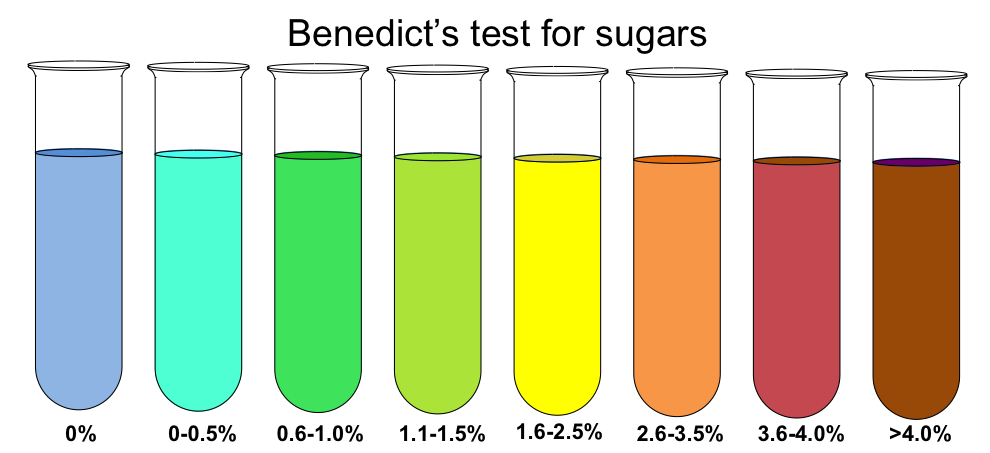
Why Benedict's works. In the alkaline, hot solution, the free aldehyde (or ketone) group of a reducing sugar reduces blue copper(II) ions (Cu²⁺) to copper(I), which precipitates as red copper(I) oxide (Cu₂O); the sugar is oxidized. The more sugar, the more precipitate, so the color shifts from green toward brick red. Four traps:
- Sucrose is non-reducing, so table sugar or beet sugar gives a negative (blue) result. If you first boil the sucrose with dilute acid (hydrolysis) and neutralize it, the freed glucose and fructose make it positive.
- Fructose is a ketose but still tests positive, because in hot alkaline solution it rearranges (through an enediol) into aldose forms that reduce copper.
- Starch and other complex carbohydrates are negative, because only the chain ends are reducing.
- Starchy foods such as bread, bagels and crackers usually give only a weak green to yellow result: their starch is negative, but they contain small amounts of free glucose, maltose (from amylase acting on starch during dough-making) and sometimes added sugar. Milk and fruit juice give stronger (orange-red) results.
Benedict's reagent is preferred over Fehling's because it is a single, stable solution that keeps on the shelf and is less caustic (it uses sodium carbonate instead of sodium hydroxide). Benedict's test was historically used to detect glucose in urine as a sign of diabetes.
Why Biuret works. In alkaline solution, copper(II) ions bind to the nitrogen atoms of peptide bonds, forming a violet complex that absorbs light most strongly at about 540 nm. It needs a chain with at least two peptide bonds, so free amino acids (such as glycine) and dipeptides do not give a positive result; proteins and longer peptides do. The more protein, the deeper the purple, which is the basis of a protein assay. The test needs no heat. The sodium hydroxide makes the solution alkaline; the copper sulfate supplies the Cu²⁺.

Why iodine works. Amylose coils into a helix about six glucose units per turn, and iodine–iodide ions (I₃⁻ and longer polyiodide chains) slide into the core of the helix. The trapped chain absorbs light strongly and looks blue-black. Branched amylopectin forms only short helices and gives a weaker reddish-purple, glycogen a red-brown, and cellulose or chitin no color at all. Heat uncoils the helix, so the test is read at room temperature.
Lipids: milk fat, esterification and fat bonding
Milk fat is about 98% triglycerides. A triglyceride is a glycerol backbone (a three-carbon alcohol with three −OH groups) with three fatty acids attached.
Esterification
The bond between a fatty acid and glycerol forms by esterification: a carboxylic acid (−COOH) reacts with an alcohol (−OH) to give an ester (−COO−) and a molecule of water. Because water is released, it is a condensation (dehydration) reaction. Three esterifications make one triglyceride and release three water molecules. The reverse reaction, splitting an ester by adding water, is hydrolysis.


Hydrolysis matters in dairy. The enzyme lipase hydrolyzes milk fat and frees fatty acids. Milk fat is unusual because it contains short-chain fatty acids, especially butyric acid (four carbons), and freed butyric acid smells and tastes rancid. This hydrolytic rancidity is why raw milk that is shaken or pumped roughly can develop off flavors, and why pasteurization (which inactivates lipase) helps shelf life. Some cheeses rely on controlled lipase activity for their sharp flavor.
Saturated and unsaturated fats
A saturated fatty acid has only single carbon–carbon bonds, so every carbon holds as many hydrogens as it can. Its chain is straight. An unsaturated fatty acid has one (monounsaturated) or more (polyunsaturated) carbon–carbon double bonds. A natural cis double bond puts a kink in the chain.
Straight chains pack closely and attract each other through many weak London dispersion forces, so saturated fats are solid at room temperature. London dispersion forces (temporary dipoles from shifting electrons) act between all molecules, polar or not, and are the only attraction between nonpolar molecules such as fat chains; they grow with molecular size and contact area. Kinked chains cannot pack tightly, so unsaturated fats are usually liquid oils. Trans fats have double bonds that keep the chain fairly straight, so they behave more like saturated fats. Milk fat naturally contains a small amount of trans fats (such as vaccenic acid) made by bacteria in the cow's rumen.
| Fatty acid | Carbons : double bonds | Type | Share of milk fat (approx.) |
|---|---|---|---|
| Butyric | 4:0 | Saturated, short chain | 3–4% |
| Myristic | 14:0 | Saturated | About 11% |
| Palmitic | 16:0 | Saturated | About 30% |
| Stearic | 18:0 | Saturated | About 12% |
| Oleic | 18:1 | Monounsaturated | About 25% |
| Linoleic | 18:2 | Polyunsaturated (omega-6) | 2–3% |
Roughly two-thirds of milk fat is saturated. That mix of saturated (higher melting) and unsaturated (lower melting) fats is why butter is solid in the fridge but spreads when warm, and why cream at 13 °C is partly crystalline, the right state for churning.
Essential fats
The body can make most fatty acids, but not linoleic acid (omega-6) or alpha-linolenic acid (omega-3), because human cells cannot put double bonds at the positions those molecules need. These are the essential fatty acids, and they must come from food. Milk supplies small amounts of both, plus conjugated linoleic acid (CLA). Fat also carries the fat-soluble vitamins A, D, E and K, which is why vitamin A is added back to low-fat and fat-free milk.
The "omega" name tells you where the first double bond counted from the methyl (−CH₃, "omega") end of the chain sits. In an omega-3 fatty acid the first double bond is three carbons from the methyl end; in an omega-6, six. (Chemists also number from the carboxyl end, which gives the Δ or "C-1" numbering.) A fatty acid is a hydrocarbon chain with a carboxyl group at one end and a methyl group at the other.
| Fatty acid | Shorthand | Family | Status | Main sources |
|---|---|---|---|---|
| Linoleic acid (LA) | 18:2 | Omega-6 | Essential | Soybean, corn, sunflower and safflower oils; nuts |
| Alpha-linolenic acid (ALA) | 18:3 | Omega-3 | Essential | Flaxseed, chia seeds, walnuts, canola and soybean oils |
| Arachidonic acid (AA) | 20:4 | Omega-6 | Conditionally essential | Meat, eggs; made from LA |
| Eicosapentaenoic acid (EPA) | 20:5 | Omega-3 | Conditionally essential | Fatty fish (salmon, mackerel, sardines), fish oil, algae |
| Docosahexaenoic acid (DHA) | 22:6 | Omega-3 | Conditionally essential | Fatty fish, fish roe (caviar), algae; added to infant formula |
Conditionally essential means the body can make the compound (EPA and DHA from ALA) but not always fast enough, for example in infancy or illness, so a dietary supply helps. Human conversion of ALA to EPA and DHA is small. DHA is concentrated in the brain and retina and is important for brain development before and after birth. There is no official RDA for EPA plus DHA; the US Adequate Intake is set only for ALA (1.6 g/day for men, 1.1 g/day for women), and many health organizations suggest roughly 250–500 mg/day of EPA plus DHA combined, about two servings of fatty fish a week. Omega-3 intake is linked with lower triglycerides and heart health.
Mammals cannot make LA or ALA because they lack the desaturase enzymes that put double bonds beyond carbon 9 of the chain (counted from the carboxyl end). Signs of essential fatty acid deficiency, rare in people eating normal diets, include dry, scaly skin, hair loss, poor wound healing and poor growth in children.
Role of fat in dairy foods
Fat gives richness and mouthfeel, carries flavor compounds, supplies energy (9 kcal/g, more than twice protein or carbohydrate) and builds structure: the partly coalesced fat network in ice cream and whipped cream, and the continuous fat phase in butter. In curds, fat globules are trapped inside the casein network, which is why whole milk gives a heavier curd than skim. Fat also transfers heat in cooking and keeps food from sticking and burning, because fats melt easily but do not break down until they are much hotter than boiling water.
Lipid classes: triglycerides, phospholipids, sterols and waxes
Lipids are the diverse group of biological molecules that do not dissolve in water. They are the one major class that does not form polymers.
| Class | Structure | Examples | Role |
|---|---|---|---|
| Triglycerides (triacylglycerols) | Glycerol + 3 fatty acids, joined by ester bonds | Milk fat, butter, vegetable oils, lard | Energy storage. Fats are solid at room temperature; oils are liquid |
| Phospholipids | Glycerol + 2 fatty acids + a phosphate group (often with choline or another polar group) | Lecithin (phosphatidylcholine) in egg yolk, soy and the milk fat globule membrane | Cell membranes; natural emulsifiers |
| Sterols | Four fused carbon rings | Cholesterol (animal foods only), plant sterols | Membranes; raw material for bile acids, steroid hormones (estrogen, testosterone) and vitamin D |
| Waxes | A fatty acid esterified to a long-chain alcohol | Beeswax, carnauba wax (a coating on fruit) | Waterproofing |

A phospholipid is amphipathic: its phosphate head is polar and its two tails are not. That is why phospholipids form cell membranes (heads facing water, tails facing each other) and why lecithin from egg yolk makes mayonnaise an emulsion. In membranes, saturated tails pack tightly and make the membrane stiffer; unsaturated, kinked tails keep it fluid.
Cholesterol is made by the body and found only in animal foods (milk, butter, eggs, meat); plants contain none. Plants make their own sterols instead (phytosterols such as β-sitosterol, stigmasterol and campesterol), which lower cholesterol absorption and are added to some spreads; fungi and yeasts make ergosterol, which UV light converts to vitamin D₂ (as in UV-treated mushrooms). Sunlight converts a cholesterol derivative in the skin (7-dehydrocholesterol) into vitamin D. Cholesterol travels in the blood in lipoproteins: LDL ("bad" cholesterol) delivers cholesterol to tissues and, in excess, deposits it in artery walls (atherosclerosis), raising the risk of heart attack and stroke; HDL ("good" cholesterol) carries cholesterol back to the liver. For adults an LDL below 100 mg/dL is considered optimal. Diets high in saturated and trans fats raise LDL; replacing them with unsaturated fats lowers it, which is why unsaturated fats are called the healthier choice.
Melting point and fatty acid structure
Three rules predict which fats are solid:
- Longer chains melt higher (more surface for London dispersion forces). Butyric acid (4 C) is liquid; stearic acid (18 C) melts near 70 °C.
- More double bonds melt lower. Each cis double bond adds a kink. Stearic (18:0) > oleic (18:1, melts around 13–16 °C) > linoleic (18:2, below 0 °C).
- Trans melts higher than cis. Elaidic acid, the trans form of oleic acid, melts around 45 °C, much higher than oleic, because its chain is nearly straight.
So for 18-carbon acids: stearic > elaidic (trans) > oleic (cis) > linoleic. Fats rich in saturated fatty acids have higher melting points (so they are solid) and, with fewer double bonds for oxygen to attack, better oxidative stability than oils. Coconut oil (about 90% saturated, much of it the 12-carbon lauric acid) is solid at about 25 °C or below. Lard, butter and coconut oil are high in saturated fat; olive, canola, peanut and corn oils, nuts, seeds, avocados and fatty fish are rich in unsaturated fat.
Hydrogenation and trans fats
Hydrogenation adds hydrogen (H₂) across carbon–carbon double bonds, turning unsaturated fatty acids into saturated ones. It is run with a metal catalyst (usually nickel; also palladium or platinum), heat and pressure. The catalyst gives the reaction a lower-energy pathway, so it runs at practical temperatures and speeds. Hydrogenation turns liquid vegetable oil into a solid or semi-solid fat that is spreadable, has a higher melting point and resists rancidity: margarine and vegetable shortening are hydrogenated products. Sugars can be hydrogenated too: the carbonyl group is reduced to an alcohol, which is how sugar alcohols such as sorbitol are made.
Full hydrogenation saturates every double bond. Partial hydrogenation leaves some double bonds, and during the reaction many of them flip from the natural cis form to the trans form. Partially hydrogenated oils (PHOs) were therefore the main source of artificial trans fats in shortening, stick margarine, baked goods, crackers and fried foods.
Why trans fats are harmful: they raise LDL cholesterol and lower HDL cholesterol, a worse combination than saturated fat, and increase the risk of heart disease. The FDA required trans fat on the Nutrition Facts label from 2006, determined in 2015 that PHOs are no longer "generally recognized as safe", and set 2018 as the main compliance date for removing them from foods. A label may say 0 g trans fat if a serving has less than 0.5 g. Small amounts of natural trans fats (vaccenic acid, CLA) occur in milk and beef fat, made by bacteria in the cow's rumen. Historically most dietary trans fat came from PHOs, not animal foods; since the PHO ban, the small natural amounts in dairy and meat make up a larger share.
Rancidity, antioxidants and the smoke point
Fats spoil by rancidity, which produces off odors and flavors:
| Type | What happens | Typical in | Prevention |
|---|---|---|---|
| Hydrolytic rancidity | Water and lipase split triglycerides into glycerol and free fatty acids; short ones such as butyric acid smell sour-cheesy | Butter, milk, cream | Pasteurize (inactivates lipase), refrigerate, avoid rough handling of raw milk |
| Oxidative rancidity | Oxygen attacks the double bonds of unsaturated fatty acids in a free-radical chain reaction, forming peroxides that break into aldehydes, ketones and other carbonyl compounds | Oils, nuts, chips, whole milk powder | Antioxidants, exclude oxygen, keep cold and dark, remove metal ions |
Oxidation is speeded by light, heat and traces of metals such as copper and iron, which is one reason milk is sold in opaque containers. The chain reaction (autoxidation) runs in three steps. Initiation: light, heat or a metal ion pulls a hydrogen atom from a carbon next to a double bond, leaving a free radical. Propagation: the radical reacts with oxygen to form a peroxyl radical, which steals a hydrogen from another fatty acid, making a hydroperoxide and a new radical, so the chain keeps going. Termination: two radicals combine, or an antioxidant donates a hydrogen and forms a stable radical, ending the chain. The hydroperoxides break down into the aldehydes and ketones that smell rancid. Defenses:
- Antioxidants stop the free-radical chain: BHA (butylated hydroxyanisole), BHT (butylated hydroxytoluene), TBHQ, vitamin E (tocopherols, the natural antioxidant in vegetable oils) and vitamin C (ascorbic acid).
- Chelators (sequestrants) such as EDTA and citric acid capture metal ions so they cannot catalyze oxidation.
- Nitrogen flushing or vacuum packaging removes oxygen; potato-chip bags are filled with nitrogen for this reason.
The smoke point is the temperature at which a heated fat starts to break down and give off visible smoke. Triglycerides split into free fatty acids and glycerol, and glycerol breaks down into acrolein, an irritating, acrid compound. Fats high in free fatty acids smoke at lower temperatures, so frying oil that is reused again and again darkens, foams, thickens and smokes sooner. Whole butter smokes and burns at a fairly low temperature because its milk proteins and lactose scorch; clarified butter does not have that problem.
Saponification
Heating a fat with a strong base such as sodium hydroxide (lye) or potassium hydroxide hydrolyzes its ester bonds and gives glycerol plus soap, the sodium or potassium salts of the fatty acids. This is saponification. A soap molecule, like a phospholipid, has a charged, water-loving head and a long fat-loving tail, which is how it lifts grease into water. Lye is also used in food processing (peeling fruits, curing olives, making pretzels' brown crust), always rinsed or neutralized afterward.
Lipase enzymes catalyze the hydrolysis of triglycerides into glycerol and fatty acids, and they work at the oil–water interface, which is why fat must be emulsified (by bile in the gut) before it is digested efficiently.
Proteins: casein and whey
Proteins are chains of amino acids joined by peptide bonds. Each amino acid has an amino group (−NH₂), a carboxyl group (−COOH), a hydrogen and a side chain on one central carbon. A peptide bond forms when the carboxyl group of one amino acid joins the amino group of the next, and like esterification it is a condensation reaction that releases water. A protein's sequence (primary structure) folds into helices and sheets (secondary), a 3D shape (tertiary) and sometimes multi-chain assemblies (quaternary).
Milk protein is about 80% casein and 20% whey protein, and the two behave very differently:
| Property | Casein | Whey proteins |
|---|---|---|
| Share of milk protein | About 80% | About 20% |
| Main members | αs1-, αs2-, β- and κ-casein | β-lactoglobulin, α-lactalbumin, serum albumin, immunoglobulins |
| Structure in milk | Large micelles with calcium phosphate | Small, compact, globular, dissolved |
| Acid at pH 4.6 | Precipitates (forms curd) | Stays dissolved |
| Rennet | Coagulates | Not affected |
| Heat | Very heat-stable | Denatures above about 70 °C |
| Digestion | Clots in the stomach, digested slowly | Digested quickly |
| Products | Cheese, curds, casein-based foods | Whey protein powders, ricotta (made by heating acidified whey) |
Of the 20 amino acids in proteins, nine are essential: the body cannot make them, so they must be eaten. They are histidine, isoleucine, leucine, lysine, methionine, phenylalanine, threonine, tryptophan and valine. Milk protein supplies all nine in useful amounts, so it is a complete protein. Whey protein is especially rich in leucine, which is why it is popular for muscle building.
Denaturation is the unfolding of a protein's shape without breaking its peptide bonds. Heat, acid, salt and mechanical stress (whipping) can denature proteins. Casein curdling in the lab is a different process from denaturation: the micelles aggregate because their charge is neutralized, while the individual proteins stay largely intact.
Amino acids and the peptide bond
Every amino acid has the same backbone around a central (alpha) carbon: an amino group (−NH₂), a carboxyl group (−COOH), a hydrogen atom and a variable side chain, the R group. Only the R group differs among the 20 amino acids, and its size, charge and polarity decide how the protein folds. Amino acids take their name from the amino group. In water near neutral pH the amino group carries H⁺ (−NH₃⁺) and the carboxyl group loses it (−COO⁻), so the molecule is a zwitterion, positive and negative at once.

A peptide bond (an amide bond) joins the carboxyl carbon of one amino acid to the amino nitrogen of the next, releasing water (dehydration synthesis). A chain of amino acids is a polypeptide; a protein is one or more polypeptides folded into a working shape. Most peptide bonds are in the more stable trans arrangement.

Levels of protein structure
| Level | What it is | Bonds that hold it |
|---|---|---|
| Primary | The sequence of amino acids | Covalent peptide bonds |
| Secondary | Local coils (α-helix) and folded strips (β-pleated sheet) | Hydrogen bonds between backbone C=O and N−H groups |
| Tertiary | The overall 3D shape of one polypeptide | R-group interactions: hydrogen bonds, ionic bonds (salt bridges), hydrophobic interactions, van der Waals forces, and covalent disulfide bridges between two cysteine side chains |
| Quaternary | Two or more polypeptide subunits fitted together (hemoglobin has four) | The same interactions as tertiary, between chains |

A protein's function depends on how it folds. Denaturation destroys the secondary, tertiary and quaternary structure but leaves the primary structure (the peptide bonds) intact. Agents that denature proteins: heat, acid or base (pH change), salts and heavy metals, alcohol and other organic solvents, freezing, and mechanical stress such as whipping or beating. In food, denatured proteins often bond to one another and form a solid network, which is coagulation: egg white turning white and firm when boiled, a beaten egg white foam setting, scrambled eggs, cheese curd made with heat and acid, and steak turning opaque as its muscle proteins (actin and myosin) denature and tighten. Stomach acid (HCl) denatures dietary proteins so that the enzyme pepsin can reach the peptide bonds. Raw egg white contains avidin, a protein that binds the vitamin biotin and blocks its absorption, so eating many raw egg whites can cause biotin deficiency; cooking denatures avidin and removes the problem. Not every kitchen change is protein denaturation: a cake rising as it bakes is caused by expanding gas.
Essential amino acids and protein quality
| Group | Amino acids | Meaning |
|---|---|---|
| Essential (9) | Histidine, isoleucine, leucine, lysine, methionine, phenylalanine, threonine, tryptophan, valine | The body cannot make them; they must come from food |
| Conditionally essential (6) | Arginine, cysteine, glutamine, glycine, proline, tyrosine | Normally made by the body, but needed from food during illness, stress or rapid growth |
| Nonessential (5) | Alanine, asparagine, aspartic acid, glutamic acid, serine | The body makes enough |
Mnemonic for the nine essential amino acids: "PVT TIM HaLL": phenylalanine, valine, threonine, tryptophan, isoleucine, methionine, histidine, leucine, lysine.
Essential versus nonessential is about whether the body can make it, not about whether the body needs it: the body needs all 20. Tyrosine is made from phenylalanine, so people with phenylketonuria (PKU), who lack the enzyme phenylalanine hydroxylase, must limit phenylalanine (including the phenylalanine in aspartame) and get tyrosine from food.
A complete protein supplies all nine essential amino acids in useful amounts: milk, yogurt, cheese, eggs, meat, fish, soy and quinoa. Most other plant proteins are incomplete, low in one limiting amino acid: grains are low in lysine, legumes in methionine. Eating complementary proteins (rice and beans, bread and peanut butter) together, or over the day, supplies a complete set; this is how strict vegetarians avoid shortages. Tryptophan is in nearly all food proteins, including turkey, milk, kefir, cheese and eggs.
The RDA for protein is 0.8 g per kg of body weight per day for adults (about 0.95 g/kg for ages 4–13 and 0.85 g/kg for ages 14–18). Protein builds and maintains muscles, organs, enzymes, hormones, antibodies and connective tissue; it can also be burned for energy (4 kcal/g).
Protein–energy malnutrition comes in two classic forms. Marasmus is severe shortage of total energy and protein: extreme wasting of fat and muscle ("skin and bones"). Kwashiorkor is protein shortage with somewhat adequate energy (often after weaning onto starchy foods): swelling (edema), starting in the feet and legs, a swollen belly, an enlarged fatty liver, skin and hair changes, and poor growth. Milk powders and other protein-rich foods are used to treat both.
Isoelectric point and charge
Each protein's isoelectric point (pI) is the pH at which its positive and negative charges balance, so its net charge is zero. At the pI, proteins repel each other least and are least soluble, so they clump and precipitate: casein's pI of about 4.6 is why milk curdles there.
- At a pH below the pI, extra H⁺ makes the protein net positive; in an electric field it moves toward the negative electrode (cathode).
- At a pH above the pI it is net negative and moves toward the positive electrode (anode).
Milk at pH 6.6 is above casein's pI, so casein carries a negative charge there. Isoelectric focusing separates proteins by running them through a pH gradient in an electric field: each protein stops where the pH equals its pI. Ordinary gel electrophoresis separates proteins by size and charge instead. Casein is the major milk protein that is insoluble at its pI; the whey proteins stay soluble. Within the micelle, the hydrophilic, "hairy" κ-casein coats the surface, while the αs- and β-caseins, which are rich in phosphate groups that bind calcium, sit inside.
Enzymes
Enzymes are biological catalysts: they speed up chemical reactions in living things without being used up, so one enzyme molecule can act again and again. Most enzymes are proteins (a few, called ribozymes, are RNA, so "all enzymes are proteins" is false). Their names usually end in -ase, after diastase (an amylase), the first enzyme isolated, in 1833. The word "enzyme" was coined by Wilhelm Kühne in 1877.
How they work. An enzyme lowers a reaction's activation energy, the energy barrier reactants must cross. The reactant, the substrate, binds at the enzyme's active site to form an enzyme–substrate complex. The active site's shape makes each enzyme specific to one substrate or one type of reaction. Two models describe the fit: lock and key (the substrate fits a rigid site exactly) and induced fit (the site changes shape slightly as the substrate binds, then returns to its original shape after the products leave; the enzyme is not permanently changed). Enzymes speed the forward and reverse reactions equally, so they help a reaction reach equilibrium faster but do not change the equilibrium or the overall energy released.
Factors that change the rate:
- Temperature: rate rises with temperature up to an optimum (about 37 °C for human enzymes), then falls sharply as the enzyme denatures. Cold slows enzymes (refrigeration); high heat destroys them (blanching, pasteurization).
- pH: each enzyme has an optimum pH: pepsin in the stomach works near pH 2, trypsin in the small intestine near pH 8. Far from the optimum, the active site loses its shape.
- Substrate concentration: rate rises until every enzyme is busy (saturation).
- Enzyme concentration: more enzyme, faster rate, if substrate is plentiful.
- Inhibitors: a competitive inhibitor resembles the substrate and blocks the active site (overcome by adding more substrate); a noncompetitive inhibitor binds elsewhere and changes the enzyme's shape. In feedback inhibition the end product of a pathway inhibits an early enzyme.
- Cofactors: many enzymes need a helper. Inorganic cofactors are metal ions (Mg²⁺, Zn²⁺, Fe²⁺); organic coenzymes are often made from vitamins (NAD⁺ from niacin, FAD from riboflavin). A cofactor bound tightly and permanently, such as the heme in catalase, is a prosthetic group.
Some enzymes are made as inactive precursors called zymogens (pepsinogen, trypsinogen) and activated only where needed, so they do not digest the cells that make them. Enzymes with different structures that catalyze the same reaction are isoenzymes.
| Enzyme class | Reaction type | Example |
|---|---|---|
| Oxidoreductases | Oxidation–reduction (electron transfer) | Dehydrogenases, polyphenol oxidase, catalase |
| Transferases | Move a functional group from one molecule to another | Kinases (move a phosphate) |
| Hydrolases | Split bonds by adding water | Lactase, amylase, lipase, proteases (pepsin, trypsin, chymosin) |
| Lyases | Add or remove groups to form or break double bonds, without water or oxidation | Decarboxylases |
| Isomerases | Rearrange a molecule into an isomer | Glucose isomerase (glucose → fructose for HFCS) |
| Ligases | Join two molecules using ATP | DNA ligase |
| Enzyme | Substrate → products | Where it acts / how it is used |
|---|---|---|
| Salivary and pancreatic amylase | Starch → maltose and short chains | Mouth and small intestine; also used to make glucose syrups and in brewing |
| Lactase (β-galactosidase) | Lactose → glucose + galactose | Small intestine; added to make lactose-free milk |
| Sucrase (invertase) | Sucrose → glucose + fructose | Small intestine; invert syrup and soft-center candies |
| Maltase | Maltose → 2 glucose | Small intestine |
| Pepsin | Proteins → peptides | Stomach (pH about 2) |
| Trypsin, chymotrypsin | Proteins → peptides | Small intestine (pH about 8); a protease; trypsin works at higher pH than pepsin |
| Lipase | Triglycerides → fatty acids + glycerol | Small intestine; cheese flavor; rancidity in milk |
| Chymosin (rennet) | Cuts κ-casein | From the stomachs of young ruminants or made by fermentation; cheesemaking |
| Papain, bromelain, ficin | Proteins (proteolytic) | From papaya, pineapple, figs; meat tenderizers; papain and bromelain stop gelatin from setting |
| Pectinase, cellulase | Pectin, cellulose | Clarifying fruit juice |
| Alkaline phosphatase | Phosphate esters | Native milk enzyme destroyed by pasteurization; its absence proves pasteurization |
| Polyphenol oxidase | Phenolic compounds + O₂ → brown pigments | Browning of cut apples and bananas |
Proteases are also used to "pre-digest" proteins in infant formulas and medical foods (protein hydrolysates). Fruits, vegetables and milk all contain active enzymes, which is why raw foods change in storage and why vegetables are blanched (briefly scalded) before freezing.
Calories and nutrition math
A calorie (small c, cal) is the heat needed to raise the temperature of 1 g of water by 1 °C; it equals 4.184 joules. The food Calorie (capital C, Cal) is a kilocalorie (kcal), 1,000 calories: the heat to raise 1 kg of water by 1 °C. The "Calories" on a Nutrition Facts label are kilocalories. The calorie and the joule both measure energy. Watch the capital letter: "the heat to raise 1 g of water by 1 °C" defines the small calorie, not the food Calorie.
Nutrients are grouped into six classes: carbohydrates, proteins, lipids, vitamins, minerals and water. Only the first three (plus alcohol) supply energy. Calories themselves are not a nutrient. The energy in food is chemical potential energy stored in the bonds of carbohydrate, fat and protein molecules; cellular respiration releases it as the molecules are oxidized to CO₂ and water. Fat holds more energy per gram because its carbon chains are more reduced (more C−H bonds, little oxygen).
| Source | Energy (kcal per gram) |
|---|---|
| Carbohydrate (sugars, starch) | 4 |
| Protein | 4 |
| Fat | 9 |
| Alcohol (ethanol) | 7 |
| Sugar alcohols | about 2 on average (0.2–3) |
| Soluble fiber | about 2 (fermented by gut bacteria); insoluble fiber about 0 |
| Water, vitamins, minerals | 0 |
So fat is the most concentrated energy source: the ratio of fat to carbohydrate energy is 9 : 4. These are the Atwater factors, averages used for labels.
Dietary recommendations for energy sources (US Dietary Reference Intakes, adults): carbohydrate 45–65% of Calories, fat 20–35% (children 4–18: 25–35%), protein 10–35%. Added sugars and saturated fat should each be under 10% of Calories. On a 2,000-Calorie diet, 10% is 200 kcal, or 50 g of added sugar, which is the Daily Value for added sugars.
A typical adult needs roughly 1,600–3,000 Calories a day depending on size, sex and activity, not 5,000. Labels use 2,000 Calories as a reference, not a recommendation for everyone.
A food is calorie-dense, or energy-dense, when it packs many Calories into a small weight or volume, usually because it is high in fat and low in water: butter, oil, nuts, chips. Water and fiber lower energy density. Nutrient density compares nutrients to Calories: milk has high nutrient density because one cup supplies about a quarter of the daily calcium and a sixth of the protein for about 80–150 Calories. The nutritional value of a food depends both on its nutrient content and on its bioavailability, how much the body can actually absorb and use (the calcium in milk is well absorbed; that in spinach is mostly bound by oxalate).
Vitamins and minerals in dairy
Dairy foods are the main source of calcium in the American diet, and important sources of vitamin D (from fortification), phosphorus, potassium, riboflavin (vitamin B2), vitamin B12, vitamin A and iodine.
The Recommended Dietary Allowance (RDA) is the daily intake that meets the needs of nearly all (97–98%) healthy people of a given age and sex. (The rules write it as "recommended daily allowance".) When there is not enough evidence to set an RDA, an Adequate Intake (AI) is used instead, as for potassium. Values for ages 9–13, from the NIH Office of Dietary Supplements:
| Nutrient | RDA, ages 9–13 | Role | What deficiency causes |
|---|---|---|---|
| Calcium | 1,300 mg (same for ages 14–18) | Bone and tooth mineral; muscle contraction; nerve signals; blood clotting | Low bone mass in youth; osteoporosis later; in severe cases muscle cramps |
| Vitamin D | 600 IU (15 µg) | Lets the gut absorb calcium and phosphorus | Rickets (soft, bowed bones) in children; osteomalacia in adults |
| Phosphorus | 1,250 mg (same for ages 14–18) | Bone mineral (calcium phosphate); ATP; cell membranes | Rare; weakness, bone pain |
| Riboflavin (B2) | 0.9 mg | Coenzymes (FAD, FMN) for energy metabolism | Sore throat, cracks at the corners of the mouth, inflamed tongue |
| Vitamin B12 | 1.8 µg | Red blood cell formation; nerve function | Megaloblastic anemia; nerve damage |
| Vitamin A | 600 µg RAE | Vision in dim light; skin and immunity | Night blindness; dry eyes |
| Potassium | AI 2,500 mg (boys), 2,300 mg (girls) | Fluid balance; nerve and muscle function; blood pressure | Muscle weakness, abnormal heart rhythm |
| Iodine | 120 µg | Thyroid hormones | Goiter; poor growth and development |
Riboflavin is destroyed by light, which is one reason milk is often sold in opaque containers. Vitamin B12 is found almost only in animal foods, so dairy is an important source for vegetarians.
The 13 vitamins
Vitamins are organic compounds needed in small amounts that the body cannot make in sufficient quantity, so they must come from food. There are 13. They split into two groups by solubility, and that split predicts how they behave:
- Fat-soluble (A, D, E, K) are absorbed with dietary fat, stored in the liver and fatty tissue, and can build up to toxic levels with large supplement doses. Healthy people rarely need supplements of them. They are lost when fat is removed from milk, which is why vitamin A (and D) is added back.
- Water-soluble (the eight B vitamins and C) dissolve in water, are not stored for long (except B12, stored in the liver), and excess is excreted in urine, so they are needed regularly and toxicity is rare. They leach into cooking water. Most B vitamins work as coenzymes in energy metabolism.
The body can make a few: vitamin D in skin exposed to sunlight (the "sunshine vitamin"), vitamin K and some B vitamins by gut bacteria, and niacin from the amino acid tryptophan.
ReferenceVitamin reference· 13 rows
F = fat-soluble; W = water-soluble. "Dairy" marks vitamins for which milk products are an important source.
No rows match.
| Vitamin | Name(s) | F/W | Main roles | Deficiency | Good sources |
|---|---|---|---|---|---|
| A | Retinol; beta-carotene is a provitamin | F | Vision in dim light (part of rhodopsin), healthy skin and linings, immunity, growth | Night blindness, dry eyes (xerophthalmia), infections | Liver, eggs, butter, fortified milk (dairy); orange and dark-green vegetables (carrots, sweet potatoes, spinach, kale) as beta-carotene; golden rice |
| D | Calciferol (D3, cholecalciferol) | F | Absorption of calcium and phosphorus; bone and tooth formation | Rickets (children), osteomalacia (adults); osteoporosis risk | Sunlight on skin, fortified milk (dairy), fatty fish, egg yolk |
| E | Tocopherol | F | Antioxidant protecting cell membranes; used as an antioxidant in oils | Rare: nerve and muscle damage (loss of feeling in arms and legs, poor coordination), weakened immunity | Vegetable oils, nuts, seeds |
| K | Phylloquinone (K1, plants), menaquinones (K2, bacteria) | F | Blood clotting; bone proteins | Bleeding, easy bruising; newborns get a vitamin K shot | Leafy greens (kale, spinach), gut bacteria; K2 in cheese and fermented foods. Intake should stay steady for people on the blood thinner warfarin (Coumadin) |
| B1 | Thiamin | W | Coenzyme in carbohydrate metabolism; nerves | Beriberi (nerve and heart damage); seen in diets of polished white rice | Whole and enriched grains, pork, legumes |
| B2 | Riboflavin | W | Coenzymes FAD and FMN in energy metabolism | Cheilosis (cracks at the mouth corners), sore throat, inflamed tongue | Milk and dairy (a top source), eggs, meat; destroyed by light |
| B3 | Niacin | W | Coenzymes NAD and NADP | Pellagra: dermatitis, diarrhea, dementia (and death) | Meat, fish, poultry, enriched grains; made from tryptophan |
| B5 | Pantothenic acid | W | Part of coenzyme A | Very rare | Found in almost all foods |
| B6 | Pyridoxine | W | Amino acid metabolism; red blood cells | Anemia, dermatitis, confusion | Poultry, fish, potatoes, bananas |
| B7 | Biotin | W | Carboxylation reactions in fat and sugar metabolism | Hair loss, rash; caused by eating many raw egg whites (avidin) | Eggs (cooked), nuts; gut bacteria |
| B9 | Folate (folic acid in supplements) | W | DNA synthesis and cell division | Megaloblastic anemia; neural tube defects such as spina bifida in early pregnancy | Leafy greens, legumes, liver, fortified grains. Large folic acid intakes can mask B12 deficiency |
| B12 | Cobalamin (contains cobalt) | W | Red blood cell formation, nerve myelin, DNA synthesis | Pernicious (megaloblastic) anemia with large red cells, fatigue, nerve damage, depression | Animal foods only: milk and dairy, meat, fish, eggs; vegans need fortified foods or supplements |
| C | Ascorbic acid, C₆H₈O₆ | W | Collagen synthesis (blood vessels, skin, wound healing), antioxidant, helps iron absorption | Scurvy: bleeding gums, bruising, poor wound healing | Citrus fruits, strawberries, peppers, broccoli; milk is a poor source |
Deficiency pairs tests love: A–night blindness, D–rickets, K–bleeding, B1–beriberi, B2–cheilosis, B3–pellagra, B9–spina bifida, B12–pernicious anemia, C–scurvy. Vitamin C (ascorbic acid) is not a B vitamin, and adenine (once called "vitamin B4") is not a vitamin at all.
Fermenting microbes make several vitamins: lactic acid bacteria in cultured dairy can produce riboflavin (B2) and folate (and some strains vitamin K2), while vitamin B12 is made mainly by propionibacteria (as in Swiss cheese) and only a few lactic acid bacterial strains; they do not make vitamin E. Both lactic acid fermentations (yogurt, cheese, sauerkraut) and yeast fermentations (bread, kefir, beer) can raise the content of some B vitamins (such as folate and riboflavin), because the microbes synthesize them, but the effect depends on the strain: some cultures use up vitamins instead (yogurt usually has less B12 than the milk it was made from), and cooking or baking afterward destroys some.
Minerals
Minerals are inorganic elements. Major minerals are needed in amounts of 100 mg or more a day; trace minerals (iron, zinc, copper, iodine, selenium, manganese, fluoride, chromium, molybdenum) in smaller amounts. Calcium, phosphorus and magnesium together keep bones and teeth hard.
| Mineral | Main roles | Deficiency (or excess) | Dairy connection and other sources |
|---|---|---|---|
| Calcium | Bones and teeth; muscle contraction, nerve signals, blood clotting | Low bone mass, osteoporosis | Milk, yogurt, cheese (a top source); fortified plant milks, leafy greens, canned fish with bones |
| Phosphorus | Bone mineral (calcium phosphate), ATP, DNA, membranes | Rare | Milk, meat, grains |
| Potassium | Fluid balance, nerve and muscle function; lowers blood pressure | Muscle weakness, abnormal heart rhythm | Milk, yogurt, bananas, potatoes, beans |
| Magnesium | Bone; cofactor for hundreds of enzymes | Muscle cramps, weakness | Nuts, whole grains, leafy greens; some in milk |
| Sodium | Fluid balance, nerve impulses | Excess raises blood pressure (hypertension) | Salt (about 40% sodium by mass), cheese, processed foods; Daily Value 2,300 mg |
| Iron | Oxygen transport in hemoglobin and myoglobin | Iron-deficiency anemia (fatigue, pale skin), the late stage after iron stores run out | Meat (heme iron, well absorbed), beans, fortified cereals and enriched flour (non-heme iron, absorbed better with vitamin C). Milk is a poor source, and calcium slightly reduces iron absorption |
| Zinc | Immunity, wound healing, taste, growth | Poor growth, slow healing | Meat, shellfish, dairy, beans |
| Iodine | Thyroid hormones | Goiter (swollen thyroid gland), poor growth and development | Iodized salt, seafood, dairy (partly from iodine sanitizers used on farms) |
| Selenium | Antioxidant enzymes | Rare | Seafood, nuts, grains |
Salt hides in many foods. If a cake recipe contains only a little added table salt but the label shows much more sodium, the rest comes from other ingredients: baking soda (sodium bicarbonate) and baking powder, salted butter, cheese, and sodium-containing additives such as sodium caseinate or sodium benzoate.
Fortification, enrichment and biofortification
- Fortification adds nutrients that were not there, or not in useful amounts: vitamin D in milk, calcium in orange juice and plant milks, iodine in salt.
- Enrichment puts back nutrients lost in processing: refined (white) flour is enriched with thiamin, riboflavin, niacin and iron (and fortified with folic acid).
- Biofortification raises nutrient levels in the crop itself by breeding or genetic engineering, such as beta-carotene-rich golden rice.
Adding riboflavin to a ready-to-eat breakfast cereal is usually called fortification; putting it back into white flour is enrichment. A food that provides 20% or more of the Daily Value for a nutrient per serving may be called an "excellent source" (or "high in"); 10–19% is a "good source".
Cooking and dairy chemistry
Heat changes milk in several ways at once, and tests ask you to connect a visible change to its chemistry:
- Whey protein denaturation. Above about 70 °C, β-lactoglobulin unfolds and exposes sulfur-containing groups, which give boiled or UHT milk its "cooked" flavor. Denatured whey proteins also stick to casein micelles.
- Skin formation. When milk is heated uncovered, water evaporates at the surface, and denatured whey proteins and fat concentrate there into a film. Stirring or covering the pan prevents it.
- Scorching and fouling. Proteins and minerals deposit on hot pan surfaces and burn, which is why milk is heated gently.
- Maillard browning. Lactose (a reducing sugar) reacts with amino groups, especially those on the amino acid lysine, when milk is heated for a long time. The products are brown pigments and caramel-like flavors, as in dulce de leche and sweetened condensed milk. The reaction also slightly lowers protein quality because the lysine bound into browning products is no longer available.
- Caramelization. Sugar heated on its own to high temperature breaks down into brown, bitter-sweet compounds. Unlike Maillard browning, it does not need protein.
- Curdling. Heat plus acid (tomato soup with milk, milk added to hot coffee with lemon) makes casein clump at a higher pH than it would in the cold. Paneer and ricotta are made deliberately this way.
- Melting and oiling off. Cheese fat melts and the casein network softens when cheese is heated. Overheated cheese squeezes out fat and turns rubbery as its proteins tighten.
| Change | What reacts | Needs | Dairy example |
|---|---|---|---|
| Maillard browning | Reducing sugar (lactose) + amino group (lysine) | Heat over time | Dulce de leche, browned cheese crust |
| Caramelization | Sugar alone | High heat | Caramel sauce |
| Whey denaturation | Whey proteins | Above about 70 °C | Cooked flavor, milk skin |
| Acid–heat curdling | Casein | Heat and acid | Paneer, ricotta |
Browning reactions compared
Foods brown in three fundamentally different ways. Two are non-enzymatic (Maillard and caramelization); one is enzymatic.
| Feature | Maillard reaction | Caramelization | Enzymatic browning |
|---|---|---|---|
| Reactants | Reducing sugar + free amino group (amino acids, peptides, proteins; especially lysine) | Sugar alone | Phenolic compounds + oxygen |
| Catalyst | None (heat) | None (heat) | Enzyme polyphenol oxidase |
| Temperature | Proceeds slowly even in storage; fast at about 140–165 °C (280–330 °F) | Higher: sucrose about 160–170 °C (fructose lower, about 110 °C) | Room temperature |
| Conditions that speed it | Intermediate water activity (about 0.6–0.8), alkaline pH, high heat | High heat, little water | Cut or bruised tissue exposed to air |
| Products | Brown melanoidins and many flavor compounds (pyrazines, furans): roasted, toasty, meaty | Caramel flavors and brown polymers; bitter if overheated | Brown melanin pigments; wanted in tea, raisins and cocoa, a defect in cut fruit |
| Examples | Toast crust, seared steak, dulce de leche, browned cheese, sweetened condensed milk and evaporated milk color | Caramel sauce, crème brûlée top, peanut brittle | Cut apples, bananas, avocados, potatoes |
As temperature rises, the reactions come in the order Maillard → caramelization → pyrolysis (charring, above roughly 200 °C, when sugars and proteins decompose to carbon). The Maillard reaction is named after Louis-Camille Maillard, who described it in 1912. It is not one reaction but a network: a reducing sugar's carbonyl reacts with an amino group, the product rearranges into Amadori products, and these break down into hundreds of color and flavor compounds. A side product, acrylamide, forms from the amino acid asparagine plus reducing sugars in starchy foods fried or baked at high temperature (fries, chips, toast); it is classed as a probable human carcinogen (IARC Group 2A). Advanced Maillard products can also lower nutritional value by tying up lysine.
Caramelization is the breakdown of sugar by heat alone: the sugar melts, loses water, and fragments and recombines into hundreds of compounds, so less and less of the original sugar remains. A "wet" caramel (sugar plus water) takes longer than a "dry" one because the water must boil off first; stirring a hot syrup can make it crystallize instead of caramelizing smoothly. Caramelization is not enzymatic, and caramelizing pure sugar is not a Maillard reaction because there is no protein. Caramel's aroma comes from compounds such as diacetyl (buttery, butterscotch), furans such as hydroxymethylfurfural (nutty, sweet), maltol (toasty, cooked-sugar) and acids, while caramelans, caramelens and caramelins are its brown polymers. Chemically, caramelization is a pyrolysis (thermal decomposition) of sugar; it is slowest near neutral pH and faster in acidic or alkaline conditions. Charring at still higher temperatures is pyrolysis carried to completion.
Enzymatic browning is prevented by acid (lemon juice), ascorbic acid, sulfites, blanching (which destroys the enzyme), cold or keeping out oxygen.
Other effects of heat and cooking
- Physical versus chemical changes. Melting butter, freezing ice cream and dissolving sugar are physical changes (no new substances). Browning, curdling with acid and heat, rancidity and fermentation are chemical changes.
- Nutrient losses. Water-soluble vitamins (C and the B vitamins) dissolve into cooking water and are destroyed by heat and oxygen. Steaming, microwaving and quick cooking in little water preserve more nutrients than long boiling. Fat-soluble vitamins (A, D, E, K) behave the opposite way: they do not leach into water, but they can dissolve into frying oil and are damaged by the high heat and oxygen of deep-frying, so fried foods lose some of them. Pasteurization changes milk's nutrition only slightly.
- Boiling point and altitude. At higher elevation the air pressure is lower, so water boils below 100 °C and foods cook more slowly in boiling water.
- Heating milk for yogurt to about 85 °C denatures the whey proteins on purpose: they unfold and bind to the casein micelles, which gives a firmer, smoother yogurt that weeps less whey.
Emulsions
An emulsion is a dispersion of droplets of one liquid in another liquid it does not mix with. Milk and cream are oil-in-water emulsions; butter is water-in-oil. An emulsifier has a water-loving (hydrophilic) end and a fat-loving (hydrophobic) end, so it settles at the oil–water boundary and keeps droplets from merging. In milk, the phospholipids and proteins of the fat globule membrane do this; casein and whey proteins are also good emulsifiers.
Homogenization forces milk through a tiny gap at high pressure, breaking fat globules from a few micrometers across to well under one micrometer. Small globules rise so slowly that the cream no longer separates. Proteins coat the new globule surfaces and keep them stable. Unhomogenized milk forms a cream layer at the top.
Commercial ice cream adds emulsifiers such as mono- and diglycerides or the lecithin in egg yolk. Oddly, these emulsifiers do not stabilize the fat in ice cream. They displace proteins from the globule surface, which makes the globules partly coalesce during freezing, creating the fat network that gives ice cream its dry, stiff texture. Stabilizers (polysaccharide gums) thicken the water phase instead.
Emulsion types and emulsifiers
| Food | Type | Continuous phase | What keeps it stable |
|---|---|---|---|
| Milk, cream | Oil-in-water (O/W) | Water | Milk fat globule membrane, casein and whey proteins |
| Ice cream mix | O/W | Water | Milk proteins, added emulsifiers |
| Mayonnaise | O/W | Water (vinegar or lemon juice) | Lecithin and proteins in egg yolk |
| Salad dressing (shaken vinaigrette) | O/W, temporary | Water | Little; separates on standing unless mustard or gums are added |
| Butter | Water-in-oil (W/O) | Fat | Solid fat crystals |
| Margarine | W/O | Fat | Fat crystals, added emulsifiers |
Food emulsifiers come from several chemical classes: proteins (casein, whey proteins, egg white and egg yolk proteins), phospholipids (lecithin from egg yolk or soy), mono- and diglycerides and other synthetic lipid emulsifiers (polysorbates), and some polysaccharides such as gum arabic. Thickening polysaccharides (starches, xanthan gum, guar gum, carrageenan, pectin, cellulose gums) are mostly stabilizers: they raise the viscosity of the water phase so droplets cannot move and merge. Proteins and polysaccharides are the two main kinds of colloid that keep food emulsions stable. Gum arabic (acacia gum) is both: an emulsifier and stabilizer in soft drinks and candy coatings. If a test asks you to classify ingredients: sucrose is a carbohydrate (disaccharide), corn starch a polysaccharide, egg white mainly protein, and egg yolk a source of lipids, including the phospholipid lecithin.
An emulsion breaks down in steps: creaming (droplets rise, as cream rises on raw milk), flocculation (droplets clump without merging), coalescence (droplets merge into bigger ones) and finally separation into two layers. Phase inversion turns one type into the other, as when cream (O/W) is churned into butter (W/O).
Colloids and foams
A colloid is a mixture in which tiny particles (roughly 1 nm to 1 µm) of one substance are dispersed through another without settling out. Emulsions are one kind of colloid.
| Colloid | Dispersed phase in continuous phase | Dairy example |
|---|---|---|
| Sol | Solid in liquid | Casein micelles in milk |
| Gel | Liquid trapped in a solid network | Yogurt, cheese curd, set pudding |
| Emulsion | Liquid in liquid | Milk, cream, butter |
| Foam | Gas in liquid | Whipped cream, milk froth on a cappuccino |
| Solid foam | Gas in solid | Frozen ice cream (with its ice and fat), meringue |
Foams are colloidal dispersions of gas bubbles in a liquid (or solid). A stable foam needs a liquid viscous enough to hold the air, a stabilizer at the bubble surfaces (proteins or fat), and low surface tension. Whipped cream is a stable foam held by partly coalesced fat. Sugar adds viscosity and makes egg-white and cream foams more stable (though it slows how fast they form); temperature matters, since cold cream whips well and warm cream does not; and a trace of fat or egg yolk ruins an egg-white foam. Beating sugar into egg whites dissolves the sugar into the protein film around the bubbles and gives a glossy, stable meringue. Cream of tartar (an acid) also stabilizes egg-white foams.
Pasteurization and dairy preservation
Pasteurization heats milk enough to kill disease-causing microbes (such as Salmonella, Listeria, E. coli O157:H7 and Mycobacterium bovis) while keeping flavor and nutrients largely intact. It does not kill every microbe, so pasteurized milk still needs refrigeration. The common US methods:
| Method | Temperature and time | Result |
|---|---|---|
| Vat (batch, LTLT) | 145 °F (63 °C) for 30 min | Kills pathogens; must be refrigerated |
| HTST (high-temperature short-time) | 161 °F (72 °C) for 15 s | The standard for fluid milk; must be refrigerated |
| Ultra-pasteurized | At least 280 °F (138 °C) for 2 s | Longer refrigerated shelf life |
| UHT with aseptic packaging | About 280–300 °F for a few seconds, packed sterile | Shelf-stable at room temperature until opened |
Pasteurization also inactivates the enzyme alkaline phosphatase, which is slightly more heat-resistant than the toughest milk pathogens, so if it is gone the pathogens are too. Testing milk for leftover phosphatase activity is how processors confirm pasteurization worked.
Other dairy preservation methods use the same ideas as all food preservation: remove what microbes need or make conditions hostile.
- Refrigeration (at or below 40 °F, 4 °C; the FDA Food Code allows 41 °F, 5 °C) slows bacterial growth but does not stop it.
- Fermentation lowers pH. Lactic acid bacteria turn lactose into lactic acid in yogurt, buttermilk and cheese, and the acid inhibits many spoilage organisms and pathogens.
- Removing water lowers the water available to microbes: evaporated milk (concentrated, then canned and sterilized), sweetened condensed milk (sugar binds the remaining water), milk powder and hard aged cheeses.
- Salt in cheese and butter draws water and slows growth.
- Freezing stops growth in ice cream and frozen butter.
Pasteurization, sterilization and thermal processing
Louis Pasteur developed pasteurization in the 1860s to stop wine and beer from spoiling; it was applied to milk later in the 19th century. Pasteurization is a comparatively mild heat treatment: it destroys the vegetative (non-spore) pathogens that matter in the product and most spoilage organisms, but not all spoilage organisms and not bacterial spores (including spores of pathogens such as C. botulinum and B. cereus). It also inactivates enzymes such as lipase. It works by heat (not by cold), it does not require temperatures above 100 °C, and it changes milk's nutrient content only slightly.
The US Pasteurized Milk Ordinance lists equivalent time–temperature pairs: the hotter the treatment, the shorter it needs to be.
| Name | Temperature | Time |
|---|---|---|
| Vat / batch (LTLT, low-temperature long-time) | 63 °C (145 °F) | 30 minutes |
| HTST (high-temperature short-time) | 72 °C (161 °F) | 15 seconds |
| Higher-heat shorter-time (HHST) | 89–100 °C (191–212 °F) | 1.0 to 0.01 seconds |
| Ultra-pasteurized (UP) | 138 °C (280 °F) or more | 2 seconds or more |
Products with more fat or added sweeteners (cream, chocolate milk, ice cream mix) are heated a few degrees higher, because fat and sugar protect bacteria from heat. The HTST standard was set high enough to destroy Coxiella burnetii (the cause of Q fever), the most heat-resistant pathogen that does not form spores. A product heated to 72 °C (345 K) for 15 s is pasteurized.
Sterilization destroys all microorganisms, including spores. Food is "commercially sterile" when nothing left in it can grow under normal storage. Canning seals food in a container and then heats it: high-acid foods (pH 4.6 or below) need only a boiling-water bath (100 °C), but low-acid foods must be heated under pressure to about 121 °C (250 °F) to destroy spores of Clostridium botulinum. UHT milk is heated to about 135–150 °C for a few seconds and then filled into sterile cartons in a sterile environment, aseptic processing, so it keeps unopened at room temperature for months. Once any can, bottle or carton is opened, microbes from the air and utensils get in, so the food can spoil like fresh food and must be refrigerated.
Three numbers describe how fast heat kills microbes:
- D-value: the time at a given temperature to kill 90% of a population (a one-log, tenfold reduction).
- z-value: the temperature increase needed to cut the D-value tenfold.
- F-value: the total lethality of a process, expressed as the number of minutes at a reference temperature (121.1 °C, 250 °F) needed to destroy a specified number of microbes. Low-acid canning targets a "12D" process for C. botulinum: enough heating to reduce its spores by a factor of 10¹².
Other preservation methods
| Method | How it works | Dairy and other examples |
|---|---|---|
| Refrigeration | Cold (at or below 4 °C, 40 °F) slows microbial growth and enzyme activity; does not kill | Fluid milk, yogurt (stops further souring), cheese |
| Freezing | Below about −18 °C (0 °F) growth stops; also lowers water activity by turning water to ice; most microbes survive | Ice cream, frozen butter. Freezing preserves nutrients longest of the common storage methods |
| Flash (cryogenic) freezing | Very fast freezing with liquid nitrogen or blast cold; small ice crystals, less cell damage. Clarence Birdseye developed quick-freezing in the 1920s | Liquid-nitrogen ice cream |
| Drying / dehydration | Removes water and lowers water activity; the oldest method | Milk powder, jerky, dried fruit, pasta |
| Freeze-drying (lyophilization) | Freeze the food, then remove the ice under vacuum by sublimation (solid → vapor, skipping the liquid), keeping shape and flavor | Instant coffee, space food, freeze-dried yogurt bites, starter cultures |
| Salting and curing | Salt draws water out of food and microbes by osmosis and binds water, lowering water activity; curing uses salt (often with nitrite) and drying | Cheese, salted butter, ham, salted fish |
| Sugaring | Sugar binds water (lowers water activity); it does not work by changing pH | Sweetened condensed milk, jam |
| Smoking | Dries the surface and deposits antimicrobial smoke compounds | Smoked cheese, smoked fish |
| Fermentation | Harmless bacteria make acid (and sometimes alcohol) that inhibits spoilage organisms and pathogens; lowers pH | Yogurt, cheese, cultured buttermilk |
| Acidification (pickling) | Acid, usually vinegar, is added to lower the pH directly | Pickles, some cheeses (acid-set paneer) |
| Pasteurization, sterilization, canning | Heat kills microbes and enzymes | See above |
| Irradiation | Ionizing radiation (gamma rays, electron beams, X-rays) damages microbial DNA; the food does not become radioactive; minimal nutrient loss; labeled with the green Radura symbol | Spices, some meats and produce |
| High-pressure processing (pascalization) | Very high water pressure (hundreds of megapascals) inactivates microbes without heat | Juices, guacamole, deli meats |
| Pulsed electric field (PEF) | Short high-voltage pulses punch holes in microbial membranes | Juices |
| Nonthermal (cold) plasma | Ionized gas (such as helium or nitrogen) kills microbes on surfaces | Surface treatment, packaging |
| Modified-atmosphere and vacuum packaging | Remove or replace oxygen to slow aerobic spoilage and oxidation; reduced-oxygen packaging raises concern about C. botulinum, which grows without oxygen | Shredded cheese packed under CO₂/N₂ |
| Microfiltration | Filters out bacteria physically | Extended-shelf-life milk |
| Chemical preservatives | Inhibit microbes or oxidation (see below) | Sorbates on cheese, propionates in bread and cheese |
Food is preserved to extend shelf life, prevent spoilage and foodborne illness, and keep nutritional value, flavor and texture. Most methods work by inhibiting the growth or activity of microbes rather than killing every one: they take away what microbes need (water, warmth, neutral pH, oxygen) or make conditions hostile. Cooking or baking a food, wrapping it in plastic wrap, or putting it in a moist environment are not preservation methods in this sense.
Historic milestones: salting, drying and fermenting are prehistoric; Nicolas Appert invented canning (in glass jars) around 1809; John Landis Mason patented his home-canning jar in 1858; Pasteur's heat treatment dates from the 1860s; the first US and British patents for killing bacteria in food with ionizing radiation were issued in 1905; Clarence Birdseye's quick-freezing machines came in the 1920s.
Preservatives and other additives
Food additives are substances added for a technical purpose: preservation, color, flavor, texture, nutrition. Preservatives must be listed in the ingredient list by their common name with their function ("sorbic acid, to preserve freshness").
| Additive | Type | Action |
|---|---|---|
| Potassium sorbate, sorbic acid | Antimicrobial | Mold and yeast inhibitor; used on cheese |
| Sodium benzoate, benzoic acid | Antimicrobial | Works in acidic foods; benzoic acid occurs naturally in cranberries, prunes, cinnamon and cloves |
| Calcium propionate, propionic acid | Antimicrobial | Mold inhibitor in bread; propionic acid is made naturally in Swiss cheese |
| Nisin | Antimicrobial peptide made by Lactococcus lactis | Prevents spore outgrowth in processed cheese |
| Sodium nitrite | Antimicrobial, color | Prevents C. botulinum in cured meats |
| Sulfites | Antimicrobial, antioxidant | Prevent browning in dried fruit and wine; some people are sensitive |
| Acetic acid (vinegar); sodium acetate and diacetate | Acidulant; antimicrobial | Acetic acid lowers pH; the acetate salts act mainly as buffers and antimicrobials |
| BHA, BHT, TBHQ, tocopherols, ascorbic acid | Antioxidants | Prevent rancidity, color and flavor loss |
| EDTA, citric acid | Chelators (sequestrants) | Capture metal ions (copper, iron, nickel) that speed oxidation |
Water activity
Water activity (a_w) measures how much water in a food is free to dissolve substances, take part in reactions and support microbes. It is defined as the ratio of the vapor pressure of water in the food to the vapor pressure of pure water at the same temperature.
Water activity is not the same as moisture content. Moisture content is the total amount of water, free plus bound, usually as a percentage of the food's mass (measured by oven drying or Karl Fischer titration). Water activity measures only the available water. Water bound to salt, sugar, proteins and starch is still in the food but unavailable to microbes. Jam and fresh bread can have similar moisture contents but very different water activities. Moisture content answers "how much water?" (a quantity question for yield and labeling); water activity answers "how safe and stable?" (a quality and safety question). Water content is not directly proportional to water activity.
What lowers water activity: drying (removes water), adding solutes such as salt and sugar (they bind water), and freezing (liquid water becomes ice). Water moves from high a_w to low a_w: dry cereal in milk absorbs water and goes soggy as its a_w rises, crackers left open in humid air go stale, and meat at a_w 0.89 exposed to drier air (a_w 0.63) loses water and dries out. For most foods, at a fixed moisture content, water activity rises somewhat as temperature rises; the exact effect depends on the food. Water activity is measured with hygrometers: chilled-mirror dew-point instruments, capacitance hygrometers and resistive electrolytic hygrometers. Moisture content is measured differently: by oven drying (loss on drying), Karl Fischer titration (a chemical titration specific to water), or moisture analyzers and meters. A titrator measures moisture content, not water activity.
| Minimum a_w for growth (typical) | Microorganisms |
|---|---|
| about 0.97 | C. botulinum type E, Pseudomonas |
| about 0.95 | Most Gram-negative rods (E. coli, Salmonella) |
| about 0.93–0.94 | Clostridium botulinum type A |
| about 0.92 | Listeria monocytogenes |
| about 0.90–0.91 | Most spoilage bacteria |
| about 0.88 | Most yeasts |
| about 0.86 | Staphylococcus aureus (aerobic growth; the most drought-tolerant common pathogen) |
| about 0.80 | Most molds |
| about 0.75 | Halophilic (salt-loving) bacteria |
| about 0.61–0.65 | Xerophilic (dry-loving) molds |
| about 0.60–0.62 | Osmophilic (sugar-loving) yeasts |
| below 0.60 | No microbial growth |
Gram-negative bacteria need the most water, then most bacteria, then yeasts, then molds. Halophiles tolerate high salt, osmophiles high sugar, and xerophiles dry conditions.
| Food | Approximate a_w |
|---|---|
| Fresh milk, raw meat, fish, chicken, fruit, vegetables | 0.97–0.99+ (most fresh foods 0.95–0.99) |
| Liverwurst, fresh cheese, bread | about 0.95–0.96 |
| Cheddar cheese, cheese spread | about 0.94–0.95 |
| Sweetened condensed milk, fudge sauce, jam | about 0.80–0.85 |
| Dried fruit | 0.60–0.75 |
| Honey | about 0.5–0.6 |
| Dried pasta, milk powder, crackers, cookies | 0.2–0.5 (dried pasta about 0.5) |
Intermediate-moisture foods (a_w about 0.60–0.85, such as dried fruit, jams and soft jerky) are shelf-stable without refrigeration even though they contain noticeable moisture. A food at a_w 0.36, such as crackers, does not need refrigeration for safety, because no microbe can grow; refrigeration would only slow staling.
Acid, low-acid and acidified foods
US canning rules sort foods by pH and water activity, because Clostridium botulinum cannot grow or make toxin at pH 4.6 or below or at a_w 0.85 or below (the regulatory a_w line includes a safety margin: proteolytic C. botulinum actually stops growing near 0.93–0.94).
| Category | Definition | Rules | Examples |
|---|---|---|---|
| Acid food | Natural pH 4.6 or below | Boiling-water processing is enough | Most fruits, tomatoes (borderline) |
| Low-acid food | Finished pH above 4.6 and a_w above 0.85 | Low-acid canned foods (LACF) must be pressure-processed (retorted) to destroy spores: 21 CFR Part 113 | Vegetables, meats, milk, beans |
| Acidified food | A low-acid food to which acid or acid foods are added, giving a finished equilibrium pH of 4.6 or below with a_w above 0.85 | 21 CFR Part 114: thermally processed, sealed in hermetically sealed (airtight) containers, made under a filed process by trained staff; plant registration under 21 CFR 108.25 | Non-fermented pickles, pickled peppers, salsas, relishes |
So "acid food" and "acidified food" are not synonyms: acid foods are naturally acidic, acidified foods are made acidic. The acidified-food rules do not cover carbonated drinks, jams and jellies, fermented foods, foods stored and sold refrigerated, or acid foods with a little low-acid food added whose final pH is not significantly different from that of the main acid ingredient (for example applesauce from apples at pH 3.9 with a few figs, if the final pH stays near 3.9). Cultured dairy foods, which are fermented and refrigerated, are outside these canning rules.
Acidified foods are thermally processed after acidification to kill vegetative pathogens and spoilage organisms and inactivate enzymes, then sealed airtight so nothing can recontaminate them. Acidic foods are packed in glass or lined cans, because acid corrodes bare metal, dissolving metal ions into the food. If an acidified or canned food is processed incorrectly, C. botulinum can survive and produce botulinum toxin; the FDA's concern for these foods is the botulism toxin.
Food microbiology and food safety
Milk is close to a perfect growth medium: water, sugar, protein, vitamins and near-neutral pH. That is why dairy science is so concerned with microbes, both the useful ones (starter cultures) and the dangerous ones (pathogens). Fermented dairy foods are "riskier" than many foods because if the acidification fails, pathogens in the milk can grow.
Microbes in food
The three main groups of microorganisms in food are bacteria, fungi (molds and yeasts) and viruses; parasites (such as Giardia, Toxoplasma, Trichinella) also cause foodborne disease. Of these, bacteria are the greatest threat to food safety overall, while norovirus causes the most cases.
| Group | Cell type | Notes |
|---|---|---|
| Bacteria | Prokaryotic (no nucleus), single cells | Most are harmless or useful; a few are pathogens. They may be autotrophs or heterotrophs, but food bacteria are heterotrophs |
| Yeasts | Eukaryotic, single-celled fungi | Ferment sugars to alcohol and CO₂; kefir grains contain yeasts |
| Molds | Eukaryotic, multicellular fungi growing as threads (hyphae) | Blue cheese and Brie molds; also spoil food; tolerate low a_w and acid. Fungi are eukaryotes: their DNA is in a nucleus |
| Viruses | Not cells; multiply only inside host cells | Do not grow in food, but food carries them (norovirus, hepatitis A) |
Not all bacteria are harmful: lactic acid bacteria make yogurt and cheese, and gut bacteria help digestion. Many bacteria can swim using flagella.
Bacterial shapes and the Gram stain
Bacteria come in three basic shapes: cocci (spheres; Streptococcus in chains, Staphylococcus in grape-like clusters, Lactococcus), bacilli (rods; Lactobacillus, Listeria, Clostridium, E. coli) and spirilla (spirals; Campylobacter is curved-spiral).
The Gram stain (Hans Christian Gram, 1884) sorts bacteria by cell wall:
- Stain with crystal violet (purple).
- Add iodine (the mordant), which locks the dye into a crystal violet–iodine complex.
- Rinse with alcohol or acetone (decolorizer).
- Counterstain with safranin (red).
Gram-positive bacteria have a thick peptidoglycan wall that traps the dye complex, so they stay purple/blue. Gram-negative bacteria have a thin peptidoglycan layer plus an outer membrane; alcohol washes the purple out and they take up the safranin, appearing pink/red.


| Gram-positive (purple) | Gram-negative (pink) |
|---|---|
| All lactic acid bacteria (Lactobacillus, Lactococcus, Streptococcus, Leuconostoc, Pediococcus), Bifidobacterium, Propionibacterium, Staphylococcus aureus, Listeria monocytogenes, Clostridium botulinum, Bacillus cereus | E. coli, Salmonella, Shigella, Campylobacter, Pseudomonas, Acetobacter (vinegar bacteria), Zymomonas |
Clostridium and Bacillus form endospores, tough dormant forms that survive boiling, pasteurization and drying and germinate when conditions improve. Lactic acid bacteria do not form spores. Bacteria can be identified by microscopy (shape, Gram reaction), culture on selective media, biochemical tests, and DNA methods such as PCR. Selective media contain ingredients that stop unwanted microbes from growing; differential media make different microbes look different. MacConkey agar is both: bile salts and crystal violet inhibit Gram-positive bacteria (selective), and lactose plus a pH indicator turn lactose-fermenting Gram-negatives such as E. coli pink, while non-fermenters such as Salmonella and Shigella stay colorless (differential). Hektoen enteric and deoxycholate citrate agars are other selective media used to recover Salmonella and Shigella.
Oxygen and temperature needs
| Oxygen class | Meaning | Examples |
|---|---|---|
| Obligate aerobe | Needs oxygen; cannot ferment or respire without it | Pseudomonas, most molds |
| Obligate anaerobe | Grows only without oxygen; oxygen is toxic | Clostridium botulinum |
| Facultative anaerobe | Grows with or without oxygen (respires with it, ferments without) | E. coli, Salmonella, Listeria, S. aureus, yeasts |
| Aerotolerant anaerobe | Does not use oxygen but is not harmed by it | Most lactic acid bacteria (often described simply as facultative anaerobes) |
| Microaerophile | Needs low oxygen levels | Campylobacter |
| Temperature class | Growth range | Food examples |
|---|---|---|
| Psychrophiles | Cold-loving; optimum below about 15 °C | Some marine microbes |
| Psychrotrophs | Grow at refrigeration temperatures though their optimum is warmer | Listeria, Pseudomonas (the main spoilers of refrigerated milk) |
| Mesophiles | Moderate temperatures, about 20–45 °C, optimum near 30–37 °C | Most pathogens; mesophilic starter cultures (Lactococcus) for cheddar, buttermilk and sour cream |
| Thermophiles | Heat-loving, about 45–70 °C or more; grow in places like hot springs | Geobacillus (spoils cans); thermophilic starters (S. thermophilus, L. bulgaricus, about 40–45 °C) for yogurt and Swiss and Italian cheeses |
From coldest to warmest: psychrophiles, mesophiles, thermophiles. Most pathogenic bacteria are mesophiles, because human body temperature (37 °C) is in their range. That is also why foodborne illness from Salmonella is more common in summer: it multiplies faster at warm temperatures.
The bacterial growth curve
A culture of bacteria in a fixed amount of food passes through four phases:

In the log phase, bacteria divide by binary fission at a constant generation (doubling) time, so the count grows exponentially.
FAT TOM and the danger zone
The six conditions that let foodborne bacteria grow are remembered as FAT TOM:
| Letter | Condition | What bacteria prefer | How to deny it |
|---|---|---|---|
| F | Food | Protein- and moisture-rich foods (milk, meat, eggs, cooked rice) | — |
| A | Acidity | Neutral to slightly acidic, pH about 4.6–7.5 | Acidify or ferment below pH 4.6 |
| T | Temperature | The danger zone, 40–140 °F (4–60 °C) | Keep cold food ≤ 40 °F, hot food ≥ 140 °F |
| T | Time | More than about 2–4 hours in the danger zone | Discard perishable food left out over 2 hours (1 hour above 90 °F) |
| O | Oxygen | Depends on the organism | Packaging, but beware anaerobes |
| M | Moisture | High water activity (above about 0.85) | Dry, salt or sugar the food |
Refrigerate at 40 °F (4 °C) or below (the FDA Food Code uses 41 °F); below this, many pathogens cannot multiply well, though Listeria still can, slowly. Freeze at 0 °F (−18 °C). Milk should be refrigerated at or below 40 °F.
Foods that need time and temperature control to stay safe are called TCS foods (time/temperature control for safety), formerly potentially hazardous foods (PHF); the FDA defines them in its Food Code. They include milk and dairy products, meat, poultry, fish, eggs, cooked rice and vegetables, cut melons, cut tomatoes, cut leafy greens, sprouts and garlic-in-oil. A food that does not support rapid growth of pathogens, because of its pH, water activity or both, is "non-TCS".
Food safety hazards fall into three categories: biological (microbes, toxins, parasites), chemical (cleaning agents, pesticides, allergens, natural toxins) and physical (glass, metal, bone). The system the food industry uses to control them is HACCP, Hazard Analysis and Critical Control Points, developed in the 1960s for NASA's space food. Its seven principles: (1) conduct a hazard analysis; (2) identify critical control points (such as the pasteurizer); (3) set critical limits (72 °C for 15 s); (4) monitor; (5) set corrective actions; (6) verify; (7) keep records.
Foodborne illness and the pathogens that matter for dairy
Common symptoms of foodborne illness are nausea, vomiting, diarrhea, abdominal cramps and fever, appearing from 30 minutes to several days after eating. Most cases resolve, but anyone with bloody diarrhea, a high fever, signs of dehydration, or symptoms lasting more than a few days should seek medical care, as should pregnant women, young children, older adults and people with weak immune systems. Foodborne illness is caused by bacteria, viruses, parasites, toxins (bacterial or fungal) and chemicals.
ReferenceFoodborne pathogens reference· 11 rows
G+ = Gram-positive; G− = Gram-negative.
No rows match.
| Pathogen | Type | Key facts | Typical foods |
|---|---|---|---|
| Norovirus | Virus | Causes the most foodborne illness in the US (about half of outbreaks); spread by infected food handlers; vomiting and diarrhea | Ready-to-eat foods, shellfish |
| Salmonella | G− rod, facultative | Leading cause of US foodborne deaths and a major cause of hospitalizations (CDC's 2025 estimates rank norovirus first for illnesses and hospitalizations); grows faster when warm | Poultry, eggs, raw milk, produce |
| Listeria monocytogenes | G+ rod, facultative, psychrotroph | Grows at refrigerator temperatures (slowly, even near 0 °C), tolerates salt and fairly acidic conditions (grows down to about pH 4.4 and survives even lower), which makes it a hazard in poorly acidified or recontaminated foods; dangerous to pregnant women (miscarriage), newborns, older adults and the immunocompromised | Soft cheeses (especially raw-milk or queso fresco), deli meats, hot dogs, raw milk, smoked seafood |
| E. coli O157:H7 (Shiga toxin-producing) | G− rod | Bloody diarrhea; can cause kidney failure (hemolytic uremic syndrome) | Undercooked ground beef, raw milk, leafy greens |
| Campylobacter jejuni | G− curved/spiral, microaerophile | A leading bacterial cause of diarrhea | Raw milk, undercooked poultry |
| Staphylococcus aureus | G+ cocci in clusters | Makes a heat-stable toxin in food; rapid vomiting 30 min–8 h after eating; tolerates salt and low a_w (0.86) | Foods handled by people: cream-filled pastries, ham, cheese, salads |
| Clostridium botulinum | G+ rod, obligate anaerobe, spore-former | Botulinum neurotoxin causes paralysis (botulism); spores survive boiling and pasteurization, but the toxin is destroyed by boiling; controlled by pH ≤ 4.6, a_w ≤ 0.85–0.93, refrigeration, nitrite and 121 °C canning | Improperly canned low-acid foods (bulging cans), reduced-oxygen packages, garlic in oil, honey (infant botulism) |
| Clostridium perfringens | G+ rod, spore-former | Grows in large batches of cooked food cooled slowly | Gravies, stews, roasts |
| Bacillus cereus | G+ rod, spore-former | Vomiting or diarrheal toxins | Cooked rice left warm |
| Brucella, Mycobacterium bovis, Coxiella burnetii | Bacteria | Historic raw-milk diseases (brucellosis, bovine tuberculosis, Q fever), largely eliminated by pasteurization | Raw milk |
| Cronobacter | G− rod | Dangerous to infants | Powdered infant formula |
Raw (unpasteurized) milk can carry Salmonella, Listeria, E. coli O157:H7, Campylobacter and Brucella. US law bans interstate sale of raw milk for drinking, and cheese made from raw milk must be aged at least 60 days.
Cross-contamination is the transfer of microbes from one food or surface to another (raw chicken juices on a cutting board). Cross-contact is the transfer of an allergen (a trace of peanut on a shared scoop); cooking kills microbes but does not remove allergens. "Best by" and "sell by" dates are about quality, not safety (infant formula is the federal exception), so a food past its best-by date is not automatically hazardous; you cannot tell whether food is unsafe just by smelling it, because pathogens usually do not change odor.
Food spoilage is any change that makes food unacceptable: microbial growth (souring, slime, mold, off odors), enzymes, chemical reactions such as oxidation, physical damage (freezer burn, moisture loss) and pests. Spoilage organisms are often harmless but make food inedible; pathogens often cause no visible change.
Cultured dairy and probiotics
Cultured dairy foods are made by adding starter cultures of lactic acid bacteria. Yogurt uses Streptococcus thermophilus and Lactobacillus delbrueckii subsp. bulgaricus, which grow together. Cheese and cultured buttermilk use Lactococcus and other lactic acid bacteria. Kefir uses a mix of bacteria and yeasts. The bacteria ferment lactose to lactic acid, which lowers the pH toward 4.6, sets the casein into a gel (that is why yogurt is thick) and gives the tangy flavor.
Probiotics are live microorganisms that give a health benefit when eaten in adequate amounts. Strains often added to yogurt and kefir include Lactobacillus acidophilus, Lacticaseibacillus rhamnosus GG and species of Bifidobacterium. Proposed benefits include reducing some kinds of diarrhea and helping lactose digestion, since yogurt bacteria carry their own lactase. Effects are specific to the strain, and not every yogurt contains live cultures in useful numbers; heat-treated yogurt does not. Prebiotics are different: they are food ingredients (usually fibers such as inulin) that feed beneficial gut bacteria.
Fermentation basics
Fermentation is the breakdown of sugars by microorganisms without using oxygen, producing acids, gases or alcohol. It is anaerobic and releases a little energy (it is exothermic): only 2 ATP per glucose, compared with about 30 or more from aerobic respiration, so a respiring organism grows much faster than a fermenting one. Cells ferment because, without oxygen, they must recycle the carrier NADH back to NAD⁺ so that glycolysis can keep making ATP; pyruvate (or something made from it) accepts the electrons. Fermentation happens in the cytoplasm of bacterial cells. Its end products (lactic acid, ethanol) still contain most of the glucose's energy, but without oxygen as a final electron acceptor the cell cannot oxidize them further, so it releases them as waste; that leftover energy is why ethanol and lactate can later be burned or respired. The study of fermentation is zymology. Louis Pasteur showed in the 1850s that fermentation is carried out by living microorganisms (including the lactic fermentation of milk), and Eduard Buchner showed in 1897 that yeast extract with no living cells could still ferment sugar, proving enzymes do the work (Nobel Prize, 1907).
| Type | Overall reaction | Gas? | Organisms | Dairy example |
|---|---|---|---|---|
| Homolactic | Glucose → 2 lactic acid (C₃H₆O₃) | No CO₂ | Lactococcus lactis, S. thermophilus, L. bulgaricus, L. acidophilus | Yogurt, cheddar, cultured buttermilk |
| Heterolactic | Glucose → lactic acid + ethanol (or acetic acid) + CO₂ | Yes | Leuconostoc, some lactobacilli | Kefir, buttermilk aroma, holes in some cheeses |
| Alcoholic | Glucose → 2 ethanol + 2 CO₂ | Yes | Yeasts (Saccharomyces) | The fizz and trace of alcohol in kefir |
| Propionic | Lactic acid → propionic acid + acetic acid + CO₂ | Yes | Propionibacterium freudenreichii | Swiss (Emmental) cheese eyes and nutty flavor |
Human muscle cells also carry out homolactic fermentation during hard exercise, when oxygen runs short. Kefir is best classified as a lactic acid fermentation of milk (by its lactic acid bacteria, several of them heterofermentative) combined with a mild alcoholic fermentation by its yeasts; yogurt is a purely (homo)lactic fermentation.
Most lactic acid bacteria grow and make acid fastest at about pH 5.5–6.5, slowing as their own acid drives the pH below about 4.5; mesophilic strains work best at about 20–30 °C and thermophilic strains at about 37–45 °C. The critical control factors for a safe fermentation are acid development (pH and how fast it falls), temperature and time, plus salt concentration where salt is used (cheese, and vegetable ferments, where about 2–3% salt favors lactic acid bacteria over spoilers). Too little acid, too warm or too long lets pathogens and spoilage organisms win. Lactic acid bacteria break lactose down with the enzyme β-galactosidase (lactase) before fermenting the sugars, which is why fermented milks contain less lactose than milk. The two lactic types use different pathways: homofermenters run glucose through ordinary glycolysis (the Embden–Meyerhof–Parnas pathway) and reduce both pyruvates to lactate (2 ATP per glucose); heterofermenters lack the glycolytic enzyme aldolase and use the phosphoketolase pathway, which splits a five-carbon sugar phosphate into a three-carbon part that becomes lactate and a two-carbon part that becomes ethanol or acetate, releasing CO₂ (about 1 ATP per glucose). Many lactic fermentations run at moderate temperatures, around 30–35 °C for many mesophilic dairy and vegetable cultures (cheddar starters near 30–32 °C), and around 40–45 °C for thermophilic yogurt cultures.
Lactic acid bacteria
Lactic acid bacteria (LAB) are the workhorses of cultured dairy. They are Gram-positive, non-spore-forming rods or cocci that make lactic acid as their main product, lack the enzyme catalase, and grow with or without oxygen (they are aerotolerant). Important genera: Lactobacillus (rods), Lactococcus and Streptococcus (cocci), Leuconostoc, Pediococcus (mostly meat and vegetable fermentations) and Enterococcus. Bifidobacterium is often grouped with them as a probiotic. In 2020 the old genus Lactobacillus was split into 25 genera, so you may see new names such as Lacticaseibacillus rhamnosus and Lactiplantibacillus plantarum.
LAB make fermented foods safe in several ways: lactic acid lowers the pH, they use up sugar and nutrients that pathogens would need, and some produce hydrogen peroxide and bacteriocins (natural antimicrobial peptides such as nisin). A starter culture is a preparation of known microorganisms, chosen strains in a growth medium, added at the start so that they dominate the fermentation quickly and reliably, which makes the product safer and more consistent than relying on wild microbes. Most dairy fermentations are pasteurized-milk fermentations seeded with starters. Properly made fermented and acidified foods have an excellent safety record over thousands of years of use, because acid, competition and bacteriocins keep pathogens out; the few outbreaks come from failed fermentations (acid too slow), contamination after processing (Listeria in soft cheese), or unpasteurized ingredients.
Cultured dairy products
| Product | Microbes | Temperature | What happens |
|---|---|---|---|
| Yogurt | Streptococcus thermophilus + Lactobacillus delbrueckii subsp. bulgaricus (required by the US standard) | Thermophilic, about 40–45 °C | Homolactic fermentation to about pH 4.5 sets the casein into a gel |
| Greek (strained) yogurt | Same | Same | Whey is strained off, concentrating protein; leaves acid whey |
| Kefir | Kefir grains: a symbiotic mix of lactic acid bacteria, acetic acid bacteria and yeasts in a polysaccharide matrix (kefiran) | Room temperature | Lactic acid, CO₂ and a little alcohol: tangy, slightly fizzy ("the champagne of dairy"); more microbial variety than yogurt |
| Cultured buttermilk | Lactococcus lactis and aroma-forming strains (Leuconostoc, L. lactis biovar diacetylactis) | Mesophilic, about 20–25 °C | Thick, tangy; diacetyl gives the buttery aroma |
| Sour cream | Same mesophilic cultures, in cream of at least 18% fat | Mesophilic | Thick, acidic cream |
| Cheese | Many (see Cheese and cheesemaking) | Mesophilic or thermophilic | Acid and rennet form the curd; ripening microbes add flavor |
| Acidophilus milk | Lactobacillus acidophilus | — | Probiotic milk |
Making yogurt
- Heat the milk to about 85 °C for about 30 minutes (or 90–95 °C for a few minutes). This kills competing microbes and denatures the whey proteins, which then bind to casein and give a firmer gel with less whey separation.
- Cool to about 43 °C (108–112 °F), the best temperature for the two cultures together.
- Inoculate with the starter culture.
- Incubate for about 4–6 hours until the pH falls to about 4.6 or below and the milk sets.
- Refrigerate to slow the bacteria. Cold does not kill them, but it slows acid production, so yogurt stays only mildly sour for weeks. Without refrigeration it keeps souring.
The two yogurt bacteria help each other (protocooperation). S. thermophilus grows first and fast, lowers the pH and makes formic acid and CO₂ that stimulate L. bulgaricus; L. bulgaricus breaks casein into peptides and amino acids that feed S. thermophilus and makes acetaldehyde, the main flavor compound of yogurt. The US standard of identity for yogurt (revised in 2021) requires both cultures and a pH of 4.6 or lower, measured on the finished product within 24 hours of filling; the old minimum titratable-acidity requirement was dropped. Under the standard, a label may say "contains live and active cultures" only if the yogurt has at least 10⁷ CFU/g at manufacture (and is expected to keep 10⁶ CFU/g through its shelf life). A "Live & Active Cultures" seal means the yogurt contained at least 100 million cultures per gram at manufacture; yogurt heat-treated after culturing has none.
Probiotics, prebiotics and fermented-food benefits
| Term | Meaning | Examples |
|---|---|---|
| Probiotic | Live microorganisms that, in adequate amounts, give a health benefit | L. acidophilus, Lacticaseibacillus rhamnosus GG, Bifidobacterium species, the yeast Saccharomyces boulardii (a fungus, not a bacterium) |
| Prebiotic | A nondigestible food substance that is selectively used by beneficial gut microbes | Inulin, fructo-oligosaccharides, galacto-oligosaccharides, human milk oligosaccharides |
| Synbiotic | A product combining probiotics and prebiotics | Yogurt with added inulin |
Probiotics act mainly in the gut. Benefits supported by evidence include fewer cases of antibiotic-associated diarrhea, some relief from irritable bowel syndrome (IBS) symptoms, help with lactose digestion, and support for a balanced gut microbiome and immune function; effects depend on the strain. Health claims for probiotics and the gut microbiome (including the gut–brain axis) are an active and controversial research area, and US regulators have not approved disease claims for them. In breast-fed infants, milk oligosaccharides (and lactose) encourage Bifidobacterium in the gut.
Benefits of fermented foods in general: preservation and longer shelf life; better digestibility (lactose and proteins partly broken down); more vitamins (B vitamins, vitamin K2) and better mineral bioavailability; bioactive peptides released from casein, some of which have antioxidant or blood-pressure-lowering effects; and new flavors, aromas and textures. Not every fermented food contains live cultures (bread, beer, pasteurized sauerkraut and heat-treated yogurt do not). Foods that are not fermented include fresh milk, ice cream, milkshakes, ordinary sweet-cream butter, applesauce, fresh fruit juice, tofu, nori and canned tuna; fermented ones include yogurt, kefir, cheese, cultured buttermilk, sour cream, sauerkraut, kimchi, pickles made by brining, vinegar, soy sauce, miso, tempeh, salami, chocolate (the cacao beans are fermented), bread and beer.
Side effects and cautions: the most common is temporary gas and bloating; aged cheeses and other fermented foods can contain histamine or tyramine that trigger headaches in sensitive people; many are salty; and people with compromised immune systems should ask a doctor before taking live probiotics. A fermented food that smells putrid, grows fuzzy mold of the wrong kind, turns slimy or develops off colors has spoiled.
Cheese and cheesemaking
Cheese is concentrated milk curd: mostly casein and fat, with the whey drained away. About 10 kg of milk makes 1 kg of cheddar. Thousands of varieties come from the same few steps, varied in milk, culture, coagulant, cutting, cooking, salting and aging.
The two essential steps in making any cheese are acidification (lactic acid from starter bacteria, or added acid) and coagulation (by rennet, acid, or acid plus heat); everything else (cutting, cooking, salting, pressing, aging) shapes moisture, texture and flavor.
- Prepare the milk. Standardize its fat and usually pasteurize it. (US cheese from raw milk must be aged at least 60 days.) Plant extracts such as annatto may be added to color cheddar orange.
- Acidify with a starter culture: lactic acid bacteria convert lactose into lactic acid.
- Coagulate with rennet: the enzyme chymosin cuts κ-casein, the micelles lose their protective hairy layer and clump, with calcium bridging them, into a gel. Rennet traditionally comes from the fourth stomach (abomasum) of young calves and other ruminants; today most US cheese uses chymosin made by fermentation with engineered microbes, or microbial coagulants from molds.
- Cut the curd. Smaller pieces lose more whey and make a drier, harder cheese.
- Cook and stir to expel more whey (syneresis), then drain it. For cheddar, slabs of curd are stacked and turned (cheddaring).
- Salt: salt adds flavor, draws moisture out of the curd, slows unwanted microbes (preserving the cheese) and controls ripening.
- Mold and press into shape.
- Ripen (age): enzymes and microbes break proteins (proteolysis) and fats (lipolysis) into flavor compounds and soften or harden the texture. The longer the aging, the stronger the flavor: mild cheddar is aged about 2–3 months, sharp about 6–9 months and extra-sharp a year or more.
Most of the lactose leaves with the whey, and the bacteria ferment what remains, so aged hard cheeses such as cheddar, Swiss and Parmesan contain almost no lactose, which makes them a good calcium source for people with lactose intolerance. Acid-set fresh cheeses (cottage cheese) lose more calcium into the whey than rennet cheeses, because acid dissolves the calcium phosphate in the micelles.
| Category | Typical moisture | Examples |
|---|---|---|
| Fresh (unripened) | High, 55–80% | Cottage cheese, cream cheese, ricotta, fresh mozzarella, queso fresco, paneer |
| Soft-ripened | About 50% | Brie, Camembert |
| Semi-soft | About 40–50% | Monterey Jack, Havarti, blue cheeses |
| Hard | About 35–40% | Cheddar, Swiss (Emmental), Gouda |
| Very hard (grating) | About 30% or less | Parmesan |
Unripened (fresh) cheeses are eaten soon after they are made, without an aging period: cottage cheese, cream cheese, ricotta, fresh mozzarella. Higher moisture means a softer cheese; a cheese with 55% water is soft. Ricotta ("recooked") is made by heating acidified whey, which coagulates the whey proteins that acid alone leaves in solution. Paneer and queso blanco are curdled with acid and heat. The simplest cheese of all is fresh curd: milk curdled with acid (as in the lab) or rennet, then drained of whey.
Cheeses ripened by microbes

Emmental (Swiss)The holes ("eyes") are bubbles of CO₂ made by Propionibacterium freudenreichii, which ferments lactic acid into propionic acid, acetic acid and CO₂ during warm-room ripening. Propionic acid gives the nutty flavor and inhibits mold.Credit: Coyau, CC BY-SA 3.0, via Wikimedia Commons · source 
Roquefort (blue)Penicillium roqueforti grows inside the cheese along air channels made by piercing it, giving blue-green veins and a sharp, spicy flavor from fat breakdown. Roquefort is made from sheep's milk.Credit: デニス モジョ from San Francisco, California, USA, CC BY 2.0, via Wikimedia Commons · source 
Brie (white mold)Penicillium camemberti forms the white "bloomy" rind and softens the cheese from the outside in as its enzymes break down protein. Soft-ripened cheeses like Brie and Camembert are about half water.Credit: Coyau, CC BY-SA 3.0, via Wikimedia Commons · source
| Ripening agent | Organism | Cheeses |
|---|---|---|
| Propionic acid bacteria | Propionibacterium freudenreichii | Swiss (Emmental), Jarlsberg: eyes and nutty flavor |
| Blue mold (inside) | Penicillium roqueforti | Roquefort, Gorgonzola, Stilton: blue-green veins, spicy flavor; the cheese is pierced so air reaches the mold |
| White mold (surface) | Penicillium camemberti | Camembert, Brie: white bloomy rind; softens the cheese from the outside in |
| Smear bacteria | Brevibacterium linens | Limburger, Muenster rind: orange color, strong aroma |
The mold in blue cheese is added on purpose and is safe to eat. Cheddar's starter (Lactococcus) makes only lactic acid; Swiss cheese's nutty flavor and eyes come from an extra propionic fermentation.
Processed cheese is natural cheese melted with emulsifying salts (sodium citrate, sodium phosphates). The salts pull calcium out of the casein network so the proteins become better emulsifiers, and the cheese melts smoothly without oiling off. In natural cheese the casein exists as calcium paracaseinate (casein after rennet, cross-linked by calcium), which is a poor emulsifier; the sodium salts swap sodium for calcium (ion exchange), turning it into more soluble sodium paracaseinate that coats fat droplets and emulsifies them. Whey, the watery liquid left after the curd forms, contains the whey proteins, most of the lactose, and water-soluble vitamins and minerals; sweet whey comes from rennet cheeses and acid whey from Greek yogurt and cottage cheese. It is dried into whey protein concentrates and isolates. In the lab, curds are separated from whey by pouring through cheesecloth.
The bean-curd analogue, tofu, is made by coagulating soy milk proteins with calcium sulfate or magnesium chloride (nigari): the divalent Ca²⁺ and Mg²⁺ ions bridge negatively charged proteins, just as calcium helps rennet curd form.
Milk types: low-fat, lactose-free, organic and non-dairy
US federal standards define each fluid milk by its fat content:
| Name | Milkfat | Fat per cup (approx.) | Calories per cup (approx.) |
|---|---|---|---|
| Whole milk | At least 3.25% | 8 g | 150 |
| Reduced-fat (2%) | 2% | 5 g | 120 |
| Low-fat (1%) | 1% | 2.5 g | 100 |
| Fat-free (skim) | Less than 0.5 g per serving | 0 g | 80–90 |
Protein, lactose and calcium stay roughly the same across the four. Because vitamin A is dissolved in the fat, removing fat removes vitamin A, so low-fat and fat-free milk must have vitamin A added back. Vitamin D is added to most milk.
Lactose-free milk is regular milk treated with the enzyme lactase, which splits lactose into glucose and galactose (some brands also filter out part of the lactose). It tastes sweeter than regular milk, even though no sugar is added, because glucose and galactose together are sweeter than lactose. Its protein, calcium and vitamins are the same as regular milk.
Organic milk in the US must meet the USDA National Organic Program rules: cows eat organic feed, graze on pasture for at least 120 days a year and get at least 30% of their dry matter from pasture during the grazing season, and they are not given antibiotics or synthetic growth hormones. Organic milk is often ultra-pasteurized for a longer shelf life. Its basic nutrient content is very similar to conventional milk; studies report somewhat more omega-3 fatty acids from the grass-heavy diet.
Non-dairy "milks" are plant-based drinks made by grinding and filtering soybeans, nuts, oats, rice or peas with water, then adding emulsifiers and (usually) calcium and vitamins. They contain no lactose and no milk protein, which makes them choices for people with lactose intolerance or milk allergy, and for vegans. Their nutrients vary widely: unsweetened soy and pea drinks have roughly as much protein as cow's milk (about 7–8 g per cup), oat drinks about 3 g and almond drinks about 1 g. FDA guidance on plant-based milk alternatives (first issued in draft in 2023) lets them use names like "soy milk" and recommends a voluntary statement comparing their nutrients with cow's milk.
| Plant drink (1 cup, unsweetened, approx.) | Protein | Notes |
|---|---|---|
| Soy | 7–8 g | Complete protein; the only plant drink US dietary guidelines count in the dairy group when fortified |
| Pea | about 8 g | Made from pea protein |
| Oat | about 3 g | More carbohydrate; contains soluble fiber (β-glucan) |
| Almond | about 1 g | Low Calorie, low protein |
| Rice | under 1 g | High carbohydrate, high glycemic index |
| Coconut | under 1 g | Mostly saturated fat |
Most are fortified with calcium and vitamins D, A and B12, and need emulsifiers or gums (lecithin, gellan gum) to stay smooth. They contain no cholesterol.
Concentrated, dried and specialty milks
| Product | How it is made | Why it keeps |
|---|---|---|
| Evaporated milk | About 60% of the water removed by heating under vacuum, homogenized, canned and sterilized in the can | Sterilization; heating gives a light tan color and cooked flavor from Maillard browning |
| Sweetened condensed milk | Milk concentrated and about 40–45% sugar added; not sterilized | The sugar lowers water activity so microbes cannot grow; long, gentle heating gives its beige color (mainly Maillard browning, often loosely called caramelization) |
| Nonfat dry milk / milk powder | Concentrated, then spray-dried to a few percent moisture | Very low water activity |
| Ultra-filtered milk | Membranes concentrate protein and calcium and remove some lactose and water | More protein, less sugar per cup |
| Extended-shelf-life (ESL) milk | Microfiltration and/or ultra-pasteurization | Fewer bacteria survive; weeks of refrigerated life |
| A2 milk | From cows bred to make only the A2 form of β-casein (A1 and A2 differ by one amino acid, at position 67) | Still contains lactose; claimed digestive benefits are not well established |
| Raw milk | Not pasteurized | Carries a real risk of pathogens; interstate sale for drinking is banned in the US |
Removing fat by centrifuging gives cream and skim milk. Skim (nonfat) milk must have less than 0.5 g of fat per 1-cup serving, which is under about 0.2% fat; older federal standards defined skim milk as less than 0.5% milkfat, so "skim milk has no more than 0.5% fat" is true either way.
rBST (recombinant bovine somatotropin) is a hormone that raises a cow's milk yield. Organic rules forbid it, and labels claiming "from cows not treated with rBST" generally carry a statement that no significant difference has been shown between milk from treated and untreated cows.
Lactose intolerance and milk allergy
These are different conditions, and tests often check that you can tell them apart.
Lactose intolerance is a digestive problem. The small intestine makes too little lactase, so lactose passes into the colon. Colon bacteria ferment it, producing gas (hydrogen, CO₂, methane) and acids, and the undigested sugar draws water into the gut by osmosis. The results are bloating, gas, cramps and diarrhea from 30 minutes to two hours after eating dairy. Most mammals lose lactase after weaning, and so do about two-thirds of people worldwide; lactase that persists into adulthood is common mainly in populations with a long history of dairy farming. It is diagnosed with a hydrogen breath test and managed by limiting lactose, choosing lactose-free milk, yogurt or hard aged cheeses (most lactose leaves with the whey or is fermented), or taking lactase pills.
Galactosemia is a rare inherited disorder (often caught by newborn screening) in which an enzyme needed to convert galactose to glucose is missing. Galactose builds up and damages the liver, brain and eyes (cataracts), so affected babies cannot have breast milk, regular formula, milk or even lactose-free milk (which still contains galactose); they use soy-based formula. Lactase persistence, by contrast, is a genetic trait: variants in a control region (in the MCM6 gene) near the lactase gene LCT keep lactase switched on in adults, and they spread in populations with a long history of dairying.
Milk allergy is an immune reaction to milk proteins, casein, whey proteins or both. In the usual (IgE-mediated) form, antibodies trigger hives, vomiting, wheezing and, in severe cases, anaphylaxis, within minutes. Even a trace of milk protein can cause a reaction, so lactose-free milk is not safe for someone with milk allergy. Milk allergy is one of the most common food allergies in young children, and many outgrow it.
| Feature | Lactose intolerance | Milk allergy |
|---|---|---|
| System involved | Digestive | Immune |
| Cause | Too little lactase enzyme | Antibodies against milk proteins |
| Trigger | Lactose (sugar) | Casein or whey (protein) |
| Amount that matters | Usually symptoms only above a threshold amount | Trace amounts can react |
| Can be dangerous | No | Yes (anaphylaxis) |
| Lactose-free milk OK? | Yes | No |
Milk is one of the nine major food allergens that US law requires labels to declare: milk, eggs, fish, crustacean shellfish, tree nuts, peanuts, wheat, soybeans and sesame. Labels must name the allergen's source, for example "whey (milk)" in the ingredient list or a "Contains: Milk" statement.
How an allergic reaction works
Almost all food allergens are proteins. In the common IgE-mediated allergy (a type I hypersensitivity reaction):
- Sensitization. On first exposure, the immune system wrongly treats a food protein as a threat and makes IgE antibodies against it. The IgE attaches to mast cells (in skin, gut and airways) and basophils.
- Reaction. On a later exposure, the allergen binds and cross-links the IgE on those cells, and they release histamine and other chemicals within minutes.
- Effects of histamine: blood vessels widen and leak (redness, hives, swelling of lips, tongue and throat), smooth muscle in the airways contracts (wheezing, shortness of breath), and the gut cramps (vomiting, diarrhea). Itching, coughing and dizziness are also common.
Anaphylaxis is the most severe reaction: rapid, affecting several body systems, with swelling that can close the airway and a sudden drop in blood pressure (shock) that can cause loss of consciousness and death. It is treated immediately with an epinephrine auto-injector, then emergency care; antihistamines alone are for mild reactions. Even a trace of the allergen can trigger a reaction, which is why cross-contact matters.
Allergies are diagnosed with a skin-prick test, a blood test for food-specific IgE, and, as the definitive test, a supervised oral food challenge. Some reactions are non-IgE (such as food protein-induced enterocolitis in infants), with slower, mostly digestive symptoms.
| Allergen | Main allergenic proteins | Usually outgrown? |
|---|---|---|
| Milk | Casein (especially αs1-casein) and whey proteins (β-lactoglobulin) | Often (most children by school age or adolescence) |
| Egg | Ovomucoid, ovalbumin | Often |
| Soy, wheat | Various storage proteins | Often |
| Peanut | Ara h proteins (arachin, conarachin, vicilin- and glycinin-type proteins) | Usually lifelong |
| Tree nuts, fish | Various | Usually lifelong |
| Crustacean shellfish | Tropomyosin (a muscle protein) | Usually lifelong; often starts in adulthood |
Among US children the most common food allergies are milk, egg and peanut (milk is the most common in infants and toddlers); peanut is the most common in US children overall, and shellfish in adults. Allergies to milk, egg, soy and wheat are the ones most likely to be outgrown. A food allergy can develop at any age, even to a food eaten often for years.
Major allergens and allergen law
The Food Allergen Labeling and Consumer Protection Act (FALCPA) of 2004 named eight major food allergens, the "Big 8", which together caused about 90% of food allergic reactions: milk, eggs, fish, crustacean shellfish, tree nuts, peanuts, wheat and soybeans. The FASTER Act of 2021 added sesame as the ninth, effective January 1, 2023. Foods like citrus fruit, strawberries, pork, honey or pollen are not major allergens under the law.
A packaged food must identify the food source of every major allergen, in one of two ways:
- In the ingredient list, with the source in parentheses after the ingredient's name: "whey (milk)", "lecithin (soy)", "flour (wheat)"; or
- In a "Contains" statement right after or next to the ingredient list: "Contains: Milk, Soy".
For tree nuts, fish and shellfish the specific kind must be named (almond, cod, shrimp). A separate allergen line is not always present: with the parenthetical method, the allergens appear only inside the ingredient list. Advisory statements such as "may contain milk" or "produced in a facility that also processes peanuts" are voluntary, not required by FALCPA, and address possible cross-contact. These labeling rules protect people with food allergies and the parents and caregivers who shop for allergic children.
Milk-derived ingredients that must be flagged as milk include casein, caseinates (sodium caseinate), whey, lactalbumin, curds, butter, ghee and milk solids. Beware the word "non-dairy": non-dairy creamers and whipped toppings can legally contain sodium caseinate, a milk protein, so they are not safe for milk allergy.
Other reactions to food
An allergy is an immune reaction that affects only sensitized people. A toxic reaction (to a pesticide residue, a mycotoxin from mold, a bacterial toxin, or natural toxins in some fish) affects anyone who eats enough of the substance, does not involve the immune system, and depends on dose.
| Condition | What it is | Key point |
|---|---|---|
| Food intolerance (e.g., lactose intolerance) | Non-immune; often a missing enzyme or sensitivity to a food chemical (sulfites, MSG, histamine) | Dose-dependent, uncomfortable, not life-threatening; does not involve IgE |
| Celiac disease | Autoimmune reaction to gluten (gliadin) that damages the villi of the small intestine | Not an allergy; lifelong gluten-free diet; not the same as wheat allergy |
| Wheat allergy | IgE reaction to wheat proteins | Can cause anaphylaxis |
| "Gluten allergy" | A misleading everyday term | Usually means celiac disease or gluten intolerance |
| Oral allergy syndrome (pollen–food allergy syndrome) | Itchy mouth and throat right after eating certain raw fruits or vegetables (raw peaches, apples) because their proteins resemble pollen proteins | Occurs in people with hay fever (allergic rhinitis); cooking usually destroys the proteins |
Labels and standards
Dairy labels are controlled by the FDA (and USDA for grading and organic claims).
- Standards of identity define what a product must contain to use its name. Milk must have at least 3.25% milkfat and 8.25% milk solids other than fat; heavy cream at least 36% milkfat; butter at least 80% milkfat; ice cream at least 10% milkfat and a minimum weight per gallon, which limits how much air it can contain. A frozen dessert with less fat must use another name ("frozen dairy dessert") unless it qualifies as a modified ice cream with a nutrient content claim, such as "reduced fat" or "light" ice cream.
- Nutrition Facts panels list the serving size, Calories, nutrients per serving and a % Daily Value column. Since the 2016 revision, the required micronutrients are vitamin D, calcium, iron and potassium. Vitamins A and C became optional.
- Nutrient content claims have defined meanings: "fat free" is less than 0.5 g fat per serving; "low fat" is 3 g or less; "reduced" means at least 25% less than the regular product. That is why 2% milk is labeled "reduced fat".
- Allergen labeling requires milk to be declared, as described above.
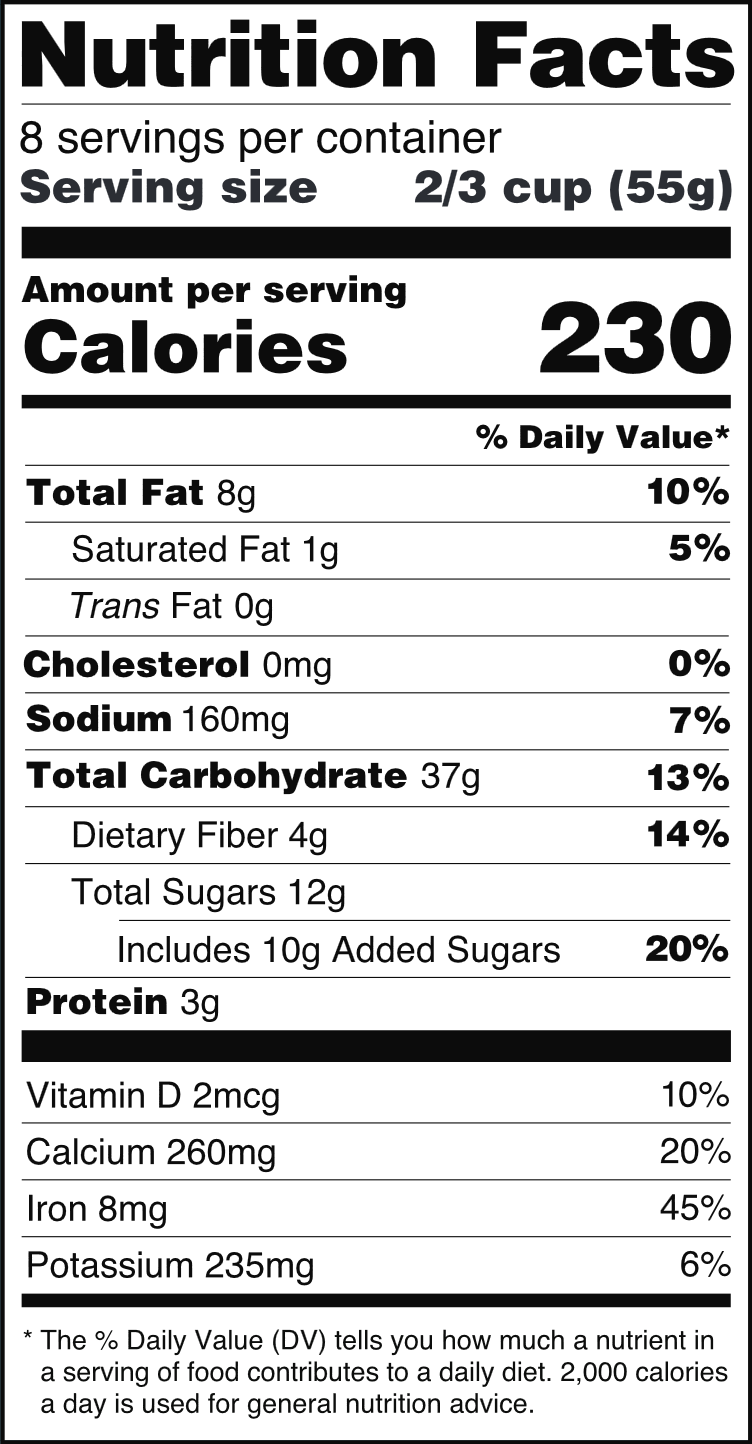
Who regulates food labels
| Agency | Responsibility |
|---|---|
| FDA (Food and Drug Administration, part of the Department of Health and Human Services) | Labels and safety of most packaged foods, including milk, cheese, yogurt, ice cream, seafood and shell eggs; Nutrition Facts; allergen labeling; acidified and low-acid canned foods; food additives |
| USDA (United States Department of Agriculture): FSIS | Meat, poultry and processed egg products (the FDA does not oversee these) |
| USDA: Agricultural Marketing Service | Grading (USDA Grade AA butter, USDA Prime beef), the National Organic Program |
| State agencies, with the FDA | Grade "A" milk under the Pasteurized Milk Ordinance |
Key laws: the Federal Food, Drug, and Cosmetic Act (1938); the Nutrition Labeling and Education Act (NLEA, 1990), which amended it to require Nutrition Facts on most packaged foods (in effect from 1994, including the sodium declaration) and set rules for nutrient content and health claims; FALCPA (2004) for allergens; trans fat labeling from 2006 (first proposed in 1999); and the FASTER Act (2021) for sesame. The current Nutrition Facts design comes from a 2016 FDA rule; manufacturers with $10 million or more in annual food sales had to comply by January 1, 2020, and smaller manufacturers by January 1, 2021.
The package panels
- The principal display panel (PDP) is the part of the label most likely to be seen by a shopper. It must carry the statement of identity (the product's common name, such as "Cheddar Cheese") and the net quantity of contents (in both US and metric units, in the bottom 30% of the panel).
- The information panel is the panel immediately to the right of the PDP as the shopper faces it. It carries the Nutrition Facts, the ingredient list (with allergen information) and the name and place of business of the manufacturer, packer or distributor. These items may also go on the PDP. On a package too small for both, the Nutrition Facts can go on any panel the shopper can see.
So the five mandatory label elements are: statement of identity, net quantity, Nutrition Facts, ingredient list (with allergens), and manufacturer's name and address.
Ingredient lists run in descending order of predominance by weight: the ingredient present in the largest amount comes first, the smallest last. Ingredients appear by their common or usual name (the label says "sugar", not "sucrose"), sub-ingredients go in parentheses, and chemical preservatives must state their function. A substitute that resembles a traditional food but is nutritionally inferior must be labeled "imitation".
The Nutrition Facts panel, line by line
From top to bottom on the current label:
- Servings per container and serving size (serving size in bold, larger type). Serving sizes are not recommendations of how much to eat; they are based on the amounts people customarily eat (the FDA's "reference amounts customarily consumed"), and some were enlarged in 2016 (ice cream went from ½ cup to ⅔ cup). Servings per container may be a decimal (about 3.5) and are not always rounded to a whole number.
- Calories, in large bold type.
- % Daily Value column heading.
- Total Fat (indented: Saturated Fat, Trans Fat), Cholesterol, Sodium, Total Carbohydrate (indented: Dietary Fiber, Total Sugars, and "Includes X g Added Sugars"), Protein.
- Vitamin D, calcium, iron and potassium, with amounts and %DV.
- The footnote: the %DV tells you how much a nutrient in a serving contributes to a daily diet; 2,000 Calories a day is used for general nutrition advice.
The panel's design follows a "limit these, get enough of these" logic. Limit: saturated fat, trans fat, sodium and added sugars (and cholesterol). Get enough: dietary fiber, vitamin D, calcium, iron and potassium on the current label. On the older (1993) label the "get enough" nutrients were dietary fiber, vitamin A, vitamin C, calcium and iron.
Total Sugars includes both naturally occurring sugars (such as lactose in milk) and added sugars; the "Added Sugars" line shows only the sugars and syrups added during processing (plus sugar from concentrated juice beyond what the juice would contain). Lines with no %DV: trans fat and total sugars (no Daily Value exists), and usually protein (a %DV for protein is required only if a protein claim is made or the food is for children under 4).
Rounding rules explain some odd-looking labels: fats under 0.5 g per serving are declared as 0 g (so "0 g trans fat" can mean up to 0.49 g); Calories under 5 are declared as 0; above 5 they are rounded to the nearest 5, and above 50 to the nearest 10.
The label normally appears as a boxed panel set in an easy-to-read type style; FDA's sample label uses Helvetica, but no specific font is required (minimum type sizes are required, for example at least 8-point for most text and larger type for Calories and serving size), the box does not have to be a particular shape on a round package, and small packages may use a tabular or linear (one-line) format instead. Dual-column labels (per serving and per package) are required for certain packages that could be eaten in one or several sittings (those holding two to three times the reference serving), so shoppers can see the total for the whole package. A package holding less than twice the reference amount, such as a 20-oz soda, must be labeled as a single serving.
What changed in 2016
- Calories and serving size are larger and bolder.
- Serving sizes updated to reflect what people actually eat.
- Added Sugars line (in grams and %DV) added.
- Vitamin D and potassium became mandatory (actual amounts and %DV); calcium and iron stayed mandatory.
- Vitamins A and C became optional, because deficiencies of them are now rare in the US.
- "Calories from Fat" was removed, because research shows the type of fat matters more than the amount.
- Daily Values were updated (below), and the footnote was rewritten.
- Dual-column labels for some multi-serving packages.
Daily Values
| Nutrient | Current Daily Value (2016 rule) | Old Daily Value (1993) |
|---|---|---|
| Total fat | 78 g | 65 g |
| Saturated fat | 20 g | 20 g |
| Cholesterol | 300 mg | 300 mg |
| Sodium | 2,300 mg | 2,400 mg |
| Total carbohydrate | 275 g | 300 g |
| Dietary fiber | 28 g | 25 g |
| Added sugars | 50 g | none |
| Protein | 50 g | 50 g |
| Vitamin D | 20 µg (800 IU) | 400 IU |
| Calcium | 1,300 mg | 1,000 mg |
| Iron | 18 mg | 18 mg |
| Potassium | 4,700 mg | 3,500 mg |
Older tests (written before the new label) use the old values, so read the question's context. Daily Values are for adults and children 4 and older on a 2,000-Calorie reference diet, not a 2,500-Calorie one.
Claims on labels
| Claim type | What it says | Rules |
|---|---|---|
| Nutrient content claim | The level of a nutrient: "low fat", "high in calcium", "reduced sodium" | Defined by FDA (table below) |
| Health claim | A link between a food or nutrient and a disease risk: "adequate calcium and vitamin D may reduce the risk of osteoporosis" | Must be authorized by FDA (or a qualified claim with a disclaimer) |
| Structure/function claim | How a nutrient affects normal body structure or function: "calcium builds strong bones" | No FDA pre-approval; must be truthful |
A label that says a product diagnoses, cures, mitigates, treats or prevents a disease is making a drug claim, which can make the product legally a drug.
| Term | Meaning (per serving) |
|---|---|
| Free (fat-free, sugar-free) | Fat under 0.5 g; sugars under 0.5 g; Calories under 5; sodium under 5 mg |
| Low fat | 3 g or less |
| Low sodium / very low sodium | 140 mg or less / 35 mg or less |
| Low cholesterol | 20 mg or less (and low saturated fat) |
| Low Calorie | 40 Calories or less |
| Reduced / less | At least 25% less than the regular product |
| Light (lite) | One-third fewer Calories, or 50% less fat (if half or more of the Calories are from fat), or 50% less sodium |
| High / rich in / excellent source | 20% DV or more |
| Good source / contains | 10–19% DV |
| %DV guide | 5% DV or less is low; 20% DV or more is high (for added sugars too) |
Health benefits of dairy foods
Dairy foods deliver a lot of nutrients per Calorie: high-quality complete protein, calcium and phosphorus for bone, vitamin D (fortified), potassium, riboflavin and B12. Milk drinking during childhood and adolescence, when most bone mass is built, helps reach a higher peak bone mass, which lowers the risk of osteoporosis later. Potassium and calcium in dairy are linked with healthy blood pressure. Fermented dairy foods can supply live cultures, and yogurt is often well tolerated by people with lactose intolerance. Research is mixed on full-fat dairy and heart disease. Earlier US guidelines (through 2020–2025) recommended mostly low-fat and fat-free choices; the 2025–2030 Dietary Guidelines (released January 2026) instead say to include full-fat dairy with no added sugars.
Dairy is not required for health: people who avoid it can get the same nutrients from fortified plant drinks, leafy greens, canned fish with bones and other foods. A balanced answer on a test names both the benefits and the alternatives.
| Benefit | Mechanism |
|---|---|
| Bone health | Calcium, phosphorus, vitamin D (fortified), protein and magnesium build bone; peak bone mass is reached by about age 30 |
| Healthy blood pressure | Potassium, calcium and magnesium; low-fat dairy is part of the DASH eating plan (Dietary Approaches to Stop Hypertension), which also stresses fruits, vegetables and whole grains and limits sodium, and was designed to lower blood pressure |
| Muscle and growth | Complete, high-quality protein; whey is rich in leucine |
| Gut health | Live cultures and probiotics in yogurt and kefir |
| Dental health | Calcium, phosphate and casein help protect enamel; cheese does not feed cavity bacteria the way sugars do |
| Nutrient density | Many nutrients for relatively few Calories, especially in low-fat milk |
The 2020–2025 US dietary guidelines recommended 2 cup-equivalents of dairy a day for ages 2–3, 2½ for ages 4–8, and 3 for ages 9 and older; the 2025–2030 guidelines keep 3 servings a day on a 2,000-Calorie pattern. One cup of milk or yogurt, 1½ oz of natural cheese, or 1 cup of fortified soy milk counts as one cup-equivalent.
Possible downsides to know: whole-milk products and cheese add saturated fat and Calories, many cheeses are high in sodium, flavored milks and yogurts can contain a lot of added sugar, and lactose intolerance and milk allergy limit what some people can eat. Too much salt (sodium) in the diet raises blood pressure and the risk of heart disease and stroke.
Strategy
- Split the written test by topic. One partner takes chemistry (carbohydrates, lipids and esterification, proteins, cooking changes, emulsions, freezing point depression). The other takes nutrition and regulation (vitamins and RDAs, allergies and intolerance, milk types, labeling, pasteurization, probiotics, health benefits). Swap at the end to check each other.
- Plan the lab in advance. Decide who measures, who mixes and who shakes for each task. Ice cream and butter both need hard, continuous shaking; trade off every minute so the shaking does not slow down.
- Do the lab first if you can. Time on lab tasks is fixed by the procedure (draining takes 15 minutes, ice cream 5–10). Start the curd draining, then work on the test while it drains.
- Use both note sheets well. One sheet can hold the lab data from your notebook (best salt amount, acid drops for each milk, cream temperature), the scoring formulas and the freezing point depression equation. The other can hold the RDA table, the casein/whey table, milk standards and the allergy versus intolerance comparison.
- Pack a checklist. Goggles, lab coat or apron, the two bags, the lidded container, cheesecloth, whatever you want to use from the Chemistry Events Lab Equipment List, a thermometer if you prefer your own, and two calculators.
- Clean up completely. The cleanup penalty can be up to 10% of the total possible score, which is close to the full value of a curd or butter task.
Common pitfalls
Changing two variables in one notebook experiment
Each experiment may change only one independent variable. If you switch both the milk type and the acid amount, the entry is flawed and loses points.
Only three experiments total
The rules ask for three or more experiments for each of the three lab tasks, so nine at minimum. A regional team that only prepares the one lab it expects still needs all nine.
Confusing lactose intolerance with milk allergy
Lactose intolerance is a missing enzyme and causes digestive discomfort; milk allergy is an immune reaction to protein and can be life-threatening. Lactose-free milk helps the first and not the second.
Saying whey proteins curdle with acid
Acid at pH 4.6 precipitates casein. Whey proteins stay dissolved and drain away with the liquid unless the mixture is also heated.
Mixing up which fats are solid
Saturated fatty acids have only single bonds and straight chains that pack tightly, so they are solid at room temperature. Double bonds (unsaturated) put kinks in chains and make fats liquid.
Calling esterification a hydrolysis
Esterification joins an acid and an alcohol and releases water (condensation). Hydrolysis adds water to split the ester. Lipase in milk does hydrolysis.
Forgetting the van 't Hoff factor
NaCl splits into two ions, so it lowers the freezing point about twice as much per mole as sugar does. Use i = 2 for NaCl and i = 1 for sucrose or lactose.
Expecting more than 10 points from a mass task
The curd and butter scores are capped at 10 even if your mass beats the supervisor's. Only the ice cream score keeps rising with height.
Treating water activity as water content
Water activity is the ratio of vapor pressures (free, available water, 0 to 1.0); moisture content is the total amount of water. Pure water has a_w = 1.00, not 0.
Calling sucrose a reducing sugar
Sucrose gives a negative (blue) Benedict's test; glucose, fructose, galactose, lactose and maltose are positive. And a Biuret test on a single amino acid is negative: it needs peptide bonds.
"Acid food" and "acidified food" are not the same
An acid food is naturally at pH 4.6 or below; an acidified food is a low-acid food brought to pH 4.6 or below by adding acid, with a_w above 0.85.
Mixing up Calorie and calorie
A food Calorie (Cal) is a kilocalorie, 1,000 small calories. "Cal" with a capital C is the correct abbreviation for the kilocalorie on a label.
Big 8 or Big 9?
FALCPA (2004) listed eight major allergens; sesame became the ninth on January 1, 2023. A question about the "Big 8" wants the original eight, without sesame.
Pasteurization does not kill spores
C. botulinum spores survive pasteurization (and boiling); only pressure canning or UHT-level heat destroys them.
How tournaments test this
Tests written to the 2027 dairy rules are not yet public, so the best guide to what will be asked is the archive of earlier Food Science tests, which mixed dairy topics with general food chemistry, nutrition and food safety. Our question bank holds about 6,000 Food Science questions. About 1,000 of them are AI-written dairy practice questions (labeled "Scio.ly Original"), not tournament questions. The other 5,000 or so come from real tournament tests: about 1,400 are exported from or match the 1,667 questions in our public test archive, and most of the rest come from older invitational tests the archive does not have. About 2,900 of the tournament questions fall within the 2027 dairy topics and the food chemistry and safety background they rest on. The rest are about yeast and alcoholic fermentation, cellular respiration (glycolysis, the Krebs cycle), bread, pickles, kimchi, kombucha, candy stages and older density lab tasks, which are outside the 2027 rules.
- Format. Of the in-scope questions, about 43% are free response, 41% multiple choice, 9% true/false and 7% select-all. Free-response "explain why" items are where most points are lost.
- What gets asked most. By share of in-scope questions: carbohydrates (sugar classes, lactose, starch versus cellulose, reducing sugars, sweeteners) about 22%; food preservation, water activity and food safety about 17%; cultured dairy, lactic acid bacteria and probiotics about 9%; lipids and fats about 8%; vitamins and minerals about 8%; chemistry basics, pH and enzymes about 7%; proteins and casein about 5%; Calories and nutrition math about 4%; cheese and curds about 4%; labeling, allergens and food tests about 3% each; then cooking reactions, pasteurization, butter, emulsions and ice cream.
- Favorite question types. Classify a sugar (mono-, di-, oligo- or polysaccharide); name the units of lactose and sucrose; predict Benedict's, Biuret and iodine results; define water activity and give microbe a_w limits; define acid and acidified foods (pH 4.6, a_w 0.85); name the yogurt bacteria; list the major allergens and the 2016 label changes; match vitamins to deficiency diseases; distinguish saturated, unsaturated and trans fats; explain hydrogenation; contrast Maillard browning and caramelization.
- Calculations. Calories from grams of macronutrients (and grams from Calories), %DV, label serving arithmetic, pH from [H⁺], freezing point depression, water activity from vapor pressures, moisture content, bacterial doubling, overrun, percent curd and the lab scores. Every one has a worked example in this guide.
- Lab-linked questions. Expect questions that tie to the lab tasks: why salt is added to ice, why acid makes curds, why cream turns into butter, and how to design a controlled experiment.
Test yourself
These questions come from public tournament tests in our archive and were chosen because they fall inside the 2027 dairy topics. Click an answer to check it; each links to its full test. The explanations are ours.
- 1
Fructose is an example of aldose sugar.
Practice more Food Science questions →
- 1
What is the main purpose of adding polysaccharides when making ice cream?
Practice more Food Science questions →
- 1
Which of the following is NOT a monosaccharide?
From: South Forsyth Science Olympiad Invitational 2020, Division B
Practice more Food Science questions →
- 1
What process is used to decrease the size of the fat globules in milk so that there is no separation of the fat from the milk serum?
From: Holt Invitational 2015-16, Division B
Practice more Food Science questions →
Breadth reference
Tests in this event reward wide, shallow recall: a term, a name, a date, a single number. These filterable tables collect the one-line facts that the chapters above use or mention, so you can look one up fast during study. Type in a table's filter box to find a term. Each row is one fact; follow the chapter for the explanation.
ReferenceGlossary of food science terms· 113 rows
No rows match.
| Term | Meaning |
|---|---|
| Acid food | Food with a natural pH of 4.6 or below |
| Acidified food | Low-acid food made pH ≤ 4.6 by adding acid, with a_w > 0.85 (21 CFR 114) |
| Activation energy | Energy barrier a reaction must cross; enzymes and catalysts lower it |
| Additive | Substance added to food for a technical effect (preservation, color, texture, flavor, nutrition) |
| Aerobe | Organism that uses oxygen |
| Aldose / ketose | Sugar with an aldehyde (−CHO) group / with a ketone (C=O) group |
| Amorphous | Solid without an ordered crystal structure (hard candy glass, spray-dried lactose) |
| Amphipathic | Having a water-loving and a fat-loving part (phospholipids, soaps, emulsifiers) |
| Anabolic / catabolic | Building larger molecules (uses energy) / breaking them down (releases energy); together, metabolism |
| Anaerobe | Organism that grows without oxygen |
| Anaphylaxis | Severe, rapid, whole-body allergic reaction; airway swelling and blood-pressure drop; treat with epinephrine |
| Anomers | The α and β ring forms of a sugar, differing at carbon 1 |
| Antioxidant | Compound that slows oxidation (vitamin E, vitamin C, BHA, BHT) |
| Aseptic processing | Sterilizing product and package separately and filling in a sterile environment (UHT milk cartons) |
| Bacteriocin | Antimicrobial peptide made by bacteria (nisin from Lactococcus lactis) |
| Binary fission | Bacterial reproduction by splitting in two |
| Bioavailability | Share of a nutrient the body can absorb and use |
| Blanching | Brief scalding in boiling water or steam to inactivate enzymes before freezing or drying |
| Bound water | Water held by solutes and food molecules, unavailable to microbes |
| Brine | Salt solution (for ice cream freezing, cheese salting, pickling) |
| Buttermilk | Liquid left after churning butter; or cultured low-fat milk |
| Casein | About 80% of milk protein; forms micelles; precipitates at pH 4.6 |
| Catalyst | Substance that speeds a reaction without being consumed |
| Chelator (sequestrant) | Compound that binds metal ions (EDTA, citric acid) |
| Coagulation | Clumping of denatured or destabilized proteins into a solid network |
| Coalescence | Droplets or fat globules merging into larger ones |
| Colligative property | Property depending only on the number of dissolved particles (freezing point depression, boiling point elevation, osmotic pressure) |
| Colloid | Particles about 1 nm–1 µm dispersed without settling (sol, gel, emulsion, foam) |
| Commercial sterility | No microbes able to grow in the food under normal non-refrigerated storage, and no viable pathogens |
| Complete protein | Supplies all nine essential amino acids |
| Condensation (dehydration synthesis) | Joining two molecules with loss of water |
| Cross-contact | Transfer of an allergen from one food to another |
| Cross-contamination | Transfer of microbes from one food or surface to another |
| Curd | Coagulated casein (and trapped fat) separated from whey |
| Curing | Preserving with salt (often nitrite) and drying; also adds flavor, firm texture and, with nitrite, a pink color |
| D-value | Minutes at a given temperature to kill 90% of a microbial population |
| Danger zone | 40–140 °F (4–60 °C), where bacteria multiply fastest |
| Denaturation | Unfolding of a protein's 3D shape without breaking peptide bonds |
| Dextrose | Another name for glucose |
| Diacetyl | Buttery-flavored compound made by some lactic acid bacteria |
| Emulsifier | Molecule with polar and nonpolar parts that stabilizes droplets of one liquid in another |
| Emulsion | Dispersion of droplets of one liquid in another it does not mix with |
| Endospore | Heat-resistant dormant form of Clostridium and Bacillus |
| Enrichment | Restoring nutrients lost in processing (thiamin, riboflavin, niacin, iron and added folic acid in white flour) |
| Enzyme | Biological catalyst, usually a protein |
| Essential nutrient | One the body cannot make in sufficient amounts |
| Eutectic point | Lowest freezing temperature of a salt–water mixture (about −21 °C for NaCl) |
| F-value | Process lethality, in minutes at 121.1 °C (250 °F) |
| Facultative anaerobe | Grows with or without oxygen |
| Fat destabilization | Partial coalescence of fat globules into a network (ice cream, whipped cream) |
| Fermentation | Anaerobic breakdown of sugars by microbes into acids, gases or alcohol |
| Foam | Gas bubbles dispersed in a liquid or solid |
| Fortification | Adding nutrients not originally present or in larger amounts (vitamin D in milk) |
| Free water | Water available to microbes and reactions; measured by water activity |
| Functional food | Food with a health benefit beyond basic nutrition (probiotic yogurt) |
| Gel | Liquid held in a solid network (yogurt, cheese curd) |
| Gelatinization | Starch granules swelling with water when heated, thickening a liquid |
| Generation time | Time for a bacterial population to double |
| GRAS | "Generally recognized as safe", an FDA status for food substances |
| HACCP | Hazard Analysis and Critical Control Points, a preventive food-safety system |
| Halophile | Salt-loving microbe |
| Homogenization | Forcing milk through a small gap under pressure to shrink fat globules so cream does not rise |
| Hydrogenation | Adding hydrogen to C=C double bonds (metal catalyst) |
| Hydrolysis | Splitting a bond by adding water |
| Hygroscopic | Readily absorbs moisture from air (fructose, honey, milk powder) |
| Immiscible | Liquids that do not mix (oil and water) |
| Inoculation | Adding a starter culture or microbe to a food or medium |
| Interfering agent | Ingredient that blocks sugar crystallization (corn syrup, fat, acid) |
| Invert sugar | Equal mix of glucose and fructose from hydrolyzed sucrose |
| Isoelectric point | pH at which a protein has no net charge and is least soluble (casein about 4.6) |
| Isomers | Same molecular formula, different structure |
| Lactase persistence | Keeping lactase activity into adulthood |
| Low-acid food | pH > 4.6 and a_w > 0.85 (21 CFR 113) |
| Lyophilization | Freeze-drying: freezing, then removing ice by sublimation under vacuum |
| Macronutrient / micronutrient | Needed in grams (carbohydrate, protein, fat, water) / in milligrams or micrograms (vitamins, minerals) |
| Mesophile | Microbe growing best at moderate temperatures (about 20–45 °C) |
| Micelle (casein) | Spherical cluster of casein molecules held by calcium phosphate, coated with κ-casein |
| Moisture content | Total water in a food, as a percentage of mass |
| Mordant | Fixing agent in staining (iodine in the Gram stain) |
| Nucleation | Formation of the first stable crystal seed |
| Nutrient density | Nutrients per Calorie |
| Organoleptic | Sensed by the senses: flavor, aroma, texture, color |
| Osmophile | Sugar-tolerant microbe (osmophilic yeasts) |
| Osmosis | Water movement across a semipermeable membrane toward higher solute concentration |
| Overrun | Percentage increase in volume of ice cream from whipped-in air |
| Pasteurization | Mild heat treatment that kills pathogens but not all microbes or spores |
| Pathogen | Disease-causing microorganism |
| Peptide bond | Amide bond linking amino acids |
| pH | −log[H⁺]; 7 neutral, below 7 acidic |
| Phase inversion | An emulsion switching type (cream O/W → butter W/O) |
| Prebiotic | Nondigestible substance that feeds beneficial gut microbes |
| Probiotic | Live microorganisms that give a health benefit in adequate amounts |
| Protease | Enzyme that breaks down proteins |
| Psychrotroph | Microbe that grows at refrigerator temperatures (Listeria, Pseudomonas) |
| Rancidity | Off-flavors from fat hydrolysis or oxidation |
| Reducing sugar | Sugar with a free aldehyde or ketone group; Benedict's positive |
| Rennet | Enzyme preparation (chymosin) that coagulates milk for cheese |
| Retrogradation | Starch molecules reassociating as a gel cools or ages (staling, weeping) |
| Saponification | Hydrolysis of fat with a strong base, giving soap and glycerol |
| Starter culture | Known microorganisms added to start a fermentation |
| Sterilization | Destroying all microorganisms, including spores |
| Supercooling | Liquid cooled below its freezing point without freezing |
| Supersaturated | Holding more dissolved solute than normally possible at that temperature |
| Syneresis | Liquid weeping out of a gel (whey on yogurt, water from a starch gel) |
| TCS food | Time/temperature control for safety food (formerly potentially hazardous food) |
| Thermophile | Heat-loving microbe (about 45–70 °C or more) |
| UHT | Ultra-high-temperature processing (about 135–150 °C for seconds) |
| Water activity (a_w) | Vapor pressure of water in a food ÷ that of pure water |
| Whey | Liquid left after curd forms; carries whey proteins, lactose, minerals |
| Xerophile | Microbe tolerating dry conditions (xerophilic molds) |
| z-value | Temperature rise that cuts the D-value tenfold |
| Zwitterion | Molecule with both a positive and a negative charge (amino acids in water) |
| Zymology | The study of fermentation |
ReferenceNamed microorganisms in food· 25 rows
No rows match.
| Organism | Type | Role |
|---|---|---|
| Streptococcus thermophilus | Thermophilic LAB, coccus | Yogurt, mozzarella, Swiss cheese starter |
| Lactobacillus delbrueckii subsp. bulgaricus | Thermophilic LAB, rod | Yogurt (acetaldehyde flavor) |
| Lactococcus lactis (formerly Streptococcus lactis) | Mesophilic LAB, coccus | Cheddar, cultured buttermilk, sour cream; makes nisin |
| Lactobacillus acidophilus | LAB, rod | Probiotic; acidophilus milk |
| Lacticaseibacillus rhamnosus GG | LAB | Probiotic |
| Lactobacillus helveticus | Thermophilic LAB | Swiss and Italian cheeses |
| Leuconostoc species | Heterofermentative LAB | Diacetyl aroma in buttermilk; kefir |
| Bifidobacterium species | Gram-positive gut bacteria | Probiotics; favored by milk oligosaccharides in infants |
| Propionibacterium freudenreichii | Propionic acid bacterium | Swiss cheese eyes and flavor; makes vitamin B12 |
| Penicillium roqueforti | Mold | Blue cheeses (Roquefort, Gorgonzola, Stilton) |
| Penicillium camemberti | Mold | Brie, Camembert rinds |
| Brevibacterium linens | Bacterium | Smear-ripened cheeses (Limburger) |
| Kefir grains | Bacteria + yeasts in kefiran | Kefir |
| Saccharomyces cerevisiae | Yeast | Bread and beer (alcoholic fermentation) |
| Saccharomyces boulardii | Yeast | Probiotic |
| Acetobacter | Gram-negative acetic acid bacterium | Vinegar (oxidizes ethanol to acetic acid) |
| Pseudomonas | Gram-negative psychrotroph | Spoilage of refrigerated milk |
| Listeria monocytogenes | Gram-positive psychrotroph pathogen | Soft cheese, deli meat, raw milk |
| Clostridium botulinum | Gram-positive spore-forming anaerobe | Botulism; canned low-acid foods |
| Staphylococcus aureus | Gram-positive coccus | Heat-stable toxin; handled foods |
| Salmonella | Gram-negative rod | Poultry, eggs, raw milk |
| E. coli O157:H7 | Gram-negative rod | Beef, raw milk, produce; kidney damage |
| Campylobacter jejuni | Gram-negative microaerophile | Raw milk, poultry |
| Bacillus cereus | Gram-positive spore-former | Cooked rice |
| Norovirus | Virus | Most foodborne illness; food handlers |
ReferenceNamed compounds and ingredients· 32 rows
No rows match.
| Compound | What it is | Where it matters |
|---|---|---|
| Lactic acid (C₃H₆O₃) | Product of lactic acid bacteria | Sours yogurt, cheese, buttermilk; lowers pH |
| Acetic acid (CH₃COOH) | Acid of vinegar (about 4–8%) | Acid curdling in the lab; pickling |
| Citric acid | Acid of lemon juice; chelator | Curdling; prevents oxidation |
| Propionic acid | Three-carbon fatty acid | Swiss cheese flavor; mold inhibitor (calcium propionate) |
| Butyric acid | Four-carbon fatty acid | Characteristic of milk fat; rancid-butter smell |
| Acetaldehyde | Flavor compound | Main yogurt flavor |
| Diacetyl | Flavor compound | Buttery aroma of cultured butter and buttermilk |
| Lactose (C₁₂H₂₂O₁₁) | Galactose + glucose | Milk sugar |
| Galacto-oligosaccharides | Short galactose chains (usually ending in glucose), made from lactose | Prebiotic |
| Lecithin | Phospholipid | Emulsifier in egg yolk and soy |
| Mono- and diglycerides | Partial glycerides | Emulsifiers in ice cream |
| Carrageenan, alginate, agar | Seaweed polysaccharides | Stabilizers and thickeners in dairy desserts |
| Guar gum, locust bean gum, xanthan gum | Plant and microbial polysaccharides | Stabilizers |
| Gum arabic | Acacia tree gum | Emulsifier and stabilizer |
| Annatto | Seed extract of Bixa orellana | Orange color of cheddar |
| Sodium caseinate | Milk protein salt | "Non-dairy" creamers; must be declared as milk |
| Sodium citrate, sodium phosphates | Emulsifying salts | Processed cheese |
| Calcium chloride | Salt | Added to pasteurized milk to firm rennet curd; i ≈ 3 for freezing point depression |
| Chymosin | Protease | Rennet |
| β-lactoglobulin, α-lactalbumin | Whey proteins | Denature on heating; milk allergens |
| Potassium sorbate | Preservative | Mold and yeast inhibitor on cheese |
| Sodium benzoate | Preservative | Acidic foods |
| Nisin | Bacteriocin | Processed cheese |
| BHA, BHT, TBHQ | Synthetic antioxidants | Prevent rancidity |
| Tocopherols | Vitamin E | Natural antioxidants in oils |
| Ascorbic acid | Vitamin C | Antioxidant; stops browning; prevents color and flavor loss |
| Sodium bicarbonate | Baking soda | Base; a hidden sodium source |
| Monosodium glutamate (MSG) | Sodium salt of glutamic acid | Umami flavor enhancer; GRAS |
| Acrylamide | Maillard by-product | Fried starchy foods; probable carcinogen |
| Melanoidins | Brown Maillard polymers | Browned foods |
| Copper(I) oxide (Cu₂O) | Red precipitate | Positive Benedict's test |
| Copper(II) sulfate | Blue reagent | Benedict's, Fehling's and Biuret tests |
ReferencePeople and dates· 21 rows
No rows match.
| Person or event | Year | Contribution |
|---|---|---|
| Antonie van Leeuwenhoek | 1670s | First to observe bacteria with a microscope |
| Nicolas Appert | about 1809 | Invented canning (heat-sealed glass jars) |
| Anselme Payen and Jean-François Persoz | 1833 | Isolated diastase (amylase), the first enzyme |
| Louis Pasteur | 1857–1860s | Showed fermentation is done by living microbes (lactic fermentation of milk); developed pasteurization (1864, patented 1865) |
| John Landis Mason | 1858 | Patented the screw-top home-canning jar |
| Wilhelm Kühne | 1877 | Coined the word "enzyme" |
| Hans Christian Gram | 1884 | Gram stain |
| Eduard Buchner | 1897 (Nobel 1907) | Cell-free fermentation by yeast extract, proving enzymes do it |
| Louis-Camille Maillard | 1912 | Described the Maillard reaction |
| Clarence Birdseye | 1920s | Quick (flash) freezing |
| Otto Wüst | 1930 | French patent for preserving food by irradiation (earliest US/UK patents on irradiating food: 1905) |
| Arthur Harden and Hans von Euler-Chelpin | Nobel 1929 | Sugar fermentation and its enzymes |
| Federal Food, Drug, and Cosmetic Act | 1938 | Basic US food law |
| HACCP | 1960s | Developed for NASA space food |
| Nutrition Labeling and Education Act | 1990 (labels 1994) | Mandatory Nutrition Facts |
| FALCPA | 2004 (effective 2006) | Eight major allergens labeled |
| Trans fat labeling | 2006 | Required on Nutrition Facts |
| Food Safety Modernization Act | 2011 | Preventive controls for food facilities |
| Nutrition Facts redesign | 2016 (compliance 2020–2021) | Added sugars, vitamin D, potassium |
| Partially hydrogenated oils removed | 2018 | No longer GRAS |
| FASTER Act | 2021 (effective 2023) | Sesame becomes the ninth major allergen |
ReferenceConstants and key numbers· 17 rows
No rows match.
| Quantity | Value |
|---|---|
| K_f of water | 1.86 °C·kg/mol |
| K_b of water | 0.512 °C·kg/mol |
| Heat of fusion of ice | 334 J/g |
| Specific heat of water | 4.18 J/g·°C (1 cal/g·°C) |
| 1 food Calorie | 1 kcal = 4.184 kJ |
| Molar mass: glucose / sucrose and lactose / NaCl | 180.16 / 342.30 / 58.44 g/mol |
| NaCl eutectic | about −21 °C at about 23% salt |
| Milk density / freezing point / pH | 1.03 g/mL / −0.53 °C / 6.6–6.7 |
| Casein isoelectric point | pH 4.6 |
| Botulism pH limit | pH 4.6 |
| Lowest a_w for any microbial growth | about 0.60 |
| Danger zone | 40–140 °F (4–60 °C) |
| HTST pasteurization | 72 °C (161 °F), 15 s |
| Canning low-acid foods | 121 °C (250 °F) under pressure |
| Atwater factors | 4 / 4 / 9 / 7 kcal/g (carbohydrate / protein / fat / alcohol) |
| Protein RDA (adults) | 0.8 g/kg body weight |
| Calcium RDA ages 9–18 | 1,300 mg |
ReferenceProtein in common foods· 14 rows
Approximate grams of protein per typical serving (USDA FoodData Central values, rounded).
No rows match.
| Food | Serving | Protein |
|---|---|---|
| Chicken breast, cooked | 3 oz (85 g) | about 26 g |
| Beef, cooked | 3 oz | about 22–25 g |
| Fish (salmon), cooked | 3 oz | about 19–22 g |
| Greek yogurt, plain | 1 cup | about 20–23 g |
| Cottage cheese | ½ cup | about 12–14 g |
| Lentils, cooked | ½ cup | about 9 g |
| Milk (any fat level) | 1 cup | about 8 g |
| Soy milk | 1 cup | about 7–8 g |
| Cheddar cheese | 1 oz | about 7 g |
| Peanut butter | 2 tbsp | about 7 g |
| Egg | 1 large | about 6 g |
| Whole-wheat bread | 1 slice | about 3–4 g |
| Rice, cooked | ½ cup | about 2 g |
| Apple | 1 medium | under 1 g |
Animal foods, dairy and legumes are the richest protein sources per serving; fruits and most vegetables supply very little. Per 100 g, cooked chicken (about 30 g) and hard cheeses (about 25 g) beat milk (about 3.3 g), because milk is mostly water.
Condensed facts
| Milk fact | Value |
|---|---|
| Composition (cow) | 87–88% water, 3.25%+ fat, 4.8% lactose, 3.3% protein (80% casein, 20% whey), 0.7% minerals |
| pH; freezing point | 6.6–6.7; −0.53 °C |
| Casein isoelectric point | pH 4.6 |
| Pasteurization | 63 °C/30 min; 72 °C/15 s (HTST); UP ≥ 138 °C/2 s; UHT + aseptic = shelf-stable |
| Yogurt cultures | S. thermophilus + L. delbrueckii subsp. bulgaricus; ~43 °C; pH ≤ 4.6 |
| Swiss cheese eyes | Propionibacterium freudenreichii → propionic acid + CO₂ |
| Blue / white mold | P. roqueforti / P. camemberti |
| Sugar | Units | Reducing? |
|---|---|---|
| Lactose | Galactose + glucose β(1→4) | Yes |
| Sucrose | Glucose + fructose | No |
| Maltose | Glucose + glucose α(1→4) | Yes |
| Starch / glycogen / cellulose | α-glucose / α-glucose (branched) / β-glucose | — |
| Test | Positive |
|---|---|
| Benedict's (heat) | Blue → green → yellow → orange → brick red (Cu₂O) for reducing sugar |
| Biuret | Blue → violet: peptide bonds (protein) |
| Iodine | Yellow-brown → blue-black: starch (amylose helix) |
| Sudan / brown paper / ethanol | Red layer / translucent spot / cloudy white: lipid |
| Vitamin | Deficiency |
|---|---|
| A (F) | Night blindness |
| D (F) | Rickets, osteomalacia |
| E (F) | Nerve damage (rare) |
| K (F) | Bleeding, bruising |
| B1 thiamin | Beriberi |
| B2 riboflavin | Cheilosis |
| B3 niacin | Pellagra |
| B9 folate | Neural tube defects |
| B12 cobalamin | Pernicious anemia |
| C ascorbic acid | Scurvy |
| Mineral | Deficiency (or excess) |
|---|---|
| Calcium | Osteoporosis |
| Iron | Anemia |
| Iodine | Goiter |
| Sodium | Excess: hypertension |
| Potassium | Weakness, arrhythmia |
| Zinc | Poor growth, slow healing |
References and further reading
- Goff, H. D., and Hartel, R. W., Ice Cream (7th ed., Springer, 2013): ice cream structure, partial coalescence, freezing point depression.
- University of Guelph, Dairy Science and Technology Education (H. D. Goff): milk composition, casein micelles, pasteurization, butter and ice cream: https://www.uoguelph.ca/foodscience/book-page/dairy-science-and-technology-ebook
- US FDA, Grade "A" Pasteurized Milk Ordinance (pasteurization times and temperatures): https://www.fda.gov/food/milk-guidance-documents-regulatory-information/national-conference-interstate-milk-shipments-ncims-model-documents
- Electronic Code of Federal Regulations, 21 CFR Part 131 (milk and cream standards) and Part 135 (frozen desserts): https://www.ecfr.gov/current/title-21/chapter-I/subchapter-B/part-131
- US FDA, Food Allergies (the nine major allergens and labeling): https://www.fda.gov/food/food-labeling-nutrition/food-allergies
- US FDA, The Nutrition Facts Label and Daily Values: https://www.fda.gov/food/nutrition-facts-label/daily-value-nutrition-facts-and-supplement-facts-labels
- NIH Office of Dietary Supplements, fact sheets for calcium, vitamin D, riboflavin, vitamin B12 and potassium (RDAs and deficiency): https://ods.od.nih.gov/factsheets/list-all/
- NIH MedlinePlus Genetics, Lactose intolerance: https://medlineplus.gov/genetics/condition/lactose-intolerance/
- USDA Agricultural Marketing Service, National Organic Program (pasture rule): https://www.ams.usda.gov/about-ams/programs-offices/national-organic-program
- OpenStax, Chemistry 2e, section 11.4 (colligative properties, freezing point depression): https://openstax.org/books/chemistry-2e/pages/11-4-colligative-properties
- SciOly Wiki, Food Science (another summary of the event): https://scioly.org/wiki/index.php/Food_Science
- Practice more: the Scio.ly test archive has public Food Science tests you can filter by subtopic.