Crime Busters
2027 season
On this page(16 sections)
Crime Busters is a forensic chemistry event. A team of up to two students receives a scenario, a set of evidence and a list of suspects. The evidence is a collection of unknown solids, metals and liquids, fibers, plastics, hair, paper chromatograms and crime-scene material. You run tests on it, then write an analysis that links the evidence to a suspect and explains why the other suspects are not the culprit. Half of the points come from identifying the unknowns in the lab. A quarter comes from the written analysis. It rewards careful observation, correct chemistry and a conclusion you can defend with two or more tests that agree.
This guide follows the Division B Crime Busters rules in the 2027 rules manual (printed pages B16 and B17). Crime Busters is a Division B event, so practice questions tagged Division C in the Scio.ly question bank (a large practice pool that also draws on the Division C Forensics event; the testing section describes it and the public-test archive) are background practice only. The 2027 rules keep the same five-part structure, unknown lists, evidence topics and score weights as last season. The main change is the iodine reagent the supervisor supplies, which may now be either iodine dissolved in potassium iodide solution or a 2% tincture of iodine. The 2027 rules also state outright that each participant may bring writing utensils. Always check soinc.org for clarifications posted during the season.
Event format
| Rule | Detail |
|---|---|
| Team | Up to 2 students |
| Time | About 50 minutes |
| Eye protection | Category C (indirect-vent chemical splash goggles marked Z87) |
| Allowed (personal) | Writing utensils; one letter-size sheet of notes, both sides, from any source, in a sheet protector sealed with tape or laminated; one Class II calculator per participant |
| Allowed (team) | Equipment from the lab list that Science Olympiad publishes for Division B chemistry events; anything off that list is banned |
| Supervisor provides | Iodine reagent (iodine dissolved in potassium iodide solution, or 2% tincture of iodine), 1 M HCl, chromatography materials and containers, waste containers, a wash bottle of distilled water (250 mL or less) |
| Supervisor may provide | Other equipment (such as a microscope, probes or a calculator), a candle and matches when fibers are given, differential density solutions or another way to find density when plastics are given, extra reagents for additional tests |
| Safety dress | Goggles, an apron or lab coat, skin covered from the neck to the wrists and toes; loose pants; shoulder-length or longer hair tied back; gloves optional unless the host requires them. Removing safety gear or handling materials unsafely can be penalized, up to disqualification |
| Scoring | Highest score wins. Time is not scored. Tiebreakers are the scores on 3.g, then 3.c, then 3.d (see the scoring section) |
What to pack. Bring only items that appear on the current Division B chemistry lab equipment list, and check each one against it before the tournament. Teams typically want spot (well) plates and small test tubes with a rack, plastic droppers, stirring rods or toothpicks, small scoops, pH paper with its color chart, a hand lens, a magnet, a millimeter ruler, a small graduated cylinder, labeled cups, paper towels, a pencil and a marker. Practice with exactly the kit you will bring, so your reference results match what you will see at the event.
Teams that skip the listed equipment may be at a disadvantage, and supervisors can penalize up to 10% for prohibited equipment. A penalty of up to 10% also applies if the bench and waste are not handled as the supervisor directs.
What the rules cover
The competition has five parts, each covered in its own section below. Part 3.c is qualitative analysis of unknown solids, metals and liquids; 3.d is hair, fibers and plastics; 3.e is paper chromatography; 3.f is crime-scene physical evidence; 3.g is the written analysis. The topics stay the same at every level. What grows from Regional to National is the number of items in each part, the number and size of the mixtures, the number of chromatography types and the number of physical-evidence topics in play. Questions may only cover the evidence topics that actually appear in that competition.
| Level | 3.c unknowns (i–iii) | 3.c mixtures (solids only) | 3.d items | 3.e chromatography | 3.f physical evidence | 3.g analysis |
|---|---|---|---|---|---|---|
| Regional | 6–15 | Up to 2, each made of 2 solids | 5–7 | 1 type | 1–2 topics | Required |
| State | 10–18 | 2–4, each made of 2–3 solids | 7–10 | 1–2 types | 2–3 topics | Required |
| National | 14–20 | 2–6, each made of 2–3 solids | 10–15 | 1–3 types | 2–4 topics | Required |
Mixtures are built only from the starred solids in the 2027 rules (everything on the solids list except anhydrous sodium acetate, yeast and vitamin C). Metals and liquids are never mixtures. A "chromatography type" means a kind of sample, such as pen ink, a juice or a drink mix. A "physical-evidence topic" is one of the five areas in 3.f: fingerprints, DNA, shoeprints and tire treads, soil, and spatters. At a Regional you may see only one or two of those five, so prepare all five but expect a subset. The written analysis is required at every level.
3.c: unknown solids, metals and liquids
Every team gets the same unknowns. The scenario says which containers hold mixtures and whether a mixture has two or three materials. The solids come from a fixed list (anhydrous sodium acetate, yeast, vitamin C, calcium carbonate, table salt, sugar, flour, gypsum, cornstarch, baking soda, powdered gelatin, powdered Alka-Seltzer, and white sand). The metals are non-powdered pieces of aluminum, iron, zinc, magnesium, copper and tin. The liquids are lemon juice, isopropyl rubbing alcohol, 3% household ammonia, water, vinegar and 3% hydrogen peroxide. You identify them by solubility, acidity, magnetism, color, density and odor.
Part 3.c is half of the score, so it deserves most of your practice time. Its tests are simple; the skill is running them in a clean sequence and recording every observation.
Scoring and what it means for strategy
The manual gives approximate weights for each part. Your team's score is roughly a weighted sum of the fraction of points you earn in each part.
| Part | Approximate weight | What it rewards |
|---|---|---|
| 3.c unknown solids, metals and liquids | 50% | Correct identifications and the test results behind them |
| 3.d polymers and natural materials | 10% | Hair, fiber and plastic identifications |
| 3.e paper chromatography | 5% | Correct Rf values and matches |
| 3.f physical evidence | 10% | Prints, DNA, footwear, soil and spatter answers |
| 3.g crime-scene analysis | 25% | Reasoning that links evidence to a suspect |
Three strategy points follow from the weights. First, do not sink the whole hour into one unknown; the points are spread across many items. Second, ties are broken by the 3.g score first, then 3.c, then 3.d, so reasoning quality decides close results. Third, the analysis depends on the earlier lab results, so the lab must be organized enough that you can cite each observation in your write-up.
Foundations: thinking like a forensic chemist
The method is simple to state and harder to execute: observe before you react, test in an order that does not destroy evidence, record each result as you get it, and draw the smallest conclusion the data support.
Observation comes first. Color, texture, luster, magnetism and density are free: they consume no sample. Solubility and pH come next, because they need only water and indicator paper. Reagents such as 1 M HCl or iodine solution come after that, because they change the sample. Heating is last, because it can destroy the evidence. This order is a sensible default, not a rule in the manual.
Every test should discriminate. A test that gives the same answer for most candidates tells you little. The best tests split the list quickly: an acid test sorts carbonates from non-carbonates, an iodine test sorts starch from sugars and salts, and a magnet sorts iron from the other metals. Write the narrowed list down after each test.
Treat a single result as a lead, not an identity. Several white solids fizz, several dissolve, and several contain starch. A conclusion gets stronger when two or three independent observations point the same way, and the analysis in 3.g depends on that habit.
Qualitative analysis: the unknowns
Solids: behavior to check against
The table below lists typical behavior for the pure substances on the solids list. Run the same tests on references under the same conditions, and compare your unknown to the reference, not to your memory of the table. Known reference samples are not guaranteed at a tournament, so in practice run every test on known samples of each listed solid and record what you actually see; at the event, compare each unknown with your own recorded results (and with any references the supervisor provides).
How to run the basic tests. Use a pea-sized or smaller portion for each test and keep the rest for later tests. Solubility: add a small scoop to about 2 mL of distilled water in a well or test tube, stir, and wait a minute; record whether it is clear (dissolved), cloudy (suspended) or leaves a settled residue. pH: touch a clean stirring rod to the solution and then to a strip of pH paper (never dip the strip into the sample) and read the color against the chart within a few seconds. Acid: add 2–3 drops of 1 M HCl to a dry portion and watch for bubbles. Iodine: add 1–2 drops of iodine reagent to a dry portion or a suspension. Rinse tools with distilled water between unknowns so one sample does not contaminate the next.
| Solid | In water | With 1 M HCl | With iodine solution | Other clues |
|---|---|---|---|---|
| Anhydrous sodium acetate | Dissolves; solution slightly basic | No fizz (may smell faintly of vinegar as acetic acid forms) | No color change | Yellow flame (sodium); anhydrous, so no water of crystallization |
| Table salt (NaCl) | Dissolves; neutral | No fizz | No color change | Yellow flame when tested (sodium) |
| Sugar (sucrose) | Dissolves; neutral | No fizz | No color change | Melts and darkens on strong heating; Benedict's test negative |
| Flour | Cloudy, clumps | No fizz | Blue-black (starch) | Contains protein as well as starch |
| Cornstarch | Cloudy suspension | No fizz | Blue-black (starch) | Nearly pure starch; smooth, fine powder |
| Baking soda (NaHCO₃) | Dissolves; mildly basic | Fizzes (CO₂) | No color change | Basic in solution |
| Calcium carbonate (powdered limestone) | Practically insoluble | Fizzes (CO₂) | No color change | Stays as a solid in water; orange-red flame (calcium) |
| Gypsum (CaSO₄·2H₂O) | Sparingly soluble | No fizz | No color change | Soft; little visible change with acid; orange-red flame (calcium) |
| Vitamin C (ascorbic acid) | Dissolves; acidic | No fizz | Brown iodine color fades (vitamin C reduces I₂ to colorless iodide) | Lowers pH of water; a reducing agent, so it also reduces Benedict's reagent |
| Yeast | Cloudy suspension | No fizz | No color change | Foams with hydrogen peroxide |
| Powdered gelatin | Swells, dissolves in warm water; may set to a gel on cooling | No fizz | No color change | A protein |
| Powdered Alka-Seltzer | Fizzes as it dissolves, with no acid added | Fizzes (CO₂) | Little change | Contains bicarbonate and an acid, so water alone triggers the fizz |
| White sand | Insoluble | No fizz | No color change | Inert under these tests |
Read the table as a decision tree. A solid that fizzes with acid is a carbonate or bicarbonate, or a mixture containing one. A solid that turns blue-black with iodine contains starch. A solid that dissolves completely in water is a salt, a sugar or an acid. Test a dry portion with HCl first: baking soda fizzes. If it does not fizz, the pH of its solution tells you which it is (vitamin C acidic, sodium acetate slightly basic, table salt and sugar neutral). A solid that stays as a cloudy suspension in water is either insoluble or a starch or protein powder that does not truly dissolve. The one solid that fizzes in plain water is powdered Alka-Seltzer, which carries its own acid. The decision keys are the core of the solids work, and you should build your own flow chart before the event so you are not improvising.
Two more physical tests separate the dissolving white solids. Conductivity: a solution conducts electricity only if the solid breaks into ions (an electrolyte). Table salt, sodium acetate and baking soda conduct; sugar does not, because sucrose dissolves as whole neutral molecules. Crystal shape under a hand lens: table salt forms small cubes; sugar forms larger, clear, slanted (monoclinic) prisms; sand is irregular, glassy and very hard. Heating also helps if a flame or hot plate is allowed: sugar melts, browns (caramelizes) and chars to black carbon; gypsum gives off water droplets as it turns into plaster; baking soda gives off CO₂ and water and turns into sodium carbonate; table salt and sand do nothing visible.
Chemistry of each listed solid
Tests often ask for the formula, a use or the reason behind a test result. Each entry below gives what the solid is, why it behaves as it does in the lab, and the facts that show up most.
ReferenceListed solids: formulas, chemistry and uses· 13 rows
M = molar mass (g/mol). "Starred" = may appear in a mixture.
No rows match.
| Solid | Formula and M | What it is | Why it tests the way it does | Common uses and facts |
|---|---|---|---|---|
| Anhydrous sodium acetate (not starred) | CH₃COONa (also written NaC₂H₃O₂), 82.03 | Sodium salt of acetic acid; "anhydrous" means no water of crystallization | The acetate ion is the conjugate base of a weak acid, so it takes H⁺ from water and leaves OH⁻: the solution is slightly basic. With HCl it forms acetic acid, which smells like vinegar. Sodium gives a yellow flame | Reusable hand warmers (a supersaturated solution of the trihydrate crystallizes and releases heat); salt-and-vinegar flavoring; buffers (with acetic acid); textile dyeing |
| Yeast (not starred) | No single formula (living cells) | Dried Saccharomyces cerevisiae, a single-celled fungus | Contains the enzyme catalase, which makes 3% H₂O₂ foam. Ferments sugar to ethanol and CO₂, so it bubbles slowly in warm sugar water. Tan granules with a bready smell | Baking (CO₂ makes bread rise) and brewing: C₆H₁₂O₆ → 2 C₂H₅OH + 2 CO₂ |
| Vitamin C (not starred) | Ascorbic acid, C₆H₈O₆, 176.12 | A water-soluble vitamin and weak acid | Acidic in water (pH roughly 2 to 3 for a strong solution). A strong reducing agent: it decolorizes iodine (I₂ → 2 I⁻) and reduces Benedict's reagent | Prevents scurvy; antioxidant food additive |
| Calcium carbonate (starred) | CaCO₃, 100.09 | Powdered limestone; also chalk, marble, calcite, aragonite, vaterite, eggshells and seashells | Practically insoluble in water, so it stays as a white solid; carbonate fizzes with acid. Calcium gives an orange-red flame. Strong heating (about 800 °C or more) drives off CO₂: CaCO₃ → CaO + CO₂ (calcium oxide is quicklime; adding water gives calcium hydroxide, slaked lime, whose solution is limewater) | Antacids (Tums), chalk, cement and lime, calcium supplement, toothpaste filler |
| Table salt (starred) | NaCl, 58.44 | Sodium chloride, an ionic solid | Very soluble (about 36 g per 100 mL water); the solution is neutral and conducts. Cubic crystals. Yellow flame. Chloride gives a white silver chloride precipitate with silver nitrate | By mass it is 39.3% sodium and 60.7% chlorine. Seasoning, de-icing, food preservation |
| Sugar (starred) | Sucrose, C₁₂H₂₂O₁₁, 342.30 | A disaccharide of glucose + fructose | Very soluble; neutral; does not conduct (molecular, not ionic). Non-reducing, so Benedict's stays blue. No iodine color. Melts, caramelizes and chars when heated | Table sugar from cane or beets |
| Flour (starred) | Mostly starch, (C₆H₁₀O₅)ₙ, plus protein | Ground wheat: roughly three quarters starch with about 10% protein (gluten) | Starch gives blue-black with iodine; the gluten protein makes it clump and turn doughy when wet; off-white or cream color | Baking |
| Gypsum (starred) | CaSO₄·2H₂O, 172.17 | Calcium sulfate dihydrate, a soft mineral (Mohs hardness 2) | Only slightly soluble (about 0.2 g per 100 mL), so water stays cloudy; a sulfate, not a carbonate, so no fizz with HCl; neutral. Heating drives off water: it becomes plaster of Paris (CaSO₄·½H₂O) | Drywall, plaster of Paris and casts, blackboard "chalk", soil conditioner. Plaster casts (dental stone is a hard form) are used for shoeprints |
| Cornstarch (starred) | Starch, (C₆H₁₀O₅)ₙ | Nearly pure starch from corn: about one quarter amylose and three quarters amylopectin | Insoluble in cold water (milky suspension that settles); thickens (gelatinizes) when heated; squeaks when rubbed; blue-black with iodine | Thickener; mixed with a little water it makes "oobleck", which turns solid-like when struck (shear-thickening) |
| Baking soda (starred) | NaHCO₃, 84.01 | Sodium bicarbonate (sodium hydrogen carbonate) | Soluble; mildly basic (about pH 8.3); fizzes with any acid, including vinegar and lemon juice. Heating decomposes it: 2 NaHCO₃ → Na₂CO₃ + H₂O + CO₂, so a heated sample fizzes less afterward | Leavening (baking powder = baking soda + a dry acid + starch), antacid, fire extinguishers. Made industrially by the Solvay process |
| Powdered gelatin (starred) | Protein (no single formula) | Partly hydrolyzed collagen from animal skin and bones | Swells in cold water, dissolves in hot water and sets to a gel as it cools (protein chains re-form helices held by hydrogen bonds). Positive biuret test (violet). Smells like burnt hair when burned (nitrogen compounds from the protein) | Desserts, capsules, photographic film |
| Powdered Alka-Seltzer (starred) | Mixture | Tablet (Original formula) of sodium bicarbonate, citric acid and aspirin | The acid and bicarbonate are dry and do not react until water lets the ions meet: citric acid + 3 NaHCO₃ → sodium citrate + 3 H₂O + 3 CO₂. Fizzes in water alone | Antacid and pain reliever |
| White sand (starred) | Mostly quartz, SiO₂, 60.08 | Silicon dioxide grains | Insoluble, unreactive, very hard (Mohs 7), gritty; sinks immediately | Glass making (soda-lime glass is sand + sodium carbonate + lime), concrete |
Bonding and properties vocabulary. Salts such as NaCl, CaCO₃, CaSO₄ and NaHCO₃ are ionic compounds: a metal cation held to an anion by ionic bonds. When the anion is polyatomic (carbonate CO₃²⁻, sulfate SO₄²⁻, bicarbonate HCO₃⁻, acetate CH₃COO⁻), the atoms inside that ion are held together by covalent bonds, so calcium sulfate contains both ionic (Ca²⁺ to SO₄²⁻) and covalent (S–O) bonds. Sugar, starch, vitamin C and the plastics are covalent (molecular) substances, which is why sugar solution does not conduct (vitamin C, a weak acid, ionizes slightly, so its solution conducts only weakly). A physical property can be observed without changing the substance's identity (color, density, mass, melting point, solubility, magnetism, hardness); a chemical property describes how it reacts and changes into new substances (flammability, reaction with acid, reactivity with oxygen). Dissolving can absorb or release heat: dissolving Alka-Seltzer in water feels cool (the overall process is endothermic), while dissolving anhydrous sodium acetate releases a little heat (exothermic).
Plaster of Paris sets because the hemihydrate takes water back and re-forms gypsum crystals: . A buffer resists pH change; it is a weak acid with its conjugate base, such as acetic acid with sodium acetate, citric acid with sodium citrate, or carbonic acid with bicarbonate (the main buffer in blood).
The Solvay process, which makes the sodium carbonate and bicarbonate used worldwide, appears in some tests as a chemistry question. Ammonia and carbon dioxide are bubbled through brine (concentrated NaCl), and the least soluble product, sodium bicarbonate, precipitates:
Heating the bicarbonate then gives sodium carbonate (soda ash). The calcium carbonate (limestone) that supplies the CO₂ ends up as calcium chloride, so the overall process is .
Mixtures of solids
At every level some containers may hold a mixture of starred solids (two solids each at Regional, two or three at State and National), and the scenario tells you which containers and how many components. The method is to subtract. Each test either shows that a component is present or rules one out, and you keep running tests until every component is accounted for.
- Observe color and grain under the hand lens. Look for two textures.
- Stir a small sample in water. Note what dissolves, what stays cloudy and what settles as a residue.
- Run iodine on a separate sample: blue-black means starch (cornstarch or flour) is in the mixture.
- Run 1 M HCl on a separate sample, and again on any water residue: fizz means carbonate or bicarbonate somewhere in the mixture.
- Test the pH of the water solution, and flame-test it if a flame is available.
Acids, bases and the fizz test
The fizz test is the most discriminating reaction on the list, and it is also the one people misread. Carbonates and bicarbonates react with acid to produce carbon dioxide gas, which you see as bubbles. Calcium carbonate reacts with hydrochloric acid according to:
Baking soda reacts the same way, with one molecule of acid per bicarbonate:
The gas is the signal. A fizz with acid tells you that a carbonate or bicarbonate is present. It does not tell you which one. You separate them with solubility: calcium carbonate is practically insoluble in water, while sodium bicarbonate dissolves. Then you separate them with solution pH: the sodium bicarbonate solution is mildly basic, which pH paper will show. The CO₂ can be confirmed by bubbling it into limewater (calcium hydroxide solution), which turns milky as calcium carbonate precipitates.
Acidity and basicity are measured with pH paper or with a visible indicator. Vitamin C, lemon juice and vinegar give acidic solutions. Household ammonia and solutions of carbonate or bicarbonate give basic ones. Water is neutral.
Acid and base vocabulary that tests use
An acid releases H⁺ ions in water (Arrhenius) or donates a proton (Brønsted–Lowry). A base releases OH⁻ in water or accepts a proton. pH is : 7 is neutral at room temperature, below 7 is acidic, above 7 is basic, and each pH unit is a tenfold change in H⁺ concentration. Strong acids and bases ionize completely in water: hydrochloric acid (HCl), sulfuric acid, nitric acid, sodium hydroxide (NaOH). Weak acids and bases ionize only partly: acetic acid (vinegar), citric acid (lemon juice), ascorbic acid (vitamin C), ammonia and bicarbonate. A weak acid can still have a low pH if it is concentrated, which is why vinegar (pH about 2.4 to 3) is called weak: strength is about the fraction that ionizes, not the pH.
| Indicator | Color in acid | Color in base | Notes |
|---|---|---|---|
| Red litmus paper | Stays red | Turns blue | Detects bases |
| Blue litmus paper | Turns red | Stays blue | Detects acids |
| Phenolphthalein | Colorless | Pink (above about pH 8.2) | Colorless in neutral water too |
| Universal indicator / pH paper | Red to orange to yellow | Green (neutral) to blue to purple | Read the pH from the color chart |
| Red cabbage juice | Red to pink | Green to yellow at high pH | A natural indicator; its color comes from pigments called anthocyanins |
Water itself is amphoteric (amphiprotic): it can donate a proton (acting as an acid) or accept one (acting as a base), which is why it can react with both acids and bases.
Indicators work because they are weak acids or bases whose acid form and base form have different structures. The two forms absorb different wavelengths of visible light (their large conjugated systems of alternating single and double bonds absorb in the visible range), so when the pH crosses the indicator's range and one form converts to the other, the color changes.
A neutralization is the reaction of an acid with a base to give a salt and water. For HCl and NaOH the full and net ionic equations are:
To write a net ionic equation, split every soluble strong electrolyte into ions, cancel the spectator ions that appear unchanged on both sides (Na⁺ and Cl⁻ here), and keep solids, gases, water and weak acids as whole formulas. For calcium carbonate and HCl the net ionic equation is . For baking soda and vinegar (acetic acid is weak, so it stays whole) it is , and the full equation is , which makes sodium acetate.
Iodine and starch
The supervisor supplies the iodine reagent, either as iodine dissolved in potassium iodide solution or as a 2% tincture of iodine (iodine in alcohol). Both behave the same way for this test. Iodine reagent turns blue-black in the presence of starch. Starch is a polymer of glucose whose chains coil into a helix, and iodine molecules fit inside the coil. The blue-black color is the signature of that complex. Sugars, salts and most acids do not give this color. The iodine test is therefore a starch test, and a negative iodine result on a sugar is expected.
Iodine (I₂) dissolves poorly in water, so the lab reagent (Lugol's solution) adds potassium iodide: the iodide ion combines with iodine to form the soluble, brown triiodide ion, . A negative test leaves the drop yellow-brown. Test keys describe a positive result as blue-black, dark blue, purple or dark purple-brown; any of these darkening colors means starch. Iodine reagent is kept in dark bottles because light slowly decomposes it. Of the two molecules in starch, amylose (unbranched α-1,4 chains that coil into a helix) gives the deep blue-black color; amylopectin (branched, with α-1,6 branch points) gives a weaker reddish-purple. Cellulose, with straight β-1,4 chains, does not coil and gives no blue-black color.
Cornstarch and flour both contain starch, so both turn blue-black; separate them with other observations. Cornstarch is close to pure starch, so its suspension is smooth. Flour contains protein and other plant material, so it clumps when wet. Two observations are required before you commit.
Two other iodine results are clues rather than "no reaction". Vitamin C (and lemon juice, which contains vitamin C) decolorizes iodine, because ascorbic acid reduces I₂ to colorless iodide ions: . Hydrogen peroxide fizzes slowly after iodine reagent is added, because iodide ions catalyze its decomposition into water and oxygen gas. Archive questions describe 3% peroxide exactly this way: clear, odorless, neutral, and fizzing after a delay with iodine.
Sugars and Benedict's test
Benedict's solution is a copper(II) reagent in a basic solution. When it is heated with a reducing sugar, copper(II) is reduced to copper(I) oxide, which forms a brick-red precipitate. The color moves from blue (no reduction) through green and yellow to orange and brick red as more reducing sugar is present. The figure below shows the standard series.
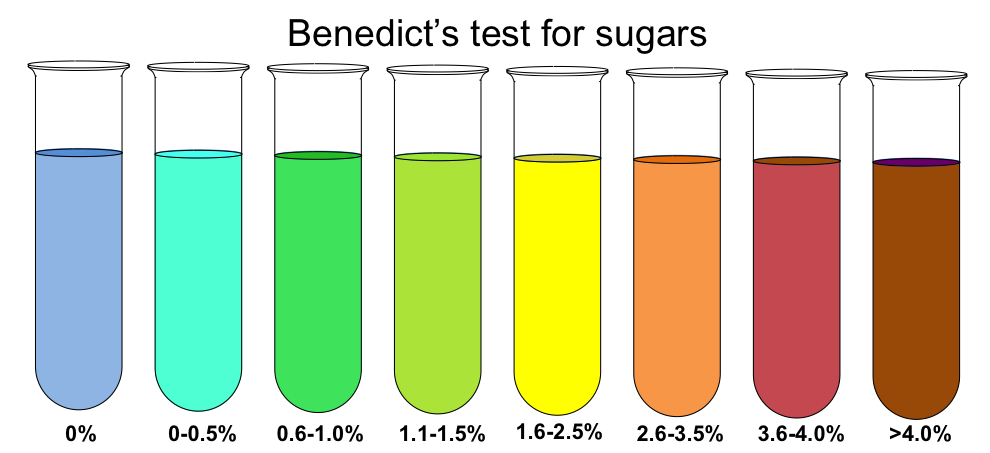
The key fact for this event is that table sugar (sucrose) is a non-reducing sugar. Its molecule does not have the free aldehyde or ketone group that reduces Benedict's reagent, so sucrose gives a negative result, staying blue. Glucose and fructose, by contrast, are reducing sugars. Many teams expect every sugar to turn Benedict's solution brick red and then misidentify the sugar. The Benedict's reagent is supplied by the supervisor only if the supervisor chooses to provide it, so do not build a plan that depends on it.
What is in Benedict's reagent. It has three ingredients. Copper(II) sulfate supplies the blue Cu²⁺ ions that do the reacting (they are the "active" part and the source of the blue color). Sodium carbonate makes the solution basic, which the reaction needs. Sodium citrate binds (chelates) the Cu²⁺ so it stays dissolved instead of precipitating as copper hydroxide in the base. The test needs heat: a boiling-water bath for a few minutes. In the positive test the sugar is oxidized (the aldehyde group becomes a carboxylate, so the sugar is the reducing agent), the Cu²⁺ is reduced to Cu⁺, and the Cu⁺ precipitates as red copper(I) oxide, Cu₂O. So the blue color comes from Cu(II), and the red color from Cu(I) oxide. Fehling's solution works the same way with tartrate instead of citrate; Tollens' reagent (ammoniacal silver nitrate: silver nitrate, a drop of NaOH, then ammonia until the brown silver oxide just redissolves as [Ag(NH₃)₂]⁺) is reduced by aldehydes and reducing sugars to a silver mirror on the glass. Make it with distilled water: chloride ions in tap water precipitate white silver chloride and spoil the reagent. Make it fresh and discard it promptly, because on standing it can form explosive silver compounds.
Why some sugars reduce and others do not. In water, glucose and fructose spend part of their time as open chains with a free aldehyde (glucose) or a ketone next to an OH group (fructose), and that group is what gets oxidized. A sugar is reducing when its anomeric carbon (carbon 1 of glucose, carbon 2 of fructose) is free. In sucrose, the glucose and fructose are joined through both anomeric carbons, so neither ring can open, and sucrose cannot reduce Cu²⁺. If sucrose is first hydrolyzed by acid or by the enzyme invertase, the free glucose and fructose then give a positive test. Starch reacts very weakly, because a long chain has only one free reducing end. Vitamin C is not a sugar, but as a strong reducing agent it also turns Benedict's reagent orange-red, so confirm with its acidity and its effect on iodine. The same rule sorts unfamiliar sugars: maltose (glucose + glucose, α-1,4) and lactose keep one free anomeric carbon and are reducing, as is the trisaccharide maltotriose; trehalose (two glucoses joined 1,1) and raffinose (a trisaccharide containing sucrose) have no free anomeric carbon and are non-reducing.
Carbohydrates in brief
Questions on sugars lean on a few structure facts:
| Type | Examples | Formula | Built from | Reducing? |
|---|---|---|---|---|
| Monosaccharide (simple sugar) | Glucose (blood sugar and the main fuel of cellular respiration, which releases energy as ATP: C₆H₁₂O₆ + 6O₂ → 6CO₂ + 6H₂O; an aldose), fructose (fruit sugar; a ketose), galactose | C₆H₁₂O₆ (isomers) | — | Yes |
| Disaccharide | Sucrose (glucose + fructose), lactose (glucose + galactose), maltose (glucose + glucose) | C₁₂H₂₂O₁₁ | Two monosaccharides joined by a glycosidic bond | Sucrose no; lactose and maltose yes |
| Polysaccharide | Starch (plant energy store), glycogen (animal store, highly branched), cellulose (plant cell walls, cotton) | (C₆H₁₀O₅)ₙ | Hundreds to many thousands of glucose units | Essentially no |
Two monosaccharides join by dehydration synthesis (a condensation reaction): an OH from one and an H from the other leave as water, forming a glycosidic bond. So glucose + fructose → sucrose + H₂O, which is why sucrose's formula is C₁₂H₂₂O₁₁ and not C₁₂H₂₄O₁₂. The reverse, adding water to split the bond, is hydrolysis. Starch and glycogen use α linkages (α-1,4 chains, α-1,6 branches); cellulose uses β-1,4 linkages, which make straight chains that hydrogen-bond side by side into strong fibers. Human enzymes can break α linkages but not β linkages, so we digest starch but not cellulose.
Proteins: gelatin, yeast and the biuret test
Two solids on the list are mostly protein: gelatin and yeast (flour has some protein too). Proteins are polymers of amino acids joined by peptide bonds, each formed by a condensation reaction that releases water. The biuret test detects peptide bonds: a blue copper(II) reagent in a basic solution turns violet or purple when protein is present (it needs at least two peptide bonds, so free amino acids do not respond). Ninhydrin reacts with free amino acids (amino groups) to give a purple product; it is the same reagent used on paper fingerprints. Proteins contain nitrogen and many contain sulfur (in the amino acids cysteine and methionine), which is why a burning protein smells like burnt hair or feathers.
Yeast is a living single-celled fungus. Two of its reactions are tested. Its enzyme catalase speeds the breakdown of hydrogen peroxide (), so yeast foams vigorously in 3% peroxide. In warm sugar water it ferments sugar into ethanol and carbon dioxide, so after several minutes the mixture bubbles and froths. In plain cold water dry yeast does little.
Flame tests
A flame test identifies a metal ion from the color it gives a flame. The heat excites electrons in the metal ions to higher energy levels. The excited state is unstable, so each electron soon falls back to a lower level and releases the energy difference as a photon. Each element has its own set of energy gaps, so it emits its own set of wavelengths (its emission or line spectrum), and the mix of those wavelengths is the color you see. For sodium, the outer electron is promoted from 3s to 3p (excited configuration 1s² 2s² 2p⁶ 3p¹), and its drop back emits the strong yellow light near 589 nm.
| Ion | Flame color | Listed source in this event |
|---|---|---|
| Sodium (Na⁺) | Intense yellow-orange, long-lasting | Table salt, baking soda, sodium acetate, Alka-Seltzer |
| Calcium (Ca²⁺) | Orange-red (brick red) | Calcium carbonate, gypsum |
| Copper (Cu²⁺) | Green to blue-green | Copper compounds (not the bare metal); also the Beilstein test for chlorine |
| Potassium (K⁺) | Lilac (pale violet); view through cobalt-blue glass | Not on the list |
| Lithium (Li⁺) | Crimson red | Not on the list |
| Strontium (Sr²⁺) | Scarlet red | Not on the list |
| Barium (Ba²⁺) | Pale (apple) green | Not on the list |
| Boron (boric acid) | Bright green | Not on the list |
| Magnesium (Mg²⁺), ammonium (NH₄⁺) | No characteristic color | Magnesium metal itself burns with a blinding white light |
Technique matters. Nichrome and platinum are used because they survive the flame and give no flame color of their own. Dip a clean nichrome or platinum wire loop (or a wooden splint soaked in the solution) into the sample and hold it in the hottest, blue part of a Bunsen flame. Clean the loop between samples by dipping it in hydrochloric acid and heating it until it gives no color. Sodium is everywhere (sweat, dust, glassware) and its yellow swamps weaker colors, so a yellow flame alone is weak evidence. Cobalt-blue glass absorbs the yellow sodium light and lets you see a potassium lilac through it. Some ions give no visible color because the energy gaps of their electrons correspond to ultraviolet light rather than visible light (magnesium), or because the compound does not vaporize enough in the flame to emit strongly (calcium sulfate and calcium carbonate give only a weak orange-red, easily masked by sodium). Ammonium salts decompose without any metal to emit. Carbon compounds such as sugar, starch and gelatin do not give an ion color; they burn or char with a smoky yellow flame.
Metals
The metals are aluminum, iron, zinc, magnesium, copper and tin, as non-powdered pieces. Start with physical properties, which cost nothing. Iron is the only one of the six attracted to a magnet. Copper is the only one with a reddish-brown color. The other four are silvery, and density separates them well: the table gives typical values to compare against (look up the exact numbers in a reference, since they vary slightly by source and alloy).
| Metal | Approximate density (g/cm³) | Appearance | Rate in 1 M HCl |
|---|---|---|---|
| Magnesium | 1.74 | Dull silvery gray, light | Fast, vigorous bubbling |
| Aluminum | 2.70 | Silvery, light | Slow to start (oxide skin), then steady |
| Zinc | 7.1 | Bluish-gray, brittle | Steady, moderate |
| Tin | 7.3 | Soft, silvery | Very slow |
| Iron | 7.9 | Gray, magnetic | Slow |
| Copper | 9.0 | Reddish-brown | None |
Measuring a metal's density. Density = mass ÷ volume. Weigh the dry piece on a balance in grams. For volume, measure a regular block with a ruler (length × width × height, in cm³), or use water displacement: partly fill a graduated cylinder, read the level, slide the piece in without splashing, and read again; the rise in mL is the volume in cm³. Example: a 10.8 g piece raises the water from 20.0 mL to 24.0 mL, so its density is 10.8 ÷ 4.0 = 2.7 g/cm³, which fits aluminum. Small pieces give large errors, so use the largest piece available and the narrowest cylinder it fits in.
Chemistry sorts the rest. A metal above hydrogen in the activity series displaces hydrogen from acid, and the bubbles are hydrogen gas:
Copper lies below hydrogen and does not react with dilute hydrochloric acid, which is why "no bubbles" is a useful result. Aluminum and zinc are also amphoteric: they dissolve in strong base as well as in acid, releasing hydrogen. The supervisor provides only 1 M HCl, so a base test will usually be given to you as a result, as in the archive tables that list "NaOH: produces hydrogen gas".
The activity series for the six metals, from most to least reactive, is Mg > Al > Zn > Fe > Sn > (H) > Cu. Aluminum sits above zinc, yet in the lab it often reacts more slowly at first: a thin, tough layer of aluminum oxide (Al₂O₃) coats the surface and must dissolve before bubbling starts, which is the "lag time" tests ask about. Iron dissolves slowly to give pale green iron(II) chloride. Zinc gives a steady stream of bubbles: .
A common mistake is treating one reaction as the whole test. Aluminum and zinc both react with acid and with base, so you need a second feature. Tin is amphoteric too, though it reacts slowly; a base result alone does not single out Al or Zn. The densities of aluminum and zinc differ by a factor of about 2.6, so a density comparison (or simply the heft of the piece) separates them cleanly. Zinc (7.1) and tin (7.3) are too close in density to separate that way, so use reaction rate with acid and the feel of the metal. Iron, tin and zinc can be told apart quickly: iron is magnetic, and zinc reacts with acid much faster than tin.
ReferenceThe six metals: properties, chemistry and uses· 6 rows
Symbols and atomic numbers: Mg 12, Al 13, Fe 26, Cu 29, Zn 30, Sn 50.
No rows match.
| Metal | Group / type | Melting point | Key identification facts | Common uses and alloys |
|---|---|---|---|---|
| Magnesium (Mg) | Group 2, alkaline earth metal | 650 °C | Lightest of the six; dull gray (oxide film); vigorous bubbling in HCl; does not react with NaOH; burns with a blinding white flame (do not look at it) | Lightweight alloys, flares and fireworks, antacids (Mg(OH)₂, milk of magnesia) |
| Aluminum (Al) | Group 13, post-transition (poor) metal | 660 °C | Light, silvery, non-magnetic, soft enough to bend; slow start in HCl because of its oxide layer; reacts with NaOH (amphoteric); most abundant metal in Earth's crust | Foil, cans, aircraft, window frames, cookware |
| Zinc (Zn) | Group 12, d-block metal | 420 °C | Bluish-gray, somewhat brittle; steady bubbling in HCl; reacts with NaOH (amphoteric) | Galvanizing (a zinc coat that protects steel from rust), brass (copper + zinc), batteries, U.S. pennies (copper-plated zinc core since 1982) |
| Tin (Sn) | Group 14, post-transition metal | 232 °C | Soft, silvery, low melting; very slow reaction with dilute HCl; a bar "cries" (crackles) when bent | Tin cans are steel coated with tin; solder; bronze (copper + tin); pewter |
| Iron (Fe) | Transition metal | 1538 °C | The only magnetic one (ferromagnetic); gray; slow reaction in HCl giving pale green Fe²⁺; rusts to reddish iron oxide (Fe₂O₃·xH₂O) | Steel (iron + a little carbon), cast iron, magnets, structural beams |
| Copper (Cu) | Transition metal | 1085 °C | Reddish-brown, very dense; no reaction with HCl (below hydrogen); weathers to a green patina (basic copper carbonate) | Electrical wire (second-best conductor after silver), pipes, brass, bronze |
Iron, copper and zinc are the three transition metals on the list (the d-block of the periodic table, where the d subshell is being filled; strictly, a transition metal has a partly filled d subshell in the atom or a common ion, which zinc, with a full 3d¹⁰, does not, but most tests count it). Transition metals tend to form colored compounds and ions with more than one charge (Fe²⁺ and Fe³⁺, Cu⁺ and Cu²⁺). Magnesium is an alkaline earth metal, and aluminum and tin are post-transition metals. Tin is used to coat steel (tin cans) because tin resists corrosion and is non-toxic, so the thin coat keeps air and water away from the iron underneath; zinc coating (galvanizing) protects steel even where scratched, because the more reactive zinc corrodes first.
An alloy is a mixture of a metal with other metals or with a non-metal, made to improve strength, hardness or corrosion resistance or to lower cost: steel (iron + carbon), stainless steel (adds chromium), brass (copper + zinc), bronze (copper + tin), gunmetal (copper + tin with a little zinc), solder and pewter (mostly tin).
A ferrous metal contains iron (iron, steel, cast iron); non-ferrous metals (aluminum, copper, zinc, tin, magnesium) do not, so these five are not magnetic and do not rust in the iron-oxide sense. General metallic properties that tests ask for are luster, malleability (can be hammered into sheets), ductility (can be drawn into wire), and good conduction of heat and electricity. Iron is ferromagnetic because its atoms have unpaired electrons whose magnetic moments line up in domains; in the other five metals they do not.
Liquids
The liquids list has a clean set of tests. The table gives the pattern to expect; confirm each with a reference sample run under the same conditions.
| Liquid | pH side | Odor | Baking soda added | Yeast added | Other clues |
|---|---|---|---|---|---|
| Lemon juice | Acidic (about pH 2) | Citrus | Fizzes | No foaming | Often cloudy or pale yellow |
| Vinegar | Acidic (about pH 2.5–3) | Sharp, acetic | Fizzes | No foaming | Clear |
| Household ammonia (3%) | Basic (above pH 11) | Pungent, irritating | No fizz | No foaming | Neutralized by HCl |
| Rubbing alcohol (isopropyl) | About neutral | Medicinal | No fizz | No foaming | Evaporates quickly, flammable, less dense than water |
| Water | Neutral | None | No fizz | No foaming | The reference for everything else |
| Hydrogen peroxide (3%) | Slightly acidic (retail 3% about pH 4–6, from stabilizers) | Almost none | No fizz | Vigorous foaming (O₂) | Bubbles on any catalyst |
Lemon juice and vinegar are the hard pair because both are acidic and both fizz with baking soda (the acid releases carbon dioxide from bicarbonate). Separate them by odor and by pH, and note that vinegar is the stronger-smelling and clearer of the two. Ammonia is the only basic liquid on the list. Rubbing alcohol mixes with water in all proportions, so a miscibility test with water does not separate it from the others. Hydrogen peroxide decomposes into water and oxygen:
Liquids decision key. 1. Test with pH paper first. Basic (pH 11–12) is ammonia; confirm by wafting its pungent odor. 2. Clearly acidic (pH about 2–3): add a drop of the supervisor's iodine reagent. If the brown color fades, it is lemon juice (its vitamin C reduces the iodine); if the brown stays and the liquid is clear with a sharp odor, it is vinegar. 3. Near neutral with a medicinal odor, and a drop evaporates within a minute or so on a watch glass or paper towel: isopropyl alcohol. 4. Neutral or only slightly acidic (pH 4–7) and odorless: add a drop of iodine reagent and wait a minute (or add a pinch of a known yeast). Slow fizzing (or vigorous foaming with yeast) means hydrogen peroxide; no change means water.
The decomposition is much faster in the presence of a catalyst. Yeast contains an enzyme, catalase, that speeds the reaction, so a yeast suspension foams when added to hydrogen peroxide. The foaming is real information, but it points two ways. If you already know the liquid is peroxide, foaming identifies the powder as yeast. If you already know the powder is yeast, foaming identifies the liquid as peroxide. Confirm one side by another test (for example, peroxide is clear, odorless and only slightly acidic, about pH 4–6, while yeast gives a tan, cloudy suspension with a bready smell) before you use it to name the other.
ReferenceThe six liquids: chemistry and facts· 6 rows
No rows match.
| Liquid | Main substance | Acid or base, strong or weak | Facts that tests ask |
|---|---|---|---|
| Lemon juice | Water with about 5–6% citric acid (C₆H₈O₇), plus some ascorbic acid | Weak acid; pH about 2 to 2.6 | Citrus odor, often cloudy; fizzes with baking soda; its vitamin C can fade iodine color |
| Vinegar | Water with about 5% acetic acid (CH₃COOH) | Weak acid; pH about 2.4 to 3 | Sharp vinegar odor, clear; fizzes with baking soda; turns blue litmus red; acetic acid + NaOH → sodium acetate + water |
| Household ammonia (3%) | Ammonia gas (NH₃) dissolved in water | Weak base; pH about 11 to 12 | NH₃ + H₂O ⇌ NH₄⁺ + OH⁻ (ammonia accepts a proton and leaves OH⁻); pungent, irritating odor; turns red litmus blue |
| Rubbing alcohol | Isopropyl alcohol, (CH₃)₂CHOH (C₃H₈O), usually 70% or 91% in water | Neutral (not an acid or base in this sense) | Pure isopropanol boils at about 82 °C and freezes far below 0 °C; sharp medicinal odor; evaporates much faster than water (weaker hydrogen bonding); flammable; less dense than water (pure isopropanol 0.79 g/mL); dissolves permanent-marker ink; disinfectant |
| Water | H₂O | Neutral, pH 7 | No odor; density 1.00 g/mL; polar; the control for every test |
| Hydrogen peroxide (3%) | H₂O₂ in water | Very weak acid; retail 3% is slightly acidic (about pH 4–6) because of added stabilizers | Decomposes to water + oxygen; foams with yeast (catalase), blood, or iodide; oxygen relights a glowing splint; sold in brown bottles because light speeds decomposition; mild antiseptic |
Hydrogen peroxide and rubbing alcohol are both used on wounds, and ammonia and hydrogen peroxide are the two listed liquids used together in permanent hair dye (ammonia swells the hair cuticle; peroxide bleaches the natural melanin).
Polymers and natural materials (3.d)
Hair, fibers and plastics are all polymers: long chain molecules built from many repeating small units called monomers. Hair and wool are protein (amino-acid monomers), cotton and linen are cellulose (glucose monomers), and plastics and synthetic fibers are made from small petrochemical monomers such as ethylene. The same few ideas explain how all of them behave, so they come first.
Polymer basics
Addition (chain-growth) polymerization joins monomers that contain a carbon–carbon double bond. The double bond opens and the monomers add to the end of a growing chain, so the polymer contains every atom of the monomers and nothing is given off. Many addition polymers (LDPE, PVC, polystyrene, PMMA) are made by free-radical polymerization, which has three steps: initiation (an initiator splits into a free radical, an atom or molecule with an unpaired electron, which attacks a monomer's double bond), propagation (the radical end adds monomer after monomer) and termination (two radical ends meet and combine, or otherwise deactivate). Polyethylene (HDPE and LDPE), polypropylene, PVC, polystyrene and PMMA are addition polymers.
Condensation (step-growth) polymerization joins monomers that each have two reactive groups, and every link releases a small molecule, usually water (sometimes HCl or methanol). PETE (a polyester), nylon (a polyamide) and polycarbonate are condensation polymers, and so are the natural polymers: proteins, starch, cellulose and DNA.
| Property | Thermoplastic | Thermoset |
|---|---|---|
| Structure | Separate linear or branched chains held by weak intermolecular forces | Chains joined by covalent cross-links into one network |
| On heating | Softens and melts; can be remolded again and again | Does not melt; chars or decomposes (it was hardened, or cured, irreversibly) |
| Recycling | Can be melted and recycled | Cannot be melted and remolded |
| Examples | All seven plastics on the list, nylon, polyester | Bakelite (the first fully synthetic plastic, Leo Baekeland, 1907), epoxy, vulcanized rubber |
Pyrolysis is breaking a polymer down with heat in the absence of oxygen (pyrolysis-GC is a lab way to identify fibers and plastics from their breakdown products). Bioplastics are made from renewable biomass (corn starch, sugarcane); biodegradable plastics are broken down by microbes. The two are not the same: some bioplastics do not biodegrade readily, and "compostable" plastics usually need the heat of an industrial composter, not a backyard bin. Vulcanization is a cross-linking example: heating natural rubber with sulfur forms sulfur bridges between chains, making the rubber stronger, more elastic and less sticky.
How tightly chains pack sets density, stiffness and clarity. Regions where chains line up in an ordered way are crystalline; tangled regions are amorphous. Most plastics are semi-crystalline (HDPE, LDPE, PP, PETE, nylon); others are amorphous (polystyrene, PMMA, PVC, polycarbonate), which is why PS, PMMA and PC can be glass-clear. More crystallinity means higher density, stiffness, strength and melting point. Branching reduces crystallinity, because side branches keep chains from packing.
Tacticity describes how side groups are arranged along a chain (for polypropylene the side group is CH₃; for polystyrene it is a benzene ring). Isotactic: every side group on the same side. Syndiotactic: side groups alternate regularly from side to side. Atactic: random. Regular (isotactic and syndiotactic) chains pack into crystals, so they are stiffer and melt higher; atactic chains cannot crystallize. Commercial polypropylene is isotactic; ordinary polystyrene is atactic, which is why it is amorphous and clear.
A third polyethylene, LLDPE (linear low-density polyethylene), is made by copolymerizing ethylene with a little butene, hexene or octene. It has a linear backbone with many short, uniform side branches, whereas LDPE has long, irregular branches (and branches on branches). LLDPE has a density similar to LDPE but is tougher and more puncture-resistant (stretch wrap, heavy-duty bags). Polyethylene in all its forms is the most widely produced plastic in the world. Most plastics, including PMMA, polyethylene and polypropylene, are hydrophobic (water-repelling), because their chains are mostly C–H with few polar groups; nylon absorbs a little water because its amide groups hydrogen-bond. Polymers have very high molecular masses (often tens of thousands to millions of g/mol), which is what makes them solid, tough materials rather than waxes.

Hair
Hair has three layers to examine. The outer cuticle is made of overlapping scales. The cortex is the bulk of the shaft and contains the pigment (melanin) and the structural protein keratin. The medulla is a central core that may be continuous, fragmented or absent. Under magnification you compare the scale pattern, the diameter of the shaft and the structure of the medulla.
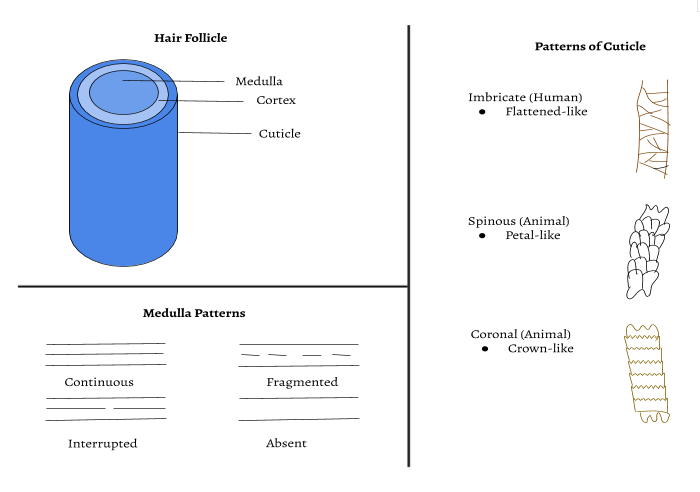
Structure and growth. Hair grows from a follicle in the dermis of the skin. At its base, the dermal papilla (connective tissue with blood vessels) feeds the root bulb, where cells divide, fill with keratin and die as they are pushed up. The visible shaft is therefore dead, keratinized cells; only the root contains living cells with nuclei. Hair's functions are protection, insulation (thermoregulation) and touch sensation.
- Cuticle: overlapping, translucent scales of hard keratin pointing toward the tip. It protects the inner layers. Damaged hair has lifted, rough scales.
- Cortex: the thickest layer, made of spindle-shaped cells packed with keratin fibers. It gives hair its strength, elasticity and most of its color, because it holds the pigment granules (melanin). It may also hold tiny air spaces (cortical fusi) and dark oval ovoid bodies.
- Medulla: the central canal of air-filled or loose cells. It may be continuous, interrupted (intermittent), fragmented or absent, and fine hairs often have none.
Whether hair is straight, wavy or curly depends mostly on the shape of the follicle and so of the shaft's cross-section (round shafts tend to be straight, flattened or elliptical ones curly), which is inherited.
Hair types over a lifetime. Lanugo is the fine, unpigmented hair that covers a fetus and is usually shed before birth. Vellus hair is the short, fine, lightly pigmented "peach fuzz" of children and much of the adult body, usually with no medulla. Terminal hair is the long, thick, pigmented hair of the scalp, eyebrows and, after puberty, the beard, armpits and pubic area.
Keratin chemistry. Hair, wool, nails, horns and the outer skin are α-keratin, a protein whose chains coil into α-helices. The amino acid cysteine is abundant, and neighboring chains are linked by disulfide bonds (S–S bridges). Disulfide bonds give hair its strength and set its curl (a perm breaks and re-forms them), and the sulfur is why burning hair smells so strong. β-keratin, built from β-pleated sheets, is found in bird feathers, beaks and claws and in reptile scales.
Color. Hair color comes from two kinds of melanin made by melanocytes in the follicle: eumelanin (brown to black) and pheomelanin (red to yellow). Black and brown hair are rich in eumelanin; red hair has a high proportion of pheomelanin and relatively little eumelanin; blond hair has little melanin of either kind. Hair turns gray or white with age as the melanocytes in the follicle produce less melanin and eventually die, so new hair grows in without pigment. Red hair is caused mainly by variants of the MC1R gene (melanocortin-1 receptor), which switch melanocytes toward making pheomelanin instead of eumelanin; people with red hair tend to have pale skin that burns easily. On average blond people have the most scalp hairs (finer hairs) and redheads the fewest. Under the microscope, bleached or chemically treated hair shows lifted, chipped or missing cuticle scales (high porosity, so it soaks up water and dye), a cortex that looks pale, yellowish or uneven with fewer pigment granules, and a brittle shaft; dyed hair shows color in the cuticle and cortex that stops abruptly at a line of new, untreated growth near the root. Peroxide bleach (with ammonia to open the cuticle) oxidizes and destroys melanin; eumelanin is broken down more readily than pheomelanin, which is why bleached dark hair passes through orange and yellow ("brassy") stages.
The medullary index is the ratio of the medulla's width to the hair's width. It is a ratio, so it has no units, and it is the standard way to make the medulla comparison quantitative:
As commonly taught, human hair has a narrow, fragmented or absent medulla, so its medullary index is small (roughly one third or less). Dog and cat hair usually have a wider, more continuous medulla, with an index around one half or more. Cat hair is often described as having a segmented or 'string of pearls' medulla and dog hair a wide, continuous one (a ladder pattern is the classic rabbit example), and the scale patterns differ as well, but treat these as clues to support the index rather than a stand-alone identification. Your reference sheet or the test's data supplies the cut-offs; use them if they differ from these.
Cuticle scale patterns are named for their shape:
| Scale pattern | Description | Typical of |
|---|---|---|
| Imbricate (flattened) | Flat, overlapping scales with smooth or slightly wavy edges, like roof shingles | Humans; also many animals, including dogs (on most of the shaft) and horses |
| Spinous (petal-like) | Triangular, pointed scales that stick out from the shaft | Cats (especially near the root), mink, seals |
| Coronal (crown-like) | Scales that circle the shaft like stacked crowns or paper cups | Rodents (mice, rats) and bats; rare in humans |
Human, dog or cat. No single feature decides; use the combination.
| Feature | Human | Dog | Cat |
|---|---|---|---|
| Medullary index | About 1/3 or less | About 1/2 or more | About 1/2 or more |
| Medulla | Usually absent, fragmented or interrupted | Usually wide and continuous | Continuous and segmented, often "string of pearls" |
| Cuticle scales | Imbricate | Mostly imbricate | Spinous (petal) near the root, imbricate toward the tip |
| Pigment | Evenly spread along the shaft, denser toward the cuticle | Often in bands of color along the shaft | Often in bands of color along the shaft |
| Shaft | Fairly even diameter along its length | Varies in diameter; tapers | Fine; varies along length |
The single most useful difference between cat and dog hair is the medulla pattern. Pigment banding (several color bands along one hair) and a shaft whose width changes along its length point to an animal.
The follicle and its neighbors. The follicle is wrapped in an inner and outer root sheath of epithelial cells that guide and support the growing hair (a forcibly pulled anagen hair often carries some sheath tissue, a good source of nuclear DNA), and an outer connective tissue sheath. A sebaceous gland opens into the follicle and coats the hair with oily sebum, and a tiny arrector pili muscle pulls the hair upright (goosebumps). A dark band near the root of some hairs from a body, the post-mortem root band, suggests the hair was still in the scalp for some time after death.
Hair growth cycle. Each follicle cycles independently through three phases. Scalp hair grows roughly 1 cm per month (about 0.3–0.4 mm per day), so the length of new growth since a dye job estimates how long ago the hair was dyed. Some references add a fourth phase, exogen, the active shedding of the old club hair at the end of telogen.
| Phase | What happens | Duration (scalp) | Share of scalp hairs |
|---|---|---|---|
| Anagen (growth, "actively growing root stage") | Follicle active; cells divide in the bulb and the shaft lengthens. The root is pigmented and may carry a translucent root sheath if pulled out | 2 to 7 years (the longest phase) | About 85–90% |
| Catagen (transition, "transitional root stage") | Growth stops; the follicle shrinks and the root becomes club-shaped | About 2 to 3 weeks | About 1% |
| Telogen (resting and shedding) | The follicle rests; the old club hair is shed as a new one starts | About 3 months | About 10–15% |
Hair as evidence. A hair is class evidence: it narrows the source to a group (human, or a dog, with a certain color and form) but cannot identify one person by its appearance. It becomes individualizing only through DNA. Nuclear DNA needs the root: an anagen hair pulled out by force often carries root tissue and gives the best nuclear DNA, while a naturally shed telogen hair has a dry club root with little nuclear DNA. The shaft has no nuclei, but it still contains mitochondrial DNA (mtDNA), which is inherited only from the mother and so cannot single out one of several maternal relatives. Hair morphology cannot reliably tell a person's age or sex. It can show dyeing or bleaching (an abrupt color change with a line of demarcation along the shaft), whether a hair was cut, crushed or pulled out, and body area (scalp hairs are round and even; pubic and beard hairs are coarse, wiry and triangular to oval in cross-section). Hair is durable but is degraded by moisture and microbes (especially at the root), heat, UV light, chemicals such as bleach, and abrasion, so collected hairs are kept dry in paper folds or envelopes. Because drugs and poisons such as arsenic are built into the growing shaft, hair can also record exposure over time.
The 2027 rules ask only whether a hair is human, dog or cat, and they do not ask for specific hair types such as guard hairs. Spend most practice time on telling those three apart from the medulla, the scale pattern and the shaft width; the structure, growth and DNA facts above are what the written questions around them ask.
Fibers
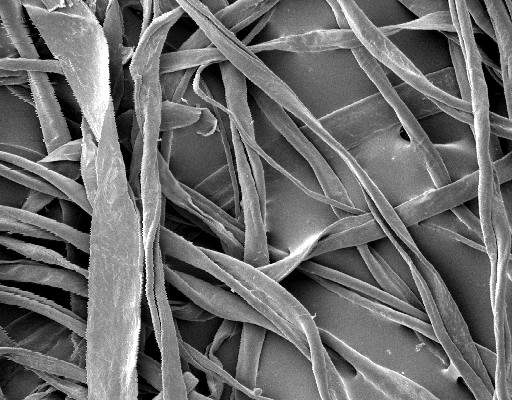
Fibers fall into three classes. Animal fibers are proteins, such as wool and silk. Plant fibers are cellulose, such as cotton and linen. Synthetic fibers are man-made polymers, such as nylon, polyester and acrylic. The table compares their most useful clues.
| Class | Chemistry | Examples | Burn behavior (your own candle test if the supervisor supplies a flame, or results given in the test) | Microscope look (qualitative) |
|---|---|---|---|---|
| Animal | Protein (contains nitrogen; wool also sulfur) | Wool, silk | Burns slowly, often self-extinguishes; burnt-hair smell; crumbly black ash | Wool shows surface scales; silk is smooth |
| Plant | Cellulose | Cotton, linen | Burns readily and keeps burning; burnt-paper smell; soft gray ash | Cotton looks like a flattened twisted ribbon |
| Synthetic | Man-made polymer | Nylon, polyester, acrylic | Melts and shrinks, often drips; hard bead; may give a chemical smell | Uniform, smooth or regularly shaped fibers |
The burning clues have a chemical reason. Proteins contain nitrogen (and wool also sulfur), so burning them releases compounds that smell like burnt hair. Cellulose is a carbohydrate and burns to carbon dioxide and water with the smell of burnt paper or wood. Synthetic polymers melt before they burn, which is why they bead and drip rather than leaving ash.
Natural or man-made. Natural fibers come from plants (cellulose) or animals (protein). Man-made fibers are either regenerated (semi-synthetic), meaning a natural polymer such as cellulose from wood pulp is dissolved and re-formed into fibers (rayon/viscose, lyocell, modal; acetate is similar but is chemically modified cellulose), or fully synthetic, made from petrochemical monomers (nylon, polyester, acrylic, spandex, olefin). On a test that asks only animal, vegetable or synthetic, a regenerated fiber such as rayon goes with the man-made group, but its burn test looks like cotton because it is cellulose.
Plant fibers are grouped by the part of the plant they come from: seed fibers (cotton), bast or stem fibers (linen from flax, hemp, jute, ramie), leaf fibers (sisal, abacá) and fruit fibers (coir from coconut husk). Cotton fibers are the seed hairs that help disperse the cotton seed; they are short (a few centimeters, the "staple" length) compared with the long bast fiber bundles of flax that make linen (tens of centimeters), which is one reason linen is stronger and smoother.
ReferenceCommon fibers: source, microscope and burn results· 12 rows
Burn columns: behavior near and in the flame / odor / residue.
No rows match.
| Fiber | Class and polymer | Source | Under the microscope | Burn behavior | Odor | Residue | Extra facts |
|---|---|---|---|---|---|---|---|
| Cotton | Vegetable; cellulose (about 90%) | Seed hairs of the cotton plant (Gossypium) | Flat, twisted ribbon with periodic twists (convolutions) and a central canal (lumen) | Ignites easily, burns fast with a yellow flame, keeps burning, afterglow | Burning paper | Soft, fine gray ash | Absorbent (many –OH groups); weakened by acids, tolerates bleach. Mercerization (treating cotton with strong NaOH under tension, John Mercer, 1844) swells the fibers, making them rounder, stronger, more lustrous and better at taking dye |
| Linen | Vegetable; cellulose | Bast (stem) fibers of flax (Linum usitatissimum) | Straight, stiff, with cross-markings (nodes) like bamboo stalks | Slower to ignite than cotton, then burns steadily, keeps burning | Burning paper or grass | Soft gray ash | Strong, cool, wrinkles easily; one of the oldest textile fibers |
| Hemp, jute, ramie | Vegetable; cellulose | Bast fibers of their plants | Coarse, with nodes | Like linen | Burning paper | Gray ash | Rope, burlap (jute), canvas |
| Wool | Animal; α-keratin protein | Sheep fleece (also goats: cashmere and mohair; alpaca and llama; angora rabbit) | Overlapping cuticle scales, natural crimp (waviness), fairly thick | Curls away from the flame, burns slowly, self-extinguishes | Burning hair | Crushable black ash | Absorbs about 30% of its weight in water without feeling wet; elastic; naturally flame-resistant; damaged and dissolved by chlorine bleach and strong bases |
| Silk | Animal; protein (fibroin with a sericin coating) | Cocoons of the silkworm Bombyx mori | Smooth, no scales, nearly transparent; triangular cross-section | Burns slowly, sputters, self-extinguishes | Burning hair or feathers | Crushable black bead | The only natural filament (continuous) fiber. Fibroin is the structural core protein, folded into β-pleated sheets held by hydrogen bonds; sericin is the gummy protein that glues the filaments and is boiled off in degumming. Dissolves in bleach |
| Rayon (viscose) | Regenerated cellulose (man-made) | Wood pulp cellulose, dissolved and re-spun | Smooth, often with lengthwise lines (striations) | Burns fast like cotton | Burning paper | Little light ash | The first man-made fiber; burns like cotton because it is cellulose |
| Acetate | Modified cellulose (man-made) | Cellulose acetate from wood pulp | Smooth, lobed cross-section | Melts and burns, drips | Vinegar | Hard, brittle black bead | Dissolves in acetone |
| Nylon | Synthetic; polyamide | Petrochemicals; nylon 6,6 from hexamethylenediamine + adipic acid | Smooth, uniform rods | Melts, shrinks from the flame, drips, often self-extinguishes | Celery | Hard gray or tan bead | First fully synthetic fiber (Wallace Carothers, DuPont, 1935; stockings by 1940); condensation polymer held by amide links (–CO–NH–) and hydrogen bonds between chains, so it is strong and fairly heat-resistant |
| Polyester | Synthetic; PET (polyethylene terephthalate) | Petrochemicals; the same polymer as PETE bottles | Smooth, uniform rods | Melts, shrinks, burns slowly with black smoke | Sweet, chemical | Hard black or dark bead | Named for its ester links (–COO–); hydrophobic, so it dries fast and resists wrinkling; patented in 1941 |
| Acrylic | Synthetic; polyacrylonitrile | Petrochemicals | Smooth, often dog-bone or bean-shaped cross-section | Flares, melts, burns rapidly | Acrid, harsh | Hard, irregular black bead | A wool substitute (sweaters); not the same polymer as PMMA "acrylic" plastic |
| Spandex (elastane, Lycra) | Synthetic; polyurethane | Petrochemicals | Smooth, often fused filaments | Melts and burns | Sharp chemical | Soft, sticky or gummy residue | Stretches to about five to eight times its length and recovers |
| Olefin (polypropylene) | Synthetic; polypropylene | Petrochemicals | Smooth rods | Melts, shrinks, burns | Candle wax or asphalt | Hard tan bead | Light enough to float on water; rope, carpets |
Chemical tests on fibers. Protein fibers (wool, silk) dissolve in chlorine bleach (sodium hypochlorite, a strong oxidizer) and in hot sodium hydroxide, and wool is damaged by bleach in the laundry for the same reason. Cellulose fibers resist bleach and base but are destroyed by strong acids (concentrated sulfuric acid dehydrates and dissolves cellulose). Acetate dissolves in acetone. Polyester resists most of these. The reason is chemistry: hypochlorite attacks the amino acid side chains and peptide bonds of proteins (oxidizing sulfur-containing cysteine and breaking the chains), whereas cellulose is a polysaccharide that hypochlorite attacks only slowly and synthetic chains such as polyester and acrylic have no protein links, so bleach mostly just whitens them. A dyed fiber can be compared further by extracting its dye and running it on TLC beside dyes from a suspect's garment, or by microspectrophotometry.
How fibers are read as evidence. Most fibers are mass-produced, so a fiber is class evidence: the same fiber type, color and dye are shared by thousands of garments. Its probative value (how strongly it links a suspect) rises when the fiber is unusual (an uncommon blend, a rare dye, a distinctive cross-section) and falls when it is common (white cotton, blue polyester). Many synthetic fibers are delustered: tiny particles of titanium dioxide are added to cut the shine, and they show under the microscope as dark specks or pits. Synthetic fibers also look uniform in diameter and shape and often show birefringence under polarized light (they appear bright against a dark background because their aligned chains bend light differently along and across the fiber). Fiber fineness is reported in denier (grams per 9000 m of fiber) or tex (grams per 1000 m), and tenacity is a fiber's breaking strength per unit of linear density.

Plastics
The recyclable plastics on the list each carry a resin code: PETE (1), HDPE (2), PVC (3), LDPE (4), PP (5) and polystyrene (6, non-expanded here). PMMA (acrylic) is not part of the common recycling codes, but it is on the event list. Burn tests are not performed by participants, but results may be given to you, and the supervisor may supply density solutions for a float-and-sink series. The table lists typical densities and burn clues; burn descriptions in tests are worded in many ways, so decide from the whole set of clues.

| Plastic | Typical uses | Density (g/mL, approx.) | In water | Burn behavior (if results are given) |
|---|---|---|---|---|
| PETE (1) | Soft-drink bottles | 1.38 | Sinks | Burns with a sooty flame; melts and drips |
| HDPE (2) | Milk jugs, detergent bottles | 0.95 | Floats | Continues burning with a clean flame; melts and drips; candle-wax smell |
| PVC (3) | Pipes, some packaging | 1.3–1.45 | Sinks | Tends to self-extinguish; acrid smoke |
| LDPE (4) | Bags, squeeze bottles | 0.92 | Floats | Continues burning; melts and drips; candle-wax smell |
| PP (5) | Yogurt cups, caps | 0.90 | Floats | Continues burning; melts and drips |
| Polystyrene (6, non-expanded) | Rigid cups, cutlery | 1.05 | Sinks, barely | Sooty flame with a prominent smoke trail |
| PMMA (acrylic) | Clear sheets, light covers | 1.18 | Sinks | Bright flame with little smoke |
Density in g/mL and in g/cm³ is the same number (1 mL = 1 cm³), so this guide uses the two units interchangeably. The density column is the reliable one. Polyethylene (HDPE and LDPE) and polypropylene are simple hydrocarbons that pack loosely, and all three float in water. PETE, PVC, polystyrene and PMMA are denser than water and sink, though polystyrene barely does. Remember "Floats: PE and PP; sinks: the rest" as your first split, then separate within each group using burn clues. Density solutions let you bracket a plastic's density more finely than a float-or-sink test does.
ReferencePlastics: full names, monomers, chemistry, uses and test results· 8 rows
Burn results vary with the source; these are the descriptions most tests use. Polycarbonate (PC) is not on the Crime Busters list but is on the Forensics list and appears in practice sets.
No rows match.
| Code | Plastic (full name) | Monomer(s) | Polymerization | Density (g/cm³) | Common uses | Burn result often given | Other tests |
|---|---|---|---|---|---|---|---|
| 1 | PETE or PET, polyethylene terephthalate | Ethylene glycol + terephthalic acid | Condensation (a polyester; releases water) | 1.38–1.39 | Soda and water bottles, peanut-butter and salad-dressing jars, polyester clothing fiber and fleece | Yellow-orange flame, melts and drips, moderately sooty smoke (less than polystyrene), sweet odor (sources vary; decide with density: PETE sinks even in saturated NaCl, while PMMA, at about 1.17–1.20, sits so close to 25% NaCl (1.19) that it may float, hover or sink there, so confirm PMMA with acetone and its fruity, low-smoke burn) | Sinks in water and in 10% salt water; resists acetone |
| 2 | HDPE, high-density polyethylene | Ethylene, CH₂=CH₂ (C₂H₄) | Addition (Ziegler–Natta catalyst) | 0.94–0.97 | Milk jugs, detergent and shampoo bottles, cutting boards, pipes, playground equipment, thin "crinkly" grocery bags | Blue flame with a yellow tip, melts and drips, keeps burning, candle-wax (paraffin) odor | Floats in water; resists acetone; opaque |
| 3 | PVC, polyvinyl chloride ("vinyl") | Vinyl chloride, CH₂=CHCl (C₂H₃Cl) | Addition (free radical) | 1.3–1.45 rigid (softer, plasticized grades lower) | Pipes, window frames, siding, credit cards, vinyl flooring, medical tubing and blood bags (plasticized) | Yellow flame with green edges or spurts, chars, self-extinguishes, white or black acrid smoke, smells of hydrochloric acid | The only listed plastic with a halogen (chlorine): Beilstein test green; sinks in water and salt solutions |
| 4 | LDPE, low-density polyethylene | Ethylene | Addition (free radical, high pressure) | 0.91–0.93 | Bread and produce bags, plastic wrap and films, squeeze bottles, six-pack rings | Like HDPE: blue flame with yellow tip, drips, candle-wax odor | Floats in water; flexible, translucent |
| 5 | PP, polypropylene | Propylene (propene), CH₂=CH–CH₃ (C₃H₆) | Addition (Ziegler–Natta; isotactic) | 0.90–0.91 (the lowest) | Yogurt and margarine tubs, bottle caps, straws, microwavable containers, car parts, rope and carpet (olefin fiber) | Yellow flame with blue base, melts and drips, little smoke, burns cleanly (complete combustion) | Floats even in some oils; resists acetone |
| 6 | PS, polystyrene | Styrene, CH₂=CH–C₆H₅ (C₈H₈) | Addition (free radical; atactic) | 1.04–1.06 | Rigid clear cups and cutlery, CD cases, foam cups and packing (expanded PS; "Styrofoam" is strictly a brand of extruded PS insulation board) | Orange-yellow flame with dense black soot (from the benzene ring), sweet (marigold-like) odor, drips | Dissolves or softens in acetone; barely sinks in water, floats in 10% salt water |
| 7 | PMMA, polymethyl methacrylate ("acrylic", Plexiglas, Lucite) | Methyl methacrylate, CH₂=C(CH₃)COOCH₃ (C₅H₈O₂) | Addition (free radical) | 1.17–1.20 | Shatter-resistant windows, aquariums, light covers, display cases, lenses | Bright flame with a blue base, little smoke, crackles, sweet fruity odor | Softened or dissolved by acetone; glass-clear |
| 7 | PC, polycarbonate | Bisphenol A + phosgene | Condensation (releases HCl) | 1.20–1.22 | Eyeglass and safety-glass lenses, bullet-resistant glazing, water-cooler jugs, CDs | Yellow flame, black soot, chars, self-extinguishes | Attacked by acetone; can release bisphenol A (BPA) |
Three tests separate plastics beyond float or sink. Beilstein test: a copper wire heated until it gives no color, touched to the plastic and returned to the flame, burns green if the plastic contains a halogen, because volatile copper chloride forms. Of the listed plastics only PVC contains chlorine. Acetone: polystyrene, PMMA and polycarbonate soften, craze or dissolve; polyethylene, polypropylene and PETE resist. Appearance: HDPE is usually opaque and stiff; LDPE translucent and flexible; PS, PMMA and PC can be glass-clear. The sliver (hot-wire) test separates thermoplastics from thermosets: a hot wire or heated spatula pressed on a thermoplastic softens and melts it, and a thin sliver shaved off curls and can be drawn into threads; a thermoset does not soften, it only chars. Polystyrene comes as solid (non-expanded, the event form: clear cups, CD and jewel cases, plastic cutlery) and as foam: expanded polystyrene (EPS) is beads puffed with gas and fused (white foam cups, packing peanuts, coolers; very low density), while extruded polystyrene (XPS) is a denser, closed-cell foam board that resists moisture and is used as building insulation. In 2016 scientists reported the bacterium Ideonella sakaiensis, which can break down PET using an enzyme (PETase).
PVC's chlorine also explains its burn: chlorine-containing polymers resist burning and tend to self-extinguish, but when they do burn they release hydrogen chloride gas (the acrid "hydrochloric acid" smell) and can form toxic dioxins. Plasticizers are small molecules (most commonly phthalate esters) mixed into a polymer to slip between the chains, lowering the glass-transition temperature and the stiffness (modulus). Rigid PVC pipe has none; flexible PVC (tubing, blood bags, vinyl flooring and "faux leather") can be a third or more plasticizer by weight, and its lower density reflects that. Polycarbonate is far more impact-resistant than PMMA (it is used for safety glasses and bullet-resistant glazing), while PMMA is clearer, more scratch- and UV-resistant but cracks more easily. Uses follow properties: PP tolerates heat, so it is the usual "microwave-safe" container plastic; PMMA and PC are glass-clear and shatter-resistant, so they are used for lenses, safety glasses and windows.
Hydrocarbon plastics such as PE and PP burn almost completely to CO₂ and water with a clean flame, while aromatic plastics (PS, PETE) burn with soot because the benzene rings burn incompletely.
Density solutions
A plastic floats in a liquid denser than itself, sinks in a liquid less dense, and stays suspended in a liquid of equal density. Supervisors use a set of liquids of known density; typical values are below (salt percentages are by mass).
| Liquid | Approximate density (g/mL) |
|---|---|
| 70% isopropyl alcohol | 0.87–0.88 |
| Corn or vegetable oil | 0.91–0.93 |
| 46% isopropyl alcohol | about 0.93 |
| Water | 1.00 |
| 10% NaCl | 1.07 |
| 25% NaCl | 1.19 |
| Saturated NaCl (about 26%) | 1.20 |
Upper and lower bounds come straight from the comparisons: floating in a liquid gives an upper bound (the plastic is less dense than that liquid), and sinking gives a lower bound. A plastic that floats in 10% NaCl has a density below about 1.07 g/mL.
Paper chromatography (3.e)
The 2027 rules use evidence such as pen inks, juices and drink mixes like Kool-Aid. Your chromatograms are handed in with the score sheet, and you are expected to work out Rf values, so label each strip and mark its origin and solvent front clearly.
In paper chromatography, a solvent climbs a strip of paper by capillary action. The paper holds water on its fibers and is the stationary phase; the moving solvent is the mobile phase. Each dye in an ink or juice divides itself between the two phases. A dye that dissolves well in the solvent and sticks weakly to the paper travels farther. Different dyes separate because they have different partition behavior.
Chromatography is a family of physical methods for separating the components of a mixture, all built on the same idea: the mixture is carried by a mobile phase past a stationary phase, and components that interact more with the stationary phase lag behind. It separates complex mixtures without changing them chemically, so it is used to compare inks (forgery and ransom-note cases), detect dyes in foods and drinks, test the purity of a compound, separate plant pigments, and screen drugs. Paper chromatography and thin-layer chromatography (TLC) are the bench versions; gas chromatography (GC) and high-performance liquid chromatography (HPLC) are instrument versions.
Why things move: polarity (and size). "Like dissolves like." Paper is cellulose, which is covered in –OH groups and holds a film of water, so the stationary phase is polar. With a polar stationary phase, polar dyes cling to the paper and move little (low Rf), while less polar dyes stay in the moving solvent and travel far (high Rf). Size and shape matter too: larger, bulkier dye molecules tend to interact more with the paper and move more slowly than small ones of similar polarity, but solubility and polarity are the main factors, not mass alone. A high Rf therefore means a strong attraction to the mobile phase; a low Rf means a strong attraction to the stationary phase. Changing the solvent changes the result: a more polar solvent competes better for polar dyes and carries them farther, raising their Rf.
| Ink or sample | Good solvent | Why |
|---|---|---|
| Washable marker, many pen inks, food dyes, Kool-Aid, juices | Water or salt water | Water-soluble (polar) dyes |
| Permanent marker (Sharpie), ballpoint | Isopropyl alcohol or ethanol | The dyes are not water-soluble, so in water they stay at the origin (Rf ≈ 0) and do not separate. Rubbing alcohol also removes permanent marker from a desk for the same reason |
Spots are compared with the retention factor, Rf (also called the retardation factor, or the "rate of flow"):
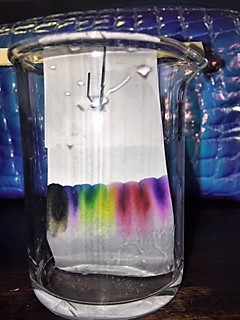
Because a spot is a blob, measure to the center of the spot every time and use the same ruler for both distances. Report Rf to two decimal places at most, since the measurement itself has about that precision. A higher Rf means the dye is more strongly drawn into the moving solvent than held by the paper. A spot with Rf near 1 barely stuck to the paper, and one near 0 barely moved.
Rf values are only comparable when the solvent, paper, temperature and origin position are the same. Mark the solvent front immediately after you remove the paper, because solvent evaporates from the paper and the front moves in the record. Keep the origin line above the solvent level, since a dye that starts in the solvent dissolves into the pool. If you are given two inks that run the same, you have two observations that agree, and the analysis can cite both.
Technique checklist, with the reason for each step:
- Draw the origin (baseline) in pencil, never pen. Graphite does not dissolve in the solvent, but pen ink would run and add its own spots.
- Keep the spot small and concentrated (spot, let it dry, spot again).
- The solvent level must sit below the origin line, or the sample dissolves into the solvent pool instead of climbing.
- Cover the beaker or chamber so the air inside is saturated with solvent vapor. This stops solvent evaporating from the paper, which would make the front uneven and the Rf values unreliable.
- Remove the strip before the solvent reaches the top, and mark the front at once.
- Run unknowns and known references side by side on the same paper in the same solvent.
What a match means. If a suspect's pen gives the same set of spots at the same Rf values as the scene ink, the inks are consistent: the pen is the same type (same ink formulation) as the one used, which is class evidence. It does not prove it was that particular pen, because every pen of that brand and model carries the same ink. A difference in even one spot excludes the pen.
Thin-layer chromatography (TLC) uses the same principle with a thin layer of adsorbent, usually silica gel (SiO₂) or alumina (Al₂O₃), coated on a glass, plastic or aluminum plate as the stationary phase. Both are very polar. TLC runs faster than paper, gives sharper and better-resolved spots, and works with a wide range of solvents. The solvent is usually less polar than the plate; a mixture such as hexane with some ethyl acetate is used because pure hexane is so non-polar that polar compounds stay stuck at the origin, while adding the more polar ethyl acetate lets them move up. On paper, colorless substances such as sugars or vitamin C (both very polar, so they cling to the water-holding paper and usually have low Rf values) are revealed by spraying a reagent (sugars do not show under UV light, though some compounds such as vitamin C absorb UV); on TLC, colorless spots are found under ultraviolet light (plates often contain a fluorescent indicator) or by staining with iodine vapor. As on paper, the more polar a compound, the lower its Rf on silica.
Vocabulary and other kinds of chromatography. Washing a substance through and off the stationary phase with the mobile phase is called elution, and the solvent that does it is the eluent. The main kinds differ in phases and in what drives the separation: paper (partition between solvent and water held on cellulose), thin-layer and column (adsorption onto silica or alumina), gas chromatography (an inert carrier gas carries vaporized samples through a coated column; used for drugs, accelerants and alcohol), HPLC (liquid pumped at high pressure through a packed column), ion-exchange (separates by charge), reverse-phase chromatography (the stationary phase is non-polar and the mobile phase polar, so polar compounds now travel farthest) and affinity chromatography (separates by a specific biological binding, such as enzyme and substrate or antibody and antigen).
Physical evidence (3.f)
Physical evidence is anything that can link a person, place or object to a crime. Two vocabulary pairs come up constantly. Class evidence narrows the source to a group (blood type, a shoe model, a fiber type, a fingerprint pattern class, a soil type). Individual evidence can be traced to a single source (a fingerprint compared by its minutiae, a nuclear DNA profile, a shoe with unique cuts and wear). Direct evidence proves a fact by itself (an eyewitness, a confession); circumstantial (indirect) evidence, which includes almost all physical evidence, requires an inference.
Fingerprints
Friction ridges fall into three pattern classes. A loop has ridges that enter from one side, curve back and exit on the same side. A whorl has ridges that form circles or spirals. An arch has ridges that enter from one side and exit the other with a rise in the middle. Loops are the most common class, roughly 60 to 65% of people, then whorls at roughly 30 to 35%, with arches the rarest at about 5%. Two landmarks help you classify. A core is the center of the pattern, and a delta is the triangular spot where ridge flows meet. A loop has one delta, a whorl has two or more, and a plain arch has none.

The eight pattern types. Each class has subtypes, giving the eight patterns of the classic Henry system:
| Class | Subtype | How to recognize it | Cores and deltas |
|---|---|---|---|
| Arch (about 5%) | Plain arch | Ridges flow in one side and out the other with a gentle wave; one of the rarest patterns | No delta, no true core |
| Tented arch | Like a plain arch but with a sharp spike or upthrust in the center | No true loop; may show a delta-like angle | |
| Loop (about 60–65%) | Ulnar loop | Opens (the ridges flow out) toward the little finger, the side of the ulna bone; far more common | One core, one delta |
| Radial loop | Opens toward the thumb, the side of the radius bone; seen mostly on index fingers | One core, one delta | |
| Whorl (about 30–35%) | Plain whorl | Ridges make at least one complete circuit (circles, ovals or spiral) | Two deltas |
| Central pocket loop whorl | Mostly a loop, with a small whorl (pocket) at its center | Two deltas | |
| Double loop whorl | Two separate loops, often S-shaped, whose ridges wrap around each other | Two deltas | |
| Accidental whorl | A mixture of two or more patterns, or a pattern that fits no other type | Two or more deltas |
To tell ulnar from radial on a print you must know which hand made it. On a standard inked card, an ulnar loop from a right-hand finger opens toward the right and one from a left-hand finger opens toward the left; a radial loop opens the opposite way.
How fingerprints form. Friction ridges are raised lines of the epidermis that follow the dermal papillae, the bumpy upper boundary of the dermis beneath. They originate in the basal layer (stratum basale), the deepest layer of the epidermis at the junction with the dermis, which is why a cut or burn that reaches this layer leaves a permanent scar in the print. They begin forming at around 10 weeks after conception (tests quote 9 to 11 weeks) and the individual ridge arrangement is set by about weeks 16 to 17 (the NIJ Fingerprint Sourcebook gives roughly 10½ to 16 weeks), as ridges grow, meet and push against one another under the pressure of growth and movement in the womb. Because those local stresses are essentially random, even identical twins (same DNA) have different fingerprints, although the general pattern type is partly inherited. Prints stay the same for life unless the dermal layer is scarred; burns, cuts and heavy manual work can blur or wear the surface ridges for a time. A few people are born without fingerprints (the rare condition adermatoglyphia). Two premises underlie fingerprint identification: no two prints are exactly alike, and a person's prints do not change over a lifetime. Biologically, friction ridges improve grip on surfaces and increase touch sensitivity; the pores along each ridge release sweat, which is why touching leaves a print.
Minutiae (ridge characteristics, also called Galton details) are the points where individual ridges end, split or join. They are what make a print individual:
| Minutia | Description |
|---|---|
| Ridge ending | A ridge stops abruptly |
| Bifurcation (fork) | One ridge splits into two |
| Dot | A ridge so short it is a point |
| Short ridge (island, independent ridge) | A short isolated ridge |
| Enclosure (lake, eye) | A ridge splits and rejoins, enclosing a space |
| Spur (hook) | A short branch off a ridge |
| Bridge (crossover) | A short ridge connecting two parallel ridges |
| Double bifurcation and trifurcation | A ridge that splits twice, or into three |
The core and delta are pattern landmarks, not minutiae, but tests sometimes list them alongside. A full print carries dozens to more than a hundred minutiae. There is no fixed number of matching points required in the United States today; the conclusion is the examiner's judgment, verified by a second examiner. Older rules and other countries used thresholds of about 8 to 16 matching points (Edmond Locard proposed that 12 or more clear matching points gave certainty).
Ridge counting is how loops are subclassified: draw an imaginary line from the delta to the core and count the ridges that cross it, not counting the delta and core themselves.
Henry classification (primary). The Henry system (Sir Edward Henry, 1890s) gives each set of ten prints a primary classification from where the whorls fall. Number the fingers 1 to 10: right thumb 1, right index 2, right middle 3, right ring 4, right little 5, then left thumb 6 through left little 10. A whorl on a finger scores points: fingers 1 and 2 score 16, fingers 3 and 4 score 8, fingers 5 and 6 score 4, fingers 7 and 8 score 2, fingers 9 and 10 score 1. Arches and loops score 0.
Types of prints by how they were left:
Prints also differ by how they were left. A patent print is visible without treatment, such as a bloody or ink print. A plastic print is an impression in a soft material such as wax or paint. A latent print is an invisible impression of the friction ridges, made when sweat and oils transfer from the skin to a surface, and it must be developed. Latent prints need development methods that match the surface. Fingerprint powder adheres to the oily residue left by the skin and suits smooth, non-porous surfaces. Iodine fuming deposits a brown stain that fades. Cyanoacrylate ("superglue") fuming forms a white deposit on non-porous surfaces. Ninhydrin reacts with the amino acids in sweat to give a purple color and is used on porous surfaces such as paper (ninhydrin is one of the most frequent correct answers in the archive, with 19 questions). Wet-surface powder suspensions are used where a surface is wet.
What a latent print is made of. Fingertips have only eccrine sweat glands, whose sweat is about 99% water with dissolved salts (mostly sodium chloride), amino acids, urea and other trace compounds. Fingers also pick up oily sebaceous secretions (fatty acids, triglycerides, wax esters, squalene) by touching the face and hair. Each development method targets one of these components:
ReferenceLatent print development methods· 11 rows
No rows match.
| Method | What it reacts with or sticks to | Result | Best surfaces | Notes |
|---|---|---|---|---|
| Powder dusting (black, white, gray, metallic) | Moisture and oils in the residue (physical adhesion) | Contrasting powder ridges, then lifted with tape | Smooth, non-porous, dry (glass, metal, painted surfaces) | The most common and simplest method; choose a powder color that contrasts with the surface |
| Magnetic powder | Same; iron-based powder applied with a magnetic wand, no brush | Fine, low-damage development | Non-porous and some semi-porous surfaces (plastic bags, glossy paper) | No bristles touch the print, so less smearing |
| Fluorescent powder | Same | Ridges glow under UV or an alternate light source | Multicolored or patterned surfaces | Photographed under the light source |
| Iodine fuming | Iodine crystals sublime (solid → gas); the vapor is absorbed by the oils and fatty acids (lipids) | Yellow-brown print | Porous and non-porous (paper, cardboard) | Temporary: the iodine sublimes back off and the print fades in minutes to hours, so photograph it at once or fix it (a starch solution turns it blue-black; α-naphthoflavone also fixes it). Non-destructive, so it can come before ninhydrin |
| Ninhydrin | Amino acids in eccrine sweat | Purple-blue product called Ruhemann's purple | Porous: paper, cardboard, raw wood | Slow (hours to a day or more); heat and humidity speed it. DFO (1,8-diazafluoren-9-one) also reacts with amino acids and fluoresces |
| Silver nitrate (AgNO₃) | Chloride ions from the salt (NaCl) in sweat: Ag⁺ + Cl⁻ → AgCl | Silver chloride darkens to gray-black silver when exposed to light | Porous: paper, raw wood | Used after iodine and ninhydrin because it is destructive; the developed print keeps darkening in light |
| Cyanoacrylate (superglue) fuming | Heated superglue vapor polymerizes on the moisture and residue of the print (polymerization is triggered by water and other compounds in the residue) | Hard, white polymer (polycyanoacrylate) ridges | Non-porous: glass, plastic, metal, foil, even greasy or wet-then-dried items | Done in a fuming chamber with ventilation (the vapor irritates eyes and lungs). Often followed by a fluorescent dye stain or powder |
| Small particle reagent (SPR) | Fatty components of the residue | Gray deposit | Wet non-porous surfaces (cars after rain) | A suspension of fine molybdenum disulfide particles sprayed on |
| Sticky-side powder, WetWop | Residue on adhesive | Developed print on tape | Adhesive side of tape | A powder suspension painted on; messy and specialized |
| Amido black, leucocrystal violet | Proteins or the heme in blood | Blue-black or violet ridges | Prints made in blood | For enhancing faint patent bloody prints |
| Alternate light source, laser | Natural fluorescence of residue or treated prints | Glowing ridges | Any | Non-destructive, often the first step |
Order of methods follows "least destructive first": visual examination and alternate light source, then iodine (it fades and leaves the print usable), then ninhydrin or DFO, then silver nitrate on porous items; on non-porous items, cyanoacrylate fuming before powder. Ninhydrin is a solid, so it is dissolved in a volatile solvent (ethanol or acetone, or a non-polar carrier solvent in commercial sprays) and sprayed or the item dipped. Powder dusting is quick and cheap, but it has weaknesses: the brush can smear or destroy fragile prints, too much powder fills in ridge detail, powder works poorly on porous, wet, sticky or textured surfaces, and once a print is dusted some chemical methods can no longer be used on it.

Databases and methods. AFIS (Automated Fingerprint Identification System) is any computer system that scans prints, encodes the type (mainly ridge endings and bifurcations), position and direction of their minutiae, and searches a database for candidate matches. IAFIS (Integrated AFIS) was the FBI's national system, replaced in 2014 by Next Generation Identification (NGI). The computer only proposes candidates; an examiner makes the identification using ACE-V: Analysis, Comparison, Evaluation, Verification (a second examiner checks). A CLPE is a Certified Latent Print Examiner. Dactyloscopy is the scientific name for fingerprint identification, and dermatoglyphics the study of skin ridge patterns.
DNA evidence
DNA evidence in this event is about comparing profiles. The scene sample and each suspect give a chromatogram or electropherogram, a graph of peaks at specific positions (loci). Forensic profiles are built from short tandem repeats (STRs), stretches where a short sequence repeats a variable number of times. Each peak marks an STR length (an allele). You inherit one allele per locus from each parent, so at each locus a person shows two peaks, or one taller peak if both alleles are the same length. A sample that shows three or more peaks at several loci suggests more than one person contributed.
Matching means the peaks line up at the same loci. A suspect whose peaks differ at even one locus is excluded from that comparison. A suspect whose peaks match at every locus is consistent with the sample, but the event does not ask you to estimate how rare that profile is.
DNA structure
DNA is deoxyribonucleic acid, a polymer of nucleotides, made of the elements carbon, hydrogen, oxygen, nitrogen and phosphorus (C, H, O, N, P). Each nucleotide has three parts: a phosphate group, a five-carbon sugar (deoxyribose) and a nitrogenous base. The four bases are adenine (A) and guanine (G), the double-ringed purines, and cytosine (C) and thymine (T), the single-ringed pyrimidines. (RNA has ribose instead of deoxyribose and uracil instead of thymine.) Sugars and phosphates alternate to form the backbone; the negative charge on the phosphates is what makes DNA move toward the positive electrode in electrophoresis.
Two strands wind into a double helix (described by Watson and Crick in 1953, using Rosalind Franklin's X-ray image), running in opposite directions (antiparallel, one 5'→3' and the other 3'→5'). Bases pair across the middle by hydrogen bonds: A with T (two hydrogen bonds) and G with C (three hydrogen bonds). This complementary pairing gives Chargaff's rule: in double-stranded DNA, %A = %T and %G = %C.

Where DNA is found. Nuclear DNA is in the nucleus of almost every cell; a smaller circular mitochondrial DNA (mtDNA) sits in the mitochondria. Mature red blood cells have no nucleus, so the DNA in blood comes from white blood cells. Useful sources at a scene: blood (white cells), saliva and the cheek cells in it (cups, cigarette butts, envelopes, stamps), semen, hair roots, skin cells left by touch ("touch DNA") and sweat, tissue under a victim's fingernails (often the attacker's skin and blood from scratching), urine (few cells), and bone and teeth, which preserve DNA for a long time and are used in old (cold) cases. About 99.9% of DNA is the same in all humans; profiling looks only at the small regions that vary.
| Nuclear DNA | Mitochondrial DNA | |
|---|---|---|
| Location and copies | Nucleus; two copies of each chromosome (one from each parent) per cell | Mitochondria; hundreds to thousands of copies per cell |
| Inheritance | Half from each parent | From the mother only |
| Discriminating power | High: STR profiles are close to individual (except identical twins) | Lower: shared by all maternal relatives |
| Survival | Degrades faster | Many copies and a circular molecule, so it survives in hair shafts, old bones and teeth, and degraded samples |
The Y chromosome passes from father to son, so Y-STRs trace a paternal line just as mtDNA traces a maternal one.
From sample to profile
Forensic DNA analysis has a standard sequence: collection (packaged dry in paper, not plastic), extraction (break open cells and purify the DNA), quantitation (measure how much human DNA there is), amplification (PCR copies the STR regions), separation and detection (capillary electrophoresis produces the electropherogram) and interpretation and comparison.
PCR (polymerase chain reaction) copies a targeted stretch of DNA millions of times, so a trace sample can be analyzed. It was invented by Kary Mullis in 1983 (Nobel Prize 1993). A reaction tube contains the template DNA, two primers (short single-stranded DNA pieces that match the two ends of the target region), a heat-stable DNA polymerase, the four DNA building blocks (dNTPs) and a buffer with magnesium ions. A machine called a thermal cycler repeats three steps:
- Denaturation, about 94–98 °C: heat breaks the hydrogen bonds and separates the double strand into two single strands.
- Annealing, about 50–65 °C: the mixture cools so the primers bind (base-pair) to their complementary sequences on each strand.
- Extension (elongation or synthesis), about 72 °C: the polymerase adds nucleotides to the end of each primer, building a new complementary strand.
The polymerase is Taq polymerase, from Thermus aquaticus, a bacterium that lives in hot springs (first isolated from Yellowstone). It survives the repeated near-boiling denaturation steps that would destroy human DNA polymerase, and it is most active at about 72–80 °C, which is why extension is run at about 72 °C.

DNA replication in cells (the process PCR imitates) happens during the S phase of interphase. It starts at origins of replication; helicase unwinds the helix, primase lays down short RNA primers, DNA polymerase builds the new strands 5'→3', and DNA ligase seals the gaps. Replication is semi-conservative: each new double helix keeps one old strand.
DNA sequencing reads the actual base order. In Sanger (dye-terminator) sequencing, each of the four bases is tagged with its own fluorescent dye and the output chromatogram shows one colored peak per position; the common display convention is A green, T red, C blue and G black.
RFLP versus STR. The first DNA fingerprints (Alec Jeffreys, 1984) used RFLP (restriction fragment length polymorphism). Restriction enzymes cut DNA at specific short recognition sequences (often palindromes), some leaving staggered "sticky" ends and some blunt ends; DNA ligase can join cut ends. Differences between people in the lengths of long repeat regions (VNTRs, minisatellites) produced fragments of different lengths, visualized on a gel with a labeled (originally radioactive) probe after Southern blotting. RFLP needs a large amount of undegraded DNA and takes weeks. STR analysis replaced it: STRs (microsatellites) are short repeats of 2 to 7 bases, usually 4 (for example GATA repeated 8 to 15 times), PCR can copy them from tiny or partly degraded samples, many loci are copied at once (multiplexing), and fluorescent tags let capillary electrophoresis read the lengths automatically. The FBI's CODIS (Combined DNA Index System) uses 20 core STR loci (13 before 2017); the large number of possible allele combinations across that many loci makes a full profile extremely rare.
Gel electrophoresis separates DNA fragments by size. Samples are loaded into wells at the negative end (cathode) of a gel; DNA's negatively charged phosphate backbone pulls it toward the positive electrode (anode). The gel is a mesh, so smaller fragments move faster and farther, and larger fragments stay near the wells. A DNA ladder (size marker) of known fragment lengths runs in its own lane to estimate the sizes of unknowns. Distance traveled depends on fragment size, gel concentration (a denser gel has smaller pores and slows large fragments more), voltage (higher voltage runs faster), run time, and the DNA's shape (supercoiled, nicked or linear forms of the same DNA run differently). Agarose (from seaweed) gels separate larger fragments; polyacrylamide gels separate small fragments with high resolution and are the basis of sequencing gels. For the same reason, a high-percentage gel (for example 2% agarose) is used to resolve small fragments, and a low-percentage gel (for example 0.7%) to resolve large ones. DNA is invisible, so it is stained, for example with ethidium bromide (glows orange under UV light; a mutagen, handled with gloves) or the safer SYBR Green or SYBR Safe dyes, and a colored loading dye shows how far the run has progressed.

Reading an electropherogram
In an electropherogram the x-axis is fragment size (base pairs) and the y-axis is signal strength (relative fluorescence units, RFU). Loci are labeled across the top (for example D8S1179, TH01, FGA), and each peak is labeled with its allele number, the number of repeats. At each locus look for:
- One peak: homozygous (both alleles the same length).
- Two peaks: heterozygous (one allele from each parent).
- Three or more peaks at several loci: a mixture of two or more people.
- Amelogenin: a sex marker; X only = female, X and Y = male.

Footwear, tire treads and soil
Shoe prints and tire treads are compared by two kinds of features. Class characteristics are shared by every item of that type, such as the tread design and size. Individual characteristics are acquired through use: wear patterns, cuts, nicks and embedded stones. A class match only says the shoe could be the one; individual features make the link stronger. Wear usually shows first at the back outer edge of the heel (where most people strike the ground) and under the ball of the foot and the toe, and the wear pattern reflects the wearer's gait, so these areas carry the most individual detail. Impressions also carry movement clues. Stride length grows with speed, a runner puts more weight on the toe, and smearing or drag marks show direction. Treat these as tentative, qualitative conclusions: the manual says you do not perform speed calculations on footwear. Tire treads work the same way, with tread pattern and wear linking to a vehicle and skid marks showing direction of travel.
Kinds of shoe marks. The fingerprint vocabulary carries over. A patent (visible) print is left in a substance such as mud, dust, paint or blood on a flat surface; it is two-dimensional and is often called an imprint. A plastic print is a three-dimensional impression pressed into a soft material such as mud, sand, snow or soil. A latent shoe print is invisible until it is developed with powder, chemicals or oblique light; a bloody footprint that has been cleaned up can be revealed with luminol.
Recording and collecting, always in this order:
- Photograph first, with a scale (ruler) in the frame and the camera perpendicular (directly above) to the print to avoid distortion. Use oblique lighting (a light held low to the side) so the edges and depth of the tread cast shadows. Both 2-D and 3-D prints are photographed; a print is never "only cast".
- Lift 2-D prints: an electrostatic dust lifter charges a film so that dust from the print jumps onto it; gelatin and adhesive lifters also work.
- Cast 3-D impressions with dental stone (a hard gypsum plaster), poured gently so it does not damage detail. Prints in snow are first sprayed with a snow wax so the warm, setting cast does not melt them.
Reading a trail. The toe points the way the person was walking, so a print whose heel points east was made by someone walking west. A deeper print means more weight (a heavier person or one carrying a load) or softer ground. Walking leaves a clear heel strike and a regular, shorter stride; running leaves longer strides and prints with a heavier toe and lighter heel, sometimes with soil thrown backward. Overlapping prints show order: the crisp print on top was made last. Tracks can also show the number of people and where they entered and left.
Tires. The tread design and its dimensions identify the tire make and model (using tread databases), and track width (the distance between the left and right tire centers) and wheelbase (front to rear axle) narrow the vehicle. Individual wear, cuts and embedded stones link one tire. Skid marks show braking and direction; curved yaw marks show a sliding turn.
Soil is compared by its composition, color, texture and particle size as the scenario describes them. A soil sample from a suspect's shoe or car is consistent with a scene location only if several features match. Soil is supportive evidence: it can exclude a location with certainty when the composition differs clearly, but a match rarely identifies one place by itself.
Soil composition and texture
Soil is a mixture of mineral particles, organic matter (humus, decomposed plant and animal material), water and air. A good agricultural soil is roughly half solids (about 45% minerals and 5% organic matter) and half pore space, shared about equally by water and air. The mineral particles are classed by size (USDA scale):
| Separate | Particle size | Feel | Water behavior |
|---|---|---|---|
| Gravel | Larger than 2 mm | — | — |
| Sand | 0.05–2 mm (largest) | Gritty | Large pores: drains fast, holds little water or nutrients |
| Silt | 0.002–0.05 mm | Smooth, floury | Intermediate |
| Clay | Smaller than 0.002 mm (smallest) | Sticky when wet, hard when dry | Tiny pores: holds water and nutrients, drains poorly |
Loam is a balanced mix, roughly 40% sand, 40% silt and 20% clay, which drains well yet holds water and nutrients, so it is the best general soil for plants. Particle sizes are separated by sieving (gravel and sand) and by settling in water (sedimentation), since larger particles settle first.
The soil texture triangle turns percentages of sand, silt and clay into a texture class. Each side is one separate. Find the clay percentage on its side and follow that line across (clay lines run horizontally); find the sand percentage and follow its line up and to the left, parallel to the silt side; the point where they meet (the silt line will pass through it as a check) lies in the named region.

Key class boundaries, for when the figure is not in front of you: clay has 40% or more clay (with under 45% sand and under 40% silt); sand has more than 85% sand (and silt + 1.5 × clay under 15); silt has 80% or more silt and under 12% clay; loam has 7–27% clay, 28–50% silt and 52% or less sand; clay loam 27–40% clay with 20–45% sand; silty clay loam 27–40% clay with 20% or less sand; sandy clay loam 20–35% clay, under 28% silt and more than 45% sand. If given percentages do not add to 100 (for example because gravel or organic matter was removed), rescale them first: divide each by their total and multiply by 100.
Soil color gives quick clues. Dark brown or black: rich in organic matter (humus). Red, yellow or orange-brown: iron oxides (rust-colored, well-drained, oxidized iron). Gray, bluish or mottled: waterlogged, poorly drained soil where iron has been reduced. White or light gray: low in organic matter, or rich in calcium carbonate or leached sand, so a pale soil does not contain much humus. Examiners compare colors with a Munsell soil color chart.
The everyday soil types are described by their dominant texture and organic content:
| Soil type | Feel and look | Water and nutrients | Typical pH |
|---|---|---|---|
| Sandy | Gritty, light-colored, loose | Drains fast, dries out, low in nutrients (they wash out) | Often slightly acidic |
| Silty | Smooth, soapy, floury when dry | Holds moisture, fertile, compacts easily | Near neutral |
| Clay | Sticky and moldable when wet, cracks when dry | Holds water and nutrients, drains poorly, heavy | Variable, often near neutral |
| Loam | Crumbly mix of all three | Drains well and still holds water and nutrients; best for plants | Near neutral (about 6 to 7) |
| Peaty | Dark brown to black, spongy, high in organic matter | Holds a lot of water | Acidic (often below 5) |
| Chalky (calcareous) | Pale, stony, often with white lumps | Free-draining | Alkaline (above about 7.5) |
Porosity is the fraction of a soil's volume that is pore space; permeability is how easily water flows through it. They are not the same: clay has high porosity (many tiny pores) but low permeability, because its pores are too small and poorly connected for water to move through quickly, while sand has larger connected pores and high permeability. Loess is wind-deposited silt, a fine, yellowish, crumbly soil made mostly of silt with some sand and little clay.
Soil pH ranges from strongly acidic peat and pine-forest soils (pH 3.5–5) to alkaline chalky and desert soils (above pH 7.5); most plants prefer about pH 6 to 7. Soil horizons (layers) from the top: O (organic litter and humus), A (topsoil, minerals mixed with humus), E (leached zone, where present), B (subsoil, where clay and iron accumulate), C (weathered parent rock) and R (bedrock). A density-gradient tube, filled with layered liquids of increasing density, lets soil particles settle into a band pattern that can be compared between samples. Soil is class evidence: it can exclude a location clearly but rarely points to one spot by itself.
Spatter and bloodstains
Spatter analysis links the shape of a drop to how it moved. A drop that falls straight down strikes the surface with little sideways motion, so its stain is round with no tail. A drop that hits at an angle leaves an elongated stain with a tail, and the more it is stretched, the shallower the angle. The narrow end, or tail, points in the direction the drop was traveling, so the source lies on the opposite side of the stain from the tail. Small satellite drops around a main stain mean the drop struck with enough force to throw off smaller droplets.
Velocity shows in drop size and spread. Crime-scene texts usually group spatter by the energy that made it: low velocity (drips and passive stains, large drops of about 4 mm or more), medium velocity (blunt-force impacts and cast-off, medium-sized drops) and high velocity (such as a gunshot, a fine mist of tiny drops). If a question gives you a photo, ask first whether the drops are large and few or small and numerous. A set of stains with different shapes, sizes and angles suggests more than one event or more than one direction of motion. An archive question about a suspect who claims one event has the key "multiple events with different velocities or angles."
The manual says spatter speed and direction should be analyzed without calculations. Answer in words: round drop (vertical fall), elongated drop (angled impact), satellite spatter (force at impact), large drops (low velocity), fine mist (high velocity).
| Category (older velocity terms) | Force behind it | Typical stain size | Examples |
|---|---|---|---|
| Low velocity (passive) | Gravity alone, up to about 5 ft/s | 4 mm or larger | Drips from a wound or weapon, pools, flows |
| Medium velocity | About 5 to 25 ft/s | About 1 to 4 mm | Blunt-force beating, stabbing, cast-off |
| High velocity | About 100 ft/s or more | Smaller than 1 mm, a fine mist | Gunshot, explosion, high-speed machinery |
Modern terminology groups stains by mechanism instead:
- Passive stains form by gravity alone: drips, drip trails, flows and pools.
- Transfer stains form when a bloody object touches a surface: a bloody fingerprint, shoeprint or hair swipe. A swipe is made when a bloody object moves onto a clean surface (it fades in the direction of motion, often with a feathered edge); a wipe is made when a clean object moves through an existing wet stain.
- Projected (spatter) stains form when force throws blood: impact spatter (a blow or gunshot), cast-off (blood flung from a swinging weapon, often in lines of drops; a blunt object swung with force), arterial spurts (bright red blood pumped from a breached artery, in arcs or zigzags that follow the pulse) and expirated blood (blown from the mouth or nose, often with air bubbles).
- A void is a gap in a pattern where something or someone blocked the blood, showing that an object was moved later.
Drop shape and surface. On a smooth, hard surface (glass, tile) a drop leaves a round stain with smooth edges. On a rough or porous surface (wood, concrete, fabric) the same drop breaks up at the edges into spines (pointed edge projections) and satellite drops. A drop falling from greater height leaves a somewhat larger stain, up to a limit (once the drop reaches terminal velocity). The narrower the angle of impact, the longer and thinner the stain; as the angle approaches 90°, the stain approaches a circle. In short, the appearance of a stain depends on the angle of impact, the velocity (force) behind the drop, the surface texture, the volume of blood and the distance fallen; blood's surface tension is what holds a drop together in flight and makes it round until it strikes.
Finding hidden blood. Luminol reacts with the iron in the heme of hemoglobin (which catalyzes its oxidation by peroxide) and glows blue in the dark, revealing cleaned or invisible stains and footprints; it is sprayed and photographed in darkness.
Writing the crime-scene analysis (3.g)
The analysis is scored for reasoning, so write it as an argument. A structure that works under time pressure has five parts.
- Claim. Name the suspect you conclude is responsible, in one sentence.
- Evidence. List each piece of evidence that implicates that suspect, and cite the test or observation that supports it. Use your table.
- Consistency. For each conclusion, cite at least two observations or tests that agree. This is the step that separates an analysis from a list.
- Exclusion. Explain why each other suspect is not chosen. A single exclusion (a DNA peak that differs, an Rf that does not match) is enough for that suspect.
- Uncertainty. Name one alternative explanation or one limitation, such as recall, contamination, or a test that was not conclusive.
The supervisor may also add other crime-scene analysis questions to Part 3.g, so leave time for them after the main write-up.
Crime-scene principles and procedure
Locard's exchange principle (Edmond Locard, early 1900s) is the foundation of trace evidence: whenever two objects come into contact, material is transferred between them; "every contact leaves a trace". Hairs, fibers, soil and glass fragments carried from scene to suspect, or suspect to scene, are the classic examples.
Processing a scene follows a standard order: secure and isolate the scene (protect it from contamination); do an initial walk-through survey; document it with notes, photographs (overall, mid-range and close-up with a scale) and a sketch with measurements; search systematically; then collect, package and label each item.
| Search pattern | How it works | Best for |
|---|---|---|
| Line (strip) | Searchers walk side by side in parallel lines across the area | Large open outdoor areas |
| Grid | A line search done twice, the second time at right angles to the first | Thorough coverage of a defined area |
| Spiral | One searcher circles inward toward a center (or outward from it) | Small areas with few searchers |
| Zone (quadrant) | The area is divided into sections, each searched separately | Houses, rooms, vehicles |
| Wheel (ray) | Searchers move outward from a central point like spokes | Rarely used; circular areas |
Packaging and chain of custody. Biological evidence (blood, hair with roots, clothing) is air-dried and packaged in paper bags or envelopes, never sealed plastic, because trapped moisture lets bacteria and mold degrade DNA. Each item is packaged separately to prevent cross-transfer, sealed and labeled. Trace fibers and hairs are collected with forceps, tape lifts or a filtered vacuum. The chain of custody is the written record of everyone who handled an item, when and why, from collection to court; a gap in it can make evidence inadmissible. Evidence that points toward guilt is inculpatory; evidence that points away from it is exculpatory. Probative value is how strongly a piece of evidence proves the point it is offered for: unusual items (a rare fiber blend, a full DNA profile) have high probative value; common ones (white cotton fiber, a loop fingerprint pattern) have low. Primary transfer is direct, from source to recipient (a fiber from the attacker's sweater onto the victim). Secondary transfer is indirect, through an intermediate (the fiber passes to a car seat and then to a passenger), so finding a trace on someone does not prove direct contact.
Strategy: splitting the work and the time
Two students can cover the whole event if each person understands all of it, because the analysis draws on every lab part. A practical split is one partner on the 3.c unknowns (the highest-weighted part), while the other runs the chromatography, which takes time to develop, and the physical evidence questions. Both record observations in the same team table. Start slow tests (chromatography, anything that needs drying) early so they run while you do other work.
Plan the time. Spend the first minutes on the safety check and reading the scenario, because it tells you which containers are mixtures and which evidence matters. Then run the 3.c tests in the order above and fill in the table as you go. Reserve the last part of the period, not the last few minutes, for the analysis, since 3.g is a quarter of the score. Clean up as the supervisor directs, because a penalty of up to 10% applies to messy benches.
The cheat sheet is one letter-size sheet, both sides. Do not spend it on the identities of unknowns from a past tournament, because which listed materials appear, and in which containers, changes every time. Spend it on decision keys: a flow chart for the solids, the fiber burn table, the plastics density and burn table, the Rf formula with a reminder about the origin line, the Benedict's and iodine color meanings, the metal reaction and density table and the fingerprint classes. The condensed facts at the end of this guide is a starting point.
Common pitfalls
The pitfalls below come from two sources: the identities that are most often the correct answer in the archive (synthetic, PETE, animal, cornstarch, sodium acetate, PVC, vegetable, vitamin C, calcium carbonate) and the false statements that appear most often in true-or-false questions.
Assuming white powders are inert
Many white solids react. Baking soda fizzes with acid, vitamin C is acidic, and calcium carbonate reacts with acid. A statement that all white powders are chemically inert is false.
Expecting sugar to be Benedict's-positive
Table sugar (sucrose) is non-reducing and stays blue. Glucose and fructose give the color change. Expecting a brick-red result for every sugar is the most common Benedict's error.
Expecting iodine to ignore vitamin C
Iodine is a starch test, but vitamin C is a reducing agent that converts iodine to colorless iodide, so the brown iodine color fades instead of staying brown or turning blue-black. Record a fading brown color as a vitamin C clue, not as "no reaction".
Treating vitamin C as a base
Ascorbic acid lowers the pH of water and reduces the hydroxide ion concentration. A statement that dissolving more vitamin C increases OH⁻ is false; the basic solids, sodium bicarbonate and sodium acetate, are the ones that raise OH⁻.
Identifying a carbonate by fizz alone
Both carbonates and bicarbonates fizz. Water solubility separates calcium carbonate (insoluble) from sodium bicarbonate (soluble), and pH separates the solutions.
Forgetting that latent prints need development
Latent prints are invisible. Patent prints are visible, and plastic prints are impressions. Mixing these up loses points in both fingerprint and physical-evidence questions.
Calling a plastic by density alone
Floating in water splits the plastics into two groups, not seven identities. HDPE, LDPE and PP all float, and PETE, PVC, polystyrene and PMMA all sink. Finish the job with a density solution or a burn result.
Reading a spatter as a speed calculation
The manual expects qualitative answers: round drops fall straight down, elongated drops show an angle, satellite spatter shows force, and fine mist shows high velocity. Do not attempt a numeric speed.
Expecting Rf values to compare across solvents
Rf depends on the solvent, paper and origin. Compare an unknown only with references run in the same conditions. Rf values always lie between 0 and 1; a number outside that range means a measurement error.
Mixing up which way DNA runs
DNA is negative, so it runs toward the positive electrode (anode), and the small fragments travel farthest. Large fragments stay near the wells at the negative end.
Calling hair or fiber individual evidence
Without a root (for nuclear DNA), a hair is class evidence; so is a mass-produced fiber. Fingerprints compared by minutiae and nuclear DNA profiles are the individual evidence in this event.
Concluding guilt from one matching clue
A single match, such as a hair or a fiber type shared by many people, is not an identification. Name the alternative suspects, and say why the evidence excludes them or does not.
Breadth reference
Tests reward vocabulary. Each row below is a term that shows up in Crime Busters and Forensics practice questions, in alphabetical order. Type a word in the filter box to find it. The sections above explain the ideas behind most of these terms.
ReferenceGlossary of terms· 111 rows
No rows match.
| Term | Meaning |
|---|---|
| ACE-V | Fingerprint comparison method: Analysis, Comparison, Evaluation, Verification |
| Addition polymerization | Monomers with C=C double bonds join with no by-product (PE, PP, PVC, PS, PMMA) |
| Adermatoglyphia | Rare inherited absence of fingerprints |
| AFIS / IAFIS / NGI | Automated (FBI: Integrated) Fingerprint Identification System; NGI replaced IAFIS in 2014 |
| Aggregates (peds) | Clumps of soil particles held together by clay, humus and electrostatic attraction (which weakens quickly with distance between particles) |
| Allele | One version of a gene or STR length; a person has two per locus |
| Amelogenin | Sex-typing marker in STR kits (X only = female; X and Y = male) |
| Amido black | Protein stain that enhances fingerprints made in blood |
| Amphoteric | Reacts as both an acid and a base (water; Al, Zn and Sn metals with acids and with NaOH) |
| Amylose / amylopectin | Unbranched helical starch (blue-black with iodine) / branched starch |
| Anagen, catagen, telogen, exogen | Hair growth, transition, resting and shedding phases |
| Anode / cathode | Positive / negative electrode in electrophoresis and electrolysis (signs reverse in a battery); DNA moves toward the anode |
| Arch (plain, tented) | Fingerprint whose ridges flow in one side and out the other; about 5%; plain arch has no delta (a tented arch may show one) |
| Atactic, isotactic, syndiotactic | Random, same-side and alternating arrangements of polymer side groups |
| Bast fiber | Fiber from a plant stem: linen (flax), hemp, jute, ramie |
| Beilstein test | Hot copper wire touched to a sample gives a green flame if a halogen (PVC's chlorine) is present |
| Benedict's reagent | CuSO₄ + sodium citrate + sodium carbonate; brick-red Cu₂O with reducing sugars |
| Bifurcation | Minutia where one ridge splits into two |
| Birefringence | Different refractive index along and across a fiber; most fibers, especially synthetics, appear bright between crossed polarizers |
| Biuret test | Copper reagent turns violet with proteins (peptide bonds) |
| Capillary action | Liquid climbing a narrow space (paper fibers) against gravity; drives paper chromatography |
| Cast-off | Blood flung in lines of drops from a swinging object |
| Catalase | Enzyme in yeast, liver and blood that splits H₂O₂ into water and O₂ |
| Chain of custody | Written record of everyone who handled an item of evidence |
| Chargaff's rule | In double-stranded DNA, %A = %T and %G = %C |
| Class evidence | Narrows a source to a group (fiber type, shoe model, blood type, hair) |
| CODIS | FBI's Combined DNA Index System; 20 core STR loci |
| Compound light microscope / polarized light microscope | Magnifies fibers and hairs with visible light / adds crossed polarizing filters so birefringent fibers (most synthetics, and also natural fibers such as cotton, flax and silk) appear bright against a dark field and their optical properties can be measured |
| Condensation polymerization | Monomers join and release a small molecule such as water (PETE, nylon, PC, proteins, starch) |
| Copolymer / homopolymer | Polymer made from two or more different monomers (LLDPE, ABS) / from one monomer (PE, PP, PVC, PS) |
| Core | Center of a loop or whorl pattern |
| Coronal scales | Crown-like hair scales circling the shaft (rodents, bats) |
| Cortex | Middle hair layer; holds pigment and gives strength |
| Cross-linking | Covalent bonds between polymer chains (thermosets, vulcanized rubber) |
| Cuticle | Outer scale layer of hair |
| Cyanoacrylate fuming | Superglue vapor polymerizes on prints on non-porous surfaces, leaving white ridges |
| Dehydration synthesis | Joining two molecules by removing water (forms glycosidic and peptide bonds) |
| Delocalized electrons | The "sea" of mobile outer electrons in a metal, which carries current and heat, so metals conduct |
| Delta | Triangular meeting point of ridge flows; loop 1, whorl 2, plain arch 0 |
| Denaturation (PCR) | Heating DNA to about 94–98 °C to separate the strands |
| Denier | Fiber fineness: grams per 9000 m |
| Density gradient tube | Column of layered liquids used to compare soil samples |
| Dermal papillae | Bumps of the dermis that shape the friction ridges |
| Dermatoglyphics | Study of skin ridge patterns |
| Devulcanization | The reverse of vulcanization: breaking the sulfur cross-links so rubber can be reprocessed |
| Dilution and pH | Diluting an acid raises its pH toward 7; diluting a base lowers its pH toward 7; neither crosses 7 |
| Disulfide bond | S–S link between cysteines in keratin; sets hair shape; sulfur smell on burning |
| Electropherogram | Graph of STR peaks (size vs fluorescence) from capillary electrophoresis |
| Electrostatic dust lifter | Charged film that lifts dusty 2-D shoeprints |
| Elution / eluent | Washing compounds along the stationary phase / the solvent that does it |
| Emission spectrum | Wavelengths given off by excited atoms; the source of flame-test colors |
| Endothermic / exothermic | Absorbs heat (feels cold) / releases heat (feels warm) |
| Essential amino acids | The nine the body cannot make and must eat: histidine, isoleucine, leucine, lysine, methionine, phenylalanine, threonine, tryptophan, valine |
| Eumelanin / pheomelanin | Brown-black / red-yellow hair pigments |
| Eumelanin building blocks | Formed from the amino acid tyrosine via DHI and DHICA units; pheomelanin adds sulfur from cysteine |
| Exculpatory / inculpatory | Evidence pointing away from / toward guilt |
| Ferrous | Containing iron |
| Fibroin / sericin | Structural core protein / gum coating of silk |
| Friction ridges | Raised skin ridges on fingers, palms and soles |
| Glycosidic bond | Bond joining sugar units |
| Henry classification | Ten-print classification; primary = (1 + values of whorls on even fingers)/(1 + values of whorls on odd fingers) |
| Humus | Decomposed organic matter that darkens soil |
| Ice density | Ice (0.92 g/cm³) floats because hydrogen bonds lock water molecules into an open hexagonal lattice with more space than the liquid |
| Imbricate scales | Flat, overlapping hair scales (humans and many animals) |
| Impression / imprint | 3-D mark in a soft material / 2-D mark on a surface |
| Individual evidence | Traceable to one source (fingerprint minutiae, nuclear DNA profile, unique shoe wear) |
| Keratin (α, β) | Hair, wool and nail protein (α-helix) / feather, beak and reptile-scale protein (β-sheet) |
| Latent print | Invisible print needing development |
| Limestone, chalk, marble / calcite, aragonite | Rocks made mostly of CaCO₃ / the mineral forms of CaCO₃ (polymorphs; vaterite is a third) |
| Locard's exchange principle | Every contact leaves a trace |
| Locus (plural loci) | A specific position on a chromosome, such as an STR site |
| Loop (ulnar, radial) | Ridges enter and leave on the same side; 60–65%; opens to little finger (ulnar) or thumb (radial) |
| Luminol | Glows blue with the heme iron of blood; finds hidden stains |
| Medulla | Central canal of a hair |
| Medullary index | Medulla width ÷ hair width; human ≤ 1/3, animal ≥ 1/2 |
| Mercerization | NaOH treatment that makes cotton rounder, stronger and shinier |
| Minutiae | Ridge details: endings, bifurcations, dots, islands, enclosures, spurs, bridges |
| Mitochondrial DNA | Maternally inherited DNA in mitochondria; found in hair shafts and old bone |
| Mobile / stationary phase | Moving solvent / fixed material (paper, silica) in chromatography |
| Molecular sieving | The gel's mesh slows large DNA fragments more than small ones; the separation mechanism of gel electrophoresis |
| Monomer / polymer | Small repeating unit / long chain built from it |
| Neutralization | Acid + base → salt + water |
| Ninhydrin | Reacts with amino acids in sweat to give Ruhemann's purple; for paper |
| Patent print | Visible print in blood, ink, paint or dirt |
| Pigment distribution (hair) | Human pigment is even or denser toward the cuticle; animal pigment is often banded or central. More reliable than a borderline medullary index |
| Plastic print | 3-D print pressed into wax, clay, putty or paint |
| Primer | Short DNA strand that marks where the polymerase starts copying |
| Probative value | How strongly evidence proves a point |
| Purine / pyrimidine | Double-ring bases A and G / single-ring bases C and T (U in RNA) |
| Reducing sugar | Sugar with a free aldehyde or ketone that reduces Cu²⁺ (glucose, fructose, maltose, lactose) |
| Regenerated fiber | Natural polymer dissolved and re-spun (rayon, lyocell; acetate is a closely related modified cellulose) |
| Resin identification code | Numbers 1–7 on plastics: PETE, HDPE, PVC, LDPE, PP, PS, other |
| Restriction enzyme | Enzyme that cuts DNA at a specific recognition sequence |
| Rf | Retention (retardation) factor = spot distance ÷ solvent-front distance |
| RFLP | Restriction fragment length polymorphism; the first DNA fingerprinting method |
| Ruhemann's purple | Purple product of ninhydrin and amino acids |
| Satellite spatter | Small drops thrown off around a parent bloodstain |
| Secondary transfer | Trace evidence moved indirectly through an intermediate person or object |
| Silk shimmer | Silk's triangular, prism-like cross-section reflects and refracts light at several angles, giving its luster; small glycine and alanine side chains let fibroin sheets pack tightly, giving strength |
| Small particle reagent | Molybdenum disulfide suspension for prints on wet surfaces |
| Spinous scales | Pointed, petal-like hair scales (cats, mink, seals) |
| STR | Short tandem repeat: 2–7 base repeat whose count varies between people |
| Sublimation | Solid turning directly into gas (iodine crystals in iodine fuming) |
| Swipe / wipe | Bloody object moving onto a clean surface / object moving through a wet stain |
| Taq polymerase | Heat-stable DNA polymerase from Thermus aquaticus; works at 72 °C |
| Thermoplastic / thermoset | Re-meltable / irreversibly cross-linked plastic |
| Thymine dimer | UV light links two adjacent thymines on a DNA strand, damaging the DNA; one reason sunlight degrades DNA evidence |
| Triiodide | I₃⁻, the soluble form of iodine in KI (Lugol's) solution |
| VNTR | Variable number tandem repeat (minisatellite); the repeat type used in RFLP fingerprinting |
| Void pattern | Gap in a bloodstain pattern where an object blocked the blood |
| Whorl (plain, central pocket, double loop, accidental) | Circular or spiral ridge pattern; 30–35%; two or more deltas |
ReferenceConstants and numbers worth memorizing· 15 rows
No rows match.
| Quantity | Value |
|---|---|
| Fingerprint pattern shares | Loops 60–65%, whorls 30–35%, arches about 5% |
| Henry whorl values (fingers 1–10) | 16, 16, 8, 8, 4, 4, 2, 2, 1, 1 |
| Medullary index | Human about 1/3 or less; animals about 1/2 or more |
| Hair growth | About 1 cm per month; anagen 2–7 years, catagen 2–3 weeks, telogen about 3 months |
| PCR temperatures | Denature 94–98 °C, anneal 50–65 °C, extend 72 °C |
| PCR copies | 2ⁿ after n cycles (2²⁰ ≈ 1.05 million) |
| DNA H-bonds | A–T 2, G–C 3 |
| Soil particle sizes | Sand 0.05–2 mm, silt 0.002–0.05 mm, clay < 0.002 mm |
| Loam | About 40% sand, 40% silt, 20% clay |
| Spatter drop sizes | Low velocity ≥ 4 mm, medium 1–4 mm, high < 1 mm |
| Plastic densities (g/cm³) | PP 0.90, LDPE 0.92, HDPE 0.95, PS 1.05, PMMA 1.18, PC 1.20, PVC 1.3–1.45 (rigid), PETE 1.38 |
| Density solutions (g/mL) | 70% isopropyl 0.87, oil 0.92, water 1.00, 10% NaCl 1.07, 25% NaCl 1.19, saturated NaCl 1.20 |
| Metal densities (g/cm³) | Mg 1.74, Al 2.70, Zn 7.1, Sn 7.3, Fe 7.9, Cu 9.0 |
| Liquid pH | Lemon ≈ 2, vinegar 2.4–3, water 7, ammonia 11–12 |
| Sodium flame line | About 589 nm (yellow) |
How tournaments test this
The archive has 5,730 Crime Busters questions from 106 public Division B tournament tests. Crime Busters is a Division B event, so that is the whole picture of how it is tested. (Practice on scio.ly uses the Crime Busters question bank, 3,130 Division B questions: about 2,100 exported from or matching these archive tests and about 1,000 from older tournament tests the archive does not have. The Division C Forensics bank is a different event and is not used here.)
| Question type | Archive questions | Share |
|---|---|---|
| Free response | 4,929 | 86.0% |
| Multiple choice | 561 | 9.8% |
| Multi-select | 144 | 2.5% |
| True or false | 61 | 1.1% |
| Numeric | 35 | 0.6% |
Most of the test is free response, and most of that is explanation: expect "explain why" and "identify the unknown from these results" far more often than recall.
Subtopic tags show where the weight sits. Evidence Analysis is tagged on 3,005 questions (52.4%), Chemistry Lab on 2,244 (39.2%), Crime Scene on 715 (12.5%), Fingerprints on 518 (9.0%) and DNA on 306 (5.3%). The tags overlap, so the percentages sum to more than 100. By topic, the largest shares are plastics and polymer chemistry, hair, fibers, fingerprint types and development, and DNA methods and structure, followed by sugars and Benedict's, carbonates and the fizz test, iodine and starch, chromatography (concepts plus Rf calculations), metals, soil, the listed solids, spatter, flame tests and liquids. Notice how much of the written test is "why" chemistry: the structure of HDPE versus LDPE, addition versus condensation, why ninhydrin turns prints purple, why sucrose fails Benedict's test.
Recent seasons dominate. Of the archive questions, 65.8% come from the 2024, 2025 and 2026 seasons (814, 1,110 and 1,848 questions). The 2026 season alone supplies 32.3%, so practice on recent tests as well as older ones.
The recurring terms show what writers return to. "Hair" appears in 1,583 prompts across the archive and the question bank, "chemical" in 1,414, "powder" in 1,357, "blood" in 1,168, "fingerprint" in 843, and "fingerprints" in 701 more. Multi-word terms tell the same story: "flame test" appears in 391 prompts, "paper chromatography" in 224, "burn test" in 204, "Benedict solution" in 181, "gel electrophoresis" in 168 and "medullary index" in 98. Two terms appear in the prompts but are not in the Division B outline: "mass spectrum" (93 prompts across the archive and bank) and "thin layer chromatography" (50 prompts). Expect them only as data a scenario supplies.
Question style is consistent. A table-driven identification asks you to name an unknown from its test results ("UNKNOWN FABRIC J... Flame test: self extinguishing: NO, chars, smell burning paper, ashes gray... fabric type"). A true-or-false statement tests a misconception, such as "all ionic powders dissolve readily." A multi-select asks which techniques reveal prints or which forces influence a result. A free-response prompt asks you to explain a mechanism in a sentence or two. Practice all four, because free response is about nine times as common as multiple choice in the archive (4,929 versus 561 questions).
Among the most frequent correct answers are synthetic (47 questions), PETE (42), animal (38), cornstarch (30), sodium acetate (29), PVC (27), vegetable (26), vitamin C (25) and calcium carbonate (24). These are the identities you are most likely to see, and they are the ones your decision keys should handle quickly.
Practice on several tournaments rather than one. The archive's top sources are invitationals such as the Mason Satellite Invitational (2025, 155 archived questions), the Rickards SO Invitational (2023, 133) and the Rickards Mini Invitational (2022, 124). Of the archive questions, 1,601 have official answers that the site trusts for quizzes, and the quiz below uses only those.
Test yourself
These questions come from public tournament tests in the Scio.ly archive and question bank. Click an answer to check it; archive questions link to the full test. Explanations appear where the reasoning is not obvious.
- 1
True or False: Dissolving larger amounts of vitamin C in H₂O will increase the OH⁻ concentration of the solution. Sodium bicarbonate will do the opposite.
2 questions from this set are no longer available.
Practice more Crime Busters questions →
- 1
UNKNOWN FABRIC J Location: Fred's Closet TESTS: Flame Test: self extinguishing: NO, chars, SMELL: Burning paper, ASHES: Grey Microscope: FABRIC TYPE: ____
5 questions from this set are no longer available.
Practice more Crime Busters questions →
- 1
Which of the following compounds is classified as a reducing sugar?
From: Marquette - WI 2025-26, Division C
Practice more Crime Busters questions →
- 1
What fingerprinting technique would most likely be used on a glass surface?
From: UC Davis Invitational 2020, Division C
Practice more Crime Busters questions →
Condensed facts
A condensed version of the guide for your one double-sided sheet. Add your own reference-sample results from practice.
| Formula sheet | |
|---|---|
| CaCO₃ + 2HCl → CaCl₂ + H₂O + CO₂ | NaHCO₃ + HCl → NaCl + H₂O + CO₂ |
| NaHCO₃ + CH₃COOH → CH₃COONa + H₂O + CO₂ | Mg + 2HCl → MgCl₂ + H₂ |
| 2H₂O₂ → 2H₂O + O₂ (catalase, iodide) | H⁺ + OH⁻ → H₂O |
| 2NaHCO₃ → Na₂CO₃ + H₂O + CO₂ (heat) | C₆H₁₂O₆ → 2C₂H₅OH + 2CO₂ (yeast) |
| Rf = spot distance ÷ front distance (0–1) | MI = medulla width ÷ hair width |
| PCR copies = 2ⁿ | sin θ = width ÷ length (Forensics) |
| Metal | g/cm³ | Clue |
|---|---|---|
| Mg | 1.74 | Light; vigorous HCl; white flame |
| Al | 2.70 | Light; slow start (oxide); reacts with NaOH |
| Zn | 7.1 | Bluish; steady HCl; reacts with NaOH |
| Sn | 7.3 | Soft; very slow HCl |
| Fe | 7.9 | Magnetic; slow HCl |
| Cu | 9.0 | Red-brown; no HCl reaction |
| Liquid | pH | Clue |
|---|---|---|
| Lemon juice | ≈2 | Citrus, cloudy, fizzes NaHCO₃ |
| Vinegar | 2.4–3 | Sharp odor, clear, fizzes NaHCO₃ |
| Ammonia | 11–12 | Only base; pungent; red litmus → blue |
| Isopropyl alcohol | ≈7 | Medicinal; evaporates fast; flammable |
| Water | 7 | Control |
| H₂O₂ | ≈4–6 | Foams with yeast; slow fizz with iodine |
| Code | Plastic | Density | Key clue |
|---|---|---|---|
| 1 | PETE | 1.38 | Sinks in all salt; bottles; sweet, sooty; condensation |
| 2 | HDPE | 0.95 | Floats; linear; milk jugs; blue flame, candle wax |
| 3 | PVC | 1.3–1.45 (rigid) | Sinks; green Beilstein; self-extinguishes, HCl smell |
| 4 | LDPE | 0.92 | Floats; branched; bags; candle wax |
| 5 | PP | 0.90 | Floats (lowest); caps, yogurt cups; acetone-proof |
| 6 | PS | 1.05 | Barely sinks, floats in 10% NaCl; black soot; acetone dissolves |
| 7 | PMMA | 1.18 | Clear; sinks in 10% NaCl, near 25% NaCl (may float or hover); acetone softens; fruity, little smoke |
| Fiber class | Burn | Smell | Residue | Examples |
|---|---|---|---|---|
| Animal (protein) | Slow, self-extinguishes, curls | Burning hair | Crushable black ash | Wool (scales), silk (smooth, triangular) |
| Vegetable (cellulose) | Fast, keeps burning, afterglow | Burning paper | Soft gray ash | Cotton (twisted ribbon), linen (nodes) |
| Synthetic | Melts, shrinks, drips | Chemical (nylon: celery) | Hard bead | Nylon, polyester, acrylic, spandex |
| Hair | Human | Dog | Cat |
|---|---|---|---|
| MI | ≤ 1/3 | ≥ 1/2 | ≥ 1/2 |
| Medulla | Absent or fragmented | Wide, continuous | "String of pearls" |
| Scales | Imbricate | Imbricate | Spinous near root |
References and further reading
- Science Olympiad, 2027 Division B rules manual (Crime Busters, pages B16 and B17) and the Division B Chemistry Events Lab Equipment List: https://www.soinc.org
- Science Olympiad store, for recommended resources: https://store.soinc.org
- SciOly Wiki, Crime Busters (another summary of the event; compare it with the manual): https://scioly.org/wiki/index.php/Crime_Busters
- OpenStax, Chemistry 2e (acids and bases, solubility, redox and the activity series): https://openstax.org/details/books/chemistry-2e
- OpenStax, Biology 2e (DNA structure, PCR and electrophoresis): https://openstax.org/details/books/biology-2e
- National Human Genome Research Institute, Genetics Glossary (PCR, electrophoresis, STR and other terms): https://www.genome.gov/genetics-glossary
- National Institute of Justice, forensic science resources (crime-scene evidence and physical evidence methods): https://nij.ojp.gov
- FBI, The Science of Fingerprints: Classification and Uses (pattern types, ridge counting, Henry classification): https://www.fbi.gov
- USDA Natural Resources Conservation Service, soil texture and the textural triangle: https://www.nrcs.usda.gov
- American Chemistry Council and the plastics industry's resin identification codes (ASTM D7611): https://www.astm.org
- Practice more: the Scio.ly test archive has many public Crime Busters tests; filter for recent seasons and read the official keys.